Skip to content
A mesh bag often looks like one of the simplest textile products on the market. It has an open body, a few seams, a drawcord or zipper, and perhaps a logo. That apparent simplicity is deceptive. Change the material from polyester to nylon and the bag may become softer and more abrasion-resistant but slower to dry. Replace synthetic mesh with cotton and the appearance becomes more natural, yet shrinkage, wet strength, drying time, and dimensional control all change. Even when two bags use the same polymer, differences in yarn form, mesh aperture, fabric weight, knitting structure, heat setting, and reinforcement can produce completely different results.
Mesh bags are mainly made from polyester, nylon, polypropylene, polyethylene, cotton, jute, linen, hemp, or blends of these materials. Polyester is widely used for washable, quick-drying, and outdoor bags. Nylon suits products requiring flexibility and abrasion resistance. Polypropylene offers low weight and strong chemical resistance. Cotton and other plant-based fibers provide a natural texture and retail appeal but absorb more water and generally need stricter shrinkage control. The right choice depends on load, moisture, sunlight, abrasion, washing method, desired appearance, cost, and the expected service life of the finished bag.
A material should never be selected from a catalog photograph alone. A fine white polyester mesh may look almost identical to a nylon version on a screen, while behaving differently after twenty wash cycles. A jute net may appear strong when empty but stretch around heavy produce. A lightweight polypropylene bag may feel less premium in the hand yet perform exceptionally well around water and chemicals. The real story begins when the bag is filled, washed, pulled, folded, dropped, and used again.
What Are Mesh Bags Made Of?

Mesh bags are made from synthetic polymers, natural fibers, or engineered combinations of both. Polyester and nylon dominate sewn textile mesh bags, while polypropylene and polyethylene are common in lightweight produce packaging, industrial sacks, protective nets, and extruded structures. Cotton, jute, linen, and hemp are used where natural appearance, softness, or renewable fiber content matters.
The material name alone does not provide enough information for product development. A complete mesh specification should identify fiber content, yarn type, yarn size, fabric weight, mesh opening, knit or weave structure, stretch direction, finishing treatment, color method, and intended performance. Without those details, two products described as “polyester mesh bags” can differ greatly in strength, softness, drainage, appearance, and cost.
| Material | Main Strength | Main Limitation | Common Mesh Bag Uses |
|---|---|---|---|
| Polyester | Quick drying, dimensional stability, UV performance | Lower elastic recovery than nylon | Laundry, beach, produce, travel and promotional bags |
| Nylon | Abrasion resistance, flexibility, toughness | Higher moisture absorption and weaker untreated UV performance | Sports, equipment, backpack and protective bags |
| Polypropylene | Very low density, chemical resistance, low moisture absorption | Lower heat resistance and less premium hand | Produce sacks, industrial packaging and aquatic applications |
| Polyethylene | Moisture resistance, toughness and simple cleaning | Often used in stiffer extruded structures | Shellfish, firewood, produce and protective packaging |
| Cotton | Softness, natural appearance and printability | Absorbs water, dries slowly and may shrink | Shopping, produce and lifestyle bags |
| Jute | Rustic appearance, stiffness and renewable fiber source | Rough hand, fiber shedding and moisture sensitivity | Produce, gift and agricultural bags |
| Linen | Natural texture, breathability and relatively good dry strength | Wrinkling, cost and dimensional variation | Premium storage and reusable shopping bags |
| Hemp | Strong natural fiber and distinctive visual character | Limited consistency and higher sourcing cost | Reusable produce and lifestyle bags |
| Fiber blends | Customized balance of touch, strength and cost | Recycling and performance become more complex | Fashion, sports, travel and specialty mesh products |
What Is Polyester Mesh?
Polyester mesh is usually made from polyethylene terephthalate, commonly abbreviated as PET. The polymer is melted, extruded into filaments, drawn to improve molecular orientation, and then converted into yarn. The yarn may be knitted or woven into an open fabric with controlled holes.
Polyester is one of the most widely used materials in mesh bag manufacturing because it provides a useful balance of strength, low moisture absorption, washability, color control, dimensional stability, and cost. Standard polyester fiber has a representative moisture regain of around 0.4% under controlled conditions. It therefore absorbs considerably less moisture than nylon and most natural fibers.
Low moisture absorption helps polyester mesh dry quickly, but drying speed still depends on the whole bag. Water can remain inside folded bindings, thick handle webbing, zipper tapes, labels, foam inserts, and multilayer seams. A bag with a lightweight polyester body and a heavy cotton top band may remain damp around the opening long after the main mesh feels dry.
Polyester mesh can be produced from several yarn forms:
Monofilament polyester uses a single, relatively solid filament. It creates clear openings, a firm hand, low lint, and easy release of sand or debris.
Multifilament polyester uses bundles of fine filaments. It normally feels softer, more textile-like, and more suitable for garments or items that may be scratched by a rigid yarn.
Textured polyester yarn is processed to add bulk, softness, coverage, or controlled stretch.
High-tenacity polyester is engineered for improved strength and may be used in equipment, military, transportation, and industrial products.
Recycled polyester is produced from post-consumer or pre-consumer PET feedstock and can be developed into lightweight or heavy mesh structures.
| Polyester Mesh Variable | Common Options | Effect on Bag Performance |
|---|---|---|
| Yarn form | Monofilament, multifilament or textured | Controls firmness, softness, lint, drainage and visual texture |
| Yarn size | Fine to heavy denier | Influences fabric weight, strength, seam bulk and cost |
| Structure | Tricot, raschel, warp knit or woven | Controls stretch, opening stability and snag behavior |
| Mesh aperture | Fine, medium or open | Affects ventilation, content retention and sand release |
| Fabric weight | Lightweight to heavy | Influences strength, drape, drying and shipping weight |
| Color method | Piece dyed, yarn dyed or solution dyed | Affects color range, consistency, UV performance and minimum quantity |
| Finish | Heat set, softened, UV stabilized or water repellent | Adjusts dimensions, touch and environmental performance |
Polyester is frequently used in laundry bags because the material can withstand repeated wetting and drying while maintaining relatively stable dimensions. Fine polyester mesh can help contain garment straps, socks, underwear, and small accessories. Medium mesh works for general apparel, while more open structures suit towels, sportswear, beach toys, balls, and large equipment.
For outdoor use, polyester generally offers better resistance to ultraviolet exposure than untreated nylon. That does not make every polyester mesh automatically suitable for years of outdoor service. Yarn pigmentation, stabilizing additives, color, fabric thickness, exposure angle, climate, heat, salt, and cleaning chemicals can all influence aging.
A black solution-dyed polyester beach bag, for example, may retain color and strength better than a pale piece-dyed construction. A fluorescent polyester mesh may fade more quickly even though its base polymer remains functional. Color retention and mechanical strength should therefore be evaluated separately.
Polyester is also attractive when a bag requires dimensional consistency. Packing organizers, zippered laundry bags, product sleeves, and retail displays depend on controlled width and length. Polyester normally changes less under humidity than nylon or natural fibers. Heat setting can further stabilize the fabric after knitting.
Its limitations should still be considered. Standard polyester is less elastic than nylon and may feel firmer. A non-stretch polyester mesh is not automatically suitable for a backpack bottle pocket that must expand and recover. An elastic construction may require mechanical stretch, elastane, special knitting geometry, or elastic binding.
What Is Nylon Mesh?
Nylon mesh is made from polyamide, most commonly nylon 6 or nylon 6,6. It is valued for toughness, abrasion resistance, flexibility, smooth hand feel, and elastic recovery. These qualities make it useful in sports bags, equipment pouches, backpack pockets, protective covers, tactical organizers, and products that are repeatedly folded or stuffed.
Nylon 6 and nylon 6,6 are related but should not always be treated as identical. Nylon 6 is widely used in textile applications and is known for toughness, flexibility, and dyeability. Nylon 6,6 generally has a higher melting region and may be selected for applications requiring additional thermal or dimensional performance.
The practical value of nylon appears most clearly in products that experience repeated movement. A climbing accessory pouch may rub against metal clips. A footwear bag may hold cleats with rough soles. A backpack pocket may be stretched every time a bottle is inserted. Nylon often handles these mechanical demands better than an equivalent standard polyester construction.
Representative nylon fiber density is close to 1.14 g/cm³, compared with approximately 1.38 g/cm³ for polyester. Nylon therefore has a lower material density, although the finished bag is not automatically lighter. Fabric weight still depends on yarn size, knit density, opening geometry, and the amount of material used.
Nylon absorbs more moisture than polyester. Representative moisture regain figures for common textile nylons often fall around 3% to 5%, depending on the polymer type and test conditions. Moisture can make nylon feel softer and more flexible while also changing dimensions, stiffness, and mechanical behavior.
| Nylon Characteristic | Manufacturing Meaning | Product Effect |
|---|---|---|
| High abrasion resistance | Suitable for repeated rubbing and rough contents | Longer wear in sports and equipment products |
| Strong elastic recovery | Can flex and recover during loading | Useful for pockets and fitted structures |
| Smooth multifilament surface | Reduced harshness against sensitive items | Suitable for garments and protective sleeves |
| Higher moisture regain | Requires wet-state and humidity testing | Drying and dimensions may change after use |
| Good dyeability | Supports rich custom colors | Wet colorfastness must be controlled |
| Lower untreated UV resistance | Stabilizers may be required outdoors | Long sunlight exposure needs validation |
| Low material density | Useful strength-to-weight potential | Final GSM remains the controlling weight value |
Nylon mesh is not always stronger than polyester mesh. A lightweight open nylon may fail before a dense polyester warp knit. Strength comes from the combination of polymer, yarn tenacity, filament structure, fabric weight, loop geometry, opening size, seam allowance, thread, reinforcement, and the way force enters the finished bag.
Nylon’s softness is also not guaranteed. A coarse nylon monofilament can feel more rigid than a fine polyester multifilament. Buyers should compare physical samples rather than relying on the fiber name.
For wet sports or diving products, nylon creates an interesting trade-off. It can resist abrasion from equipment, buckles, and hard edges, but polyester may dry faster and withstand sunlight more consistently. A hybrid bag can use nylon in high-wear zones and polyester across large drainage panels.
Nylon may also require more careful production handling. Flexible mesh can stretch under the sewing machine, creating distorted seams or uneven zipper edges. Stable facings, controlled feeding, suitable needles, and clearly defined cutting direction can reduce these problems.
What Is Polypropylene Mesh?
Polypropylene mesh is made from a polyolefin polymer with very low density and extremely low moisture absorption. Its representative density is around 0.90 to 0.91 g/cm³, allowing it to float in water and create lightweight structures. Polypropylene is widely used for produce sacks, firewood bags, aquatic packaging, industrial nets, disposable or reusable storage, and selected promotional products.
Polypropylene’s low water absorption makes it suitable for wet environments. The polymer itself does not readily take in moisture, although water can remain between yarns or inside seams. It also offers useful resistance to many chemicals, which is valuable in agriculture, industrial handling, and outdoor storage.
Polypropylene mesh can be knitted, woven from tapes, or extruded directly into a net structure. Woven polypropylene sacks commonly use narrow flat tapes rather than soft textile filaments. Extruded polypropylene mesh is created as a connected plastic grid and may feel firmer than a knitted polyester or nylon fabric.
| Polypropylene Advantage | Practical Benefit |
|---|---|
| Very low density | Lightweight bags and lower shipping mass |
| Low moisture absorption | Quick drainage and limited wet-weight increase |
| Chemical resistance | Suitable for many agricultural and industrial uses |
| Economical processing | Competitive cost for high-volume packaging |
| Good fatigue resistance | Useful in flexible hinges and repeated bending |
| Color introduced during extrusion | Consistent bulk coloration can be achieved |
Polypropylene has lower heat resistance than polyester or nylon. Hot washing, tumble drying, ironing, heat transfer printing, and storage near high temperatures may distort the material. The complete bag should be tested at the intended care temperature rather than assuming that all synthetic meshes tolerate the same conditions.
UV exposure is another concern. Standard unstabilized polypropylene can degrade under prolonged sunlight. UV stabilizers, pigments, fabric thickness, and controlled exposure specifications may be required for agricultural, marine, garden, or outdoor storage products.
Polypropylene is often selected for bags where function matters more than a soft premium hand. Onion sacks, firewood nets, shellfish bags, vegetable packaging, and industrial collection bags benefit from its low weight and open structure. For retail lifestyle bags, polyester or cotton may create a more familiar textile appearance.
Recycling claims require careful wording. Polypropylene is technically recyclable, but the actual recycling route depends on local collection, contamination, color, labels, closures, mixed materials, and access to appropriate processing facilities. A polypropylene body combined with polyester binding, nylon cord, metal eyelets, and printed labels may be harder to process as a single material stream.
Are Natural Fibers Used?
Natural fibers are used in mesh bag manufacturing when softness, renewable feedstock, tactile quality, natural appearance, or lifestyle positioning is important. Cotton is the most common, followed by jute, linen, and hemp. Natural mesh bags are frequently used for produce, groceries, storage, gifts, home organization, and fashion accessories.
Natural does not automatically mean stronger, lighter, easier to wash, or more environmentally responsible. Cotton absorbs significantly more moisture than polyester or polypropylene. Jute can shed fibers and become weaker or less stable when repeatedly wet. Linen and hemp can provide good dry strength but may vary in color, texture, and dimensions.
Cotton mesh is often made by knitting cotton yarn into an expandable net structure. It feels soft and can stretch to hold irregular produce. The material accepts printing and dyeing well, creating a warm, familiar appearance. Its main challenges are shrinkage, drying time, wet weight, mildew risk during damp storage, and dimensional change.
A prewashing or preshrinking process can reduce later movement, but it cannot remove all variation. The complete bag should be washed according to the proposed care instructions and measured after several cycles.
Jute mesh has a coarse, rustic texture. The fiber offers useful stiffness and visual character for agricultural, gift, and decorative bags. It is less suitable where a smooth surface is needed. Fine garments, polished products, or delicate fruit may be scratched by rough yarns or broken fiber ends.
Linen mesh has a refined natural texture and can provide good airflow. It is generally more expensive than cotton and may wrinkle strongly. Yarn irregularity is part of its visual character but can complicate strict opening consistency.
Hemp is known for strong bast fibers and a distinctive natural appearance. Its availability, yarn consistency, softness, and price vary significantly. Hemp mesh may be blended with cotton to create a softer hand and improve processing.
| Natural Fiber | Hand Feel | Moisture Behavior | Dimensional Risk | Suitable Uses |
|---|---|---|---|---|
| Cotton | Soft and familiar | Highly absorbent | Shrinkage and stretching | Produce, shopping and household storage |
| Jute | Coarse and firm | Absorbs moisture | Distortion and fiber weakening | Agricultural, gift and rustic packaging |
| Linen | Crisp and textured | Absorbent but can dry faster than dense cotton | Wrinkling and variation | Premium reusable and home-storage bags |
| Hemp | Firm to moderately soft | Absorbent | Depends on yarn and blend | Produce, lifestyle and specialty products |
| Cotton blend | Adjustable | Depends on blend ratio | Can be more controlled | Fashion, retail and reusable bags |
A common comparison is cotton produce mesh versus polyester produce mesh. Cotton provides a natural look and soft expansion around fruit. Polyester offers lower tare weight, faster drying, stronger dimensional control, and easier color consistency. Neither is automatically the correct choice.
A retailer emphasizing a soft household aesthetic may prefer cotton despite the longer drying time. A grocery application where the bag is repeatedly weighed with produce may prefer lightweight polyester. A premium reusable collection may use cotton for the main body but polyester thread and cord to improve durability. That choice creates a mixed-material product, which then affects recycling and labeling.
Natural-fiber treatments also matter. Bleaching, dyeing, softening, enzyme washing, anti-mildew finishing, and wrinkle control can change the fabric’s environmental profile and performance. Material selection should consider processing, not merely the agricultural origin of the fiber.
Do Mesh Bags Use Mixed Materials?
Many mesh bags use mixed materials because a single fiber rarely provides every required property. The body may need airflow, the handles need tensile strength, the closure needs low friction, and the base needs abrasion or water resistance. Combining materials allows each zone to perform a different job.
A polyester beach bag may include nylon webbing handles, polypropylene cord locks, a coated Oxford fabric base, a TPU-lined valuables pocket, polyester thread, and a woven brand label. Calling the finished product a polyester mesh bag is understandable, but it does not describe the whole construction.
Common combinations include:
Polyester mesh with Oxford fabric reinforcement
Nylon mesh with polyester webbing
Cotton mesh with synthetic drawcords
Polyester mesh with elastane for stretch
Jute mesh with cotton handles
Mesh panels with neoprene padding
Polypropylene net with polyethylene or nylon closures
Polyester mesh with TPU or PVC waterproof compartments
Mixed construction can solve real performance problems. A soft mesh body may not support heavy handles, so woven reinforcement is added. An open beach tote cannot protect a phone, so a coated pocket is inserted. A stretch bottle pocket needs elastane, while the main backpack body may use nylon or polyester Oxford fabric.
| Bag Zone | Main Requirement | Common Material Choice |
|---|---|---|
| Mesh body | Airflow, drainage or visibility | Polyester, nylon, polypropylene or cotton |
| Base | Abrasion and shape support | Oxford, canvas, coated polyester or nylon |
| Handles | Tensile strength and comfort | Polyester, nylon or cotton webbing |
| Closure | Secure and repeated operation | Nylon zipper, polyester zipper tape or polypropylene cord lock |
| Stretch pocket | Extension and recovery | Nylon-elastane or polyester-elastane mesh |
| Waterproof pocket | Water barrier | TPU, PVC, coated polyester or coated nylon |
| Binding | Edge control and load distribution | Polyester or nylon woven tape |
| Label | Branding and care information | Polyester satin, cotton, TPU or paper hangtag |
The drawback is complexity. Different materials may shrink at different rates, accept color differently, age differently under sunlight, and require different sewing settings. A black polyester mesh and black nylon binding may not look identical under daylight. A cotton handle can remain wet after the polyester body dries. A stretch mesh can deform beside a stable zipper tape.
Mixed-material products are also more difficult to recycle because the components must be separated or processed together. Designers should use each additional material for a clear reason rather than adding unnecessary layers.
A good bill of materials records the fiber and function of every component. This improves costing, testing, labeling, quality control, and future material replacement. It also prevents a seemingly small substitution from changing product performance during bulk production.
Which Synthetic Material Works Best?
Polyester is the best general-purpose synthetic mesh for products requiring washability, quick drying, stable dimensions, UV resistance, broad color options, and cost control. Nylon is better where abrasion, softness, repeated flexing, and elastic recovery are the main priorities. Polypropylene and polyethylene are suitable for lightweight, moisture-resistant, agricultural, aquatic, and industrial applications.
No synthetic material performs best in every environment. The correct choice depends on the dominant failure risk. A beach bag faces sunlight, water, salt, sand, and wet storage. A tool pouch faces sharp edges and abrasion. A produce sack needs low weight and ventilation. A laundry bag requires repeated washing and closure protection. Material selection should follow the use case rather than a simple ranking.
| Performance Area | Polyester | Nylon | Polypropylene | Polyethylene |
|---|---|---|---|---|
| Moisture absorption | Very low | Low to moderate | Extremely low | Extremely low |
| Drying speed | Fast | Moderate to fast | Fast | Fast |
| Abrasion resistance | Good | Very good | Moderate | Good in suitable structures |
| Flexibility | Moderate | High | Moderate | Varies by grade and structure |
| Dimensional stability | Very good | Moderate | Good at normal temperatures | Good but heat-sensitive |
| UV performance | Generally good | Lower without stabilization | Requires stabilization | Requires suitable grade and stabilization |
| Heat resistance | Good | Good to very good | Lower | Lower |
| Textile hand | Familiar and adjustable | Soft and flexible | Often less premium | Often firm in extruded form |
| Relative material cost | Competitive | Usually higher | Competitive | Competitive |
| Common bag role | General sewn mesh | Technical and abrasion-focused | Packaging and industrial netting | Extruded nets and protective bags |
Is Polyester Best for Wet Use?
Polyester is usually the strongest all-round choice for bags that are repeatedly washed, exposed to rain, filled with wet contents, or used around pools and beaches. Its low moisture regain supports fast drying, limited wet-weight increase, and stable dimensions.
Wet performance should not be reduced to fiber absorption. The structure controls drainage. A very fine polyester mesh can hold water between closely packed filaments, while a large-opening nylon mesh may release free water quickly. The complete construction determines how long the bag stays damp.
For wet-use design, evaluate:
Mesh opening and open-area percentage
Fabric weight
Monofilament or multifilament yarn
Seam thickness
Binding material
Handle construction
Zipper tape
Labels
Internal reinforcement
Whether the bag can hang fully open
A lightweight polyester swimming bag with open seams may dry quickly. Add a foam-padded handle, cotton label, and multilayer base, and the bag develops several moisture traps. Users judge the whole bag, not the laboratory moisture regain of the body yarn.
Polyester is often suitable for:
Laundry wash bags
Swim-equipment sacks
Beach-toy carriers
Shower organizers
Reusable produce bags
Wet-clothing organizers
Poolside storage
Marine-accessory bags with controlled loads
| Wet-Use Requirement | Recommended Polyester Direction |
|---|---|
| Fast drainage | Medium or large openings |
| Delicate-item washing | Fine smooth multifilament mesh |
| Sand release | Firm monofilament or open raschel mesh |
| Shape retention | Heat-set warp-knit structure |
| Outdoor wet use | UV-stabilized yarn and thread |
| Repeated machine washing | Validated zipper, labels, binding and printing |
| Wet valuables separation | Add a coated or waterproof inner pouch |
| Odor reduction | Minimize thick folds and improve drying access |
Polyester mesh is not waterproof. Water passes through the openings. Water-repellent finishing can reduce wetting on the yarn surface, but it cannot close the holes. A bag intended to isolate wet clothing from dry luggage needs a separate barrier compartment.
Saltwater, chlorine, sunscreen, detergent, and cleaning chemicals should be considered. The polymer may tolerate wet exposure while metal hardware corrodes, printed logos fade, elastic loses recovery, or coatings delaminate. Tests should cover the actual components and chemicals used.
Is Nylon Better for Abrasion?
Nylon is generally better for abrasion-intensive mesh bags. Its toughness, flexibility, and smooth surface help it tolerate repeated rubbing, stuffing, folding, and contact with rough equipment. It is commonly considered for sports bags, technical backpack pockets, climbing accessories, footwear bags, tool organizers, helmet carriers, and tactical storage.
Abrasion resistance should be evaluated in the actual contact zone. A bag holding football boots may wear at the bottom where studs press against the mesh. A climbing pouch may rub around metal carabiners. A bottle pocket may abrade where the bottle base enters. Replacing the entire bag with heavy nylon may be unnecessary when localized reinforcement can solve the problem.
| Abrasion Source | Likely Failure | Recommended Response |
|---|---|---|
| Rough shoe soles | Filament wear and enlarged openings | Nylon mesh with a solid base panel |
| Metal tools | Cutting and puncture | Dense nylon plus protective lining |
| Concrete floors | External surface wear | Reinforced bottom and corner guards |
| Buckles and clips | Local yarn breakage | Smaller openings or backing patches |
| Repeated bottle insertion | Pocket thinning | Engineered stretch nylon and lower reinforcement |
| Zipper movement | Edge wear | Stable woven facing beside the zipper |
| Internal loose hardware | Snagging | Covered compartments and smooth seam finishes |
Laboratory abrasion results are useful for comparing materials under the same method, but they do not directly predict years of service. Real use may combine dirt, water, sharp edges, compression, heat, and irregular movement. Product testing should recreate the contents and handling pattern.
Nylon’s greater elongation can absorb movement, reducing sudden yarn breakage. The same property may allow the bag to sag or distort. An equipment pouch can remain unbroken while becoming too stretched to fit its storage location.
Nylon may also soften after moisture exposure. In a wet technical bag, the material can behave differently from its dry condition. Wet-state load, recovery, seam movement, and closure alignment should be checked.
A hybrid construction often provides the most balanced result. Nylon can be placed where abrasion occurs, polyester where quick drying and UV performance matter, and solid Oxford fabric where sharp objects need a barrier.
When Is Polypropylene Suitable?
Polypropylene is suitable when very low weight, moisture resistance, chemical resistance, and economical large-volume production matter more than a soft textile hand. It is common in agricultural sacks, onion and citrus bags, shellfish nets, firewood packaging, industrial collection bags, aquatic products, and selected reusable carriers.
Its low density is a major advantage. Polypropylene can create a large bag with relatively low material mass. This can reduce product weight and freight burden, especially when thousands of bags are packed together.
Polypropylene also resists many common chemicals, but chemical suitability must be confirmed for the actual substance, concentration, temperature, and exposure time. An agricultural bag may contact fertilizer residue, oils, soil treatments, or cleaning agents. General chemical resistance should not replace specific testing.
Polypropylene is less suitable for high-temperature care. Hot washing, tumble drying, ironing, steam, and heat-transfer branding may cause shrinkage or distortion. Printing methods must match the material’s low surface energy, which can make ink adhesion more difficult without surface treatment or suitable ink chemistry.
| Application | Why Polypropylene Works | Main Caution |
|---|---|---|
| Onion or citrus sacks | Low weight and ventilation | Openings must retain the smallest produce |
| Shellfish bags | Floats and absorbs little water | UV, salt and knot strength need validation |
| Firewood nets | Economical and highly open | Sharp wood edges can cut yarns |
| Industrial collection | Chemical and moisture resistance | Heat and puncture exposure must be assessed |
| Garden storage | Washable and lightweight | Outdoor UV stabilizers may be required |
| Promotional bags | Low cost and custom color potential | Hand feel may appear less premium |
Extruded polypropylene mesh differs from knitted textile mesh. It is formed as a continuous plastic grid with junctions rather than interlooped yarns. It can be stiff, open, and easy to clean. Knitted polypropylene feels more textile-like and may fold more easily.
Polypropylene may be selected for products where the bag itself is temporary packaging. For a premium reusable retail product, polyester, nylon, or cotton may offer a more familiar feel and cleaner sewing appearance.
How Does Polyethylene Mesh Perform?
Polyethylene mesh performs well in moisture-rich environments and applications requiring toughness, simple cleaning, and an open protective structure. High-density polyethylene and low-density polyethylene can be extruded into netting used for shellfish, produce, firewood, toys, industrial components, filtration support, and protective packaging.
High-density polyethylene generally produces a firmer, more rigid structure. Low-density polyethylene is softer and more flexible. The grade, strand thickness, opening geometry, and extrusion process determine the final behavior.
Polyethylene absorbs very little moisture and can resist many chemicals. Like polypropylene, it has lower heat resistance than polyester or nylon. Hot processing, storage near heat sources, and heat-based branding require careful control.
Extruded polyethylene netting does not fray like a conventional woven or knitted fabric, but damage at a junction or strand can still spread depending on the structure. Sharp contents may cut individual strands. Seams and closures may require welding, clipping, tying, stitching through reinforced edges, or attaching additional fabric components.
| Polyethylene Property | Product Benefit | Possible Limitation |
|---|---|---|
| Very low water absorption | Useful around water and wet products | Does not make the finished bag waterproof |
| Tough extruded structure | Protects and contains irregular contents | Can feel stiff against delicate products |
| Chemical resistance | Suitable for selected industrial environments | Compatibility must still be tested |
| Easy rinse cleaning | Useful for shellfish, produce and outdoor items | Dirt can remain around junctions |
| Lightweight construction | Reduces packaging mass | May not create a premium textile appearance |
| Custom aperture | Controls ventilation and retention | New structures may require tooling or volume |
Polyethylene is often chosen where the bag’s primary function is containment rather than fashion. A shellfish sack needs drainage and resistance to wet handling. A firewood net needs visibility and ventilation. A protective net around manufactured parts needs to prevent surface contact.
For a sewn lifestyle tote, polyethylene mesh may be too firm or plastic-like. It can still be combined with woven handles, labels, or solid panels, but production methods differ from normal textile sewing.
Are Coated Mesh Materials Durable?
Coated mesh can be highly durable when the coating, base fabric, adhesion, flexibility, and use environment are correctly matched. Common combinations include polyester mesh coated with PVC, polyester mesh laminated or coated with TPU, and specialty meshes treated with polyurethane or other polymers.
Coating changes the behavior of the base mesh. It can increase stiffness, abrasion resistance, water resistance of the yarn surface, cleanability, color depth, and dimensional control. It also adds weight, reduces softness, changes airflow, and may complicate recycling.
PVC-coated polyester mesh is widely used in outdoor furniture, banners, industrial screens, storage panels, heavy-duty bags, equipment products, and applications requiring a firm, wipe-clean surface. The polyester core provides tensile structure, while the PVC layer protects the yarn and stabilizes the opening.
TPU-coated or laminated mesh can offer flexibility, abrasion resistance, and a different environmental or tactile profile. Cost is generally higher, and processing conditions must be controlled.
| Coated Mesh Feature | Benefit | Trade-Off |
|---|---|---|
| Encapsulated yarn | Improved surface protection | Higher material weight |
| Firm opening geometry | Better shape stability | Reduced drape |
| Wipe-clean surface | Useful for industrial and outdoor use | Less textile-like hand |
| Increased abrasion resistance | Longer service in contact zones | Coating can crack under unsuitable flexing |
| Reduced yarn wetting | Faster surface cleaning | Openings still allow water penetration |
| Strong color appearance | Useful for branding and visibility | UV and plasticizer stability require control |
Coating durability depends on adhesion. Poorly bonded coatings can peel, crack, whiten, or separate after folding, washing, heat, cold, chemical exposure, or UV aging. A mesh that looks excellent when new may fail at repeated crease lines.
Testing can include:
Coating adhesion
Flex resistance
Cold-crack performance
Abrasion
UV aging
Colorfastness
Hydrolysis resistance
Chemical resistance
Heat aging
Wash resistance
Odor and restricted-substance review
Coated mesh is not always the best way to improve durability. A heavy coating across the entire bag can add unnecessary weight. Localized solid panels or reinforcement patches may solve abrasion problems more efficiently.
A coated mesh also remains open. It can repel water from the yarn surface, but water still passes through the holes. Waterproof performance requires a continuous film and sealed construction, not an open net.
The strongest synthetic material choice comes from matching each risk with a material response. Polyester handles moisture, sunlight, washing, and dimensional control well. Nylon addresses abrasion and repeated movement. Polypropylene and polyethylene serve lightweight, aquatic, agricultural, packaging, and industrial roles. Coated mesh adds protection where cleaning, stiffness, and surface wear justify the extra weight and complexity.
Which Natural Materials Are Used?

Natural mesh bags are mainly made from cotton, jute, linen, hemp, or blends combining these fibers with synthetic yarns. They are chosen for their texture, renewable origin, visual warmth, softness, and suitability for reusable shopping, produce storage, household organization, gift packaging, and fashion-led products.
Their advantages come with more demanding production control. Natural fibers absorb more moisture than polyester, nylon, polypropylene, or polyethylene. They can shrink, crease, stretch, change color, develop odor when stored damp, and vary between production lots. Fiber length, yarn twist, bleaching, dyeing, knitting tension, washing, finishing, and storage conditions all influence the final result.
A natural mesh bag should therefore be evaluated as a finished product rather than approved from an untreated yarn sample. A cotton bag may look perfectly proportioned before washing and become noticeably shorter afterward. A jute bag may carry dry onions successfully but soften after repeated wet storage. A linen mesh may look premium on a retail shelf but require careful seam design because its low elasticity places more stress on stitch lines.
| Natural Material | Main Character | Main Strength | Main Risk | Common Applications |
|---|---|---|---|---|
| Cotton | Soft and familiar | Washability, printability and natural appearance | Shrinkage, slow drying and wet weight | |
| Jute | Coarse and rustic | Stiffness, visual texture and agricultural appeal | Fiber shedding, roughness and moisture sensitivity | |
| Linen | Crisp and refined | Breathability, dry strength and premium texture | Wrinkling, cost and limited elasticity | |
| Hemp | Firm and distinctive | Strong fiber and durable visual character | Yarn variation, stiffness and supply consistency | |
| Cotton-polyester blend | Balanced and adaptable | Improved stability with a natural touch | More difficult fiber separation | |
| Cotton-hemp blend | Textured and substantial | Softens hemp while retaining strength | Higher cost and shade variation | |
| Jute-cotton blend | Rustic but less abrasive | Better hand feel than pure jute | Performance depends strongly on blend ratio |
What Is Cotton Mesh?
Cotton mesh is made by knitting or weaving cotton yarn into an open structure. It is widely used for produce bags, shopping bags, laundry organizers, storage nets, household bags, gift packaging, and fashion accessories.
Cotton has a soft, familiar hand that appeals to users who want a product to feel less technical and more connected to everyday textiles. It also accepts dyeing, printing, embroidery, garment washing, and decorative finishing well. These qualities make cotton mesh useful for products where appearance and touch matter as much as ventilation.
Knitted cotton mesh is commonly more flexible than woven cotton mesh. Loop structures allow the bag to expand around irregular contents such as fruit, vegetables, toys, or clothing. Woven cotton mesh holds a more controlled shape but normally offers less multidirectional stretch.
Cotton yarn selection has a major effect on appearance and durability. Important variables include:
Yarn count
Single or plied yarn
Combed or carded cotton
Ring-spun or open-end yarn
Twist level
Organic or conventional cotton
Natural, bleached or dyed yarn
Mercerized or non-mercerized finish
A fine combed yarn can create a cleaner, smoother mesh with fewer visible short fibers. A coarser carded yarn may produce a more rustic texture at a lower cost. Plied yarn combines multiple strands and can improve body, strength, and visual definition, although it also increases fabric weight.
| Cotton Mesh Option | Appearance | Performance | Suitable Direction |
|---|---|---|---|
| Fine single yarn | Light and clean | Soft but less suitable for heavy loads | Delicate produce and lifestyle packaging |
| Plied cotton yarn | Fuller and more defined | Better body and load distribution | Reusable shopping and household storage |
| Carded cotton | Natural and slightly hairy | Economical with more visible fiber ends | Rustic retail and promotional bags |
| Combed cotton | Smooth and refined | Reduced lint and cleaner printing surface | Premium reusable bags |
| Organic cotton | Similar to conventional cotton | Performance depends on yarn and structure | Products requiring documented organic content |
| Recycled cotton | Textured and variable | Strength may be lower without blending | Lifestyle bags and reduced-virgin-fiber collections |
Cotton mesh absorbs water readily. A produce bag holding recently washed vegetables can become heavier and may stretch more than it does when dry. Thick cotton bindings and handles also retain moisture, so the complete bag may need much longer to dry than a polyester alternative.
Shrinkage must be addressed before dimensions are finalized. A bag can be prewashed, compacted, or produced from pre-shrunk material, but natural variation remains. The approved pattern should be based on tested post-wash measurements rather than simply adding a general shrinkage allowance.
Cotton mesh is often chosen for reusable produce bags because it can expand around mixed contents. This flexibility is useful, but too much extension creates three problems:
The bag may become much longer when loaded.
The opening may loosen.
The printed logo may distort.
A controlled gusset or shaped pattern can provide capacity without relying entirely on fabric stretch. Reinforced top bands can also prevent the drawcord channel from carrying the full load.
Color should be tested in both dry and wet conditions. Dark cotton can transfer dye onto light clothing, produce, countertops, or other bags if fixation and washing are not properly controlled. Natural unbleached cotton avoids heavy coloration but may show seed particles, shade variation, or small visual irregularities.
Cotton is not automatically the best environmental choice for every mesh bag. A heavier cotton bag requires more material and may consume more energy during repeated washing and drying. A lightweight synthetic bag can sometimes complete many more use cycles with less water retention. The more useful comparison considers product weight, expected lifespan, cleaning, packaging, transport, and end-of-life options.
Is Jute Mesh Strong?
Jute mesh can be strong enough for produce, agricultural goods, gift packaging, firewood, decorative storage, and selected shopping products. Its fibers provide a firm structure and distinctive rustic appearance. Its strength, however, changes with yarn quality, moisture exposure, opening size, knotting or knitting method, and seam construction.
Jute is a bast fiber obtained from plant stems. It is naturally coarse, relatively stiff, and less elastic than cotton or nylon. These characteristics help an empty jute bag maintain visual structure, but they also make the material less forgiving when the bag is folded tightly or loaded suddenly.
Jute mesh works well when the product benefits from:
A natural brown or earthy appearance
High airflow
Firm yarn definition
Agricultural or handmade visual positioning
Limited stretch
Low to moderate handling cycles
Jute may be less suitable when the product requires:
Frequent machine washing
Soft contact with skin
Contact with delicate fruit or polished surfaces
Precise dimensions after repeated wet use
Very fine printed artwork
Long damp storage
Low fiber shedding
| Jute Design Factor | Benefit | Risk | Manufacturing Response |
|---|---|---|---|
| Coarse yarn | Strong visual texture | Rough against delicate contents | Add a cotton liner or use finer blended yarn |
| Low elasticity | Holds an open shape | Transfers sudden loads to seams | Use wider reinforcement and flexible handles |
| Natural stiffness | Good shelf presentation | Can crease or break after tight folding | Control packing method and fold lines |
| Moisture absorption | Natural fiber character | Swelling, odor and slower drying | Use dry-storage instructions and moisture control |
| Fiber irregularity | Authentic rustic appearance | Variation in openings and shade | Define visual tolerance standards |
| Short fiber ends | Natural texture | Shedding and surface roughness | Use higher-quality yarn or finishing treatment |
A jute onion or garlic sack may perform well because the contents need ventilation and the product suits the material’s coarse character. A jute bag for peaches, delicate knitwear, or polished accessories would require an inner layer or softer contact surface.
The top closure deserves special attention. A drawcord moving directly against coarse jute can create rapid wear. A cotton or polyester channel reduces friction and provides a more comfortable grip. Handles should also be attached through a woven band or reinforcement panel rather than stitched only to several open jute strands.
Jute fiber is sensitive to prolonged moisture. A bag may carry damp agricultural products but should not remain closed and wet for long periods. Odor, mildew, discoloration, and fiber weakening can develop when drying conditions are poor.
Jute is also difficult to print with fine detail because the surface is irregular and the openings interrupt artwork. Woven labels, cotton patches, kraft hangtags, and printed solid panels often create clearer branding than direct printing.
Blending jute with cotton can reduce roughness and improve flexibility. Blending with synthetic fibers can improve durability and dimensional control, although it changes the material story and makes recycling more complicated.
How Does Linen Mesh Perform?
Linen mesh offers good breathability, a crisp hand, distinctive slub texture, and an appearance often associated with premium home, fashion, food-storage, and reusable lifestyle products. It is made from flax fiber and can be knitted or woven into open structures.
Linen fibers generally perform well under dry tension, but the material has less natural elasticity than cotton or nylon. It does not stretch and recover easily, which means sudden loads can transfer directly to seams, corners, and handle attachments.
The visual character of linen comes partly from natural irregularity. Small differences in yarn thickness, shade, and texture are often accepted as part of the material. They can become problems when a project requires highly uniform mesh openings, exact color matching, or perfectly smooth logo printing.
Linen mesh is suited to:
Premium produce bags
Bread and food-storage bags
Home organization
Decorative packaging
Spa and hospitality products
Fashion accessories
Gift collections
Lightweight travel organizers
| Linen Property | Product Advantage | Design Caution |
|---|---|---|
| Crisp hand | Premium and structured appearance | Can feel less soft against delicate contents |
| Good airflow | Useful for dry storage and produce | Fine openings may still retain dust or crumbs |
| Low elasticity | Helps retain visual form | Seams need reinforcement against sudden loads |
| Natural slub texture | Distinctive premium character | Print detail and mesh uniformity may vary |
| Absorbency | Comfortable natural textile feel | Slower drying and greater wet-weight increase |
| Wrinkling | Authentic relaxed appearance | May not suit highly formal retail presentation |
| Fiber cost | Supports premium positioning | Less suitable for price-sensitive high-volume use |
Linen can wrinkle heavily during washing, packing, and transport. Wrinkling may be acceptable for a natural lifestyle product but undesirable for a structured gift bag. Washing, steaming, folding, and packaging methods should therefore be agreed before production.
Linen mesh can also lose its neat appearance if the openings distort during cutting or sewing. Stable panel orientation, careful feeding, sufficient seam allowance, and reinforcement tape help maintain symmetry.
For bread or dry-food storage, airflow may be beneficial, but direct food-contact requirements should still be reviewed according to the destination market. Dyes, finishes, print inks, sewing thread, and labels are part of the finished article and may need supporting documentation.
A linen mesh shopping bag should not rely on open fabric alone for heavy carrying. Woven linen, cotton, polyester, or nylon webbing can be added around the top and handle areas. A solid lower panel can also prevent small contents from pushing through the mesh.
Are Hemp Mesh Bags Practical?
Hemp mesh bags can be practical for reusable produce, shopping, storage, garden, gift, and lifestyle applications when the yarn is sufficiently consistent and the construction is matched to the load. Hemp fibers are known for a firm hand and strong natural character, but finished performance varies significantly with fiber processing and blending.
Raw hemp can feel coarse and stiff. Mechanical processing, enzyme treatment, washing, blending, and yarn spinning can make it softer and more suitable for consumer products. Hemp-cotton blends are common because cotton improves softness while hemp contributes texture and strength.
Hemp mesh may appeal to products requiring:
A distinctive natural material story
A substantial hand
Visible fiber texture
Reusable construction
Neutral or earthy colors
Reduced dependence on conventional synthetic fibers
Practical limitations include:
Higher or less predictable yarn cost
Limited availability in specific counts
Color variation
Coarse hand in lower-grade yarns
Shrinkage
Wrinkling
Lower elasticity
More complex logo printing
| Hemp Construction | Main Character | Best Use | Main Concern |
|---|---|---|---|
| Pure hemp mesh | Firm and strongly textured | Rustic storage and specialty produce bags | Coarse hand and cost |
| Hemp-cotton blend | Softer and more familiar | Shopping and lifestyle bags | Blend ratio affects labeling and recycling |
| Hemp-polyester blend | More stable and durable | Travel and repeated-use products | Reduced natural-fiber purity |
| Washed hemp | Relaxed and softer | Premium home and fashion collections | Additional processing and shade variation |
| Undyed hemp | Natural visual identity | Minimalist product ranges | Lot-to-lot color inconsistency |
Hemp should not be selected only because the name sounds environmentally attractive. The actual fiber source, processing method, blend ratio, dyeing, transport, product lifespan, and disposal route all matter. A durable hemp bag used for years may offer good value, while a poorly constructed one that tears early does not.
Testing should include dry and wet load performance, washing, shrinkage, seam slippage, handle attachment, colorfastness, odor after damp storage, and surface fiber release.
For premium mesh bags, hemp can create a point of difference that polyester or polypropylene cannot easily reproduce. It works best when natural texture is accepted as part of the design rather than treated as a defect.
Do Natural Mesh Bags Shrink?
Natural mesh bags can shrink after washing, drying, steaming, or exposure to changes in humidity. Cotton, linen, hemp, and jute all respond to moisture and heat, although the amount and direction of shrinkage depend on yarn, structure, finishing, fabric tension, and care method.
Knitted mesh can change in both length and width because its loops relax after wetting. A bag may become shorter and wider, narrower and longer, or generally smaller depending on the construction. Woven mesh usually has more controlled geometry but can still shrink when yarn tension relaxes.
Shrinkage is affected by:
Fiber type
Yarn twist
Knitting or weaving tension
Fabric weight
Mesh opening
Bleaching and dyeing
Heat treatment
Prewashing
Compacting
Wash temperature
Mechanical agitation
Drying temperature
| Shrinkage Risk | Typical Cause | Prevention or Control |
|---|---|---|
| Bag becomes shorter | Loop relaxation in the length direction | Prewash material and adjust pattern dimensions |
| Bag becomes wider | Knitted structure opens sideways | Control fabric tension and panel orientation |
| Opening becomes uneven | Inconsistent yarn or finishing | Set aperture tolerances and inspect fabric lots |
| Handles shorten differently | Different handle fiber or weave | Test body and handles together |
| Zipper edge puckers | Mesh and zipper tape shrink differently | Stabilize the edge and select compatible materials |
| Logo distorts | Print applied before material stabilization | Complete shrinkage treatment before branding |
| Bag twists | Panels cut in different grain directions | Define cutting orientation in the technical file |
A single wash test is not always enough. The first cycle may cause the largest change, while repeated cycles reveal continued relaxation, seam distortion, color loss, or handle movement.
The finished sample should be measured at defined points before and after washing. Useful measurements include:
Overall length and width
Opening circumference
Handle length
Gusset depth
Zipper length
Logo position
Mesh aperture
Drawcord-channel width
Measurement should occur after the bag has dried and conditioned for an agreed period. Measuring while wet gives a different result from measuring after complete drying.
Care labeling should be based on validated performance. A natural mesh bag that remains stable in cold water may shrink excessively in warm machine washing or tumble drying. Clear care instructions protect both the user and the product.
Preshrinking can reduce risk but may increase cost and processing time. It may also change hand feel, texture, and color. The decision should be made during development rather than after the first production lot shows unexpected movement.
How Do Mesh Structures Differ?
Mesh structures differ in the way yarns or plastic strands are connected. Knitted mesh is built from loops, woven mesh from crossing yarns, and extruded mesh from a continuous plastic grid. These structures influence stretch, airflow, tear behavior, softness, shape retention, cutting, sewing, and the types of bags that can be manufactured.
The structure can matter as much as the fiber. A knitted polyester mesh may stretch more than a woven nylon mesh. An extruded polyethylene net may release sand more easily than a soft multifilament polyester mesh. A 3D spacer mesh may provide cushioning and airflow but add thickness and sewing complexity.
| Mesh Structure | Main Character | Stretch | Shape Stability | Common Bag Uses |
|---|---|---|---|---|
| Warp-knitted mesh | Stable looped construction | Controlled | Good | Laundry, sports, backpack and travel bags |
| Raschel mesh | Open and highly configurable | Moderate | Good when heat-set | Beach, ball, produce and equipment bags |
| Circular-knit mesh | Soft and expandable | High | Moderate to low | Produce, fashion and stretch storage bags |
| Woven mesh | Defined yarn intersections | Low to moderate | High | Industrial, filtration and structured bags |
| Extruded mesh | Continuous plastic grid | Depends on geometry | High | Produce, shellfish, firewood and packaging |
| 3D spacer mesh | Two faces with connecting yarns | Moderate | High thickness stability | Padded panels, ventilation and protective bags |
What Is Knitted Mesh?
Knitted mesh is made by forming yarn into interlocking loops. The looped structure allows flexibility and controlled extension, making knitted mesh the most common choice for sewn laundry bags, sports bags, beach bags, backpack pockets, packing organizers, produce bags, and apparel-related products.
Warp-knitted mesh is produced with yarns running generally along the length of the fabric. It can offer good stability, low unraveling risk, and controlled stretch. Tricot and raschel are common warp-knitting systems used to create fine or open mesh structures.
Circular-knit mesh is produced in a tubular or continuous form. It can provide strong expansion and soft drape, making it suitable for produce nets, fashion items, and bags that need to grow around irregular contents.
Raschel mesh is highly versatile. It can create diamond, square, hexagonal, or decorative openings with light or heavy yarns. It is often used for:
Ball bags
Beach bags
Produce bags
Equipment storage
Backpack pockets
Laundry bags
Toy organizers
| Knitted Mesh Variable | Effect on Performance |
|---|---|
| Loop length | Longer loops usually increase openness and stretch |
| Yarn denier | Heavier yarn adds body and potential strength |
| Wale density | Influences vertical stability and opening shape |
| Course density | Influences horizontal density and stretch |
| Heat setting | Controls shrinkage, width and opening consistency |
| Yarn texture | Changes softness, bulk and surface friction |
| Elastic yarn | Adds extension and recovery |
| Finishing tension | Can change final width and aperture |
Knitted mesh does not stretch equally in every direction. One direction may extend easily while the other remains stable. Cutting direction must therefore be controlled. If two side panels are cut in opposite orientations, the finished bag may twist or sag unevenly.
Loop structures can also snag. Hooks, buckles, sharp corners, zipper pullers, and rough footwear can catch individual loops. Smaller openings, smoother yarns, dense structures, and reinforcement around contact zones reduce this risk.
Cut edges may curl or distort, especially in lightweight stretch mesh. Sewing production may require:
Temporary stabilization
Controlled fabric feeding
Wider seam allowance
Binding
Specialized folders
Suitable rounded needles
Lower presser-foot pressure
Knitted mesh is often the best choice when the bag needs textile softness and flexibility. Its success depends on controlling stretch rather than trying to eliminate it completely.
What Is Woven Mesh?
Woven mesh is made by interlacing warp and weft yarns at controlled angles, usually close to ninety degrees. It offers defined geometry, lower stretch, high dimensional stability, and consistent openings.
Woven mesh is used in filtration, industrial handling, medical organization, screening, technical packaging, and structured bag applications. It may be produced from polyester, nylon, polypropylene, polyethylene, cotton, linen, metal, or other materials.
Compared with knitted mesh, woven mesh generally:
Stretches less
Holds opening dimensions more consistently
Provides a flatter surface
Can fray more at cut edges
Transfers stress more directly to seams
Feels less forgiving around irregular contents
| Woven Mesh Feature | Benefit | Design Risk |
|---|---|---|
| Stable intersections | Controlled aperture and shape | Lower adaptability around bulky contents |
| Flat surface | Easier measurement and some printing methods | Can feel less soft |
| Low stretch | Reliable dimensions | Higher stress concentration at handles and corners |
| Defined yarn direction | Predictable cutting | Bias distortion can still occur |
| Open cut edges | Easy panel preparation | Fraying requires binding or heat sealing |
| Broad material range | Supports technical applications | Sewing method varies by polymer and yarn |
Plain weave is the simplest structure, with each weft yarn crossing over and under alternating warp yarns. More complex weaves can change strength, openness, surface texture, and filtration behavior.
Monofilament woven mesh creates precise openings and a smooth surface. It is useful where content visibility, drainage, filtration, or cleaning matters. Multifilament woven mesh is softer and can offer better flexibility, though fine particles and residues may be harder to release.
For bag manufacturing, woven mesh edges often need binding because cut yarns can pull free. Heat cutting may seal synthetic yarns, but excessive heat can create hard, sharp edges. A sealed edge may still need to be enclosed for comfort and appearance.
Woven mesh is a strong choice when a bag must maintain size and opening geometry. It is less suitable when large stretch and recovery are required.
What Is Extruded Mesh?
Extruded mesh is made by melting a thermoplastic polymer and forming it into a continuous net with connected strands and junctions. Polyethylene and polypropylene are the most common materials.
Unlike woven or knitted mesh, extruded netting does not begin as separate yarns that are later interlaced. The grid is formed as one connected structure. This creates a distinct plastic-like feel and allows high-volume production of open packaging nets.
Extruded mesh is commonly used for:
Onions
Citrus fruit
Shellfish
Firewood
Beach toys
Industrial parts
Protective sleeves
Agricultural products
Product packaging
| Extruded Mesh Character | Practical Meaning |
|---|---|
| Continuous junctions | No conventional woven intersections |
| Low water absorption | Suitable for wet products and rinsing |
| Large open area | Good ventilation and visibility |
| Firm hand | Can hold shape but may feel harsh |
| Low fraying | Cut strands do not unravel like fabric yarns |
| Heat sensitivity | Hot storage or processing can distort the net |
| Lightweight production | Efficient for packaging and large bags |
| Simple cleaning | Smooth strands release some dirt easily |
Extruded net can be manufactured in diamond, square, tubular, flat, or custom geometries. Strand thickness and junction design control stiffness and load distribution.
Tubular netting can be cut to length and closed at one or both ends. This is efficient for produce and packaging. Flat extruded mesh can be combined with labels, handles, header cards, or woven edges.
The material is not ideal for every sewn bag. Needle holes can weaken narrow strands, and stiff junctions may interfere with smooth feeding. Some products use clips, welding, knots, or attached fabric bands rather than conventional seams.
Extruded mesh can also scratch delicate surfaces. Protective net sleeves for metal or glass parts must be selected by strand softness and opening geometry. A structure suitable for firewood would be completely unsuitable for polished cosmetic packaging.
How Do Monofilament and Multifilament Differ?
Monofilament yarn consists of one continuous filament. Multifilament yarn consists of many fine filaments grouped together. This difference influences hand feel, stiffness, drainage, abrasion, lint, cleaning, visual clarity, and sewing behavior.
Monofilament mesh is generally firmer and smoother. Its openings remain clearly defined, and the yarn surface holds less lint or fine residue. It is useful for beach bags, filtration, produce, equipment, medical organizers, and applications where easy cleaning is important.
Multifilament mesh is generally softer and more fabric-like. It bends easily and feels more comfortable against clothing, skin, or delicate contents. It is often selected for laundry bags, apparel storage, baby items, cosmetic organizers, and premium travel products.
| Property | Monofilament Mesh | Multifilament Mesh |
|---|---|---|
| Hand feel | Firm and sometimes wire-like | Soft and textile-like |
| Opening clarity | Very clear | Softer visual edges |
| Sand release | Usually better | Fine sand can remain between filaments |
| Lint retention | Lower | Higher |
| Surface comfort | Lower in coarse grades | Higher |
| Drying | Often fast | Water may remain between fine filaments |
| Abrasion behavior | Resists fuzzing but can crease | Can fuzz or pill after rubbing |
| Printing | Firm surface but limited by openings | Better ink hold in fine structures |
| Typical use | Beach, filtration, produce and technical bags | Laundry, apparel and personal storage |
Monofilament is not automatically stronger. A thin monofilament may break more easily than a heavy multifilament bundle. Multifilament yarn can distribute damage among several fine strands, but surface abrasion may cause fuzzing before complete breakage.
The choice also influences seams. Coarse monofilament can resist folding and create bulky bound edges. Multifilament compresses more easily under stitching but may be cut by an unsuitable needle.
A bag can use both. A beach tote may use monofilament mesh for sand release and multifilament binding for comfort. A technical organizer may use monofilament panels for visibility and woven reinforcement around handles.
What Is 3D Spacer Mesh?
Three-dimensional spacer mesh consists of two outer fabric layers connected by vertical or angled spacer yarns. The structure creates thickness, airflow channels, cushioning, spring, and pressure distribution.
Spacer mesh is often used in:
Backpack back panels
Shoulder straps
Protective sleeves
Medical supports
Sports equipment
Footwear
Seat covers
Padded organizers
Breathable carrying systems
It is not normally selected as the full body of a lightweight produce or laundry bag because it is thicker, heavier, and more expensive than ordinary open mesh. It is used where ventilation and cushioning must work together.
| Spacer Mesh Feature | Product Benefit | Manufacturing Concern |
|---|---|---|
| Three-dimensional thickness | Cushioning without conventional foam | Bulky seams |
| Internal air channels | Improved ventilation | Airflow falls when compressed |
| Spring recovery | Comfort under repeated pressure | Recovery must be tested after aging |
| Open faces | Moisture movement and breathability | Dirt can enter the internal structure |
| Moldable construction | Fits curved panels | Requires controlled cutting and binding |
| Reduced foam dependency | Can simplify layered padding | May not provide enough impact protection alone |
Spacer mesh thickness can range from a thin breathable layer to a substantial cushioning panel. The correct thickness depends on the pressure, curvature, stiffness, and sewing method.
For backpack shoulder straps, spacer mesh is usually combined with woven fabric, webbing, binding, and sometimes foam. The spacer layer improves airflow against the body, but the load is carried by the structural components rather than the mesh alone.
For medical or support products, the material may need additional testing for skin contact, compression recovery, washability, chemical resistance, and restricted substances. General textile suitability does not establish medical compliance.
Spacer mesh can trap dust, sweat, and fine debris inside its thickness. Care instructions should consider how the product will be cleaned and dried. A thick panel can feel dry on the surface while moisture remains inside.
Selecting a mesh structure is therefore not simply a visual decision. Knitted mesh provides flexibility, woven mesh provides dimensional control, extruded mesh offers efficient open packaging, and spacer mesh adds ventilation with cushioning. The best structure is the one that matches the load path, contents, cleaning method, appearance, and expected use cycle of the finished bag.
Which Material Fits Each Bag Type?

The best mesh bag material depends on the contents, working load, moisture exposure, washing method, abrasion level, desired hand feel, and expected service life. Polyester is the most versatile option for washable and quick-drying bags. Nylon is often selected for abrasion-intensive products. Polypropylene and polyethylene suit lightweight agricultural, aquatic, and industrial packaging. Cotton, jute, linen, and hemp are used where natural texture and retail appearance carry more weight.
A useful material decision starts with the product’s most likely failure point. A laundry bag may fail because its zipper catches the mesh. A produce bag may stretch too far when loaded with wet vegetables. A beach bag may retain sand in folded seams. A sports bag may wear through where cleats touch the bottom. An industrial bag may remain structurally sound but become unsuitable because chemicals attack its coating.
Selecting the fiber without studying these use conditions often leads to a bag that looks right in a sample room but performs poorly after repeated handling.
| Bag Type | Preferred Starting Material | Main Performance Need | Common Design Risk |
|---|---|---|---|
| Laundry bag | Polyester or soft nylon | Washability, fine-item protection and quick drying | Zipper snagging and seam distortion |
| Produce bag | Lightweight polyester, cotton or polypropylene | Ventilation, low weight and load control | Excessive stretch and closure wear |
| Beach bag | Polyester or polyethylene mesh | Drainage, sand release and UV resistance | Corroded hardware and wet seams |
| Sports bag | Nylon, polyester or hybrid construction | Abrasion resistance, ventilation and load capacity | Wear from footwear and equipment |
| Industrial bag | Nylon, coated polyester, polypropylene or polyethylene | Strength, chemical resistance and traceability | Puncture, heat and incompatible cleaning |
| Backpack pocket | Engineered nylon or polyester stretch mesh | Recovery, bottle retention and abrasion resistance | Elastic fatigue and lower-corner tearing |
| Shopping bag | Cotton, polyester or blended mesh | Appearance, carrying comfort and repeated use | Handle failure and dimensional stretching |
| Medical organizer | Polyester, nylon or coated mesh | Visibility, cleaning and controlled construction | Unsupported compliance assumptions |
Which Material Is Best for Laundry Bags?
Polyester is generally the most practical material for everyday mesh laundry bags because it absorbs little moisture, dries quickly, retains dimensions relatively well, and can withstand repeated washing when the yarn, dye, seams, zipper, and labels are properly selected.
Nylon may be preferred for premium delicate-garment bags where softness, flexibility, and low surface harshness are more important. Fine multifilament nylon can feel smooth against lace, hosiery, lingerie, baby garments, and decorated apparel. It normally requires closer control of wet-state stretch, drying, and heat exposure.
Cotton mesh can be used for household laundry sorting, travel storage, and natural-looking product collections. It is less suitable for repeated machine washing when fast drying and exact dimensions are required. Cotton also becomes heavier when wet and may shrink unless the fabric and finished bag have been preshrunk and tested.
Laundry bags are not all built for the same load. A fine lingerie bag holds very little weight but must prevent hooks and straps from escaping. A hotel laundry sack may carry several kilograms of damp textiles. A shoe wash bag needs abrasion resistance and a reinforced internal structure. The material should therefore be selected according to the actual contents rather than the word “laundry.”
| Laundry Application | Recommended Material | Mesh Direction | Construction Priority |
|---|---|---|---|
| Lingerie and hosiery | Fine polyester or nylon multifilament | Small, smooth openings | Covered zipper and enclosed seams |
| General clothing | Polyester warp-knit mesh | Fine to medium openings | Stable dimensions and secure closure |
| Shoes | Nylon or reinforced polyester mesh | Medium dense construction | Abrasion-resistant base and internal protection |
| Bedding and towels | Medium to heavy polyester | Larger openings | Reinforced handles and wide top access |
| Travel laundry | Lightweight polyester | Fine to medium mesh | Low packing volume and quick drying |
| Hotel sorting | Heavy polyester | Medium mesh | Color coding, label durability and load testing |
| Baby garments | Soft polyester or nylon | Very fine mesh | Smooth seams and restricted-substance control |
| Delicate decorated clothing | Fine nylon or polyester | Tight, snag-resistant openings | Zipper guard and low-friction interior |
Mesh aperture is critical. A large opening improves water flow but allows hooks, straps, laces, or small items to escape. Fine mesh provides better containment but may hold more lint, detergent residue, and water between yarns.
A laundry bag used inside a washing machine should allow water and detergent to circulate. Overfilling reduces cleaning performance because garments cannot move freely. The dimensions and recommended loading volume should therefore be considered together.
The zipper is one of the most common weak points. Suitable features include:
A covered zipper pull
A zipper garage at the closing end
A reverse-coil zipper
A woven reinforcement strip beside the zipper
Locked or protected end stops
A puller without sharp corners
Colorfast zipper tape
The zipper tape and mesh must shrink at compatible rates. If the body contracts while the zipper tape remains stable, the opening can become wavy. If the mesh stretches beside a rigid zipper, the seam may pucker or tear.
Thread and seam design also matter. A lightweight mesh can be damaged by heavy thread or very dense stitching. A narrow overlocked edge may pull away under wet load. Fine laundry bags often benefit from enclosed or bound seams that keep rough cut edges away from garments.
Washing tests should be conducted with the complete sample rather than the mesh fabric alone. The test should review:
Finished dimensions
Zipper operation
Seam condition
Mesh opening distortion
Color transfer
Print adhesion
Label readability
Drying time
Odor after damp storage
Surface fuzzing or pilling
For machine-dryable products, temperature exposure must be confirmed for every component. A polyester body may tolerate conditions that damage elastic, coatings, plastic zipper parts, printed graphics, or care labels.
Which Material Is Best for Produce Bags?
Lightweight polyester is one of the most practical materials for reusable produce bags because it dries quickly, remains relatively stable, can be produced with low tare weight, and allows users to see the contents. Cotton is selected when a natural appearance and expandable hand are desired. Polypropylene is useful for economical agricultural and retail packaging where low weight and high ventilation matter.
The correct produce bag also depends on whether the product is intended for repeated household use, supermarket weighing, farm packing, long-distance transport, or temporary retail packaging.
Reusable household produce bags usually prioritize:
Low tare weight
Washability
Soft contact with fruit and vegetables
Visible contents
Secure drawcords
Compact storage
Repeated-use durability
Commercial agricultural bags may prioritize:
Ventilation during transport
High filling speed
Stacking behavior
Product visibility
Resistance to moisture and soil
Closure efficiency
Batch identification
| Produce Category | Suitable Material | Suggested Mesh Character | Main Risk |
|---|---|---|---|
| Apples and oranges | Polyester or polypropylene | Medium openings | Local pressure around stems |
| Onions and potatoes | Polypropylene, polyethylene or strong polyester | Medium to large openings | Abrasion and heavy load |
| Garlic | Fine polyester or polypropylene | Small openings | Cloves escaping through stretched mesh |
| Leafy vegetables | Soft polyester or cotton | Fine to medium openings | Compression damage and moisture retention |
| Delicate fruit | Fine multifilament polyester or cotton | Soft small openings | Surface marking |
| Root vegetables | Robust polyester, polypropylene or polyethylene | Medium openings | Soil abrasion and high wet weight |
| Herbs and small produce | Fine polyester | Tight stable mesh | Leaves and stems escaping |
| Mixed household produce | Lightweight polyester or cotton | Expandable medium mesh | Excessive bag elongation |
Tare weight matters when produce is weighed inside the bag. A heavy cotton bag may add a noticeable amount to the total scale reading. Some reusable produce bags print their tare weight on a permanent label, but the printed value must remain accurate after washing and should reflect normal production tolerances.
Stretch must be controlled. Cotton net bags can expand dramatically around large vegetables. This is convenient, but the bag may become long and difficult to carry. A lightweight polyester mesh can also stretch if its knit structure is very open.
Capacity should be created through pattern engineering rather than uncontrolled extension. Options include:
Side gussets
Bottom gussets
Shaped panels
A reinforced top band
Controlled mechanical stretch
Multiple size options
A wide opening with a stable body
The drawcord channel is another common failure point. A cord running directly against open mesh can cut or abrade the yarns. A lightweight woven polyester or cotton casing distributes friction and creates a cleaner finish.
Food-contact considerations vary by destination market and product use. Fiber content alone is not enough. Dyes, finishes, printing inks, cord locks, labels, coatings, and packaging materials may also require review.
Natural unbleached cotton is sometimes assumed to be free from chemical processing, but it may still contain cleaning agents, sizing, finishing substances, or contaminants from production and handling. A clear material and processing record is more useful than assumptions based on appearance.
For long-distance agricultural packaging, ventilation must be balanced with physical protection. Very open netting improves airflow but exposes produce to pressure, impact, and contamination. Mesh bags are not always suitable for easily bruised fruit.
Which Material Is Best for Beach Bags?
Polyester is usually the best all-round material for reusable beach mesh bags. It absorbs little moisture, dries quickly, offers better untreated UV resistance than nylon, and can be engineered with openings that release sand and water.
Extruded polyethylene mesh is also suitable for beach toys, aquatic equipment, and simple storage where a firmer plastic net is acceptable. Nylon may be used in abrasion zones, handles, pockets, or equipment-focused bags, but prolonged wet and sunny exposure should be considered.
A beach bag handles more than water. It may be exposed to:
Ultraviolet light
Saltwater
Chlorinated water
Sand
Sunscreen
Body oils
High temperatures
Wet towels
Sharp toy edges
Metal zippers
Repeated folding
Storage while damp
| Beach Bag Area | Recommended Material | Reason |
|---|---|---|
| Main mesh body | UV-stabilized polyester | Fast drying and outdoor performance |
| Toy carrier body | Open polyester or polyethylene net | Sand and water release |
| Bottom panel | Coated polyester or nylon Oxford | Abrasion resistance and shape support |
| Handles | Polyester or nylon webbing | Strength and lower moisture retention |
| Valuables pocket | Coated fabric or waterproof pouch | Protection from splash and wet contents |
| Binding | Polyester woven tape | Edge control and dimensional stability |
| Zipper | Plastic coil with suitable tape | Reduced corrosion risk |
| Logo panel | Solid polyester or coated patch | Clear branding across open mesh |
Large mesh openings release sand more effectively than fine mesh. Multifilament yarn can trap fine sand between its many filaments, while smooth monofilament yarn generally cleans more easily. A firmer polyester monofilament may therefore be more suitable for toy bags than a soft laundry-style mesh.
Very large openings introduce other risks. Keys, small shells, jewelry, toy parts, or coins can fall out. A beach tote may need internal pockets or a tighter mesh area for small items.
The bag should be designed to drain from every zone. A quick-drying main body offers limited benefit when the bottom contains foam, multilayer reinforcement, or absorbent fabric that stays wet. Drainage paths should extend through:
Bottom corners
Binding overlaps
Pocket seams
Handle attachment points
Zipper ends
Internal dividers
A wide top opening makes the bag easier to load and allows it to hang open while drying. A narrow drawstring opening can trap damp towels and reduce airflow.
Hardware requires attention. Salt and moisture can corrode untreated metal sliders, eyelets, snaps, and rivets. Acetal plastic buckles, plastic coil zippers, coated hardware, or corrosion-resistant metals may be better choices.
A beach bag should not be described as waterproof merely because it uses synthetic mesh. Mesh is intentionally open. Valuables require a separate continuous waterproof or water-resistant compartment.
Which Material Is Best for Sports Bags?
Nylon is often the preferred material for sports mesh bags exposed to rough equipment, frequent stuffing, repeated folding, and surface abrasion. Polyester is often better for swimming bags, washable clothing compartments, sunny outdoor use, and products where rapid drying and dimensional stability matter.
Many sports bags perform best with hybrid construction because the product faces several different conditions at once.
A football boot bag needs abrasion control.
A swimming bag needs chlorine resistance and drainage.
A ball sack needs volume and large openings.
A helmet carrier needs flexibility and reinforced perimeter seams.
A gym bag needs ventilation but may also require odor control and washable surfaces.
A climbing organizer needs resistance to metal hardware and concentrated load.
| Sports Application | Recommended Material | Construction Direction |
|---|---|---|
| Football boot bag | Nylon mesh with solid base | Abrasion reinforcement and washable interior |
| Swimming equipment bag | Polyester mesh | Open drainage and chlorine-resistant components |
| Ball bag | Polyester or nylon raschel mesh | Large openings and reinforced drawcord top |
| Helmet carrier | Nylon or heavy polyester | Strong binding and handle load distribution |
| Gym shoe compartment | Polyester or nylon | Opposing ventilation panels and stable zipper edge |
| Climbing gear pouch | Nylon mesh | Dense openings and protective solid zones |
| Yoga accessory bag | Lightweight polyester or cotton blend | Soft hand and low product weight |
| Team equipment sack | Heavy polyester, nylon or hybrid | Wraparound webbing and dynamic-load testing |
Ventilation should not be judged by the presence of a small mesh panel. Air needs a path through the product. A shoe compartment with mesh on only one side may still stay damp when packed tightly. Opposing panels, structured spacing, or an openable compartment improve air movement.
Sports equipment creates dynamic load. Users swing, drag, throw, compress, and drop bags. A static load test cannot represent all of these actions. Development tests can include:
Repeated lifting
Loaded drop testing
Swing testing
Abrasion against representative surfaces
Closure cycling
Wet and dry handling
Wash cycles
Stuffing and compression
Aging after UV or chemical exposure
The interior contact surface should be considered carefully. Rough cleats, buckles, protective pads, and metal hardware can cut open mesh. A solid lower panel often extends product life more effectively than changing the entire body to a heavier material.
Odor-control finishes may be requested for sports bags. Such finishes should not replace proper cleaning, drainage, and drying. Any antimicrobial or odor-control claim should be supported by suitable testing and reviewed according to destination-market rules.
Printed logos must also tolerate abrasion and washing. A logo applied directly to a stretch area may crack or distort. Woven labels, silicone patches, or solid print panels often perform better than large transfers on flexible mesh.
Which Material Is Best for Industrial Bags?
Industrial mesh bags can be made from nylon, high-tenacity polyester, coated polyester, polypropylene, polyethylene, or specialized technical materials. Selection depends on working load, part geometry, temperature, chemicals, abrasion, identification needs, cleaning, and whether the bag is reused or discarded.
There is no single industrial mesh. A bag holding plastic molded parts faces different risks from one holding metal fasteners, medical equipment, wet marine products, machine components, or firewood.
| Industrial Use | Suitable Material Direction | Main Requirement |
|---|---|---|
| Lightweight plastic parts | Polyester or polypropylene | Visibility and low bag weight |
| Metal components | Nylon or coated polyester | Abrasion and puncture control |
| Wet marine products | Polyethylene or polypropylene | Drainage and low moisture absorption |
| Machine-part washing | Monofilament polyester or nylon | Chemical resistance and low lint |
| Firewood | Polypropylene or polyethylene net | Ventilation and economical strength |
| Medical equipment organization | Polyester or nylon | Visibility, cleanability and traceability |
| Agricultural collection | Polypropylene or polyester | Moisture handling and load capacity |
| Reusable factory kits | Coated polyester or heavy nylon | Identification and repeated handling |
Working load should be defined precisely. “Heavy duty” is not a test requirement. The specification should state:
Normal load
Maximum test load
Loading duration
Number of lifting cycles
Content shape
Temperature
Wet or dry state
Acceptable deformation
Failure criteria
Sharp parts may require an inner liner, reinforced base, molded insert, or capped edges. Even heavy nylon mesh can be cut by a concentrated metal corner.
Temperature can eliminate some material options. Polypropylene and polyethylene may soften or distort at lower temperatures than polyester and nylon. A bag used near heated equipment, in steam cleaning, or in high-temperature drying requires material-specific validation.
Chemical compatibility must be reviewed with exact details. “Chemical resistant” is too broad. Required information includes:
Chemical name
Concentration
Contact time
Temperature
Number of exposures
Cleaning method
Whether stress is applied during exposure
Polyester, nylon, polypropylene, and polyethylene each respond differently to acids, alkalis, solvents, oils, oxidizing agents, and disinfectants. Coatings, thread, labels, and closures may fail even when the body mesh remains intact.
Low lint may be important for electronics, medical equipment, painting, filtration, and precision manufacturing. Monofilament mesh normally releases fewer loose fibers than soft multifilament or natural-fiber mesh.
Industrial products may also require traceability. Options include:
Printed batch numbers
Barcode labels
RFID pockets
Color-coded bindings
Serialized woven labels
Inspection tags
Date markings
The label material and attachment method should survive the same cleaning and handling as the bag.
Products intended for medical environments require particularly careful language. A mesh organizer can be manufactured for use around healthcare equipment, but material selection alone does not make the product sterile, medical-grade, suitable for direct patient contact, or compatible with a sterilization process. Those requirements must be defined and validated separately.
How Do Specifications Affect Performance?
Mesh bag performance is determined by measurable specifications such as yarn denier, fabric weight, opening size, open-area percentage, structure, stretch, finishing, seam design, and reinforcement. Fiber type provides the performance foundation, but specifications determine how that fiber behaves in the finished product.
A heavy polyester mesh can outperform a lightweight nylon mesh in load testing. A fine cotton mesh can feel softer than a coarse multifilament synthetic. A low-denier warp knit may hold its shape better than a high-denier expandable net. Material comparisons are meaningful only when construction details are considered.
A useful specification should include:
Fiber composition
Yarn form
Yarn denier or count
Fabric weight
Mesh aperture
Open-area percentage
Knit or weave type
Stretch direction
Color and dye method
Finishing
Usable width
Shrinkage tolerance
Physical test requirements
Seam and reinforcement details
| Specification | What It Measures | Why It Matters |
|---|---|---|
| Denier | Yarn linear density | Influences yarn thickness, strength potential and hand |
| GSM | Fabric mass per square meter | Helps compare total material quantity |
| Mesh aperture | Opening dimensions | Controls airflow, drainage and content retention |
| Open area | Percentage of empty space | Indicates relative ventilation and visibility |
| Elongation | Stretch under load | Predicts sagging and dimensional change |
| Recovery | Return after stretch | Important for pockets and fitted products |
| Bursting strength | Multidirectional pressure resistance | Useful for knitted mesh and rounded contents |
| Tensile strength | Pulling resistance in a direction | Supports structural comparison |
| Seam strength | Performance of the sewn assembly | Often more relevant than fabric strength alone |
| Shrinkage | Dimensional change after treatment | Essential for washable bags |
How Does Denier Affect Strength?
Denier expresses yarn weight in grams per 9,000 meters. A 300-denier yarn is heavier and usually thicker than a 150-denier yarn of the same material and basic construction.
Higher denier can improve strength, abrasion resistance, body, and visual substance. It can also increase cost, stiffness, seam bulk, product weight, and drying time. It should not be treated as a direct guarantee of bag strength.
The finished fabric’s load performance also depends on:
Number of yarns per unit area
Yarn tenacity
Filament count
Loop or weave structure
Opening size
Fabric weight
Heat setting
Direction of force
Damage around seams
A 420D open mesh may contain fewer supporting yarns across a seam than a dense 210D mesh. The lighter yarn construction can therefore produce higher bursting or seam strength if its geometry distributes force more evenly.
| Denier Direction | Likely Benefit | Possible Drawback |
|---|---|---|
| Fine yarn | Softness, low weight and small openings | Reduced abrasion margin |
| Medium yarn | Balanced hand and durability | May not meet severe load requirements |
| Heavy yarn | Strong visual body and wear potential | Higher weight and stiffness |
| Very heavy yarn | Suitable for selected equipment uses | Bulky seams and excessive cost for ordinary bags |
Monofilament and multifilament denier should not be compared only by the number. A monofilament is one continuous strand. A multifilament yarn divides the same or similar linear density across many smaller filaments.
A coarse monofilament mesh may feel firm and release debris easily. A comparable multifilament mesh feels softer but can retain lint, fine sand, or water between filaments.
Natural fibers use different yarn count systems, including English cotton count, metric count, tex, and other conventions. Suppliers should state the measurement system clearly. A number without its unit can create serious specification errors.
For custom mesh bag development, denier should be approved together with a physical fabric swatch. The swatch should be labeled with:
Material code
Fiber content
Denier
Filament construction
GSM
Aperture
Finish
Lot number
This avoids replacing the approved mesh with a visually similar fabric that uses a different yarn structure.
What Does Fabric GSM Mean?
GSM means grams per square meter. It describes the mass of a fabric area and is one of the most useful values for comparing mesh constructions.
Higher GSM usually means more material is present. This may result from heavier yarn, smaller openings, greater knitting density, thicker coatings, or multiple layers. Higher GSM can improve body and strength, but performance does not increase in a perfectly linear way.
Two fabrics with the same GSM can behave differently:
One may use thick yarn with large openings.
Another may use fine yarn with small openings.
One may be soft multifilament.
Another may be rigid monofilament.
One may stretch heavily.
Another may be heat-set and stable.
| Approximate GSM Direction | General Character | Possible Uses |
|---|---|---|
| Below 60 GSM | Very light | Produce bags, lightweight packaging and fine liners |
| 60–100 GSM | Lightweight | Laundry, travel and promotional bags |
| 100–160 GSM | Medium | Beach, sports and reusable storage bags |
| 160–250 GSM | Robust | Equipment, footwear and heavy storage products |
| Above 250 GSM | Heavy or coated | Industrial, protective and structured applications |
These ranges are development references, not universal quality grades. A 70 GSM mesh may be sufficient for delicate laundry, while a 200 GSM mesh could be unnecessarily heavy and damaging to fine garments.
GSM influences several practical costs:
Material consumption
Product weight
Freight
Carton quantity
Drying time
Cutting behavior
Sewing speed
Binding thickness
Storage volume
A heavier bag may communicate durability, but excess weight can reduce user convenience. Produce bags and travel organizers benefit from lower mass. Equipment carriers may need more material in selected zones rather than across the entire body.
GSM testing should use a defined method and conditioned samples. Knitted mesh can vary across the width, and finishes can add or remove mass. A production tolerance should be established instead of requiring a single exact number with no allowance.
Coated mesh requires additional clarity. The stated GSM may include both base mesh and coating. Two 300 GSM coated meshes can use different ratios of textile reinforcement and polymer coating, leading to different tensile, flexibility, and aging performance.
How Does Mesh Size Affect Airflow?
Mesh size strongly affects airflow, drainage, visibility, particle retention, snag risk, and load distribution. Larger openings generally increase free air movement and drainage, while smaller openings protect contents and provide more yarn intersections across the bag.
Airflow is not determined by opening size alone. It also depends on:
Open-area percentage
Fabric thickness
Yarn diameter
Bag volume
Whether contents block the openings
Air pressure
Panel placement
Internal compartments
Surface coatings
A bag can use large mesh and still ventilate poorly if wet shoes press tightly against every opening. Opposing mesh panels or structured spacing allow air to enter one side and exit another.
| Opening Direction | Main Advantage | Main Risk | Suitable Products |
|---|---|---|---|
| Very fine | Protects small and delicate items | Slower drainage and greater residue retention | Lingerie and small-component bags |
| Fine | Balanced containment and airflow | May trap fine sand or lint | General laundry and produce bags |
| Medium | Good ventilation and visibility | Small contents can escape when stretched | Shoes, sportswear and storage |
| Large | Strong drainage and sand release | Higher snagging and lower small-item retention | Beach toys and ball bags |
| Very large | Maximum openness and low material coverage | Concentrated force on fewer yarns | Large equipment and packaging nets |
Mesh aperture should be measured in both directions because many openings are rectangular, diamond-shaped, or hexagonal. Knitted openings also change under tension. Measurements should include the relaxed state and, where relevant, an agreed load.
Open-area percentage gives a better picture of ventilation than opening size alone. A mesh with 5 mm openings and thick yarn may have less open area than a mesh with slightly smaller openings and very fine yarn.
Content retention should be tested with the smallest item the bag may carry. A garlic bulb is larger than a mesh opening, but individual cloves, roots, or pieces of skin may escape. A beach-toy bag may hold buckets but lose small toy parts.
Snag behavior also changes with aperture. Large loops can catch hooks, buckles, branches, zipper pullers, and garment hardware. Dense mesh reduces snagging but may show more abrasion because more surface area contacts the contents.
For printed mesh, small openings provide a more continuous surface. Large openings interrupt letters and fine details. A solid logo panel is often more reliable when the mesh is very open.
Do Finishes Improve Performance?
Finishes can improve softness, dimensional stability, water repellency, UV resistance, anti-static behavior, flame performance, odor control, colorfastness, or abrasion resistance. They can also add cost, weight, chemical complexity, stiffness, odor, and recycling challenges.
Heat setting is one of the most important processes for synthetic knitted mesh. Controlled heat and tension stabilize the structure, reduce curling, set the width, and help maintain aperture consistency.
Softening finishes reduce surface friction and improve hand feel. They may be useful for laundry, apparel, baby-item, and lifestyle bags. Excessive softener can influence printing, coating adhesion, absorbency, or odor.
UV stabilizers help polyester, nylon, polypropylene, and polyethylene resist sunlight. Their effectiveness depends on polymer, additive concentration, pigment, exposure, and fabric thickness.
Water-repellent treatment can reduce wetting on yarn surfaces. It does not make open mesh waterproof.
| Finish | Intended Benefit | Important Limitation |
|---|---|---|
| Heat setting | Dimensional and aperture stability | Incorrect temperature can damage hand or elasticity |
| Softener | Smoother touch | May affect print and coating adhesion |
| UV stabilization | Improved outdoor aging | Does not guarantee unlimited outdoor life |
| Water repellent | Reduced surface wetting | Openings still allow water through |
| Anti-static | Reduced static buildup | Performance may decline after washing |
| Antimicrobial treatment | Controls specified microorganisms under test conditions | Claims require evidence and regulatory review |
| Flame-retardant finish | Improved response under defined test | Can change hand, color and wash durability |
| Resin finish | Added stiffness and shape control | May reduce flexibility and create cracking |
| Anti-odor treatment | Supports odor management | Does not replace cleaning and drying |
| Abrasion coating | Surface protection | Adds weight and can peel or stiffen |
Finish durability should be defined. Some finishes are temporary and decline after several washes. Others are incorporated into the polymer or strongly bonded to the yarn and last longer.
A requirement such as “antimicrobial mesh” is incomplete without:
The target organism
Test method
Required reduction
Wash durability
End-use claim
Destination-market review
Similarly, “UV-resistant” should identify the accelerated exposure method, color-change limit, strength-retention requirement, or intended outdoor period.
Restricted substances must be considered, particularly for children’s products, skin-contact products, food-related bags, medical organizers, and items sold in regulated markets.
Finishes should be chosen only when they solve a real use problem. Adding several treatments to a simple produce bag can increase cost and complexity without improving the user experience.
How Do Seams Affect Durability?
Seams often determine mesh bag durability more than the fabric itself. Open structures provide fewer yarns for stitches to capture, so force can become concentrated around individual loops. A strong mesh can tear beside a weak seam long before the main panel reaches its breaking point.
Suitable seam design depends on:
Mesh opening
Fabric stretch
Yarn thickness
Working load
Washing method
Edge fraying
Bag shape
Need for a smooth interior
The most common seam risks are:
Mesh pulling out of the stitch line
Yarn cutting from the needle
Thread breakage
Skipped stitches
Seam opening
Binding separation
Puckering
Differential shrinkage
Handle attachment tearing
| Seam Type | Main Benefit | Suitable Direction | Main Caution |
|---|---|---|---|
| Overlocked seam | Fast edge control | Lightweight bags | Limited load distribution |
| Bound seam | Protects and captures open edges | Beach, sports and storage bags | Added bulk and water retention |
| Enclosed seam | Smooth interior | Delicate laundry and apparel bags | More production steps |
| Webbing-covered seam | Strong load distribution | Equipment and industrial bags | Heavier and less flexible |
| Mesh-to-solid seam | Reinforces stress zones | Bases, zippers and handles | Requires compatible shrinkage |
| Double-needle seam | Parallel security | Stable medium mesh | Too many holes can weaken fine mesh |
Seam allowance must capture enough mesh rows. A narrow allowance may save material but leave only one or two yarn loops carrying the load.
Needles should be selected according to the fabric. Rounded or ballpoint needles may reduce cutting in knitted mesh. Needle size should match the thread and yarn. A large needle can sever fine filaments, while a small needle may bend, heat excessively, or create skipped stitches in heavy mesh.
Stitch density also requires balance. Too few stitches create gaps and poor security. Too many stitches can form a perforation line that encourages tearing.
Thread selection affects stretch, UV durability, washing, abrasion, and chemical resistance. Polyester thread is common because it offers good stability and broad processing compatibility. Nylon thread provides elasticity and abrasion advantages in selected applications but needs outdoor and moisture review.
Handle attachments should not be sewn directly onto lightweight open mesh. Reinforcement options include:
Backing patches
Woven top bands
Extended webbing
Wraparound straps
Solid side panels
Box-and-cross stitching on dense fabric
Bar tacks positioned over reinforcement
Seam testing should use the final production combination. A fabric test does not reveal whether the binding, needle, thread, operator method, or seam allowance is correct.
A useful finished-product test looks for the mode of failure. If the thread breaks, thread size or stitch formation may need adjustment. If the mesh pulls out intact, the seam allowance or reinforcement may be inadequate. If the yarns are cut beside each needle hole, the needle or stitch density may be damaging the fabric.
The strongest mesh bag is therefore not created by choosing the heaviest available material. It comes from matching fiber, yarn, GSM, aperture, finish, seams, handles, and closures to the actual way the product will be carried, cleaned, stored, and reused.
Are Recycled Mesh Materials Better?
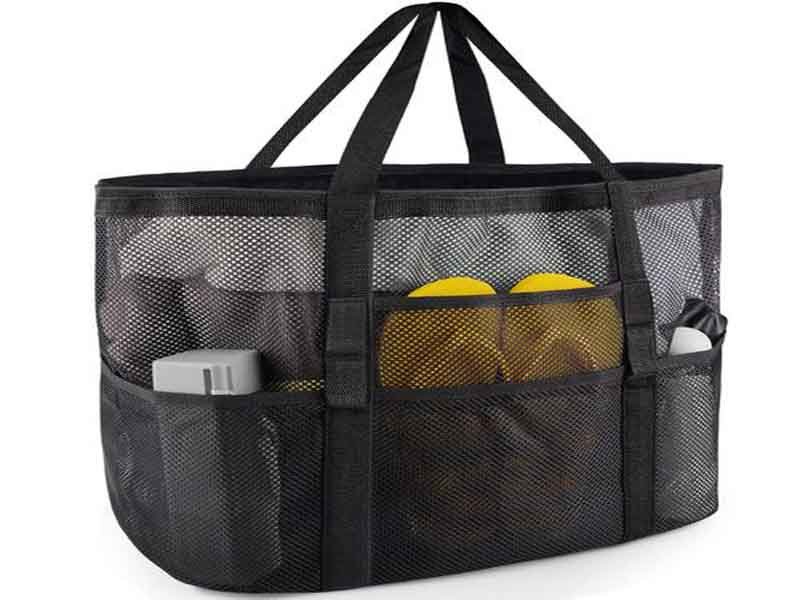
Recycled mesh materials can reduce demand for virgin polymer and give existing plastic or textile waste another production cycle, but they are not automatically better for every bag. Their value depends on verified recycled content, manufacturing efficiency, product weight, service life, wash durability, transport, finishing treatments, and whether the finished bag can be collected or recycled again.
Recycled polyester is currently the most widely available recycled synthetic option for sewn mesh bags. Recycled nylon is useful for products requiring flexibility and abrasion resistance, although its supply, color range, minimum order, and cost may be less predictable. Recycled polypropylene and polyethylene are also available for selected extruded nets and industrial packaging applications.
The most responsible material is not always the one with the highest recycled percentage. A lightweight virgin mesh bag that remains usable for years may create less waste than a poorly engineered recycled bag that tears after a few uses. Recycled content should therefore be treated as one part of the product specification, not as a substitute for strength, washability, safety, or production consistency.
| Material Option | Main Benefit | Main Limitation | Suitable Applications |
|---|---|---|---|
| Recycled polyester mesh | Broad availability and low moisture absorption | Shade and yarn consistency require control | Laundry, beach, produce, travel and promotional bags |
| Recycled nylon mesh | Strong abrasion and flexibility potential | Higher cost and limited supply in some specifications | Sports, backpack and equipment products |
| Recycled polypropylene net | Low weight and useful chemical resistance | Heat and UV performance require validation | Produce, agriculture and industrial packaging |
| Recycled polyethylene net | Moisture resistance and simple cleaning | Often has a firmer plastic hand | Shellfish, firewood and protective packaging |
| Recycled cotton mesh | Natural hand with reduced virgin cotton use | Shorter fibers may reduce strength | Lifestyle, shopping and light produce bags |
| Recycled fiber blend | Adjustable cost and performance | Composition and future recycling become more complex | Fashion, retail and general reusable bags |
What Is Recycled Polyester Mesh?
Recycled polyester mesh is usually made from PET waste that is collected, sorted, cleaned, processed, and converted into new polymer chips or yarn. Feedstock may come from post-consumer bottles, packaging, discarded textiles, or pre-consumer manufacturing waste.
The resulting yarn can be knitted or woven into fine laundry mesh, open beach mesh, stretch pockets, lining fabrics, produce nets, and heavy equipment structures. It can also be textured, dyed, heat-set, coated, or finished in much the same way as conventional polyester.
Two broad recycling routes are used.
Mechanical recycling generally involves sorting, cleaning, shredding, melting, filtering, and re-extruding the material. It is widely used and can produce reliable yarn when feedstock and processing are well controlled. Repeated thermal processing may reduce polymer quality, so filtration, viscosity control, blending, and yarn engineering are important.
Chemical recycling breaks the polymer into smaller chemical components before rebuilding it into polyester. This can remove certain contaminants and may produce polymer properties closer to virgin PET, although availability, cost, energy use, and supply-chain infrastructure vary.
| Recycled Polyester Factor | What to Review |
|---|---|
| Feedstock source | Post-consumer bottles, textile waste or production waste |
| Recycled percentage | Exact percentage by product or component |
| Recycling method | Mechanical or chemical |
| Yarn construction | Monofilament, multifilament, textured or high-tenacity |
| Certification scope | Fiber, fabric, dyeing mill, bag factory or complete supply chain |
| Color method | Piece dyed, solution dyed or yarn dyed |
| Performance | Strength, abrasion, washability, shrinkage and colorfastness |
| Traceability | Purchase records, transaction documents and material codes |
Recycled polyester can offer performance close to virgin polyester, but it should not be approved solely from a supplier declaration. The mesh still needs testing for:
Yarn uniformity
Fabric weight
Opening consistency
Tensile or bursting strength
Elongation
Seam performance
Abrasion
Shrinkage
Colorfastness
Odor
Surface contamination
Wash durability
A recycled polyester laundry bag must survive its intended wash cycles. A recycled beach bag must retain strength under UV, moisture, salt, and abrasion. A recycled produce bag must maintain low tare weight and secure closure performance.
Color can influence both cost and environmental impact. Solution-dyed recycled polyester introduces pigment during yarn production and may provide strong color consistency and outdoor performance. It can reduce the need for later wet dyeing, but color choices and minimum production quantities may be more restricted.
Piece-dyed recycled mesh offers greater shade flexibility. It requires careful control of dye penetration, lot variation, wash fastness, and wastewater management. Very pale shades may reveal small differences in recycled feedstock more clearly than dark colors.
Recycled polyester remains polyester. It still releases microfibers during manufacturing, washing, and abrasion, and it does not biodegrade under ordinary conditions. Longer product life, controlled washing, strong construction, and appropriate end-of-life planning remain important.
What Is Recycled Nylon Mesh?
Recycled nylon mesh is made from recovered polyamide waste, which may include fishing nets, carpet fiber, industrial yarn waste, fabric scraps, or discarded nylon products. The material can be mechanically or chemically processed into new nylon yarn.
It is attractive for products that need nylon’s flexibility, abrasion resistance, smooth hand, and toughness while reducing the use of virgin polyamide. Common applications include backpack pockets, equipment organizers, sports bags, technical pouches, protective sleeves, and performance accessories.
Recycled nylon supply is generally more specialized than recycled polyester. Material type should be identified clearly because nylon 6 and nylon 6,6 differ in melting behavior, dyeing, moisture response, and processing.
Important questions include:
Is the yarn recycled nylon 6 or nylon 6,6?
What is the recycled-content percentage?
Is the waste pre-consumer or post-consumer?
Is the recycling route mechanical or chemical?
Is the certification valid through the bag manufacturing stage?
Does the yarn contain virgin material for strength control?
What colors and deniers are available?
How consistent is supply between orders?
| Recycled Nylon Consideration | Practical Importance |
|---|---|
| Feedstock variation | Can influence color, viscosity and yarn uniformity |
| Nylon type | Affects heat, dyeing and dimensional behavior |
| Moisture regain | Wet-state testing remains important |
| Abrasion performance | Must be verified in the actual mesh construction |
| Color matching | May be more difficult in pale or bright shades |
| Minimum quantity | Specialty yarn may require larger production commitments |
| Lead time | Feedstock and spinning schedules may be less flexible |
| Cost | Often higher than common recycled polyester |
A recycled nylon claim does not guarantee superior abrasion resistance. Performance depends on yarn quality, denier, fabric density, opening, heat setting, and finished construction. A well-designed recycled polyester mesh may outperform a lightweight recycled nylon mesh in a particular bag.
Recycled nylon is most valuable where the performance advantages of nylon are genuinely needed. Using it for a lightweight produce bag may add cost without meaningful benefit. Using it for an equipment pocket subjected to repeated abrasion may help extend service life and justify the material investment.
Moisture and UV exposure still require attention. Recycled nylon behaves as a polyamide and generally absorbs more moisture than polyester. Outdoor products may require UV stabilization, suitable pigments, and accelerated weathering tests.
For marine-related marketing, recycled nylon made from recovered fishing nets can create a compelling story. Claims should remain precise. A product should not imply that every gram came directly from ocean waste unless traceability confirms it.
Are Natural Fibers Always Greener?
Natural fibers are not automatically greener than synthetic fibers. Cotton, jute, linen, and hemp come from renewable plants, but their environmental profiles depend on farming, water use, land, fertilizers, pesticides, retting, fiber processing, bleaching, dyeing, washing, transport, product weight, and service life.
A cotton mesh bag may be biodegradable under suitable conditions, but a dyed, printed, blended, coated, or heavily sewn product behaves differently from untreated cotton fiber. A natural bag can also require more material than a lightweight synthetic bag to reach the same working load.
A more balanced comparison asks:
How much material is used per bag?
How many times will the bag be reused?
How often will it be washed?
How much water does it retain?
Does it require tumble drying?
How far is the material transported?
Does it contain blended fibers?
Can trims be removed?
Will local systems collect the product at end of life?
| Evaluation Area | Natural Mesh | Synthetic Mesh |
|---|---|---|
| Feedstock | Renewable agricultural source | Fossil-based or recycled polymer source |
| Water absorption | Generally high | Usually low |
| Drying energy | Can be higher | Often lower |
| Product weight | Often heavier for similar capacity | Can be very light |
| Dimensional stability | More variable | Generally easier to control |
| Biodegradation potential | Possible for untreated pure fibers | Very limited under ordinary conditions |
| Recycled-content availability | Recycled cotton and selected bast fibers | Broad recycled polyester and selected nylon |
| Microfiber concern | Cellulosic fiber shedding | Persistent synthetic microfiber shedding |
| Service consistency | Depends strongly on washing and moisture | Usually more predictable |
| End-of-life route | Composting may be possible only under defined conditions | Recycling depends on polymer purity and collection |
Cotton mesh can be a sensible choice when softness, natural appearance, repairability, and user preference support long-term reuse. It is less convincing when the bag is oversized, frequently tumble dried, or replaced early because it shrinks.
Jute requires relatively little processing in some applications and creates a strong agricultural appearance. It may have a shorter service life where moisture, folding, and repeated washing are common.
Linen and hemp offer strong fibers and distinctive textures, but premium yarn preparation, shipping, dyeing, and finishing still contribute to the product footprint.
Synthetic mesh can be efficient because a small amount of material may carry a relatively large load and dry quickly. Its disadvantages include fossil-derived feedstock, persistent waste, microfiber release, and limited collection for recycling.
The most credible approach is to avoid broad statements such as “eco-friendly” without qualification. More precise language may include:
Made with a stated percentage of recycled polyester
Produced from certified organic cotton
Designed for repeated washing and reuse
Constructed from one primary polymer family
Supplied without unnecessary individual plastic packaging
Made with replaceable drawcords
Tested for a defined working load and wash cycle
Specific statements give users information they can evaluate.
How Is Recycled Content Verified?
Recycled content is verified through supply-chain documentation, certification programs, transaction records, material declarations, purchasing documents, and, in some cases, laboratory analysis. No single laboratory test can always prove the exact origin and percentage of recycled polymer after it has been processed into a finished bag.
Certification systems generally use chain-of-custody controls. Each participating organization records the purchase, processing, and sale of certified material. The scope should include the relevant stages rather than only the original yarn producer.
Documents may include:
Scope certificates
Transaction certificates
Yarn purchase invoices
Fabric production records
Dye-lot records
Material declarations
Bill of materials
Production issue records
Finished-goods quantity records
Packing lists
Audit reports
| Verification Document | What It Shows | What It Does Not Automatically Prove |
|---|---|---|
| Scope certificate | A facility is approved under a certification program | A particular shipment contains certified material |
| Transaction certificate | Certified material moved through a specified transaction | Finished-product performance |
| Supplier declaration | Stated composition and material source | Independent verification |
| Bill of materials | Planned component composition | Actual production consumption without records |
| Purchase invoice | Quantity and material purchased | How the material was allocated to each order |
| Laboratory fiber test | General fiber composition | Exact recycled origin in many polymer cases |
| Production record | Material issued to a manufacturing order | Consumer-facing claim compliance by itself |
A bag described as “100% recycled polyester” can still include non-recycled thread, zipper teeth, webbing, elastic, coatings, labels, ink, or packaging. The claim should clarify whether it refers to the mesh body, textile components, or the entire product by weight.
Percentage claims should have a clear calculation basis. Possible bases include:
Percentage of the mesh fabric
Percentage of total textile weight
Percentage of total product weight
Percentage of one specific component
These are not equivalent. A product with a recycled polyester body and a heavy virgin-polymer base may have a lower total recycled percentage than the fabric label suggests.
Certification logos and wording must follow the rules of the selected program. A company’s certification does not necessarily allow every finished product to display the logo. Artwork approval, minimum content, transaction documentation, and certified supply-chain stages may be required.
Traceability should be planned before production begins. Trying to reconstruct documents after shipment can reveal missing certificates, incorrect quantities, or suppliers outside the required certification scope.
Can Mesh Bags Be Recycled Again?
Some mesh bags can be recycled again, but practical recyclability depends on material purity, local collection, product size, contamination, color, coatings, and the ability to separate trims. A technically recyclable polymer is not necessarily recycled in the area where the bag is discarded.
A simple polyester mesh bag made with polyester thread, polyester binding, and compatible labels is easier to classify than a bag combining polyester mesh, nylon zipper teeth, elastane, PVC coating, rubber patches, metal eyelets, foam padding, and cotton handles.
Design choices that can improve recyclability include:
Using one dominant polymer family
Reducing unnecessary coatings
Avoiding permanent mixed-material laminates
Using removable metal parts
Selecting labels compatible with the main body
Making drawcords and inserts replaceable
Reducing adhesive use
Marking the material clearly
Providing disassembly guidance where realistic
| Design Choice | Recycling Effect |
|---|---|
| Mono-material polyester construction | Simplifies polymer identification |
| Elastane-containing stretch mesh | Makes material separation more difficult |
| PVC-coated polyester | Combines polymer systems that are difficult to separate |
| Sewn removable liner | Easier to separate than permanent lamination |
| Metal eyelets | May require removal before processing |
| Large silicone patch | Adds another material and increases sorting complexity |
| Printed ink | Usually remains with the material and may affect output color |
| Natural-synthetic blend | Difficult to separate mechanically |
Small lightweight bags can be difficult for sorting equipment to identify and handle. They may become tangled in machinery or be removed as residue. Collection programs often focus on bottles, rigid containers, or larger textile streams rather than small mesh accessories.
Contamination also matters. Produce residue, sand, oil, chemicals, mildew, and food waste may make recycling unsuitable. Cleaning the bag can require energy and water, so processors evaluate both material value and preparation cost.
Reuse usually provides more immediate value than recycling. A durable bag that completes hundreds of use cycles delays disposal and reduces replacement demand. Repairable handles, replaceable cords, and reinforced stress zones can extend service life.
Recyclability should therefore be described carefully. Better wording includes “made primarily from polyester, which may be recyclable where suitable textile recycling facilities exist.” Claiming that a product is simply recyclable can mislead users when no practical collection route is available.
How Should You Choose a Material?
Choose a mesh bag material by defining the contents, working load, use environment, cleaning method, required lifespan, appearance, compliance needs, and target cost. Polyester is a reliable general-purpose choice. Nylon suits repeated abrasion and flexing. Polypropylene and polyethylene perform well in lightweight wet, agricultural, and industrial applications. Cotton, jute, linen, and hemp provide natural texture but require closer control of moisture and shrinkage.
A structured selection process prevents costly sampling mistakes. Instead of asking for “strong mesh,” specify what strength means in the intended product. Instead of requesting “breathable material,” define opening size and airflow needs. Instead of asking for “sustainable fabric,” identify the desired recycled percentage, certification, service life, and end-of-life direction.
| Selection Question | Why It Matters |
|---|---|
| What will the bag carry? | Determines opening size, abrasion and puncture risk |
| What is the working load? | Controls yarn, GSM, seams and reinforcement |
| Will contents be wet? | Influences polymer, drying and odor risk |
| Will the bag be washed? | Requires shrinkage, colorfastness and closure testing |
| Is the bag used outdoors? | Adds UV, heat, rain and chemical exposure |
| Must the bag stretch? | Determines structure, elastic yarn and recovery |
| Will it contact food or skin? | Adds material and restricted-substance requirements |
| What appearance is required? | Influences fiber, finish, color and branding |
| How long should it last? | Defines cycle testing and safety margins |
| Can the product use mixed materials? | Affects performance, cost and recyclability |
What Load Will the Bag Carry?
The intended load is one of the first specifications to establish because it affects fabric strength, mesh opening, seam type, handle construction, base reinforcement, and closure design. A bag for 500 grams of delicate produce should not be engineered in the same way as a 15-kilogram equipment carrier.
A useful load specification includes:
Normal working load
Maximum expected load
Test load
Loading duration
Number of carrying cycles
Content shape
Dry or wet condition
Carrying method
Acceptable permanent stretch
Required safety margin
A statement such as “the bag must hold 10 kilograms” is incomplete. It should explain whether the bag is suspended for thirty seconds or twenty-four hours, lifted once or hundreds of times, and filled with smooth weights or sharp tools.
| Load Category | Typical Design Direction |
|---|---|
| Under 1 kg | Lightweight mesh with simple reinforcement |
| 1–5 kg | Medium mesh, controlled seams and secure closure |
| 5–10 kg | Robust mesh, reinforced top and handle patches |
| 10–20 kg | Heavy or hybrid construction with extended webbing |
| Above 20 kg | Specialized engineering, dynamic testing and industrial reinforcement |
These categories are only general development references. A one-kilogram load of sharp metal parts can be more damaging than ten kilograms of soft laundry.
Contents influence force distribution. Rounded balls push outward across a broad area. Books create defined corners. Wet towels add weight and pull downward. Firewood and tools create puncture and cutting risks.
The bag’s carrying method changes the load path. A drawstring sack supported around its full top circumference distributes force differently from a tote with two short handles. A shoulder bag swings and experiences dynamic load. A hanging organizer carries continuous static load.
For heavy products, webbing can extend from the handles down the sides or completely around the bottom. This allows the webbing to carry much of the weight while the mesh provides ventilation and containment.
Load testing should be repeated after washing, UV exposure, moisture conditioning, or chemical treatment where those conditions apply. Material properties and seam performance may change after aging.
How Often Will It Be Washed?
Washing frequency influences fiber selection, shrinkage control, colorfastness, finish durability, closure construction, label choice, and product lifespan. Polyester generally performs well under repeated washing because it absorbs little moisture and maintains dimensions. Nylon can also be washed but may require closer control of heat and wet-state behavior. Cotton and other natural fibers need shrinkage and drying evaluation.
A bag washed once before first use has different requirements from a laundry bag washed every week. A sports organizer may be rinsed after each use. An industrial bag may be cleaned with chemicals rather than household detergent.
The care specification should define:
Hand wash or machine wash
Water temperature
Detergent type
Bleach exposure
Mechanical agitation
Rinse method
Spin speed
Air drying or tumble drying
Drying temperature
Number of cycles
| Cleaning Condition | Material Consideration |
|---|---|
| Cold hand washing | Suitable for many natural and synthetic meshes |
| Warm machine washing | Requires shrinkage and colorfastness control |
| Hot washing | Limits polypropylene, polyethylene and sensitive trims |
| Tumble drying | Requires complete-product heat validation |
| Chlorinated water | Affects dyes, elastics, coatings and some hardware |
| Strong alkaline detergent | Material compatibility must be checked |
| Disinfectant cleaning | Exact chemical and concentration are required |
| Industrial washing | Needs repeatable cycle and load specifications |
Testing only the mesh fabric is not enough. A finished bag may contain components with lower wash resistance, including:
Zipper tape
Elastic
Drawcord
Cord lock
Printed logo
Adhesive patch
Care label
Foam
Waterproof lining
Coating
Metal hardware
The bag should be measured before and after washing at fixed points. Measurements may include overall length, width, gusset, opening, handle drop, zipper length, and logo position.
Wash testing should also evaluate appearance. Users may reject a bag that remains functional but becomes severely wrinkled, faded, pilled, or distorted.
Drying time is important for products stored in luggage, lockers, hospitals, bathrooms, boats, or sports facilities. Thick seams and absorbent bindings often remain wet longer than the main mesh. Good construction minimizes hidden water traps.
Which Tests Should Be Required?
Required tests should match the product’s material, intended use, destination market, contents, and claims. Testing every possible property adds unnecessary cost, while testing only basic fabric strength can miss the actual failure point.
Physical tests may include:
Fabric weight
Yarn count or denier
Mesh aperture
Tensile strength
Bursting strength
Tear strength
Abrasion resistance
Elongation
Elastic recovery
Seam strength
Handle attachment
Closure cycling
Loaded drop performance
Shrinkage
Wash durability
Colorfastness
UV aging
Coating adhesion
| Product Risk | Useful Test Direction |
|---|---|
| Heavy contents | Finished-bag load and handle tests |
| Knitted mesh expansion | Bursting strength and recovery |
| Rough equipment | Abrasion and puncture evaluation |
| Machine washing | Repeated wash and closure testing |
| Outdoor exposure | UV, heat and color-change testing |
| Wet storage | Drying time, odor and microbial-risk review |
| Printed branding | Adhesion, wash and abrasion testing |
| Stretch pocket | Extension, recovery and retention testing |
| Coated mesh | Flex, adhesion and cold-crack testing |
| Food-related use | Material and chemical compliance review |
Chemical and regulatory testing may involve restricted substances, heavy metals, azo colorants, phthalates, formaldehyde, total lead, and other requirements depending on the material and market. The relevant test plan should be established according to the actual product category rather than copied from an unrelated bag.
Children’s products require additional caution around cords, small parts, sharp points, flammability, and age grading. A mesh storage bag sold for adult household use may face different requirements from a toy-storage bag marketed directly to children.
Food-contact products need review of every component that can touch unpackaged food. A compliant base fabric does not make an untested printed logo or coating suitable for direct food contact.
Medical applications also require clear boundaries. A bag may be used to organize medical equipment without being a medical device or sterile barrier. Claims, cleaning, skin contact, sterilization, and intended use determine the necessary validation.
Third-party testing should use the approved production specification. A laboratory report from a similar mesh cannot guarantee that a different dye lot, weight, coating, or construction will perform identically.
How Should Material Samples Be Compared?
Material samples should be compared under the same conditions and labeled with measurable specifications. Judging one fabric by touch and another by a technical sheet creates an unreliable decision.
A useful sample set may include three to six materials that differ in one or two controlled variables, such as polyester versus nylon, 100 GSM versus 140 GSM, or fine versus medium aperture.
Each sample should show:
Material code
Fiber content
Virgin or recycled status
Yarn type
Denier or yarn count
GSM
Mesh opening
Open-area percentage where available
Stretch direction
Color method
Finish
Supplier and lot
| Sample Evaluation | What to Check |
|---|---|
| Hand feel | Softness, stiffness, surface friction and comfort |
| Visual appearance | Opening consistency, color and transparency |
| Stretch | Direction, amount and recovery |
| Drainage | Water release through the structure |
| Drying | Time required for the full sample to return to dry weight |
| Abrasion | Fuzzing, yarn breakage and surface wear |
| Snagging | Response to hooks, buckles or rough contents |
| Sewing | Curling, feeding, needle damage and seam appearance |
| Printing | Detail, adhesion, penetration and distortion |
| Folding | Creasing, bulk and recovery after packing |
A fabric swatch should be followed by a complete bag prototype. Swatches cannot reveal handle comfort, zipper distortion, seam pullout, loading shape, or drying around multilayer areas.
The sample bag should be filled with representative contents and used as intended. For example:
A produce bag should be weighed with real fruit and vegetables.
A beach bag should be tested with wet towels, sand, toys, and sunscreen.
A laundry bag should be washed with garments containing hooks and zippers.
A sports bag should be loaded with actual footwear or equipment.
An industrial bag should be tested with representative parts and cleaning chemicals.
Samples should be conditioned before measurement, especially nylon and natural fibers that respond to humidity. Comparing one dry sample with another that has absorbed moisture can create misleading results.
Photographs are useful for records but cannot replace approved physical standards. Softness, stiffness, weight, stretch, and transparency vary with lighting and cannot be judged accurately from a screen.
The approved sample should be signed, dated, coded, and retained by both parties. Production fabric can then be compared with the same reference.
What Should a Manufacturer Specify?
A professional mesh bag manufacturer should specify the material, yarn, structure, weight, opening, finishing, construction, testing, tolerances, branding, and packaging. A quotation based only on a reference picture is likely to contain assumptions that later cause price changes or quality disputes.
The technical specification should cover the mesh body and every supporting component.
| Specification Area | Required Information |
|---|---|
| Fiber | Polyester, nylon, polypropylene, polyethylene, cotton, jute, linen, hemp or blend |
| Recycled content | Percentage, source and certification requirement |
| Yarn | Denier, count, monofilament or multifilament |
| Fabric | GSM, aperture, open area, width and knit or weave type |
| Stretch | Direction, elongation and recovery |
| Finish | Heat setting, softness, UV, water repellency or coating |
| Color | Pantone reference, dye method and tolerance |
| Dimensions | Finished size and measurement tolerance |
| Seams | Type, allowance, binding and stitch density |
| Thread | Fiber, size and color |
| Handles | Material, width, length and attachment |
| Closure | Zipper, drawcord, buckle, elastic or hook-and-loop |
| Logo | Method, position, dimensions and color |
| Testing | Physical, wash, chemical and regulatory requirements |
| Packaging | Folding, labels, individual packing and carton plan |
The manufacturer should also explain known risks. Examples include:
A large logo may not print clearly on open mesh.
Cotton dimensions may change after washing.
Nylon may require stronger UV stabilization outdoors.
A drawcord can wear directly against large openings.
Very soft mesh may stretch beside a zipper.
A heavy coating may crack along repeated fold lines.
A manufacturer willing to identify these risks before production is more useful than one that simply agrees with every request.
Quality-control requirements should include incoming-material inspection and finished-product checks. Incoming checks may cover:
Fabric width
GSM
Color
Aperture
Surface defects
Stretch
Lot identification
Coating quality
Finished checks may cover:
Dimensions
Seam appearance
Stitch density
Closure function
Handle position
Logo placement
Load performance
Cleaning result
Label accuracy
Packing quantity
Final approval should use a pre-production sample made with the intended bulk materials and construction. Changing yarn, GSM, zipper, binding, coating, or reinforcement after approval should require review because each change can affect performance.
Szoneier provides mesh material selection, fabric development, product design, sampling, manufacturing, finishing, logo customization, packaging, and quality inspection for custom mesh bag projects. With more than 18 years of experience in fabric research and finished-product manufacturing, the team works with polyester, nylon, polypropylene, polyethylene, cotton, canvas, jute, linen, neoprene, Oxford fabric, and other engineered materials.
Custom development can include:
Fine or open polyester mesh
Abrasion-resistant nylon mesh
Polypropylene and polyethylene netting
Cotton, jute, linen, or hemp mesh
Recycled polyester and recycled nylon options
Custom GSM and mesh openings
Monofilament or multifilament yarn
UV, softening, water-repellent, anti-static, or other finishing
Zippers, drawcords, elastic, buckles, and reinforced handles
Screen printing, heat transfer, embroidery, woven labels, and patches
Solid fabric bases and waterproof compartments
Custom retail and transport packaging
Send Szoneier your bag dimensions, reference images, logo artwork, intended contents, target load, preferred material, quantity, care method, destination market, and any required test standard. The team can compare suitable fabrics, prepare material samples, develop a working prototype, and recommend construction details before production.
A successful mesh bag begins with more than selecting polyester, nylon, cotton, or another familiar fiber name. It begins with understanding how the bag will be filled, carried, washed, exposed, stored, and reused. Contact Szoneier through szoneierfabrics.com to request material samples, custom design support, and a manufacturing quotation for your next mesh bag project.