Skip to content
Shoes are often the dirtiest items packed inside otherwise clean luggage. Their soles collect dust, grass, mud, moisture, locker-room debris, and tiny stones, while their uppers may still hold sweat long after a workout or match ends. Placing them directly beside clothing is unpleasant. Sealing them inside the wrong pouch can be nearly as bad, because trapped moisture creates a warm, stale-smelling space before the traveler even reaches home.
The best waterproof shoe bag for travel and sports is not simply the bag made from the thickest coated fabric. A well-designed option combines a water-blocking outer shell, controlled ventilation, a cleanable lining, durable seams, a reliable zipper, and enough internal space to hold the intended footwear without compressing it. Lightweight coated polyester or nylon works well for everyday travel, while reinforced Oxford fabric, TPU-laminated fabric, or welded constructions are better suited to wet cleats, golf shoes, hiking footwear, and repeated sports use.
The key is balance. A completely sealed bag may stop dirty water from reaching a suitcase, but it can also trap the moisture and odor already inside the shoes. A highly ventilated bag dries faster, yet may allow dampness or soil to escape. Good product engineering decides where waterproof protection is needed, where airflow should enter, and how the user will clean the bag after use.
Picture a traveler opening a suitcase after a rainy tournament. The clothes are dry, but the shoe compartment smells like a closed locker room. The fabric did not leak; the design failed somewhere else. Understanding that difference is where choosing a better shoe bag begins.
What Is a Waterproof Shoe Bag?
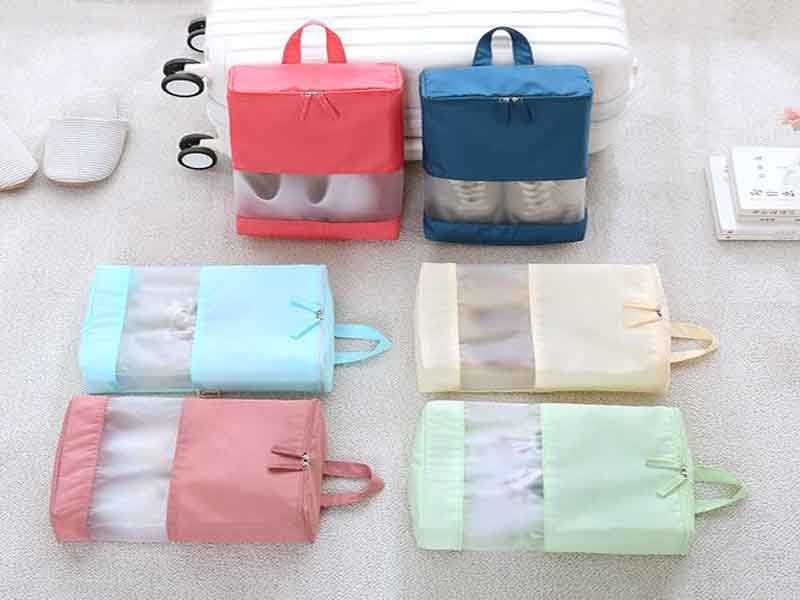
A waterproof shoe bag is a purpose-built container that separates footwear, moisture, dirt, and odor from clothing or sports equipment. Its outer fabric should resist water penetration, while its seams, zipper, lining, and ventilation structure should match the level of protection promised. A bag made from waterproof fabric is not automatically a waterproof finished product. Water can still enter or escape through stitch holes, zipper teeth, mesh panels, handles, and poorly sealed joints.
For travel, the main job is luggage hygiene. For sports, the job becomes more demanding: the bag may need to hold damp footwear, resist abrasion from cleats, manage odor, survive frequent cleaning, and handle repeated opening and carrying. A successful design therefore protects both the items outside the bag and the shoes inside it.
What Does a Shoe Bag Protect?
A shoe bag creates a controlled barrier between footwear and surrounding belongings. That barrier may sound simple, but it solves several different problems at once.
First, it protects clothing from sole contamination. Outdoor shoes can carry fine dust, sand, dried mud, grass, rubber particles, road residue, and moisture. Even when soles appear clean, friction against light-colored clothing can leave visible marks.
Second, it protects footwear from pressure and abrasion. Shoes packed loosely in a suitcase may be crushed by toiletries, electronics, or tightly rolled clothing. Decorative overlays, printed logos, polished leather, mesh uppers, and molded heel counters can all be damaged through poor packing.
Third, it protects the suitcase or sports bag itself. Mud and moisture that reach the main lining are harder to clean than a removable shoe pouch. A washable inner lining turns a large cleaning problem into a small one.
Fourth, it helps the user organize by activity. Running shoes, golf shoes, cycling shoes, dance footwear, football boots, and casual sneakers may look similar when buried under clothing. Separate bags make each pair easier to identify and reduce unpacking time.
Protection need varies by footwear type. A soft canvas sneaker used on a city trip presents a different risk from a wet football boot covered in soil. Product design should begin with the contamination and impact level, not with a generic claim such as “one bag fits all.”
| Footwear Type | Main Contamination Risk | Main Product Risk | Recommended Bag Protection |
|---|---|---|---|
| Casual sneakers | Dust, street residue, light moisture | Upper compression and scuffing | Lightweight coated shell and soft lining |
| Running shoes | Sweat, dust, odor, damp insoles | Odor buildup and mesh snagging | Water-resistant body with controlled ventilation |
| Football or rugby cleats | Mud, wet grass, soil, stud abrasion | Puncture and interior abrasion | Reinforced base, washable lining, strong seams |
| Golf shoes | Grass, sand, morning moisture | Spike or sole pressure | Structured base and separated ventilation area |
| Hiking shoes | Mud, grit, rainwater | Heavy abrasion and slow drying | Durable Oxford shell and easy-clean lining |
| Cycling shoes | Sweat, road dust, rigid soles | Closure and cleat damage | Shaped compartment with internal clearance |
| Leather dress shoes | Surface dust and polish transfer | Creasing, scratching, shape loss | Soft nonwoven or brushed lining inside a protective shell |
| Water shoes | Sand, saltwater, retained moisture | Mildew and odor | Drainable or ventilated construction with fast-drying materials |
A waterproof travel bag therefore protects more than clean shirts. It can preserve shoe shape, maintain luggage hygiene, simplify sorting, and reduce cleaning after a trip.
How Does It Keep Luggage Clean?
A useful shoe bag controls four contamination routes: direct contact, loose debris, liquid transfer, and odor movement.
Direct contact is the easiest problem to solve. The shoe sole remains inside the bag instead of rubbing against clothes. Loose debris is more demanding because fine sand or dry soil can escape through large mesh openings, zipper gaps, or incomplete closures.
Liquid transfer is harder again. A coated body fabric may block water, but water can migrate through sewn seams or collect near the zipper. When wet shoes are placed inside, the bag is protecting the suitcase from moisture moving outward rather than protecting the shoes from rain moving inward. That reverses the direction of the challenge.
Odor control is not the same as waterproofing. Odor molecules and humid air can move through openings even when liquid water cannot. Fully sealing a pair of warm, damp shoes may protect the clothes for a short journey, but the trapped humidity can intensify odor and extend drying time.
The cleanest luggage result usually comes from a layered approach:
The outer shell limits water and dirt transfer.
The lining presents a smooth surface that can be wiped clean.
The base contains mud or small amounts of liquid.
The closure prevents debris from escaping.
The ventilation zone sits away from the suitcase contact surface.
The internal dimensions prevent dirty soles from forcing against the zipper.
Consider the difference between a flat drawstring pouch and a structured shoe case. A drawstring pouch may work well for dry slippers or dress shoes. Under pressure, however, the open folds around the cord can release dust. A zippered case provides a more complete barrier and holds its shape more effectively. Neither construction is universally better; the intended use decides which one creates a cleaner result.
Is It Different from a Shoe Pouch?
The terms shoe bag, shoe pouch, shoe case, and shoe compartment are often used interchangeably, but they can describe noticeably different structures.
A shoe pouch is usually soft, lightweight, and minimally structured. It may use a drawstring, simple zipper, or flap closure. Pouches are easy to fold and inexpensive to pack, making them suitable for slippers, flats, dry sneakers, or occasional travel.
A shoe bag often includes a carrying handle, larger opening, shaped side panels, reinforced seams, or separate storage areas. It is more likely to be designed for repeated use.
A shoe case normally has more structure. Foam, piping, a reinforced base, or molded panels may help protect premium footwear and maintain a stable shape.
A shoe compartment is integrated into another product, such as a duffel bag, golf bag, backpack, or suitcase. It saves the user from carrying a separate item, although cleaning becomes more difficult because the compartment cannot always be removed.
| Product Format | Structure | Closure | Best Use | Main Limitation |
|---|---|---|---|---|
| Drawstring pouch | Very soft | Cord channel | Dry shoes and light travel | Limited containment around opening |
| Flat zipper pouch | Soft and foldable | Single zipper | Casual shoes and luggage sorting | Can compress shoe uppers |
| Box-shaped shoe bag | Semi-structured | U-shaped or clamshell zipper | Sneakers and sports shoes | Occupies more luggage volume |
| Double-layer bag | Divided interior | Zippered sections | Two pairs or shoes plus accessories | Requires careful size planning |
| Ventilated sports case | Structured or semi-structured | Wide zipper opening | Cleats, running shoes, golf shoes | Mesh placement may reduce water containment |
| Integrated compartment | Built into duffel or backpack | External zipper | Gym and team travel | Harder to wash separately |
| Molded footwear case | Rigid or semi-rigid | Heavy-duty zipper | Premium or delicate shoes | Higher weight and cost |
The best format depends on how the bag will be carried. Airline travelers often prioritize low weight and foldability. Team athletes may care more about a strong handle and fast access. Golfers may prefer shape retention and ventilation. Retail packaging sets may need a compact pouch that adds perceived value without increasing carton volume too much.
Calling every format “waterproof” can be misleading. A drawstring opening cannot provide the same containment as a sealed zipper. A sports case with two large mesh side panels may breathe well but cannot fully isolate wet footwear. Clear and accurate product descriptions create more trust than exaggerated performance labels.
Do Travelers Really Need One?
Not every traveler requires a technical shoe case, but most travelers benefit from some form of footwear separation. The need becomes stronger when the trip involves wet weather, formal clothing, children’s shoes, outdoor activities, gym sessions, or multiple destinations.
A disposable plastic bag can separate footwear for one journey, but it tears easily, traps condensation, offers little shape protection, and often becomes waste after the trip. A reusable fabric shoe bag is easier to organize, open, carry, clean, and customize for repeated use.
A traveler should seriously consider a dedicated bag when any of the following conditions apply:
Shoes will be used outdoors before repacking.
Footwear may be damp at checkout time.
Clean or light-colored clothes share the same suitcase.
The trip includes training, hiking, golf, football, or court sports.
The footwear has studs, spikes, buckles, or hard components.
More than one pair must be identified quickly.
The suitcase lining is difficult to wash.
Shoes need protection from crushing or surface damage.
A waterproof bag is less essential when packing brand-new shoes, indoor slippers, or completely dry footwear in a separate hard-shell compartment. Even then, a soft protective pouch can still prevent scuffing.
The practical question is not “Does everyone need a waterproof shoe bag?” It is “What could the shoes transfer to the luggage, and what could the luggage do to the shoes?” When either answer involves meaningful risk, a dedicated bag earns its space.
What Should a Waterproof Claim Include?
The word waterproof should describe a measurable product condition rather than a vague impression. Three levels need to be separated.
Water-repellent fabric causes droplets to bead or roll away from the surface. Surface repellency is useful for splashes and light rain, but it does not prove resistance under pressure.
Water-resistant construction slows water entry or escape. It may use coated fabric and a covered zipper while still containing sewn seams or ventilation openings.
Waterproof construction is designed to prevent water penetration at a stated pressure or under a defined use condition. Fabric performance, seam construction, zipper design, and attachment points all matter.
A complete product claim should therefore answer several questions:
Was only the fabric tested, or was the finished bag tested?
Was the test based on spray exposure, hydrostatic pressure, leakage, or immersion?
Were the seams sealed?
Was the zipper water-resistant or fully sealed?
Are there mesh panels or drainage holes?
Is the bag designed to keep rain out, keep wet-shoe moisture in, or both?
A technically honest specification might state: “PU-coated 300D polyester body with water-resistant zipper; designed to contain damp shoes and resist splashes, not intended for immersion.” Such wording is more useful than a large “100% waterproof” label placed on a bag with open mesh panels.
Which Materials Work Best?
The best material depends on the footwear, expected moisture, cleaning frequency, target weight, and required durability. Coated polyester is a strong all-round choice for travel shoe bags because it balances cost, dimensional stability, printability, and water resistance. Nylon offers excellent strength at low weight and suits compact premium designs. Oxford fabrics provide a durable woven structure for repeated sports use. TPU-laminated fabrics deliver stronger moisture containment and a smoother cleanable surface, while mesh should be used selectively where airflow matters more than full liquid isolation.
No material works alone. The face fabric provides strength and appearance; the coating or film controls water penetration; the lining affects cleaning; and the seam method determines whether the finished bag performs like the fabric sample.
Is Nylon Better Than Polyester?
Nylon and polyester can both produce reliable shoe bags, but they behave differently.
Nylon is known for high toughness relative to weight. It flexes well, resists tearing, and can create a smooth premium hand feel. Lightweight nylon is useful when the bag needs to fold into a small space or accompany premium travel accessories.
Polyester provides good dimensional stability, retains less moisture than nylon, and generally performs well in printed or color-controlled programs. It is widely available in plain weave, ripstop, twill, and Oxford constructions. Polyester often offers an efficient balance for airline travel kits, sports promotions, luggage organizers, and washable shoe cases.
The fiber name alone does not determine quality. A tightly woven 210D polyester with a stable coating can outperform a loosely constructed nylon fabric of a similar yarn designation. Denier describes yarn linear density, not finished fabric thickness, tear strength, coating adhesion, or waterproofness.
A proper comparison should include:
Fiber type
Yarn denier
Weave density
Finished fabric weight
Coating chemistry
Coating amount
Tear and tensile performance
Abrasion resistance
Colorfastness
Hydrostatic resistance
Seam compatibility
Cleaning method
| Material | Main Strength | Main Trade-Off | Suitable Applications |
|---|---|---|---|
| 70D–100D nylon | Very light, compact, smooth | Less structure and lower puncture protection | Foldable travel pouches and premium packing sets |
| 210D nylon | Strong for its weight and flexible | May require careful coating and color control | Lightweight reusable shoe organizers |
| 210D polyester | Balanced weight, printability, and cost | Less premium hand feel than some nylon options | General travel shoe bags |
| 300D polyester Oxford | Better structure and abrasion resistance | Slightly heavier | Everyday sports and gym shoe bags |
| 420D nylon | Strong, durable, and relatively light | Higher material cost | Technical travel and performance footwear cases |
| 600D polyester Oxford | Robust, structured, widely available | Bulkier and slower to fold | Cleat bags, team sports bags, and heavy-use cases |
| Ripstop nylon or polyester | Limits tear propagation and looks technical | Grid appearance may not suit every style | Outdoor, hiking, and cycling footwear bags |
| Recycled polyester | Supports recycled-material programs | Performance depends on yarn and finish control | Travel collections and sustainability-led programs |
For most travel applications, 210D polyester or nylon can provide enough protection without unnecessary weight. For repeated sports use, 300D to 600D Oxford is usually more suitable because the bag must handle rough floors, hard soles, studs, dirt, and frequent washing.
A heavier denier should not be selected automatically. Putting 600D fabric around a pair of lightweight slippers adds bulk without solving a meaningful problem. Likewise, a delicate 70D pouch may look elegant but quickly show wear when used for muddy cleats.
Which Coatings Resist Water?
The coating or laminate often controls water performance more than the face fabric. Several coating systems are common, and each changes weight, feel, flexibility, cleaning, durability, and price.
PU coating is widely used on polyester and nylon. It creates a flexible barrier and can be adjusted for different performance targets. PU-coated fabric remains relatively soft and foldable, which works well for travel organizers. Coating quality, curing, storage conditions, and hydrolysis resistance need attention, especially when products may remain in humid environments.
PVC coating creates a heavier, firmer, and easy-to-wipe surface. It can provide strong water containment and good structure, but the material adds weight and may become stiff in low temperatures. Brands also need to consider odor, restricted substances, plasticizer requirements, and market-specific chemical regulations.
TPU film offers strong flexibility, elasticity, and moisture-barrier performance. It can be laminated to woven fabrics or used in supported constructions. TPU is well suited to higher-performance wet-item bags, but material and processing costs are generally higher. Lamination control is critical because bubbles, wrinkles, uneven bonding, or edge lifting can weaken the finished product.
Acrylic and other light back coatings can improve fabric stability and mild water resistance, but they are not the first choice for containing wet sports shoes.
Water-repellent surface treatments help water bead on the face fabric. They improve rain and splash performance but do not replace a continuous back coating or film. Surface treatments can also lose effectiveness after abrasion and repeated washing.
| Coating or Laminate | Water Protection | Flexibility | Weight | Cleaning | Main Consideration |
|---|---|---|---|---|---|
| Light PU coating | Light to moderate | High | Low | Wipeable | Suitable for travel splash resistance |
| Heavier PU coating | Moderate to high | Medium to high | Medium | Easy to wipe | Coating uniformity and hydrolysis resistance |
| PVC coating | High barrier potential | Medium to low | High | Very easy | Weight, cold stiffness, odor, and chemical compliance |
| TPU lamination | High barrier potential | High | Medium | Very easy | Lamination quality and higher cost |
| Acrylic backing | Low to moderate | Medium | Low | Moderate | Better for fabric stability than wet containment |
| Surface water-repellent finish | Surface wetting protection | No major change | Very low | Depends on base fabric | Performance can decline with wear and washing |
| PEVA or EVA film lining | Moderate to high liquid barrier | Medium | Medium | Smooth and wipeable | Film durability around folds and sewn seams |
Waterproof performance should be selected according to exposure.
A dry-shoe travel organizer mainly needs splash resistance and dirt separation.
A running-shoe bag needs moisture control and ventilation.
A football-cleat bag needs mud containment, abrasion resistance, and easy cleaning.
A wet water-shoe bag needs stronger liquid containment or drainage.
A winter boot bag may need a reinforced waterproof base because melting snow collects at the lowest point.
Using the same coating specification for every product can lead to unnecessary cost in one design and inadequate performance in another.
Are Oxford Fabrics More Durable?
Oxford refers to a woven construction rather than one specific fiber or performance level. Oxford fabrics can be made from polyester, nylon, recycled yarn, and several yarn sizes. Their basket-like or textured weave gives them a recognizable appearance and often provides more body than lightweight plain weaves.
Oxford fabric is a strong choice for sports shoe bags because it can support handles, piping, zippers, pockets, reinforcement patches, and shaped panels. It also hides minor scuffs better than very smooth fabric.
Durability still depends on more than the word Oxford. Yarn quality, weave density, fabric weight, backing, coating adhesion, and sewing construction all affect service life.
A loosely woven 600D Oxford with poor coating may fray around stitch holes and delaminate after folding. A carefully finished 300D Oxford can perform better because its structure and coating are more stable.
Practical fabric selection can follow the expected use intensity:
| Use Level | Suggested Construction | Main Reason |
|---|---|---|
| Occasional city travel | 210D polyester or nylon | Low weight and easy folding |
| Frequent business or leisure travel | 210D–300D coated fabric | Better balance of structure and packability |
| Gym and running use | 300D Oxford with ventilated zone | Repeated handling and moisture management |
| Golf and court sports | 300D–420D structured fabric | Shape retention and sole protection |
| Football, rugby, or field sports | 420D–600D Oxford | Better abrasion and puncture resistance |
| Hiking and outdoor use | 420D–600D ripstop or Oxford | Rough surfaces, mud, and heavier footwear |
| Wet footwear containment | Laminated woven fabric with sealed or protected seams | Stronger liquid barrier and easier cleaning |
The base panel deserves special attention. Most abrasion happens where the bag touches a locker-room floor, vehicle trunk, pavement, or luggage compartment. A product may use 300D fabric on the upper panels and a reinforced 600D, TPU-laminated, or double-layer base. That targeted reinforcement adds durability without making the entire bag unnecessarily heavy.
Handle attachment areas also require reinforcement. The fabric may be strong enough, yet repeated pulling can concentrate stress around a small stitch line. Bartacks, box stitching, backing patches, or webbing that continues under the bag can distribute the load.
Do TPU Linings Prevent Leaks?
TPU linings and laminates can greatly improve water containment, but they do not guarantee a leakproof bag by themselves.
A continuous TPU film can block liquid through the panel. Once the panel is sewn, every needle creates a hole. Water may then pass through the seam, especially when a puddle forms inside the base or pressure is applied during packing.
Leak control depends on the entire assembly:
The TPU film must be continuous and evenly bonded.
Panel edges must not expose weak layers.
Seams may need tape, binding, welding, or a protective seam position.
The zipper should sit above the likely liquid level.
Handle and label attachments should avoid puncturing containment zones.
Corners need enough radius to prevent film stress.
The bag should not be folded repeatedly along one sharp line.
TPU works particularly well in designs where wet footwear is expected. A removable TPU-coated liner can make cleaning easier. A welded wet compartment can provide stronger containment than a sewn pouch. A roll-top structure can avoid zipper leakage, although it changes the user experience and packing shape.
For many travel shoe bags, full leakproof construction is unnecessary. The goal may only be to stop damp soles from transferring moisture to clothing. A coated shell with a protected base and well-positioned seams may provide sufficient performance at lower weight and cost.
For water shoes, muddy cleats, or snow-covered boots, stronger containment becomes more valuable. Product requirements should specify the amount and duration of liquid exposure rather than relying on an undefined “waterproof” label.
A useful development test is a controlled internal leakage check. A measured amount of water can be placed inside the finished bag for a defined period while the bag rests on absorbent paper. The test does not replace a recognized textile standard, but it reveals weak seams, corners, zipper ends, and attachment points in the finished construction.
Which Materials Dry Faster?
Drying speed matters because a bag that remains damp can develop odor, staining, coating damage, or mildew during storage. Fast drying depends on water absorption, fabric thickness, airflow, lining construction, and whether water becomes trapped between layers.
Lightweight polyester usually dries quickly because the fiber absorbs relatively little moisture and the fabric contains less mass. Coated fabric may prevent water from entering the yarn structure from one side, but moisture can remain on the surface or become trapped in seam allowances.
Nylon can also dry quickly in lightweight forms, although it tends to absorb more moisture than polyester. Thick nylon, padded constructions, and multiple bonded layers take longer.
Mesh dries rapidly because air passes through it, but mesh does not contain water or fine dirt. It should be positioned where airflow can occur without allowing muddy soles to contact luggage.
Cotton and canvas are generally less suitable for wet sports shoes. They offer a natural hand feel and strong lifestyle appeal but absorb moisture and dry more slowly. Waxed canvas can resist light water exposure, yet it remains heavier and requires different care.
Foam padding extends drying time because water may enter through seams and stay between the face fabric and lining. If cushioning is needed, closed-cell foam is generally preferable to absorbent foam around wet-use areas.
| Material Structure | Drying Speed | Moisture Containment | Odor Risk When Packed Damp | Best Use |
|---|---|---|---|---|
| Lightweight uncoated polyester | Fast | Low | Medium | Dry shoes and dust protection |
| PU-coated polyester | Fast on surface | Medium to high | High without ventilation | General travel and damp soles |
| Coated nylon | Fast to moderate | Medium to high | High without ventilation | Lightweight technical bags |
| Polyester mesh | Very fast | Very low | Low | Ventilation panels |
| TPU-laminated fabric | Surface dries quickly | High | High in fully sealed designs | Wet-item containment |
| PVC-coated fabric | Surface dries quickly | High | High in fully sealed designs | Easy-clean heavy-use bags |
| Cotton canvas | Slow | Low unless treated | Medium to high | Dry lifestyle footwear |
| Padded multilayer fabric | Slow | Varies | High | Protective cases for dry footwear |
A fast-drying design should allow the user to expose the interior after use. Wide U-shaped openings, clamshell panels, reversible linings, or hanging loops make drying easier. A tiny top zipper may hold shoes securely, but it prevents the user from opening the bag fully for cleaning and airflow.
How Should Waterproofing and Ventilation Be Balanced?
Water containment and airflow pull the design in opposite directions. Increasing one often reduces the other.
A sealed TPU bag can contain wet soles effectively but may trap heat and odor. A full-mesh bag releases moisture but allows dirt and water to reach surrounding items. The strongest designs divide the product into functional zones.
The lower zone handles contamination. It can use coated fabric, a smooth lining, reinforced corners, and fewer seams.
The upper zone manages airflow. Ventilation eyelets, covered mesh, or a breathable panel can sit above the likely moisture level.
The zipper zone controls access. A wide opening helps the shoes enter without scraping mud against the zipper tape.
The back panel protects luggage. It should remain closed and water resistant because it is the surface most likely to contact clothing.
Ventilation panels can be protected with an external flap. Air moves through the gap, while direct splashes and loose debris are less likely to pass straight through. Metal eyelets offer limited airflow but maintain better containment than large mesh panels. Laser-cut or perforated laminated materials create a cleaner technical appearance, although hole placement and reinforcement need evaluation.
The right balance depends on travel duration. A pair of damp shoes sealed for a 20-minute drive creates less risk than shoes sealed for an overnight flight. Users should still be instructed to remove wet shoes and open the bag as soon as possible.
How Should a Material Specification Be Written?
A useful material specification should go beyond “waterproof Oxford fabric.” That phrase leaves too many variables undefined.
A stronger specification may include:
Face material: polyester, nylon, recycled polyester, or another fiber
Yarn size: such as 210D, 300D, 420D, or 600D
Weave: plain, Oxford, twill, or ripstop
Finished weight: stated as a target range
Back treatment: PU coating, TPU lamination, PVC coating, or film lining
Surface finish: water-repellent treatment where required
Color standard: approved swatch or color reference
Water-resistance target: stated test method and acceptance level
Abrasion target: based on intended use
Colorfastness target: dry rubbing, wet rubbing, and washing where relevant
Chemical requirements: market-specific restricted-substance limits
Cleaning method: wipe-clean, hand wash, or machine wash
Seam method: sewn, taped, bound, or welded
A material specification should also reflect the finished-product structure. There is little value in ordering high-performance waterproof fabric and then adding an unprotected cotton zipper tape across the lowest panel.
During custom development, Szoneier can combine polyester, nylon, Oxford fabric, mesh, TPU laminates, linings, webbing, and reinforcement materials according to the intended footwear and use environment. Material samples should be evaluated not only for appearance but also for coating adhesion, folding behavior, odor, sewing compatibility, cleaning, water resistance, and finished-bag leakage.
The best-performing shoe bag is rarely made from the most expensive material in every panel. It comes from assigning the right material to each functional area. A lightweight upper, reinforced base, cleanable lining, protected ventilation zone, and dependable closure can outperform a bag made from one heavy fabric throughout.
How Waterproof Are Shoe Bags?

Waterproof performance in shoe bags is often misunderstood because it is treated as a single feature instead of a layered system. In reality, water resistance depends on fabric coating, seam construction, zipper design, and how the bag is used in real travel or sports environments. A shoe bag may resist rain on the outside but still leak internally when wet shoes release moisture under pressure. The real question is not “Is it waterproof?” but “What type of water exposure can it handle without failure?”
In real-world use, most failures come from seams and zippers rather than fabric itself. Even TPU or PU-coated materials can leak if stitching is not sealed or if liquid pools at the base. A properly designed shoe bag should therefore be evaluated as a complete system, not just a fabric sample.
What Does Waterproof Really Mean?
Waterproof is not a single universal standard. In textile engineering, it usually refers to resistance against water penetration under specific pressure or exposure conditions. A fabric that passes a light spray test may still fail under sustained pressure from wet shoes inside a packed suitcase.
There are three commonly used interpretations:
Surface resistance: water beads and rolls off the fabric, but may enter through seams.
Splash resistance: protection against rain, spills, or wet surfaces during handling.
Hydrostatic resistance: ability to resist water pressure measured in millimeters of water column.
| Performance Level | Test Condition | Real-World Meaning | Suitability for Shoe Bags |
|---|---|---|---|
| Water-repellent | Spray or light mist | Resists rain droplets briefly | Dry shoe storage, travel protection |
| Water-resistant | Short exposure to moisture | Handles damp shoes and splashes | General travel shoe bags |
| Waterproof barrier | Pressure or pooling water | Contains wet shoes and leakage risk | Sports, cleats, hiking, wet environments |
A critical insight is that shoe bags are often “inside-out waterproof systems.” Instead of protecting shoes from rain, they must prevent moisture inside the bag from leaking outward into luggage. This reverse exposure makes seam and zipper sealing even more important than fabric choice.
Is Water-Resistant Fabric Enough?
Water-resistant fabric is sufficient for many travel scenarios, but not all. A PU-coated polyester bag may handle light rain, airport transfers, and dry footwear without issues. However, when shoes are wet from sports, rain, or snow, water resistance alone becomes insufficient.
The limitation is time and pressure. Water-resistant materials delay penetration but do not stop long exposure or internal pooling. When wet shoes are compressed inside luggage, pressure increases at the base and seams. This is when leakage occurs.
A practical comparison:
| Scenario | Water-Resistant Bag | Fully Waterproof System |
|---|---|---|
| Dry sneakers in luggage | Fully sufficient | Over-engineered |
| Slightly damp running shoes | Usually safe | Ideal |
| Wet football cleats | Risk of leakage | Controlled containment |
| Snow-soaked boots | High failure risk | Reliable protection |
In real customer feedback from travel gear users, most complaints are not about fabric failure but about unexpected leakage after sports use. This confirms that “water-resistant” is a lifestyle feature, while “waterproof system design” is a performance requirement.
How Are Seams Protected?
Seams are the weakest point in any shoe bag because stitching creates thousands of micro-penetration points. Even high-density fabric loses waterproof integrity if seams are untreated.
There are several industrial approaches to seam protection:
Standard stitching: simplest method, no water sealing, suitable for dry-use bags.
Binding seams: fabric edges are covered to reduce direct exposure.
PU sealing tape: heat-applied tape covers stitch holes.
Welded seams: fabric layers fused without stitching in key zones.
Hybrid construction: stitching for structure, sealing for wet zones.
| Seam Method | Waterproof Level | Durability | Cost Impact | Use Case |
|---|---|---|---|---|
| Plain stitching | Low | Medium | Low | Dry shoe pouches |
| Bound seams | Medium | High | Medium | Travel organizers |
| Tape sealed seams | High | High | High | Wet sports shoe bags |
| Welded seams | Very high | Very high | Very high | Premium waterproof systems |
| Hybrid system | Adjustable | High | Medium–High | Most professional shoe bags |
A strong design strategy often uses hybrid sealing: critical zones like the base, corners, and zipper ends are sealed, while upper panels remain stitched for flexibility. This balances cost, weight, and performance.
Seam placement also matters. A poorly designed seam at the lowest point of the bag will always collect water. Advanced designs move seam lines away from pooling zones and reinforce stress areas with double stitching or internal backing strips.
Do Zippers Let Water In?
Zippers are another major vulnerability in waterproof shoe bags. Standard coil zippers allow water and dust to pass through gaps between teeth, especially under pressure. Even water-resistant fabric cannot compensate for a weak closure system.
There are three main zipper types used in shoe bags:
Coil zipper: flexible, lightweight, but least water-resistant.
PU-coated zipper: improved resistance, commonly used in travel bags.
Waterproof sealed zipper: rubberized or laminated, designed to block water entry.
| Zipper Type | Water Resistance | Flexibility | Durability | Ideal Use |
|---|---|---|---|---|
| Coil zipper | Low | High | Medium | Dry shoe bags |
| PU-coated zipper | Medium | High | High | Travel and light sports use |
| Waterproof zipper | High | Medium | High | Wet shoe containment |
| Covered zipper system | Medium–High | High | High | Balanced travel sports bags |
However, even waterproof zippers are not fully immune to leakage. Water can accumulate at zipper ends or enter through stitching points where the zipper tape connects to fabric.
Design solutions include:
Flap covering over zipper track
Raised zipper positioning above base level
End-fold sealing structures
Dual-layer zipper protection systems
Drainage positioning away from closure area
In real use cases, most leakage complaints come from zipper corners rather than the main zipper track. This is why high-performance shoe bags often reinforce these points with extra stitching or internal sealing patches.
How Are Waterproof Tests Performed in Practice?
Laboratory testing provides a controlled way to evaluate waterproof performance, but shoe bags require additional real-use simulation because footwear creates irregular pressure and moisture distribution.
Common test methods include:
Spray testing (simulating rain exposure)
Hydrostatic pressure testing (measuring water column resistance)
Leakage holding test (internal water retention over time)
Abrasion-wet cycle testing (repeated movement with moisture)
A practical factory-level test often used in production development:
Fill shoe bag with damp material simulating wet footwear.
Place bag on absorbent surface for 2–4 hours.
Apply light pressure similar to luggage stacking.
Inspect leakage points at seams, corners, and zipper ends.
This type of test reflects real travel conditions more accurately than fabric-only testing.
A key insight from production experience is that waterproof failure usually happens in combination points:
Seam + zipper junction
Base corner folds
Handle reinforcement area
Folded compression zones inside luggage
Addressing only one of these areas rarely solves the problem completely.
Which Size Fits Your Shoes?
Choosing the correct shoe bag size is not just about shoe length. It involves understanding shoe volume, sole thickness, upper material stiffness, and whether the shoes will be packed clean or wet. A tight bag may compress shoes and damage structure, while an oversized bag wastes luggage space and allows unnecessary movement inside the suitcase. The ideal size provides enough clearance for airflow, shape protection, and easy insertion without forcing the zipper.
In practical use, most size issues appear when users switch between footwear types—sneakers, cleats, boots, or cycling shoes. Each category has a different spatial footprint even if the foot size is identical.
How Do You Measure Shoe Bag Size?
Shoe bag sizing is typically based on internal dimensions rather than external measurements. This is important because padding, seams, and coating can reduce usable space inside the bag.
Three core measurements matter:
Length: heel-to-toe clearance
Width: lateral shoe expansion
Height: upper shoe volume including tongue and collar
| Shoe Type | Average Length Range | Recommended Bag Length | Volume Consideration |
|---|---|---|---|
| Women’s sneakers | 23–25 cm | 26–28 cm | Low–medium volume |
| Men’s sneakers | 26–30 cm | 30–34 cm | Medium volume |
| Running shoes | 25–31 cm | 30–35 cm | Medium–high volume (foam midsoles) |
| Football cleats | 24–30 cm | 32–36 cm | High volume (stud structure) |
| Golf shoes | 25–30 cm | 31–35 cm | Medium volume |
| Hiking boots | 28–34 cm | 36–42 cm | Very high volume |
| Cycling shoes | 24–29 cm | 30–34 cm | Compact length, rigid structure |
A key insight is that shoe height often causes more sizing failure than length. High-top sneakers, boots, or thick cushioned running shoes require more vertical space, especially when packed with insoles or damp interiors.
Which Size Fits Sneakers?
Sneakers are the most commonly stored footwear and also the most forgiving in sizing. However, variations in design can significantly change space requirements.
Low-profile sneakers can fit into compact 30 cm shoe bags. Chunky sneakers or “dad shoes” require more height clearance due to thick midsoles and padded tongues.
Key design considerations:
Sneakers compress easily but lose shape if forced.
Mesh uppers require protection from zipper abrasion.
Lightweight EVA midsoles may deform under stacking pressure.
| Sneaker Type | Best Bag Size | Key Risk |
|---|---|---|
| Slim casual sneakers | 28–30 cm | Minimal |
| Standard lifestyle sneakers | 30–32 cm | Slight compression |
| Chunky sneakers | 32–34 cm | Shape distortion |
| High-top sneakers | 34–36 cm | Collar folding and zipper pressure |
A well-designed sneaker bag should include internal clearance rather than tight contouring. Slight extra space improves airflow and reduces odor buildup after wear.
Are Boot Bags Larger?
Boots require significantly larger storage volume due to height, structure, and sole rigidity. Hiking boots, work boots, and winter boots often exceed sneaker dimensions by a wide margin.
Boot bags also need reinforced bases because weight is concentrated unevenly. Wet boots can double their effective weight due to water absorption.
| Boot Type | Average Height | Recommended Bag Size | Design Requirement |
|---|---|---|---|
| Mid hiking boots | 15–18 cm | 36–38 cm | Reinforced base |
| High hiking boots | 20–25 cm | 38–42 cm | Structural support |
| Work boots | 18–26 cm | 38–45 cm | Heavy-duty handle |
| Winter boots | 20–30 cm | 40–45 cm | Moisture resistance |
Boot bags also benefit from wider openings. Narrow zippers make insertion difficult and increase the chance of mud or debris scraping the inner lining.
How Much Space Do Cleats Need?
Cleats and studded shoes are among the most demanding footwear types for bag design. The studs create uneven pressure points, which require careful internal spacing.
Cleats also retain moisture and soil after use, making waterproof containment more important than aesthetics.
Key design challenges:
Studs may puncture soft linings
Mud accumulates at base corners
Odor is intensified by enclosed moisture
Rigid structure reduces flexibility
A typical cleat bag requires:
Reinforced base layer
Washable or wipeable lining
Ventilation zone above moisture line
Slight width expansion for stud clearance
Do Multi-Pair Bags Save Space?
Multi-pair shoe bags are often marketed as space-saving solutions, but their effectiveness depends on how they are used. In theory, combining two shoes into one structured case reduces the number of items in luggage. In practice, uneven weight distribution and odor transfer can become challenges.
| Feature | Advantage | Limitation |
|---|---|---|
| Two-shoe compartments | Efficient packing | Cross-odor risk |
| Stackable design | Better luggage organization | Increased thickness |
| Separate ventilation zones | Odor control | More complex structure |
| Single large chamber | Flexible storage | Less protection per shoe |
Multi-pair systems are most effective for clean footwear such as sneakers or travel shoes. They are less suitable for wet sports shoes unless internal separation layers are included.
A better design approach is modular separation: two compartments within one bag, each with partial ventilation and partial waterproofing. This allows both organization and contamination control.
How Do Shoe Bags Control Odor?
A shoe bag controls odor by managing moisture, airflow, contamination, and cleaning rather than simply sealing footwear inside coated fabric. Sweat itself has relatively little smell when fresh. Odor develops when moisture, warmth, skin residue, and microorganisms remain together for extended periods. A fully sealed waterproof bag may protect clothing from wet soles, yet it can also create an enclosed environment where unpleasant smells become stronger. Effective odor control therefore requires a carefully planned balance between containment and ventilation.
For travel and sports, the best design depends on how long the shoes will remain packed. A water-resistant bag with limited ventilation may work well for a short drive from the gym. Shoes stored through an overnight flight need more airflow, a cleanable lining, and enough room to avoid trapping humid air deep inside the footwear.
Are Waterproof Bags Breathable?
Waterproofness and breathability are often treated as opposites because a continuous coating blocks both liquid water and much of the airflow through the fabric. PU, PVC, and TPU barriers can prevent moisture from reaching clothing, but they also slow evaporation from damp shoes.
A waterproof shoe bag can still manage humidity through structural ventilation. Air does not need to pass directly through every panel. It can move through covered mesh sections, eyelets, perforated zones, zipper gaps, or adjustable openings located above the wettest part of the bag.
The most effective layout usually separates the bag into two zones:
The lower zone contains water, dirt, sand, and grass.
The upper zone releases warm, humid air.
Placing mesh across the base may improve airflow, but it also allows dirt and moisture to escape. Positioning ventilation near the upper side panels provides a better compromise for most running shoes, golf shoes, and cleats.
| Construction | Airflow | Liquid Containment | Dirt Control | Suitable Use |
|---|---|---|---|---|
| Fully coated sealed body | Low | High | High | Short-term wet shoe transport |
| Coated body with metal eyelets | Low to medium | High | High | Golf shoes and casual sports use |
| Coated body with upper mesh panel | Medium to high | Medium | Medium to high | Running and gym shoes |
| Large mesh side panels | High | Low | Low to medium | Drying shoes outside luggage |
| Covered mesh ventilation | Medium | Medium to high | High | Travel and sports crossover bags |
| Roll-top wet compartment | Very low when closed | Very high | Very high | Water shoes and heavily soaked footwear |
| Adjustable vent opening | Adjustable | Adjustable | Adjustable | Multi-purpose travel collections |
Breathable does not always mean better. Large openings may release odor, but they also allow fine dirt to enter the suitcase. A sports bag placed in a car trunk can use more open ventilation than a shoe pouch packed beside clean clothing.
Travel duration also matters. For journeys under one hour, containment may be the priority. For storage lasting six to twelve hours, humidity management becomes much more important. Product instructions should encourage users to remove the shoes and open the bag after arrival instead of treating the bag as long-term storage.
Do Mesh Panels Reduce Odor?
Mesh panels help reduce odor by allowing humid air to escape, but their effectiveness depends on size, position, and surrounding airflow. A small mesh patch hidden against another suitcase panel may provide little benefit. A large upper panel exposed to open air can noticeably improve evaporation.
Mesh selection should consider more than hole size. Yarn strength, abrasion resistance, recovery, and edge reinforcement affect product life. Cleats and hard sole edges can snag weak mesh. Fine mesh contains more dust but provides less airflow. Open mesh moves more air but exposes the contents.
| Mesh Type | Airflow | Dirt Containment | Abrasion Resistance | Recommended Position |
|---|---|---|---|---|
| Fine polyester mesh | Medium | High | Medium | Upper side panel |
| Athletic spacer mesh | Medium | Medium | High | Padded ventilation zone |
| Open-hole mesh | High | Low | Medium | External drying bag |
| Reinforced power mesh | High | Medium | High | Sports shoe side panel |
| Mesh under fabric flap | Medium | High | High | Travel-oriented shoe bag |
| Perforated coated fabric | Low to medium | High | High | Clean technical designs |
The edge around a mesh panel is often more vulnerable than the mesh itself. Repeated pulling can cause seam separation where flexible mesh joins a stiff coated fabric. Reinforcement tape, wider seam allowances, and rounded panel corners help spread tension.
A useful sports design may combine two small ventilation panels rather than one large opening. Air can enter one side and exit the other, improving circulation while preserving more coated surface area for containment.
Mesh should not be placed directly beneath dirty soles. Wet mud can push through the openings, and studs may damage the panel. A solid base extending several centimeters up the sidewalls creates a shallow containment tray before the ventilation zone begins.
How Do Wet Shoes Affect Smell?
Wet shoes create stronger odor because moisture slows drying and supports microbial activity on insoles, linings, socks, and skin residue. Sports footwear is especially vulnerable because padded collars, foam insoles, and multilayer uppers retain water in areas with limited airflow.
Different sources of moisture create different cleaning challenges:
Sweat introduces salts and organic residue.
Rainwater may appear clean but can carry road dirt.
Mud contains soil, grass, and microorganisms.
Pool water may contain chlorine and body oils.
Seawater leaves salt that attracts moisture and can stiffen materials.
Snowmelt may contain road salt and grit.
A waterproof bag keeps these contaminants away from clothing, but it should not become a permanent humid chamber. Shoes should be shaken free of loose dirt, allowed to drain, and packed only when immediate transport is necessary.
| Condition Before Packing | Odor Risk | Leakage Risk | Recommended Action |
|---|---|---|---|
| Dry and recently cleaned | Low | Low | Pack normally |
| Warm after light walking | Low to medium | Low | Allow a few minutes of cooling |
| Damp from sweat | Medium to high | Low to medium | Remove insoles when possible and use ventilation |
| Wet from rain | High | Medium to high | Blot surface water before packing |
| Muddy after field sports | Very high | High | Remove loose mud and use washable containment |
| Soaked after water sports | Very high | Very high | Drain first and use a wet compartment |
| Saltwater exposure | High | High | Rinse when possible before long storage |
The amount of empty space inside the bag influences odor as well. A bag packed too tightly reduces air circulation around the upper and tongue. Excessive empty space, however, allows shoes to move and spread dirt around the lining. A small but deliberate clearance around the footwear is preferable.
Removable insoles can be placed in a separate breathable sleeve. Such separation accelerates drying and reduces the dense moisture pocket commonly found under the footbed. Socks should not be pushed inside damp shoes unless the trip is very short, because they add another absorbent layer and concentrate odor.
Which Linings Are Easy to Clean?
The lining determines how easily mud, sweat residue, sand, and water can be removed after use. A soft lining protects delicate shoes, but a smooth coated lining is easier to wipe clean. No single lining suits every footwear category.
For sports shoes, a light-colored smooth lining can make dirt visible during cleaning. Dark linings hide stains but may cause users to overlook residue that later produces odor. Medium tones often provide a balanced appearance.
| Lining Material | Cleaning Method | Drying Speed | Protection Level | Suitable Footwear |
|---|---|---|---|---|
| Uncoated polyester | Hand wash | Fast | Light | Dry sneakers |
| PU-coated polyester | Wipe or hand wash | Fast | Medium | Running and gym shoes |
| TPU-laminated fabric | Wipe, rinse, or hand wash | Fast | High moisture barrier | Wet sports footwear |
| PEVA film lining | Wipe clean | Fast | High liquid barrier | Muddy shoes and cleats |
| Soft brushed fabric | Gentle hand wash | Slow | High surface protection | Leather and premium shoes |
| Nonwoven fabric | Spot clean | Medium | Light | Promotional and dry-use pouches |
| Spacer mesh | Hand wash | Medium | Cushioned ventilation | Structured sports cases |
| Removable liner | Wash separately | Depends on material | Adjustable | Heavy-use and team sports bags |
Corners should be designed for cleaning access. Sharp internal corners trap mud and are difficult to reach with a cloth. Rounded base panels, fewer internal folds, and bound seam allowances reduce residue buildup.
Dark thread and binding can hide soil, but the surface still needs to withstand repeated wiping. Low-quality coatings may become sticky, crack, or peel after contact with detergents, heat, and moisture. Material approval should include cleaning trials using the intended care method.
A removable base insert can protect the main bag from studs and mud. It may be made from coated board, molded EVA, flexible TPU, or a washable fabric panel. The insert should be easy to remove without touching the dirtiest surface.
Do Antimicrobial Treatments Stop Odor?
Antimicrobial treatments may slow the growth of certain microorganisms on treated fabric, but they do not replace drying, ventilation, or cleaning. Odor can also come from trapped sweat, mud, foam, insoles, and residues that remain untreated.
A treatment should be selected only after considering its intended organism, durability, wash resistance, chemical compliance, and substantiation requirements. Broad statements such as “odor-free” or “kills all bacteria” are difficult to support and may create regulatory problems in some markets.
A more responsible product approach is to describe the measurable design features:
Quick-drying lining
Ventilated upper panels
Wipe-clean interior
Removable washable insert
Moisture-separating compartment
Odor-absorbing accessory pocket
An activated-carbon insert or replaceable deodorizing sachet may help manage odor during short trips. It should remain separated from wet mud and should never be presented as a substitute for cleaning.
| Odor-Control Method | Immediate Effect | Long-Term Value | Main Limitation |
|---|---|---|---|
| Ventilation | Medium to high | High | Reduces liquid containment |
| Quick-dry lining | Medium | High | Requires open drying after use |
| Antimicrobial textile finish | Variable | Medium | Performance depends on treatment and washing |
| Activated-carbon insert | Medium | Medium | Must be replaced or regenerated |
| Fragrance sachet | Masks odor | Low | Does not remove the source |
| Removable washable liner | High after cleaning | High | Adds components and handling |
| Fully sealed construction | Contains external smell briefly | Low | Can intensify odor inside |
| Moisture-absorbing packet | Medium | Medium | Limited capacity and unsuitable for direct soaking |
Claims should match test results and market regulations. A company may choose to avoid antimicrobial claims entirely and rely on transparent language about airflow, moisture management, and washability. Such positioning is often easier for users to understand and verify.
How Can Odor Control Be Designed for Different Sports?
Odor-control needs vary according to activity intensity, shoe structure, and storage duration.
Running shoes generate heat and sweat but usually carry less mud than field-sport footwear. Upper ventilation and quick drying are priorities.
Football and rugby cleats carry soil, grass, and significant moisture. Containment, cleaning access, and reinforced bases are more important than maximum airflow while inside luggage.
Golf shoes may collect damp grass and sand. Moderate ventilation and structured protection work well.
Cycling shoes often contain rigid synthetic uppers and cleat hardware. Their compact shape allows controlled ventilation, but the base needs abrasion protection.
Dance and indoor court shoes may be relatively clean but still retain sweat. Lightweight breathable bags are usually sufficient.
Water shoes need drainage and rapid drying. A fully coated travel bag may be useful for transport, followed by an open mesh bag for drying after arrival.
| Activity | Main Odor Source | Preferred Ventilation | Preferred Interior |
|---|---|---|---|
| Running | Sweat and damp foam | Medium to high | Quick-dry coated polyester |
| Gym training | Sweat and worn socks | Medium | Wipeable lining with accessory pocket |
| Football | Mud, grass, and sweat | Covered upper ventilation | Reinforced waterproof base |
| Golf | Damp grass and soil | Medium | Smooth structured lining |
| Hiking | Mud, sweat, and rainwater | Medium | Heavy-duty cleanable lining |
| Cycling | Sweat and road dust | Medium | Abrasion-resistant base |
| Dance | Sweat | High | Lightweight breathable lining |
| Water sports | Retained water and salt | Drainage or high airflow | Rinseable liner |
The strongest product concept starts with the user’s post-activity routine. A commuter leaving the gym needs a compact bag that fits inside a work tote. A football player may carry the shoe bag separately and wash it after every match. A traveler may keep shoes enclosed for a full day. Those routines should guide material and ventilation choices.
How Should Users Store Shoes After Arrival?
A waterproof shoe bag is designed primarily for transport and separation, not indefinite storage of wet footwear. After arriving, users should remove the shoes, open the tongue, take out removable insoles, and allow all components to dry in a ventilated area.
The empty bag should also be opened fully. Wiping the interior immediately is more effective than waiting for mud or sweat residue to dry. Bags with hanging loops can be suspended upside down so moisture drains away from the base.
Strong heat should generally be avoided unless the shoe and bag materials are designed for it. Radiators, tumble dryers, and intense sunlight may deform foam, weaken adhesives, damage coatings, or fade colors.
Simple care guidance can be printed on a woven label, heat-transfer label, hangtag, or packaging insert:
Remove loose dirt before packing.
Do not store wet shoes for extended periods.
Open the bag after use.
Wipe or wash according to the care label.
Dry completely before folding.
Keep away from direct high heat.
Clear care instructions improve product life and reduce complaints that are actually caused by prolonged wet storage rather than manufacturing defects.
Which Features Matter Most?

The most useful shoe bag features improve access, containment, carrying comfort, cleaning, and organization without adding unnecessary bulk. A strong zipper, reinforced handle, washable interior, and correctly sized opening usually matter more than decorative complexity. For sports use, ventilation and base reinforcement become more important. For travel, low weight, foldability, and efficient suitcase dimensions often take priority.
Features should solve a clearly identified problem. Extra pockets, windows, dividers, padding, and hardware can raise cost and weight while making cleaning more difficult. Product value comes from selecting the right combination rather than adding every available option.
Do Handles Improve Portability?
A handle allows the shoe bag to function as a separate carry case instead of only an internal organizer. It is useful when moving between a locker room, vehicle, hotel, golf course, gym, or training field.
Handle design must match the expected load. A pair of lightweight sneakers may weigh under one kilogram, while wet boots can place much greater force on attachment points. Dynamic movement during walking produces higher stress than the static weight alone.
Common handle structures include:
Short webbing loop
Padded top handle
Side grab handle
Detachable shoulder strap
Dual carry handles
Integrated luggage strap
| Handle Type | Comfort | Load Capacity | Packability | Suitable Use |
|---|---|---|---|---|
| Thin fabric loop | Low | Low to medium | Excellent | Lightweight travel pouches |
| 20–25 mm webbing handle | Medium | High | Good | General sports bags |
| Padded handle | High | High | Medium | Boots and structured cases |
| Side grab loop | Medium | Medium | Excellent | Pulling bag from luggage |
| Detachable shoulder strap | High | High | Low to medium | Stand-alone sports carry |
| Luggage pass-through | Not hand-carried | Medium | Good | Airport travel |
| Full-wrap webbing | High | Very high | Medium | Heavy wet footwear |
The strongest handle attachments distribute force beyond a short seam. Box stitching, cross stitching, bartacks, backing patches, and webbing that extends beneath the bag reduce the risk of tearing.
Handle position also affects balance. A top handle placed too far toward the heel or toe causes the case to tilt. Wet mud may then collect against the zipper end. Prototype testing should include actual shoes rather than evenly distributed weights alone.
For a compact packing pouch, a small loop may be enough. For a boot bag or team-sports case, a wider reinforced handle is worth the added material.
Are Double Zippers Better?
Double zipper sliders improve access because the user can open the bag from either direction and position the opening where convenient. They are especially helpful on U-shaped and clamshell designs.
Double sliders do not automatically increase durability or water resistance. They add another meeting point where water and fine dirt may pass. Low-quality sliders can also move unevenly or separate under pressure.
| Zipper Configuration | Access | Water Control | Manufacturing Complexity | Best Application |
|---|---|---|---|---|
| Single straight zipper | Medium | Medium | Low | Flat travel pouch |
| Double straight zipper | High | Medium | Medium | Wide-opening organizer |
| U-shaped double zipper | Very high | Medium | Medium | Sneaker and sports case |
| Clamshell zipper | Very high | Medium | High | Structured footwear protection |
| Covered zipper | High | High | High | Water-resistant travel case |
| Roll-top closure | Medium | Very high | Medium | Wet shoe containment |
| Drawstring closure | High | Low | Low | Dry and lightweight footwear |
Zipper size should correspond to the product. Lightweight pouches may use smaller coil zippers, while cleat and boot bags benefit from larger, stronger zipper chains and pullers that are easy to grip with wet or gloved hands.
The zipper path should avoid sharp corners. Tight turns increase friction, make opening harder, and place stress on the slider. Rounded corner radii improve operation and reduce sewing distortion.
A zipper garage can protect the closed slider ends from splashes. Internal zipper guards prevent shoe uppers and laces from catching in the teeth. These small construction details often improve daily use more than a decorative metal puller.
Is a Clear Window Useful?
A clear window allows users to identify footwear without opening the bag. It is useful for team kits, school sports, rental equipment, event organization, retail sets, and households storing several similar bags.
Window materials may include transparent PVC, TPU, or mesh. Each choice creates different advantages.
| Window Material | Visibility | Flexibility | Cold Performance | Cleaning | Main Concern |
|---|---|---|---|---|---|
| Clear PVC | High | Medium | May stiffen | Easy | Weight, odor, and compliance |
| Clear TPU | High | High | Better flexibility | Easy | Higher cost |
| Frosted TPU | Medium | High | Good | Easy | Reduced identification detail |
| Mesh window | Medium | High | Good | Washable | Does not contain water or fine dirt |
| Label-card pocket | Low to medium | High | Good | Easy | Requires inserted identification card |
A large clear panel can create condensation when damp shoes are enclosed. Scratches and creases may also reduce visibility over time. A smaller identification window often delivers enough function with less material.
For branded travel products, a transparent pocket can hold a name card, team number, itinerary card, or shoe category label. Such a pocket provides identification without exposing the entire contents.
Window stitching must be carefully controlled. Transparent film can tear around needle holes if the seam is too close to the edge or the stitch density is excessive. Rounded corners and reinforcement tapes reduce stress concentration.
Which Pockets Hold Sports Gear?
Accessory pockets can store socks, laces, shin guards, insoles, gloves, shoe-care cloths, spikes, cleat tools, or deodorizing inserts. However, placing clean and dirty items together defeats the purpose of footwear separation.
Pocket planning should begin with contamination level.
Clean socks need a protected dry pocket.
Used socks require a separate washable or ventilated area.
Metal spikes and tools need a reinforced pocket.
Insoles need airflow.
Shoe-care products should remain isolated from fabric uppers.
| Pocket Type | Suitable Contents | Placement | Main Design Requirement |
|---|---|---|---|
| External flat zipper pocket | Clean socks, tags, travel documents | Front panel | Water-resistant closure |
| Internal mesh pocket | Insoles and laces | Upper lid | Airflow and edge reinforcement |
| Waterproof internal pocket | Used socks or wet accessories | Base or side | Sealed lining |
| Small reinforced pocket | Spikes, keys, or tools | External side | Puncture resistance |
| Elastic sleeve | Shoehorn or cleaning brush | Interior wall | Secure retention |
| Replaceable insert pocket | Odor absorber | Upper interior | Air exposure without shoe contact |
| Name-card pocket | Identification | Exterior | Clear readable surface |
Pockets should not reduce the main shoe compartment below its stated size. A heavily filled external pocket can also change balance and create pressure against the shoes.
For travel-oriented designs, fewer pockets often produce a cleaner and lighter product. For sport-specific designs, carefully placed pockets can add meaningful value. A golf shoe bag may benefit from a spike-tool pocket. A football boot bag may need space for shin guards. A running shoe pouch may only require a small sleeve for spare laces.
How Do Foldable Bags Save Space?
Foldable shoe bags use lightweight fabrics, limited padding, and flexible construction so they occupy little space when empty. They are valuable for travelers who carry an extra bag for the return journey or pack several pairs.
Foldability should not make the product unstable during use. Very soft bags collapse around the zipper, making shoes harder to insert. A lightweight piping edge, shaped gusset, or thin removable base can improve structure without adding much bulk.
| Construction | Empty Pack Size | Shoe Protection | Water Containment | Best Use |
|---|---|---|---|---|
| Flat drawstring pouch | Very small | Low | Low | Slippers and dry shoes |
| Soft zipper pouch | Small | Low to medium | Medium | General travel |
| Gusseted foldable bag | Small | Medium | Medium | Sneakers and running shoes |
| Semi-structured case | Medium | High | Medium to high | Sports and premium shoes |
| Padded rigid case | Large | Very high | Varies | Delicate or valuable footwear |
| Collapsible framed case | Medium | High | High | Repeated travel and sports |
Compression straps or snap tabs can keep an empty bag folded. A self-storage pocket allows the bag to pack into itself, although the pocket adds seams and may collect dirt.
Fold lines should be tested for coating damage. Repeated sharp folding can create cracks, whitening, or delamination in some coated and laminated materials. Softer PU coatings generally tolerate folding better than stiff heavy coatings, while TPU laminates require suitable film thickness and bonding.
A product designed for frequent folding should have rounded folds rather than a single permanent crease. Care instructions may recommend rolling or loosely folding the bag when stored.
Are Dividers Worth Adding?
Dividers separate shoes from each other, reduce sole-to-upper contact, and create organized compartments for multiple items. They are helpful for premium footwear, light-colored shoes, and double-pair bags.
A fixed divider improves organization but limits flexibility. A removable divider allows the user to carry one bulky pair or two smaller pairs. Hook-and-loop attachment is easy to adjust but can collect lint and catch delicate uppers. Snap attachments are cleaner but provide fewer positions.
| Divider Type | Flexibility | Protection | Cleaning | Suitable Use |
|---|---|---|---|---|
| Fixed fabric divider | Low | Medium | Easy | Standard two-shoe layout |
| Padded divider | Low to medium | High | Medium | Premium footwear |
| Removable hook-and-loop divider | High | Medium to high | Medium | Multi-use cases |
| Zippered separator | Medium | High | Medium | Clean and dirty compartments |
| Mesh divider | Medium | Medium | Easy | Breathable dry shoes |
| Waterproof divider | Medium | High contamination control | Easy | Wet and dry separation |
The divider should not press tightly against shoe uppers. A rigid separator can create marks on soft leather or knit materials when luggage is compressed.
For muddy sports footwear, a divider may create extra corners that trap dirt. One open, easy-to-clean compartment can be more practical than a complex internal layout.
Does Padding Protect Shoes?
Padding protects shoes from impact, abrasion, and compression, but it increases weight, drying time, and cost. It is most useful for footwear with delicate surfaces, molded components, decorative trims, or high retail value.
Common padding materials include foam laminated to fabric, spacer mesh, felt, and removable molded inserts. Closed-cell foam resists water absorption better than open-cell foam, making it more suitable for sports applications.
| Padding Level | Protection | Drying Speed | Weight | Suitable Footwear |
|---|---|---|---|---|
| No padding | Low | Fast | Very low | Slippers and casual travel shoes |
| Light laminated foam | Medium | Medium | Low | Sneakers and golf shoes |
| Spacer mesh cushioning | Medium | Medium | Medium | Breathable sports cases |
| Structured foam panels | High | Slow to medium | Medium | Premium sneakers and cycling shoes |
| Molded shell | Very high | Fast on surface | High | Valuable or fragile footwear |
Padding should be applied selectively. Reinforcing the lid and sidewalls may protect the upper while leaving the base thin and washable. Padding the bottom of a muddy cleat bag can trap moisture and make cleaning difficult.
A removable shoe form or internal support may protect shape more effectively than thick padding around the entire bag. Such accessories are useful for leather shoes and collectible sneakers but unnecessary for ordinary travel footwear.
Which Base Construction Lasts Longer?
The base experiences concentrated abrasion, moisture, mud, and pressure from soles or studs. It is often the first area to fail.
A durable base may include:
Higher-denier exterior fabric
Double-layer coated fabric
TPU or PVC reinforcement
Removable washable insert
Raised sidewall construction
Reduced seam exposure
Reinforced corner patches
| Base Design | Abrasion Resistance | Cleaning | Liquid Control | Suitable Use |
|---|---|---|---|---|
| Single-layer 210D fabric | Low | Easy | Low to medium | Light travel |
| Double-layer 300D fabric | Medium | Easy | Medium | Frequent travel |
| 600D reinforced base | High | Easy | Medium to high | Sports shoes |
| TPU-laminated tray base | High | Very easy | High | Wet footwear |
| Removable EVA insert | High | Very easy | Depends on cover | Cleats and boots |
| Molded base panel | Very high | Very easy | High | Heavy-duty structured cases |
A tray-style base extends waterproof material upward along the sides, moving seams above the area where liquid collects. Such construction can significantly improve containment without sealing every seam in the entire bag.
Studded footwear needs puncture resistance as well as abrasion resistance. A flexible protective insert can prevent studs from repeatedly pressing against one point in the fabric.
How Do Reflective and Identification Features Help?
Reflective trim improves visibility when athletes or travelers carry shoe bags near roads, parking areas, or training fields in low light. It is useful for running clubs, cycling teams, school sports, and outdoor events.
Reflective elements should be placed where they remain visible while the bag is carried. A narrow strip hidden beneath the handle provides little practical value.
Identification features reduce mix-ups in team environments. Options include:
Printed names or numbers
Embroidered initials
Heat-transfer logos
Woven labels
Clear name-card pockets
Color-coded zipper pullers
Different piping colors by size or team
Customization should remain compatible with waterproof performance. Embroidery creates needle holes and should not pass through the main containment area. A separate exterior patch or upper dry zone is safer. Heat transfer and screen printing avoid puncturing the fabric, although adhesion must be tested on coated surfaces.
Which Features Add Value Without Adding Too Much Cost?
The strongest value improvements often come from construction details rather than expensive hardware.
A wider opening improves access.
A reinforced base extends service life.
An internal zipper guard prevents snagging.
A hanging loop helps drying.
A smooth lining simplifies cleaning.
A covered ventilation panel balances airflow and containment.
A name-card pocket supports team use.
Reinforced handle stitching reduces failure.
Feature selection can be prioritized by user need:
| Priority | Travel Use | Sports Use | Wet Footwear Use |
|---|---|---|---|
| First | Correct size | Washable interior | Leak-resistant base |
| Second | Low weight | Ventilation | Sealed or protected seams |
| Third | Easy opening | Reinforced handle | Water-resistant closure |
| Fourth | Foldability | Abrasion resistance | Easy drainage or cleaning |
| Fifth | Identification | Accessory organization | Fast post-use drying |
A shoe bag should not become a miniature suitcase overloaded with compartments. Every feature should improve a real part of packing, carrying, cleaning, or footwear protection.
During custom product development, Szoneier can adjust fabric weight, coatings, mesh placement, zipper structure, handle reinforcement, base construction, internal dividers, pockets, printing, embroidery, labels, and packaging. Prototype evaluation should include the intended footwear, actual loading weight, wet-use simulation, repeated zipper operation, handle pulling, abrasion, cleaning, and packing inside a suitcase or sports bag.
A feature is valuable only when it performs after repeated use. Good design feels simple because the engineering work has already solved the difficult parts.
How Do You Use and Clean Them?
A waterproof shoe bag works best when shoes are prepared before packing, the bag is loaded without excessive compression, and both the footwear and interior are cleaned soon after use. Even a well-sealed bag cannot prevent odor, coating damage, or mildew when heavily soaked shoes remain enclosed for several days. Good care begins before the zipper closes and continues after the journey ends.
For everyday travel, remove loose dirt, dry visible moisture, arrange the shoes sole-to-sole or heel-to-toe, and avoid overfilling the compartment. After sports, empty the bag promptly, wipe away mud and sweat residue, open all panels, and allow the product to dry completely before storage.
How Do You Pack Shoes Safely?
Safe packing starts by identifying what needs protection. Clean clothing must be isolated from the soles, while the shoes themselves may need protection from crushing, abrasion, or deformation.
Before packing, inspect the footwear for loose mud, small stones, wet grass, metal spikes, or damaged components. These can scratch the lining, puncture lightweight fabric, or increase contamination inside the bag.
A reliable packing routine follows several steps:
Remove loose dirt with a brush or cloth.
Shake out sand, gravel, or grass.
Blot visible water from the outsole and upper.
Loosen laces or straps so the shoe sits naturally.
Remove detachable metal spikes when appropriate.
Place delicate uppers away from hard sole edges.
Keep wet socks outside the shoe interior.
Close the zipper without forcing it around the footwear.
Position the bag near a stable suitcase wall rather than beneath heavy items.
Packing orientation affects both space and protection. Shoes placed sole-to-sole contain dirt effectively but may create a thick central block. A heel-to-toe arrangement often uses luggage space more efficiently. Separating the pair with a lightweight divider protects light-colored or delicate uppers from dirty soles.
| Packing Method | Space Efficiency | Dirt Control | Upper Protection | Best Application |
|---|---|---|---|---|
| Sole-to-sole | Medium | High | Medium | Casual sneakers |
| Heel-to-toe | High | Medium | Medium | Travel luggage |
| Shoes side by side | Low to medium | High | High | Structured cases |
| Each shoe in a sleeve | Medium | Very high | High | Premium footwear |
| Divider between shoes | Medium | High | Very high | Light-colored or delicate shoes |
| Shoes compressed tightly | High initially | Low | Low | Not recommended |
Hard objects should not be stored inside the shoes unless they are designed as shape supports. Toiletries, chargers, or metal accessories may save space, but they can stretch linings, damage insoles, and create pressure marks.
Soft items such as clean socks can be packed inside completely dry shoes, although damp or used socks should be placed in a separate washable pocket. Mixing sweaty socks with wet shoes increases humidity and makes odor harder to control.
For leather shoes, insert soft tissue or a lightweight shoe tree before packing. Avoid excessive pressure on polished surfaces. For knit running shoes, make sure zipper teeth and internal seams do not snag the upper.
Do Shoes Need to Dry First?
Shoes should be as dry as circumstances allow before entering a closed bag. Complete drying is ideal, but travel schedules and sports events do not always make it possible.
The amount of preparation should match the moisture level:
Lightly damp soles can usually be wiped and packed.
Sweaty running shoes should cool briefly before packing.
Rain-soaked shoes should be blotted with an absorbent towel.
Mud-covered cleats should be brushed or rinsed before transport when facilities allow.
Water shoes should be drained thoroughly.
Snow boots should be cleared of loose snow and standing water.
Packing warm footwear immediately after exercise is a common mistake. Heat raises the humidity inside the enclosed space, while foam and insoles continue releasing moisture. Allowing even ten to twenty minutes of open-air cooling can reduce condensation during a short trip.
| Shoe Condition | Preparation Before Packing | Maximum Recommended Closed Time | Bag Design Priority |
|---|---|---|---|
| Completely dry | Remove dust | Extended travel | Lightweight protection |
| Slightly warm | Cool briefly | Several hours | Basic ventilation |
| Damp from sweat | Remove insoles when possible | Short transport | Ventilated upper |
| Wet from rain | Blot exterior | Short transport | Coated base and lining |
| Muddy | Remove loose soil | Direct journey home | Washable containment |
| Soaked | Drain and wrap temporarily | Minimal time | High liquid containment |
| Wet with saltwater | Drain and rinse when possible | Minimal time | Rinseable construction |
A waterproof bag can safely contain damp shoes during transport, but it should not be presented as a long-term drying chamber. Once the destination is reached, both the shoes and the bag should be opened.
When users need to keep footwear enclosed for many hours, a design with covered ventilation offers a better balance than a completely sealed pouch. For heavily soaked items, a sealed wet compartment may be necessary during travel, followed by immediate removal and drying.
How Do You Wash the Bag?
The correct washing method depends on the face fabric, coating, lining, foam, zipper, printing, and reinforcement components. A cleaning method that is safe for uncoated polyester may damage a laminated or padded bag.
The first step is always to empty every compartment. Remove insoles, liners, base inserts, odor absorbers, and identification cards. Shake out dry debris before adding water, because wet sand and soil are harder to remove.
For routine cleaning:
Open all zippers.
Brush away dry dirt.
Wipe the lining with a damp cloth.
Use mild soap on stained areas.
Rinse away detergent residue.
Press out water without aggressive twisting.
Dry the bag fully open in a ventilated area.
Avoid strong bleach, solvent-based cleaners, and abrasive brushes unless the product specification confirms compatibility. Harsh chemicals can weaken coatings, fade printing, corrode hardware, and damage seam-sealing tape.
| Bag Construction | Preferred Cleaning Method | Water Temperature | Main Precaution |
|---|---|---|---|
| Lightweight polyester pouch | Hand wash or gentle wipe | Cool to lukewarm | Avoid rough scrubbing |
| PU-coated shoe bag | Wipe or gentle hand wash | Cool | Do not soak for extended periods |
| TPU-laminated bag | Wipe, rinse, or hand wash | Cool to lukewarm | Avoid sharp folding while wet |
| PVC-coated case | Wipe clean | Cool | Avoid solvents and strong heat |
| Mesh sports bag | Hand wash | Cool to lukewarm | Protect mesh from snagging |
| Padded shoe case | Spot clean or gentle hand wash | Cool | Dry foam completely |
| Bag with cardboard structure | Surface wipe only | Minimal water | Do not immerse |
| Bag with removable liner | Wash liner separately | Based on liner label | Dry components before reassembly |
The zipper track should also be cleaned. Fine sand and dried mud increase friction and may damage the slider over time. A soft brush can remove particles without forcing them deeper into the teeth.
For bags used with muddy field shoes, cleaning immediately after use is easier than allowing soil to harden. Rounded internal corners and removable base panels make this routine much faster.
Are Shoe Bags Machine Washable?
Some shoe bags are machine washable, but machine washing should never be assumed. Agitation, spinning, heat, and detergent can damage coatings, laminated films, structured panels, printed logos, zipper coatings, foam, and seam tape.
A machine-washable product should be developed and tested for that care claim. The completed bag should be evaluated after repeated wash cycles, not merely after one wash.
Potential machine-washing failures include:
Coating peeling from the base fabric
Film delamination around folds
Foam shifting inside laminated panels
Clear windows becoming cloudy
Printed logos cracking or lifting
Zipper pullers striking the drum
Seam tape separating
Fabric shrinking at a different rate from the lining
Structured inserts bending permanently
| Construction Feature | Machine-Wash Suitability | Reason |
|---|---|---|
| Uncoated polyester | Generally good | Stable and quick-drying |
| Light PU coating | Variable | Coating quality determines durability |
| TPU laminate | Variable to good | Requires stable lamination |
| PVC coating | Limited | May crease or become stiff |
| Large mesh panels | Good with protection | Can snag during agitation |
| Foam padding | Limited | Holds water and may shift |
| Cardboard reinforcement | Unsuitable | Loses shape when wet |
| Removable plastic base | Good after removal | Main shell can be washed separately |
| Heat-transfer logo | Variable | Adhesion must be wash-tested |
| Embroidery | Usually durable | Needle holes may affect containment |
When machine washing is approved, the bag should usually be placed inside a laundry net, washed on a gentle cycle in cool water, and air-dried. The zipper can be partially closed to protect the slider while still allowing water to circulate.
Tumble drying should be avoided unless testing confirms that all materials tolerate the temperature. High heat can deform film, soften adhesives, shrink binding, and warp structural components.
A clear care label protects both the user and the product. Terms such as “wipe clean only,” “hand wash,” or “gentle machine wash” should be based on confirmed construction performance.
How Often Should You Clean Them?
Cleaning frequency depends on moisture, contamination, and use intensity rather than a fixed calendar.
A bag used for dry dress shoes may need only occasional wiping. A cleat bag used on a muddy field may require cleaning after every match. A running-shoe bag should be aired after each use even when visible dirt is minimal.
| Usage Pattern | Recommended Routine |
|---|---|
| Dry leisure travel | Wipe after each trip and wash when visibly dirty |
| Business travel | Air after use and spot clean as needed |
| Gym use | Ventilate after every session and clean weekly with frequent use |
| Running | Air after every run and wipe sweat residue regularly |
| Golf | Remove grass and sand after each round |
| Football or rugby | Clean after every muddy session |
| Hiking | Brush after each trip and wash after heavy mud exposure |
| Water sports | Rinse after every use, especially after saltwater |
| School team use | Inspect and clean several times per week |
| Seasonal storage | Clean and dry completely before long-term storage |
The smell test is useful but should not be the only signal. By the time a strong odor develops, residue may already have built up in seams and lining folds.
Visible mud, salt marks, sticky surfaces, dampness, and zipper friction are all reasons to clean the bag. Frequent light cleaning is usually better for materials than occasional aggressive washing.
How Do You Dry a Shoe Bag Properly?
Drying should expose the entire interior to moving air. Open the zipper fully, remove detachable parts, and position the bag so water cannot remain in the base corners.
A hanging loop is helpful, but hanging only from one end may create a low pocket where moisture collects. Turning the bag during drying improves airflow.
Recommended drying methods include:
Hanging fully open in a shaded, ventilated area
Placing the bag over a drying rack
Turning the lining outward when construction allows
Standing a structured case open like a clamshell
Drying removable liners separately
Using a fan at room temperature
Strong direct heat may damage both coated fabric and footwear. Avoid placing the bag directly on a radiator or using a high-temperature dryer.
The bag should feel dry not only on the surface but also around bound seams, padding, zipper tape, handle attachments, and internal pockets. These areas retain water longer than flat panels.
How Can Coating Damage Be Prevented?
Coated and laminated shoe bags last longer when they are kept clean, dry, and loosely stored. Repeated exposure to heat, humidity, detergent, oils, and sharp folding can reduce coating life.
Common warning signs include:
Sticky interior surface
White stress marks at folds
Cracking near corners
Bubbles beneath a laminate
Peeling coating around seams
Strong material odor after storage
Water no longer beading or remaining contained
To reduce damage:
Do not store the bag while damp.
Avoid leaving it inside a hot vehicle for extended periods.
Do not fold repeatedly along the same sharp line.
Keep solvents, oils, and strong cleaning products away.
Rinse saltwater residue promptly.
Follow the stated washing method.
Store the bag with the zipper relaxed rather than under tension.
A coated product is not automatically lower quality when it eventually shows wear. Every flexible barrier has a service life influenced by formulation, application, storage, folding, and cleaning. Proper material selection and realistic care instructions extend that life considerably.
What Should Be Checked Before Reusing the Bag?
Before the next trip or sports session, inspect the areas most likely to fail:
Base corners
Zipper ends
Handle attachments
Mesh seams
Internal coating
Divider connections
Clear windows
Seam tape
Odor-absorber pockets
A simple check can prevent a small defect from becoming a suitcase leak. If a seam is beginning to open or a coating is peeling, heavily wet footwear should not be placed inside until the product is repaired or replaced.
For team or rental use, regular inspection is particularly important because different users may overload, wash, or store the bags inconsistently.
How Do You Choose the Right Bag?

The right waterproof shoe bag is selected by matching the footwear, moisture level, travel duration, cleaning routine, and desired protection to the product structure. Travelers carrying dry sneakers need a lighter solution than athletes transporting muddy cleats. A suitable bag should have enough internal space, a dependable closure, a cleanable interior, and waterproof performance that is clearly defined rather than exaggerated.
The most expensive construction is not always the best one. A successful choice uses stronger materials only where they add value, such as the base, handle area, zipper, and wet-contact zones.
Which Bag Is Best for Travel?
A travel shoe bag should be lightweight, compact, easy to open, and shaped to fit efficiently inside luggage. It should separate sole dirt from clothing without taking up more space than the footwear itself.
For most leisure or business travel, a coated 210D or 300D polyester bag provides a useful balance of weight, water resistance, cost, and durability. A U-shaped zipper makes packing easier, while a small upper ventilation area helps manage humidity.
Important travel features include:
Low empty weight
Foldable construction
Smooth snag-resistant lining
Wide zipper opening
Water-resistant base
Internal zipper guard
Luggage-friendly rectangular shape
Carry loop or side grab handle
Clear identification area when multiple bags are used
A flat drawstring pouch is sufficient for dry slippers or dress shoes. Standard sneakers benefit from a gusseted zippered bag. Premium or delicate shoes may require light padding and a divider.
| Travel Scenario | Recommended Construction | Main Priority |
|---|---|---|
| Weekend city trip | Lightweight coated pouch | Compact packing |
| Business travel | Soft-lined zippered case | Protecting polished shoes |
| Long-haul flight | Ventilated structured bag | Moisture management |
| Family holiday | Color-coded multi-size set | Easy identification |
| Luxury footwear travel | Padded divided case | Surface and shape protection |
| Rainy destination | Coated shell and raised base | Moisture isolation |
| Backpack travel | Foldable ripstop pouch | Low weight |
| Cruise or resort travel | Fast-drying ventilated bag | Repeated footwear changes |
Travelers should compare internal dimensions with their largest intended pair. A bag that fits everyday sneakers may not hold chunky shoes purchased during the trip.
The closure should remain accessible after the bag is placed inside a suitcase. A zipper that runs only across a narrow top opening may save manufacturing steps but makes shoes harder to remove without touching dirty surfaces.
Which Bag Is Best for Sports?
Sports use places greater demands on abrasion resistance, ventilation, cleaning, and handle strength. A suitable sports shoe bag should tolerate wet soles, repeated transport, locker-room floors, and frequent opening.
A 300D to 600D Oxford shell is appropriate for many sports applications. TPU-laminated or coated base materials can improve mud and moisture containment. Covered mesh panels or reinforced eyelets support airflow without exposing the entire compartment.
| Sport | Recommended Bag Structure | Important Detail |
|---|---|---|
| Running | Lightweight ventilated case | Quick-dry lining |
| Gym training | Compact bag with accessory pocket | Used-sock separation |
| Football | Reinforced waterproof base | Mud containment |
| Rugby | Heavy-duty Oxford construction | Strong handle and wide opening |
| Golf | Semi-structured ventilated case | Shape protection |
| Cycling | Abrasion-resistant base | Cleat clearance |
| Hiking | Large coated case | Reinforced corners |
| Basketball | High-volume ventilated bag | Space for padded high-tops |
| Dance | Lightweight breathable pouch | Soft interior |
| Water sports | Drainable or sealed wet bag | Saltwater-friendly cleaning |
Sports-specific construction adds value when it matches the activity. A pocket for removable golf spikes is helpful in a golf case but unnecessary in a general running bag. Football cleats need a stronger base than indoor court shoes. Water-sport footwear needs drainage or complete containment depending on how the bag is carried.
A hypothetical product-development example shows the importance of use-based design. Suppose a team requests one shoe bag for both muddy field cleats and indoor trainers. A full-mesh case would dry the trainers well but allow mud to escape. A fully sealed wet bag would contain the cleats but trap humidity around indoor shoes. A better solution would use a coated tray-style base, solid rear panel, and covered upper ventilation. One structure then handles both uses without claiming complete immersion protection.
How Do You Check Product Quality?
Product quality should be evaluated through materials, construction, fit, operation, and realistic use testing. A visually attractive sample can still fail when loaded with wet shoes or repeatedly opened.
Begin with the fabric:
Check weave consistency.
Inspect coating uniformity.
Look for pinholes, bubbles, peeling, or uneven gloss.
Fold the material to observe cracking or whitening.
Rub the surface to evaluate color transfer.
Smell the material after sealed storage.
Then examine construction:
Are stitch lines straight and consistent?
Are seam allowances fully captured?
Are thread ends trimmed?
Are handle areas reinforced?
Does the zipper move smoothly around corners?
Does the lining lie flat without bunching?
Are mesh edges securely bound?
Are critical wet-zone seams protected?
Does the bag sit evenly when loaded?
| Quality Area | Simple Evaluation | Possible Failure |
|---|---|---|
| Fabric | Inspect under light | Weave defects or coating pinholes |
| Coating | Fold and rub repeatedly | Cracking, whitening, or peeling |
| Zipper | Open and close repeatedly | Jamming or slider separation |
| Handle | Load and pull dynamically | Seam tearing |
| Base | Place wet weight inside | Leakage or deformation |
| Lining | Wipe after mud simulation | Staining or surface damage |
| Mesh | Stretch and snag check | Hole growth or seam opening |
| Printing | Rub and flex | Cracking or color transfer |
| Dimensions | Load intended shoes | Poor fit or zipper pressure |
| Odor | Seal sample and reopen | Strong residual material smell |
Finished-product testing should include actual footwear. Standard weights cannot reproduce studs, rigid heel counters, irregular soles, and wet foam.
A useful development test plan may include:
Repeated zipper cycling
Loaded handle suspension
Dynamic handle pulling
Base abrasion simulation
Internal wet-containment test
External spray exposure
Seam inspection after flexing
Cleaning-cycle evaluation
Colorfastness checks
Packing compression inside luggage
Drop testing for structured cases
Temperature and humidity storage when required
Quality should also remain consistent across production, not only in the approved sample. Material shade, coating feel, zipper tension, dimensions, logo position, and stitching should be checked against confirmed standards.
What Custom Features Are Available?
Custom shoe bags can be developed around footwear size, material, use environment, branding, packaging, and target retail position. The most valuable customization begins with function rather than decoration.
Structural options include:
Single-pair or double-pair storage
Flat, gusseted, box-shaped, or clamshell construction
Separate wet and dry compartments
Removable or fixed dividers
Reinforced tray-style base
Covered ventilation panels
Metal eyelets or perforated airflow zones
External and internal accessory pockets
Foldable or semi-structured body
Padded walls
Clear identification window
Detachable shoulder strap
Luggage pass-through
Hanging loop
Removable washable liner
Material options include:
Polyester
Nylon
Recycled polyester
Oxford fabric
Ripstop fabric
Cotton canvas for dry-use designs
Neoprene for soft protective cases
TPU-laminated fabric
PU-coated fabric
PVC-coated fabric
Mesh
PEVA or EVA lining
Soft brushed lining
Spacer mesh
| Customization Area | Available Direction | Development Question |
|---|---|---|
| Size | Children’s, standard, oversized, boot size | What footwear must fit? |
| Waterproofing | Repellent, resistant, sealed wet zone | What exposure is expected? |
| Ventilation | Eyelets, mesh, covered vents | How long will shoes stay enclosed? |
| Structure | Foldable, semi-rigid, padded | Is packing space or protection more important? |
| Interior | Wipeable, soft, removable | What contamination must be cleaned? |
| Closure | Drawstring, coil zipper, coated zipper, roll-top | How much containment is needed? |
| Carrying | Loop, handle, strap, luggage sleeve | Will the bag travel independently? |
| Organization | Divider, pockets, name card | Which accessories travel with the shoes? |
| Branding | Print, embroidery, patch, label | Which surface and appearance are required? |
| Packaging | Polybag, recycled sleeve, box, set packaging | How will the product be presented and shipped? |
A complete development brief should include reference photos, target dimensions, footwear type, material preference, color, logo file, expected quantity, packaging, market destination, and required testing.
When the final design is not yet decided, the development process can begin with the use scenario. Szoneier can help translate that scenario into fabric weight, coating type, lining, ventilation, seam structure, zipper, handle, and reinforcement choices.
How Are Logos and Colors Added?
Logo application should match the fabric, coating, expected wear, and waterproof requirements. Some methods penetrate the material, while others remain on the surface.
Screen printing works well for simple graphics and larger quantities. It provides strong color coverage when the ink system is compatible with the coating.
Heat-transfer printing supports detailed graphics and multiple colors. Adhesion and flexibility should be tested on coated fabric, particularly around folds.
Sublimation works on suitable polyester materials and becomes part of the fabric coloration. It is useful for all-over graphics but requires compatible light-colored base material.
Embroidery creates a textured premium appearance, yet the needle holes may reduce water containment. It should be placed above the wet zone or on a separate patch.
Woven and rubber patches add dimension. Their attachment method should be chosen carefully to avoid leakage through critical panels.
| Logo Method | Detail Level | Durability | Effect on Waterproofing | Suitable Style |
|---|---|---|---|---|
| Screen printing | Medium to high | High | No needle holes | Sports and promotional designs |
| Heat transfer | High | Medium to high | No needle holes | Multicolor travel products |
| Sublimation | Very high | High | No surface film | Full-print polyester |
| Embroidery | Medium | Very high | Creates needle holes | Premium dry-zone branding |
| Woven patch | High | High | Depends on attachment | Lifestyle collections |
| Rubber patch | Medium | High | Depends on attachment | Technical sports bags |
| Reflective transfer | Medium | High | No needle holes | Running and cycling |
| Woven label | Medium | High | Minimal when seam-mounted | Discreet identity |
| Metal plate | Medium | High | Requires reinforcement | Premium structured cases |
Color matching should be confirmed on the actual material rather than only on a digital screen. Coatings, texture, gloss, and recycled yarn can change visual color.
A color approval process may include:
Digital reference
Physical color standard
Laboratory dip or material swatch
Printed or dyed sample
Approval under controlled lighting
Production shade check
Zippers, webbing, binding, mesh, thread, lining, and logo colors should be reviewed together. Components described by the same color name can appear different because their materials reflect light differently.
Which Sustainability Choices Are Practical?
Sustainability claims should be specific and supported by material documentation. Recycled polyester is one option, but durability, coating chemistry, packaging, repairability, and product life also influence the overall result.
Practical approaches include:
Using certified recycled polyester when documentation is required
Reducing unnecessary multilayer construction
Selecting durable zippers and reinforced stress points
Designing removable liners instead of replacing the whole bag
Avoiding oversized packaging
Using recyclable paper sleeves where suitable
Reducing mixed-material decorations
Providing accurate care instructions
Choosing lightweight materials appropriate to the use
Developing one durable reusable bag instead of disposable packaging
A recycled face fabric does not automatically make the complete product recyclable. Coatings, foam, zippers, thread, mesh, labels, and reinforcement materials create a mixed assembly. Claims should describe the verified component rather than implying that the entire product has one environmental attribute.
Durability is often the most practical contribution. A bag that survives repeated travel, cleaning, and sports use replaces more disposable alternatives and reduces premature replacement.
How Should a Sample Be Evaluated?
A sample should be evaluated in the same way the user will handle the final product.
Place the intended shoes inside.
Check clearance around the toe, heel, collar, and sole.
Open and close the zipper with one hand.
Carry the loaded bag for several minutes.
Pack it inside the intended luggage.
Add damp shoes and observe condensation.
Wipe the interior after simulated mud exposure.
Inspect stress points after repeated use.
The sample should also be compared with the approved specification:
Dimensions
Material construction
Fabric weight
Coating or laminate
Color
Logo size and position
Zipper type
Handle length
Pocket size
Lining
Seam method
Packaging
Care label
A sample can appear correct while still feeling awkward. User interaction matters. The opening may be technically large enough but positioned poorly. The handle may be strong but uncomfortable. The bag may fit the shoes but become too bulky inside a standard suitcase.
Photographs, videos, measurement reports, and written comments help document revisions. Changes should be consolidated into a clear update instead of being communicated through scattered messages.
How Do You Balance Cost and Performance?
Cost should be managed by prioritizing the areas that directly affect service life and user experience. Reducing quality in the zipper, base, handle, or coating may create more complaints than simplifying a decorative pocket or metal accessory.
A practical priority order is:
Correct internal size
Reliable fabric and coating
Strong base construction
Smooth durable zipper
Reinforced handle
Cleanable lining
Suitable ventilation
Clear branding
Optional pockets and decorative details
| Budget Decision | Lower-Cost Direction | Higher-Performance Direction |
|---|---|---|
| Body fabric | 210D polyester | 420D nylon or reinforced Oxford |
| Water barrier | Light PU coating | TPU lamination |
| Closure | Standard coil zipper | Coated zipper with protective flap |
| Base | Single layer | Reinforced tray-style construction |
| Lining | Basic polyester | Wipeable laminated lining |
| Ventilation | Metal eyelets | Covered technical mesh |
| Handle | Simple webbing loop | Padded full-wrap handle |
| Structure | Soft pouch | Foam-supported case |
| Branding | One-color print | Multicolor transfer or molded patch |
| Packaging | Simple sleeve | Printed box or coordinated travel set |
Higher cost is justified when it solves a known problem. TPU lamination makes sense for wet footwear but may be unnecessary for dry dress shoes. Heavy 600D fabric supports field sports but adds avoidable weight to an airline packing pouch.
A well-engineered product can combine materials strategically. Lightweight coated fabric can be used on the upper panels, reinforced Oxford at the base, mesh in a protected ventilation zone, and soft lining only where the shoe upper touches. Such material mapping improves performance without making every part expensive.
How Can Szoneier Customize Waterproof Shoe Bags?
Szoneier supports custom development from fabric selection and structural planning through sampling, logo application, manufacturing, quality inspection, and packaging. With more than 18 years of experience in fabric research, finished-product manufacturing, and material processing, the team can develop shoe bags for travel, gyms, running, football, golf, hiking, cycling, water sports, team equipment, retail collections, and branded travel sets.
Available material directions include cotton, canvas, polyester, nylon, neoprene, jute, linen, Oxford fabric, mesh, coated fabrics, and laminated structures. Depending on the design, fabrics can be developed with water-resistant finishes, PU coatings, TPU laminations, printing, dyeing, reinforcement, lining, and other post-processing options.
A custom project can begin with any of the following:
A reference product
A sketch
A technical drawing
A target size
A pair of actual shoes
A fabric sample
A logo file
A description of the use scenario
The development team can help determine:
Suitable internal dimensions
Fabric denier and weave
Coating or laminate type
Waterproof performance level
Ventilation position
Zipper and opening structure
Base reinforcement
Lining and cleaning method
Handle load requirement
Logo application
Color combination
Labels and packaging
Prototype testing should reflect real footwear and actual use. Wet containment, zipper operation, handle strength, abrasion, fit, cleaning, folding, printing, and luggage packing can all be reviewed before production.
The best waterproof shoe bag is not defined by one material or one impressive claim. It is the bag that keeps luggage clean, protects the footwear, manages moisture responsibly, survives repeated use, and feels easy every time the user packs or carries it.
Send Szoneier your shoe type, target dimensions, preferred material, logo artwork, quantity, color requirements, waterproof expectations, and packaging idea. The team can help turn those details into a practical custom shoe bag with suitable fabric, structure, ventilation, workmanship, and quality controls.
Contact Szoneier through szoneierfabrics.com to request material options, samples, custom design support, or a quotation for waterproof travel and sports shoe bags.