Skip to content
A camouflage pattern can make a hunting bag look ready for the field, but appearance alone says very little about how the bag will perform after being dragged across rock, pushed through thorny brush, loaded with wet equipment, or opened quietly at close range to an animal. Two fabrics may carry nearly identical woodland prints, yet one may remain stable for several seasons while the other begins whitening at fold lines, peeling behind the coating, or fraying around the shoulder-strap seams after only a few trips.
The best camouflage fabrics for hunting bags are tightly woven polyester or high-tenacity nylon fabrics selected according to the bag’s weight, noise, weather protection, abrasion, and cost requirements. A 420D or 600D polyester Oxford fabric works well for general-purpose hunting packs, while 330D to 500D high-tenacity nylon is better suited to lighter technical packs. Heavier 900D polyester, 1000D nylon, canvas, or reinforced laminated fabric is normally reserved for bottoms, rifle-rest areas, tool compartments, and other high-wear zones.
The real decision is therefore not simply polyester versus nylon or 600D versus 1000D. A reliable hunting bag depends on the interaction between fiber type, yarn size, weave density, coating, surface finish, camouflage printing, seam design, reinforcement, and intended terrain. Denier alone cannot predict whether a fabric will tear beside a bartack, become noisy in freezing weather, absorb water through needle holes, or fade under repeated sunlight.
A well-developed bag often uses several materials rather than one heavy fabric everywhere. The main body may use a moderately weighted camouflage Oxford, the bottom may receive a more abrasion-resistant reinforcement, the pocket interiors may use a quiet brushed fabric, and the lining may use a lightweight plain-weave polyester. Such zoning can reduce unnecessary weight without sacrificing field durability.
One product development team learned that lesson after testing a hunting daypack made entirely from a stiff, heavily coated fabric. The prototype looked rugged, passed an initial water spray check, and photographed beautifully. In the field, however, every pocket opening produced a sharp crackling sound in cold weather. The second prototype used the same camouflage pattern but changed the pocket panels to a softer face fabric, reduced coating stiffness, and reinforced only the bottom and load-transfer points. The result was lighter, quieter, and more practical. The pattern had not changed. The material strategy had.
What Makes a Good Camo Fabric?
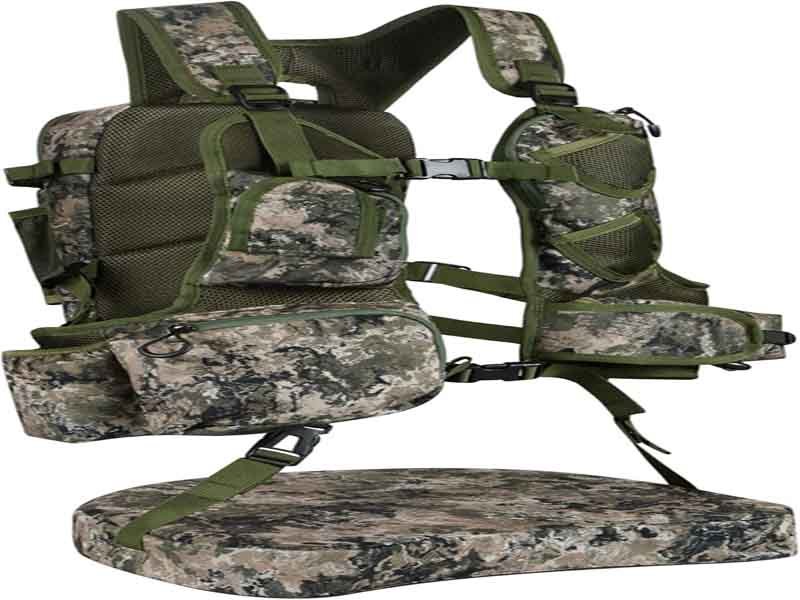
A good camouflage fabric for a hunting bag must combine visual concealment with controlled noise, sufficient tear and abrasion resistance, stable color, manageable weight, reliable sewing performance, and weather protection appropriate to the intended use. No single laboratory number defines a good hunting fabric. Performance should be judged as a system that includes the face textile, coating or membrane, seam construction, reinforcement layout, and finished bag design.
A fabric that performs well on a dry woodland daypack may be unsuitable for a waterfowl blind bag, a saddle-mounted hunting pack, or a pack designed to carry sharp metal tools. Product teams should begin with real field conditions rather than choosing fabric from a color card. Load, climate, vegetation, temperature, carrying duration, contact surfaces, and expected service life all influence the correct specification.
What Must Hunting Bags Resist?
Hunting bags face a combination of mechanical and environmental stresses rarely represented by a single test. During use, a bag may rub against bark, scrape over gravel, catch on branches, sit on wet soil, carry uneven metal objects, and experience repeated loading through straps and handles. The fabric must tolerate both surface wear and concentrated force.
Abrasion resistance matters when a pack repeatedly contacts rock, vehicle beds, tree trunks, rough ground, or hunting stands. Tear resistance becomes more important after a small puncture or cut has already formed. Tensile or breaking strength helps describe how a fabric behaves under force across a wider strip, but it does not reveal whether a poorly reinforced seam will pull apart. Seam strength, stitch density, thread selection, and the distance between the needle line and fabric edge must therefore be evaluated alongside the textile.
ASTM D3884 covers abrasion evaluation using a rotary platform, double-head abrader. Other relevant textile methods include ASTM D4966 for Martindale abrasion and ASTM D5035 for strip breaking force. Results obtained under different test methods, loads, abrasives, endpoints, or conditioning procedures should not be compared as though they came from one universal scale.
A supplier statement such as “50,000 abrasion cycles” has limited value unless the test method, abradant, load, endpoint, and tested construction are also reported. A coated fabric may reach a high cycle count before yarn breakage while showing visible coating damage much earlier. For a hunting bag, surface whitening, print loss, coating exposure, fuzzing, and water-resistance decline may become commercially unacceptable before the textile forms a hole.
The following table provides practical development priorities. The values are project targets rather than universal standards, because bag size, fabric construction, test method, coating, and end use can change the required level.
| Exposure | Common Failure | Development Focus | Practical Evaluation |
|---|---|---|---|
| Brush and thorns | Snags, punctures, yarn pulls | Tight weave, ripstop structure, tear resistance | Thorn snag trial, tongue or trapezoid tear test |
| Rock and rough ground | Surface wear, print loss, coating exposure | Abrasion-resistant face and reinforced bottom | Laboratory abrasion plus loaded drag test |
| Heavy equipment | Seam opening, fabric distortion, strap failure | Tensile strength, seam strength, reinforcement | Static loading and repeated lift testing |
| Rain and wet vegetation | Face wet-out, leakage, added weight | DWR, PU or TPU layer, protected seams | Spray, hydrostatic pressure, and rain simulation |
| Mud and organic debris | Staining, odor retention, difficult cleaning | Smooth finish, color stability, cleanable coating | Soil exposure and cleaning trial |
| Cold conditions | Stiffness, crackling, coating damage | Low-temperature flexibility | Cold-chamber flex and sound comparison |
| Sunlight | Fading, weakening, pattern imbalance | UV and colorfastness control | Accelerated light test and outdoor exposure |
| Sharp internal contents | Punctures and internal abrasion | Lining, sleeves, foam, local reinforcement | Loaded movement and point-pressure testing |
Bag testing should reproduce complete use rather than focusing only on flat fabric. A textile may have excellent tear strength but fail where a webbing loop is attached through a single layer. Another textile may pass a water-column test but leak at unsealed seams. A heavy base fabric may survive dragging while transferring too much force to the stitching around the bottom panel.
A more reliable development process combines material tests with finished-product tests. The fabric can first be screened for weight, construction, color, abrasion, tear, breaking force, coating adhesion, water resistance, and low-temperature flexibility. Approved candidates can then be sewn into prototypes for load cycling, drop testing, zipper operation, rain exposure, pocket access, and field-noise evaluation.
Which Fabric Properties Matter Most?
The most important properties depend on where and how the bag will be used. For a lightweight bow-hunting daypack, low noise and low mass may rank above extreme abrasion resistance. For a blind bag placed on wet ground, water protection and cleanability become more important. For a large frame pack carrying meat or equipment, seam stability, tear resistance, bottom-panel durability, and load transfer deserve priority.
The following decision matrix shows how performance priorities can shift by product type. Ratings indicate relative importance during development rather than a guaranteed material grade.
| Hunting Bag Type | Abrasion | Tear Strength | Quietness | Water Protection | Low Weight | Cleanability |
|---|---|---|---|---|---|---|
| Lightweight daypack | 4/5 | 4/5 | 5/5 | 3/5 | 5/5 | 3/5 |
| Waterfowl blind bag | 4/5 | 3/5 | 3/5 | 5/5 | 3/5 | 5/5 |
| Rifle hunting pack | 4/5 | 4/5 | 5/5 | 4/5 | 4/5 | 3/5 |
| Frame or load-hauling pack | 5/5 | 5/5 | 3/5 | 4/5 | 3/5 | 4/5 |
| Tree-stand accessory bag | 3/5 | 3/5 | 5/5 | 3/5 | 4/5 | 3/5 |
| ATV or vehicle gear bag | 5/5 | 4/5 | 2/5 | 4/5 | 2/5 | 5/5 |
Fabric mass should be considered together with coating mass. Two products described as 600D polyester may feel and perform very differently. One may use a dense weave with a light PU layer, while another uses a looser face construction made rigid by a thick backing. The second fabric can feel heavier and initially more waterproof but may develop crease marks or coating separation if formulation and adhesion are weak.
Yarn type also matters. Filament yarns generally create a smoother, cleaner face, while textured yarns can provide a more textile-like appearance and different hand feel. High-tenacity yarn can improve the strength-to-weight relationship, although the final result still depends on weave construction, yarn density, finishing, and quality control.
Fabric specification should therefore include more than fiber and denier. A useful purchasing or development sheet may identify:
Fiber composition
Yarn denier
Warp and weft density
Weave type
Finished fabric weight
Usable width
Coating or lamination type
Coating weight or thickness
Water-resistance target
Tear and breaking-strength targets
Abrasion method and acceptance point
Colorfastness requirements
Camouflage artwork and color tolerances
Low-temperature performance
Restricted-substance requirements
Such detail helps prevent material substitution. Ordering “600D camouflage polyester with waterproof coating” leaves room for substantial variation. Yarn density, fabric weight, coating chemistry, camouflage registration, and color tolerance can all change while the broad description remains technically true.
How Does Fabric Affect Bag Noise?
Bag noise comes from several sources: yarn-to-yarn movement, surface texture, coating stiffness, lamination, fabric folding, contact between panels, rubbing against vegetation, zipper operation, hardware movement, and items shifting inside the bag. The shell textile is important, but silence cannot be created by the shell alone.
Smooth, stiff, heavily coated fabrics often produce sharper high-frequency sounds when folded or crushed. Softer woven fabrics, brushed surfaces, and some canvas constructions can produce lower, less distinct sounds. However, a soft fabric that absorbs water, collects seeds, or wears rapidly may solve one problem while creating several others.
Temperature can change acoustic behavior. A fabric that feels acceptable in a warm sample room may become stiffer and louder in freezing conditions. Coatings and laminated structures should therefore be evaluated at temperatures close to the intended hunting environment. The test does not need to begin with expensive equipment. Conditioning identical sewn pockets at room temperature and low temperature, then opening, folding, rubbing, and compressing them in a controlled environment can quickly expose major differences.
A practical sound evaluation should include:
Slow hand compression
Rapid pocket opening
Fabric rubbing against fabric
Fabric rubbing against bark or dry vegetation
Zipper movement under tension
Drawcord and buckle operation
Movement with a realistic internal load
Testing after cold conditioning
Testing after water exposure and drying
Sound level meters can support comparison, but decibel readings alone do not describe whether a sound is sharp, prolonged, repetitive, or easily distinguished from natural background noise. A product team should combine instrument readings with a controlled listening panel and field trial.
Noise can also be managed through material zoning. A quiet face fabric may be used around frequently opened pockets, the lid, rangefinder storage, or areas contacting clothing. A more durable but louder fabric can remain on the bottom or internal frame sleeve. Soft zipper garages, elastic retainers, covered pullers, and hardware isolation can further reduce unwanted sound.
The quietest fabric is not automatically the best fabric. Deep brushing may reduce rustle but increase surface snagging, moisture retention, and print distortion. Bonding a brushed textile to a membrane may improve weather protection but add weight and reduce flexibility. Product development should find the lowest acceptable noise without ignoring durability, cleaning, and weather exposure.
Is Fabric Weight Important?
Fabric weight affects carrying comfort, perceived quality, packability, sewing behavior, drying time, and freight cost. Yet reducing fabric weight does not always reduce finished bag weight efficiently. Excessive reinforcement added to compensate for a weak shell can eliminate the original saving.
A hunting pack built from one heavy fabric across every panel may feel rugged in a showroom, but the additional weight remains on the user’s shoulders throughout the trip. A better approach places strength where force and wear occur. Bottom panels, lower corners, strap anchors, compression-strap bases, and tool sleeves can use heavier materials or additional layers. Large low-stress panels can use lighter fabric.
Denier and finished fabric weight are related but not interchangeable. Denier describes yarn linear density, while grams per square meter describe the mass of the finished textile area. Weave density, yarn count, coating, lamination, and finish influence the final weight. A well-engineered lower-denier high-tenacity fabric may outperform a poorly constructed higher-denier fabric in a particular test.
The practical development ranges below are broad starting points rather than fixed standards.
| Fabric Construction | Approximate Finished Weight | Suitable Bag Zones | Main Trade-Off |
|---|---|---|---|
| 210D polyester or nylon | 90–160 gsm | Lining, internal pockets, rain-cover storage | Too light for exposed high-wear panels |
| 330D high-tenacity nylon | 150–230 gsm | Lightweight technical pack body | Higher cost than standard polyester |
| 420D polyester Oxford | 180–280 gsm | Daypack body, pockets, moderate-use panels | Moderate puncture and abrasion resistance |
| 500D high-tenacity nylon | 200–300 gsm | Technical hunting pack body, reinforced pockets | Material cost and possible surface noise |
| 600D polyester Oxford | 280–400 gsm | General hunting bags, gear bags, main body | More weight and stiffness than lighter options |
| 900D polyester Oxford | 330–480 gsm | Bottoms, tool areas, vehicle-use bags | Often excessive for complete lightweight packs |
| 1000D high-tenacity nylon | 350–500 gsm | High-abrasion reinforcement and load-hauling zones | High weight, cost, and stiffness |
| Cotton or blended canvas | 300–600 gsm | Traditional packs, quiet exterior panels | Water absorption and slower drying |
| Laminated technical fabric | 180–450 gsm | Weather-focused packs and structured panels | Crease noise, cost, and sewing complexity |
A target weight should be established for the finished bag, not only for the shell fabric. Foam, webbing, buckles, frames, zippers, lining, reinforcement, hook-and-loop tape, and packaging all contribute mass. A seemingly small fabric increase becomes significant when multiplied across the entire surface area and production volume.
For example, adding 100 grams per square meter to a bag consuming 1.2 square meters of shell material increases theoretical shell weight by about 120 grams before allowing for cutting waste, reinforcement, and secondary components. On a large pack, several “small” material upgrades can add half a kilogram without improving the areas most likely to fail.
The strongest development decision is often not choosing a heavier textile. It is identifying the exact failure mode and reinforcing the correct zone.
Which Fabrics Are Commonly Used?
Polyester Oxford, nylon Oxford, high-tenacity branded fabrics, canvas, and laminated constructions are the main camouflage fabric families used for hunting bags. Polyester offers favorable cost, printability, dimensional stability, and broad availability. Nylon provides a strong strength-to-weight relationship and is widely selected for technical packs. Canvas offers a quiet, natural hand but requires careful weather treatment. Laminated fabrics provide structured weather protection but can increase noise, cost, and manufacturing complexity.
No fabric family is superior in every application. Fiber names should be treated as the beginning of a specification rather than the final decision. A dense, well-finished polyester can outperform a low-grade nylon in real use. A lighter nylon may provide better durability per unit of weight than a heavy standard polyester. A laminated fabric may resist water penetration well but become uncomfortable or noisy for a stalking pack.
Is Polyester Good for Hunting Bags?
Polyester is one of the most practical materials for camouflage hunting bags because it accepts a wide range of print methods, has good dimensional stability, dries relatively quickly, and can be produced in many weights, weaves, colors, and coating combinations. Common options include 300D, 420D, 600D, and 900D Oxford constructions.
For general-purpose hunting daypacks and gear bags, 420D or 600D polyester often creates a useful balance among durability, cost, structure, and print quality. The fabric can receive a PU coating for water resistance, a water-repellent face finish, or a laminate when stronger water protection is required.
Polyester also performs well when camouflage artwork requires stable color reproduction. Sublimation printing is particularly suitable for polyester because the dye system can create detailed imagery without leaving a thick print film on the fabric face. The exact appearance depends on yarn luster, base-fabric whiteness, weave texture, pretreatment, color management, and heat-transfer conditions.
Not every 600D polyester is equivalent. A product team should examine yarn density, finished weight, weave consistency, coating adhesion, tear performance, and surface abrasion rather than relying on denier alone. Lower-density material may feel stiff because of a heavy backing while lacking the compact woven structure needed to control puncture propagation.
Polyester is often a good choice for:
General hunting backpacks
Waterfowl gear bags
Range bags
Vehicle or ATV storage bags
Cooler-style hunting bags
Game-accessory organizers
Moderately priced camouflage collections
Products requiring detailed custom camouflage graphics
Its limitations should also be acknowledged. Standard polyester may require greater finished weight than high-tenacity nylon to reach a demanding strength target. Smooth polyester Oxford can create noticeable rustle, especially when heavily coated. Surface shine may also weaken visual concealment, so matte yarns, textured constructions, low-gloss finishes, or brushed surfaces may be considered.
A polyester hunting bag can therefore be durable and quiet, but those results come from construction and finishing rather than from the word “polyester.”
Is Nylon More Durable?
Nylon is commonly selected for technical hunting packs because well-engineered nylon fabrics can provide high tear and abrasion performance at a manageable weight. High-tenacity nylon is particularly useful where a bag must carry substantial loads, resist repeated flexing, or reduce mass without becoming fragile.
Nylon also has trade-offs. It can absorb more moisture than polyester at the fiber level, which may affect dimensional behavior and drying under certain conditions. Dyeing and camouflage-printing routes require careful selection. Some nylon fabrics cost more, and high-performance grades may involve longer sourcing cycles or stricter minimum production requirements.
A 500D nylon pack should not automatically be described as weaker than a 600D or 900D polyester pack. Yarn tenacity, weave density, coating, and finished construction may allow the lighter nylon to perform more effectively. Conversely, a loosely woven or poorly coated nylon fabric will not become a premium material merely because “nylon” appears on the specification.
Nylon works especially well for:
Load-hauling hunting packs
Technical daypacks
Modular attachment systems
Frame-compatible bags
High-stress compression panels
Products requiring strength at reduced weight
Premium outdoor equipment collections
When comparing nylon and polyester, the useful question is not “Which fiber is stronger?” The useful question is “Which complete fabric construction meets the required performance at the acceptable weight, noise, cost, and production risk?”
A fair comparison requires samples with known finished weights and test methods. Comparing a 220 gsm high-tenacity nylon with a 380 gsm polyester and reporting only which one survives more abrasion cycles tells little about strength-to-weight efficiency. Comparing equal-denier materials without accounting for yarn type and weave density is equally misleading.
A balanced evaluation may include cost per meter, usable width, finished gsm, tear result, breaking force, abrasion performance, water resistance, coating adhesion, print quality, sound behavior, and sewing stability. The result may justify nylon for one product and polyester for another.
What Is CORDURA Fabric?
CORDURA is a branded family of performance fabrics rather than a generic synonym for any rugged nylon. CORDURA Classic Fabric is made with high-tenacity, air-jet-textured filament fiber and is offered in yarn sizes including 330D, 500D, 700D, and 1000D. The brand describes the fabric as providing tear strength, abrasion resistance, and water repellency.
CORDURA Ballistic Fabric uses high-tenacity nylon 6,6 filament yarns in a dense woven construction designed for enhanced tear and abrasion resistance. CORDURA HP includes plain, dobby, basket, and ripstop options intended for durable applications such as bags, backpacks, footwear, and outdoor equipment.
The brand name should only be used when the supplied fabric is an authenticated CORDURA product obtained through an appropriate supply route. A generic “Cordura-style” or “high-density nylon” fabric should not be marketed as genuine CORDURA. Product labels, hangtags, invoices, and website descriptions need to match the actual material.
For hunting bags, 500D CORDURA can suit main bodies and modular pockets where durability and manageable weight are important. A 1000D version may be selected for heavily abraded panels, although using it across an entire pack can create unnecessary weight and stiffness. Lower-denier options can support lightweight designs when pattern engineering and reinforcement are well controlled.
CORDURA does not remove the need for development testing. A branded face fabric can still be undermined by weak seam allowance, unsuitable thread, poor bartack placement, exposed raw edges, inferior lining, or an incompatible coating. Finished-product performance remains dependent on the entire construction.
Product teams should request:
Exact CORDURA fabric article or style
Fiber and yarn specification
Finished weight and width
Available camouflage or base colors
Coating and finish details
Performance data
Traceability documents
Brand-label authorization requirements
Production lead time
Color-lot control procedure
The strongest use of a premium textile is strategic rather than decorative. Placing a high-performance material in the areas that benefit from its properties can improve the bag more effectively than applying a premium name to an otherwise underdeveloped product.
When Is Canvas Suitable?
Canvas is suitable when quiet handling, a traditional appearance, natural texture, and a softer sound profile are more important than minimum weight or rapid drying. Cotton canvas, polyester-cotton canvas, and nylon-cotton blends can all be used for hunting bags, although their performance differs considerably.
A tightly woven canvas often produces less sharp rustling than smooth coated Oxford fabric. After use, it may become softer and quieter. Such characteristics appeal to woodland hunting, heritage outdoor collections, bushcraft equipment, and products intended to blend visually with natural environments.
Pure cotton canvas can absorb water, become heavier when wet, dry slowly, and support staining or mildew when stored damp. Wax treatment or water-repellent finishing can improve weather performance, but finishes change hand feel, color, breathability, odor, and maintenance requirements.
Cotton-focused durability technologies can improve abrasion resistance, strength, and colorfastness, showing that canvas performance can be modified through fiber blends and finishing rather than treated as fixed.
Blended canvas can offer a useful compromise. Polyester-cotton canvas may retain a quieter textile character while improving dimensional stability and drying. Nylon-cotton constructions can provide greater mechanical durability while preserving some cotton hand. CORDURA NYCO, for example, is available in blends containing up to 60% cotton and 40% nylon 6,6 and was developed for demanding environments.
Canvas can be a strong choice for:
Quiet woodland packs
Traditional game bags
Bushcraft and fieldcraft bags
Leather-trimmed hunting collections
Ammunition pouches
Tool rolls and accessory organizers
Lifestyle products influenced by hunting heritage
Canvas is less suitable when the product must remain very light, withstand continuous saturation, dry quickly, or maintain a highly structured shape without added backing. A canvas bag also requires careful storage instructions because users may assume rugged appearance means zero maintenance.
Camouflage printing on canvas deserves special attention. Pigment printing can produce attractive results, but surface wear may become visible sooner than on deeply dyed fibers. The natural base color can influence final camouflage shades. Pretreatment, curing, wash testing, rubbing fastness, and lot-to-lot color control should be approved before production.
Are Laminated Fabrics Better?
Laminated fabrics are better when the design requires controlled water resistance, low stretch, structural stability, or a technical strength-to-weight construction. They are not automatically better for quiet hunting bags.
A laminated textile combines a woven face with one or more backing layers, films, scrims, or membranes. The structure can improve water protection and dimensional control while reducing dependence on a heavy surface coating. Some laminates integrate reinforcement yarns or grids to manage tearing and distortion.
The disadvantages can include higher material cost, visible creasing, edge delamination, increased sound, reduced drape, more complex sewing, and greater difficulty sealing seams. Needle holes still create possible leakage paths unless seam construction and sealing are addressed.
Laminated fabric works well for:
Weather-resistant equipment bags
Pack liners
Map and document compartments
Structured lids
Wet-ground panels
Lightweight technical packs
Removable dry compartments
The main question is whether the hunting activity requires waterproof fabric or a waterproof bag. A waterproof face material does not make the finished product waterproof when zippers, seams, attachment points, and openings remain unprotected. In many hunting packs, a water-resistant shell combined with a removable waterproof liner or rain cover offers better repairability, lower cost, and easier field use.
A successful hybrid construction may use a quieter camouflage woven fabric externally and a waterproof drop-in liner internally. Another design may use laminated fabric only on the bottom and rain-exposed lid. Such combinations can provide better field performance than forcing one material to satisfy every requirement.
Material selection should ultimately follow the product’s real failure risks. Polyester is not merely a budget option. Nylon is not automatically superior. Canvas is not always outdated. Laminates are not inherently waterproof after sewing. CORDURA is not a substitute for good pattern engineering.
The best hunting bag fabric is the construction that remains quiet enough, strong enough, dry enough, and light enough for the intended terrain while supporting consistent cutting, printing, sewing, inspection, and repeat production.
Which Fabric Denier Is Best?
The best fabric denier for a hunting bag depends on the pack’s size, load, terrain, expected service life, reinforcement design, and acceptable weight. There is no single denier that works best for every hunting bag. Lightweight 210D to 420D fabrics may suit liners, internal pockets, compact daypacks, and protected panels. Fabrics around 500D to 600D are commonly selected for general hunting pack bodies. Heavier 900D to 1000D materials are more appropriate for bottoms, tool pockets, rifle-contact zones, and high-abrasion reinforcement.
Denier should not be treated as a durability score. It describes the linear density of the yarn, not the finished strength of the fabric. A tightly woven 420D high-tenacity nylon can outperform a loosely woven 600D polyester in tear resistance. A well-engineered 500D fabric can provide better strength-to-weight performance than a much heavier fabric with lower yarn quality or poor coating adhesion.
For product development, denier works best as one part of a complete specification that also includes fiber type, yarn tenacity, weave, warp and weft density, finished weight, coating, abrasion result, tear strength, breaking strength, and seam performance.
What Does Fabric Denier Mean?
Denier is a unit used to describe yarn thickness by mass. One denier means that 9,000 meters of the yarn weighs one gram. A 600D yarn is therefore heavier per 9,000 meters than a 300D yarn. In everyday product language, a higher denier is often associated with a thicker and more rugged fabric, but the relationship is not always direct.
Two fabrics with the same denier can have very different finished weights and performance. The number of yarns packed into the weave, the yarn shape, the fiber type, the coating thickness, and the finishing process all influence how the finished textile behaves.
For example, these three materials may all be sold under broad “600D” descriptions:
A dense 600D polyester Oxford with a controlled PU coating
A loosely woven 600D polyester made stiff with a thick backing
A 600D recycled polyester fabric with different yarn consistency and heat response
All three carry the same denier label, but they may differ in abrasion resistance, tear propagation, sewing stability, surface appearance, coating adhesion, and print clarity.
The following table explains the most important terms that should be reviewed together with denier.
| Specification | What It Describes | Why It Matters for Hunting Bags |
|---|---|---|
| Denier | Yarn linear density | Influences thickness, appearance, and potential durability |
| GSM | Finished fabric mass per square meter | Helps estimate total bag weight |
| Warp density | Number of lengthwise yarns | Affects dimensional stability and tear behavior |
| Weft density | Number of crosswise yarns | Influences coverage, strength, and surface compactness |
| Weave type | Oxford, plain, basket, ripstop, dobby | Changes texture, tear control, and appearance |
| Yarn tenacity | Strength of the yarn relative to size | Important for strength-to-weight performance |
| Coating weight | Amount of PU, PVC, TPU, or other backing | Affects water resistance, stiffness, and mass |
| Abrasion result | Resistance to repeated rubbing | Important for ground, bark, and equipment contact |
| Tear strength | Resistance to growth of a cut | Critical around punctures and damaged edges |
| Breaking strength | Resistance to force across a wider sample | Relevant to loaded panels and seams |
| Seam slippage | Yarn movement beside stitching | Important around handles, straps, and pockets |
Denier is useful during early material screening because it quickly separates very light lining fabrics from medium-duty shells and heavy reinforcement materials. Problems begin when denier becomes the only purchasing criterion.
A factory may receive a request for “1000D camouflage fabric” without any target for finished weight, water resistance, low-temperature flexibility, or abrasion. The material may technically meet the denier request while being too stiff, too loud, too heavy, or unsuitable for the intended print.
A stronger request would specify:
500D high-tenacity nylon or 600D polyester Oxford
Target finished weight range
PU coating or TPU lamination
Minimum hydrostatic pressure
Abrasion method and acceptance level
Tear-strength target
Colorfastness requirements
Low-temperature flexibility
Matte surface appearance
Approved camouflage artwork and color tolerance
This level of detail allows the material to be developed around the finished bag rather than around one number.
Is 420D Fabric Strong Enough?
A well-constructed 420D fabric can be strong enough for many hunting daypacks, lightweight equipment bags, accessory pockets, and medium-duty outer panels. Its success depends on load, fiber type, weave density, reinforcement, and the way stress is distributed through the pattern.
A 420D polyester Oxford can provide a practical balance for packs that carry clothing, food, optics, rangefinders, calls, small tools, and other moderate loads. It is lighter and usually more flexible than 600D or 900D polyester. This can reduce rustling and improve packability, particularly when the coating remains soft.
A 420D high-tenacity nylon can provide even stronger performance at a similar or lower finished weight, although material cost may be higher. In a carefully engineered pack, 420D nylon can be used across large body panels while 500D, 600D, or 1000D reinforcement is added only where abrasion or concentrated load occurs.
The fabric is more likely to be sufficient when:
The pack volume is moderate
The load is below heavy hauling levels
The bottom receives reinforcement
Shoulder straps are attached through multiple layers
Sharp equipment is stored in sleeves or padded compartments
The weave is compact
The coating remains flexible
Seam allowances are wide enough
Stress points use webbing or bartack reinforcement
The fabric is less likely to be sufficient when:
The pack is dragged over rock
It carries metal traps or sharp tools
It is used as a seat or shooting rest
The bottom is frequently saturated and abraded
The pack carries heavy harvested game
External compression straps place high force on isolated points
The material has low yarn density
The seam line sits too close to the cut edge
A common design mistake is rejecting a lighter material because an early prototype fails at a strap attachment. The failure may come from the construction rather than from the base fabric. If the strap is sewn directly onto one layer of shell fabric, the needle holes can create a perforation line. Adding a load-spreading backing patch or extending the webbing into the seam may solve the problem more effectively than making the entire bag heavier.
The table below shows sensible uses for 420D fabric.
| Bag Area | 420D Suitability | Recommended Construction |
|---|---|---|
| Main front panel | High | Single shell layer with lining where needed |
| Side pockets | High | Elastic or bound opening with reinforced base |
| Lid or top flap | High | Soft coating to reduce folding noise |
| Back panel | Moderate to high | Foam, mesh, and backing layer distribute stress |
| Bottom panel | Moderate | Add 600D, 900D, 1000D, or double-layer reinforcement |
| Shoulder-strap anchor | Low without reinforcement | Use webbing extension and backing patch |
| Rifle or tool sleeve | Moderate | Add lining, foam, or puncture-resistant insert |
| Load-hauling panel | Low to moderate | Use higher-tenacity material or structural laminate |
For many products, 420D is not a weak fabric. It is simply a material that requires disciplined engineering. When used in the correct zones, it can produce a lighter and quieter bag than an all-over heavy shell.
When Should 600D Be Used?
A 600D fabric is a strong general-purpose choice for hunting backpacks, gear bags, blind bags, range bags, cooler exteriors, and vehicle storage bags. It provides more body and surface durability than many lighter polyester fabrics while remaining easier to sew and less costly than many high-tenacity nylon options.
The popularity of 600D polyester comes from its manufacturing flexibility. It can be woven in different densities, printed with detailed camouflage artwork, coated with PU, laminated with films, treated with water repellent, and combined with foam or lining. It also supports structured bag shapes without requiring excessive internal reinforcement.
600D is especially suitable when the bag needs:
Moderate to high abrasion resistance
A structured appearance
Custom camouflage printing
A balance between cost and durability
Stable dimensions during cutting and sewing
Water-resistant coating
Broad color and finish availability
Compatibility with foam and lining
Enough body for commercial presentation
However, 600D should not automatically cover every panel. On a compact waist pack, the fabric may add more stiffness than necessary. On a quiet stalking pack, a smooth coated version may produce too much rustle. On a high-end technical load-hauling pack, standard polyester 600D may not offer the same strength-to-weight performance as high-tenacity nylon.
A productive way to use 600D is as the main structural shell while varying secondary materials:
600D camouflage polyester for the body
900D polyester or 1000D nylon for the bottom
420D brushed fabric for quiet pockets
210D polyester for the lining
Spacer mesh for the back panel
Nylon webbing for load transfer
TPU-coated fabric for a removable waterproof compartment
This mixed-material system can produce better results than an entire bag made from one fabric.
The following table compares common 600D constructions.
| 600D Construction | Main Advantage | Main Concern | Suitable Use |
|---|---|---|---|
| Standard polyester Oxford with PU | Balanced cost and performance | Can vary greatly by weave density | General hunting packs |
| Dense polyester Oxford with heavy PU | Higher water resistance and structure | More stiffness and noise | Gear bags and vehicle use |
| Recycled polyester Oxford | Sustainability positioning | Lot consistency and print control require attention | Outdoor collections |
| Brushed polyester face | Lower surface noise | Can collect debris and show wear | Quiet-access pockets |
| PVC-backed polyester | Strong structure and easy cleaning | Heavy, less flexible, environmental concerns | Wet gear or utility bags |
| TPU-laminated polyester | Strong weather protection | Higher cost and seam complexity | Waterproof compartments |
When reviewing 600D fabric samples, bend and crush them rather than judging only flat swatches. Listen to the sound, inspect white stress marks, check whether the coating cracks, and rub the face against bark, webbing, hook-and-loop tape, and another panel. A fabric that looks excellent on a table may behave poorly once sewn into a three-dimensional bag.
Do 1000D Fabrics Add Weight?
Yes. A 1000D fabric usually adds noticeable weight, bulk, stiffness, and cost compared with lighter constructions. It can provide valuable abrasion and tear performance, but using it across an entire hunting bag may reduce comfort without creating a meaningful field advantage.
The additional weight depends on the exact fabric. A 1000D high-tenacity nylon may fall within a different finished-weight range from a 1000D polyester or ballistic weave. Coating and lamination can add substantial mass beyond the face textile.
A rough product-level comparison helps show the effect. Assume a hunting pack uses 1.4 square meters of exterior shell material.
| Finished Fabric Weight | Shell Area | Approximate Shell Mass |
|---|---|---|
| 220 gsm | 1.4 m² | 308 g |
| 300 gsm | 1.4 m² | 420 g |
| 380 gsm | 1.4 m² | 532 g |
| 450 gsm | 1.4 m² | 630 g |
| 520 gsm | 1.4 m² | 728 g |
The difference between a 300 gsm shell and a 520 gsm shell is about 308 grams before adding cutting overlap, reinforcements, pockets, lining, foam, frames, hardware, and webbing. Once a design adds heavier zippers and buckles to match the rugged appearance, the total increase can become much larger.
A heavy pack may feel reassuring in a store, but the user carries that extra weight for hours. In steep terrain, unnecessary mass can affect fatigue, balance, and how much water, ammunition, optics, or clothing can be carried.
1000D fabric makes the most sense in targeted areas:
Bottom panels
Lower corners
Compression-strap anchors
Rifle-butt contact zones
Tool pockets
Frame sleeves
Drag handles
External modular attachment panels
Vehicle-contact surfaces
Meat-hauling sections
It is less necessary on:
Large front panels
Lightweight lid sections
Internal dividers
Soft bottle pockets
Rain-cover compartments
Areas protected by foam or lining
A zoned bag can use 1000D fabric on 15% to 30% of the exterior rather than 100%. This often captures most of the durability benefit while controlling weight and cost.
Fabric weight also affects production. Heavy 1000D materials may require stronger needles, heavier thread, longer stitch lengths, binding adjustments, and more powerful sewing machines. Multiple folded layers around zippers and corners can become bulky. If the design includes foam, webbing, and binding in the same seam, needle deflection and skipped stitches may increase.
The decision should therefore be based on failure risk rather than visual preference. When a 500D or 600D body fabric survives field testing and only the bottom shows damage, upgrading the entire bag to 1000D solves the wrong problem.
How Do Camo Patterns Match Terrain?

Camouflage patterns should match the scale, color temperature, contrast, vegetation density, light conditions, and seasonal changes of the hunting environment. A pattern that performs well in green woodland may become a dark, solid-looking shape in dry grassland. A snow pattern with too much white may fail in mixed brush, while a dense digital print may lose definition at longer viewing distances.
The most effective camouflage does not copy every leaf or branch. It breaks up the bag’s outline across several viewing distances. Large shapes disrupt the overall form, medium elements connect the pattern to surrounding terrain, and small details add texture at close range. Color balance matters just as much as artwork. Excessive black, overly saturated green, or poor brown ratios can make the bag more visible.
The pattern should also be evaluated on the finished bag rather than only on a flat fabric roll. Seams, pockets, webbing, zippers, foam channels, and panel orientation change how camouflage appears. A successful textile print can still produce a highly visible bag when solid black components create hard outlines.
Which Patterns Suit Woodland?
Woodland hunting environments usually contain a mixture of tree trunks, bark, leaves, branches, shadow, moss, dead vegetation, and uneven light. Effective patterns commonly use olive, brown, tan, gray, muted green, and controlled dark accents.
The correct balance depends on forest type. Dense evergreen forest often has darker greens and stronger vertical shadow. Deciduous woodland changes significantly across the year. Early season may contain broad green foliage, while late season can shift toward gray trunks, brown leaves, and exposed ground.
A strong woodland pattern should include:
Large irregular shapes that break the bag silhouette
Vertical and diagonal elements that resemble branches
Medium brown and gray areas that match bark
Muted greens rather than bright synthetic green
Limited dark zones to create depth
Tan or dry-leaf tones for ground transition
A non-reflective surface
Photorealistic leaf prints can appear convincing at close range but may merge into one dark mass from 20 to 50 meters away. Abstract macro patterns often perform better across distance because their larger blocks remain visible as disruptive shapes.
The following pattern structure can guide custom artwork development.
| Pattern Layer | Approximate Visual Scale | Function |
|---|---|---|
| Macro shapes | 15–40 cm | Breaks the overall bag outline |
| Mid-scale branches and blocks | 5–15 cm | Connects the pattern to trunks and vegetation |
| Small texture | 0.5–5 cm | Adds close-range surface detail |
| Dark accents | Limited distribution | Creates depth without forming large black zones |
| Light accents | Controlled distribution | Prevents the bag from becoming a dark mass |
The fabric finish should support the artwork. Glossy yarns or shiny PU films can reflect light and weaken concealment even when the colors are accurate. Matte yarn, low-gloss coating, textured weaving, or a light brushing process can reduce reflection.
Component selection is equally important. A woodland shell combined with bright zipper tape, reflective buckles, or smooth black webbing creates visual breaks. Components can be dyed or selected in brown, olive, tan, gray, or pattern-matched colors.
A well-matched woodland bag often avoids perfect uniformity. Natural environments contain irregularity. Slight variation between webbing, fabric, mesh, and binding can look more integrated than forcing every component into one identical green.
What Works in Marshes?
Marsh, wetland, and waterfowl environments require camouflage that reflects reeds, cattails, dry grass, muddy banks, shallow water, and open sky. Tan, straw, beige, muted brown, olive, gray, and limited dark accents are more useful than heavy green woodland colors in many marsh settings.
Vertical visual elements are especially valuable because marsh vegetation often grows in long upright forms. Patterns with horizontal woodland branches may look unnatural against reeds.
Marsh bags also face more water, mud, and vegetation contact than many dry-land packs. Pattern selection should therefore be combined with cleanability and water protection. A soft brushed fabric may be quiet, but it can hold mud, seeds, and organic material. A smoother face with a matte finish may be easier to wipe down.
Important marsh design considerations include:
Straw and reed color balance
Vertical pattern direction
Low water absorption
Mud-release surface
Corrosion-resistant hardware
Protected zippers
Drainage in open pockets
Dark bottom panels that hide staining
Water-resistant lining
The camouflage artwork should not contain too much white or light beige unless the environment is consistently pale. Under overcast conditions, a pattern that appears balanced indoors may become too bright. Under strong sunlight, a dark pattern may become a distinct block against dry reeds.
Field photography can support pattern development. Images should be taken from several distances and angles:
Five meters for close texture
Twenty meters for body-shape breakup
Fifty meters for macro-pattern behavior
Low angle near water level
Standing height
Direct sun
Cloud cover
Early morning
Late afternoon
The finished prototype should be filled to its actual shape. An empty flat bag does not represent the curves, shadows, and panel breaks created by real use.
Which Camo Fits Snow?
Snow camouflage should match the amount of snow cover, exposed vegetation, tree structure, shadow, and weather conditions. Pure white fabric is rarely the most adaptable solution because winter terrain often includes gray bark, dark branches, brown grass, exposed rock, and blue-gray shadow.
A practical snow pattern uses white or off-white as the main background, combined with gray, muted brown, and controlled black or dark green elements. The ratio should change according to the environment.
| Winter Environment | Suggested Light Coverage | Supporting Colors | Main Risk |
|---|---|---|---|
| Open deep snow | 65–85% | Light gray and sparse dark marks | Too much dark artwork |
| Snowy woodland | 45–65% | Gray, brown, black, muted green | Pure white looks unnatural among trees |
| Patchy early snow | 25–45% | Brown, tan, gray, olive | High-white pattern becomes obvious |
| Alpine rock and snow | 40–60% | Gray, charcoal, stone brown | Leaf patterns look out of place |
| Late-season dirty snow | 35–55% | Gray, beige, muted brown | Bright white creates excessive contrast |
Seasonal versatility can be achieved through removable covers rather than producing an entire bag in snow camouflage. A lightweight printed rain cover or outer shell can transform a woodland pack during winter. This approach reduces inventory complexity and allows one core bag to serve multiple seasons.
The cover should be large enough to fit a loaded pack, secured against wind, and designed so that essential pockets remain accessible. A loose white cover that flaps or blocks the shoulder-strap system may create more problems than it solves.
Snow conditions also introduce low-temperature requirements. Coatings, buckles, zipper pulls, elastic cords, and laminated fabrics should remain flexible in cold weather. A material that becomes loud or brittle at low temperature can defeat the purpose of visual concealment.
Colorfastness and print stability should be checked after cold flexing, because repeated folding may create white stress marks or coating cracks. Ironically, such marks may be less visible on a snow pattern, but they still indicate structural weakness.
How Do Seasons Change Camo?
Seasonal change can transform the same hunting area from green and dense to brown, open, gray, or snow-covered. A single highly specific camouflage pattern may perform extremely well for a short period and poorly for the rest of the year.
Early-season conditions often favor:
Medium and dark greens
Leaf texture
Olive and brown transitions
Higher vegetation density
Lower contrast between pattern elements
Late-season conditions often favor:
Brown and gray dominance
Exposed branch shapes
Dry grass tones
Larger open areas
Reduced green content
Winter conditions may favor:
Gray and white balance
Strong branch elements
Lower saturation
Patterns designed for patchy snow
A versatile pattern should avoid extreme dependence on one color. Green-dominant artwork can age badly when leaves fall. Dark brown artwork can look too heavy in bright early-season foliage. Neutral olive, gray, tan, and brown combinations often provide wider use.
Custom hunting bag collections can address seasonality in several ways:
Offer early-season and late-season colorways
Use a neutral main bag with interchangeable exterior panels
Add removable camouflage covers
Produce solid earth-tone bags with camouflage accessories
Use reversible pocket flaps
Develop region-specific print programs
The choice depends on order size, inventory planning, and how specialized the final product needs to be. Multiple camouflage colorways can increase commercial appeal but also create more fabric minimums, print approvals, shade control, and stock risk.
A development team should consider whether customers genuinely need six patterns or whether two carefully selected patterns cover most use conditions. More options do not automatically create better products. A smaller pattern range can improve consistency, forecasting, and repeat production.
Do Digital Patterns Work?
Digital camouflage patterns can work well when their scale, contrast, and color palette match the terrain. The square or pixel-like appearance is only a visual style. Its effectiveness depends on how the shapes break the object outline across different viewing distances.
Small digital pixels may look detailed on a screen but merge into a uniform color when viewed from far away. Larger digital blocks can disrupt shape more effectively, especially on backpacks where the visible area is broad.
Digital patterns offer several practical advantages:
Easy color adjustment
Clear repeat structures
Efficient artwork scaling
Good compatibility with sublimation printing
Strong visual identity
Flexible regional color versions
They also present risks:
Repetition may become obvious
Small pixels may blur during printing
The pattern may look artificial in organic terrain
Large black clusters can form visible blocks
Poor scaling can create an almost solid color from distance
The following comparison helps distinguish major camouflage approaches.
| Pattern Type | Main Strength | Main Weakness | Best Application |
|---|---|---|---|
| Photorealistic | Strong close-range terrain recognition | Can become visually dense at distance | Specialized woodland and marsh products |
| Digital | Flexible color control and modern identity | Scale errors reduce disruption | Multi-region technical packs |
| Abstract macro | Strong outline breakup across distance | Less literal terrain appearance | Versatile hunting packs |
| Branch-based | Matches woodland structure | Can be region-specific | Forest and tree-stand hunting |
| Reed-based | Strong marsh alignment | Weak in dense woodland | Waterfowl and wetland bags |
| Solid earth tone | Broad usability and easy coordination | Lower pattern disruption | Accessories and mixed-use outdoor bags |
Digital artwork should be tested at actual print size. Designing only on a small monitor creates false confidence. The artwork should be printed on at least one full-width fabric section, sewn into a representative panel, and viewed from multiple distances.
Pattern repeat also matters. A very small repeat can create visible tiling across a large bag. A larger repeat looks more natural but may increase printing and artwork-control complexity. Panel cutting should avoid placing identical focal elements on adjacent pockets where repetition becomes obvious.
For custom camouflage development, Szoneier can support pattern scaling, color adjustment, fabric selection, coating, lamination, brushing, water-repellent finishing, sample production, and complete hunting bag manufacturing. A useful inquiry should include the intended terrain, hunting season, bag capacity, target weight, expected load, required water protection, preferred noise level, reference pattern, and annual quantity.
The more clearly the environment and use conditions are defined, the more accurately the fabric denier, weave, print, coating, and reinforcement system can be matched to the finished hunting bag.
How Quiet Should the Fabric Be?
A hunting bag does not need to be completely silent, because no textile, zipper, buckle, or loaded compartment can eliminate all sound. It does, however, need to remain quiet enough that normal access, body movement, and contact with vegetation do not create sharp, unfamiliar noises that stand out from the surrounding environment.
Quietness matters most on stalking packs, bow-hunting bags, tree-stand organizers, rangefinder pockets, ammunition pouches, and other products used when animals may be nearby. It matters less on vehicle storage bags, transport cases, and equipment organizers opened far from the hunting area. The correct noise target should therefore be based on the bag’s actual use rather than a broad promise such as “silent fabric.”
A good quiet hunting fabric usually has a soft surface, controlled coating stiffness, limited surface gloss, and enough flexibility to fold without producing sharp crackling sounds. Brushed polyester, soft canvas, microfiber-faced textiles, and selected laminated fabrics can all work, but each involves trade-offs in water resistance, cleaning, abrasion, drying time, and cost.
The most effective design often combines quiet fabric in frequently touched areas with stronger, more weather-resistant materials in less noise-sensitive zones.
Why Does Fabric Noise Matter?
Wild animals constantly hear natural sounds such as wind, leaves, rain, branches, insects, and other animals. The problem is not simply sound volume. Sudden, repetitive, high-frequency, or mechanically regular sounds are more likely to seem unusual.
A soft rustle may blend into moving vegetation, while the sharp crack of a stiff coated pocket can draw attention. A metal zipper pull tapping repeatedly against a slider may be more noticeable than a brief fabric movement. This means hunting bag noise should be evaluated by character, duration, frequency, and repetition rather than by one decibel number.
Noise usually comes from several interactions:
The shell fabric folding against itself
A coated backing creasing during pocket opening
Webbing rubbing against the shell
Hook-and-loop tape separating
Zipper sliders striking metal pullers
Hard buckles contacting frames or accessories
Loose equipment moving inside the bag
Fabric brushing against dry grass or branches
Rain covers fluttering in wind
Foam panels squeaking against coated lining
A product can use a quiet exterior textile and still perform poorly if the internal structure creates mechanical sound. Noise management must therefore include materials, components, pattern design, and packing layout.
For example, a quiet rangefinder pocket may use a brushed shell, soft lining, elastic closure, covered zipper, and fabric zipper pull. A standard pocket made with stiff Oxford, exposed hook-and-loop tape, and a metal puller may be easier to manufacture, but it introduces several unnecessary sound sources.
The following table shows common noise problems and practical solutions.
| Noise Source | Typical Sound | Main Cause | Practical Improvement |
|---|---|---|---|
| Stiff coated shell | Sharp crackling | Thick or rigid coating | Use softer PU, lighter coating, or flexible laminate |
| Smooth Oxford rubbing | High-frequency rustle | Hard surface and low drape | Add brushing, textured yarn, or softer face construction |
| Hook-and-loop closure | Loud tearing sound | Aggressive hook engagement | Replace with magnets, elastic, buckle, or silent tab |
| Metal zipper pull | Repeated tapping | Puller strikes slider or hardware | Use cord pull, rubber pull, or fabric cover |
| Loose buckle | Hard clicking | Component movement | Add elastic keeper or soft isolation patch |
| Webbing movement | Squeak or scrape | Webbing rubs against coating | Change webbing finish or add guide channel |
| Internal tools | Metallic movement | Poor compartment control | Add sleeves, elastic retainers, foam, or dividers |
| Rain cover | Flapping | Loose fit and excess material | Improve tension points and shape |
| Cold-stiffened panel | Louder folding sound | Reduced coating flexibility | Specify low-temperature flex performance |
Noise becomes especially important when the bag is repeatedly accessed. A hunter may open the same optics pocket, ammunition pouch, or call compartment many times. A material that creates only a brief sound during initial handling may become distracting when repeated throughout the day.
Product teams should identify the highest-frequency actions before selecting materials. The question is not only where the bag rubs against vegetation, but also which parts users touch most often.
Which Fabrics Rustle Less?
Fabrics with soft surfaces, lower coating stiffness, greater drape, and controlled yarn movement usually rustle less than smooth, heavily coated, rigid textiles. Brushed polyester, peach-finished fabric, microfiber, fleece-faced laminates, cotton canvas, blended canvas, and soft high-density woven fabrics are common options.
Brushed polyester is often used when a camouflage print and quieter surface are both required. The brushing process raises fine fibers on the face, reducing sharp surface contact and creating a softer hand. It can also reduce light reflection, helping the camouflage appear more natural.
The disadvantages are equally important. A heavily brushed surface may:
Collect burrs, seeds, and dry grass
Hold mud and organic debris
Show flattening in high-contact zones
Absorb more surface moisture
Take longer to clean
Lose print clarity
Develop visible pilling
Wear unevenly around pocket edges
A light peach finish may offer a better balance than deep brushing. It softens the hand and reduces gloss while preserving more abrasion resistance and cleanability.
Canvas is naturally quieter than many stiff synthetic Oxford fabrics, particularly after it softens through use. It works well for traditional hunting packs, game bags, ammunition pouches, and woodland equipment. Cotton-rich canvas, however, absorbs water and dries more slowly. Blended canvas can reduce some of these disadvantages while retaining a softer acoustic profile.
Microfiber-faced fabrics can be very quiet and visually refined. They are suitable for premium daypacks and accessory compartments, but backing strength and coating performance must be carefully controlled. A very soft face does not guarantee good tear resistance or seam stability.
Fleece-faced laminates are often used in quiet hunting apparel and can be adapted for selected bag panels. They provide a low-noise surface but may be too heavy, warm, absorbent, or difficult to clean for complete backpack construction. Strategic use on pocket lids or body-contact zones is usually more practical.
Noise-sensitive materials can be grouped by relative performance.
| Fabric Type | Relative Quietness | Weather Resistance Potential | Cleaning Ease | Best Use |
|---|---|---|---|---|
| Cotton canvas | High | Moderate with treatment | Moderate to low | Heritage packs and dry woodland use |
| Polyester-cotton canvas | High | Moderate | Moderate | Quiet general-use packs |
| Brushed polyester | High | Moderate to high | Moderate | Main panels and frequent-access pockets |
| Peach-finished polyester | Medium to high | Moderate to high | Good | Balanced quiet hunting packs |
| Microfiber-faced textile | High | Moderate | Moderate | Premium accessory zones |
| Smooth 420D Oxford | Medium | High with coating | High | Lightweight structural panels |
| Standard 600D Oxford | Medium to low | High with coating | High | General pack bodies and gear bags |
| Heavy PVC-backed Oxford | Low | High | Very high | Utility bags where noise is secondary |
| Fleece-faced laminate | Very high | High with membrane | Low to moderate | Quiet lids and specialized panels |
| High-tenacity nylon | Medium | High | High | Technical packs with weight targets |
These ratings are relative rather than absolute. A soft 600D polyester may be quieter than a stiff 420D material. A flexible 500D nylon can sound better than a heavily coated brushed polyester. Finished samples should always be compared.
Noise also depends on pattern construction. A flat panel may sound quiet, but the same material can become louder when folded around a gusset or compressed by foam. Pocket depth, seam position, binding, and zipper tension all change the way the fabric moves.
A useful prototype should include the real layer structure:
Outer camouflage fabric
Coating or membrane
Foam
Lining
Binding
Zipper
Webbing
Reinforcement
Testing a single textile swatch cannot reproduce the sound of a complete pocket.
Do Brushed Finishes Stay Durable?
Brushed finishes can remain durable when the brushing depth, yarn construction, abrasion target, and intended use are properly balanced. The finish becomes less reliable when the surface is raised too aggressively or applied to a loosely woven base fabric.
Brushing changes the surface by lifting fibers. This improves softness and lowers sharp friction noise, but the raised fibers are more exposed to wear. Repeated rubbing can flatten the nap, change color appearance, or create polished areas. Hook-and-loop tape and rough vegetation can cause accelerated damage.
The most common durability issues include:
Surface pilling
Nap flattening
Color change caused by directional pile
Fuzzing around seams
Snagging from thorns
Accumulation of seeds and debris
Reduced water-repellent performance
Uneven appearance after cleaning
The severity depends on fiber type and brushing level. Polyester filament fabric with a controlled peach finish often maintains a cleaner surface than deeply brushed staple-fiber fabric. Dense construction helps prevent yarn disturbance and supports better long-term appearance.
When evaluating brushed camouflage fabric, samples should be tested in several ways:
Rub the surface repeatedly with webbing
Expose it to hook-and-loop contact
Brush it against dry vegetation
Apply mud and allow it to dry
Clean it with water and a mild detergent
Fold and compress it repeatedly
Compare color before and after abrasion
Evaluate water beading after surface wear
Inspect print details after brushing
The print process should be selected before brushing parameters are finalized. Brushing can soften image edges and alter color depth. If the camouflage artwork contains fine branches, small leaves, or digital pixels, excessive brushing may reduce definition.
Directional shading is another concern. Brushed fabric can appear darker or lighter depending on pile direction. Cutting panels in inconsistent directions may cause visible color variation on the finished bag, even when all pieces come from the same roll. Marker planning and cutting instructions should preserve direction.
Brushed fabrics also need careful handling during sewing. Presser-foot pressure, feed balance, and seam allowance should be controlled to avoid shifting. Surface fibers can collect around machines, so production lines may require more frequent cleaning.
The finish should be applied according to the use zone. A deeply brushed surface may be appropriate on a quiet optics pocket but unnecessary on the bottom panel. A lighter finish may provide enough noise reduction for large body panels without creating excessive debris retention.
How Is Fabric Noise Tested?
There is no single universal bag-noise test that predicts every field situation. A reliable evaluation combines controlled mechanical comparison, human listening, low-temperature conditioning, complete-product testing, and field observation.
The first stage can be a comparative swatch test. Equal-size fabric samples are conditioned under the same temperature and humidity, then subjected to identical actions:
Folded at the same speed
Crumpled with the same force
Rubbed face to face
Rubbed against webbing
Rubbed against dry grass
Opened as a sewn pocket
Compressed against foam
The testing environment should have low background noise. Audio can be recorded from a fixed distance with the same microphone and settings. Sound-level data may be collected, but frequency pattern and sound character should also be reviewed.
A practical internal rating system can score:
Maximum sound level
Average sound level
High-frequency sharpness
Duration
Repetition
Panel-to-panel friction
Cold-condition change
Wet-condition change
Human acceptability
A five-point rating may be easier to use than complex acoustic language:
1 means very loud and unsuitable for close-range use.
2 means clearly noticeable and suitable only for low-noise-priority products.
3 means acceptable for general hunting bags.
4 means quiet enough for most stalking and frequent-access zones.
5 means very quiet under the tested condition.
The test should be repeated after low-temperature conditioning. Common hunting environments can fall below freezing, and coatings often become stiffer in cold weather. A material that receives a rating of 4 at room temperature may drop to 2 after cold exposure.
Water exposure can also change sound. Some fabrics become softer when damp, while others become heavier or develop different friction against clothing. Samples should be evaluated dry, lightly wet, saturated where relevant, and after drying.
Finished bag tests are essential. The bag should be loaded with realistic items, adjusted to the user, and moved through common actions:
Walking
Crouching
Shoulder rotation
Removing the pack
Opening key pockets
Drawing equipment
Tightening compression straps
Contacting branches
Setting the bag on the ground
Lifting it by the handle
A listening panel should include people unfamiliar with which fabric is expected to perform best. Blind evaluation reduces bias caused by material price, supplier claims, or appearance.
Field testing then confirms whether controlled results match real use. Testers should record the location, weather, temperature, bag load, action, sound source, and whether the noise affected use. General comments such as “a little noisy” are less useful than “the lid panel produced a sharp crack at minus five degrees when opened slowly.”
How Quiet Is Quiet Enough?
The acceptable level depends on distance to animals, hunting method, access frequency, and the user’s expectations.
A vehicle gear bag does not need the same acoustic target as a bow-hunting daypack. A waterfowl blind bag may be opened before birds approach, making cleanability and water protection more important than extreme silence. A tree-stand organizer accessed during quiet waiting periods requires much more careful sound control.
Product requirements can be divided into three practical levels.
Standard quietness suits general hunting bags where moderate rustle is acceptable. Smooth Oxford fabrics may be used if coatings remain flexible and hardware is controlled.
Enhanced quietness suits stalking packs, rifle packs, and frequently accessed daypacks. Peach-finished or lightly brushed fabrics are often appropriate, with soft zipper pullers and limited hook-and-loop tape.
Specialized quietness suits bow-hunting packs, tree-stand systems, and close-range accessory pouches. Soft-faced textiles, covered closures, isolated hardware, and carefully controlled internal movement are needed.
It is rarely necessary to make every panel equally quiet. The back panel, lid, front pockets, and body-contact areas deserve more attention than the bottom or hidden frame compartment.
A thoughtful quietness specification should state where silence is needed, under what temperatures, and during which actions. That is more useful than asking for a “no-noise hunting fabric,” because such a material does not exist in real use.
How Is Water Resistance Added?
Water resistance is added through a combination of tight fabric construction, face treatments, back coatings, laminated membranes, sealed seams, protected zippers, drainage design, and internal liners. A water-repellent face finish helps rain bead and roll away, while PU or TPU layers slow water penetration through the textile. The finished bag will only reach meaningful weather protection when seams, openings, and components are designed to support the fabric.
Water resistance and waterproofing are not the same. A fabric may resist water under pressure while the sewn bag leaks through needle holes. A bag may survive light rain but fail when placed on wet ground. A fully waterproof compartment requires more than a coated fabric; it needs controlled seams, closures, and construction.
The right level depends on use. A dry-climate daypack may only need water repellency. A waterfowl blind bag needs stronger protection and easy cleaning. A pack liner or removable dry compartment may provide better protection than making the entire outer bag waterproof.
What Does a DWR Finish Do?
A durable water-repellent finish, commonly called DWR, reduces the surface energy of the fabric so water forms beads instead of immediately spreading into the face textile. This helps the outer surface remain lighter, dry faster, and resist wetting during light rain or contact with damp vegetation.
DWR does not create a waterproof barrier. Water can still pass through the fabric under pressure, through seams, or after the finish wears down. Its main role is to control surface wetting.
A good DWR finish can provide several benefits:
Reduced water absorption at the surface
Faster drying
Lower wet weight
Less darkening of the camouflage face
Improved comfort against clothing
Reduced dirt attachment in some conditions
Better performance of underlying membranes
The finish gradually loses effectiveness through abrasion, contamination, cleaning, oil exposure, and repeated use. Shoulder areas, bag bottoms, pocket edges, and hip-belt contact zones usually lose beading first.
DWR performance should be evaluated before and after abrasion or cleaning. A fabric that beads water when new may wet out rapidly after surface wear. For hunting bags, test areas should include folds, seams, and high-contact zones rather than only untouched flat fabric.
The finish can also influence appearance and hand feel. Some formulations darken the fabric slightly or make it feel firmer. Camouflage color should therefore be approved after all finishing processes are complete.
Environmental requirements have changed the types of repellents used in textiles. Product developers should confirm the finish chemistry, restricted-substance compliance, target market requirements, and supplier documentation rather than assuming all water-repellent treatments are equivalent.
DWR works best as the first line of defense. It should usually be combined with a back coating or liner when the bag must withstand sustained rain.
Is PU Coating Enough?
PU coating is enough for many water-resistant hunting bags when the expected exposure is light to moderate rain, wet vegetation, damp ground, and short periods outdoors. It is widely used because it can provide a good balance of flexibility, water resistance, cost, adhesion, and sewing compatibility.
The coating is applied to the back of the fabric. Its performance depends on formulation, thickness, curing, base-fabric preparation, and adhesion. A thin PU layer may provide basic resistance while maintaining flexibility. A heavier coating can raise water resistance but also increase stiffness, noise, weight, and the risk of crease damage.
Practical development targets may be grouped as follows.
| Intended Protection | Approximate Fabric Water-Resistance Target | Typical Use |
|---|---|---|
| Light splash resistance | 300–800 mm | Dry-climate daypacks and accessory pouches |
| General rain resistance | 800–1,500 mm | Standard hunting backpacks |
| Enhanced rain resistance | 1,500–3,000 mm | Wet-weather hunting bags and outer shells |
| High fabric waterproofness | 3,000–10,000 mm | Rain-focused compartments and specialized panels |
| Dry-bag level systems | Above fabric rating alone | Requires welded or sealed construction |
These values are development ranges rather than universal product guarantees. Test method, fabric stretch, sample conditioning, aging, and pass criteria all affect results.
PU coating can fail in several ways:
Peeling from the textile
Cracking after repeated folding
Becoming sticky during aging
Turning brittle in cold conditions
Developing white crease marks
Losing water resistance after abrasion
Hydrolyzing under heat and humidity
Blocking during roll storage
Performance should therefore be checked after aging, cold flexing, abrasion, and repeated folding. A high initial water-column result does not guarantee reliable field life.
The base fabric must support the coating. A loosely woven textile may require more coating to close gaps, increasing weight and stiffness. A dense weave may achieve the same water resistance with less coating.
For general hunting packs, PU coating is often sufficient when combined with:
DWR on the fabric face
Covered zipper construction
Storm flaps
Bound or protected internal seams
A rain cover for heavy rain
A removable waterproof liner for sensitive contents
This layered approach is practical, repairable, and cost-efficient.
When Is TPU Lamination Better?
TPU lamination is better when the product requires stronger water protection, better flexibility, improved resistance to repeated folding, or compatibility with welded construction. TPU films can be bonded to woven fabrics to create technical laminates used in waterproof compartments, dry bags, cooler liners, medical bags, and demanding outdoor products.
Compared with standard PU coating, TPU can offer:
More consistent film thickness
Strong flexibility
Good low-temperature performance
Better suitability for heat or radio-frequency welding
Higher puncture resistance in selected constructions
Improved control of waterproof layers
Cleaner internal surfaces
TPU also costs more and requires greater process control. Lamination quality depends on adhesive selection, film thickness, temperature, pressure, base-fabric compatibility, and curing. Poor bonding can lead to bubbles, edge separation, wrinkles, or delamination.
TPU-laminated fabrics may be noisier than soft coated textiles, particularly when the film is thick or the face fabric is rigid. They may also show permanent creases after folding. For this reason, TPU is often more appropriate for inner compartments, wet-gear sections, bag bottoms, removable liners, or waterproof roll-top areas than for every exterior panel.
The following comparison helps clarify the main options.
| Water-Protection Method | Main Strength | Main Limitation | Suitable Hunting Bag Use |
|---|---|---|---|
| DWR only | Light, breathable, soft | Limited resistance under pressure | Dry-climate accessory bags |
| PU coating | Flexible and cost-effective | Can age, crack, or hydrolyze | General hunting backpack shells |
| PVC coating | Strong structure and easy cleaning | Heavy and stiff | Utility and wet-equipment bags |
| TPU coating | Durable flexible barrier | Higher cost | Waterproof liners and premium shells |
| TPU lamination | Controlled waterproof film | Lamination and noise concerns | Dry compartments and technical packs |
| Waterproof insert | Protects contents independently | Adds a separate component | Electronics, clothing, and ammunition storage |
| Removable rain cover | Broad external protection | Can flap and restrict access | General packs exposed to occasional heavy rain |
TPU should be considered when the bag is expected to sit in wet grass, carry water-sensitive electronics, contain bloody or wet equipment, or be cleaned repeatedly. It is also valuable when seams will be welded rather than sewn.
A hybrid design can combine a quiet camouflage exterior with a TPU-laminated internal liner. The exterior controls visual and acoustic performance, while the liner manages moisture. This avoids forcing one fabric to satisfy conflicting requirements.
Do Sealed Seams Prevent Leaks?
Sealed seams reduce leakage through needle holes and seam openings, but they only work when tape, adhesive, fabric, coating, seam shape, pressure, and temperature are compatible.
Sewing punctures the waterproof layer. Even a fabric with a high hydrostatic-pressure result can leak when hundreds of needle holes pass through it. Seam tape covers these holes from the inside, creating a barrier over the stitched area.
Effective seam sealing requires:
A coating or laminate that bonds with the tape
Clean seam surfaces
Consistent seam allowance
Controlled machine temperature
Correct pressure
Suitable application speed
No excessive seam bulk
Proper tape width
Trained operators
Inspection after application
Curved seams, corners, zipper junctions, bartacks, and multiple-layer intersections are difficult to seal. Thick hunting bags often contain foam, webbing, lining, and reinforcement, creating uneven seam surfaces. Complete seam sealing may therefore be expensive or impractical.
Seam tape can also reduce flexibility and add stiffness. On quiet bags, taped seams may create a different sound when folded. The construction should be tested rather than assumed to remain silent.
Alternative methods include:
Welded seams
Adhesive bonding
Internal waterproof liners
Drop-in dry bags
Bound seams with rain flaps
Overlapping construction
Waterproof zipper systems
Each method has different cost and performance implications.
Welded seams can provide strong waterproof construction when the fabric contains a compatible thermoplastic layer. They reduce needle holes but require specialized machinery and controlled geometry. Complex three-dimensional hunting backpacks are harder to weld than simple roll-top bags or liners.
A removable waterproof liner is often the most reliable solution for a conventional sewn hunting pack. It protects the contents even if the outer shell becomes wet. The outer pack can use quieter, more abrasion-resistant fabric, while the liner uses a lightweight waterproof laminate.
Is Full Waterproofing Necessary?
Full waterproofing is not necessary for every hunting bag. Many products perform better with a water-resistant outer shell and separate protection for critical contents.
A fully waterproof bag may require welded seams, waterproof zippers, roll-top closures, coated webbing attachments, and carefully controlled construction. These features increase cost, weight, stiffness, and production complexity. They may also reduce pocket access and increase noise.
The correct protection level should be selected according to exposure.
| Bag Use | Recommended Water Strategy | Reason |
|---|---|---|
| Dry-weather daypack | DWR plus light PU | Controls brief rain and vegetation moisture |
| General woodland pack | DWR, PU coating, protected zippers, rain cover | Balanced protection and access |
| Waterfowl blind bag | Strong coating or laminate, raised base, drainage, easy-clean surface | Frequent mud and wet-ground contact |
| Electronics or optics pouch | Waterproof zipper or internal dry insert | Protects sensitive contents |
| Meat-hauling pack | Washable liner and drainage control | Moisture is generated inside the bag |
| Snow hunting pack | Flexible coating and protected seams | Melting snow creates sustained moisture |
| ATV gear bag | Heavy water-resistant shell and covered openings | Exposed to spray, mud, and abrasion |
| Dry compartment | TPU laminate with welded or sealed seams | Requires higher containment performance |
Full waterproofing makes sense when water exposure is continuous or the contents cannot tolerate moisture. Examples include electronics, maps, medical kits, ammunition, dry clothing, and communication equipment.
For a standard hunting backpack, full waterproofing can create disadvantages. Waterproof zippers are often stiffer and require more pulling force. Roll-top closures reduce fast access. Welded fabrics may be louder than brushed woven shells. A waterproof pack can also trap moisture generated inside, especially when wet clothing or harvested game is carried.
Drainage can be more useful than sealing in some compartments. Open bottle pockets, game compartments, and wet-equipment areas should allow water to escape. Mesh panels, eyelets, or shaped drain points prevent liquid from collecting inside.
The bag’s bottom deserves separate attention. Ground contact subjects it to water pressure, mud, abrasion, and puncture. A more waterproof and abrasion-resistant bottom panel can be used even when the rest of the bag has moderate protection.
How Should Water Resistance Be Tested?
Water resistance should be tested at fabric, seam, component, and finished-bag levels.
Fabric testing can measure hydrostatic pressure, spray performance, water absorption, and coating adhesion. These results help compare materials but do not prove that the bag will remain dry.
Seam testing should expose stitched samples to water under pressure or prolonged spray. Several seam types should be included:
Straight seam
Bound seam
Curved seam
Zipper seam
Webbing attachment
Bartack area
Reinforced corner
Finished-bag rain testing should use a loaded product rather than an empty shell. Loading stretches seams and changes panel shape. The bag should be exposed from several directions, including the top, back, sides, and bottom.
A useful rain simulation records:
Water flow rate
Exposure time
Bag orientation
Internal load
Zipper position
Amount and location of leakage
Weight gain
Drying time
Changes in coating or appearance
Ground-contact testing is equally important. A bag may resist falling rain but absorb water when placed on wet soil. The loaded bag should sit on a saturated surface for a defined period, then be checked for internal moisture and bottom-panel damage.
Field testing should include wet vegetation because repeated brushing against plants creates pressure and abrasion that standard spray tests may not reproduce.
The final product claim should match the test. Terms such as water resistant, rain resistant, highly water resistant, and waterproof should not be used interchangeably. A clear claim supported by realistic testing builds more trust than an exaggerated promise.
Szoneier can develop camouflage fabrics and finished hunting bags as one connected project. Material options include polyester Oxford, high-tenacity nylon, canvas blends, brushed fabrics, PU-coated fabrics, TPU laminates, and custom camouflage prints. Finishing can include water repellency, brushing, lamination, coating, color control, abrasion improvement, and low-temperature adjustment.
For a precise quotation and material recommendation, provide the intended bag type, capacity, target load, hunting terrain, temperature range, preferred camouflage pattern, required quietness, water-protection level, reinforcement zones, estimated order quantity, and reference sample or drawing. Szoneier can then compare suitable fabric constructions, prepare samples, test critical performance, and manufacture the complete custom hunting bag with your logo and packaging.
How Are Camo Fabrics Printed?
Camouflage fabrics are printed through sublimation, pigment printing, reactive printing, acid printing, screen printing, or digital direct printing, depending on the fiber, order volume, artwork complexity, colorfastness target, surface finish, and intended hunting environment. Polyester commonly uses sublimation, cotton and canvas often use pigment or reactive systems, while nylon requires dyes and process conditions compatible with polyamide fibers.
The most important decision is not simply choosing digital or screen printing. The printing method must work with the fiber, coating sequence, fabric texture, camouflage repeat, color tolerance, and final bag construction. A detailed woodland image can look excellent on smooth polyester but lose definition on deeply brushed canvas. A technically accurate print can also fail in the field if the colors are too bright, the repeat is too small, or the surface becomes glossy after coating.
Camouflage development should therefore connect artwork design, textile selection, laboratory color matching, print trials, finishing, and finished-product evaluation. Printing should never be treated as a decorative step added after the bag has already been engineered.
Is Sublimation Best for Polyester?
Sublimation is often the best printing method for polyester camouflage fabrics because it can reproduce detailed artwork, smooth gradients, small branches, digital pixels, and multi-tone terrain patterns without creating a heavy surface film.
The process uses disperse dyes printed onto transfer paper or directly onto prepared polyester fabric. Under controlled heat and pressure, the dyes move into the polyester structure. Because the color becomes part of the fiber rather than sitting as a thick layer on top, the printed fabric usually remains flexible and maintains much of its original texture.
Sublimation works especially well for:
Polyester Oxford fabrics
Lightweight polyester linings
Brushed polyester camouflage
Digital camouflage patterns
Photographic woodland prints
Marsh and reed graphics
Snow camouflage
Regional color variations
Low-volume custom artwork trials
The process offers several practical advantages. It can handle many colors without requiring separate screens for every shade. Design changes are easier than with rotary screen printing. Small trial quantities can often be prepared before larger production. Pattern scaling and colorway development can also be adjusted digitally.
However, sublimation is not automatically successful on every polyester construction. The final appearance is influenced by:
Base fabric whiteness
Yarn luster
Polyester purity
Recycled polyester consistency
Weave density
Fabric texture
Brushing depth
Heat-transfer temperature
Transfer pressure
Processing speed
Paper quality
Color-management profile
A bright white base fabric produces cleaner and more saturated colors, while an off-white, gray, or optical-white base can shift the final camouflage palette. This matters when the design contains muted olive, beige, bark brown, or stone gray. Small changes in the base fabric can alter the entire visual balance.
Yarn luster is another important factor. A shiny polyester yarn can reflect light even when the printed colors are accurate. Matte or semi-dull yarns are often better for hunting applications because they reduce artificial-looking reflections. Surface finishing can further reduce gloss, but deep brushing may soften artwork edges.
The following table shows how fabric characteristics affect sublimation results.
| Fabric Variable | Effect on Print | Development Action |
|---|---|---|
| Bright white base | Produces clean and vivid colors | Reduce saturation for natural camouflage |
| Off-white base | Warms beige and brown tones | Adjust color profile before approval |
| High-luster yarn | Creates visible reflection | Select matte or semi-dull yarn |
| Tight weave | Improves image definition | Suitable for detailed digital patterns |
| Coarse Oxford texture | Breaks fine image detail | Increase artwork scale |
| Light brushing | Softens surface and reduces glare | Check color loss after brushing |
| Deep brushing | Reduces small-detail clarity | Simplify micro-elements |
| Recycled polyester | May show greater lot variation | Strengthen incoming color control |
| Heavy PU backing | Can affect hand and heat response | Print before coating where appropriate |
The order of operations must also be planned carefully. In many cases, printing occurs before water-repellent finishing and back coating. The heat used during sublimation can affect previous treatments, while later coating and brushing can change the print’s appearance.
A sensible process may follow this sequence:
Prepare the base polyester fabric
Stabilize and inspect the textile
Print the camouflage artwork
Apply heat transfer or fixation
Inspect color and repeat alignment
Apply brushing or peach finishing
Add water-repellent treatment
Apply PU coating or lamination
Cure the fabric
Inspect shade, hand, width, and performance
The exact sequence depends on the construction. Every treatment can change color, so the final approval should be made on fully finished fabric rather than an unfinished print strike-off.
Sublimation also requires heat-stable artwork. Brown, gray, and olive tones may shift under production temperatures. Laboratory samples should be compared with production under controlled lighting, using both visual judgment and instrument readings.
A strong camouflage approval should include:
A signed color standard
Approved fabric base
Approved print method
Defined repeat size
Color measurement conditions
Maximum acceptable color difference
Viewing under daylight-equivalent light
Outdoor viewing
Finished fabric approval
Sewn bag-panel approval
Sublimation is best for polyester when the project values detail, flexibility, multiple colors, and custom artwork. It is less suitable for cotton-rich canvas, nylon constructions requiring other dye systems, or products where the base fabric cannot withstand the heat cycle.
How Does Pigment Printing Work?
Pigment printing places colored particles on the fabric surface using a binder that anchors them to the textile. Unlike reactive or disperse dyes, pigments do not need to chemically bond with a specific fiber type. This allows pigment systems to print on cotton, polyester, blended canvas, and other mixed constructions.
The fabric is printed with a paste containing pigment, binder, and supporting chemicals. Heat curing then develops the binder film that holds the color to the textile surface.
Pigment printing is widely used for:
Cotton canvas
Polyester-cotton canvas
Nylon-cotton blends
Heavy decorative fabrics
Traditional woodland patterns
Branch and bark graphics
Vintage hunting collections
Products requiring a dry, natural visual effect
Its flexibility across fiber blends makes pigment printing useful for canvas hunting bags. It can create muted colors that suit woodland, bushcraft, and heritage-style products. It can also work with rotary screen, flatbed screen, or selected digital pigment systems.
The main limitation is that the color sits primarily on the surface. Repeated rubbing can wear the printed layer, especially on raised yarns, folds, seams, corners, and bag bottoms. A poorly cured print may show weak dry or wet rubbing fastness. Excessive binder can make the fabric stiff, noisy, or plastic-like.
Print quality depends on balancing four requirements:
Color depth
Surface softness
Rubbing resistance
Fabric flexibility
Increasing the binder may improve color attachment, but too much binder can harden the hand. Reducing the binder can create a softer result while increasing the risk of color transfer or surface wear.
Pigment printing also behaves differently on coarse canvas than on smooth polyester. Canvas yarns create peaks and valleys. Ink may cover the raised areas while leaving lower points less saturated. This can create a natural textured appearance, but fine digital details may become unclear.
Artwork for canvas should therefore use:
Larger branches and leaf shapes
Reduced dependence on tiny lines
Strong mid-scale elements
Controlled dark coverage
Fewer delicate gradients
Repeat sizes suitable for coarse texture
Camouflage pigment printing can be produced through screen printing or digital pigment printing. Screen printing is efficient for stable artwork and larger production quantities. Digital pigment printing offers easier artwork changes, more complex colors, and lower setup requirements, although production speed and ink cost may differ.
| Pigment Printing Factor | Positive Effect | Possible Problem |
|---|---|---|
| Higher binder level | Better color attachment | Stiffer hand and more noise |
| Lower binder level | Softer fabric | Reduced rubbing resistance |
| Higher curing temperature | Better fixation when controlled | Fabric yellowing or hand change |
| Insufficient curing | Softer initial feel | Color transfer and washing failure |
| Coarse fabric texture | Natural visual depth | Loss of fine details |
| Heavy pigment coverage | Strong color | Surface cracking at folds |
| Light pigment coverage | Softer appearance | Inconsistent shade on dark bases |
The production team should test dry rubbing, wet rubbing, flexing, abrasion, washing where relevant, and surface appearance after sewing. Bag seams can create concentrated bending that exposes pigment weakness. A print may pass a flat-fabric inspection but crack when folded around piping.
Pigment printing also requires careful camouflage color control. Surface pigments interact with the base fabric. A natural cotton ground may warm greens and grays, while a dyed base can reduce the number of printed colors required.
For example, a fabric may first be dyed olive and then printed with brown, tan, gray, and dark branch elements. This can improve coverage and reduce the visibility of surface wear because the underlying textile remains colored.
Do Camouflage Prints Fade?
Camouflage prints can fade due to sunlight, washing, abrasion, wet rubbing, mud, body oils, cleaning chemicals, heat, and poor dye fixation. The rate of change depends on the fiber, dye or pigment system, print process, finishing, exposure time, and color chemistry.
Outdoor use creates a demanding combination of conditions. A hunting bag may remain in direct sunlight, rub against clothing and vegetation, become wet, collect mud, and then be stored in a warm vehicle. These conditions can affect colors differently.
Olive green may become more yellow.
Dark brown may lose depth.
Black may shift toward gray or purple.
Tan may become lighter.
Gray may change in color temperature.
The pattern can remain recognizable while losing its original environmental balance. A woodland print with faded green and stable black may become too high in contrast. A marsh pattern with weakened tan may look darker and less suitable against dry reeds.
Colorfastness should therefore be evaluated as a camouflage system, not only as individual shades. Product teams should examine whether the overall pattern still matches the terrain after exposure.
Important colorfastness evaluations include:
Light exposure
Dry rubbing
Wet rubbing
Water exposure
Perspiration exposure where body contact occurs
Cleaning or washing
Heat aging
Mud and stain cleaning
Abrasion
Coating and finishing processes
Common textile test frameworks include ISO 105 and AATCC colorfastness methods. The precise method and target rating should be selected according to the market and product use.
The following table provides practical development expectations.
| Colorfastness Area | Main Risk | Desired Outcome |
|---|---|---|
| Light exposure | Sun fading and color imbalance | Pattern remains visually balanced |
| Dry rubbing | Color transfer onto hands or clothing | Minimal transfer |
| Wet rubbing | Dye or pigment transfer when damp | Controlled staining |
| Water exposure | Shade change and bleeding | No obvious migration |
| Cleaning | Color loss after maintenance | Stable camouflage tones |
| Abrasion | Print removal at contact zones | Acceptable wear without rapid whitening |
| Heat aging | Dye shift or coating discoloration | Consistent tone after storage |
| Finishing | Color change after DWR, brushing, or coating | Final shade matches approved standard |
Dark colors often create greater rubbing-fastness challenges because they contain more colorant. Printed canvas with heavy black or dark brown areas may show more visible transfer than lighter tan areas.
Print fading is also influenced by physical wear. When a pigment layer is rubbed away, the base fabric becomes visible. If the ground is white, wear appears as bright marks. Using a base-dyed fabric closer to the camouflage palette can make normal wear less visually disruptive.
For polyester sublimation, surface abrasion may not remove a thick print film because the dye is integrated into the fiber. However, yarn damage, fuzzing, and fabric whitening can still change the appearance. A dark printed polyester can look pale at heavily abraded folds even when the dye itself remains stable.
Camouflage fabrics should be evaluated after complete finishing. Water repellents, coatings, laminates, heat curing, brushing, and calendaring can change the shade. Production approval based only on the initial printed fabric creates avoidable disputes.
Color should be checked under several conditions:
Controlled daylight-equivalent lighting
Outdoor daylight
Shade
Direct sunlight
Wet condition
Dry condition
Flat fabric
Sewn bag shape
Different viewing distances
A print that looks balanced under warm indoor lighting may appear too green or too red outdoors. Camouflage exists for real environments, so outdoor review is essential.
How Are Custom Patterns Developed?
Custom camouflage patterns are developed by defining the target terrain, collecting visual references, selecting a pattern strategy, creating multi-scale artwork, adjusting the color palette, establishing repeat dimensions, printing trials, and evaluating the design on finished fabric and sewn prototypes.
The first step is understanding the environment. “Woodland camouflage” is too broad for precise artwork development. A useful brief identifies:
Country or region
Forest type
Season
Vegetation density
Dominant tree colors
Ground-cover colors
Light conditions
Average viewing distance
Snow or rain exposure
Intended hunting method
The design team can then decide whether the pattern should be photorealistic, digital, abstract, branch-based, reed-based, or hybrid.
A strong custom pattern often contains several scales.
Macro elements break the overall outline of the bag.
Mid-scale elements connect the object to branches, rocks, reeds, or grass.
Micro elements add texture at close distance.
The proportions must match the finished bag. A pattern designed for clothing may have a repeat too small for a large backpack. On a 50-liter pack, tiny elements can merge into one dark visual block. Larger disruptive shapes are needed to break the bag silhouette.
Repeat size affects both appearance and production. A small repeat is easier to handle but can look artificial. A large repeat appears more natural but requires careful artwork preparation and may increase the chance that noticeable focal elements fall awkwardly on pockets or seams.
A custom pattern workflow may include:
Terrain research
Reference photography
Color extraction
Initial pattern concepts
Macro-scale evaluation
Repeat construction
Digital mockups
Laboratory print strike-offs
Color correction
Full-width print trial
Finishing trial
Prototype cutting
Sewn bag evaluation
Field photography
Final approval
During digital mockup, artwork should be placed on a three-dimensional bag model or real pattern pieces. This reveals whether a major branch ends at a zipper, whether a light patch lands on the center of the front panel, or whether repeated elements appear side by side.
Panel orientation matters. Some prints have a clear top and bottom. Cutting pieces in different directions may make branches appear upside down or cause visible shade changes on brushed fabric. The cutting marker should preserve artwork direction where required.
Custom camouflage can also include a hidden visual identity. A logo shape, geographic feature, animal silhouette, or brand symbol may be integrated subtly into the pattern. Such details should remain secondary to camouflage function. If the branding is too obvious or repeated too frequently, it can disrupt concealment and make the pattern look promotional.
A custom print approval package should include:
Final artwork file
Color references
Repeat dimensions
Scale confirmation
Fabric specification
Print method
Finishing sequence
Approved strike-off
Approved full-width sample
Signed production standard
Panel orientation instructions
Color-tolerance requirements
Rights and ownership terms
Artwork ownership should be clarified before production. The agreement should state whether the pattern is exclusive, whether the factory may display it, and how files will be stored and protected.
Szoneier can support the complete development route, from terrain-based pattern planning to printed fabric and finished hunting bag samples. This reduces the risk that artwork, fabric, coating, and bag construction are developed separately.
How Should Brands Select Camo Fabric?
Brands should select camouflage fabric by starting with the hunting environment and finished-product requirements, then comparing materials through measurable tests, complete prototypes, production feasibility, and total cost. Fiber type and denier are useful filters, but the final decision should include abrasion, tear strength, seam behavior, noise, water resistance, colorfastness, coating durability, chemical compliance, lead time, and lot consistency.
The best material is not always the one with the highest laboratory result. A fabric can be extremely abrasion resistant yet too heavy or noisy. Another can be beautifully printed but difficult to sew. A technically advanced laminate may provide excellent waterproofness while making pocket access stiff in cold weather.
Selection should identify the minimum performance needed for reliable use, then achieve it with controlled weight, cost, and manufacturing complexity.
Which Durability Tests Are Needed?
Durability testing should reflect the actual failure risks of the hunting bag. At a minimum, development may include abrasion resistance, tear strength, breaking strength, seam strength, seam slippage, puncture resistance, coating adhesion, flex resistance, and finished-bag load testing.
Not every product needs the same testing program. A small call pouch and a 70-liter load-hauling pack have very different risks.
A call pouch may prioritize quietness, colorfastness, and closure durability.
A daypack may prioritize abrasion, tear, zipper reliability, and shoulder-strap strength.
A frame pack may require stronger load cycling, seam-strength testing, and repeated stress evaluation.
A waterfowl bag may prioritize water resistance, cleanability, coating adhesion, and bottom-panel abrasion.
The following table links common tests to practical failures.
| Test Area | What It Helps Predict | Relevant Bag Zone |
|---|---|---|
| Abrasion resistance | Surface wear from rock, bark, and ground | Bottom, corners, front panel |
| Tear strength | Growth of cuts and punctures | Pocket edges and exposed shell |
| Breaking strength | Resistance to broad pulling force | Large loaded panels |
| Seam strength | Ability of stitched construction to carry load | Handles, straps, gussets |
| Seam slippage | Yarn movement beside stitching | Looser woven fabrics |
| Puncture resistance | Damage from sharp tools and branches | Tool pockets and base |
| Coating adhesion | Peeling or separation | All coated areas |
| Flex resistance | Cracking from repeated folding | Lids, roll tops, pocket flaps |
| Low-temperature flex | Brittleness and crackling in cold weather | Winter hunting bags |
| Zipper cycling | Slider, teeth, and tape durability | Main openings and pockets |
| Buckle cycling | Repeated opening and closing | Compression and waist systems |
| Static load | Short-term load capacity | Handles and shoulder straps |
| Dynamic load | Repeated real-use stress | Complete pack system |
| Drop testing | Impact under load | Bottom and frame connections |
Abrasion tests should specify the method, loading, abrasive surface, endpoint, and conditioning. Results from different methods cannot be compared directly.
Tear testing should also identify the method. Tongue tear, trapezoid tear, and Elmendorf tear produce different values. A fabric specification saying “tear strength above 40” is incomplete without units and method.
Complete bag testing should include realistic loads. A pack rated for 20 kilograms should not be tested only with soft clothing. Dense weights should be arranged to reproduce concentrated pressure, and sharp or rigid items should be included where appropriate.
A development test may involve:
Loading the bag to the intended working weight
Walking or mechanical cycling
Repeated lifting by the top handle
Opening and closing all zippers
Tightening compression straps
Dropping onto the bottom and corners
Dragging over controlled rough surfaces
Exposing the loaded bag to rain
Checking seams, coating, hardware, and shape
The purpose is not to produce dramatic marketing claims. It is to locate weaknesses before mass production.
How Is Colorfastness Checked?
Colorfastness is checked by exposing fabric to light, rubbing, water, washing or cleaning, perspiration where relevant, and production processes, then grading the amount of color change and transfer.
For camouflage hunting bags, the evaluation must consider both individual shades and the balance of the pattern. Small changes can alter how well the fabric fits the environment.
A useful color-control program includes:
Laboratory dip or print strike-off approval
Instrumental color measurement
Visual assessment
Dry and wet rubbing tests
Lightfastness testing
Water exposure
Cleaning simulation
Abrasion exposure
Final finished-fabric approval
Production roll inspection
The color standard should be based on the final fabric construction. Approving artwork on paper or a computer screen is insufficient. Screen settings, paper ink, fabric texture, and lighting all change perception.
Color measurement instruments can calculate differences between the standard and sample. However, numerical color difference alone does not replace visual judgment. Camouflage contains neighboring colors that interact. Two shades may fall within individual tolerances but create the wrong overall contrast.
Visual evaluation should use controlled lighting. A sample may match under daylight-equivalent light but differ under store lighting or outdoor shade. This behavior is known as metamerism and should be considered when multiple dyes or fiber blends are involved.
For printed fabrics, inspection should also review:
Repeat alignment
Missing print areas
Color contamination
Registration between colors
Streaks
Shading across width
Shading along roll length
Edge-to-center variation
Print penetration
Surface marks
Colorfastness testing should be repeated after finishing because DWR, brushing, coating, lamination, and heat curing can shift the shade.
Production rolls should be grouped by color lot. Mixing panels from different shade lots in one bag can create visible mismatches, particularly when the front pocket and main body sit side by side.
A practical cutting procedure should:
Record roll number
Record shade group
Avoid mixing groups within one bag
Cut directional fabrics consistently
Retain fabric references from every lot
Inspect first finished pieces before full production
These controls are especially important for large camouflage areas. Solid black components can tolerate more variation than a multi-color front panel with continuous pattern flow.
Are Chemical Tests Required?
Chemical testing may be required depending on the destination market, product category, customer policy, material composition, coating, print chemistry, and whether the bag is intended for children or specialized applications.
Hunting bags for adults are not subject to exactly the same requirements as children’s products, but they still need to comply with applicable market regulations and restricted-substance policies.
Potential areas of concern include:
Azo dyes
Formaldehyde
Phthalates
Lead and other heavy metals
Perfluorinated substances
Organotin compounds
Polycyclic aromatic hydrocarbons
Dimethyl fumarate
Chlorinated phenols
Nickel release from metal components
Volatile substances
Odor
Restricted flame retardants
The exact test list should be determined by the target market and product construction. A PU-coated polyester bag with plastic buckles, metal zipper sliders, printed logos, rubber patches, foam, adhesive, and packaging contains many different material types. Testing only the shell fabric does not confirm compliance of the complete product.
A material-risk review can separate components into groups:
Textiles
Coatings and films
Printing inks
Synthetic leather
Rubber and silicone
Plastic hardware
Metal hardware
Foam
Adhesives
Labels
Packaging
Higher-risk materials may require specific testing or supplier documentation.
Recycled materials also require control. Recycled polyester can support environmental objectives, but recycled content does not automatically mean lower chemical risk. Traceability, contamination control, certification, and finished-product testing remain important.
Chemical compliance should begin during sourcing rather than after production. Replacing a failed coating or rubber patch after thousands of bags have been completed is expensive and disruptive.
A sound compliance process includes:
Market requirement review
Customer restricted-substance list
Material declaration collection
Supplier certificates
Risk-based laboratory testing
Pre-production approval
Production-lot verification when needed
Document retention
Traceability records
Products intended for military, medical, or institutional use may also require additional specifications beyond ordinary consumer-market expectations. These should be defined at the start of development.
What Samples Should Be Approved?
Several sample stages should be approved before mass production: material swatches, print strike-offs, finished-fabric samples, construction prototypes, fit or function samples, pre-production samples, packaging samples, and shipment references.
Approving only one final-looking sample is risky because it does not show how every component was controlled.
A complete sample path may include:
Material swatch
Confirms fiber, denier, weave, hand, weight, and coating concept.
Print strike-off
Confirms camouflage color, scale, repeat, and print method.
Finished fabric trial
Confirms the appearance after brushing, DWR, coating, or lamination.
First construction sample
Confirms dimensions, pocket layout, seams, and assembly method.
Function sample
Confirms loading, access, comfort, noise, and weather performance.
Revised sample
Corrects issues from the first complete prototype.
Pre-production sample
Uses approved production materials, components, artwork, labels, and packaging.
Golden sample
Serves as the signed reference for mass-production inspection.
Packaging sample
Confirms polybag, carton, inserts, labels, folding, and protection.
The pre-production sample is particularly important. It should be made with the same materials and processes intended for production, not substitute fabric or sample-room hardware.
Approval should cover:
Dimensions
Bag weight
Fabric
Camouflage colors
Pattern direction
Logo method
Stitch density
Thread color
Reinforcement
Zippers
Buckles
Webbing
Foam
Lining
Seam finish
Water protection
Load performance
Packaging
Warning labels
Care instructions
Comments should be written clearly and connected to photos or drawings. Statements such as “make stronger,” “change color,” or “improve quality” are difficult to execute. Better instructions identify the location, target, method, and acceptance condition.
For example:
Increase the shoulder-strap backing patch from 80 × 100 mm to 110 × 140 mm.
Change the main shell from shade reference A to approved shade B.
Move the side pocket opening 20 mm upward.
Replace the metal zipper pull with a 3 mm cord pull to reduce noise.
Increase the bottom coating target from 1,000 mm to 2,000 mm.
Add bartacks at both ends of the compression-strap webbing.
A signed golden sample should remain protected and accessible during production. Inspection teams can use it to compare color, workmanship, shape, and components.
How Do Cost and Performance Balance?
Cost and performance should be balanced by defining the product’s most important risks, setting minimum acceptable test levels, and spending more on the areas that materially improve field use.
The lowest fabric price does not always create the lowest finished-product cost. A cheaper material may lead to:
Higher cutting waste
More defects
Coating inconsistency
Shade variation
Sewing difficulty
Rework
Customer complaints
Shorter product life
Unstable repeat orders
An expensive fabric can also be wasteful if its performance exceeds what the product needs. Using 1000D high-tenacity nylon on every panel of a lightweight accessory pack adds cost and weight without solving a real problem.
The most effective cost strategy is usually material zoning.
Use lighter fabric in protected areas.
Use stronger fabric at the bottom and corners.
Use quiet fabric near frequent-access pockets.
Use waterproof laminate only where moisture protection is critical.
Use standard lining where abrasion is low.
Add reinforcement at load-transfer points.
This approach controls both material cost and finished weight.
| Cost Decision | Lower-Cost Approach | Higher-Performance Approach | Balanced Choice |
|---|---|---|---|
| Main shell | Standard 420D polyester | 500D high-tenacity nylon | Dense 600D polyester or zoned nylon |
| Bottom | Same material as body | 1000D high-tenacity reinforcement | 900D polyester or double-layer body fabric |
| Water protection | Light PU only | Full TPU laminate | PU shell with waterproof liner |
| Quietness | Smooth Oxford | Full brushed laminate | Quiet fabric on access zones |
| Printing | Standard stock camouflage | Exclusive custom artwork | Modified regional colorway |
| Closures | Exposed standard zipper | Waterproof zipper throughout | Protected zipper on critical pockets |
| Reinforcement | Minimal patches | Heavy reinforcement everywhere | Load-specific reinforcement |
| Packaging | Basic polybag | Premium retail box | Protective branded packaging matched to channel |
Cost should also be considered over the complete production cycle. A custom camouflage print may involve artwork, laboratory trials, fabric minimums, and color approvals. However, it can create stronger differentiation and reduce direct comparison with standard stock patterns.
Stock fabric offers speed and lower development risk, but availability may change. Repeat orders can face shade differences or discontinued patterns. A custom program requires more planning but gives greater control when annual volume supports it.
Szoneier can compare several construction routes before the final material is selected. A project may receive:
A cost-focused polyester option
A balanced polyester or nylon option
A high-performance technical option
Each option can be compared by weight, hand, abrasion, tear strength, water resistance, noise, print quality, lead time, and price.
The final decision should answer five questions:
Will the fabric survive the intended use?
Will it remain quiet and comfortable enough?
Will it protect the contents from expected weather?
Can it be produced consistently?
Does the improvement justify the additional cost?
A material that answers all five questions is more valuable than one selected only because it carries the highest denier or strongest marketing description.
For custom camouflage hunting bags, Szoneier can coordinate fabric development, camouflage printing, coating, lamination, brushing, water-repellent finishing, pattern engineering, sample production, testing, manufacturing, logo application, packaging, and quality inspection.
Send Szoneier your bag drawing, reference sample, intended terrain, capacity, target load, preferred camouflage pattern, fabric requirement, weather-protection level, expected order quantity, logo file, and destination market. The team can recommend suitable polyester, nylon, canvas, Oxford, or laminated constructions and prepare a practical quotation for your custom hunting bag project.