Skip to content
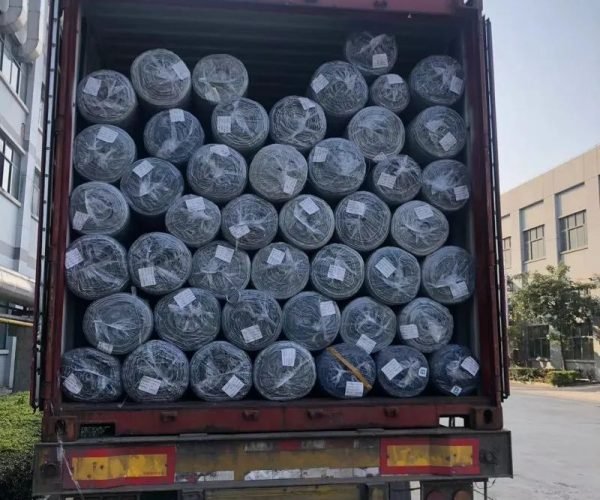
At a certain scale, fabric sourcing stops being about choosing a material—and starts becoming a logistics and risk decision. When orders move from sample rolls to full 40HQ container loads, questions shift quickly: Will the fabric behave the same across every roll? Will waterproofing survive ocean transit? Will the cost still make sense once freight, waste, and delays are counted?
This is exactly where 18oz waterproof canvas shipped FOB Shenzhen becomes relevant. It sits at the intersection of durability, predictability, and shipping efficiency—especially for bag programs that require structure, weather resistance, and long service life. 18oz waterproof canvas fabric FOB Shenzhen is a heavy-duty cotton canvas engineered for bag manufacturing, supplied in container-scale volumes with stable performance, controlled waterproof finishing, and export-ready logistics. It is commonly chosen for tote bags, tool bags, travel bags, and outdoor carry goods that demand strength, water resistance, and cost efficiency at scale.
One sourcing manager once said: “A container of bad fabric costs more than ten containers of good fabric.” That lesson usually comes after the first big mistake. Let’s help you avoid it.
What Is 18oz Waterproof Canvas Fabric and Why Is It Ideal for Bags Shipped FOB Shenzhen?


18oz waterproof canvas fabric is a heavy-weight cotton duck material engineered for demanding bag applications, combining a dense, load-bearing base fabric with water-resistant or waterproof treatments that protect contents during real use, storage, and international transport. When sourced and shipped FOB Shenzhen, it also benefits from one of the world’s most mature textile finishing and export ecosystems, making it a practical choice for brands scaling structured bag programs.
This fabric is designed for use, not display.
In wholesale bag manufacturing, waterproof canvas is rarely chosen for fashion appeal alone. It is selected because it reduces failure risk across the entire lifecycle—from cutting and sewing, through ocean freight, warehousing, retail handling, and years of customer use. The combination of 18oz weight, cotton duck construction, controlled waterproof finishing, and FOB Shenzhen logistics makes this material especially reliable for export-oriented bag programs.
What Makes 18oz Waterproof Canvas Different in Real Production
To understand why this fabric works so well, it is important to separate marketing language from production reality. Waterproof canvas performance depends on three layers of decision-making: the base fabric, the waterproof treatment, and the supply-chain context in which it is produced and shipped.
A) Base Fabric: Strength Comes Before Waterproofing
Waterproof performance means very little if the underlying fabric cannot survive load, abrasion, and seam stress. This is why serious bag programs start with heavy cotton duck, not lightweight canvas later “upgraded” with coatings.
| Parameter | Typical Value (18oz Canvas) |
|---|---|
| Finished weight | ~610–620 GSM |
| Weave type | High-density plain weave |
| Yarn | Ring-spun cotton |
| Tensile strength | High, balanced warp & weft |
The key point is balance. An 18oz canvas suitable for bags is not simply thick—it is densely woven, with controlled yarn twist and tight interlacing. This construction delivers:
- High tear resistance at corners and handles
- Low seam slippage under stitch tension
- Stable panel geometry after washing or coating
The waterproof layer does not replace strength; it protects strength. Without a structurally sound cotton duck base, coatings crack, seams fail, and bags deform under load.
Why 18oz Is a Practical Threshold
Below 14–15oz, canvas often requires additional reinforcement layers to carry weight reliably. At 18oz, the fabric itself provides enough body to support structured bags—totes, tool bags, duffels—without excessive interlining. This simplifies construction and improves long-term durability.
B) Waterproof vs Water-Resistant: An Important Distinction
In bag sourcing, “waterproof” is often used loosely. For production decisions, the distinction matters.
| Term | What It Really Means |
|---|---|
| Water-resistant | Repels light rain and splashes |
| Waterproof | Blocks water penetration |
| Weather-proof (marketing) | Undefined |
Most bag programs using 18oz canvas do not aim for fully sealed, submersible waterproofing. Instead, they choose water-resistant to medium waterproof finishes that strike a balance between protection, breathability, and sewability.
Fully waterproof constructions—such as thick TPU laminations—can:
- Reduce needle penetration quality
- Increase seam stiffness
- Trap moisture inside the bag
For totes, tool bags, and travel bags, controlled water resistance often delivers better user satisfaction than absolute waterproofing.
Common Waterproofing Approaches on 18oz Canvas
In practical terms, 18oz waterproof canvas may use:
- DWR (durable water repellent) for light rain resistance
- PU or acrylic back-coating for stronger moisture barriers
- Wax or hybrid finishes for controlled repellency and aging
Each approach is chosen based on how the bag will actually be used, not how waterproof claims read on a hangtag.
C) Why FOB Shenzhen Matters for This Fabric Category
FOB Shenzhen is not just a commercial incoterm. For heavy waterproof canvas, it represents a structural supply-chain advantage.
| Advantage | Why It Matters |
|---|---|
| Major port access | Faster vessel availability |
| Concentrated mills | Stable cotton duck supply |
| Advanced finishing lines | Consistent coating quality |
| Export expertise | Fewer clearance delays |
Southern China, and Shenzhen in particular, sits at the intersection of weaving, coating, laminating, and exporting capabilities. For waterproof canvas, proximity matters. Coating quality depends on process control, and shorter distances between weaving and finishing reduce variability.
Quality Stability Across Batches
Heavy canvas coatings are sensitive to:
- Temperature
- Humidity
- Line speed
- Curing conditions
Shenzhen-area finishing facilities specialize in these processes at scale. When fabric is woven, finished, inspected, and packed within a tight geographic cluster, batch-to-batch consistency improves. This is critical for bag programs that reorder seasonally.
Logistics Efficiency for Heavy Materials
18oz canvas is dense and heavy. FOB Shenzhen offers advantages for container planning:
- Predictable container loading weights
- Access to frequent sailings
- Easier consolidation with bag production
For brands shipping bags or fabric internationally, this reduces freight risk and cost volatility.
D) Typical Bag Applications
18oz waterproof canvas is selected when function outweighs disposability. Common applications include:
- Heavy-duty tote bags
- Tool and utility bags
- Travel and duffel bags
- Outdoor gear storage bags
- Reusable industrial carry bags
These products share three requirements: load capacity, shape retention, and moisture protection.
Why Waterproofing Matters Even for “Dry” Use
Even bags not marketed as outdoor products face moisture exposure:
- Rain during commuting
- Condensation during shipping
- Humid warehouses
- Accidental spills
Waterproof canvas reduces claims related to staining, odor, and structural degradation. It is as much about logistics and storage safety as end-user performance.
Production Behavior: How 18oz Waterproof Canvas Handles in Factories
From a manufacturing perspective, this fabric category offers practical advantages.
During cutting:
- Dense structure resists edge distortion
- Coated backing reduces fraying
- Panels stay dimensionally stable
During sewing:
- Fabric supports heavy stitch tension
- Seams remain clean under load
- Handle attachments perform more predictably
After finishing:
- Shrinkage is controlled
- Shape retention improves
- Surface is easier to clean
These behaviors reduce rework and speed up production lines.
Waterproofing and Seam Design
One common misunderstanding is expecting fabric waterproofing to eliminate seam leakage. In reality, seams are always the weakest point.
For 18oz waterproof canvas bags, brands typically accept:
- Fabric-level water resistance
- Localized seam vulnerability
This is appropriate for totes, tool bags, and travel bags. Fully seam-sealed construction is reserved for specialized dry bags, not most canvas programs.
Cost Perspective: Why This Fabric Makes Economic Sense
While 18oz waterproof canvas costs more per yard than lighter canvas, it often reduces total project cost.
Cost savings appear in:
- Lower return rates
- Reduced reinforcement materials
- Fewer QC failures
- Longer product lifespan
For wholesale buyers, the economics favor durability over initial material savings.
FOB Shenzhen and Risk Management
From a buyer’s perspective, FOB Shenzhen shifts control appropriately:
- Supplier manages production and export clearance
- Buyer controls ocean freight and insurance
- Responsibilities are clearly defined
For heavy canvas sourcing, this clarity matters. It simplifies dispute resolution and aligns accountability with operational reality.
A Real-World Sourcing Pattern
Many bag brands follow the same evolution:
- Start with lighter canvas to reduce cost
- Encounter durability or moisture complaints
- Upgrade to 18oz waterproof canvas
- Stabilize quality and reduce after-sales issues
Once upgraded, brands rarely revert—because the fabric supports both product performance and supply-chain reliability.
Why This Fabric Is Not for Every Project
18oz waterproof canvas is not appropriate for:
- Ultra-light fashion bags
- Foldable or packable designs
- Price-driven promotional giveaways
Its value appears when performance, not novelty, defines success.
How Buyers Should Frame the Decision
Instead of asking “Is this canvas waterproof?”, experienced buyers ask:
- How much moisture exposure is realistic?
- Where will bags be stored and shipped?
- How much load will seams carry?
- How consistent must reorders be?
When these questions guide selection, 18oz waterproof canvas shipped FOB Shenzhen often emerges as the most reliable option.
The Strategic Role of Location + Material
The combination of heavy cotton duck + controlled waterproof finishing + Shenzhen export infrastructure creates a material solution that is difficult to replicate in fragmented supply chains. It is not just a fabric choice—it is a system choice.
18oz waterproof canvas fabric is ideal for bags shipped FOB Shenzhen because it aligns material performance with supply-chain efficiency. The heavy cotton duck base provides strength and stability. Waterproof or water-resistant finishes protect against real-world moisture. Shenzhen’s mature textile and export ecosystem ensures consistency, predictable lead times, and reliable logistics.
For bag programs built around durability, repeatability, and global distribution, this fabric is not an upgrade—it is a foundation.
Which Performance Characteristics Should Buyers Look for in Waterproof Canvas for High-Volume Container Orders?


When waterproof canvas is purchased by the container, performance evaluation must shift from sample-level thinking to system-level thinking. A single lab report or a well-performing swatch is no longer enough. What matters is whether hundreds of rolls, produced, finished, packed, shipped, and cut at scale, behave the same way on real production lines.
In high-volume container orders, most quality failures are not dramatic fabric defects. They are small inconsistencies multiplied by scale: slight coating variation, marginal shrinkage differences, subtle stiffness zones, or uneven abrasion resistance. These issues rarely appear in lab testing—but they show up immediately in cutting rooms, sewing lines, and finished bags.
Consistency is the real performance metric.
Evaluating Fabric the Way Production Lines Do
Production lines do not experience fabric as data points. They experience it as:
- Rolls laid side by side on spreading tables
- Panels stacked and cut in layers
- Seams sewn continuously for hours
- Bags loaded, lifted, dragged, and stored
Buyers sourcing waterproof canvas at container scale must evaluate performance characteristics through this operational lens.
A) Waterproof Performance That Survives Production
Waterproof canvas must perform not only against rain, but against manufacturing stress.
| Test Item | Practical Expectation |
|---|---|
| Hydrostatic pressure | Suitable for rain exposure |
| Surface repellency | Uniform across roll |
| Coating adhesion | No flaking after sewing |
Hydrostatic Pressure: Context Matters
Hydrostatic pressure ratings indicate resistance to water penetration under static conditions. For most canvas bag applications, extreme ratings are unnecessary. What matters is that the fabric:
- Resists rain and splashes
- Does not wick moisture through seams under normal use
- Maintains protection after bending and folding
Excessively high hydrostatic ratings often come from thick coatings that compromise flexibility and sewability. In container-scale production, moderate, stable waterproofing outperforms extreme but brittle coatings.
Surface Repellency Uniformity
In high-volume orders, repellency must be consistent across the entire roll, not just at test points. Uneven application creates zones where water beads well next to areas where it absorbs.
These inconsistencies cause:
- Customer complaints about “random leaks”
- Confusing QC results
- Brand trust erosion
Uniform repellency is achieved through controlled finishing speed, coating viscosity management, and post-curing stabilization—process controls that matter more than the chemistry itself.
Coating Adhesion Under Sewing Stress
A common failure at scale is coating delamination around stitch holes. Needle penetration introduces localized stress, heat, and friction.
Waterproof canvas suitable for container orders must show:
- No coating flaking along stitch lines
- No powdering after folding
- No cracking at high-stress seams
This is why buyers should require post-sewing inspection samples, not just flat fabric test reports.
B) Abrasion Resistance Under Load
Abrasion is cumulative. In container-scale bag programs, abrasion failures rarely appear in testing—they appear in customer use.
Canvas bags experience abrasion at:
- Bottom panels dragged on floors
- Corners rubbing against hard surfaces
- Strap contact points
| Abrasion Cycles | Real-World Meaning |
|---|---|
| <15,000 | Short-term use |
| 15,000–30,000 | Standard retail |
| 30,000+ | Heavy-duty programs |
18oz waterproof canvas typically sits in the upper retail to heavy-duty range, but only if the coating and base fabric are balanced correctly.
Why Coating Choice Affects Abrasion
A strong base fabric with a weak coating still fails. Likewise, a tough coating on a weak base cracks under flex.
Balanced systems show:
- Gradual surface wear, not sudden failure
- No peeling at abrasion zones
- Maintained waterproof performance after wear
Buyers should ask for abrasion testing after waterproof finishing, not before. Pre-finish abrasion numbers are misleading for coated canvas.
C) Dimensional Stability After Finishing
Waterproof finishing introduces tension and stiffness into canvas. At container scale, small dimensional changes translate into major production disruption.
| Risk | Production Impact |
|---|---|
| Excess shrinkage | Panel mismatch |
| Curling edges | Cutting issues |
| Stiff zones | Uneven sewing |
Shrinkage Control
Even 2–3% uncontrolled shrinkage can cause:
- Misaligned panels
- Skewed bag shapes
- Size inconsistency across production
For container orders, buyers should confirm:
- Warp and weft shrinkage after finishing
- Conditioning procedures before packing
- Stability after at least one stress cycle (wash or flex)
Stable waterproof canvas behaves predictably when stacked, cut, and sewn repeatedly.
Edge Curling and Stiffness Zones
Uneven coating thickness often causes edges to curl or sections to stiffen. These issues slow cutting lines and force manual intervention.
Production-friendly canvas shows:
- Flat lay during spreading
- Consistent resistance to folding
- No “boardy” sections within a roll
These qualities cannot be confirmed on swatches—they require full-width roll evaluation.
D) Roll-to-Roll Consistency (Often Ignored, Always Costly)
A container order may include 300–500 rolls of waterproof canvas. At this scale, consistency matters more than peak performance.
| Variation Type | Result |
|---|---|
| Shade drift | Visible panel mismatch |
| Weight variance | Structural inconsistency |
| Coating thickness variance | Uneven waterproofing |
Shade Consistency
Slight shade differences are invisible on single rolls but obvious when panels from different rolls are sewn into the same bag. Waterproof coatings can amplify shade differences by altering surface reflection.
Buyers should require:
- Batch-controlled dyeing
- Clear roll identification
- Shade grouping for cutting
Weight and Handfeel Variance
Waterproof canvas that fluctuates in finished weight creates inconsistent bag stiffness. Some bags feel firm, others floppy—leading to perception of poor quality even when construction is identical.
Weight tolerance control is more important than hitting an exact GSM target.
Coating Thickness Variance
Uneven coating thickness leads to:
- Variable waterproof performance
- Inconsistent abrasion resistance
- Irregular sewing behavior
In container orders, coating consistency must be monitored roll by roll, not assumed from process settings.
E) Performance After Handling, Not Just Testing
High-volume canvas is handled repeatedly before becoming a bag:
- Loaded into containers
- Exposed to humidity at sea
- Stored in warehouses
- Spread and stacked for cutting
Buyers should consider how waterproof canvas behaves after:
- Compression
- Humidity exposure
- Time under load
Anti-mildew treatment and moisture-controlled packing often matter as much as the waterproof coating itself.
F) Why Single-Sample Test Reports Are Not Enough
Many quality disputes start with this sentence: “The sample passed all tests.” The missing follow-up question is: “Did the rest of the container behave the same way?”
For container orders, buyers should prioritize:
- Roll-level inspection
- Random roll testing
- Production-stage validation
Consistency across rolls protects production efficiency far more than impressive numbers from one lab report.
G) How SzoneierFabrics Manages Container-Scale Performance
For high-volume waterproof canvas orders, SzoneierFabrics focuses on process repeatability, not just material capability.
Key controls include:
- Roll-level weight and width tolerance management
- Uniform coating application and curing
- Post-finishing conditioning before packing
- Clear roll ID tracking to prevent mixing
By controlling these variables, SzoneierFabrics reduces the risk of performance drift across large shipments—one of the most common hidden costs in container sourcing.
H) The Cost of Ignoring Consistency
When performance variation appears mid-production, the costs escalate quickly:
- Cutting delays
- Re-layout of markers
- Increased rejects
- Sewing line downtime
These costs often exceed any savings gained by choosing a lower-priced fabric supplier.
I) How Buyers Should Frame Evaluation Questions
Instead of asking only:
- “Is it waterproof?”
- “What is the abrasion rating?”
Experienced buyers ask:
- Does waterproof performance survive sewing and folding?
- Is abrasion resistance consistent across rolls?
- Will dimensional behavior remain stable across hundreds of panels?
- Can different rolls be mixed safely during cutting?
These questions reflect production reality, not laboratory ideals.
J) Matching Performance to Container Strategy
Not every container order requires maximum performance in every category. The key is alignment.
- Retail totes need uniform appearance and moderate protection
- Tool bags need high abrasion and seam stability
- Travel bags need moisture resistance and shape retention
Performance targets should be defined by end use, then validated at scale.
For high-volume container orders of waterproof canvas, buyers should prioritize performance consistency across rolls, not just passing test results from a single sample. Waterproof stability after sewing, abrasion resistance under load, dimensional control after finishing, and roll-to-roll uniformity determine whether production runs smoothly—or becomes an expensive troubleshooting exercise.
At container scale, consistency is not a bonus feature. It is the performance standard.
How Does FOB Shenzhen Pricing Work for a 40HQ Container Load of Canvas Fabric, and What Cost Factors Influence It?
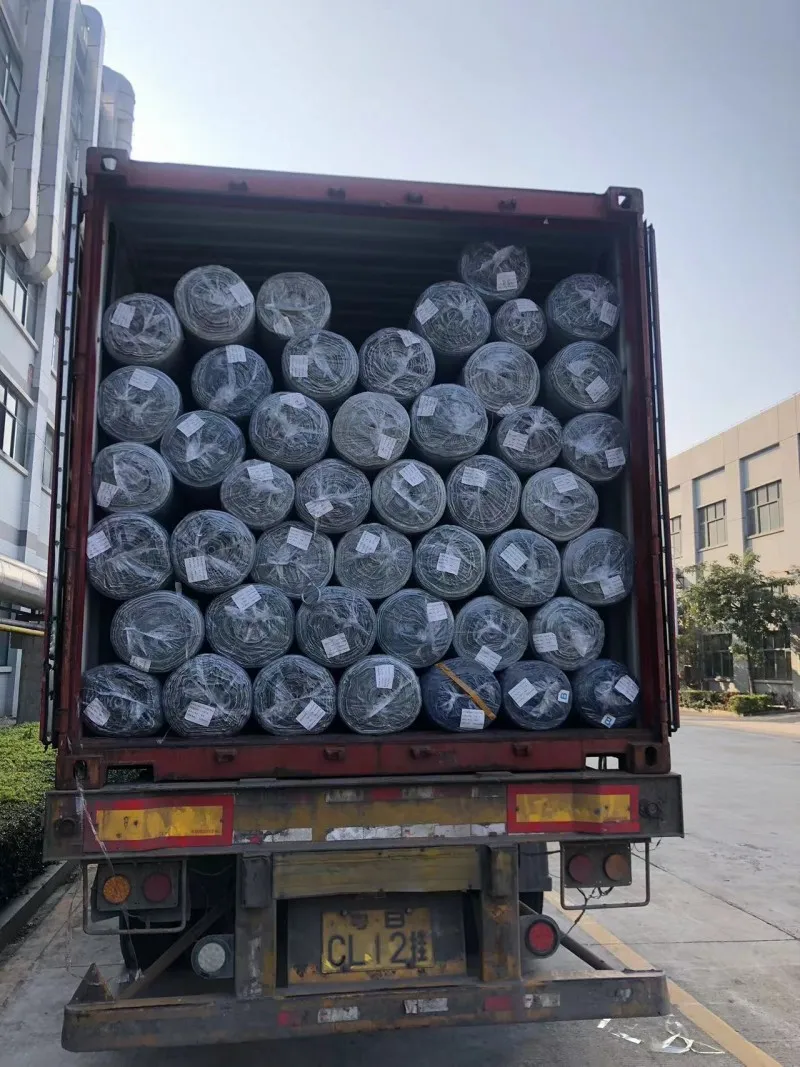

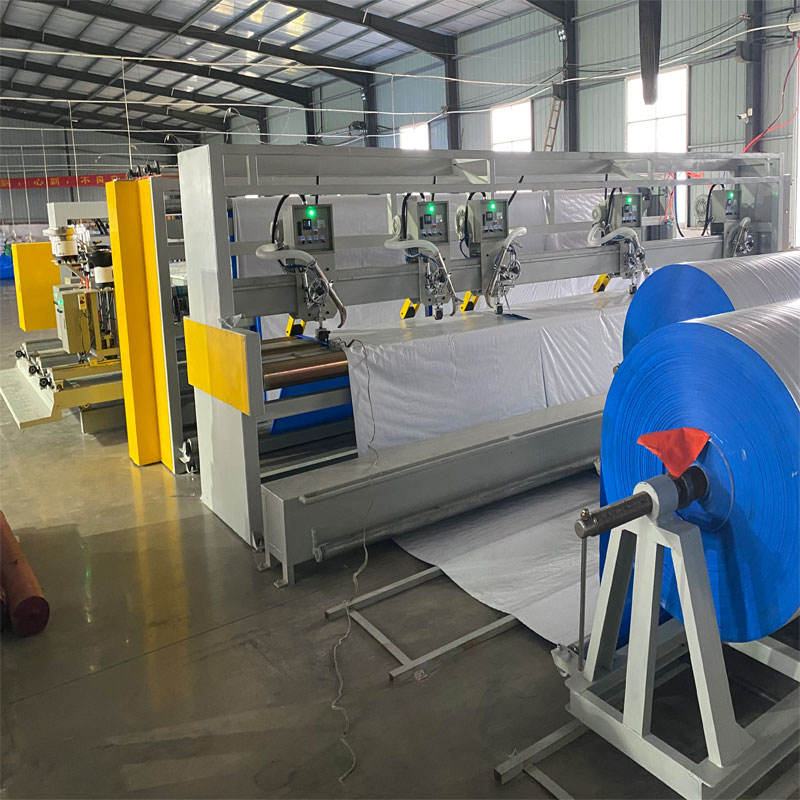
For buyers sourcing 18oz waterproof canvas at container scale, FOB Shenzhen pricing is often misunderstood. Many assume it is simply “fabric price × meters per container.” In reality, FOB pricing reflects a system of production, finishing, packing, and yield control, and the true cost only becomes clear when the fabric reaches the cutting table.
At 40HQ volume, small inefficiencies multiply. A few percentage points of waste, shrinkage, or packing inefficiency can erase any advantage from a lower per-meter quote. This is why experienced buyers evaluate FOB Shenzhen pricing not as a number, but as a cost structure.
At container scale, cheap fabric often becomes expensive fabric.
Understanding the Real Cost Structure Behind FOB Pricing
FOB Shenzhen is attractive because it anchors responsibility clearly: the supplier delivers compliant goods to one of the world’s most efficient export ports, and the buyer controls everything afterward. But clarity only helps if buyers understand what drives the number they are quoted—and what silently increases cost after arrival.
A) What FOB Shenzhen Actually Includes (and What It Doesn’t)
Before comparing prices, buyers must compare scope. FOB Shenzhen has a specific commercial meaning.
| Included in FOB Shenzhen | Not Included |
|---|---|
| Fabric production | Ocean freight |
| Waterproof finishing | Cargo insurance |
| In-house QC & inspection | Import duties & VAT |
| Packing & roll labeling | Inland delivery after port |
| Export documentation | Destination port charges |
FOB pricing ends when the fabric is loaded and cleared for export at the Shenzhen port. Any quote that quietly excludes QC, inspection, or proper packing may look cheaper but shifts risk downstream.
For heavy waterproof canvas, what is included before the port often matters more than what happens after it.
Why This Matters for Canvas Buyers
Canvas is not a precision component—it is a high-volume material. Problems discovered after arrival usually mean:
- Re-cutting or re-layout
- Delayed sewing schedules
- Excess leftover rolls
- In extreme cases, container rejection
FOB pricing should therefore be evaluated as risk-adjusted cost, not just purchase price.
B) Typical 40HQ Container Loading Logic for Canvas Fabric
Unlike light textiles, canvas fills container volume before it reaches maximum weight. This makes packing geometry a critical cost factor.
| Item | Typical Range |
|---|---|
| Container volume | ~76 CBM |
| Roll diameter | 28–35 cm |
| Roll length | 80–100 yards |
| Total rolls | 350–500 rolls |
Two suppliers may quote the same fabric price per meter, yet deliver very different usable meter counts per container due to packing efficiency.
Packing Density and Real Cost
Key variables that affect how much fabric fits into a 40HQ include:
- Roll diameter consistency
- Core size and winding tension
- Roll length accuracy
- Void space between rolls
An inefficient packing plan can reduce usable meters per container by 8–12%, which directly raises cost per finished bag—even if the FOB price per meter looks competitive.
The Hidden Cost of “Short” Rolls
Inconsistent roll lengths create leftovers that cannot be paired efficiently during cutting. At container scale, these short ends accumulate into meaningful waste.
Factories prefer:
- Fewer roll lengths
- Narrow tolerance on yardage
- Clear roll ID tracking
These details rarely appear on quotations—but they strongly influence real cost.
C) Core Cost Drivers Buyers Often Underestimate
Beyond the quoted price, several technical variables determine how much value a container actually delivers.
| Cost Driver | Why It Matters |
|---|---|
| Waterproof method | Affects durability & sewability |
| Finished weight tolerance | Impacts structure consistency |
| Shrinkage control | Determines cutting accuracy |
| Shade consistency | Prevents panel mismatch |
| Roll length accuracy | Reduces leftovers |
Each of these drivers affects usable yield, which is the only metric that truly matters at scale.
Waterproof Method and Cost Stability
Different waterproofing methods carry different cost profiles:
- Acrylic coating: lower cost, stiffer hand
- PU coating: higher cost, better water barrier
- Lamination: highest cost, strongest protection
However, cost differences between methods are often smaller than the cost of production disruption caused by poor adhesion, cracking, or needle resistance.
A cheaper coating that slows sewing lines or causes rework often increases total bag cost far more than a slightly higher FOB fabric price.
Finished Weight Tolerance
Two fabrics both labeled “18oz” can behave very differently if tolerance is loose.
- Overweight fabric increases stiffness and sewing resistance
- Underweight fabric reduces load performance
Stable suppliers control finished weight within tight ranges, which allows factories to maintain consistent stitch settings and construction logic.
Shrinkage Control as a Cost Factor
Uncontrolled shrinkage increases waste invisibly:
- Panels misalign
- Width loss reduces marker efficiency
- Finished dimensions drift
At container scale, even 2–3% unexpected shrinkage can cost thousands of meters in effective yield loss.
Shade Consistency and Re-Cut Risk
Waterproof coatings amplify visual differences. Slight shade variation between rolls becomes obvious when panels are mixed.
Poor shade control leads to:
- Re-cutting panels
- Manual roll separation
- Increased labor cost
Stable shade grouping protects both appearance and efficiency.
D) The Difference Between Fabric Price and Fabric Cost
The most common sourcing mistake is equating price per meter with cost per usable meter.
A fabric that costs less but generates waste is more expensive than a higher-priced fabric that cuts cleanly.
A Real Container Pricing Scenario
A buyer compared two FOB Shenzhen offers for 18oz waterproof canvas:
| Supplier | Fabric Price | Usable Yield |
|---|---|---|
| Lower price supplier | Lower | −9% waste |
| Stable supplier | Slightly higher | +98% yield |
Although the second supplier charged more per meter, the buyer produced more finished bags per container, with fewer delays and less rework.
The total landed cost per bag was lower—even before accounting for time savings.
E) Labor and Efficiency: The Invisible Multiplier
Fabric behavior affects factory efficiency:
- Curling edges slow spreading
- Uneven stiffness complicates sewing
- Coating flakes damage needles
When labor costs are factored in, fabric that runs smoothly often saves more money than it costs.
FOB pricing that ignores production friendliness is incomplete.
F) Why Shenzhen Specifically Impacts Cost Structure
FOB Shenzhen offers structural advantages for heavy waterproof canvas:
- Dense cluster of weaving and coating facilities
- Short internal transport between processes
- High export throughput and scheduling flexibility
This ecosystem reduces:
- Batch-to-batch variation
- Waiting time between processes
- Risk of inconsistent finishing
For container buyers, this stability translates into predictable cost per unit, not just predictable delivery dates.
G) Pricing Transparency vs Pricing Attractiveness
Some suppliers quote aggressively low FOB prices by:
- Using wider tolerances
- Reducing inspection steps
- Packing less efficiently
These savings appear on paper but surface later as waste, delays, or quality disputes.
Experienced buyers prefer transparent cost breakdowns over attractive headline prices.
H) How Buyers Should Compare FOB Shenzhen Quotes
Instead of comparing only price per meter, buyers should compare:
- Estimated meters per 40HQ
- Expected waste percentage
- Finished weight tolerance
- Roll length consistency
- Included QC and inspection
When these factors are normalized, many “cheaper” offers are no longer competitive.
I) Why Container Economics Favor Consistency
At small volumes, buyers can compensate for fabric issues manually. At container scale, there is no such flexibility.
- Mistakes repeat hundreds of times
- Variability multiplies
- Recovery becomes expensive
This is why high-volume buyers prioritize consistency over marginal savings.
J) SzoneierFabrics’ FOB Pricing Philosophy
For 40HQ waterproof canvas orders, SzoneierFabrics structures FOB Shenzhen pricing around usable output, not nominal metrics.
Key principles include:
- Controlled roll length and diameter
- Tight finished weight tolerances
- Stable waterproof finishing parameters
- Efficient packing plans for 40HQ containers
The goal is to maximize finished bag yield per container, not simply minimize fabric price per meter.
K) The Strategic View of FOB Shenzhen Pricing
FOB Shenzhen pricing is most powerful when buyers treat it as a supply-chain tool, not a bargaining target.
It defines:
- Where risk sits
- Who controls quality before shipment
- How much variability enters production
When aligned correctly, FOB pricing supports scalable, repeatable bag manufacturing.
FOB Shenzhen pricing for a 40HQ container of 18oz waterproof canvas includes far more than fabric production. It reflects finishing quality, packing efficiency, yield control, and consistency across hundreds of rolls.
At container scale, the real cost driver is not the lowest price per meter, but the highest usable output per container. Buyers who evaluate FOB Shenzhen pricing through this lens consistently achieve lower total cost, smoother production, and fewer downstream surprises.
In high-volume canvas sourcing, price is visible. Cost is structural.
What Quality Standards and Test Methods Ensure Canvas Fabric Performs in Real-World Bag Applications?

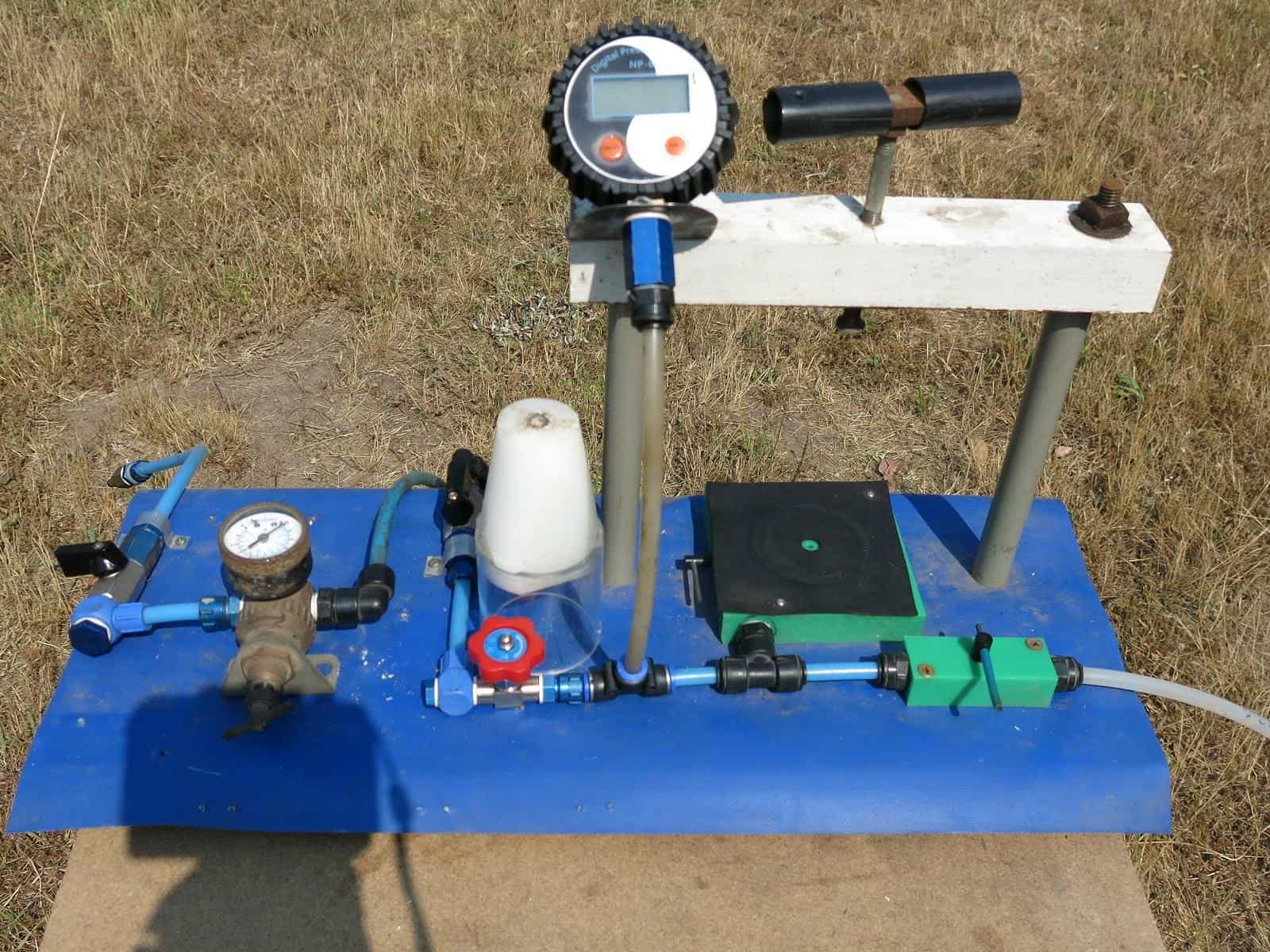
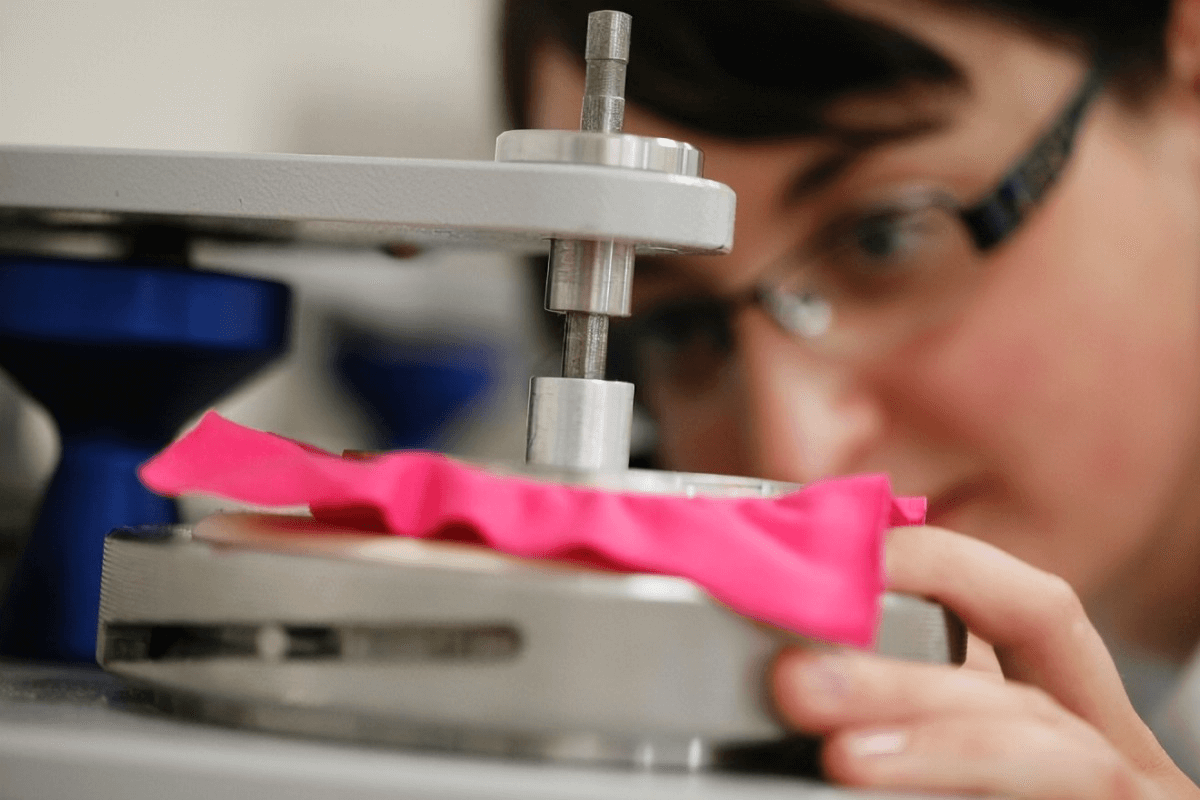
When sourcing canvas fabric—especially at container scale—quality cannot be defined by a single number or a basic weave label. Canvas that performs well in bags must withstand real-life stresses: load, abrasion, weather, sewing tension, and dimensional cycles. For wholesale programs, the difference between a durable fabric and a problematic one is not a single lab result, but a suite of tests tied to real-world use cases.
Testing protects production—not paperwork.
The right standards and test methods validate not just how canvas behaves in isolation, but how it behaves after finishing, during sewing, and over repeated use. Consistency across hundreds of rolls—not just one sample—is the true performance metric.
Quality Control That Actually Matters at Scale
Effective quality standards are grounded in real-use failure modes, not abstract textile metrics. The tests below are selected because they directly correlate with bag performance and factory experience.
A) Mechanical Strength Tests Tied to Bag Use
Mechanical strength describes how canvas handles static and dynamic loads—threads under tension, panels under weight, and sudden stress at corners and handles.
| Test | Purpose |
|---|---|
| Tensile strength (warp & weft) | Measures fabric’s ability to carry static loads |
| Tear strength | Evaluates resistance to propagation after a cut starts |
| Seam slippage | Assesses how fabric holds up when stitched under load |
Why balanced results matter more than peak numbers
A canvas with high warp tensile strength but low weft performance often fails unpredictably once sewn into bags. Balanced strength across directions ensures that handles, side seams, and base panels carry load evenly.
Recommended standards & methods
- ASTM D5034 (Grab test) for tensile strength
- ASTM D2261 (Tongue tear) for tear resistance
- ASTM D1683 (Seam slippage) for stitched panel stability
These tests simulate the forces encountered in daily wear, shipping, and stacking.
B) Waterproof Durability Testing (Beyond First Contact)
Waterproof canvas is only practical if the waterproofing survives the sewing and use cycle. Initial repellency does not guarantee performance after fabric is pierced by needles or flexed repeatedly.
| Test | What It Reveals |
|---|---|
| Hydrostatic head | Initial resistance to water penetration |
| Flex (or bending) test | Coating durability under repeated motion |
| Needle penetration resistance | Waterproofing survival after stitching |
Important considerations
- Hydrostatic tests simulate rain or puddle pressure, but real bag use involves bending, folding, and load stress.
- Needle penetration tests ensure coatings do not crack when seams are sewn.
- Flex testing mimics repeated use (opening/closing, folding, flexing at corners).
Recommended standards & methods
- AATCC 127 for hydrostatic water resistance
- AATCC 61 for accelerated wash/flex testing
- Custom needle penetration checks at stitch density
Because waterproof coatings behave differently after sewing, buyers should test finished, stitched samples, not just flat fabric swatches.
C) Abrasion and Surface Wear
Canvas bags are frequently dragged, stacked, and contacted with rough surfaces. Abrasion resistance determines how long the surface holds up before fibers fuzz, thin, or break, which impacts both appearance and structural longevity.
| Abrasion Cycles | Use Expectation |
|---|---|
| 10,000 | Entry-level use |
| 20,000 | Standard retail use |
| 30,000+ | Heavy-duty use |
For 18oz waterproof canvas, realistic performance targets usually fall in the 20,000–30,000 cycle range under standardized abrasion testing.
Recommended standards & methods
- Martindale Abrasion Test (ISO 12947)
- Wyzenbeek Abrasion Test (ASTM D4157)
Abrasion tests simulate real wear conditions better than visual cues or handfeel. Heavy-duty bags—especially those intended for travel or industrial use—benefit greatly from higher abrasion metrics.
D) Shrinkage and Dimensional Stability
Waterproof finishes and coatings often introduce internal tension in the canvas. Unless shrinkage and dimensional behavior are controlled, panels can warp or misalign after finishing, leading to bag size inconsistency and alignment issues.
| Shrinkage Level | Production Impact |
|---|---|
| <2% | Safe for most applications |
| 2–4% | Manageable with allowance |
| >5% | High rejection and rework risk |
Uncontrolled shrinkage affects:
- Panel match-up in cutting
- Marker efficiency
- Print and branding alignment
- Finished bag fit
Recommended standards & methods
- AATCC 135 for dimensional changes after laundering
- Controlled conditioning cycles simulating factory and retail environments
Pre-conditioning fabric before packing (or sealing finished goods into plastic) often reduces later dimensional surprises.
E) Pre-Shipment Inspection Logic
Before loading hundreds of rolls into a 40HQ container, buyers should insist on a systematic pre-shipment inspection. This is not cosmetic only—it prevents the most expensive failures from entering the supply chain.
Core components:
- Roll-by-roll shade check: prevents mismatched panels during cutting
- Random cut-and-sew simulation: validates fabric behavior once sewn
- Length & weight verification: ensures usable yield meets expectations
- Coating adhesion spot checks: confirms waterproof finish survives normal handling
A well-structured inspection prevents discovering problems only after the container arrives—when corrective action is costly or impossible.
How Tests Should Be Selected and Interpreted
Instead of using tests as pass/fail checkboxes, savvy buyers interpret them in combination with:
- End-use expectations (e.g., tool bag vs. commuter tote)
- Finishing treatment effect (coating vs. wax vs. membrane)
- Sewability factors (needle resistance, thread compatibility)
- Production variance tolerance (how sensitive the cutting line is to shade drift)
For example, a canvas that passes abrasion tests but fails seam slippage is unsuitable for heavy belts or handle-heavy bags, even if it looks strong on paper.
Why Single-Test Pass Rates Are Misleading
A fabric might pass tensile testing, but if the waterproof coating cracks after needle penetration, it is still unfit for bag use. Similarly, excellent hydrostatic head scores mean little if shrinkage causes panel mismatch in mass production.
The most reliable approach combines:
- Multiple tests that simulate real use
- Post-finishing and post-stitching sample evaluation
- Roll-level and lot-level consistency checks
Recommended Minimum Test Suite for Waterproof Canvas
| Category | Critical Tests |
|---|---|
| Strength | Tensile (warp/weft), Tear, Seam slippage |
| Waterproof | Hydrostatic head, Flex/Coating durability, Needle penetration |
| Wear | Abrasion resistance (Martindale/Wyzenbeek) |
| Stability | Shrinkage/dimensional change after conditioning |
| Visual & Consistency | Shade check, Roll inspection, Length verification |
This suite aligns test results with actual failure modes seen in bag performance over time—rather than isolated textile properties.
When Testing Should Happen
Tests should be conducted at multiple stages:
- Initial fabric qualification – before any container booking
- Prototype sample validation – after cutting and sewing test bags
- Pre-shipment roll sampling – random checks before packing
- Batch-level checks – consistency verification across the container
Testing that stops at qualification rarely protects production timelines.
The Cost-Benefit Perspective
Performance testing adds upfront cost. However, the cost of poor quality at scale—rejected rolls, rework loops, customer returns, and brand damage—often dwarfs testing investment.
In container-loaded programs where margins matter and repeatability is expected, robust testing becomes a cost-saving mechanism, not an expense.
The Buyer’s Mental Shift
Instead of asking:
- “Does this fabric pass tensile testing?”
Experienced buyers ask:
- “Will this fabric behave consistently after finishing, sewing, and use?”
- “Does performance hold across hundreds of rolls?”
- “Do test results reflect real-world failure modes, not just laboratory abstractions?”
Quality standards should reflect production reality, not just paperwork.
To ensure canvas fabric performs in real-world bag applications—especially at high volume—buyers should require a suite of performance-based tests that align with how bags are used, sewn, and worn over time. Tensile and tear strength, waterproof durability beyond initial contact, abrasion resistance under load, shrinkage and dimensional stability checks, and structured pre-shipment inspection together form a quality regime that protects production, reduces waste, and stabilizes finished bag performance.
Testing protects production—not paperwork.
How Do Width, Roll Length, Shrinkage, and Weight Tolerances Affect Container Yield and Cutting Efficiency?


When ordering canvas fabric at container scale, technical tolerances are not abstract quality markers—they directly determine how many usable bag panels can be cut from a load, how smoothly cutting rooms run, and how much labor and material waste accumulates. Small deviations in width, roll length, weight, or shrinkage multiply across hundreds of rolls, often changing the final output by thousands of finished bags per 40HQ.
At scale, spec discipline equals profit discipline.
Below, we unpack the four key tolerance areas that cause the biggest production impact: fabric width, roll length consistency, finished weight variation, and shrinkage control.
The Production Math Behind Container-Scale Canvas
Canvas yield is a cascading series of geometric and performance constraints. Each tolerance interacts with the next, influencing marker efficiency, cutting speed, sewing consistency, and final product quality.
A) Fabric Width: Nominal vs Usable Reality
Most heavy canvas is quoted with a nominal width—often 58″ or 60″. But cutting rooms do not work with nominal width; they work with usable width, which accounts for:
- Selvedge removal
- Edge distortion after finishing
- Width loss after conditioning
| Width Metric | Typical Outcome |
|---|---|
| Nominal width | 60″ |
| Selvedge loss | 1–1.5″ total |
| Usable width | 57–58″ |
Why this matters: A 1″ reduction in usable width may sound small, but for bag panels (often wide and rectangular), that loss can reduce marker efficiency by 3–5%. Across a container load, a few percentage points translates to hundreds of fewer panels cut and thousands of dollars in lost capacity.
Spec discipline: SzoneierFabrics typically controls usable width within ±0.5″ after finishing and conditioning. This stabilizes cutting plans, reduces marker redesign frequency, and improves layer stacking behavior.
B) Roll Length Accuracy: Why “Average” Is Dangerous
In container orders, what matters is not the average roll length, but the variance across all rolls. Factory cutting plans assume rolls follow a consistent pattern; significant length swings break those assumptions.
| Roll Type | Production Impact |
|---|---|
| Consistently accurate rolls | Predictable cutting |
| Mixed short rolls | More unusable leftover |
| Overstated rolls | Planning failure |
The risk: If 3% of rolls are shorter than expected, cutting rooms must re-layout markers mid-run, increasing setup time and yielding unusable remnant strips. Over-extended rolls can create planning confusion and waste handling time.
The result: A container with tight roll-length control enables stable marker reuse and minimizes leftovers that can’t be nested into panels.
C) Finished Weight Tolerance: Structure Lives Here
Weight is often quoted in ounces per square yard (oz/yd²), but many suppliers reference loom-state weight, not finished weight (after washing/coating).
Bags rely on predictable weight because fabric mass affects:
- Panel stiffness
- Sewability and needle choice
- Wear resistance
- Customer perception
| Weight Deviation | Effect on Bags |
|---|---|
| ±2–3% | Stable |
| ±5% | Noticeable stiffness change |
| >±7% | Structural inconsistency |
Why finished weight matters: Two batches both labeled “18oz” but measured after finishing at 16.8oz and 19.2oz will feel fundamentally different in the hand and perform differently in sewing and wear testing.
SzoneierFabrics specifies and controls finished weight with tight tolerances (often ±3%) to avoid these “feel” inconsistencies that slow sewing lines and reduce product uniformity.
D) Shrinkage: The Hidden Multiplier
Waterproof finishing and coating processes introduce internal tension in the fabric. If not controlled and preconditioned before cutting, this tension releases unevenly, causing panel size drift after sewing or washing.
| Shrinkage After Finish | Production Impact |
|---|---|
| <2% | Safe |
| 2–4% | Manageable with allowance |
| >5% | High rejection risk |
Why shrinkage matters: In bags with structured panels, even 2–3% uncontrolled shrinkage can lead to:
- Misaligned seams
- Bias distortion
- Inaccurate branding placement
- Rework or rejection at cut or finish stage
Solution: Pre-shrunk or post-conditioned canvas ensures dimensional stability before panels are cut, preserving marker integrity and sewing plan consistency.
E) Yield Example: Same Container, Different Outcome
To illustrate how tolerances compound, consider two scenarios for a 40HQ container of identical bag panels:
| Scenario | Bags per Container |
|---|---|
| Loose tolerance fabric | ~18,500 |
| Controlled tolerance fabric | ~20,200 |
That’s 1,700+ more bags, with the same design, same container, and same cutting program—just different fabric discipline.
This difference represents:
- Lower cost per unit
- Higher output per container
- Shorter cutting and sewing cycles
- Fewer rejects and rework points
Tolerances directly improve bottom-line metrics.
Why Spec Discipline Equals Profit Discipline
When sourcing at scale, buyers often focus on fabric price per meter. But the real cost driver is yield per container. A lower upfront price that delivers inconsistent width, weight, or shrinkage leads to:
- More waste
- Slower production
- Higher labor cost per bag
- Increased risk of returns and rejects
By contrast, a slightly higher-priced fabric with tight tolerances delivers:
- Higher marker efficiency
- Predictable cutting and batching
- Reduced leftover remnants
- Consistent bag quality across production runs
The result: lower true cost per finished bag, not just lower fabric cost.
How Buyers Should Specify Tolerances
Instead of generic allowances, experienced buyers specify:
Fabric Width
- Usable width after finishing and conditioning (not just nominal)
- Tolerance: ±0.5″
Roll Length
- Target plus tolerance per roll, consistent across the container
- Variance threshold (e.g., ±2–3%)
Finished Weight
- Measured at fabric stage (after finishing)
- Tolerance: ±3%
Shrinkage
- Warp & weft measured after conditioning
- Target: ≤2% with post-finishing conditioning
These tolerances should be agreed upon and validated before bulk production—not assumed from swatches or lab data.
Operational Benefits of Tight Tolerances
Across Cutting Rooms
- Marker reuse becomes feasible
- Nesting efficiency increases
- Leftover waste decreases
Across Sewing Lines
- Consistent feed behavior
- Stable thread tension
- Fewer stop-start cycles
Across Quantity Orders
- Predictable container yield
- Better cost forecasting
- Fewer “last-minute surprises”
Final Perspective: Real Yield vs. Quoted Yield
It is common for suppliers to quote meters per container. But the real yield is:
Usable Meters – Waste – Panel Rejections = Effective Production Output
This output is what defines cost efficiency, not the quoted meters alone.
At container scale, fabric tolerances determine yield. Controlled width, accurate roll lengths, tight finished weight tolerance, and stable shrinkage behavior multiply positive production effects across cutting, sewing, and finished bag quality.
When buyers enforce spec discipline, they unlock higher yield, lower unit cost, and more predictable production performance. In high-volume canvas sourcing, tolerances are not technical details—they are profit levers.
Which Waterproofing Methods (Coating, Lamination, DWR, Wax Finish) Are Best for Canvas Used in Bags?

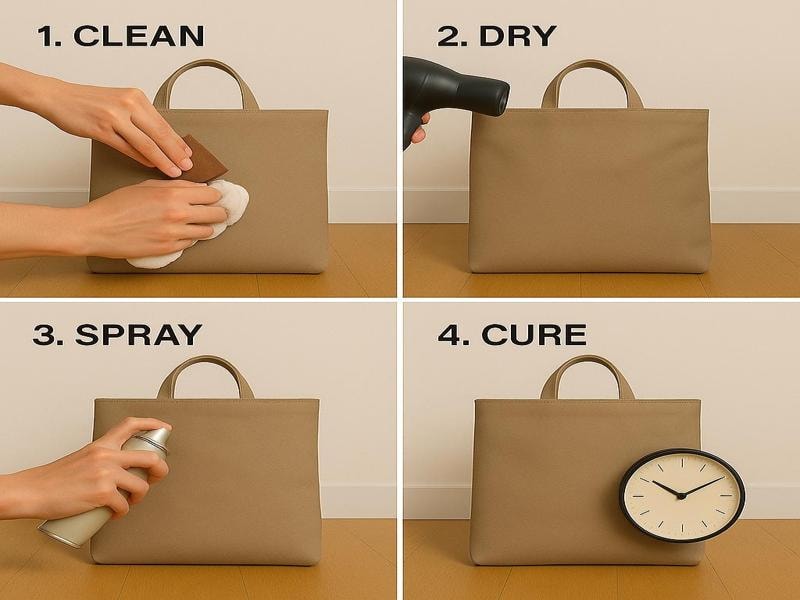
Canvas remains one of the most widely used materials in bag manufacturing because it offers a rare balance of strength, cost control, and aesthetic flexibility. However, untreated canvas is naturally absorbent, which makes waterproofing a critical engineering decision rather than a cosmetic upgrade. The waterproofing method chosen will directly influence not only water resistance, but also sewing efficiency, long-term durability, surface appearance, and how the product ages in real use.
In practice, there is no universally superior waterproofing method for canvas bags. Each option serves a specific purpose, and the “best” solution is always defined by product intent, usage environment, and production scale. What works perfectly for a lifestyle backpack may fail entirely in a technical outdoor application.
The most effective approach is to treat waterproofing as a system decision, not a single finish.
Understanding Waterproofing Expectations in Canvas Bags
In bag manufacturing, waterproofing does not always mean full submersion resistance. Different markets define performance differently, and misunderstanding this often leads to overengineering or customer dissatisfaction.
Waterproofing performance for canvas bags usually falls into four practical categories:
- Splash resistance, suitable for light rain and urban use
- Rain protection, capable of handling prolonged exposure without soaking through
- Barrier waterproofing, designed to block water penetration under pressure
- Aging stability, referring to how protection changes after months or years of use
Canvas waterproofing methods should be selected based on which of these outcomes matter most for the product, rather than chasing the highest possible resistance rating.
PU Coating: Controlled, Scalable, and Predictable
PU coating is the most commonly used waterproofing method in modern canvas bag production. It involves applying a polyurethane layer to one side of the fabric, typically the reverse, to create a controlled moisture barrier.
| Feature | PU Coating |
|---|---|
| Waterproof level | Medium–High |
| Consistency | Excellent |
| Sewability | Good |
| Aging | Stable |
PU-coated canvas offers repeatable performance across large production runs, making it especially suitable for factory-scale manufacturing. Coating thickness can be adjusted depending on the target resistance level, allowing brands to fine-tune performance without dramatically altering fabric weight or hand feel.
From a production standpoint, PU-coated canvas remains easy to cut, stitch, and edge-finish. Needle penetration is predictable, seam integrity remains high, and additional seam sealing is often unnecessary for standard rain protection use cases.
This balance of performance and manufacturability makes PU coating the default choice for commuter backpacks, travel bags, tool bags, and mid-range outdoor products where reliable water resistance is expected without introducing stiffness or complexity.
Acrylic Coating: Lightweight Protection with Cost Control
Acrylic coatings are often chosen when light water resistance is required but cost sensitivity is high. The coating forms a basic barrier that slows moisture absorption rather than fully blocking it.
| Feature | Acrylic |
|---|---|
| Waterproof level | Light–Medium |
| Hand feel | Slightly stiffer |
| Cost | Lower |
| Durability | Moderate |
Compared to PU, acrylic coatings tend to feel marginally stiffer at similar fabric weights, and their resistance performance declines more quickly under abrasion. However, they perform adequately for short-term exposure to rain and splashes.
Acrylic-coated canvas is commonly used for promotional totes, shopping bags, and lightweight carry solutions where the expectation is convenience rather than technical protection. In these scenarios, the coating adds functional value without pushing the product into a higher cost bracket.
DWR (Durable Water Repellent): Surface-Level Defense
DWR treatments work by modifying the surface tension of canvas fibers so that water beads and rolls off rather than soaking in. Unlike coatings or laminations, DWR does not create a physical barrier.
| Feature | DWR |
|---|---|
| Waterproof level | Low |
| Breathability | High |
| Longevity | Limited |
| Re-treatment | Required |
On its own, DWR should not be considered a waterproofing solution for bags. Its value lies in delay, not prevention. It slows wetting and helps maintain a dry surface appearance during light rain, but sustained exposure will eventually saturate untreated canvas beneath.
For this reason, DWR is most effective when combined with another waterproofing method. It improves initial water shedding, reduces surface staining, and helps fabrics dry faster after exposure. This combination approach is often used in premium city bags where natural fabric aesthetics matter but light weather protection is still expected.
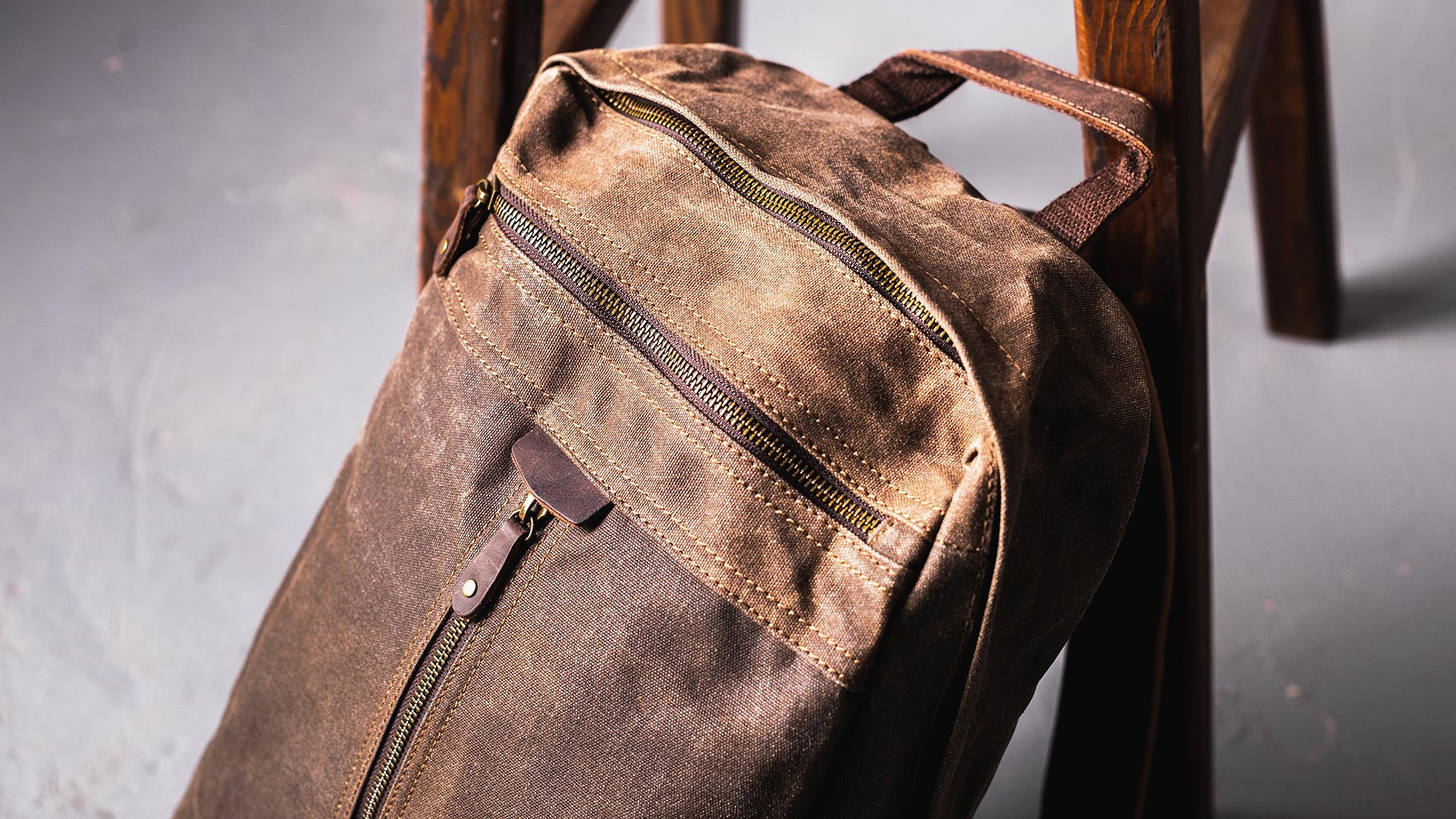
Waxed Canvas: Character-Driven Performance
Waxed canvas relies on fiber saturation rather than surface film formation. Wax penetrates the cotton yarns, filling gaps and increasing water resistance by physically blocking moisture pathways.
| Feature | Wax Finish |
|---|---|
| Waterproof level | Medium |
| Visual aging | Develops patina |
| Consistency | Natural variation |
| Maintenance | Re-waxing |
One of the defining characteristics of waxed canvas is intentional variability. Creases, stress points, and fold lines develop lighter or darker tones over time, creating a worn-in look that many consumers associate with authenticity and craftsmanship.
From a technical perspective, waxed canvas performs well against rain but is less predictable in mass production. Wax distribution can vary, hand feel changes with temperature, and long-term performance depends on user maintenance. Re-waxing is necessary to restore resistance after extended use.
Waxed canvas is best suited for heritage backpacks, duffel bags, and lifestyle-oriented outdoor products where visual aging is a feature rather than a flaw.
Lamination (TPU / PE): Maximum Barrier, Higher Engineering Demand
Lamination bonds a waterproof film directly to the canvas, creating a near-impermeable barrier. This approach delivers the highest water resistance but also introduces new design and production challenges.
| Lamination | Result |
|---|---|
| TPU | High waterproofing |
| PE | Cost-effective barrier |
| Fabric-to-film | Increased stiffness |
TPU laminations offer superior flexibility compared to PE films, making them better suited for products that experience frequent folding or compression. PE laminations are more cost-effective but typically stiffer and less forgiving at seams.
Laminated canvas often requires reinforced seam construction, controlled stitch density, and careful needle selection to avoid puncture-related leakage. In many cases, seam sealing becomes necessary to maintain full waterproof integrity.
Because of these factors, lamination is generally reserved for technical bags, such as bikepacking equipment, marine gear, and heavy-duty outdoor storage, where maximum barrier performance outweighs aesthetic and softness considerations.
Matching Waterproofing Methods to Real Use Cases
Selecting the correct waterproofing approach becomes easier when aligned with actual product use:
- Everyday urban bags: PU coating with optional DWR for balanced protection and clean appearance
- Lifestyle and heritage designs: Waxed canvas for texture, character, and moderate rain resistance
- Technical outdoor equipment: TPU lamination with engineered seams for sustained exposure
- Cost-sensitive or short-term products: Acrylic coating for basic moisture resistance
Waterproofing canvas for bags is not about choosing the strongest barrier available. It is about choosing the right level of protection, delivered in a way that supports the product’s design language, manufacturing workflow, and customer expectations.
A well-matched waterproofing method enhances durability, usability, and perceived quality. A mismatched one adds cost, stiffness, or maintenance without delivering meaningful value. The most successful canvas bags reflect this balance clearly — not through claims, but through performance over time.
How Do Customs, Documentation, and Logistics Work When Exporting Large Container Loads of Canvas from Shenzhen?
Exporting a full 40HQ container of heavy-weight 18oz waterproof canvas from Shenzhen is not a last-minute port task — it is a logistics ecosystem that begins when fabric rolls are cut and packed in your factory and ends when those rolls are discharged at the buyer’s destination. When customs compliance, documentation accuracy, container engineering, and transit planning are all synchronized, you avoid costly port delays, excess duties, and storage charges that can erode your margins.
In this article, we’ll expand on the practical steps that textile exporters — especially those dealing with bulk canvas — must understand in order to move goods smoothly from Shenzhen to major global markets.
Fundamentals of Export Logistics for Canvas Fabric
Export logistics is a sequence of coordinated steps that includes documentation preparation, customs clearance, HS classification, container stuffing, and carrier coordination. None of these are independent; they interface at every stage of the supply chain.
In textile exports from China, customs authorities will scrutinize your cargo based on value, classification, and origin before release. Without accurate paperwork, shipments are flagged for inspection, which can delay departure and lead to unexpected port demurrage.
A) Core Export Documents Required
Maintaining a clear set of compliant documents is the foundational requirement for any China-to-overseas textile shipment. Below is a more detailed view of each document’s role:
| Document | Purpose | Key Requirements |
|---|---|---|
| Commercial Invoice | Declares the value of goods for customs valuation | Must reflect accurate invoice value in currency, buyer/seller info, payment terms |
| Packing List | Lists roll count, weights, and measurements | Precise count by SKU, gross & net weight, container package breakdown |
| Bill of Lading (B/L) | Contract of carriage between shipper and carrier | Must match consignee details and vessel schedule |
| HS Code (Harmonized System) | Customs classification for duties and control | Accurate 8- or 10-digit code based on fabric content & structure |
| Certificate of Origin / Origin Declaration | Confirms goods qualify for trade preferences | Often required for preferential tariff programs |
Commercial invoices and packing lists must be prepared before goods arrive at the port gate. Mistakes in values or SKU descriptions are frequent triggers for customs examination and can result in port holds that delay vessel departure.
B) HS Code Accuracy: Why It Matters
The HS Code — or Harmonized System code — used by customs authorities determines duty rates and regulatory controls on your fabric shipment. Canvas fabrics, depending on their composition (e.g., cotton %, synthetic blend), weight, and coating application, can fall into different tariff headings.
An inaccurate HS classification is more than a clerical error:
- It can lead to revaluation of goods by customs
- Increased duty liabilities at destination
- Hold orders and detailed inspections at origin customs
- Penalties or forced re-declaration
For example, plain 100% cotton canvas heavier than 200 g/m² is often classified differently from coated, waterproofed textiles. Exporters like SzoneierFabrics ensure HS codes are aligned with the finished goods criteria — not just the raw weaving data — to prevent risk. Accurate HS codes also help buyers at destination plan out duty obligations properly.
C) Container Loading and Roll Protection
Canvas fabric rolls are heavy and susceptible to damage if container stuffing is not engineered with correct blocking and bracing. When you’re exporting a 40HQ (high cube) container, plan the stow plan ahead of time so that each roll and pallet fits the container’s cubic capacity without stress.
| Risk | Preventive Measure | Implementation Note |
|---|---|---|
| Moisture ingress | Desiccants and moisture barriers | Use commercial-grade desiccants, especially for rainy seasons |
| Roll deformation | Core reinforcement tubes | Ensure consistent core diameter to prevent crushed edges |
| Coating abrasion | Protective poly wrapping | Use thick films to preserve waterproof coating |
Fabric exporters contract logistics providers to implement dunnage bags, corner boards, and pallet straps. A poorly stuffed container doesn’t just risk roll damage; it also forces mid-ocean load shifts that can violate shipping contracts and insurance conditions.
D) Transit Planning and Arrival Considerations
Once the container leaves Shenzhen’s port terminals — such as Yantian or Shekou — it enters a transit phase that varies by sea route, season, and destination port efficiency.
| Factor | Impact on Delivery |
|---|---|
| Sea route | Determines transit time and vessel schedule reliability |
| Seasonality (monsoon, winter) | Alters humidity inside container; may require extra desiccants |
| Destination port handling | Speed of discharge and inland trucking queue times |
Canvas exported to Europe may follow routes via Singapore, Malaysia, or direct east–west lanes. Seasonal weather patterns such as the South China Sea monsoon can increase humidity risk inside sealed containers. Exporters mitigate this by scheduling shipments in favorable windows and including moisture control beyond minimal requirements.
E) Customs Clearance at Destination
Destination customs authorities repeat the inspection, valuation, and duty collection process. Importers must submit:
- Commercial invoice and packing list matching the export documents
- Bill of lading or airway bill
- Customs declaration forms
- Import licenses (if required)
- HS code declaration aligning with local tariff schedules
Customs brokers at destination play a major role in expediting clearance. A minor discrepancy between export and import documentation can lead to reassessment, delay, or fines.
F) Logistics Partners and Workflow
Most textile exporters do not handle every logistics step internally. Instead, they collaborate with:
- Freight forwarders — prepare documentation, book space
- Customs brokers — manage declaration at origin and destination
- Inland trucking — moves goods from factory to port
- NVOCCs / Ocean carriers — issue bills of lading and carry containers
This integrated ecosystem ensures that fabrics leave the factory, pass through customs, and arrive in market in a predictable timeframe and condition.
Professionalism Preserves Value
Exporting heavy canvas in bulk is not a commodity task; it is a risk-managed supply chain discipline. Accuracy in documentation, knowing how to classify textile HS codes, planning container loading, and collaborating with seasoned logistics partners all contribute to:
- Faster port clearance
- Reduced detention/demurrage costs
- Fewer quality issues on arrival
- Better buyer relationships
With a structured export process, your next 40HQ shipment from Shenzhen can become a competitive advantage rather than a logistical headache.
What Sourcing Support and Services Does SzoneierFabrics Provide for Custom Canvas Orders From Prototype to Full Container Shipment?
Sourcing heavy-weight custom canvas is not a one-step purchase decision. For brands, importers, and industrial users, the real challenge lies in maintaining consistency from the first prototype roll to the tenth full 40HQ container—without sacrificing performance, appearance, or trust. SzoneierFabrics approaches canvas sourcing as a controlled production lifecycle, not a transactional fabric sale.
From early material development to repeat bulk shipments, SzoneierFabrics structures its services to ensure that what is approved in sampling is exactly what arrives at the customer’s warehouse months later. Scale should never break trust, and in canvas manufacturing, trust is built through systems, not promises.
How Full-Container Canvas Programs Are Executed
Large-volume canvas programs require more than production capacity. They require engineering discipline, traceability, and supply continuity, especially when fabrics are destined for demanding end uses such as outdoor equipment, industrial covers, marine applications, or premium bag manufacturing.
A) Development and Customization Support
Every custom canvas program begins with a development phase focused on how the fabric will perform in real use. Instead of pushing fixed catalog SKUs, SzoneierFabrics builds canvas specifications around application needs.
| Area | Support | Practical Outcome |
|---|---|---|
| Fabric weight | 16–24oz options | Matches strength and drape to product load |
| Waterproof method | PU, acrylic, lamination | Controls hydrostatic resistance and aging |
| Color | Custom dyeing | Stable shade across batches |
| Hand feel | Adjusted finishing | Balances stiffness vs. sewability |
For example, a 18oz waterproof canvas used for outdoor bags may require a different coating elasticity than the same weight fabric used for rigid tool covers. Development discussions focus on abrasion resistance, folding fatigue, colorfastness, and cutting yield, not just GSM numbers on a datasheet.
SzoneierFabrics’ development team typically proposes 2–3 technical options per requirement, allowing clients to evaluate trade-offs between durability, cost, and production complexity before committing.
B) Sampling That Mirrors Bulk Production
One of the most common sourcing failures in canvas projects is the mismatch between samples and bulk production. To eliminate this risk, SzoneierFabrics enforces a strict rule: samples are made using the same inputs and processes as bulk orders.
Sampling is produced with:
- Identical yarn suppliers and yarn counts
- The same weaving settings and loom tension
- The same coating or lamination lines
- The same curing, drying, and finishing parameters
- The same internal QC standards applied to bulk
This approach avoids the classic scenario where samples feel softer, lighter, or cleaner than the bulk fabric. Clients receive samples that behave like real production fabric—because they are.
For many customers, this consistency shortens decision cycles. Once a sample is approved, downstream teams (cutting, sewing, finishing) can develop patterns and processes with confidence that bulk material will not introduce surprises.
C) Production Control for Full Container Orders
When orders scale to 20,000–30,000 meters per container, quality control shifts from individual roll inspection to system-level production control. Each container is treated as a production system rather than a shipment.
| Control Point | Purpose | Risk Prevented |
|---|---|---|
| In-process inspection | Early defect detection | Large-batch defect repetition |
| Finished weight checks | Structural stability | GSM drift and performance loss |
| Roll-length verification | Yield accuracy | Cutting shortages and waste |
In practice, this means continuous monitoring during weaving and finishing, rather than end-of-line checks only. Weight tolerances are tracked batch by batch, not averaged across the container. Roll lengths are verified to ensure customers receive predictable cutting yield, especially critical for automated cutting systems.
This level of control is particularly important for coated canvas, where small deviations in coating thickness can alter stiffness, waterproof performance, or sewing behavior.
D) Packaging and Traceability Systems
Once production is complete, traceability becomes the priority. SzoneierFabrics implements structured labeling and packaging systems so that fabric performance can be tracked even after arrival.
Rolls are labeled by:
- Production batch
- Color shade lot
- Weight range and coating version
- Production date window
This information allows customers to segregate rolls during cutting, manage inventory rotation, and quickly isolate any issues without disrupting entire stock.
Packaging is engineered for long-distance sea transport, with reinforced cores, protective wrapping, and moisture control. For heavy canvas, correct packaging prevents deformation, edge crushing, and surface abrasion that could otherwise occur before the fabric is even unloaded.
E) Logistics Coordination From Factory to Port
SzoneierFabrics supports clients through the logistics interface between production and export. While freight forwarding may be handled by appointed partners, the factory coordinates:
- Export packing lists aligned with actual roll data
- Container loading plans optimized for weight distribution
- Moisture protection measures based on season and route
- Pre-shipment checks to confirm documentation accuracy
By aligning production records with export documentation, discrepancies that often trigger customs inspection are minimized. This coordination is especially valuable for repeat customers shipping multiple containers per year, where predictability matters more than speed alone.
F) Ongoing Supply Stability and Repeatability
Long-term canvas programs depend on stability more than one-off performance. SzoneierFabrics invests in supply continuity through:
- Long-term yarn supplier relationships
- Dedicated weaving and finishing capacity for repeat SKUs
- Locked-in production recipes for coating and finishing
- Archived physical samples for future reference
This infrastructure allows repeat orders to match earlier shipments even when they are placed months apart. For clients building branded products or regulated goods, this repeatability reduces internal testing costs and lowers downstream quality risk.
Consistency across containers matters more than speed alone. A fabric that arrives two weeks earlier but behaves differently can cost far more than a predictable, well-controlled delivery.
G) Support Beyond the Shipment
SzoneierFabrics’ sourcing support does not end when the container departs. Post-delivery feedback is incorporated into future production planning, whether adjustments are needed in hand feel, coating balance, or packaging format.
For clients scaling from pilot runs to annual container programs, this feedback loop becomes a continuous improvement system, strengthening both product performance and supplier-buyer alignment over time.
A Lifecycle-Driven Approach to Canvas Sourcing
Custom canvas sourcing at scale is not about finding the lowest unit price. It is about ensuring that every roll performs the same way, shipment after shipment. SzoneierFabrics’ end-to-end support—from development and sampling to full-container execution—is designed to protect that consistency.
By treating each container as part of a controlled production lifecycle, rather than a standalone order, SzoneierFabrics helps customers build reliable products, reduce downstream risk, and scale with confidence.
If you want, I can next expand this topic with real-world client program examples, or create a comparison section showing how structured sourcing differs from trader-based fabric procurement.
When a Container Becomes a Commitment
Ordering a 40HQ container of 18oz waterproof canvas FOB Shenzhen is not just a purchase—it is a commitment to a production strategy. The right fabric supports cutting efficiency, reduces waste, protects margins, and delivers bags that perform as expected in the hands of real users.
The wrong fabric turns a container into a liability.
If you are planning container-scale bag production and need customized, stable, export-ready waterproof canvas, SzoneierFabrics can support your program from early sampling through full container shipment.
Reach out to SzoneierFabrics to request samples, discuss specifications, or receive a customized quotation tailored to your bag application and shipping plan.
canvas fabric for bags FOB Shenzhen, 18oz waterproof canvas fabric, waterproof canvas fabric wholesale, cotton duck waterproof canvas, 40HQ container canvas fabric, heavy duty canvas fabric for bags, waterproof canvas rolls supplier, canvas fabric container load, FOB Shenzhen canvas supplier, waterproof cotton canvas fabric, canvas fabric for tote bags, canvas fabric for tool bags, industrial waterproof canvas fabric, PU coated canvas fabric, laminated canvas fabric for bags, waxed canvas fabric supplier, water resistant canvas fabric, canvas fabric export from China, custom canvas fabric manufacturer, canvas fabric roll wholesale, bag making canvas fabric, high GSM canvas fabric, canvas fabric waterproof coating, canvas fabric logistics FOB, container shipping canvas fabric, China canvas fabric factory, bulk canvas fabric supply, canvas fabric quality control, canvas fabric for outdoor bags