Linen has a reputation that both attracts and intimidates product teams. It is loved for its natural texture, breathability, and premium feel—but feared for one simple reason: shrinkage. Anyone who has worked with linen long enough has heard the same sentence repeated in different ways: “The sample was fine, but after washing, everything changed.”
The truth is that linen does shrink during industrial washing and garment finishing—but not randomly, and not uncontrollably. Shrinkage is not a flaw; it is a predictable physical response of flax fibers to moisture, heat, and mechanical action. Problems only arise when shrinkage is not measured, not planned for, or not stabilized before production decisions are made. Yes, linen fabric does shrink during industrial washing and garment finishing. Typical shrinkage ranges from 3% to 8% depending on fiber structure, weave density, washing method, and finishing technique. However, with proper pre-washing, sanforization, controlled finishing processes, and accurate shrinkage testing, linen shrinkage can be predicted and reduced to stable, manageable levels suitable for commercial production.
A European apparel label once assumed their linen shirts would shrink “a little, like cotton.” After garment washing, sleeve lengths shortened unevenly by over 5%. Returns followed—not because the linen was poor, but because shrinkage was never engineered into the product spec. Stories like this explain why understanding linen shrinkage is not optional; it’s foundational.
What Causes Linen Fabric to Shrink During Industrial Washing and Finishing?

Linen fabric shrinks during industrial washing and finishing because flax fibers release stored mechanical tension when exposed to water, heat, and movement. This relaxation causes the fabric structure to contract, particularly during the first wash. Shrinkage in linen is not a flaw or manufacturing error—it is a predictable physical response rooted in fiber anatomy, yarn engineering, loom tension, and finishing sequence.
Understanding why linen shrinks allows designers, developers, and sourcing teams to control it rather than react to it. Most production problems attributed to “bad linen” are actually the result of unmanaged structural relaxation, not poor fiber quality.
Shrinkage is a mechanical and structural response, not a quality defect.
The Physical Reasons Behind Linen Shrinkage
Linen shrinkage is cumulative. It begins at the fiber level, continues through yarn formation and weaving, and finally expresses itself during washing and finishing. Each production stage adds tension that must eventually be released.
Fiber-Level Behavior: Flax Under Stress
Flax fibers differ significantly from cotton or viscose. They are long, stiff, and highly crystalline, which gives linen its strength and breathability—but also limits elasticity.
During spinning and weaving, flax fibers are stretched and held under controlled tension to create uniform yarns and stable fabric structures. This tension is essential for production efficiency, but it is not the fiber’s natural state.
Industrial washing introduces three key forces simultaneously:
- Moisture, which causes fiber swelling
- Heat, which increases molecular mobility
- Mechanical action, which breaks static friction between fibers
Together, these forces allow fibers to relax and move closer to their original, unstressed configuration.
| Stage | Fiber Condition |
|---|---|
| Post-weaving | High tension |
| First wash | Rapid relaxation |
| Subsequent washes | Minor movement |
This explains why the majority of linen shrinkage occurs during the first industrial wash. Later washes typically cause smaller, incremental changes unless additional finishing steps are introduced.
Why Linen Shrinks More Than Cotton in Early Processing
Cotton fibers are naturally twisted and more elastic. They absorb tension during weaving but recover more gradually. Linen fibers, by contrast, store tension rigidly and release it abruptly once conditions allow.
This is why unwashed linen can shrink 5–10% in extreme cases, while untreated cotton typically shrinks less under similar conditions.
Yarn Twist and Its Influence on Shrinkage
Yarn twist plays a critical role in how much tension is stored in the fabric—and how violently it is released during washing.
Lower twist yarns allow fibers to sit more loosely within the yarn body. This improves softness and drape but increases freedom of movement when washed. Higher twist yarns bind fibers more tightly, increasing stability but reducing softness.
| Yarn Twist Level | Handfeel | Shrinkage Risk |
|---|---|---|
| Low twist | Soft, relaxed | High |
| Medium twist | Balanced | Medium |
| High twist | Firm | Low |
Designers often request low-twist linen for comfort, especially in apparel. Without controlled pre-shrinking, this choice almost guarantees visible dimensional change during finishing.
At SzoneierFabrics, yarn twist levels are selected based on intended end use. For garments requiring stable dimensions, medium-twist yarns are preferred. For relaxed silhouettes, low-twist yarns may be used—but always with adjusted finishing protocols to manage shrinkage.
Yarn Count, Ply, and Shrinkage Behavior
Beyond twist, yarn thickness and ply configuration also matter. Single-ply yarns shrink more unevenly than plied yarns because internal stress is distributed less evenly. Plied yarns, while slightly heavier, often show more predictable shrinkage behavior.
This becomes especially relevant in heavier linen fabrics for bags, upholstery, or workwear-inspired garments.
Weave Tension and Loom Settings
Fabric does not leave the loom in a neutral state. Warp yarns are held under constant tension, while weft yarns are beaten into place mechanically. The tighter the loom setup, the more tension is embedded in the fabric structure.
Key loom variables that influence shrinkage include:
- Warp tension calibration
- Reed density and beat-up force
- Loom speed
- Ambient humidity during weaving
High-speed looms increase productivity but also increase stored tension, particularly along the warp direction. When released during washing, this tension causes lengthwise shrinkage, which is often more severe than width shrinkage in linen.
This is why linen fabrics frequently shrink more in length than width after the first wash.
Directional Shrinkage: Warp vs. Weft
Shrinkage is rarely uniform. Warp yarns typically shrink more because they experience higher tension during weaving. Weft yarns, inserted under lower tension, tend to move less.
Understanding directional shrinkage is essential for pattern engineering. Designers who assume symmetrical shrinkage often encounter fit distortion, particularly in sleeves, trouser legs, and long panels.
The Role of Industrial Washing Parameters
Not all industrial washes are equal. Shrinkage intensity depends heavily on how washing is executed.
Key variables include:
- Water temperature
- Wash duration
- Drum rotation speed
- Liquor ratio
- Load size
Higher temperatures and longer wash times accelerate fiber relaxation. Aggressive mechanical action increases movement at yarn intersections, allowing the fabric to settle into a denser state.
A single aggressive wash can release most of the stored tension at once. Multiple gentler washes may achieve similar results more gradually, often with less distortion.
Finishing Sequence Matters More Than Individual Steps
Shrinkage behavior is influenced not just by washing, but by when washing occurs relative to other finishing steps.
For example:
- Washing before dyeing produces different results than washing after dyeing
- Enzyme treatments applied before shrinkage control may amplify relaxation
- Calendaring after washing can temporarily mask shrinkage, but not eliminate it
If finishing steps are poorly sequenced, shrinkage may appear “delayed,” emerging later during garment washing rather than at fabric stage.
This is a common cause of post-production shrinkage complaints.
Why Shrinkage Varies Between Suppliers
One of the most frustrating realities for buyers is that two linen fabrics with identical specifications—same GSM, same weave, same fiber content—can shrink differently.
This variation is real and explainable.
Differences often arise from:
- Fiber retting method (water-retted vs. dew-retted)
- Fiber maturity and length distribution
- Spinning tension and conditioning
- Loom speed and humidity control
- Washing chemistry and mechanical intensity
Each supplier optimizes these variables differently. Without visibility into upstream processes, buyers may assume equivalence where none exists.
This explains why “similar linen” behaves differently across suppliers—even within the same country of origin.
Retting Method and Shrinkage Potential
Retting affects how cleanly fibers separate and how much non-cellulosic material remains. Fibers with higher residual lignin content are stiffer and may release tension less uniformly, leading to uneven shrinkage.
Well-controlled retting produces fibers that relax more predictably during washing.
Moisture Content and Pre-Conditioning
Linen is highly sensitive to moisture. Fabric woven in low-humidity environments stores more tension and often shrinks more dramatically when washed.
Some mills pre-condition linen by humidifying fabric before finishing to reduce shock during washing. Others do not. This small difference can have significant impact on shrinkage outcome.
Why Shrinkage Is Most Dramatic in the First Wash
The first industrial wash removes the largest amount of stored energy from the system. Once fibers have relaxed and repositioned, subsequent washes produce diminishing returns.
This behavior is consistent across linen types and is why experienced developers insist on testing beyond the first wash. While most shrinkage occurs early, secondary movement still matters for fit accuracy.
Managing Shrinkage Is a Design Decision
Shrinkage cannot be eliminated entirely, but it can be managed intelligently.
Effective strategies include:
- Pre-washing fabric under controlled conditions
- Designing pattern allowances based on measured shrinkage
- Selecting appropriate yarn twist and weave density
- Sequencing finishing steps to stabilize structure early
Brands that treat shrinkage as a controllable variable achieve far more consistent results than those who treat it as an inconvenience.
Shrinkage vs. Fabric Quality: A Critical Distinction
It is important to separate shrinkage behavior from fabric quality. High-quality linen can shrink significantly if left untreated. Poor-quality linen may shrink less if over-processed—but at the cost of durability and character.
Low shrinkage does not automatically mean better linen. It often means that tension has been forcibly removed through aggressive processing, which may weaken fibers.
The goal is not zero shrinkage. The goal is predictable, repeatable shrinkage aligned with product requirements.
Real Production Insight
At SzoneierFabrics, linen development always begins with shrinkage mapping. Sampling yardage is washed under multiple conditions to identify the natural relaxation range of the fabric.
From there, finishing parameters are adjusted to balance dimensional stability, hand feel, and durability. This approach prevents surprises later and allows designers to make informed trade-offs rather than reactive fixes.
Why Similar GSM Does Not Guarantee Similar Shrinkage
GSM measures weight, not structure. Two fabrics can share the same GSM but differ in yarn count, twist, weave density, and tension—all of which affect shrinkage.
This is why GSM alone is an unreliable predictor of linen behavior. Shrinkage must be tested, not assumed.
Linen fabric shrinks during industrial washing and finishing because stored mechanical tension is released when flax fibers encounter water, heat, and movement. This response is inherent to linen’s structure and is most pronounced during the first wash.
Shrinkage is not a defect. It is a physical reality that must be understood, measured, and managed.
When designers and sourcing teams respect the mechanics behind linen shrinkage—rather than fighting them—they gain control over fit, consistency, and performance. Linen then stops being unpredictable and becomes a reliable, expressive material suitable for both creative design and scalable production.
The real question is not whether linen will shrink, but whether you have planned for it.
How much does linen fabric typically shrink under different industrial washing processes?
Linen shrinkage is not a fixed number. It is a process outcome, shaped as much by washing method and mechanical stress as by fiber quality or weave. Under standard industrial washing conditions, most linen fabrics shrink between 3% and 8%, but that range widens quickly when temperature, agitation, or drying intensity increases. Aggressive garment washing can push shrinkage beyond 10%, while properly pre-washed or sanforized linen can reliably stay below 3%.
For designers, product developers, and OEM buyers, the real risk is not shrinkage itself—it is unplanned shrinkage. When shrinkage behavior is not tested, documented, and built into patterns, it surfaces late as fit inconsistency, size complaints, and production waste.
The process matters as much as the fabric itself.
Shrinkage ranges by washing method
Linen responds strongly to both heat and mechanical action. Many teams focus on temperature alone, but in industrial environments, drum rotation, load weight, and tumble force often play a larger role than water temperature.
Typical industrial washing methods and outcomes
| Washing Method | Temperature | Mechanical Action | Typical Shrinkage |
|---|---|---|---|
| Cold enzyme wash | Low | Mild | 2–4% |
| Warm stone wash | Medium | Moderate | 4–6% |
| Hot garment wash | High | High | 6–10% |
| Industrial tumble wash | Variable | High | 5–8% |
These ranges assume standard plain-woven linen or linen blends used for apparel or home textiles. Lightweight or loosely woven linens may exceed these figures, while tightly woven or stabilized fabrics may perform slightly better.
Why mechanical action matters more than most buyers expect
Mechanical action determines how much internal tension in the linen fiber is released. Linen yarns carry residual stress from spinning, weaving, and finishing. Washing allows those stresses to relax.
In industrial settings, mechanical stress comes from:
- Drum rotation speed
- Load size and fabric-to-fabric friction
- Tumble height during drying
- Stone or enzyme carrier media
A cold wash with high agitation can cause more shrinkage than a warm wash with gentle movement. This is why two factories using the “same wash” on paper can produce very different results.
Designers who only specify temperature but ignore machine type and cycle intensity leave shrinkage behavior uncontrolled.
Cold enzyme wash: controlled softening with limited shrinkage
Cold enzyme washing is often used when the goal is to soften linen without aggressive dimensional change.
Typical characteristics include:
- Lower temperature (often below 30°C)
- Mild mechanical action
- Enzyme activity focused on surface fibers
Shrinkage under this method usually stays within 2–4%, provided the fabric has been relaxed before washing. This makes cold enzyme wash suitable for garments where softness is desired but fit tolerance is tight, such as shirts or lightweight trousers.
However, enzyme washing does not fully stabilize linen. Residual shrinkage may still occur in subsequent washes, which is why post-enzyme testing is essential.
Warm stone wash: balanced aesthetics, moderate risk
Warm stone washing introduces both temperature and abrasion. It is often chosen for its visual effect and lived-in feel.
Typical outcomes:
- Shrinkage in the 4–6% range
- Noticeable softening and surface texture change
- Slight GSM reduction
This method is popular for casual garments, but it introduces variability. Stone distribution, wash time, and load balance can all affect results. Without pre-testing, size consistency across batches can drift.
Stone washing also increases fiber abrasion, which may reduce long-term durability if overused.
Hot garment wash: maximum relaxation, maximum risk
Hot garment washing releases the most internal tension in linen. It is commonly used when brands want to “get all the shrinkage out” before the product reaches the consumer.
Typical characteristics:
- High temperature (often above 60°C)
- High mechanical action
- Significant dimensional change
Shrinkage of 6–10% is common, and in loosely woven fabrics, it can exceed that range. While this method stabilizes garments for end users, it demands precise pattern compensation. Any miscalculation is amplified.
This is the wash method most likely to expose weak sampling processes. Fabrics that looked stable in swatch form often fail dramatically under hot garment washing.
Industrial tumble wash and drying: the hidden shrinkage multiplier
Many teams overlook drying as a shrinkage driver. In industrial laundries, tumble drying introduces sustained mechanical stress while fibers are still plastic from moisture and heat.
Key contributors include:
- Over-drying
- High tumble speed
- Heavy load compression
Even fabrics that shrink modestly in washing can lose additional dimensions during aggressive tumble drying. This is why some programs report total shrinkage that exceeds laboratory wash results.
Experienced teams always test wash + dry as a system, not as separate steps.
Warp vs. weft shrinkage differences
Linen rarely shrinks evenly in both directions. This anisotropic behavior is one of its defining—and challenging—characteristics.
| Direction | Typical Shrinkage |
|---|---|
| Warp (length) | 2–5% |
| Weft (width) | 3–8% |
Weft shrinkage is usually higher because:
- Weft yarns are inserted with less tension during weaving
- Fabric width relaxes more freely than length
- Cutting and handling amplify width relaxation
This imbalance affects more than final measurements. It influences:
- Pattern grading accuracy
- Sleeve and leg proportions
- Seam alignment and twist
- Fabric yield per meter
Designers who assume uniform shrinkage often encounter skewed garments after washing, even when total shrinkage seems acceptable.
Shrinkage and pattern engineering
Shrinkage should be treated as an engineering input, not a post-production surprise.
Best practices include:
- Measuring warp and weft shrinkage separately
- Building directional compensation into patterns
- Testing shrinkage on sewn samples, not just flat fabric
For example, a fabric with 3% warp shrinkage and 6% weft shrinkage requires different pattern adjustments in length versus width. Applying a single “average” shrinkage factor leads to distortion.
Case insight: controlled vs. uncontrolled washing
A home textile program evaluated two production approaches using the same linen fabric.
- Washed after cutting: Fabric was cut to nominal dimensions, then washed as finished products. Shrinkage varied across batches, causing inconsistent sizing and frequent re-cuts.
- Washed at fabric stage: Fabric was washed and stabilized before cutting. Cutting dimensions remained consistent, and pattern placement became predictable.
The second approach reduced fabric waste by over 10%, even though fabric cost increased slightly due to pre-washing. The savings came from reduced rework, fewer rejects, and improved yield.
The fabric did not change. The process control did.
Why one wash is never enough
Linen does not always stabilize after a single wash. Internal fiber relaxation can continue over multiple cycles.
This is why experienced teams measure:
- First wash shrinkage: Initial tension release
- Second wash residual shrinkage: Ongoing relaxation
If significant shrinkage occurs in the second wash (often more than 1%), the fabric is not fully stabilized. Ignoring this leads to garments that continue to change size in consumer use.
Second-wash testing is especially important for:
- High-wear apparel
- Home textiles
- Hospitality and commercial programs
The role of pre-washing and sanforization
Pre-washing and sanforization aim to shift shrinkage from the consumer stage to the production stage.
Typical outcomes:
- Pre-washed linen: shrinkage reduced to 2–4%
- Sanforized linen (or blends): shrinkage reduced to 1–3%
However, these processes must align with intended washing methods. A fabric pre-washed gently may still shrink significantly under aggressive garment washing.
Buyers should always ask: Pre-washed for which process?
Shrinkage, GSM loss, and handfeel change
Shrinkage rarely happens alone. It is often accompanied by:
- GSM reduction
- Increased softness
- Reduced stiffness and structure
These changes affect garment drape and opacity. A fabric approved at 180 GSM pre-wash may drop to 165–170 GSM post-wash, changing how it performs in trousers or dresses.
Sampling that measures only dimensions but ignores weight and handfeel change is incomplete.
Common misconceptions about linen shrinkage
Several persistent myths contribute to sampling failures:
- “Good linen doesn’t shrink much” – All linen shrinks; the question is when and how much.
- “Cold wash means no shrinkage” – Mechanical action still causes relaxation.
- “If the mill says 3%, it’s safe” – Shrinkage depends on your process, not the mill’s standard test.
Correcting these assumptions requires data, not reassurance.
Documentation as a control tool
Shrinkage data is only useful if it is documented and shared.
Effective documentation includes:
- Wash method used
- Temperature and cycle details
- Warp and weft shrinkage values
- Number of cycles tested
- Drying method
This information becomes the reference point for pattern making, grading, and reorders. Without it, even a successful first run cannot be reliably repeated.
Designing with shrinkage in mind
Experienced designers often design with linen shrinkage rather than against it.
Strategies include:
- Allowing relaxed silhouettes
- Avoiding overly tight tolerances
- Using garment washing intentionally as a finishing step
- Communicating care expectations clearly to consumers
When shrinkage is anticipated and engineered, linen becomes a reliable material rather than a risky one.
Linen fabric typically shrinks 3–8% under standard industrial washing, but actual outcomes depend heavily on washing method, mechanical action, and drying intensity. Aggressive garment washing can push shrinkage beyond 10%, while pre-washed or sanforized fabrics can reduce shrinkage to under 3%.
Shrinkage is directional, ongoing, and process-dependent. Mechanical action often matters more than temperature, and one wash cycle is rarely enough to reveal true behavior.
Teams that measure, document, and design around shrinkage early avoid downstream surprises. Teams that rely on assumptions encounter problems late—when correction is expensive.
In linen production, shrinkage is not a flaw. It is a variable. And like all variables, it must be managed, not ignored.
Which Factors Influence the Amount of Shrinkage in Linen Fabric?
Shrinkage in linen fabric is not driven by a single cause. It is the combined outcome of fiber structure, yarn construction, weave density, finishing sequence, washing intensity, and environmental conditions. Treating shrinkage as a fixed percentage or a simple after-wash adjustment almost always leads to inaccurate expectations and downstream fit issues.
For linen, shrinkage is a system behavior, not a defect.
Teams that understand how these variables interact can predict shrinkage, engineer it into patterns and processes, and maintain consistency across production cycles. Teams that do not often find themselves reacting after garments or products are already in market.
Why Linen Shrinkage Requires a Different Mindset
Unlike many synthetic fabrics, linen fibers are strong but minimally elastic. They hold tension mechanically rather than elastically. During spinning, weaving, and finishing, linen accumulates internal stress. Shrinkage occurs when that stress is released—usually through washing, moisture exposure, or mechanical agitation.
This means shrinkage is not random, but latent. The amount released depends on how much stress was stored and how aggressively it is allowed to relax.
The Key Variables That Control Linen Shrinkage
Each stage of linen production contributes to the final shrinkage profile. Ignoring any one of them leads to incomplete predictions.
Fiber Maturity and Retting Method
Shrinkage behavior begins at the fiber level. Flax fiber maturity and the retting process used to separate fibers from the stem directly affect uniformity, strength, and stability.
Flax fibers that are evenly retted and well-matured behave more predictably during spinning and weaving. Poorly retted fibers vary in diameter and surface integrity, increasing uneven stress distribution.
| Retting Method | Fiber Uniformity | Shrinkage Risk |
|---|---|---|
| Dew retting | Variable | Higher |
| Water retting | More uniform | Medium |
| Enzyme retting | Highly controlled | Lower |
Dew retting relies on natural environmental conditions and produces wide variation between batches. This variation translates into inconsistent shrinkage behavior later in fabric life.
Water retting offers better control, producing more uniform fibers, but still depends on water chemistry and process consistency.
Enzyme retting allows precise control over fiber separation and cleanliness. Fibers tend to be more uniform in length and surface condition, reducing unpredictable relaxation during washing.
At SzoneierFabrics, enzyme-retted flax is often specified for programs where dimensional stability is critical, such as fitted garments, table linens, or repeat OEM programs.
Yarn Construction and Linear Density
Yarn construction is one of the most influential—but often misunderstood—factors in linen shrinkage.
Linen yarns can vary dramatically in twist level, linear density, and spinning tension. These characteristics determine how much internal stress is locked into the yarn before it ever becomes fabric.
| Yarn Type | Shrinkage Behavior |
|---|---|
| Fine, tight yarn | Lower shrinkage |
| Coarse, loose yarn | Higher shrinkage |
Fine yarns with higher twist levels are more compact and stable. They store less residual stress and resist movement when exposed to moisture and heat.
Coarse yarns or loosely spun yarns trap more air and internal tension. When washed, these yarns relax significantly, shortening and thickening in the fabric structure.
This explains a common misconception: heavyweight linen does not always shrink less. In some cases, heavy linen made with coarse, low-twist yarns shrinks more than lighter linen made with tightly spun yarns.
For buyers, GSM alone is not a reliable predictor of shrinkage without understanding yarn construction.
Weave Density and Fabric Structure
Weave density determines how much freedom yarns have to move when tension is released.
| Weave Density | Shrinkage Pattern |
|---|---|
| Loose | Higher initial shrinkage |
| Medium | Balanced |
| Tight | Lower after stabilization |
Loose weaves allow yarns to shift and contract more easily, leading to higher initial shrinkage. These fabrics often show significant dimensional change during the first wash but stabilize quickly afterward.
Medium-density weaves balance movement and restraint, producing moderate shrinkage that is easier to predict and engineer.
Tight weaves restrict yarn movement, reducing visible shrinkage after stabilization. However, they can store more internal stress initially. If not properly pre-washed or stabilized, that stress may release unevenly, causing distortion rather than uniform shrinkage.
Weave structure also matters. Plain weaves, twills, and basket weaves distribute tension differently across warp and weft, leading to directional shrinkage differences that must be accounted for in pattern design.
Warp vs Weft Shrinkage
Linen rarely shrinks equally in both directions. Warp yarns are typically under higher tension during weaving, which often leads to greater shrinkage lengthwise. Weft yarns, being inserted with less tension, may shrink less or behave differently.
Pre-production testing should always measure:
- Warp shrinkage percentage
- Weft shrinkage percentage
- Differential shrinkage across fabric width
Ignoring directional behavior is a common cause of twisting seams and skewed panels in finished products.
Finishing Sequence Matters
The order in which finishing processes are applied has a measurable impact on shrinkage.
Linen that is washed before dyeing often shows different behavior than linen washed after dyeing. Dyeing introduces additional chemical exposure and thermal stress, which can further relax fibers.
In practice:
- Washing before dyeing releases mechanical stress first
- Dyeing then locks color into a more relaxed structure
- Washing after dyeing combines chemical and mechanical stress, often increasing shrinkage
Linen washed after dyeing frequently shows greater total shrinkage than linen washed earlier in the process.
Softening treatments also matter. Mechanical softening may reduce perceived stiffness without significantly affecting dimensions, while enzyme or chemical softening can accelerate fiber relaxation.
This is why two fabrics with identical fiber, yarn, and weave specifications can shrink differently if finishing sequences vary.
Washing Intensity and Process Parameters
Shrinkage is highly sensitive to how linen is washed.
Key parameters include:
- Water temperature
- Wash duration
- Mechanical agitation
- Load size
- Chemical additives
Higher temperatures increase fiber swelling, allowing greater relaxation. Longer wash times and higher agitation accelerate stress release.
Industrial garment washing is typically more aggressive than consumer laundering. A fabric that appears stable in lab testing may still shrink further during bulk garment washing if process intensity increases.
For accurate prediction, shrinkage testing must match real production wash conditions, not simplified lab cycles.
Environmental Conditions: Humidity and Drying Method
Linen is hygroscopic. It absorbs and releases moisture readily, and this behavior influences dimensional stability.
High ambient humidity allows fibers to swell and relax even without washing. Conversely, very dry conditions can temporarily tighten fibers, masking latent shrinkage.
Drying method is equally important.
- Tumble drying applies heat and mechanical stress, increasing shrinkage
- Line drying allows gravity-assisted relaxation with less stress
- Flat drying minimizes distortion and dimensional change
Tumble drying almost always produces higher shrinkage than line or flat drying, especially in the first cycle. For products expected to be tumble dried by consumers, testing must reflect that reality.
Shrinkage Across Multiple Wash Cycles
Linen does not release all stored stress in a single wash. Shrinkage typically follows a curve:
- First wash: largest dimensional change
- Second wash: moderate additional change
- Subsequent washes: stabilization
Pre-production testing that includes only one wash cycle often underestimates total shrinkage. Experienced teams test at least two cycles to capture realistic behavior.
This is particularly important for apparel and home textiles intended for repeated laundering.
Interaction Effects: Why Single-Factor Thinking Fails
The most important insight is that these variables do not operate independently.
For example:
- Coarse yarn + loose weave + post-dye wash = high shrinkage risk
- Fine yarn + tight weave + pre-wash stabilization = low shrinkage risk
Focusing on only one factor—such as weave density or GSM—misses the interaction that actually determines outcome.
This is why two fabrics with similar specifications on paper can behave very differently in production.
Predicting Shrinkage vs Reacting to It
Teams that predict shrinkage treat it as a design parameter. They:
- Specify acceptable shrinkage ranges
- Test under real wash conditions
- Adjust patterns intentionally
- Lock finishing sequences
Teams that react to shrinkage often discover problems after bulk production, when options are limited.
Predictive control turns shrinkage from a risk into a managed variable.
Why Linen Shrinkage Complaints Are Often Misdiagnosed
Many shrinkage complaints are labeled as “fabric defects,” when in reality they are specification gaps.
Common misdiagnoses include:
- Blaming fiber quality instead of wash intensity
- Blaming GSM instead of yarn construction
- Blaming supplier inconsistency instead of finishing changes
Clear shrinkage specifications and aligned testing eliminate most of these disputes.
Practical Guidance for Designers and Buyers
Experienced linen programs typically include:
- Defined warp and weft shrinkage limits
- Shrinkage testing after at least two wash cycles
- Documentation of finishing order and wash parameters
- Pattern allowances matched to measured shrinkage
These steps add time early in development but save far more time and cost later.
Long-Term Stability and Reorders
Shrinkage behavior must be consistent across reorders. Even small changes in fiber source, yarn supplier, or finishing partner can alter shrinkage outcomes.
This is why repeat programs often lock:
- Retting method
- Yarn specification
- Weave density
- Finishing sequence
Without these controls, shrinkage drift between seasons becomes almost inevitable.
Shrinkage in linen fabric is not random, and it is not mysterious. It is the predictable result of how fibers, yarns, weaves, and processes interact under stress.
When teams understand these factors, shrinkage becomes something to engineer—not fear. When they do not, it becomes a recurring surprise that erodes fit, consistency, and customer trust.
For linen, managing shrinkage is less about eliminating movement and more about knowing exactly when, where, and how that movement will occur.
That knowledge is what separates reactive production from controlled, repeatable manufacturing.
Do Fiber Content and Blends Affect Linen Shrinkage During Finishing?

Yes. Fiber content and blend composition have a direct and measurable impact on how linen shrinks during finishing, washing, and garment processing. Linen on its own has a naturally high tendency to relax and contract once exposed to moisture and mechanical action. Introducing other fibers into the yarn system changes how that movement is absorbed, redistributed, or constrained.
Blends are not shortcuts—they are design tools.
For brands and OEM buyers, understanding how different fibers interact with linen is essential for controlling shrinkage, maintaining fit, and avoiding late-stage production surprises. Shrinkage behavior is not a defect; it is a predictable outcome of fiber physics and fabric engineering.
How Different Fiber Blends Change Linen Behavior
Linen fibers are stiff, low-elasticity, and highly sensitive to moisture. During weaving, they are held under tension. During finishing or washing, that tension is released. The degree to which the fabric contracts depends on whether other fibers in the structure amplify or resist that release.
Blending changes shrinkage behavior in three main ways:
- Altering moisture absorption
- Modifying elastic recovery
- Redistributing internal stress within the fabric
Different fibers contribute differently to each of these mechanisms.
Common Linen Blends and Shrinkage Impact
| Blend Type | Shrinkage Risk | Notes |
|---|---|---|
| 100% Linen | High | Needs stabilization |
| Linen–Cotton | Medium–High | Balanced feel |
| Linen–Viscose | Medium | Softer drape |
| Linen–Polyester | Low | High stability |
| Linen–Elastane | Directional | Stretch control |
This table reflects typical behavior observed across commercial apparel and home-textile production. Actual shrinkage percentages still depend on weave, yarn twist, and finishing, but fiber composition sets the baseline risk level.
100% Linen: Maximum Natural Movement
Pure linen exhibits the highest shrinkage potential among common linen constructions. This is not a quality flaw; it is a consequence of flax fiber structure.
Key characteristics influencing shrinkage include:
- Low inherent elasticity
- High moisture sensitivity
- Strong response to mechanical relaxation
During washing or wet finishing, linen fibers swell slightly and release loom tension. Once relaxed, they do not return to their original dimensions.
Typical shrinkage ranges for unfinished or lightly finished 100% linen often fall between:
- 3–6% in warp
- 4–8% in weft
Without stabilization treatments such as pre-washing, sanforizing, or controlled finishing, this movement will appear either during garment production or in consumer use. Brands that choose 100% linen must decide where shrinkage will occur—upstream or downstream.
Linen–Cotton Blends: Balanced Feel, Amplified Shrinkage
Linen–cotton blends are popular because they soften linen’s hand feel while retaining a natural appearance. However, from a shrinkage perspective, cotton often increases overall contraction risk.
Why Cotton Increases Shrinkage
Cotton fibers are highly hydrophilic. When exposed to water, they swell more than linen fibers. In a blended yarn or fabric, this swelling introduces additional internal stress during washing.
As the fabric dries:
- Cotton fibers contract
- Linen fibers follow that movement
- The overall structure tightens
This is why linen–cotton blends often show:
- Higher initial shrinkage than expected
- More variability between batches
- Greater sensitivity to wash temperature
From a development standpoint, linen–cotton blends require the same level of shrinkage control as pure linen, and sometimes more. Pre-washing and testing are especially important for garments with tight fit tolerances.
Linen–Viscose Blends: Reduced Shrinkage, Increased Sensitivity
Viscose behaves differently from cotton. It absorbs moisture readily, but its fiber structure is regenerated rather than naturally crystalline. This gives it different shrinkage dynamics.
In linen–viscose blends:
- Initial shrinkage is often lower than linen–cotton
- Drape improves significantly
- Fabric feels cooler and smoother to the touch
However, viscose introduces its own risks:
- Lower wet strength
- Greater distortion under mechanical stress
- Sensitivity to aggressive washing
Shrinkage risk is typically medium, but dimensional stability under repeated laundering can become an issue if finishing is not carefully controlled.
These blends are often used in:
- Fashion garments
- Draped silhouettes
- Products where softness is prioritized over structural rigidity
They are less suitable for applications where long-term dimensional stability is critical.
Linen–Polyester Blends: Structural Stabilization
Polyester fundamentally changes how linen behaves. Unlike natural fibers, polyester:
- Absorbs very little moisture
- Maintains dimensional integrity when wet
- Provides elastic recovery within the yarn system
Why Polyester Stabilizes Linen
In blended fabrics, polyester fibers act as anchors. When linen fibers attempt to relax and contract during washing, polyester resists that movement. The result is reduced overall shrinkage and improved dimensional stability.
Common outcomes include:
- Lower warp and weft shrinkage
- Improved cutting yield
- Better repeatability across production runs
At SzoneierFabrics, linen–polyester blends are frequently used for:
- Upholstery
- Bags and accessories
- Structured garments
- Products with repeat sizing requirements
These blends trade some breathability and natural texture for predictability. For many OEM programs, that trade-off is economically justified.
Linen–Elastane Blends: Directional Control, Added Complexity
Linen–elastane blends are used to introduce stretch and comfort, particularly in fitted garments. Shrinkage behavior in these fabrics is directional, not uniform.
Key characteristics include:
- Controlled stretch in one direction
- Reduced static shrinkage
- Increased risk of distortion if poorly balanced
Elastane does not eliminate shrinkage; it redistributes it. If elastane content is concentrated in the weft, for example, width shrinkage may be reduced while length shrinkage remains unchanged.
These blends require precise engineering:
- Balanced yarn placement
- Controlled finishing temperatures
- Strict wash testing protocols
When executed well, linen–elastane blends offer comfort and shape retention. When executed poorly, they create unpredictable deformation.
Shrinkage Is Not Just About Fiber—But Fiber Sets the Limits
While fiber content strongly influences shrinkage behavior, it does not act alone. The following factors interact with fiber composition:
- Yarn twist level
- Weave structure
- Loom tension
- Finishing sequence
- Wash temperature and agitation
However, fiber choice defines the upper and lower boundaries of what is achievable. No finishing process can make 100% linen behave like a linen–polyester blend. Conversely, no blend can fully replicate the texture and airflow of pure linen.
Understanding these boundaries helps brands make realistic performance commitments.
Shrinkage Control Strategies by Blend Type
Different blends require different stabilization strategies.
For 100% linen and linen–cotton:
- Pre-washing or sanforizing is strongly recommended
- Shrinkage allowances must be built into patterns
- Wash-tested samples are essential
For linen–viscose:
- Gentle finishing reduces distortion
- Wet strength testing is critical
- Care instructions must be conservative
For linen–polyester:
- Lower stabilization cost
- More consistent bulk behavior
- Easier repeat production
For linen–elastane:
- Direction-specific testing
- Controlled heat exposure
- Clear stretch and recovery benchmarks
Blends reduce risk only when they are paired with appropriate process control.
The Designer’s Trade-Off: Performance vs Identity
Every blend decision involves compromise.
Lower shrinkage often comes at the cost of:
- Reduced breathability
- Less pronounced linen texture
- A more engineered feel
Higher natural content offers:
- Stronger brand storytelling
- Traditional aesthetics
- Enhanced airflow
Smart development balances these factors rather than optimizing only one. The right blend depends on:
- End use
- Fit tolerance
- Wash expectations
- Brand positioning
There is no universally “best” blend—only blends that are better aligned with specific product goals.
Why Assumptions Cause Most Shrinkage Problems
Many shrinkage failures occur not because of poor fabric quality, but because teams assume all linen behaves the same. Treating linen blends as interchangeable materials leads to:
- Incorrect pattern allowances
- Inconsistent fit across SKUs
- Unexpected post-wash size changes
Blends must be treated as distinct materials, each with its own testing and documentation requirements.
Documenting Shrinkage by Fiber Composition
Best practice is to document shrinkage behavior by blend, not by generic linen category. This includes:
- Warp and weft shrinkage ranges
- Test method used
- Fabric state tested (washed, unwashed, garment-washed)
This documentation allows future developments to start from known behavior rather than assumptions.
Fiber content and blends profoundly affect how linen shrinks during finishing and washing. Natural fibers tend to increase shrinkage potential, while synthetic fibers reduce it by adding dimensional stability. Blends are not compromises; they are engineering decisions.
Brands that understand how fiber composition shapes shrinkage behavior gain:
- Better fit consistency
- Higher cutting efficiency
- Fewer post-production surprises
- Stronger alignment between design intent and production reality
The key is not to avoid shrinkage, but to choose where it happens and how much is acceptable.
In linen development, control does not come from fighting the material. It comes from designing with its fiber physics in mind.
How Do Different Finishing Techniques Impact Linen’s Dimensional Stability?
Finishing techniques play a decisive role in determining whether linen’s shrinkage is a controlled, one-time event or an ongoing, unpredictable problem that surfaces after garments or products reach the market. Washing, sanforization, heat control, and softening do not merely change how linen feels—they determine how much internal tension remains locked inside the fabric structure.
In linen production, finishing is not cosmetic. It is structural engineering.
For designers, sourcing managers, and product developers, understanding finishing is the difference between linen that behaves consistently over time and linen that continues to change long after production is complete.
Why Finishing Is the Main Shrinkage Control Lever
Linen shrinkage originates from stored mechanical tension introduced during spinning and weaving. Finishing is the stage where this tension is either intentionally released under controlled conditions or left partially intact, to be released later during consumer washing.
Unlike synthetics, linen cannot be permanently “fixed” through heat alone. Its dimensional stability depends on when, where, and how relaxation occurs. Finishing decisions therefore determine whether shrinkage happens on the factory floor—where it can be measured and managed—or in the customer’s washing machine—where it becomes a quality issue.
Fabric-Stage Washing vs. Garment-Stage Washing
The stage at which linen is washed is one of the most important structural decisions in the entire production chain.
| Washing Stage | Dimensional Outcome | Risk Profile |
|---|---|---|
| Fabric-stage wash | Stabilized yardage | Low |
| Garment-stage wash | Variable sizing | High |
Fabric-stage washing allows linen to release most of its stored tension before cutting and sewing. Shrinkage is expressed evenly across the fabric roll, and patterns can be developed based on stabilized dimensions. This approach produces predictable results and minimizes size variation in finished products.
Garment-stage washing, by contrast, introduces shrinkage after cutting. At this point, seams, grain direction, and construction details influence how shrinkage expresses itself. Panels may shrink unevenly, seams may pucker, and proportions may shift in ways that are difficult—or impossible—to correct.
At SzoneierFabrics, linen programs intended for washing or repeated laundering are almost always stabilized at the fabric stage, not after sewing. This decision alone eliminates a large percentage of post-production fit complaints.
Why Garment Washing Increases Variability
Garment washing exposes linen to non-uniform stress. Different panels experience different forces depending on orientation, seam density, and load during washing. Linen’s low elasticity means these stresses often result in permanent deformation.
While garment washing can create desirable aesthetics, it is structurally risky unless patterns, seams, and allowances are engineered specifically to absorb that movement.
Sanforization: Controlled Mechanical Shrinkage
Sanforization is one of the most effective finishing techniques for controlling linen’s dimensional stability. It works by forcing fabric to shrink mechanically under controlled moisture, heat, and pressure, rather than allowing shrinkage to occur randomly.
| Attribute | Result |
|---|---|
| Residual shrinkage | ≤2–3% |
| Handfeel | Slightly firmer |
| Cost impact | Moderate |
During sanforization, fabric is compressed in the warp direction while damp, allowing fibers and yarns to relax into a shorter, more stable configuration. Once released, there is less stored tension left to express later.
Sanforized linen is widely used in:
- Fitted garments
- Uniform programs
- Bedding and table linens
- Products with tight dimensional tolerances
The trade-off is handfeel. Sanforized linen often feels slightly firmer and less fluid than heavily washed alternatives. However, this firmness reflects structural stability, not poor quality.
Sanforization Is Not a Softening Process
A common misconception is that sanforization improves softness. It does not. Its purpose is dimensional control. Softness can be added later through controlled finishing, but shrinkage control must come first.
When sanforization is skipped and softness is added prematurely, shrinkage often reappears later—especially after consumer washing.
Enzyme and Softener Finishes
Enzyme washes and softener applications are widely used to improve linen’s handfeel and visual appeal. However, their impact on dimensional stability is often misunderstood.
| Finish Type | Shrinkage Effect | Caution |
|---|---|---|
| Enzyme wash | Moderate reduction | Risk of over-softening |
| Silicone softener | Minimal control | Does not stabilize |
Enzyme washes remove surface impurities and loosen fiber bundles, which can help release some residual tension. When applied carefully, they contribute to moderate shrinkage reduction and improved softness. When overused, they weaken fiber bonding, reducing long-term durability and increasing the risk of distortion.
Silicone and chemical softeners improve surface lubricity and drape but do almost nothing to control shrinkage. They mask stiffness without addressing internal tension.
A critical mistake in linen finishing is assuming that “softened” means “stabilized.” It does not. Soft linen can still shrink significantly if underlying tension remains.
The Order of Finishing Steps Matters
Finishing techniques do not operate independently. Their sequence determines whether shrinkage is controlled or merely delayed.
For example:
- Enzyme washing before shrinkage control can increase relaxation later
- Softening before sanforization can reduce effectiveness
- Calendaring before washing can temporarily flatten fabric, masking future movement
An effective finishing sequence typically prioritizes:
- Shrinkage release and control
- Structural stabilization
- Handfeel and aesthetic finishing
Reversing this order often produces linen that looks good initially but changes after use.
Heat Control and Drying: Limited but Important
Unlike synthetic fibers, linen does not truly heat-set. High temperatures do not lock flax fibers into a fixed shape. However, controlled drying still plays an important role in dimensional stability.
Proper heat management:
- Removes moisture evenly
- Prevents localized tension buildup
- Reduces post-finish distortion
Over-drying or uneven drying can introduce new stresses, particularly in heavier linen fabrics. While heat cannot eliminate shrinkage, it can either stabilize or destabilize the fabric depending on how it is applied.
Calendaring and Surface Compression
Calendaring uses pressure and heat to smooth and flatten fabric surfaces. While it improves appearance, it has limited impact on shrinkage control.
Calendaring can:
- Temporarily improve smoothness
- Slightly increase dimensional regularity
But it does not remove internal tension. Once the fabric is washed again, calendared effects diminish, and underlying shrinkage behavior re-emerges.
Calendaring should be viewed as an aesthetic step, not a structural one.
Pre-Shrinking vs. Shrinkage Elimination
No finishing technique eliminates shrinkage entirely. The goal is predictability, not zero movement.
Effective finishing reduces shrinkage to a controlled range—often 2–3%—that can be accounted for in pattern design and labeling. Linen that claims “no shrinkage” has usually been over-processed, often at the expense of strength and longevity.
Predictable shrinkage is a sign of good process control, not poor fabric quality.
Fabric Weight and Finish Interaction
Heavier linens respond differently to finishing than lightweight linens. Dense fabrics store more tension and often require more aggressive shrinkage control. Lightweight linens release tension more quickly but are more sensitive to over-processing.
This is why finishing recipes must be adjusted based on:
- GSM
- Yarn count
- Weave density
Applying the same finish across different linen weights often leads to inconsistent outcomes.
Long-Term Stability vs. Initial Appearance
Some finishes prioritize immediate appearance over long-term behavior. Heavy softening and aggressive washing can produce attractive samples that pass initial approval but fail after repeated laundering.
Designers and buyers must decide whether their priority is:
- Immediate visual appeal
- Long-term dimensional reliability
For repeat programs, hospitality textiles, and uniform applications, long-term stability almost always outweighs short-term softness.
Testing Finishing Effectiveness
Finishing effectiveness cannot be judged visually alone. It must be validated through testing.
Key validation steps include:
- Measuring shrinkage after multiple wash cycles
- Tracking width and length changes
- Observing seam behavior in test garments
- Comparing post-wash dimensions to pattern assumptions
Finishes that appear successful after one wash may reveal additional movement after subsequent cycles.
Case Insight
A table linen program experienced frequent complaints about size inconsistency after customer laundering. The fabric used garment-stage washing with heavy softening to achieve a relaxed look.
By switching to sanforized, fabric-washed linen, the brand stabilized dimensions before cutting. Shrinkage was reduced to within predictable limits, and post-delivery complaints dropped sharply—without changing fiber source, yarn, or weave.
The solution was not material. It was process control.
Cost Implications of Finishing Choices
Stabilizing linen at the fabric stage often increases upfront cost. Sanforization, controlled washing, and additional testing require time and resources.
However, these costs are typically outweighed by:
- Reduced returns
- Fewer fit-related complaints
- Improved reorder consistency
- Lower rework rates
Brands focused on long-term programs consistently find that proper finishing reduces total cost over time.
Choosing the Right Finishing Strategy
There is no single “best” finishing method for all linen products. The right strategy depends on:
- End use
- Required dimensional tolerance
- Expected care behavior
- Aesthetic priorities
Finished linen for decorative use may tolerate more variation. Linen for fitted garments or functional textiles cannot.
The critical mistake is choosing finishing techniques based on appearance alone.
Finishing techniques determine whether linen’s shrinkage is controlled or deferred. Fabric-stage washing, sanforization, and thoughtful sequencing of finishes convert linen’s natural relaxation into a predictable process. Softening and aesthetic finishes improve feel but do not replace structural stabilization.
In linen production, finishing is not about making fabric look better. It is about deciding when and how linen is allowed to change.
When finishing is treated as a structural tool rather than a cosmetic one, linen becomes reliable, repeatable, and suitable for long-term use. When it is treated as an afterthought, shrinkage reappears later—often where it costs the most.
The fabric does not decide when it will relax. The process does.
What tests and standards are used to measure linen shrinkage reliably?
Reliable measurement of linen shrinkage is not a matter of visual judgment or informal washing trials. Linen is a natural fiber with high responsiveness to water, heat, and mechanical action, which means that shrinkage must be quantified, not assumed. Professional evaluation relies on standardized test methods that define washing conditions, drying procedures, and measurement techniques so results can be compared, repeated, and engineered into production decisions.
If shrinkage is not measured, it is guessed. And guessed shrinkage is one of the most common causes of sizing errors, fit complaints, and costly rework in linen programs.
How professionals quantify linen shrinkage
In professional textile development, shrinkage testing serves three purposes:
- Understanding real dimensional change under defined conditions
- Comparing fabrics or finishes using the same benchmark
- Creating repeatable references for future production and reorders
Because linen reacts differently depending on washing method, testing must follow recognized standards rather than ad-hoc procedures. These standards ensure that results are not only accurate, but also meaningful across teams, suppliers, and markets.
Commonly used international test standards
Several international standards are widely accepted for measuring linen shrinkage. Each has a slightly different focus, but together they form a robust testing framework.
| Standard | Region | Application |
|---|---|---|
| ISO 6330 | Global | Domestic washing |
| ISO 5077 | Global | Dimensional change |
| AATCC 135 | North America | Garment washing |
| AATCC 150 | North America | Fabric testing |
At SzoneierFabrics, fabric-stage shrinkage testing most commonly combines ISO 6330 and ISO 5077, as this pairing simulates realistic washing behavior while providing precise dimensional measurement protocols. This approach is especially suitable for linen fabrics ordered by the yard for OEM or private-label production.
ISO 6330: defining the washing process
ISO 6330 specifies how the washing and drying are performed, rather than how measurements are taken. It defines:
- Water temperature
- Wash cycle type (normal, mild, etc.)
- Mechanical action level
- Load composition
- Drying method (line dry, tumble dry, flat dry)
For linen, this standard is critical because mechanical action often contributes more to shrinkage than temperature alone. By fixing these variables, ISO 6330 allows teams to isolate fabric behavior rather than washing-machine differences.
ISO 6330 is commonly used to simulate:
- Consumer home laundering
- Light industrial washing
- Pre-wash conditions for apparel
The standard includes multiple procedure codes. Choosing the correct one matters. A fabric tested under a mild domestic cycle may behave very differently under an aggressive garment wash used in production.
ISO 5077: measuring dimensional change
ISO 5077 defines how shrinkage is measured and calculated after washing and drying. It focuses on:
- Marking reference points on the fabric
- Measuring warp (length) and weft (width) directions separately
- Calculating dimensional change as a percentage
This standard ensures that measurements are taken consistently, using defined distances and tolerances. For linen, where warp and weft shrinkage are rarely equal, ISO 5077 is essential.
Without ISO 5077-style measurement discipline, teams often rely on rough estimates or visual judgment, which leads to inaccurate compensation in patterns and grading.
AATCC standards: garment and fabric perspectives
In North America, AATCC standards are widely used, particularly for apparel programs.
AATCC 135 focuses on garment washing, making it suitable for finished products that will be washed after sewing. It reflects how shrinkage affects completed garments rather than flat fabric.
AATCC 150 is used for fabric testing, similar in intent to ISO 5077 but aligned with AATCC procedures.
For linen programs involving garment washing, many teams test fabric under ISO standards and garments under AATCC standards to capture both stages of behavior.
How shrinkage is measured step by step
Regardless of the standard used, reliable shrinkage testing follows a disciplined sequence. Shortcuts undermine accuracy.
Fabric samples are:
- Conditioned in a controlled environment (temperature and humidity stabilized)
- Marked with reference dimensions in warp and weft directions
- Washed according to the selected standard
- Dried using the specified method
- Reconditioned before final measurement
- Measured again at the same reference points
Shrinkage is calculated as a percentage change relative to the original dimensions.
| Direction | Acceptable Range (Stabilized Linen) |
|---|---|
| Warp | ≤2–3% |
| Weft | ≤3–4% |
These ranges are typical for stabilized or pre-washed linen. Untreated linen often exceeds these values.
Why warp and weft must be measured separately
Linen fabrics rarely shrink evenly. This anisotropic behavior comes from how the fabric is woven.
- Warp yarns are held under higher tension during weaving
- Weft yarns are inserted with more freedom
- Width relaxation is usually greater than length relaxation
If shrinkage is averaged into a single number, pattern compensation becomes inaccurate. A fabric with 2% warp shrinkage and 6% weft shrinkage requires directional adjustment, not a uniform scale-up.
Standards like ISO 5077 explicitly require separate warp and weft measurement to avoid this error.
Why multiple cycles matter
One of the most common mistakes in linen testing is measuring shrinkage after only one wash cycle.
Linen often shows:
- Major shrinkage in the first wash as internal tension is released
- Residual shrinkage in subsequent washes as fibers continue to relax
Testing only once often underestimates long-term behavior, especially for garments expected to be washed repeatedly.
Experienced teams commonly perform:
- First wash measurement
- Second wash measurement
- Sometimes a third cycle for high-risk programs
If the second wash still shows more than 1% additional shrinkage, the fabric is not fully stabilized.
Testing fabric vs testing garments
Shrinkage behavior changes once fabric is sewn into garments.
Key differences include:
- Seam constraints limit or redirect shrinkage
- Fabric panels may shrink unevenly due to construction
- Mechanical stress during washing increases
For this reason, many teams test:
- Flat fabric to establish baseline behavior
- Sewn test garments to understand real product impact
A fabric that meets shrinkage limits in flat testing may still cause garment distortion if seams, grain direction, or pattern layout are not aligned with its behavior.
Drying method: an often overlooked variable
Drying contributes significantly to linen shrinkage, yet it is frequently under-specified.
Key drying variables include:
- Line dry vs tumble dry
- Tumble temperature
- Over-drying duration
In industrial settings, tumble drying can add 1–3% additional shrinkage, even when washing shrinkage is modest. Standards like ISO 6330 explicitly define drying methods to control this variable.
Testing wash only, without drying, produces incomplete data.
Laboratory vs production reality
Laboratory tests are designed for repeatability, not exact replication of every factory condition. This creates a gap between test results and real production behavior.
To bridge this gap, experienced teams:
- Use standardized tests for comparison
- Supplement with in-house wash simulations that reflect actual production machines
- Compare results across methods
When lab and production results differ significantly, the issue is usually process mismatch rather than fabric quality.
Shrinkage limits and how they are set
Shrinkage limits should be defined based on end use, not generic benchmarks.
Typical considerations include:
- Garment fit tolerance
- Product category (apparel vs home textile)
- Washing frequency expectation
- Customer care behavior
For example:
- Fitted trousers may require ≤2% warp shrinkage
- Loose-fit shirts may tolerate higher values
- Table linens may prioritize width stability over length
Standards provide measurement methods, not acceptance criteria. Acceptance limits must be agreed between buyer and supplier.
Documentation: the foundation of repeatability
Shrinkage testing only creates value if results are documented and referenced.
Effective documentation includes:
- Test standard used (ISO or AATCC)
- Exact procedure code
- Wash temperature and cycle
- Drying method
- Warp and weft shrinkage results
- Number of cycles tested
This data becomes the technical baseline for bulk production and future reorders. Without it, even identical fabrics can drift in behavior over time.
Linking shrinkage data to pattern engineering
Shrinkage data should not remain in testing reports alone. It must be translated into production decisions.
This includes:
- Pattern compensation values
- Marker planning adjustments
- Size grading rules
- Garment wash allowances
When shrinkage data is shared only within QA teams, designers and pattern makers may continue working with incorrect assumptions.
Cross-functional visibility is essential.
Common testing mistakes to avoid
Even when standards are referenced, mistakes still occur.
Common pitfalls include:
- Using different wash methods for sample and bulk
- Measuring fabric before full reconditioning
- Averaging warp and weft results
- Ignoring second-cycle shrinkage
- Testing only swatches, not full-width samples
These errors undermine the reliability of otherwise “standardized” testing.
Why visual checks are not enough
Visual assessment may reveal extreme distortion, but it cannot quantify shrinkage accurately. Linen can shrink 3–4% without obvious visual cues, yet that difference is enough to affect garment fit.
Relying on visual checks often leads to late discoveries, when correction is expensive.
Standards exist to replace subjective judgment with measurable data.
Role of suppliers and third-party labs
Reliable shrinkage testing can be performed:
- In-house by experienced mills
- At certified third-party laboratories
For critical programs, third-party testing provides neutrality and traceability, especially for export markets.
Suppliers who proactively offer standardized test data signal a higher level of process control.
Reliable linen shrinkage measurement depends on standardized washing and measurement methods, not visual inspection or assumptions. International standards such as ISO 6330, ISO 5077, AATCC 135, and AATCC 150 provide structured frameworks to quantify dimensional change under controlled conditions.
Accurate testing requires:
- Defined wash and drying procedures
- Separate warp and weft measurement
- Multiple wash cycles
- Clear documentation
Shrinkage is not a defect—it is a predictable response to process. When measured properly and engineered into patterns and production planning, linen becomes a stable, manageable material.
When shrinkage is guessed instead of tested, it becomes a source of surprise.
In linen development, standards do not slow production. They prevent expensive corrections later.
Are There Practical Strategies to Minimize Linen Fabric Shrinkage During Production?
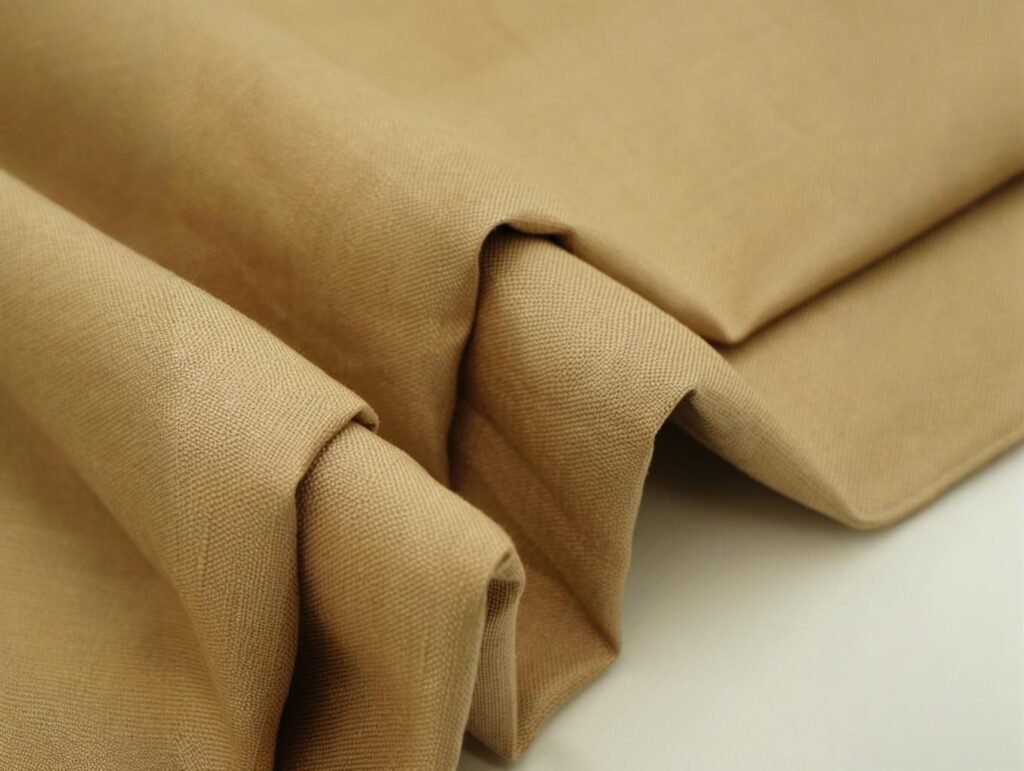
Yes. Linen shrinkage can be significantly reduced when teams combine controlled fiber selection, fabric-stage stabilization, disciplined washing protocols, and rigorous documentation. Shrinkage in linen can never be fully eliminated—because it is rooted in natural fiber behavior—but it can be engineered, predicted, and managed to a level that supports consistent bulk production.
The most reliable results do not come from shortcuts or assumptions. They come from process control applied early and maintained consistently.
Shrinkage Is a Design Variable, Not a Defect
Many teams treat shrinkage as something to “fix” after problems appear. Experienced manufacturers treat shrinkage as a design variable that must be addressed before cutting begins.
Linen fibers store mechanical tension during spinning, weaving, and finishing. Shrinkage is simply the release of that tension when moisture, heat, or agitation is introduced. The goal of shrinkage management is not to prevent movement entirely, but to decide when and how that movement occurs.
How Professionals Manage Linen Shrinkage in Real Production
The strategies below are widely used in stable linen programs for apparel, home textiles, and soft goods. Each strategy addresses a different stage of the production lifecycle.
Strategy 1: Stabilize Fabric Before Cutting
The single most effective way to reduce unpredictable shrinkage is to allow linen to relax before it is transformed into a product.
| Approach | Result |
|---|---|
| Cut → wash | Unpredictable sizing |
| Wash → cut | Stable dimensions |
Fabric-stage washing, pre-shrinking, or sanforization removes a large portion of internal tension while the fabric is still flat and unstructured. Once that tension is released, dimensional behavior becomes far more predictable.
When cutting happens before washing, each panel shrinks independently. Seams, corners, and stress points respond differently, leading to distorted proportions and fit drift.
By contrast, washing fabric in open width allows shrinkage to occur uniformly across warp and weft. Patterns drafted afterward reflect the fabric’s true, relaxed dimensions.
For this reason, experienced teams almost always stabilize linen at the fabric stage when:
- Fit precision matters
- Finished dimensions are fixed
- Reorders are planned
Strategy 2: Select Yarn and Weave for Stability
Shrinkage control starts long before finishing. It begins with yarn construction and weave design.
Designers often focus on handfeel and appearance first, but linen stability is largely determined upstream.
| Choice | Impact |
|---|---|
| Medium–high yarn twist | Reduced shrinkage |
| Balanced weave density | Even relaxation |
| Avoid extreme looseness | Less distortion |
Higher yarn twist increases internal cohesion, reducing the amount of latent stress released during washing. Extremely low-twist yarns feel soft initially but often shrink more and unevenly.
Weave density must be balanced. Very loose weaves allow yarns to move freely, increasing shrinkage and distortion. Very tight weaves can store excessive tension that releases unevenly if not properly stabilized.
At SzoneierFabrics, yarn twist level and loom tension are adjusted based on product priorities. Programs that emphasize softness may accept slightly higher shrinkage, while programs requiring dimensional accuracy prioritize stability at the yarn and weave stage.
This upstream control reduces reliance on aggressive finishing later.
Strategy 3: Control Washing Intensity Precisely
Washing is the primary trigger for linen shrinkage. The degree of shrinkage depends less on the fact that linen is washed, and more on how it is washed.
| Parameter | Recommendation |
|---|---|
| Temperature | Moderate, consistent |
| Agitation | Controlled, not aggressive |
| Load size | Balanced |
High temperatures increase fiber swelling, allowing greater relaxation. Aggressive agitation accelerates stress release and increases distortion risk. Overloaded machines create uneven movement, leading to inconsistent results across a batch.
Professional production avoids “over-washing” as a shortcut to softness. Instead, softness and shrinkage are managed independently through:
- Controlled wash time
- Defined agitation levels
- Consistent load ratios
Consistency is more important than intensity. A moderate, repeatable wash profile produces far more stable results than aggressive washing that varies by batch.
Strategy 4: Separate Shrinkage Control From Softness Goals
A common mistake is trying to achieve softness by increasing wash aggression. This often increases shrinkage unpredictably.
Experienced teams separate these objectives:
- Shrinkage is controlled through stabilization
- Softness is achieved through finishing techniques
Mechanical softening, enzyme treatments, or calendaring can improve handfeel without significantly increasing dimensional change. When softness and shrinkage are treated as separate variables, both can be optimized.
Strategy 5: Measure, Record, Repeat
Shrinkage control improves dramatically when teams treat data as part of the product specification.
Effective programs:
- Measure shrinkage in both warp and weft
- Record results after multiple wash cycles
- Define acceptable shrinkage ranges
- Reference historical data for reorders
This transforms shrinkage from an uncertainty into a known input.
For example, instead of saying “pre-shrunk linen,” professional specifications state:
- Warp shrinkage ≤3% after two washes
- Weft shrinkage ≤2% after two washes
Once these ranges are approved, they become reference points for quality control and future production.
Strategy 6: Lock Finishing Sequence and Do Not Deviate
The order of finishing steps matters as much as the steps themselves.
Changing when washing occurs—before dyeing, after dyeing, or after softening—can alter shrinkage outcomes even if all other parameters remain constant.
Professional linen programs lock:
- Finishing sequence
- Wash timing
- Drying method
Any change triggers re-testing. This discipline prevents “quiet drift,” where each small process adjustment pushes fabric behavior further from the original approval.
Strategy 7: Align Pattern Engineering With Measured Shrinkage
Shrinkage control is incomplete without pattern alignment.
Once fabric shrinkage is measured and stabilized, patterns should be drafted for the relaxed fabric, not theoretical dimensions. This includes:
- Length allowances
- Panel balance
- Seam positioning
Pattern engineers who work with real shrinkage data can eliminate most fit surprises before bulk production.
This is particularly important for:
- Tailored garments
- Structured home textiles
- Products with fixed dimensions
Strategy 8: Control Drying Methods
Drying is often overlooked, but it has a significant impact on shrinkage.
Tumble drying combines heat and mechanical stress, increasing shrinkage. Line drying allows gravity-assisted relaxation with less stress. Flat drying minimizes distortion but is slower.
Production drying should reflect end-user reality. If the final product is likely to be tumble dried by consumers, testing should include that method. If not, production should avoid unnecessary tumble drying that exaggerates shrinkage.
Consistency between test drying and bulk drying is essential.
Strategy 9: Use Blends When Absolute Control Is Required
When dimensional stability is non-negotiable, blends provide a practical solution.
| Blend | Benefit |
|---|---|
| Linen–polyester | Dimensional lock |
| Linen–cotton | Softer feel, moderate control |
Polyester fibers add structural memory and reduce relaxation. Cotton improves softness and moderates shrinkage without fully sacrificing linen’s character.
The goal is not fiber purity, but performance alignment. For some products, blended linen delivers better long-term consistency and fewer customer complaints than 100% linen.
Strategy 10: Test More Than Once
Shrinkage does not always finish after a single wash.
Linen typically follows a curve:
- First wash: largest change
- Second wash: additional, smaller change
- Subsequent washes: stabilization
Testing only one wash cycle often underestimates total shrinkage. Experienced teams test at least two cycles before final approval, especially for apparel and home textiles.
Why Shortcuts Fail
Common shortcuts include:
- Assuming GSM predicts shrinkage
- Relying on supplier claims without testing
- Skipping fabric-stage washing to save time
These shortcuts usually result in:
- Fit drift
- Inconsistent reorders
- Increased returns
The cost savings are temporary. The consequences are long-term.
Shrinkage Control Across Reorders
Shrinkage management does not end after the first bulk run.
To maintain consistency across seasons, teams often lock:
- Fiber source
- Yarn specification
- Weave density
- Finishing partner
- Wash parameters
Without these controls, even small changes can alter shrinkage behavior enough to affect fit and customer perception.
A Practical Production Insight
Many experienced buyers follow a simple rule:
If shrinkage would be unacceptable in market, it must be unacceptable before cutting.
This mindset shifts effort earlier in the process, where changes are cheaper and outcomes are controllable.
Linen shrinkage cannot be eliminated, but it can be engineered, predicted, and managed through disciplined process control.
The most effective strategies work together:
- Stabilize fabric early
- Design yarn and weave for balance
- Wash consistently and moderately
- Measure, document, and reference results
- Align patterns with real behavior
When these steps are followed, linen becomes a reliable production material rather than a recurring risk.
In professional manufacturing, shrinkage is not a surprise to be corrected. It is a variable to be designed—deliberately, transparently, and repeatably.
How Should Designers and Product Developers Plan for Linen Shrinkage in Their Specifications?
Linen shrinkage should be designed into product specifications from the very beginning, not addressed as a corrective action after sampling or production issues appear. Because linen is a low-elasticity, moisture-responsive fiber, dimensional change is not an exception—it is an expected behavior. The role of designers and product developers is not to eliminate shrinkage, but to anticipate it, quantify it, and manage it systematically through specifications, patterns, and approval criteria.
Designing without shrinkage assumptions is designing blind.
Brands that struggle with linen rarely fail because the fabric is unstable. They fail because shrinkage was treated as an afterthought rather than a design parameter.
Smart planning avoids downstream corrections, re-cutting, and post-launch fit complaints.
Designing With Shrinkage in Mind
Shrinkage planning begins before fabric approval and continues through pattern development, grading, and quality control. It requires designers and developers to think beyond how the linen looks and feels, and instead focus on how it will behave after finishing, washing, and real use.
Effective shrinkage planning answers three questions early:
- How much will the fabric shrink?
- In which direction will it shrink?
- Where in the process will that shrinkage occur?
Once these are defined, specifications can be built around reality instead of assumptions.
Pattern and Size Allowances
Patterns are the first and most important tool for managing linen shrinkage. Experienced teams do not wait for shrinkage problems to appear—they build allowances directly into cutting dimensions based on tested data.
| Expected Shrinkage | Pattern Adjustment |
|---|---|
| 2–3% | Minor allowance |
| 4–6% | Full compensation |
| 7%+ | Re-evaluate fabric |
These adjustments ensure that garments, home textiles, or soft goods finish at their intended dimensions after washing or finishing, not just off the cutting table.
Minor shrinkage (2–3%) can often be absorbed through standard tolerance buffers, especially in relaxed silhouettes. Moderate shrinkage (4–6%) requires explicit compensation in patterns and grading rules. When shrinkage exceeds 7%, teams should pause and reassess whether the fabric choice aligns with the product’s fit and performance requirements.
Ignoring these thresholds leads to undersized products, inconsistent grading, and costly post-production fixes.
Warp vs. Weft: Directional Planning Matters
Shrinkage is not uniform. Linen almost always shrinks more in the weft (width) than in the warp (length). Designers who plan shrinkage as a single percentage risk distorting proportions and fit.
Pattern specifications should reflect:
- Warp shrinkage assumptions for length, rise, and drop
- Weft shrinkage assumptions for width, girth, and panel fit
For example, a shirt body that shrinks excessively in width but not length may feel tight across the chest while appearing visually correct in length. Only directional planning prevents these imbalances.
Size Grading and Shrinkage Interaction
Size grading amplifies shrinkage effects. A small dimensional error in the base size can multiply across a full size run.
If shrinkage is not incorporated into grading rules:
- Smaller sizes may fall outside tolerance
- Larger sizes may show disproportionate distortion
- Fit consistency across sizes deteriorates
Best practice is to:
- Apply shrinkage compensation at the base size
- Verify that grading increments still produce acceptable post-wash dimensions
- Validate at least two sizes (one small, one large) during sampling
This approach prevents late-stage surprises where only certain sizes fail.
Spec Sheets That Reflect Reality
A specification sheet is only useful if it reflects how the product behaves after intended care, not just how it measures when new.
Effective linen specifications include:
- Tested shrinkage values (warp and weft)
- Acceptable tolerance ranges after wash
- Wash and dry methods used during testing
- Fabric condition at measurement (pre-wash or post-wash)
Without these details, production teams are forced to guess. Guessing leads to inconsistency, rework, and disputes over responsibility.
Specifications should state not only the target measurement, but also the measurement condition. A finished dimension without context is incomplete information.
Tolerance Ranges: Designing for Variation
Linen is a natural fiber. Even well-controlled programs show some variation. Specifications must acknowledge this reality.
Instead of a single fixed measurement, professional specs define:
- Target dimension
- Acceptable positive tolerance
- Acceptable negative tolerance
This allows quality teams to make informed decisions rather than rejecting units unnecessarily or passing unacceptable ones due to ambiguity.
Tight tolerances should be reserved for areas that affect fit or function. Overly strict tolerances everywhere increase rejection rates without improving customer experience.
Fabric Approval Criteria Linked to Shrinkage
Fabric approval should not be based solely on appearance or hand feel. It must include shrinkage performance as a formal acceptance criterion.
Approved linen fabrics should meet:
- Defined maximum shrinkage limits
- Consistent behavior across multiple tests
- Compatibility with intended washing or finishing processes
If a fabric cannot meet these criteria, it should not move forward—no matter how attractive it appears at first touch.
This discipline prevents late-stage design compromises caused by unsuitable fabric behavior.
Communication Across Teams
Shrinkage planning fails when information stays siloed. Shrinkage data must flow across all teams involved in development and production.
It should be shared with:
- Designers, to guide silhouette and ease decisions
- Pattern makers, to build correct allowances
- Production teams, to align cutting and sewing
- Quality teams, to inspect against the right criteria
When one group works with incomplete information, errors propagate. Alignment ensures that shrinkage becomes a managed variable, not a recurring surprise.
Aligning Fabric Testing With Design Intent
Shrinkage values are only meaningful if testing reflects real use. Designers should ensure that shrinkage tests match intended care instructions.
For example:
- A garment labeled “machine wash cold” must be tested accordingly
- A fabric intended for garment washing should be tested post-wash, not loom state
- Home textiles should reflect consumer laundering behavior, not lab-only conditions
Mismatch between test conditions and real use is one of the most common causes of shrinkage-related complaints.
Planning for Shrinkage in Different Product Categories
Shrinkage tolerance varies by product type.
- Relaxed garments can tolerate more variation
- Fitted garments require tighter control
- Home textiles demand dimensional accuracy for compatibility
- Upholstery and accessories prioritize stability over softness
Designers should align shrinkage planning with product expectations rather than applying a one-size-fits-all rule.
Early Validation Reduces Late Corrections
The cheapest time to address shrinkage is during sampling. The most expensive time is after bulk production or market launch.
Smart teams:
- Validate shrinkage during pre-production sampling
- Wash and measure before final sign-off
- Adjust specs and patterns before scale
Late corrections—such as resizing patterns after bulk cutting—are costly, disruptive, and often incomplete.
Documenting Decisions for Future Programs
Once shrinkage behavior is understood and managed, it should be documented clearly. This documentation becomes a reference for future styles, reorders, or new team members.
Useful records include:
- Approved shrinkage ranges
- Pattern adjustment logic
- Fabric-finishing relationships
- Known risks and mitigations
This prevents teams from relearning the same lessons season after season.
A Mindset Shift That Matters
The most successful linen programs share a common mindset. Instead of asking:
“Will this linen shrink?”
They ask:
“How much will it shrink, in which direction, under which conditions—and have we planned for it?”
That single shift transforms shrinkage from a problem into a design input.
Shrinkage as a Design Parameter, Not a Defect
Shrinkage is not a failure of linen. It is a property of the material. When designers and product developers accept this and plan accordingly, linen becomes predictable, controllable, and reliable.
Brands that integrate shrinkage into specifications achieve:
- Better fit consistency
- Higher production efficiency
- Fewer returns and complaints
- Stronger collaboration between teams
Planning for linen shrinkage is not about being conservative. It is about being precise.
By embedding shrinkage assumptions into patterns, grading, tolerances, and specifications, designers and product developers replace uncertainty with control.
Smart planning avoids downstream corrections. And in linen development, control is what turns a beautiful fabric into a successful product.
Linen shrinkage is predictable—when treated correctly
Linen does shrink during industrial washing and garment finishing. That fact does not make linen risky—it makes it honest. Shrinkage reveals how fibers respond to real use, and when understood, it becomes a controllable part of product engineering.
Teams that struggle with linen shrinkage often lack data, not quality. Teams that succeed measure early, stabilize intentionally, and design with shrinkage in mind.
SzoneierFabrics supports linen development from fiber selection and sampling through stabilization, testing, and repeatable production. With flexible quantities, rapid sampling, and controlled finishing processes, the goal is simple: help linen behave the way your product requires—not the other way around.
If you’re developing a linen fabric or finished product and need shrinkage control tailored to your use case, reach out to SzoneierFabrics to discuss custom specifications, sampling, and quotation options.