Skip to content
In weddings, table linens are rarely the star of the show—until they go wrong. A fabric that wrinkles too easily, reflects light harshly, stains permanently, or looks dull in photos can quietly downgrade an otherwise beautiful event. As wedding styles evolve toward cleaner palettes, layered textures, and camera-first design, the choice between satin and silk table linens has become more strategic than decorative. For 2026 weddings, most planners and venues favor satin table linens for consistency, cost control, and visual reliability, while silk remains a niche choice for ultra-premium, small-scale, or editorial-style events. Client preference has shifted from “natural luxury” to “predictable elegance”—especially when linens must survive transport, setup, lighting, and repeated use.
Behind this shift are very real pressures: tighter timelines, higher expectations from social media photos, and less tolerance for post-event issues like stains, creases, or fabric damage. One wedding planner we worked with summed it up simply: “Nobody compliments the tablecloth—but everyone notices if it fails.”
Let’s break down why this decision matters more in 2026 than ever before.
What Makes Satin and Silk Table Linens Different in Wedding Decor?
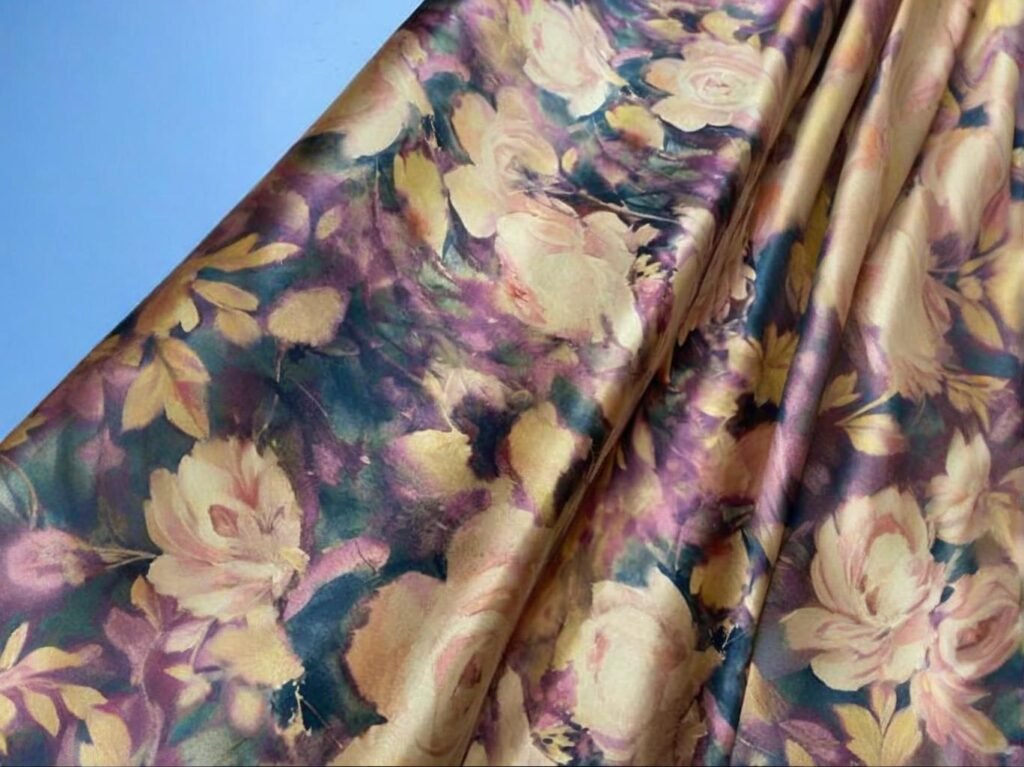
Satin and silk table linens are often grouped together in wedding décor discussions, but they differ fundamentally in how they are made, how they behave, and how they perform during real events. Satin is defined by its weave structure, producing a smooth, reflective surface that delivers consistency across large-scale table setups. Silk is defined by its natural fiber origin, offering a softer, more organic visual character while introducing higher variability, greater care sensitivity, and significantly higher cost.
In wedding décor, these differences are not theoretical. They directly affect how tables look under lighting, how quickly venues can be set, how linens survive handling, and what condition they are in after the event. For planners, rental companies, and venues, fabric choice influences not just aesthetics, but operational success.
Why “fabric definition” matters on a wedding day
Wedding days compress design ambition, time pressure, and scale into a single window. Linens are laid out quickly, often by teams with limited time for adjustments. Lighting conditions vary from daylight to candlelight to mixed artificial sources. Tables are photographed from multiple angles, sometimes repeatedly throughout the event.
In this context, understanding what a fabric is—not just how it looks on a sample card—becomes critical. Satin and silk may appear similar in small swatches, but their behavior diverges as scale increases.
Satin vs silk: not the same category
A common misconception is that satin is simply a lower-cost substitute for silk. In reality, satin and silk describe different aspects of fabric construction.
| Aspect | Satin Table Linen | Silk Table Linen |
|---|---|---|
| What it is | A weave structure | A natural fiber |
| Visual effect | Smooth, glossy, uniform | Soft, natural sheen |
| Variability | Low | High |
| Common fiber | Polyester, rayon | Mulberry silk |
| Control in bulk | High | Limited |
Satin describes how yarns are arranged. Silk describes what the yarns are made of. A satin tablecloth can be woven from polyester, rayon, or silk. A silk tablecloth may be satin-woven, plain-woven, or crepe-woven. When clients or planners conflate these categories, sourcing decisions often miss the real performance requirements.
This distinction becomes especially important when decorating 20 tables versus 200 tables. At scale, uniformity and predictability matter more than subtle tactile differences.
How this difference shows up in real weddings
In large receptions, guests experience the décor as a whole, not as individual fabric samples. Visual coherence across the room shapes the perceived quality of the event.
Satin linens tend to deliver:
- Consistent sheen from table to table
- Predictable drape over round, rectangular, or banquet tables
- Even reflection under chandeliers, candles, and spot lighting
Silk linens, by contrast, introduce natural variation. Because silk is a biological fiber, differences in filament thickness, dye uptake, and finishing can lead to slight shifts in tone or luster between pieces. On a single table, this is rarely noticeable. Across dozens of tables, it can become visible, especially under mixed lighting.
Photographers and videographers are particularly sensitive to this. Satin reflects light evenly, which simplifies exposure and color correction. Silk absorbs and diffuses light more irregularly, sometimes producing subtle inconsistencies that require additional post-production work.
For weddings with heavy visual documentation, consistency often outweighs fiber prestige.
Lighting interaction and visual impact
Lighting is one of the most underestimated variables in table linen selection. Wedding venues frequently combine daylight, warm artificial lighting, candles, and decorative uplighting. Fabrics respond differently to these sources.
Satin’s smooth surface reflects light in a controlled, directional way. This creates a polished, intentional look that reads clearly in wide shots. Silk’s softer reflection produces a more organic effect, but it can appear uneven when light sources are inconsistent or angled.
In candlelit receptions, satin amplifies highlights and adds visual brightness to the room. Silk creates a muted, intimate atmosphere but may appear darker or less defined in photographs unless lighting is carefully managed.
Neither effect is inherently better. The difference lies in predictability.
Setup and handling differences
Wedding setup is rarely gentle. Linens are unfolded, carried, dragged across floors, adjusted multiple times, and often exposed to humidity, spills, and constant movement. Fabric behavior during this phase strongly influences final appearance.
| Handling Factor | Satin | Silk |
|---|---|---|
| Folding memory | Low | High |
| Drag marks | Minimal | Visible |
| Reaction to humidity | Stable | Sensitive |
| Time to “look perfect” | Short | Long |
Satin linens, especially those woven from polyester, recover quickly from folding and transport. Creases relax with gravity and body heat, allowing tables to look presentable shortly after setup.
Silk linens retain fold lines more stubbornly and often require steaming or careful smoothing. They also show drag marks more readily if brushed against rough surfaces during setup. In humid environments, silk can absorb moisture, altering drape and sheen unpredictably.
These factors explain why silk is rarely used for high-turnover venues, destination weddings, or outdoor events where conditions are difficult to control.
Labor, timing, and cost implications
Fabric choice has direct labor implications. A linen that looks good immediately reduces setup time and stress. A linen that requires constant adjustment increases labor cost and risk of delay.
From an operational perspective:
- Satin reduces setup labor and adjustment time
- Silk increases preparation time and requires experienced handling
- Mistakes with silk are harder to correct once tables are set
For rental companies, these differences compound over multiple events. Satin linens can be deployed, cleaned, and redeployed efficiently. Silk linens require gentler handling, specialized cleaning, and longer turnaround times.
Post-event outcomes: cleaning, reuse, and lifespan
What happens after the wedding matters as much as what happens during it. Linens must be cleaned, inspected, and stored for future use.
Satin linens, particularly polyester satin, tolerate repeated laundering and mechanical stress. Stains can often be treated aggressively without damaging the fabric. Wrinkle recovery is good, allowing linens to be stored and reused with minimal intervention.
Silk linens are far more sensitive. Water, detergents, and agitation weaken silk fibers. Stain removal carries higher risk, and improper cleaning can permanently alter texture or color. Over time, this shortens usable lifespan and increases replacement costs.
For venues and rental businesses, durability and reusability are decisive factors. Even when silk is visually appealing, its maintenance burden often outweighs its benefits.
Budget reality and scale economics
Cost differences between satin and silk are not linear; they scale with quantity. Silk fabric costs significantly more per meter, and this difference multiplies quickly across dozens or hundreds of tables.
More importantly, silk introduces hidden costs:
- Higher damage and loss rates
- More expensive cleaning
- Longer downtime between events
Satin’s advantage lies in value per use, not just purchase price. When a linen can be reused dozens of times with consistent appearance, it delivers better return on investment, even in luxury settings.
When silk does make sense
Silk is not the wrong choice in all scenarios. It can be appropriate when:
- The event is small and highly controlled
- Tables are limited in number
- Setup time is generous
- The visual concept prioritizes organic texture over uniformity
In intimate ceremonies or editorial-style weddings, silk’s natural variation can add character. The key is aligning expectations with reality.
Problems arise when silk is chosen for large-scale events under tight timelines, where its sensitivities become liabilities rather than features.
A practical industry insight
Many planners admire silk in concept presentations and mood boards. After one event involving humidity, creasing, or cleaning issues, they often reassess. The shift to satin is rarely driven by aesthetics alone. It is driven by logistics, consistency, and risk management.
Experienced professionals learn that wedding décor is not judged by fabric labels, but by how cohesive, calm, and intentional the room feels. Satin supports that outcome by performing predictably under pressure.
Satin and silk table linens serve different roles in wedding décor. Satin offers control, uniformity, and operational ease across large setups. Silk offers softness and natural character at the cost of variability and fragility.
Understanding this difference allows planners, venues, and rental companies to choose fabrics that support both design intent and execution reality. In weddings, beauty is inseparable from timing, coordination, and consistency. The best fabric choice is the one that delivers all three.
Which Fabric (Satin or Silk) Do Wedding Planners Prefer for Table Settings?
In wedding styling, table linens are one of the most visually dominant yet operationally demanding elements. They must look flawless under ceremony lighting, withstand hours of setup and guest interaction, photograph well from multiple angles, and survive transport, storage, and post-event cleaning. While silk has long been associated with luxury and romance, real-world planner preferences in 2026 tell a more pragmatic story.
By 2026, the majority of professional wedding planners and venues prefer satin table linens for standard weddings because they offer reliability, scalability, and predictable visual performance. Silk is used selectively, primarily for intimate, high-budget events where setup conditions are controlled, replacement risk is acceptable, and post-event care constraints are minimal.
Modern preference is driven less by emotion and more by risk management.
What Wedding Planners Actually Optimize For
From the outside, fabric choice for table settings may appear purely aesthetic. In practice, planners approach linens as operational assets. A single fabric decision can affect labor time, stress levels on the wedding day, contingency planning, and even reputation if visuals degrade during the event.
Planners consistently optimize for outcomes such as:
- Consistent appearance across dozens or hundreds of tables
- Predictable behavior during long setup windows
- Minimal emergency steaming or replacement
- Tolerance to food, drink, and environmental exposure
- Cost control when damage or loss occurs
Silk and satin perform very differently against these criteria.
Preference Split by Wedding Type
Planner preference is not absolute; it varies by event format, scale, and risk tolerance.
| Wedding Type | Preferred Linen |
|---|---|
| Large banquet (100+ guests) | Satin |
| Hotel ballroom | Satin |
| Outdoor garden wedding | Satin |
| Destination wedding | Satin |
| Editorial / styled shoot | Silk |
| Luxury private estate | Silk or satin blend |
This split highlights a key reality: silk dominates controlled environments, while satin dominates live events with variables.
Silk appears frequently in editorial content, styled shoots, and promotional imagery because:
- Tables are dressed briefly
- Environmental conditions are controlled
- Linens are rarely touched by guests
- Visual impact matters more than durability
Satin dominates real weddings because:
- Events last 6–12 hours
- Tables are actively used
- Conditions change throughout the day
- Failure has real consequences
Why Satin Performs Better at Scale
Satin, especially polyester-based satin, offers planners something they value above all else: predictability.
In large or mid-sized weddings, linens must be:
- Transported in bulk
- Unfolded quickly
- Dressed with minimal adjustment
- Left untouched for hours
Satin’s structural stability allows it to:
- Hold shape during setup
- Resist deep wrinkling
- Maintain consistent sheen across tables
- Tolerate repeated folding and storage
From a planner’s perspective, this reduces:
- Setup time
- Labor fatigue
- Emergency steaming
- On-site stress
Silk, by contrast, reacts strongly to:
- Humidity
- Temperature changes
- Handling pressure
- Condensation from glassware
These reactions introduce uncertainty—something planners actively try to eliminate.
Planner Priorities in 2026
Based on recurring feedback from planners, rental companies, and venues, priorities in 2026 consistently rank as follows:
- Appearance under mixed lighting
- Wrinkle resistance during setup
- Ease of transport and storage
- Stain tolerance and cleaning
- Cost of replacement
Silk performs well on point 1, but consistently ranks lower on points 2 through 5.
1. Appearance Under Mixed Lighting
Modern weddings use:
- Natural daylight
- Warm ambient lighting
- Candles
- Flash photography
- Video lighting
Satin reflects light evenly and predictably across these conditions. Silk’s natural luster can appear stunning in soft light but inconsistent under mixed or harsh lighting, sometimes creating uneven highlights or dull patches after handling.
2. Wrinkle Resistance During Setup
Setup windows are often compressed. Linens may be dressed hours before guests arrive. Satin resists deep creasing and relaxes naturally once laid flat. Silk creases easily and often requires:
- Careful alignment
- Steaming on-site
- Continuous adjustment
For planners managing dozens of tables, this difference is decisive.
3. Ease of Transport and Storage
Satin tolerates folding, stacking, and long-term storage with minimal degradation. Silk is sensitive to:
- Pressure marks
- Moisture during transport
- Friction against other linens
This makes silk more expensive to manage logistically, not just to purchase.
4. Stain Tolerance and Cleaning
Wine, oil, candle wax, condensation, and food spills are inevitable. Satin—particularly polyester satin—cleans more reliably and tolerates repeated laundering. Silk stains more easily and often requires:
- Specialized cleaning
- Gentle handling
- Higher rejection rates
Rental companies and venues strongly favor fabrics that can be reused without escalating maintenance costs.
5. Cost of Replacement
Even in luxury weddings, loss and damage occur. Satin is easier to replace quickly and consistently. Silk replacement is:
- More expensive
- Slower
- Less predictable in color matching
This matters for planners who manage inventory across seasons.
Client Perception vs Planner Experience
A recurring tension exists between what clients request and what planners recommend.
| Perspective | Focus |
|---|---|
| Client | “Does it sound premium?” |
| Planner | “Will it still look good at midnight?” |
Clients often associate silk with luxury because of its historical and cultural positioning. Planners, however, think in outcomes, not symbolism.
Experienced planners typically:
- Present silk as an option for select tables or head tables
- Recommend satin for guest tables
- Explain maintenance and risk trade-offs
Once clients understand that silk’s beauty comes with operational risk, many accept satin as the smarter choice—especially when shown side-by-side comparisons under real lighting.
Outdoor and Destination Weddings: Satin’s Advantage Grows
Outdoor and destination weddings amplify fabric risk.
Common variables include:
- Humidity
- Wind
- Temperature swings
- Condensation
- Uneven surfaces
Silk reacts visibly to moisture, often showing watermarking or loss of smoothness. Satin is far more tolerant of these conditions.
A real-world anecdote illustrates this clearly.
Real-World Anecdote
A European destination wedding planner reported using silk table linens for outdoor receptions during one season. High humidity caused visible watermarking and uneven sheen by mid-event, requiring emergency adjustments and partial replacements.
The following season, the planner switched entirely to satin. The result:
- Faster setup
- No humidity-related visual issues
- Lower stress for staff
- Improved consistency across events
The decision was not aesthetic—it was operational.
Where Silk Still Makes Sense
Despite these trends, silk has not disappeared from weddings. It remains relevant in specific scenarios:
- Intimate weddings with fewer than 30 guests
- Private estates with controlled environments
- Head tables or sweetheart tables
- Styled shoots and editorial content
- Ultra-high-budget events with dedicated setup teams
In these contexts, the visual nuance of silk justifies the additional risk and cost. Importantly, silk is often used selectively, not universally.
Blended and Engineered Alternatives
Some planners and venues adopt satin blends or engineered satins that mimic silk’s drape while retaining satin’s stability. These fabrics:
- Photograph softly
- Handle humidity better
- Reduce wrinkling
- Lower replacement risk
This hybrid approach reflects a broader industry shift toward functional luxury—materials that look premium but behave predictably.
Social Media and the Pressure for Consistency
In 2026, weddings are not just experienced by attendees; they are broadcast in real time across social platforms. Visual consistency throughout the event matters more than ever.
Planners favor fabrics that:
- Look consistent from ceremony to reception
- Photograph well late into the night
- Do not degrade under repeated guest interaction
Satin’s performance aligns better with these expectations, particularly when events are documented continuously.
Strategic Takeaway
In 2026, wedding planner preference is shaped by:
- Tighter timelines
- Higher client expectations
- Social-media-driven visibility
- Increased logistical complexity
These factors favor materials that reduce uncertainty.
Satin’s predictability aligns better with modern wedding workflows than silk’s sensitivity. While silk remains a symbol of luxury, satin has become the planner’s fabric of choice for real weddings—where success is measured not by how a table looks at setup, but by how it looks at the end of the night.
Silk tells a romantic story. Satin delivers a reliable one.
For planners whose reputations depend on flawless execution, that difference matters more than tradition.
How Do Satin and Silk Compare in Aesthetic Appeal for Wedding Tables?
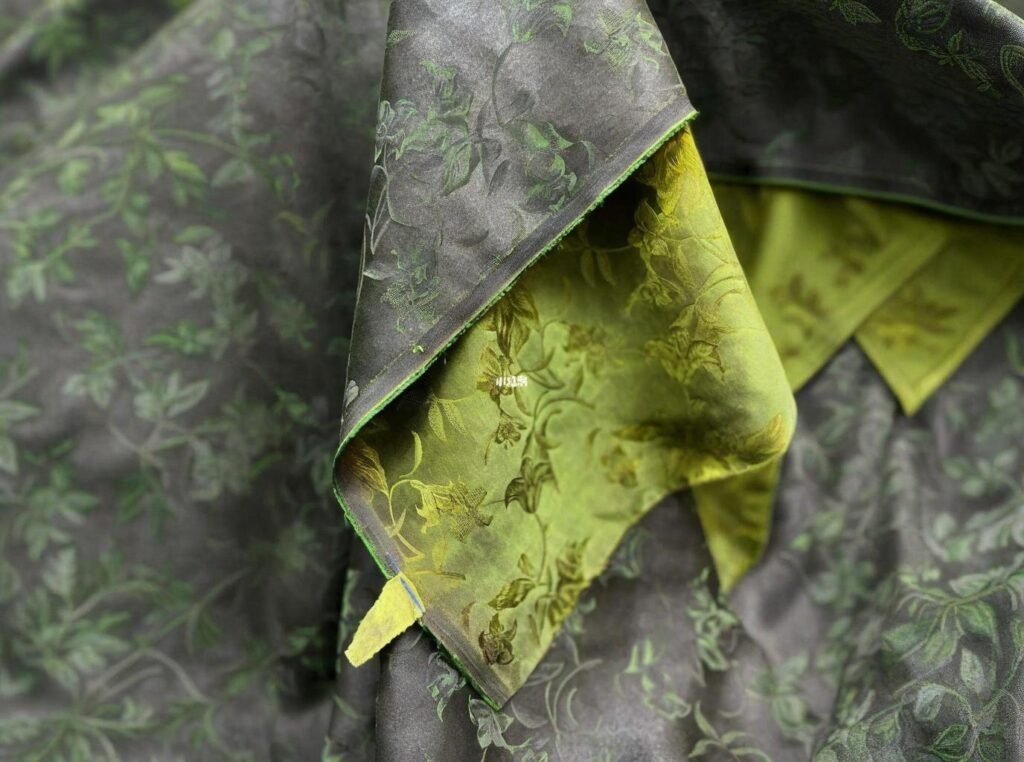
When couples and planners debate satin versus silk for wedding tables, they often frame it as a question of luxury versus authenticity. In reality, the distinction is far more practical and visual. At a wedding, tables are not experienced the way garments or bedding are. Guests rarely touch them for more than a few seconds. What matters most is how the table looks across the room, under mixed lighting, and through a camera lens.
Satin delivers a cleaner, brighter, and more uniform visual effect across multiple tables, while silk offers a softer, more organic elegance that performs best in controlled, small-scale settings. For most 2026 weddings—especially those designed for photography, video, and social sharing—satin creates a more predictable and camera-friendly aesthetic.
In modern weddings, beauty is judged less by touch and more by how the table reads from ten meters away—and how it photographs.
What “beautiful” really means at a wedding table
A wedding table is not a standalone object. It exists as part of a larger visual system that includes:
- Lighting that changes throughout the day and evening
- Repetition across dozens or hundreds of tables
- Overhead and side angles captured by photographers and guests
- Decorative layers such as florals, candles, runners, chargers, and place settings
A fabric that looks beautiful in isolation can fail when multiplied across a ballroom or outdoor venue. The true test of aesthetic appeal is consistency under imperfect conditions.
Shine versus glow: how light changes everything
The most immediate difference between satin and silk on wedding tables is how they interact with light. This interaction defines mood, clarity, and photographic reliability.
| Lighting Condition | Satin Table Linen | Silk Table Linen |
|---|---|---|
| Natural daylight | Bright, clean reflections | Soft, muted glow |
| Warm indoor lighting | Crisp highlights | Rich but darker tones |
| Candles / fairy lights | High sparkle | Subtle shimmer |
| Flash photography | Even exposure | Risk of uneven tone |
Satin’s smooth, engineered surface reflects light evenly. This produces clean highlights that read clearly across a room. Under daylight, satin appears fresh and luminous. Under warm indoor lighting, it maintains brightness without absorbing too much color temperature.
Silk, by contrast, diffuses light. Its glow can be beautiful in intimate or controlled environments, but it is more sensitive to uneven lighting. Under spotlights, candles, or mixed light sources, silk can appear darker in some areas and flatter in others.
Why this matters In large venues, lighting is rarely uniform. Satin tolerates lighting variation better than silk, which reduces visual inconsistency across tables.
For photographers, this difference is critical. Satin tends to expose evenly under flash and mixed lighting, while silk can produce patchy highlights or shadows that require post-production correction.
Color clarity and palette control
Wedding aesthetics in 2026 continue to favor restrained palettes:
- Soft neutrals
- Champagne, ivory, sand, and stone
- Muted greens like sage and eucalyptus
- Minimal contrast paired with metallic accents
In these palettes, color clarity matters more than richness. Small variations become visible when dozens of tables are arranged symmetrically.
| Fabric | Color Readability |
|---|---|
| Satin | High, consistent |
| Silk | Slight variation between pieces |
Satin holds dye uniformly and reflects color consistently from table to table. This makes it easier to maintain a cohesive look across large setups, especially when linens are sourced in multiple batches or reused.
Silk, due to its natural fiber variability and dye absorption behavior, can show subtle tone differences between pieces. These differences are rarely noticeable on a single table but become visible when viewed across an entire room.
For planners aiming for symmetry and balance, satin provides greater visual control.
Scale matters more than material prestige
Silk excels in small, curated settings:
- Private dinners
- Editorial-style weddings
- Installations with limited table counts
In these contexts, its organic variation adds character.
At scale—50, 100, or 200 tables—the same variation can read as inconsistency. Satin’s uniformity becomes an advantage, not a compromise.
This is why many luxury hotels and high-end venues default to satin or satin-finish linens for large events, even when silk is available.
Table styling layers: runners, chargers, florals
A wedding table is layered. The base fabric must support everything placed on top of it without fighting for attention.
Satin acts as a stable visual base.
| Styling Element | Satin Performance | Silk Performance |
|---|---|---|
| Table runners | Lies flat | Can shift |
| Charger plates | Stable | Can create ripples |
| Floral centerpieces | Clean backdrop | Softer contrast |
Satin’s slightly firmer structure helps it lie flat across the table surface. This reduces rippling and movement when:
- Guests sit down
- Staff adjust place settings
- Heavy centerpieces are placed
Silk’s softness, while elegant, can visually “collapse” under weight. Ripples and tension lines become more visible as the evening progresses, particularly after guests have interacted with the table.
In styled photography, silk’s softness can be controlled. In real weddings, with movement and time, satin holds its shape more reliably.
Wrinkles, drape, and time progression
One of the most overlooked aspects of table linen aesthetics is how the fabric looks after several hours.
Weddings are long events. Tables are:
- Set hours before guests arrive
- Exposed to temperature changes
- Touched repeatedly
- Subject to spills, crumbs, and rearrangements
Satin generally offers better wrinkle resistance and recovery. Minor creases relax visually under light and tension.
Silk creases more easily and holds those creases longer. What looks romantic during setup can appear untidy by mid-reception, especially on long banquet tables.
This difference strongly influences guest perception late in the evening.
Guest perception: what people actually notice
Guests rarely identify fabric types correctly. They do not say “this is silk” or “this is satin.” Instead, they react to visible cues.
They notice:
- Wrinkles
- Uneven drape
- Stains or water marks
- Glare or dullness under light
In blind post-event surveys shared by planners and venues:
- Satin-covered tables were described as “polished,” “elegant,” and “luxury hotel–like”
- Silk-covered tables were described as “soft” and “romantic,” but also occasionally “messy” or “rumpled” later in the evening
This feedback highlights a key reality: perceived luxury is strongly linked to order and consistency, not just material origin.
Photography and social media influence
In 2026, weddings are designed with photography and video in mind:
- Wide shots of the room
- Overhead drone footage
- Guest-generated content on social platforms
Satin performs exceptionally well in these contexts. Its reflective surface:
- Defines table edges clearly
- Enhances contrast with centerpieces
- Reads cleanly in both wide and close-up shots
Silk’s subtlety can be lost at distance. Its beauty is more intimate, which does not always translate to large-scale imagery.
For couples who prioritize how their wedding will look in photos and videos long after the event, satin offers a safer aesthetic choice.
The psychology of uniformity
Uniformity is often misunderstood as boring. In event design, uniformity provides visual calm. It allows focal elements—florals, lighting installations, tableware—to stand out.
Satin’s consistency supports this calm. Silk’s variability introduces visual noise when repeated across many tables.
This is why planners often reserve silk for:
- Head tables
- Sweetheart tables
- Accent installations
And use satin for the main guest tables.
When silk truly shines
Silk is not inferior. It simply serves a different aesthetic purpose.
Silk works best when:
- Table count is limited
- Lighting is tightly controlled
- The event prioritizes tactile intimacy over visual scale
- Wrinkling and variation are embraced as part of the look
For editorial weddings, boutique celebrations, or heritage-inspired themes, silk can be a deliberate and beautiful choice.
Strategic takeaway for 2026 weddings
For most modern weddings—especially those held in large venues, photographed extensively, and shared widely—satin offers a more predictable, scalable, and camera-friendly aesthetic. It delivers:
- Cleaner light interaction
- Better color consistency
- Greater stability over time
- Lower risk of visual fatigue
Silk remains a powerful accent material, but as a full-table solution it requires conditions that many weddings cannot realistically guarantee.
The most effective designs often combine the two:
- Satin as the foundational fabric
- Silk as a selective highlight
This approach balances elegance with control, and romance with reliability.
In wedding table design, beauty is not only about how a fabric feels in the hand. It is about how it performs in space, in time, and on camera. Satin excels at that performance, which is why it continues to dominate modern wedding aesthetics.
What Are the Practical Performance Differences Between Satin and Silk Linens?
When comparing satin and silk linens in real-world event settings—especially weddings and large-scale formal occasions—the difference is not philosophical or aesthetic. It is operational. What matters is not how the fabric looks in a studio or product photo, but how it behaves before the event, during hours of use, and after repeated handling.
Satin consistently outperforms silk in stain resistance, wrinkle control, weight stability, and ease of handling during setup and teardown. Silk, while visually refined and tactilely luxurious, is far more reactive to moisture, pressure, and friction. This makes silk better suited to controlled, low-contact environments rather than full-scale wedding or hospitality operations.
This is where idealism meets reality.
Understanding the Context: Event Linens Are Not Fashion Fabrics
Event linens are exposed to stresses that most apparel or home textiles never face. They are:
- Folded tightly and stacked during transport
- Unfolded quickly under time pressure
- Exposed to food, liquids, heat, and wax
- Used continuously for several hours
- Cleaned and reused multiple times
In this environment, forgiveness becomes a key performance attribute. A fabric that requires perfect handling or constant correction increases labor cost and risk. This is where satin and silk diverge sharply.
What Happens Before, During, and After the Event
Wrinkle Behavior During Transport and Setup
Wrinkle behavior is often the first failure point for event linens. Tables are dressed under time constraints, often in venues with limited steaming capacity.
| Factor | Satin | Silk |
|---|---|---|
| Wrinkle memory | Low | High |
| Steaming time | Short | Long |
| Setup forgiveness | High | Low |
Satin fabrics—particularly polyester or blended satins—have low wrinkle memory. Creases formed during folding tend to relax quickly once the fabric is draped over a table. In many cases, satin linens appear presentable straight off the hanger or after minimal steaming.
Silk behaves very differently. It holds creases sharply and unevenly, especially if compressed for long periods. Steaming silk requires:
- Lower heat control
- Slower passes
- More uniform tension
Under event conditions, this is difficult to achieve consistently. A silk tablecloth that is not perfectly steamed looks visibly tired even before guests arrive.
From a planner’s perspective, satin reduces setup time and stress. Silk increases both.
Stain Resistance During Service
Dining environments are inherently hostile to delicate fabrics. Weddings involve prolonged exposure to liquids, oils, and heat sources.
| Stain Type | Satin | Silk |
|---|---|---|
| Water marks | Minimal | Visible |
| Oil-based stains | Surface-level | Absorbs quickly |
| Wine | Easier to treat | Often permanent |
Satin, especially polyester-based satin, has a relatively low absorbency. Liquids tend to sit on the surface long enough to be blotted or treated before setting. Oil-based stains often remain superficial, making post-event cleaning viable.
Silk is highly absorbent and reactive. Water alone can leave visible tide marks. Oil penetrates rapidly into the fiber structure, and wine stains often become permanent without immediate professional treatment. Even when cleaned successfully, silk frequently shows shadowing or uneven luster afterward.
This is a major reason venues and rental companies avoid silk for dining tables. The cost of loss, replacement, and reputation damage outweighs the aesthetic benefit.
Weight and Table Grip
Fabric weight plays a surprisingly important role in how linens behave during events, especially in large or outdoor venues.
| Property | Satin | Silk |
|---|---|---|
| Fabric weight (typical) | Medium | Light |
| Table grip | Stable | Can shift |
| Outdoor breeze | Resistant | Moves easily |
Satin linens typically have a medium weight that helps them drape evenly and stay in place. This weight improves table grip, reducing the need for clips, tape, or constant adjustment.
Silk, being lighter and smoother, is more prone to shifting. In indoor venues, this can result in uneven overhangs or misaligned corners. Outdoors, silk reacts quickly to airflow. Even a light breeze can cause movement that disrupts table settings and visual consistency.
For outdoor ceremonies and receptions, satin is strongly favored because it behaves predictably.
Performance Under Guest Interaction
Another practical difference emerges once guests arrive. Event linens are touched, leaned on, brushed against, and occasionally pulled.
Satin tolerates this interaction well. Minor friction does not significantly alter its appearance, and the fabric tends to recover its drape after contact.
Silk shows wear faster. Areas of repeated contact can appear:
- Dull compared to surrounding fabric
- Creased or crushed
- Uneven in sheen
This visual fatigue becomes more apparent as the event progresses.
End-of-Night Appearance
The true test of an event linen is not how it looks at the start of the ceremony, but how it looks after hours of use.
| Time Point | Satin | Silk |
|---|---|---|
| Ceremony start | Excellent | Excellent |
| Dinner service | Excellent | Good |
| Late evening | Good | Often tired-looking |
At the beginning of an event, both satin and silk can look equally impressive. The difference emerges over time. By late evening, satin typically still looks intentional—even if slightly relaxed. Silk often looks rumpled, uneven, or visibly stressed.
Many planners choose satin for this reason alone. Guests may not consciously analyze fabric choice, but they notice when tables look disheveled by the end of the night. Satin maintains visual coherence longer.
Cleaning, Reuse, and Lifecycle Cost
For venues, hotels, and rental companies, reuse is critical. Linens are not single-use items; they are assets expected to survive dozens of cycles.
Satin performs well in:
- Machine washing
- Controlled tumble drying
- Repeated folding and storage
Color retention and surface integrity remain relatively stable over time.
Silk requires:
- Gentle or professional cleaning
- Strict temperature control
- Careful handling during drying
Each cleaning cycle introduces risk. Over time, silk linens often suffer from:
- Luster loss
- Fiber weakening
- Increased tear risk
From a lifecycle cost perspective, satin delivers a much lower cost per use.
Labor and Risk Management Considerations
Beyond material cost, labor is a major factor in event operations. Fabrics that require:
- More steaming
- More careful placement
- More frequent adjustment
Increase staffing needs and stress levels.
Satin reduces labor intensity. Silk increases it. This difference becomes critical in large weddings or venues managing multiple events per week.
Planners and venue managers tend to favor materials that reduce points of failure, even if those materials are less romantic in theory.
Aesthetic Reality vs Operational Reality
Silk occupies a powerful place in the imagination. It signals refinement, tradition, and luxury. In controlled environments—such as styled shoots, private dining rooms, or ceremonial backdrops—it performs beautifully.
However, weddings are not controlled environments. They are dynamic, crowded, emotional, and unpredictable. In this context, operational reliability matters more than symbolic luxury.
Satin delivers consistency:
- Consistent appearance
- Consistent handling
- Consistent post-event recovery
Silk delivers sensitivity:
- Sensitive to handling
- Sensitive to stains
- Sensitive to environment
Where Silk Still Makes Sense
This does not mean silk has no place in events. It performs best when:
- Used for decorative accents rather than dining tables
- Applied in low-contact areas
- Managed by experienced teams with adequate setup time
Examples include:
- Ceremony backdrops
- Head tables with limited service
- Styled photo installations
In these roles, silk’s visual depth can be appreciated without exposing it to full operational stress.
Silk performs beautifully in ideal conditions. Satin performs reliably in real conditions.
For most weddings—especially those involving dining, outdoor elements, or high guest interaction—reliability wins. Satin’s ability to resist stains, recover from wrinkles, stay in place, and maintain appearance over time makes it the pragmatic choice for professionals.
This is not a rejection of luxury. It is a recognition that, in event environments, the most luxurious outcome is a fabric that does its job quietly and consistently.
In practice, the best linens are not the ones guests admire up close for five minutes, but the ones that still look composed when the lights dim and the night winds down.
How Do Cost and Budget Influence the Choice of Satin vs Silk Table Linens?
Cost is one of the most decisive factors when choosing table linens for weddings, but it is often misunderstood. Budget decisions in modern wedding planning are not simply about spending less; they are about allocating money where it creates the strongest visual and emotional impact. In that context, satin consistently outperforms silk for most events. Satin delivers a lower cost per table, predictable replacement expenses, and stronger long-term value when linens are reused across multiple weddings. Silk, by contrast, is typically reserved for small, high-budget events where material cost represents a minor portion of the total spend and where visual storytelling takes priority over operational efficiency.
In 2026, cost decisions are less about being “cheap” and more about being financially intelligent.
Understanding cost beyond the purchase price
One of the most common mistakes clients make is focusing on the fabric’s price per meter rather than its true cost in use. Wedding professionals rarely evaluate linens in isolation. They consider how many tables must be dressed, how many staff hours are required to handle the fabric, how often it can be reused, and how much loss or damage must be absorbed over time.
A table linen is not a decorative accessory. It is a functional asset that must perform under pressure: rapid setup, mixed lighting, guest movement, spills, humidity, and repeated laundering. When viewed through this lens, the apparent luxury of silk often becomes a liability rather than an advantage.
Satin’s cost advantage is not just lower upfront pricing. It lies in predictability.
Cost per table: the real comparison
Professional planners and rental companies calculate linen budgets based on cost per dressed table, not cost per meter of fabric. This approach accounts for cutting, hemming, setup losses, cleaning, and replacement.
| Fabric | Approx. Cost Impact per Table |
|---|---|
| Satin | Low to moderate |
| Silk | High to very high |
A single silk tablecloth may cost several times more than a satin equivalent. That difference multiplies quickly. For a wedding with 20 tables, silk may still feel manageable within a six-figure budget. For a reception with 120 tables, linen costs become a line item clients scrutinize closely.
At scale, even small per-table differences matter. An additional 40–60 USD per table can translate into several thousand dollars overall. Clients often begin questioning whether that spend meaningfully improves the guest experience.
Scale amplifies budget pressure
Large weddings expose the economic reality of material choices. When planners present line-item breakdowns, silk linens stand out because they deliver subtle visual differences at a disproportionately high cost. Satin, by contrast, provides a polished, uniform appearance that satisfies aesthetic expectations without dominating the budget.
This is why silk is more common in editorial shoots and intimate ceremonies than in large banquets. The economics simply do not scale gracefully.
Replacement and damage economics
No linen survives every wedding. Spills, candle wax, makeup, wine, oil, and floor abrasion are unavoidable. What matters is how expensive those losses are.
| Cost Factor | Satin | Silk |
|---|---|---|
| Replacement frequency | Low | High |
| Cost of loss | Manageable | Painful |
| Stain write-offs | Rare | Common |
Satin linens, especially polyester satin, tolerate aggressive cleaning. Most stains can be treated without compromising fabric strength or appearance. When damage does occur, replacement costs are relatively contained.
Silk behaves very differently. Stains often require specialized cleaning, and even then, color shifts or texture changes are common. Many silk linens are written off after a single incident, particularly if stains occur near edges or high-visibility areas.
For rental companies and venues, this creates a hidden cost structure. Silk inventories often include a built-in damage allowance that raises rental prices to compensate for inevitable losses. Clients rarely understand this upfront, leading to tension when pricing appears high for reasons that are not visually obvious.
Risk management and margin protection
From a business perspective, satin reduces financial risk. Its durability and cleaning tolerance protect margins over time. Silk increases exposure. A single damaged tablecloth can erase profit from an entire event.
This difference explains why many venues restrict silk usage to premium packages or require higher deposits when silk is requested. The fabric itself is not the problem; the financial volatility it introduces is.
Budget psychology: what clients are willing to pay for
Wedding budgets are shaped as much by psychology as by arithmetic. Clients are generally willing to spend more on elements they believe guests will notice and remember.
Interestingly, post-event surveys and planner feedback consistently show that guests tend to remember:
- Floral arrangements
- Lighting and ambiance
- Food and drink quality
They rarely remember the specific fabric type of the tablecloth.
This does not mean linens are unimportant. It means they serve as a supporting element rather than a focal point. When table linens do their job well, they fade into the background, allowing other design features to shine.
Planners understand this intuitively. They often redirect budget away from silk linens toward lighting, florals, or custom installations that deliver stronger emotional return. Satin supports these elements without competing for attention.
Visual adequacy versus marginal luxury
Silk offers marginal visual improvement in many settings, particularly under controlled lighting. Satin already achieves a smooth, elegant surface that reads as “luxury” to most guests. The incremental upgrade that silk provides is subtle and often lost in the complexity of a real event.
Clients are increasingly pragmatic. They prefer to invest where differences are obvious rather than theoretical.
Long-term ownership vs single-event logic
Fabric choice also depends on whether linens are purchased for a single event or held as inventory for repeated use. Venues and rental companies evaluate linens over dozens, sometimes hundreds, of events.
| Ownership Model | Preferred Fabric |
|---|---|
| Single-use luxury | Silk |
| Reusable inventory | Satin |
| Destination rentals | Satin |
| Hotel venues | Satin |
Silk aligns with one-time showcase events where cost recovery is immediate and maintenance expectations are secondary. These are typically high-budget weddings with limited table counts and generous setup time.
Satin aligns with reusable inventory. It withstands transport, storage, laundering, and redeployment. For hotels and destination venues, where logistics are complex and replacement timelines matter, satin is the only practical choice.
Destination and hotel economics
Destination weddings introduce additional constraints. Linens must travel, sometimes internationally. Weight, volume, and durability become cost factors. Satin packs efficiently, resists damage in transit, and performs reliably in unfamiliar climates.
Hotels operate under similar logic. Linen inventories are part of operational infrastructure. Predictability and lifespan matter more than material prestige. Satin integrates smoothly into these systems; silk disrupts them.
Opportunity cost in wedding budgets
Every dollar spent on linens is a dollar not spent elsewhere. This opportunity cost becomes more visible as clients become more informed. When presented with choices, many couples prefer to enhance lighting, upgrade florals, or improve guest experience rather than invest heavily in silk tablecloths.
Satin enables this reallocation. It meets aesthetic requirements while freeing budget for elements that deliver higher perceived value.
When silk still makes financial sense
Silk is not financially irrational in all cases. It can make sense when:
- The wedding is small and tightly controlled
- Linen cost is a negligible fraction of the total budget
- The event prioritizes tactile storytelling or editorial impact
- Cleaning and replacement risk is accepted
In these scenarios, silk functions as a deliberate statement rather than a default choice. The key difference is intentionality.
Problems arise when silk is chosen by assumption rather than by strategy.
Client education and expectation management
Experienced planners often guide clients through these trade-offs early. When clients understand that satin is not a “cheap substitute” but a financially efficient choice, resistance fades quickly.
Clear communication about cost structure, replacement risk, and visual impact helps align expectations. Informed clients rarely insist on silk once they understand the full implications.
Cost and budget influence the choice between satin and silk table linens in ways that go far beyond fabric price. Satin offers lower cost per table, predictable replacement economics, and superior long-term value. Silk offers visual nuance and narrative appeal at a significantly higher financial and operational cost.
In 2026, satin aligns with value-driven elegance—a balance of appearance, efficiency, and risk control. Silk aligns with statement-driven luxury, appropriate for select, controlled contexts.
Most weddings choose value, not because budgets are tight, but because intelligent allocation creates better overall experiences.
Are There Seasonal or Theme-Based Preferences for Satin or Silk Linens?
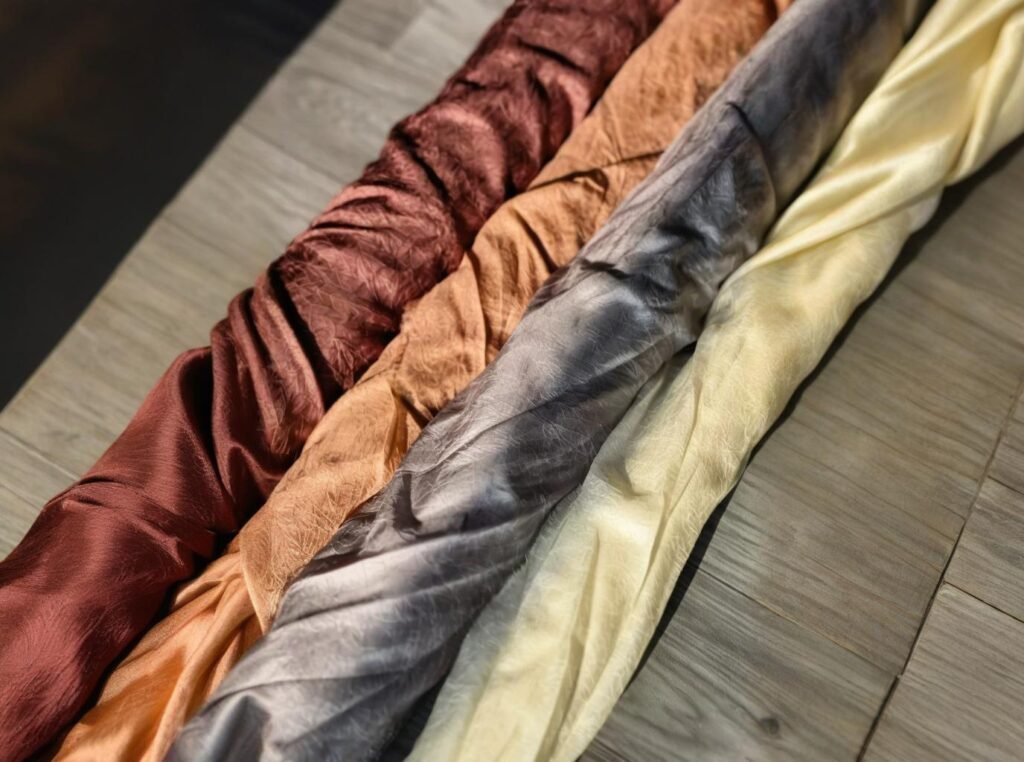
In wedding and event styling, linen selection is never made in isolation. While fabric choice is often discussed in terms of luxury or texture, seasonal conditions and thematic context play a far more decisive role in real-world decision-making. Professional planners, venues, and rental companies increasingly select table linens based on how fabrics behave under climate pressure, lighting variation, and long event timelines—not just how they look in curated inspiration images.
Yes, there are clear seasonal and theme-based preferences between satin and silk linens. Satin is favored year-round because of its stability, adaptability, and predictable performance across environments. Silk, by contrast, appears primarily in cooler seasons or tightly controlled themes, where softness, organic texture, and subtle drape are prioritized and environmental risks are manageable.
In practice, fabric choice often follows climate and setting more closely than color palette or trend forecasts.
When Silk Works—and When It Doesn’t
Silk is a beautiful but sensitive material. Its behavior changes noticeably with humidity, temperature, and handling. Satin—particularly polyester satin—maintains consistent appearance across a much wider range of conditions. This difference becomes most obvious when fabrics are evaluated season by season.
Seasonal Performance Differences
| Season | Satin Suitability | Silk Suitability |
|---|---|---|
| Spring | Excellent | Good |
| Summer | Excellent | Risky (humidity) |
| Autumn | Excellent | Good |
| Winter | Very good | Excellent |
These preferences are not stylistic opinions—they reflect failure rates observed by planners and rental operators.
Spring Weddings
Spring offers moderate temperatures but unpredictable weather. Morning dew, light rain, and fluctuating humidity are common.
- Satin performs reliably, resisting moisture marks and relaxing naturally once laid.
- Silk can work, but requires careful handling and protection from condensation, especially during early setup.
As a result, satin dominates large spring weddings, while silk is reserved for smaller, indoor ceremonies.
Summer Weddings
Summer is where the performance gap becomes most pronounced.
High humidity, heat, and condensation from cold drinks significantly increase silk’s risk of:
- Water spotting
- Loss of smoothness
- Uneven sheen
- Visible handling marks
Satin remains stable even in these conditions, making it the default choice for:
- Outdoor receptions
- Destination weddings
- Coastal and tropical venues
Many planners consider silk high-risk in summer, regardless of budget, unless the event is fully climate-controlled.
Autumn Weddings
Autumn offers cooler temperatures and lower humidity, restoring silk’s viability. Both fabrics perform well, but satin still dominates for large events due to ease of setup and storage as venues transition between indoor and outdoor spaces.
Silk appears more often in:
- Intimate ceremonies
- Romantic, textural themes
- Controlled indoor receptions
Winter Weddings
Winter is silk’s strongest season. Cold, dry air reduces moisture-related issues, and indoor venues are typically climate-controlled.
Silk performs exceptionally well in:
- Formal indoor weddings
- Private estates
- Luxury hotel ballrooms
Even here, many planners still limit silk to select tables or accent pieces, using satin for the majority of guest seating.
Outdoor vs Indoor Weddings
Beyond season, venue type heavily influences fabric choice. Outdoor weddings now represent a significant share of the global market, especially in destination and lifestyle-driven events.
Fabric Performance by Setting
| Setting | Recommended Fabric |
|---|---|
| Beach | Satin |
| Garden | Satin |
| Rooftop | Satin |
| Ballroom | Satin or silk |
| Private estate | Silk (selective) |
Outdoor Environments
Outdoor settings introduce variables that silk struggles to tolerate:
- Wind causing fabric shifting
- Dew settling on table surfaces
- Uneven ground affecting drape
- Direct sunlight creating uneven reflection
Satin’s heavier body and structural stability help it stay in place and maintain visual consistency. Silk, being lighter and more reactive, often requires constant adjustment.
For this reason, experienced planners almost universally specify satin for outdoor use, regardless of theme or budget.
Indoor Venues
Indoor environments allow more flexibility. Ballrooms and hotels with stable temperature and humidity can accommodate silk, especially for:
- Head tables
- Sweetheart tables
- VIP seating
Even so, satin remains the dominant choice for large-scale guest seating due to speed of setup and lower replacement risk.
Theme-Driven Fabric Choices
While season and setting define feasibility, wedding theme influences aesthetic preference. Certain visual styles naturally align better with specific fabric behaviors.
Theme-Based Fabric Preferences
| Wedding Theme | Fabric Preference |
|---|---|
| Modern minimalist | Satin |
| Luxury hotel | Satin |
| Romantic vintage | Silk |
| Editorial / fashion | Silk |
| Botanical / garden | Satin |
Modern Minimalist
Clean lines, symmetry, and controlled shine favor satin. Its smooth surface and consistent reflection support modern aesthetics without visual noise.
Luxury Hotel and Formal Events
Hotels prioritize efficiency and repeatability. Satin aligns with:
- Neutral palettes
- Large guest counts
- Tight turnover schedules
Silk is rarely used beyond feature elements.
Romantic Vintage and Editorial Themes
These themes value:
- Soft drape
- Organic texture
- Natural movement
Silk’s subtle irregularities enhance this look, particularly in styled or curated environments where conditions are controlled.
Botanical and Garden Themes
Despite the romantic association, botanical themes often occur outdoors. Satin’s resistance to moisture and debris makes it the practical choice, often paired with natural elements like florals or linen runners for texture contrast.
Color Trends in 2026 and Fabric Response
Color trends also influence fabric choice—not because colors differ, but because fabrics handle color differently under real lighting.
Trending wedding tones in 2026 include:
- Soft ivory
- Warm champagne
- Muted taupe
- Dusty sage
On satin, these colors remain:
- Even under mixed lighting
- Consistent across large surfaces
- Stable from setup to late evening
On silk, the same tones can:
- Appear uneven under spot lighting
- Show watermarking in humid conditions
- Shift subtly as the fabric moves
For planners managing visual consistency across dozens of tables, satin offers greater control.
Operational Realities Behind Fabric Preference
Beyond aesthetics, planners make decisions based on workflow realities:
- Limited setup windows
- Small teams managing large spaces
- Tight schedules between ceremony and reception
Satin allows:
- Faster table dressing
- Less steaming
- Fewer mid-event adjustments
Silk demands:
- More labor
- Higher attention
- Greater contingency planning
In high-pressure environments, predictability often outweighs subtle texture differences.
The Rise of Hybrid Styling Approaches
A notable shift in recent years is the adoption of hybrid linen strategies.
Many planners now:
- Use satin as the base tablecloth
- Add silk runners, overlays, or napkins
- Introduce silk selectively at focal points
This approach captures:
- Silk’s softness and visual richness
- Satin’s structural stability and reliability
It also reduces risk while preserving design intent.
Perspective Shift in Professional Planning
Rather than asking “silk or satin,” many planners now ask:
- Where is softness most visible?
- Where is durability most critical?
- Which surfaces will guests interact with most?
This layered thinking reflects a more mature understanding of materials as tools, not symbols.
Why Satin Dominates Year-Round
Satin’s year-round preference is not driven by cost alone. It reflects:
- Consistent performance
- Broad thematic adaptability
- Lower sensitivity to climate
- Reduced labor and stress
Silk remains valued—but within clearly defined boundaries.
Seasonal and theme-based preferences for satin and silk linens are shaped by experience, not trend cycles. As weddings become more complex, more public, and more time-sensitive, fabrics that reduce uncertainty gain favor.
Satin serves as the dependable foundation across seasons and themes. Silk functions as a deliberate accent—powerful when conditions allow, risky when they do not.
This is why many planners now begin with satin as the default and layer silk strategically, rather than choosing one fabric universally.
In modern wedding planning, success is measured not by how linens look at setup—but by how they perform throughout the entire event.
What Do Clients Care About in Table Linens (Durability, Care, Stain Resistance)?
When clients choose table linens for weddings or large events, they rarely think in terms of fiber science or textile theory. What they care about is far more practical: Will this look good all night? Will it survive the event? Will it create problems afterward? In real-world use, durability, ease of care, and stain resistance consistently outweigh abstract ideas like “natural fiber” or “heritage material.”
Across planners, venues, rental companies, and couples themselves, the same pattern appears again and again: satin meets these expectations far more reliably than silk.
In short, clients want linens they never have to worry about.
Why client priorities shift once the event begins
Before an event, clients focus on mood boards, inspiration photos, and idealized visuals. During the event, priorities shift quickly toward damage control and stress reduction. After the event, what remains is a clear memory of what caused problems—and what did not.
Table linens sit at the center of this transition:
- They are present from setup to teardown
- They are touched by every guest
- They absorb the consequences of food, drinks, heat, and movement
A fabric that looks beautiful at setup but deteriorates under real use creates disappointment, even if the damage is subtle.
The gap between expectation and experience
Silk often carries high expectations because of its reputation. Satin often carries modest expectations because of its familiarity. Ironically, this gap frequently works against silk and in favor of satin.
Clients expect silk to feel special, flawless, and effortless. When it wrinkles, stains, or frays, the disappointment feels sharper. Satin, by contrast, is expected to perform—and when it does, satisfaction increases.
This psychological gap plays a major role in how clients evaluate linens after the event.
Durability under real use
Wedding tables are not static displays. They are functional surfaces that experience constant friction and pressure throughout the event.
Linens are subjected to:
- Continuous contact with cutlery, plates, and glassware
- Chairs brushing against table edges
- Guests leaning, resting elbows, standing, and adjusting seats
- Staff clearing and resetting items repeatedly
| Durability Factor | Satin | Silk |
|---|---|---|
| Abrasion tolerance | High | Low |
| Edge wear | Minimal | Visible over time |
| Tear resistance | Stable | Fragile when stressed |
Satin’s filament structure and finishing give it higher abrasion resistance. It tolerates repeated friction without visibly degrading. Edges remain clean, and the fabric maintains structural integrity even after hours of use.
Silk, while strong in tensile terms, is surface-sensitive. Repeated rubbing causes:
- Fuzzing along edges
- Localized thinning
- Visible wear near corners and seams
In environments where guests behave casually—which is almost all weddings—silk’s delicacy becomes a liability rather than a virtue.
Edge behavior and table geometry
Edges are where table linens fail first. Long banquet tables, cocktail tables, and high-tops all create stress points.
Satin:
- Holds a clean edge line
- Resists curling and distortion
- Maintains visual order
Silk:
- Softens and collapses at edges
- Shows movement and distortion more easily
- Develops visible wear sooner
For planners managing dozens of tables, edge behavior directly affects how “finished” the room looks by mid-event.
Care requirements after the event
Post-event care strongly influences satisfaction, especially for venues and rental companies that reuse linens. What happens after guests leave determines whether a fabric feels like a smart investment or an ongoing burden.
| Care Aspect | Satin | Silk |
|---|---|---|
| Washing method | Machine or gentle wash | Often dry clean only |
| Drying tolerance | Good | Poor |
| Ironing difficulty | Low | High |
Satin can typically be:
- Machine washed or gently laundered
- Dried with minimal risk
- Ironed or steamed quickly
This simplicity translates directly into lower labor costs and faster turnaround.
Silk often requires:
- Dry cleaning or specialized washing
- Careful drying to avoid water marks
- Slow, delicate ironing
Many clients only realize these requirements after the event. At that point, the perceived luxury of silk is overshadowed by frustration and expense.
The hidden cost of ownership
For one-time private events, care costs may seem secondary. For venues and rental companies, they are central.
Repeated use reveals that silk:
- Increases per-event cleaning cost
- Shortens usable lifespan
- Requires more staff training
Satin’s lower care burden allows:
- Faster reuse
- Lower long-term cost per event
- Greater operational efficiency
This is why many high-end venues reserve silk for accent pieces and rely on satin for core inventory.
Stain resistance and forgiveness
No matter how carefully an event is planned, accidents are inevitable. Spills, condensation, wax, and food contact happen at every wedding.
| Common Issue | Satin Outcome | Silk Outcome |
|---|---|---|
| Wine spill | Often removable | Frequently permanent |
| Candle wax | Easy to remove | Risk of fiber damage |
| Condensation rings | Minimal | Visible water marks |
Satin’s surface chemistry makes it more forgiving. Liquids tend to sit on the surface longer, allowing staff to blot and clean before permanent damage occurs.
Silk absorbs liquids more readily. Wine, oil, and even water can leave visible marks that are difficult or impossible to remove completely.
The emotional impact of stains
Beyond technical outcomes, stains have an emotional cost. When clients see marks appearing during the event, anxiety rises.
Satin reduces this anxiety because:
- Small spills often disappear after quick attention
- Marks are less visible under lighting
- Fabric recovers visually
Silk increases anxiety because:
- Marks appear immediately
- Damage feels irreversible
- Attention shifts from celebration to concern
Even if guests never comment, clients notice—and remember.
Wrinkles, movement, and time
An event lasts several hours. Linens must look acceptable not just at setup, but at every stage of the day.
Satin offers:
- Better wrinkle resistance
- Faster visual recovery after movement
- More stable drape over time
Silk wrinkles easily and holds those wrinkles. As guests sit, stand, and adjust chairs, creases accumulate and remain visible.
By the end of the evening, silk-covered tables often look noticeably more rumpled than satin-covered ones, regardless of initial setup quality.
Guest behavior versus fabric ideal
Clients often imagine guests behaving carefully around expensive linens. Reality is different.
Guests:
- Place bags and phones on tables
- Drag chairs slightly
- Lean heavily during conversations
- Spill drinks without noticing
Satin tolerates this behavior without obvious damage. Silk does not.
This mismatch between imagined and actual behavior is one of the biggest drivers of post-event regret.
Emotional factor: peace of mind
While clients may talk about aesthetics and style, what they value most during an event is peace of mind.
Peace of mind means:
- Not watching every table nervously
- Not worrying about stains
- Not anticipating cleaning problems
Satin delivers this more consistently because it removes fabric-related stress from the event experience.
Silk, by contrast, often demands attention—careful placement, monitoring, and post-event concern.
Planner and venue perspective
Professional planners and venues think in terms of risk management. Their recommendations strongly influence client choices.
From their perspective:
- Satin reduces complaints
- Satin lowers replacement rates
- Satin simplifies logistics
This is why planners frequently steer clients toward satin even when silk is technically available.
Their goal is not to downgrade luxury, but to protect the overall experience.
Perceived luxury versus lived luxury
Luxury is often confused with rarity. In event contexts, luxury is more accurately defined as effortless execution.
A fabric that:
- Looks good throughout the event
- Requires minimal intervention
- Leaves no lasting problems
feels more luxurious than one that demands constant care.
Many clients only understand this distinction after experiencing both options.
Long-term satisfaction and memory
What clients remember weeks later is not fiber content. They remember:
- Whether the event felt smooth
- Whether anything went wrong
- Whether they felt stressed
Satin’s reliability supports positive memory. Silk’s fragility can undermine it.
This memory effect influences:
- Reviews
- Referrals
- Repeat bookings
Especially for venues and planners, these downstream effects matter more than initial material prestige.
When silk still makes sense
Silk is not inherently wrong. It simply fits narrower use cases.
Silk works best when:
- Table count is small
- Styling is controlled
- Staff-to-table ratio is high
- Visual softness is prioritized over durability
In these situations, its organic elegance can shine.
For most weddings, however, those conditions are difficult to maintain.
Clients may initially be drawn to the idea of silk, but what they truly value is not having to think about linens at all.
A “luxury” fabric that creates anxiety rarely feels luxurious by the end of the night.
Satin aligns more closely with what clients care about in practice: durability, easy care, stain resistance, and peace of mind. That alignment—not marketing language—is why satin continues to dominate real-world wedding table use.
How Should Event Buyers and Suppliers Source Satin or Silk Linens for 2026 Events?
By 2026, sourcing event linens is no longer a simple purchasing task. It has become a performance-driven supply chain decision shaped by tighter timelines, higher design expectations, and less tolerance for operational risk. Weddings and large-scale events are more customized, more visually documented, and more logistically compressed than ever before. In this environment, the difference between a successful event and a costly failure often comes down to how linens were sourced months earlier.
Successful sourcing in 2026 depends on working with fabric partners who can customize weight, finish, color consistency, and performance, not just supply standard rolls from a catalog. Event buyers should prioritize tested specifications, fast sampling capability, and stable lead times over brand reputation or fiber labels.
Fabric sourcing is about process reliability, not promises.
Why 2026 Linen Sourcing Is Fundamentally Different
Several industry shifts are reshaping how event linens must be sourced:
- Weddings are more design-driven, with precise color palettes and texture expectations
- Photography and video amplify fabric flaws that once went unnoticed
- Outdoor and destination events are more common, increasing environmental stress on materials
- Venues and planners face tighter setup windows and higher labor costs
- Clients expect flawless execution, even under unpredictable conditions
These trends reduce tolerance for fabrics that behave unpredictably. A linen that wrinkles excessively, shifts on tables, stains easily, or arrives inconsistent in color can derail an entire setup.
As a result, professional buyers now treat satin and silk linens less as decorative textiles and more as functional materials with defined performance requirements.
How Professionals Source With Confidence
Start With Performance-Based Specifications
The most common sourcing mistake is starting with a fabric name instead of a performance outcome. Terms like “satin” or “silk” describe broad categories, not behavior. Two satins can perform very differently depending on weave density, finish, and weight. Two silks can vary dramatically in wrinkle memory and stain response.
Instead of asking suppliers what they have, professionals specify what the fabric must do.
| Specification | Why It Matters |
|---|---|
| Fabric weight (GSM) | Controls drape, table grip, wind resistance |
| Weave density | Influences wrinkle recovery and surface stability |
| Finish | Affects stain resistance, softness, and reflectivity |
| Color tolerance | Ensures visual consistency across batches |
| Shrinkage rate | Determines fit after washing and reuse |
Each parameter removes ambiguity. For example, specifying a satin at 220–240 GSM with low wrinkle memory and matte finish provides far more clarity than requesting “heavy satin.”
In 2026, suppliers expect this level of precision. Buyers who cannot articulate performance requirements are more likely to receive generic solutions that fail under event conditions.
Define the Use Scenario Clearly
Specifications should be tied to how the linen will actually be used, not how it looks in a showroom.
Key questions include:
- Will the linens be used indoors, outdoors, or both?
- Will they be used for dining tables, cocktail tables, head tables, or décor backdrops?
- How long will they remain in place without adjustment?
- Will they be reused across multiple events?
A satin intended for outdoor banquet tables needs different weight and finish characteristics than one used for indoor ceremony styling. Without defining these scenarios, even detailed specs can miss critical requirements.
Always Request Samples and Wash Tests
No amount of verbal assurance replaces physical testing. In 2026, professionals treat sampling as a non-negotiable step, not a courtesy.
| Test Stage | Purpose |
|---|---|
| Visual sample | Confirms color, sheen, and surface quality |
| Table mock-up | Evaluates drape, grip, and corner behavior |
| Wash test | Reveals shrinkage, wrinkle memory, color shift |
| Stain test | Simulates wine, oil, and condensation exposure |
Visual samples alone are insufficient. A fabric that looks flawless flat may behave poorly once draped over a round table or exposed to weight at the edges.
Wash testing is especially critical for buyers planning reuse. Many linens look excellent new but degrade quickly after the first or second wash. Testing reveals:
- Post-wash stiffness or limpness
- Increased wrinkle retention
- Color fading or unevenness
- Changes in hand feel
Skipping these tests transfers risk directly to the event floor.
Mock-Ups Reveal What Swatches Cannot
Experienced buyers insist on table mock-ups, not just hand swatches. Draping a fabric over the actual table size reveals:
- Whether corners stay aligned
- How the fabric reacts to gravity
- Whether weight distribution is stable
- How the surface photographs under lighting
These behaviors cannot be predicted from small samples.
Why Customization Matters More in 2026
Standard linens are increasingly inadequate for modern weddings. Design briefs are more specific, and venues are more diverse. Custom development allows buyers to solve real problems rather than compromise around limitations.
Customization enables:
- Heavier satin for outdoor stability and wind resistance
- Matte or soft-gloss finishes optimized for photography
- Precise color matching for branded or themed weddings
- Controlled wrinkle recovery for fast setups
In 2026, customization is no longer a luxury reserved for high-end events. It is becoming an expectation, especially for planners serving clients who demand differentiation.
For example, a soft-gloss satin may photograph better under LED lighting than a high-shine satin, which can create glare. Without customization, buyers are forced to choose from suboptimal stock options.
Managing Color Consistency at Scale
Color inconsistency is one of the most damaging failures in event linens. Slight dye variations become obvious when multiple tables are set side by side.
Professional sourcing addresses this by:
- Defining acceptable ΔE color tolerances
- Requesting bulk lab dips, not just small swatches
- Confirming batch control and dye lot consistency
In 2026, clients notice color mismatches immediately—often through photos shared online. Preventing this requires process control, not trust alone.
Choosing the Right Manufacturing Partner
Fabric quality alone is not enough. Bulk success depends on supplier capability and discipline.
Reliable manufacturing partners typically offer:
- In-house fabric development rather than outsourced sourcing
- Low MOQ flexibility for custom runs
- Fast sampling turnaround to support tight timelines
- Documented quality control standards
- Clear, realistic communication on lead times
Without these elements, even a well-designed fabric can fail due to delays, substitutions, or inconsistency.
Why Process Control Matters More Than Brand Names
In event sourcing, brand reputation does not guarantee batch consistency. What matters is whether the supplier controls:
- Yarn selection
- Weaving or finishing parameters
- Dyeing processes
- Inspection and packing standards
Suppliers with in-house control can reproduce results reliably. Those relying on multiple subcontractors often introduce variation between samples and bulk orders.
Lead Time Stability as a Sourcing Criterion
In 2026, timelines are compressed. Late deliveries can collapse event schedules. Buyers increasingly evaluate suppliers not on theoretical capacity, but on lead time reliability.
Key questions to ask include:
- How long does sampling realistically take?
- What is the buffer for unexpected delays?
- How are peak seasons handled?
- What happens if specifications change slightly?
Suppliers who communicate clearly about constraints are often more reliable than those who promise aggressive timelines without evidence.
Sourcing as Risk Management
Professional event buyers view sourcing as risk mitigation. Every unclear spec, skipped test, or rushed decision increases exposure.
Common risks include:
- Wrinkling that cannot be corrected on-site
- Staining that becomes permanent during service
- Fabric shifting that disrupts table alignment
- Color mismatches across tables or venues
Each of these issues carries reputational cost that far exceeds fabric price differences.
Aligning Cost With Lifecycle Value
In 2026, cost evaluation is shifting from unit price to cost per successful use. A slightly more expensive satin that:
- Sets faster
- Requires less steaming
- Cleans more easily
- Lasts twice as many cycles
Often delivers lower total cost than a cheaper fabric that fails early.
Professional buyers increasingly ask:
- How many events can this linen realistically support?
- How does performance change after washing?
- How much labor does it save during setup?
These questions reshape sourcing decisions.
Collaboration Over Transaction
The most successful sourcing relationships in 2026 resemble product development partnerships, not transactional purchasing. Buyers share:
- Event scenarios
- Design goals
- Logistical constraints
Suppliers respond with material adjustments, not just price quotes.
This collaboration reduces last-minute surprises and builds long-term reliability.
As weddings and events become simultaneously more customized and more logistically demanding, fabric sourcing is evolving into a form of applied engineering. Buyers are no longer just selecting textiles—they are specifying performance systems that must operate under pressure.
In this environment, satin and silk are not opposing choices. They are tools with different strengths. The winning strategy is not choosing the “right” fiber label, but sourcing fabrics that behave predictably before guests arrive, during service, and at the end of the night.
In 2026, the most successful event buyers will be those who treat linen sourcing not as decoration—but as infrastructure.
Ready to Customize Wedding Table Linens for 2026?
At SzoneierFabrics, we support wedding planners, venues, and event suppliers with custom satin and silk table linen development—designed for real weddings, not just showroom displays.
We offer:
- Custom satin and silk fabrics for table linens
- Adjustable weight, sheen, and drape
- Low MOQ customization for trial projects
- Fast sampling and free samples
- Stable lead times and consistent quality
If you’re planning weddings for 2026 and want table linens that look beautiful, perform reliably, and stay stress-free, we’re ready to help.
Contact SzoneierFabrics to request samples, customization options, or a tailored quotation today.