
Color problems in spandex fabrics rarely show up on the dyeing floor. They appear later—after washing, stretching, sweating, or long-term wear—when shades dull, bleed, or shift unexpectedly. This is why spandex dyeing has earned a reputation as one of the most demanding processes in textile manufacturing. It’s not that spandex can’t be dyed well; it’s that it reacts very differently from most fibers once color is introduced.
the spandex dyeing process requires controlled chemistry, lower thermal stress, and carefully matched dyes to achieve stable colorfastness without damaging elastic performance. Unlike cotton or polyester, spandex cannot tolerate aggressive dyeing conditions, so industrial solutions focus on protecting the fiber while fixing color securely in blended fabrics.
What makes this topic especially important is that spandex almost never stands alone. It’s usually blended into fabrics meant to stretch, recover, and perform under real-life conditions. When dyeing goes wrong, the failure isn’t just visual—it affects elasticity, comfort, and product lifespan. Understanding how spandex dyeing really works is the difference between fabrics that age gracefully and those that fail prematurely.
What Is the Spandex Dyeing Process, and Why Is It Different from Dyeing Conventional Fibers?
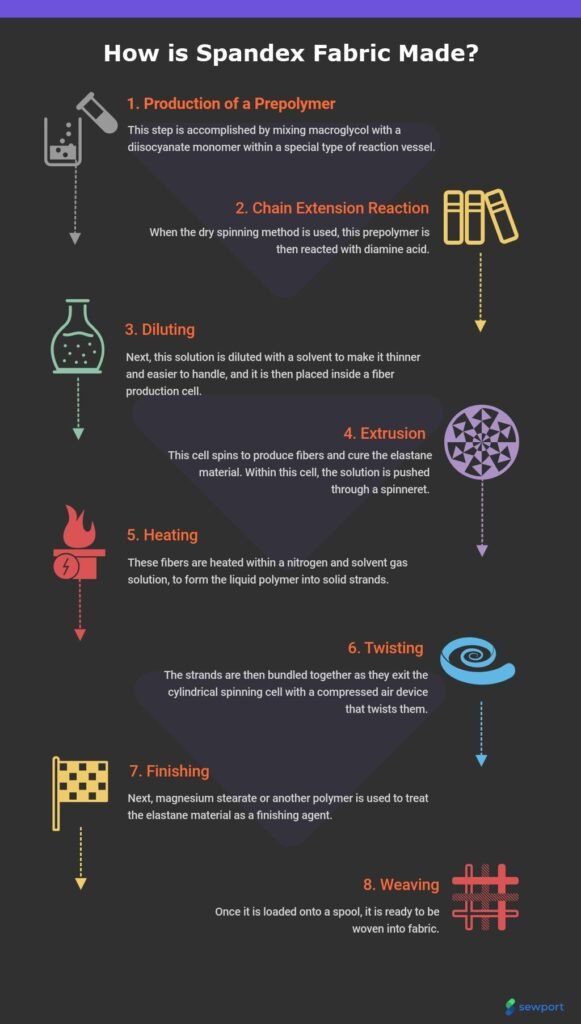
The spandex dyeing process is a carefully controlled industrial operation designed to achieve acceptable color appearance while preserving elastic recovery, tensile strength, and long-term durability. Unlike cotton, polyester, or nylon, spandex is not engineered to tolerate aggressive chemical environments. It is a segmented polyurethane fiber whose primary function is stretch and recovery, not dye uptake. As a result, dyeing spandex-containing fabrics is less about “coloring elastane” and more about protecting it while other fibers are dyed.
This difference explains why spandex dyeing cannot simply follow conventional recipes. Processes that work well for polyester or cotton can permanently damage elastane, even if the fabric initially appears acceptable. The consequences—loss of stretch, yellowing, reduced recovery, and early fabric failure—often emerge only after laundering or extended wear, making dyeing mistakes particularly costly.
Spandex behaves differently because it is chemically and physically different. Its polymer structure is designed to elongate and retract repeatedly, not to resist high heat, extreme pH, or aggressive dye carriers.
Why spandex behaves differently in dyeing
From a dyeing perspective, spandex is one of the most sensitive fibers used in modern textiles. Its limitations dictate the entire dyeing strategy for blended fabrics.
Spandex fibers:
- Have low inherent dye affinity
- Degrade at elevated temperatures
- Are vulnerable to both strong acids and strong alkalis
- Are rarely intended to be dyed as the dominant fiber
| Fiber Type | Typical Dyeing Temperature | Chemical Tolerance |
|---|---|---|
| Cotton | 60–90°C | High |
| Polyester | 130°C | High |
| Nylon | 95–100°C | Medium |
| Spandex | ≤80°C (often lower) | Low |
Polyester can withstand high-temperature dyeing because its molecular structure is relatively stable under heat and pressure. Cotton tolerates a wide pH range and aggressive auxiliaries. Spandex does neither. Exposure to temperatures commonly used for polyester disperse dyeing or to harsh scouring conditions can irreversibly damage elastane chains.
Because spandex is usually present at low percentages—often between 2% and 10%—its role is structural rather than visual. This means dyeing strategies must prioritize protecting elastane while still achieving acceptable shade depth on the companion fiber.
The segmented polyurethane structure and its implications
Spandex is composed of alternating hard and soft segments. The soft segments provide extensibility, while the hard segments act as anchor points that enable recovery. This segmented structure is what allows spandex to stretch several times its original length and return with force.
However, this same structure is sensitive to heat and chemical attack. High temperatures can disrupt the balance between hard and soft segments. Strong acids or alkalis can break urethane linkages. Once these bonds are damaged, recovery force drops, and the fiber may yellow, stiffen, or lose elasticity.
Dyeing conditions that are harmless to polyester can therefore be destructive to spandex. The fiber may survive the dye bath visually intact but fail mechanically after use.
Indirect dyeing: the core concept
In most commercial applications, spandex is not dyed directly. Instead, dyeing focuses on the companion fiber in the blend, while spandex is either lightly tinted or effectively protected.
In practice:
- Polyester, nylon, or cotton absorbs the majority of the dye
- Spandex takes up little or no dye
- Overall color uniformity depends on blend ratio and fabric construction
This is why spandex dyeing is fundamentally about blend management rather than elastane coloration. The goal is to make the fabric appear evenly colored while ensuring elastane remains chemically intact.
In a polyester–spandex fabric, for example, disperse dyes are chosen and applied under modified conditions. Temperature may be reduced, dwell times shortened, and carriers carefully selected to avoid attacking elastane. The polyester carries the color; the spandex contributes stretch.
In cotton–spandex blends, reactive or direct dyes target cotton, while elastane is shielded from harsh alkali exposure. Process steps are adjusted to limit the time elastane is exposed to damaging conditions.
Process adjustments required for spandex-containing fabrics
Dye houses handling spandex blends must modify several aspects of standard dyeing recipes. These changes are not optional; they are essential to maintaining fabric performance.
Key adjustments include:
- Lower dyeing temperatures
- Shorter dyeing cycles
- Controlled pH windows
- Reduced mechanical agitation
- Careful selection of auxiliaries
Temperature control is particularly critical. Even brief exposure above recommended limits can initiate elastane degradation. Unlike shrinkage or shade variation, elastane damage is irreversible.
pH control is equally important. Strong alkalis used in cotton dye fixation or aggressive reduction clearing steps can attack elastane. Buffer systems and milder fixation strategies are often required.
Mechanical stress also matters. Excessive agitation during dyeing or washing can overstretch elastane when it is in a weakened state due to heat or chemicals, compounding damage.
What happens when spandex is dyed like polyester?
One of the most common process errors occurs when polyester–spandex fabrics are dyed using standard high-temperature polyester recipes without adequate modification.
When spandex is exposed to:
- Excessive heat
- Prolonged dye cycles
- Strong carriers or dispersants
the consequences include:
- Loss of elasticity
- Yellowing or discoloration
- Reduced recovery force
- Premature fabric failure
These effects are often delayed. Fabrics may pass shade approval and even initial stretch tests. However, after a few laundering cycles, recovery drops noticeably, garments bag out, and complaints begin.
This delayed failure is particularly dangerous in production environments, because it shifts problems downstream—into garment manufacturing or even into the consumer’s hands.
Spandex yellowing and shade instability
Yellowing is a common symptom of spandex degradation. It can be caused by heat exposure, oxidative damage, or reaction with certain dye auxiliaries. Once yellowing occurs, it is difficult to correct without further stressing the fiber.
Shade instability can also result from uneven dye uptake between the companion fiber and elastane. While spandex itself may not take dye readily, its presence influences how the fabric reflects light. If elastane degrades unevenly, visual shade can shift over time, especially in pale or pastel colors.
This is another reason why dyeing recipes for spandex blends are often more conservative, favoring stability over maximum shade depth.
Wash durability and recovery retention
From a performance standpoint, the most important metric is not initial shade accuracy but how well the fabric retains elastic recovery after repeated washing. Spandex damage often reveals itself as a gradual loss of stretch and snap-back rather than an immediate failure.
In controlled testing, fabrics dyed under overly aggressive conditions may lose significant recovery within a short period.
Practical industry data shows that spandex fabrics dyed above recommended limits often lose 15–30% of elastic recovery after just a few wash cycles. This level of degradation is enough to compromise garment fit and appearance, even if the fabric still meets basic dimensional specifications.
This is why experienced dye houses prioritize fiber protection over shade speed or maximum depth. A slightly lighter shade with stable elasticity is far preferable to a perfect initial color that fails prematurely.
Dye selection and auxiliary compatibility
Not all dyes and auxiliaries are equally compatible with spandex. Certain dispersants, carriers, and leveling agents can interact negatively with elastane polymers.
Dye houses specializing in spandex blends typically:
- Avoid aggressive carriers
- Use spandex-safe dispersants
- Limit oxidative and reductive treatments
- Validate chemical compatibility through testing
Chemical compatibility is often verified through accelerated aging tests, not just immediate shade evaluation. This helps identify recovery loss or yellowing before full-scale production.
The role of fabric construction
Fabric construction influences how spandex responds during dyeing. Tight constructions restrict elastane movement, which can either protect it or concentrate stress, depending on conditions. Looser constructions allow more movement but may expose elastane to greater mechanical strain.
Balanced structures help distribute stress evenly, reducing the risk of localized damage. This is why dyeing parameters must be aligned not only with fiber type but also with fabric geometry and elastane percentage.
Process sequencing matters
The order of operations in dyeing and finishing can significantly affect elastane performance. Steps such as scouring, dyeing, reduction clearing, and softening must be sequenced to minimize cumulative stress on spandex.
For example, performing aggressive reduction clearing after dyeing may remove surface dye from polyester but at the cost of elastane damage. Alternative cleaning strategies are often used for spandex blends, even if they are less efficient for dye removal.
Practical industry insight
In real production environments, the most reliable spandex dyeing operations are those that treat elastane as the limiting factor in the process. Instead of asking how fast or deep a shade can be achieved, they ask how much stress elastane can tolerate without losing recovery.
When this mindset is applied, fabrics maintain stretch performance over time, even if the dyeing process takes longer or requires additional controls. When it is ignored, failures appear later, often outside the dye house’s direct responsibility.
Key understanding
Spandex dyeing is not simply a variation of conventional dyeing. It is a fundamentally different process driven by the need to protect a chemically sensitive, mechanically critical fiber. Success depends on controlling temperature, pH, chemistry, and mechanical stress across the entire process.
Color can always be adjusted. Lost elasticity cannot be restored.
This is why experienced producers treat spandex dyeing as a discipline of restraint. By respecting elastane’s limitations and designing processes around them, it is possible to achieve stable color, durable recovery, and long-lasting fabric performance—something no amount of aggressive dyeing can compensate for later.
Which dye types are suitable for spandex and spandex-blend fabrics, and why?
Spandex itself has very limited dye affinity because its segmented polyurethane structure lacks the functional groups that most dyes bind to. As a result, spandex is almost never dyed directly. Instead, dye systems are selected according to the primary fiber in the blend, with processing conditions carefully adjusted to avoid damaging the elastane component. In practice, dye selection is a balance between achieving target shade, maintaining elasticity, and preserving long-term fabric performance.
For spandex-blend fabrics, the dye choice is never just about color depth or brilliance. It is about chemical compatibility, thermal tolerance, pH exposure, and mechanical stress during dyeing. A dye that works perfectly for the base fiber can still cause irreversible elastane degradation if process conditions are not controlled.
Common spandex blends and matching dye systems
| Spandex Blend | Primary Dye Type | Key Consideration |
|---|---|---|
| Polyester + Spandex | Disperse dyes | Lower temperature, short dwell |
| Nylon + Spandex | Acid dyes | Controlled pH |
| Cotton + Spandex | Reactive dyes | Mild alkali exposure |
| Viscose + Spandex | Reactive/vat dyes | Time & tension control |
The base fiber dictates dye chemistry, but elastane dictates process limits. Understanding both is essential for stable dyeing results.
Why spandex has limited dye affinity
Spandex fibers are composed primarily of polyurethane chains with alternating soft and hard segments. These segments provide elasticity but offer very few active sites for dye attachment. Unlike cotton, which has abundant hydroxyl groups, or nylon, which contains amide groups, spandex does not readily form chemical bonds with common dyes.
As a result:
- Most dyes pass over spandex without fixation
- Color appears only on the base fiber
- Spandex remains visually neutral within the fabric
- Chemical attack on elastane becomes the primary risk, not shade failure
This is why spandex dyeing is fundamentally about protecting elastane while dyeing everything else.
Polyester–spandex: why disperse dyes are preferred
Polyester-spandex blends dominate sportswear, compression garments, and performance apparel. For these fabrics, disperse dyes are the industry standard.
Disperse dyes are non-ionic, low-molecular-weight dyes designed to diffuse into hydrophobic polyester fibers. Their advantages for spandex blends include:
- No need for strong acids or alkalis
- Lower dye concentration compared to reactive systems
- Compatibility with controlled temperature profiles
- Minimal direct chemical interaction with elastane
However, traditional polyester dyeing often occurs at temperatures of 130 °C or higher. Spandex is sensitive to prolonged exposure above approximately 120 °C, especially under tension.
To protect elastane, dye houses typically:
- Reduce maximum dyeing temperature to 110–120 °C
- Shorten high-temperature dwell time
- Use carrier-free or elastane-safe carrier systems
- Apply gradual heating and cooling curves
When these controls are applied correctly, polyester-spandex fabrics retain 90% or more of their original elastic recovery after dyeing.
The hidden risk of dye carriers
Some disperse dye systems rely on carriers to promote dye uptake at lower temperatures. While effective for polyester, many traditional carriers are aggressive solvents that can swell or weaken spandex.
Problematic carrier effects include:
- Loss of tensile strength in elastane
- Reduced recovery after stretch
- Increased risk of yarn breakage during finishing
- Premature fabric aging
For this reason, modern spandex dyeing increasingly relies on carrier-free disperse dyes or elastane-approved auxiliary systems, even if dye cycles become slightly longer.
Nylon–spandex: acid dyes with pH discipline
Nylon-spandex blends are common in hosiery, swimwear, intimate apparel, and medical textiles. Nylon fibers have strong affinity for acid dyes due to their amide groups, which bond readily under acidic conditions.
Acid dyes offer:
- Excellent shade range
- Good levelness on nylon
- High colorfastness when properly fixed
The challenge lies in pH control. Elastane is sensitive to prolonged exposure to strong acids, particularly at elevated temperatures.
Best-practice acid dyeing for nylon-spandex typically involves:
- Maintaining dyebath pH between 4.5 and 5.5
- Avoiding strong mineral acids
- Using buffered acid systems
- Limiting dyeing time at peak temperature
When pH drops too low or exposure is too long, elastane can undergo hydrolytic degradation, leading to:
- Reduced elongation
- Brittle fiber behavior
- Loss of compression consistency
In well-controlled acid dyeing, nylon-spandex fabrics can achieve excellent shade depth with minimal elasticity loss, but discipline is non-negotiable.
Cotton–spandex: reactive dyes under mild alkali
Cotton-spandex blends are widely used in stretch denim, casual wear, and comfort-oriented garments. Cotton dyes easily with reactive dyes, which form covalent bonds with cellulose under alkaline conditions.
Reactive dyes are favored because they offer:
- Strong color fixation
- Wide shade availability
- Good wash fastness
However, elastane is vulnerable to strong alkalis, especially sodium hydroxide. Excessive alkalinity can damage spandex chains, reducing recovery and causing yellowing.
To protect elastane, dye houses modify standard reactive dyeing by:
- Using milder alkalis such as sodium carbonate
- Lowering alkali concentration
- Reducing fixation temperature
- Shortening alkali exposure time
These adjustments slightly reduce dye fixation efficiency but preserve elastane integrity. In cotton-spandex fabrics, a small sacrifice in dye yield is preferable to long-term elasticity loss.
Viscose–spandex: managing time and tension
Viscose (rayon)-spandex blends behave similarly to cotton-spandex in dye chemistry but introduce additional mechanical risks. Viscose fibers weaken significantly when wet, and elastane is sensitive to both tension and chemical exposure.
Reactive or vat dyes are commonly used, but process control must address:
- Lower wet strength of viscose
- Risk of elongation under fabric weight
- Elastane sensitivity to prolonged wet processing
Key process adjustments include:
- Minimizing fabric tension during dyeing
- Using support rollers or low-tension transport
- Shortening total dye cycle duration
- Careful neutralization after dyeing
Failure to control these factors often results in permanent fabric length growth, uneven recovery, or distorted garment dimensions.
Dye compatibility vs color brilliance
Highly brilliant or high-energy dyes are often attractive from a design perspective, but they typically require more aggressive dyeing conditions.
Highly brilliant dyes often:
- Require higher temperatures
- Need longer dwell times
- Involve stronger auxiliaries
- Increase dye migration risk
| Dye Characteristic | Effect on Spandex |
|---|---|
| Mild, stable | Better elasticity retention |
| Aggressive, high-energy | Higher degradation risk |
In spandex blends, extreme brightness can come at the cost of elasticity retention. This is why many industrial and performance fabrics favor stable, medium-bright shades that maintain fabric function over time.
Colorfastness and elastane protection
Colorfastness testing for spandex blends must consider both shade retention and elastic performance. A fabric that holds color but loses recovery is not a successful result.
Well-managed dye systems aim to achieve:
- Minimal shade change after washing
- Stable elasticity after repeated laundering
- No surface cracking or powdering
- Consistent compression behavior
This requires dye systems that are chemically compatible with elastane and finishing processes that do not overstress the fiber.
Real-world dye house practice
Experienced dye houses treat spandex blends as a separate category, not a simple extension of base-fiber dyeing. Common professional practices include:
- Modified dye curves with gradual heating and cooling
- Reduced peak temperature dwell
- Elastane-protective auxiliaries
- Controlled fabric tension throughout the process
- Separate shade libraries for spandex blends
These adjustments may reduce throughput slightly, but they significantly extend fabric lifespan and reduce post-dyeing defects.
In production audits, mills that follow elastane-specific dye protocols consistently report:
- Lower rejection rates
- Fewer elasticity-related complaints
- Better consistency between dye lots
- Improved garment performance after washing
Why finishing cannot fix dye damage
Once elastane is chemically or thermally damaged during dyeing, no finishing process can restore its original properties. Heat setting may stabilize dimensions, but lost recovery and fatigue resistance are permanent.
This is why dye compatibility decisions are upstream quality decisions. Cutting corners in dye selection or process control often leads to irreversible performance loss.
Practical decision takeaway
Selecting dye types for spandex-blend fabrics is not about choosing the strongest dye for the base fiber. It is about choosing the least aggressive system that achieves acceptable color performance.
Successful spandex dyeing relies on:
- Matching dye chemistry to the primary fiber
- Limiting temperature, pH, and dwell time
- Avoiding aggressive carriers and auxiliaries
- Accepting moderate shade trade-offs for long-term elasticity
When dye systems respect elastane’s limits, spandex remains an invisible performance contributor rather than a failure point. The result is fabric that not only looks right on day one, but continues to perform after months of wear and repeated laundering.
How does spandex content affect dye uptake, shade uniformity, and fabric appearance?
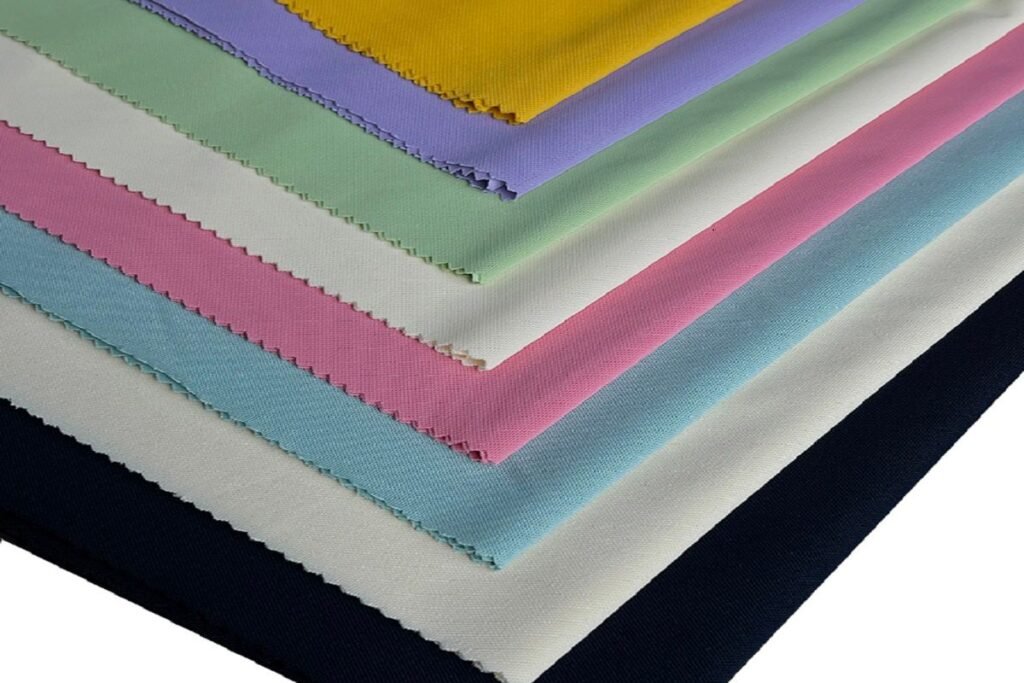
As spandex content increases in a fabric, color control becomes less about dye chemistry alone and more about managing tension, structure, and optics. Elastane fibers absorb little to no dye, yet they exert a disproportionate influence on how color is perceived. They change loop geometry, alter surface reflection, and introduce elastic forces that affect dye penetration and fixation. The result is a fabric that may meet laboratory color targets but still look lighter, patchier, or less uniform in real use.
This is why spandex-rich fabrics are often described as “difficult to dye.” The difficulty is not that elastane rejects color—it is that spandex reshapes the visual and mechanical environment in which dyeing occurs. Without process adjustments, higher spandex percentages increase the risk of shade dilution, uneven appearance, and stretch-dependent color variation.
Spandex doesn’t want color—but it changes how color looks.
Why Higher Spandex Percentages Change the Shade
Elastane fibers are typically undyed or only lightly pigmented. As their proportion increases, the share of dyeable fibers in the fabric decreases, even if the total fabric weight remains constant. This has immediate visual consequences.
- The effective dyeable surface area is reduced
- Color depth appears lighter at the same dye concentration
- Light scattering increases due to elastic-induced surface changes
| Spandex % | Visual Impact on Shade |
|---|---|
| 2–5% | Minimal |
| 6–10% | Slight lightening |
| 11–20% | Noticeable dilution |
| >20% | High risk of uneven appearance |
At low spandex levels, the dominant fibers (polyester, nylon, or cotton) control color appearance. As elastane content rises, undyed elastic filaments interrupt the color field, reflecting light differently and reducing apparent saturation. Designers often respond by specifying deeper shades, but adding more dye does not address mechanical imbalance.
At higher elastane levels, shade dilution becomes non-linear. A 5% increase from 10% to 15% spandex typically causes a more visible lightening effect than an increase from 2% to 7%, because elastic filaments begin to dominate surface behavior rather than merely supporting stretch.
Mechanical Effects on Color Uniformity
Spandex changes how a fabric behaves in the dye bath. These mechanical effects are often the primary cause of uneven color, even when dye recipes are correct.
- Increased elastic tension alters loop opening and closure
- Elastic rebound changes fabric density dynamically
- Liquor penetration becomes inconsistent across the width
| Issue | Resulting Defect |
|---|---|
| Uneven stretch | Barre or striping |
| Elastic rebound | Patchy shade |
| Fabric torque | Visual streaks |
Uneven stretch across the fabric width creates differential exposure to dye liquor. Areas under higher tension absorb dye differently from relaxed zones, leading to subtle striping or barre effects that become more visible after drying and finishing. Elastic rebound during heating ramps can cause temporary density changes, producing patchy appearance even when final measurements appear uniform.
Fabric torque—especially in asymmetrical knits—causes localized loop distortion. This changes how light reflects off the surface, making streaks visible even when dye uptake is technically even. In these cases, the defect is optical rather than chemical.
Uniform color therefore requires uniform tension control, not just correct dye concentration or time.
Dyeing Dynamics in Spandex-Rich Fabrics
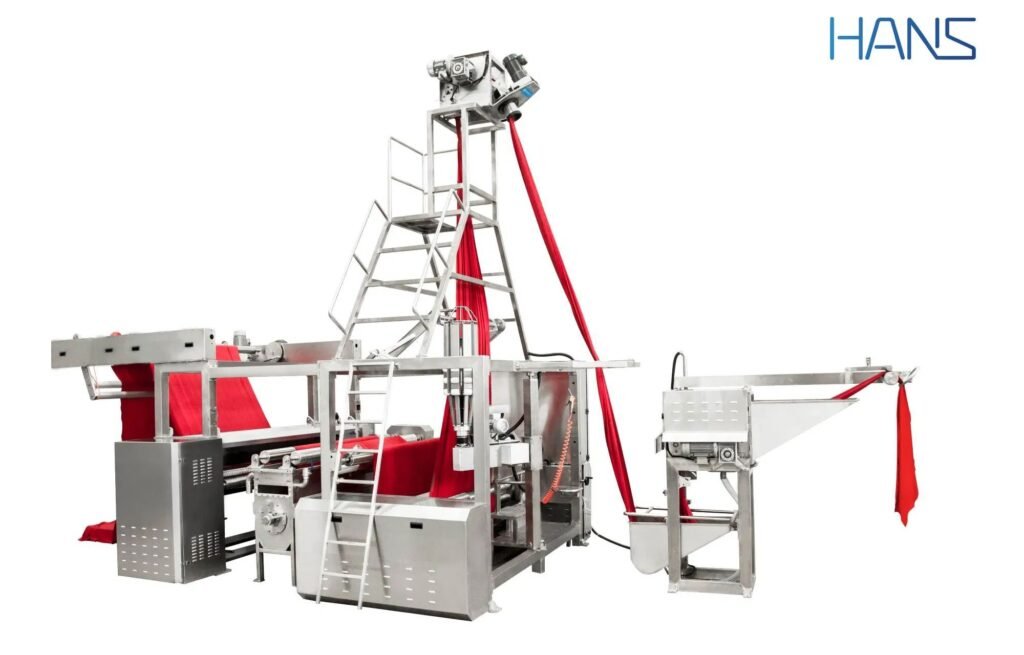
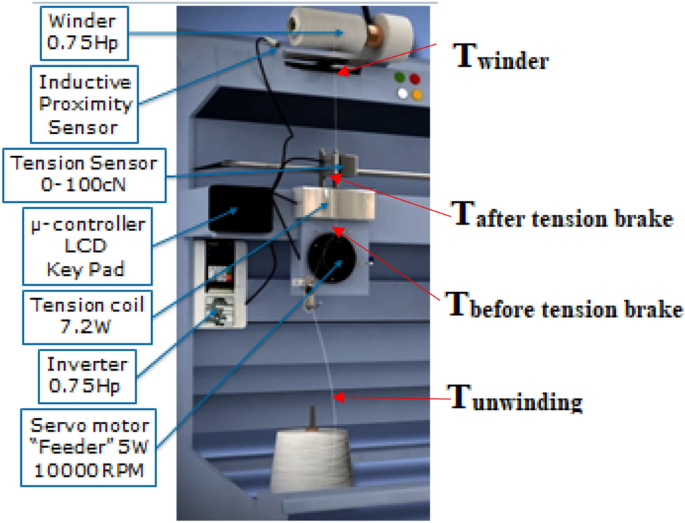
In spandex-containing fabrics, dye uptake of the main fiber and elastic behavior occur simultaneously. As temperature rises, elastane softens and attempts to retract. If this retraction is constrained unevenly—by machine geometry, fabric seams, or winding tension—the fabric surface changes while dyeing is in progress.
This dynamic movement explains why spandex fabrics may show acceptable lab dips but inconsistent bulk results. Small-scale samples experience relatively uniform conditions, while full-width production exposes variations in tension, flow, and heat transfer.
Dye houses that treat spandex fabrics as static substrates often struggle with repeatability. Those that treat them as elastic systems under load achieve far better shade consistency.
Why Shade Looks Different Under Stretch
One of the most misunderstood aspects of spandex fabrics is their stretch-dependent color appearance. This is not a defect; it is a physical reality of elastic structures.
| Fabric State | Visual Effect |
|---|---|
| Relaxed | Deeper shade |
| Stretched | Shade opens up |
| Recovered | Color stabilizes |
When a spandex fabric is stretched, loop spacing increases and the surface becomes flatter. This reduces light absorption per unit area and increases reflectance, making the color appear lighter. When the fabric recovers, loops close again and color depth returns.
This effect is present in all elastic fabrics, but it becomes more pronounced as spandex percentage increases. In well-balanced fabrics, the shift is uniform and visually acceptable. In poorly controlled fabrics, different zones stretch differently, creating apparent color inconsistency during wear.
Excessive variation between relaxed and stretched states signals issues such as uneven elastane distribution, inconsistent loop geometry, or insufficient heat setting.
Interaction Between Fiber Type and Spandex Content
The base fiber strongly influences how spandex content affects dye appearance. Polyester-spandex fabrics rely on disperse dyes, which already require precise temperature control. Adding more spandex narrows the processing window, because elastane is sensitive to heat while polyester requires high dyeing temperatures.
Nylon-spandex fabrics dye more readily at lower temperatures, but elastic tension effects are often more visible due to the smoother surface of nylon. Cotton-spandex fabrics face a different challenge: reactive dyes color cotton effectively, but the undyed elastane can create speckled or muted appearance if distribution is uneven.
In all cases, higher spandex content magnifies any inconsistency in fiber distribution, knitting balance, or finishing discipline.
Practical Color-Balancing Strategies
Industrial dye houses that regularly process spandex-rich fabrics rely on a combination of chemical and mechanical controls. No single adjustment is sufficient.
- Adjusting dye depth upward in controlled increments
- Slowing heating ramps to reduce elastic shock
- Using leveling agents to promote even uptake
- Relaxing fabric before dyeing to normalize tension
Deeper dye shades compensate for dilution, but only to a point. Slower heating allows elastane to relax gradually rather than snapping back suddenly, reducing patchiness. Leveling agents help dyes migrate evenly across fibers, especially when loop geometry changes during processing.
Pre-dye relaxation is particularly effective. Allowing the fabric to release residual knitting stress before dyeing reduces tension variation in the dye bath, leading to more uniform color development.
These measures improve appearance consistency, not elastane coloration itself.
Finishing Effects on Final Appearance
Post-dye finishing can either enhance or undermine shade uniformity. Heat setting stabilizes loop geometry and locks in surface texture, reducing optical variation during wear. Over-tensioned finishing, however, can flatten the fabric temporarily and exaggerate shade differences once tension is released.
Compacting and controlled overfeed help normalize surface density, making color appear more even across the width. Excessive calendaring may increase surface reflectivity, making colors appear lighter and more sensitive to stretch.
The key is alignment: dyeing and finishing parameters must be designed together. Optimizing one while neglecting the other leads to inconsistent results.
Measurement vs. Perception: The Color Gap
Instrumental color measurements often underestimate appearance issues in spandex fabrics. A fabric may pass ΔE tolerance under flat, relaxed conditions yet still appear uneven in motion or under stretch.
This gap between measurement and perception grows with spandex content. Higher elastic levels amplify optical effects that instruments do not capture unless testing includes stretch-state evaluation.
Experienced developers therefore assess color under multiple conditions: relaxed, partially stretched, and fully stretched. Consistency across these states is a better indicator of real-world performance than static lab values alone.
Production Insight from Comparative Trials
In controlled trials comparing fabrics with identical construction and dye recipes but different spandex content, a clear pattern emerges.
Fabrics with 5% spandex showed minimal change in perceived color depth and excellent uniformity. Fabrics with 15% spandex exhibited up to 12% lower perceived color depth and increased sensitivity to tension variation unless dye depth, heating rate, and relaxation steps were adjusted.
The difference was not due to dye chemistry failure, but to elastic-induced changes in surface geometry and light reflection.
Designing for Color Stability at the Fabric Stage
Color stability in spandex fabrics begins long before dyeing. Even elastane distribution, balanced knit structures, and controlled yarn tension reduce the visual impact of undyed elastic filaments. Fabrics engineered with color performance in mind require fewer corrective measures later.
Once spandex content exceeds roughly 10–12%, color development must be treated as a system-level problem, involving knitting, dyeing, and finishing together. Attempting to fix shade issues solely at the dye house stage is rarely successful.
The Real Role of Spandex in Color Appearance
Spandex does not absorb dye, but it shapes how color is perceived through mechanics and optics. As its percentage increases, color management shifts from chemistry-driven to structure-driven control.
Fabrics that acknowledge this reality—by balancing elastic forces, controlling tension, and validating appearance under stretch—achieve stable, attractive color even at high spandex levels. Fabrics that ignore it may meet specifications on paper yet fail visually in use.
Understanding how spandex content influences dye uptake, shade uniformity, and appearance is therefore not about making elastane accept color. It is about engineering the fabric so color behaves predictably in a dynamic, elastic environment.
What Are the Main Challenges in Spandex Dyeing (Heat Sensitivity, Degradation, Uneven Color)?
Dyeing spandex-containing fabrics is fundamentally different from dyeing rigid fibers such as cotton, polyester, or nylon. The difficulty does not come from one single weakness, but from the interaction between spandex’s elastic nature, its chemical sensitivity, and fabric structure under tension. Heat sensitivity, chemical degradation, and uneven color are not isolated problems—they reinforce each other throughout the dyeing and finishing process.
A spandex fabric can look acceptable when it exits the dye machine and still fail later during heat setting, washing, or real-world wear. This delayed failure is what makes spandex dyeing particularly challenging. By the time defects become visible, the root cause often lies several process steps earlier.
Most failures happen after dyeing, not during it.
Understanding these challenges requires looking beyond color chemistry and focusing on how elastane behaves under heat, chemicals, and mechanical stress.
Heat Sensitivity: The Silent Risk in Spandex Dyeing
Heat is the most underestimated risk factor in spandex dyeing. Unlike polyester, which requires high temperatures for dye penetration, spandex begins to lose elastic integrity at much lower thermal thresholds.
| Temperature Exposure | Spandex Effect |
|---|---|
| ≤80 °C | Generally safe |
| 90–100 °C | Recovery loss risk |
| >120 °C | Severe degradation |
At temperatures up to about 80 °C, most commercial elastane fibers maintain acceptable recovery and tensile strength. Beyond this point, polymer chains begin to relax irreversibly. The problem is not immediate breakage, but progressive loss of elastic memory.
Between 90 °C and 100 °C, spandex may still appear functional when relaxed, but its recovery force weakens. Fabrics dyed at these temperatures often pass initial inspection but exhibit bagging, reduced compression, or shape distortion after washing.
Above 120 °C, elastane degradation accelerates sharply. Polymer chains break down, resulting in permanent loss of stretch and, in severe cases, visible cracking or powdering of the fiber. This damage cannot be reversed through finishing.
What makes heat damage particularly dangerous is its invisibility at early stages. A fabric may:
- Look flat and evenly dyed
- Measure within dimensional tolerances
- Feel elastic when handled
Yet still fail weeks later because elastic strength was compromised during a brief thermal spike.
This is why spandex dyeing requires strict temperature discipline, not just peak temperature control but also controlled heating rates, dwell times, and cooling profiles.
Chemical Degradation Risks: When Dye Chemistry Works Against Elastane
Spandex is a polyurethane-based fiber, and its chemical resistance is limited compared to many base fibers. Certain dyeing chemicals that are harmless to polyester or nylon can quietly weaken elastane.
Spandex is particularly vulnerable to:
- Strong alkalis
- Oxidizing agents
- Aggressive dye carriers
| Chemical Condition | Result |
|---|---|
| High pH | Elastic weakening |
| Long dwell time | Yellowing |
| Harsh dispersants | Surface roughness |
High pH environments accelerate hydrolysis of polyurethane bonds. Even brief exposure to strongly alkaline conditions can reduce recovery performance. This is why spandex dyeing processes typically operate in neutral to mildly acidic ranges, even when dye classes might tolerate higher pH.
Oxidizing agents pose another risk. Bleaching residues, peroxide traces, or strong oxidants used in cleaning cycles can attack elastane directly. The damage often appears as reduced elongation or brittle behavior rather than visible discoloration.
Long dwell times compound these effects. Even mild chemicals become harmful when exposure is prolonged. Spandex dyeing therefore prioritizes short, efficient cycles rather than extended soaking.
Aggressive dispersants and carriers, often used to improve dye uptake in synthetics, can roughen the elastane surface or extract plasticizers from the polymer. This leads to increased friction, faster fatigue, and reduced long-term elasticity.
This is why professional spandex dyeing emphasizes mild chemistry over speed. Faster color is meaningless if elastic performance is sacrificed.
Uneven Color: A Structural Problem, Not Just a Chemical One
Uneven color in spandex fabrics is frequently misdiagnosed as a dye formulation issue. In reality, it is often a mechanical and structural problem caused by elastic behavior under tension.
Uneven dyeing commonly originates from:
- Variable fabric tension
- Inconsistent fabric circulation
- Spandex rebound during heating
| Root Cause | Visual Symptom |
|---|---|
| Tension variation | Striping |
| Poor relaxation | Patchy shade |
| Torque | Spiral marks |
When fabric tension varies across width or length, dye uptake changes accordingly. Areas under higher tension present less accessible surface area to dye molecules, resulting in lighter shades. Areas with lower tension absorb dye more readily, appearing darker.
Poor relaxation before dyeing is another major contributor. Spandex fabrics that enter the dye bath with residual knitting tension will relax unevenly as temperature rises. This relaxation happens during dye fixation, creating localized differences in dye concentration and resulting in blotchy or cloudy appearance.
Torque and spirality further complicate the picture. Twisted fabric paths cause uneven circulation, meaning some sections experience more dye exposure than others. Chemical adjustments alone cannot correct these mechanical inconsistencies.
This is why chemical “fixes” such as adding leveling agents or increasing dye concentration often fail. They address symptoms, not causes. Without mechanical relaxation and tension balance, uneven color will persist.
The Interconnection Between Heat, Chemistry, and Color
The three main challenges—heat sensitivity, chemical degradation, and uneven color—are deeply interconnected.
- Excessive heat increases chemical reaction rates, accelerating elastane degradation.
- Chemical damage weakens elastic recovery, increasing uneven tension during finishing.
- Uneven tension leads to irregular dye uptake, amplifying color inconsistency.
Attempting to solve one problem in isolation often worsens another. For example, increasing temperature to “even out” dyeing may improve initial color uniformity but permanently damage recovery. Using stronger chemicals to force dye uptake may shorten elastane life and increase post-wash distortion.
Successful spandex dyeing requires system-level control, not isolated parameter optimization.
Why Many Defects Appear After Finishing, Not Immediately
A defining feature of spandex dyeing problems is delayed manifestation. Many fabrics look acceptable at early checkpoints:
- Immediately after dyeing
- Before heat setting
- Before first wash
Defects appear later because:
- Elastic stress was not fully released during dyeing
- Color fixation occurred while the fabric was still under tension
- Spandex degradation progressed silently
Heat setting often exposes hidden problems. When fabric is heated again to stabilize dimensions, elastane relaxes further. If elastic energy was unevenly distributed earlier, warping, skew, or color distortion becomes visible at this stage.
The first wash is another critical trigger. Water, heat, and mechanical action allow residual stresses to release fully. Fabrics with compromised elastane suddenly lose shape, recovery, or uniform appearance.
This delayed behavior explains why spandex dyeing defects are so difficult to trace back to their origin. By the time problems appear, the dyeing process is already complete.
Mechanical Factors That Amplify Dyeing Challenges
Mechanical handling plays a much larger role in spandex dyeing than in rigid fabrics. Fabric circulation, rope tension, and machine loading directly affect both color and elastic performance.
Key risk factors include:
- Overloading dye machines, restricting fabric movement
- High rope tension during heating phases
- Abrupt temperature ramps that trigger rapid elastane relaxation
Gentle circulation allows fabric to relax evenly and absorb dye uniformly. Excessive mechanical stress locks in tension differences that later become visual defects.
This is why many dyehouses reduce batch size, slow circulation speed, and introduce controlled relaxation phases when dyeing spandex fabrics—even at the cost of throughput.
Prevention Mindset: Designing the Process to Protect Elastane
Because post-dye correction is limited, spandex dyeing success depends on prevention rather than repair.
Successful spandex dyeing focuses on:
- Controlled temperature curves
- Short exposure times
- Mechanical relaxation
- Fiber-protective auxiliaries
Temperature curves should rise gradually, allowing elastane to relax before dye fixation begins. Holding fabric at moderate temperatures before full dyeing helps release residual tension evenly.
Short exposure times reduce chemical attack. Efficient exhaustion and fixation are preferred over extended dwell cycles.
Mechanical relaxation—allowing fabric to move freely without tension before and during dyeing—is essential for both color uniformity and elastic stability.
Fiber-protective auxiliaries, such as elastane-safe dispersants and stabilizers, help buffer chemical stress without interfering with dye uptake.
This mindset treats spandex not as a passive fiber but as a reactive component that must be managed carefully at every stage.
Practical Manufacturing Reality
Factories that specialize in spandex fabrics often report the same lesson: most dyeing problems are process design problems, not dye selection problems.
Switching dye brands or increasing dosage rarely solves root causes. Adjusting temperature discipline, relaxation stages, and mechanical handling produces far greater improvements.
In controlled production environments, modest changes—such as lowering peak dyeing temperature by 5–10 °C or adding a short relaxation hold before fixation—have reduced post-wash defect rates dramatically without sacrificing shade depth.
These improvements do not come from new chemistry. They come from respecting elastane’s limits.
Final Technical Perspective
The main challenges in spandex dyeing—heat sensitivity, chemical degradation, and uneven color—are inseparable. They arise from the same underlying reality: elastane is elastic, reactive, and unforgiving of shortcuts.
Spandex dyeing succeeds when processes are designed around controlled energy release rather than forced color fixation. Heat must be managed, chemistry must be gentle, and fabric must be allowed to relax mechanically.
When these principles are followed, spandex fabrics dye evenly, retain recovery, and perform consistently throughout their lifespan. When they are ignored, defects simply wait until finishing, washing, or wear to reveal themselves.
Fixing problems later is difficult. Preventing them early is far easier—and far more reliable.
How do industrial dyeing parameters (temperature, pH, time) impact spandex colorfastness?
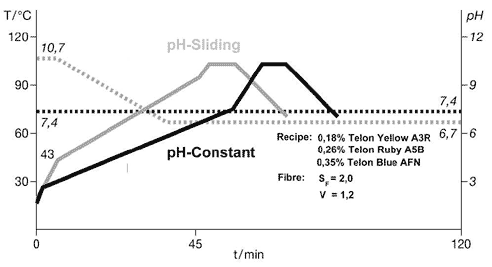
Spandex colorfastness is not determined by dye selection alone. It is the cumulative result of how temperature, pH, and dwell time interact with a chemically sensitive elastic fiber during dyeing. Unlike cotton or polyester, spandex operates within a narrow and unforgiving processing window. Staying inside that window preserves elastic recovery and long-term color stability. Stepping outside it—even briefly—can lead to irreversible elasticity loss, shade instability, and premature fabric failure that only becomes visible after washing or wear.
In industrial practice, many spandex-related colorfastness problems are not caused by poor dyes or finishing chemistry, but by process parameters that are slightly too aggressive. Spandex does not fail loudly during dyeing. It degrades quietly, and the consequences appear later.
Think of spandex dyeing as precision cooking: too hot, too long, or too alkaline—and the texture is ruined.
Why spandex colorfastness is parameter-driven
Spandex is a segmented polyurethane fiber designed for stretch and recovery, not chemical robustness. Its polymer chains are sensitive to thermal stress, hydrolysis, and oxidation. When exposed to unfavorable dyeing conditions, the fiber may still appear visually intact, but its elastic backbone is compromised.
Colorfastness in spandex blends depends on two parallel outcomes:
- The companion fiber must fix dye properly
- The spandex must retain recovery and surface integrity
If either side fails, the fabric will show problems. Poor dye fixation leads to fading, crocking, or wash-off. Spandex degradation leads to bagging, loss of stretch, and secondary color issues such as yellowing or uneven shade appearance. The challenge is that optimizing one without damaging the other requires tight parameter control.
Temperature: the most critical lever
Temperature is the single most influential parameter in spandex dyeing. Heat accelerates dye diffusion and fixation on many fibers, but it also accelerates spandex degradation.
| Temperature Range | Effect on Spandex |
|---|---|
| ≤70–80°C | Safe for most blends |
| 85–95°C | Risk zone (short exposure only) |
| ≥100°C | High degradation risk |
At temperatures below 70–80°C, most spandex fibers remain stable for extended periods. This is why polyester–spandex blends are dyed using modified low-temperature disperse dye processes instead of standard 130°C polyester dyeing.
The danger zone begins around 85°C. Short exposure may be tolerated, especially in nylon–spandex dyeing where acid dyes require higher temperatures. However, tolerance depends on dwell time, pH, and mechanical stress. Above 100°C, spandex degradation accelerates sharply. Loss of recovery, surface damage, and yellowing become likely.
A critical but often overlooked factor is heating and cooling rate. Rapid temperature ramps create thermal shock, stressing elastane chains. Controlled ramps allow the fiber to adapt gradually, reducing internal stress accumulation.
Key insight: it is not just peak temperature that matters—it is cumulative time at elevated temperature. Ten minutes at 95°C can be more damaging than a brief spike that passes quickly.
Heat exposure and long-term colorfastness
Excessive heat does not only reduce elasticity. It also indirectly affects colorfastness. When spandex degrades, its surface chemistry changes. This can lead to:
- Increased dye migration during washing
- Uneven shade appearance over time
- Yellowing that alters perceived color
These effects are often misattributed to poor finishing or washing conditions, when the root cause is thermal damage incurred during dyeing.
pH: protecting the elastic backbone
Spandex is sensitive to both acidic and alkaline extremes. pH control is therefore essential for maintaining colorfastness and elasticity.
| pH Range | Impact |
|---|---|
| 5.5–6.5 | Ideal for nylon-spandex |
| 6.0–7.0 | Safer neutral zone |
| >9.0 | Elastic damage risk |
Acidic conditions are generally safer for spandex than strong alkalinity, but only within limits. Very low pH can still attack urethane linkages if exposure is prolonged. Alkaline environments are particularly risky. Strong alkalis can hydrolyze polyurethane bonds, leading to permanent loss of recovery.
This creates a specific challenge in cotton–spandex dyeing, where reactive dyes require alkaline fixation. To manage this risk, experienced dye houses:
- Use the mildest effective alkali system
- Minimize alkali exposure time
- Neutralize immediately after fixation
- Apply elastane-protective auxiliaries
The goal is to give the cotton enough alkali to fix dye while limiting spandex exposure to damaging conditions. Poor pH control is one of the most common reasons cotton–spandex fabrics lose elasticity prematurely.
pH fluctuations and hidden damage
Even when average pH values appear acceptable, localized pH spikes can occur due to uneven chemical addition or poor bath circulation. Spandex reacts to these spikes, even if they are brief. Damage may not be uniform, leading to uneven recovery and localized colorfastness issues.
This is why controlled chemical dosing and thorough bath mixing are essential in spandex dyeing. Manual or poorly timed additions increase risk significantly.
Time: long cycles quietly cause damage
Dwell time is often underestimated because it does not produce immediate visual defects. However, extended exposure to even moderate heat or pH gradually degrades spandex.
| Dwell Time | Outcome |
|---|---|
| Optimized | Stable color & recovery |
| Excessive | Hidden elastic loss |
| Repeated | Progressive degradation |
Long dye cycles increase elastic fatigue, promote dye migration, and reduce recovery stability. The fiber may pass initial stretch tests but fail after washing or wear. Repeated long cycles—such as extended rinsing, holding, or delayed unloading—compound the problem.
In practice, shorter, well-controlled dye cycles almost always outperform long, aggressive ones. Achieving shade depth through efficiency rather than duration preserves both colorfastness and elasticity.
Time-temperature interaction
Time and temperature cannot be evaluated independently. A safe temperature becomes unsafe if exposure is prolonged. Similarly, a short exposure to a marginally high temperature may be acceptable, while a long exposure at the same level is not.
Experienced dye houses think in terms of total thermal load rather than single setpoints. This mindset helps prevent cumulative damage that would otherwise go unnoticed until later stages.
Why colorfastness starts in dyeing—not finishing
Many colorfastness problems are incorrectly blamed on finishing. In reality, finishing can only compensate for so much. If dyes are poorly fixed during dyeing, finishing chemicals are forced to work harder and often fail.
Poorly fixed dyes tend to:
- Rub off under friction
- Migrate during washing
- Fade under light and sweat
When spandex integrity is compromised, these problems worsen because fabric structure becomes unstable. Yarn movement increases, surface abrasion rises, and dyes are more easily released.
Proper dyeing parameters reduce reliance on heavy finishing chemistry and result in inherently more stable colorfastness.
Mechanical stress as a secondary factor
Although temperature, pH, and time are primary parameters, mechanical stress interacts with all three. At elevated temperatures or unfavorable pH, spandex becomes more vulnerable to damage from agitation and tension.
Excessive circulation speed, harsh jet action, or tight fabric packing can overstretch spandex when it is chemically weakened. This accelerates recovery loss and contributes to uneven shade and fastness issues.
Reducing mechanical stress during critical stages—especially at peak temperature or during fixation—significantly improves outcomes.
Practical parameter snapshot (illustrative)
| Blend Type | Temp | pH | Strategy |
|---|---|---|---|
| Polyester + Spandex | ≤80°C | Neutral | Gentle disperse dyeing |
| Nylon + Spandex | 85–95°C | Acidic | Controlled acid dyes |
| Cotton + Spandex | ≤60°C | Mild alkali | Short reactive cycles |
These ranges are not universal recipes, but they illustrate how parameter priorities shift depending on the companion fiber. In all cases, spandex defines the upper limit of acceptable stress.
Real production insight
In production audits, fabrics with poor wash fastness or early elasticity loss often trace back to marginal parameter overruns rather than catastrophic errors. A few extra degrees, an extended hold during a shift change, or delayed neutralization can be enough to degrade spandex.
Lab comparisons consistently show that spandex fabrics dyed just outside recommended limits may pass initial shade and hand feel checks but lose 10–30% of recovery after several wash cycles. This loss then manifests as fit complaints, bagging, and perceived fading—even when dye chemistry itself is sound.
This delayed failure pattern is why parameter discipline matters more than speed or convenience.
Operational discipline over shortcuts
Dye houses that handle spandex successfully tend to share several habits:
- Conservative temperature ceilings
- Tight pH monitoring and control
- Short, purposeful dwell times
- Immediate corrective actions when deviations occur
They also train operators to understand why these limits exist, rather than treating them as arbitrary rules. When operators recognize that spandex damage is irreversible, compliance improves.
Industrial dyeing parameters determine spandex colorfastness long before garments reach finishing or consumers. Temperature sets the thermal stress level, pH governs chemical stability, and time determines how much cumulative damage occurs. These three variables interact continuously.
Spandex dyeing rewards restraint and precision. When parameters are controlled carefully, fabrics retain both color and elasticity through repeated washing and wear. When limits are pushed for speed or shade depth, failures emerge later—and cannot be fixed.
Color can be adjusted. Elastic recovery cannot.
This is why successful spandex dyeing is less about aggressive processing and more about disciplined control.
What colorfastness issues are most common in spandex fabrics, and how can they be prevented?
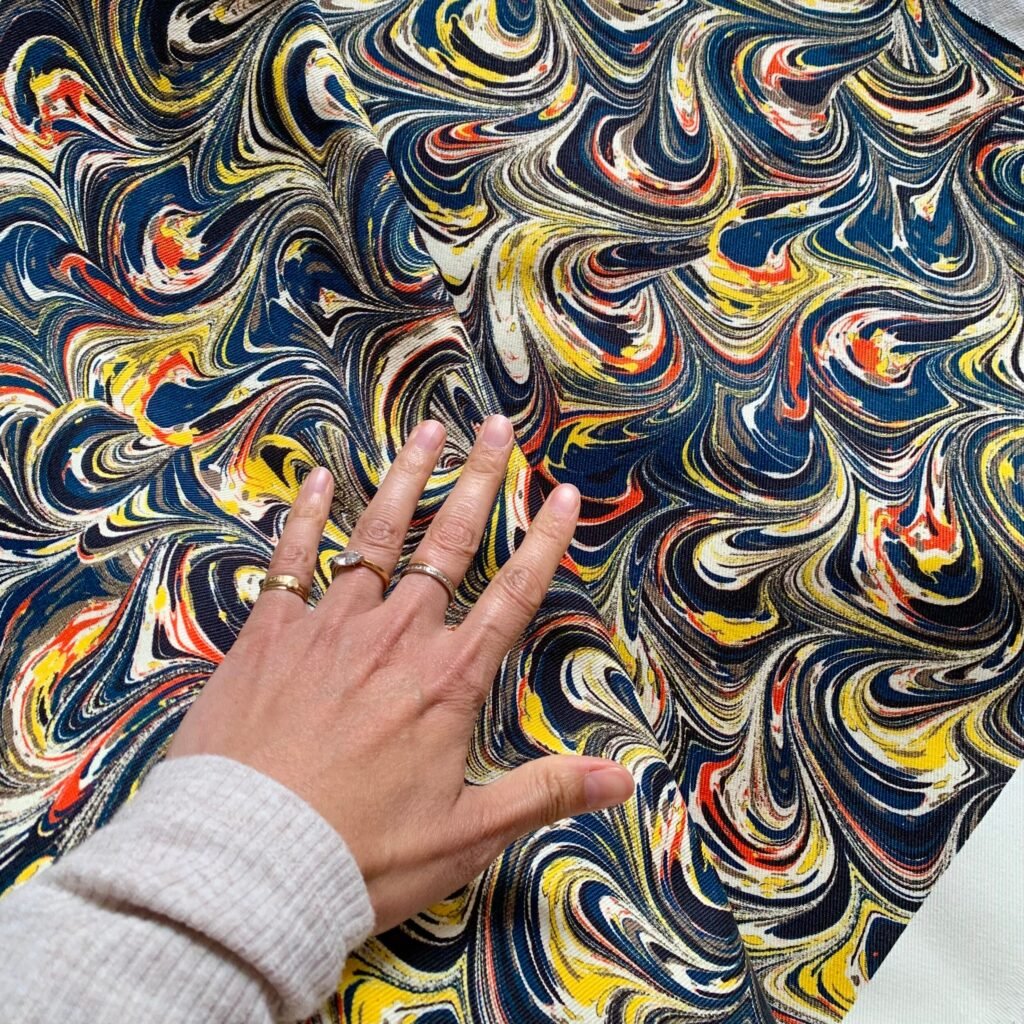
Colorfastness problems are among the most persistent quality challenges in spandex fabrics. Unlike rigid textiles, spandex-containing fabrics are constantly stretched, relaxed, rubbed, and exposed to heat, sweat, and repeated washing. These dynamic conditions magnify weaknesses in dye fixation, surface stability, and finishing balance. As a result, colorfastness failures in spandex fabrics are rarely caused by a single error—they are almost always system-level failures involving dye choice, process parameters, mechanical stress, and post-treatment decisions.
Understanding why spandex complicates colorfastness is the first step toward preventing defects that otherwise appear late in production or, worse, after the product reaches the market.
Most frequent fastness failures
In spandex fabrics, fastness issues tend to cluster around a few repeatable failure modes.
| Fastness Type | Common Symptom |
|---|---|
| Wash fastness | Shade fading |
| Rubbing (crocking) | Color transfer |
| Perspiration | Staining or bleeding |
| Stretch-induced change | Shade shift |
Each of these failures has a distinct mechanism, but they are all intensified by the elastic behavior of the fabric.
Why spandex makes colorfastness more difficult
Spandex does not absorb dye in the same way as cotton, nylon, or polyester. It remains largely undyed within the fabric structure, acting as an elastic framework rather than a color carrier. During wear and testing, this creates several unique challenges.
Spandex fabrics experience:
- Continuous stretch and recovery cycles
- Frequent surface-to-surface friction
- Changes in fabric density during movement
- Localized stress at seams, bends, and high-motion zones
These behaviors expose weaknesses that might never appear in non-elastic fabrics.
Key mechanisms include:
- Stretch exposure: As the fabric stretches, undyed elastane becomes more visible, especially in dark shades, creating apparent lightening or shade shift.
- Density fluctuation: Recovery changes loop or yarn packing density, altering light reflection and perceived color depth.
- Increased friction: Movement increases rubbing forces, accelerating dye abrasion and transfer.
| Condition | Effect |
|---|---|
| Dry rubbing | Surface color loss |
| Wet rubbing | Dye migration |
| Sweat + heat | Accelerated bleeding |
In short, spandex fabrics are constantly testing the limits of dye fixation.
Wash fastness: fading under repeated laundering
Wash fastness issues typically appear as gradual shade fading rather than dramatic color loss. In spandex blends, fading often becomes noticeable earlier than in rigid fabrics because stretch and recovery repeatedly disrupt the dyed surface.
Common contributing factors include:
- Incomplete dye fixation on the base fiber
- Excess unfixed dye trapped near the surface
- Aggressive wash temperatures
- Mechanical agitation combined with elastic movement
In polyester-spandex fabrics, insufficient reduction clearing after disperse dyeing is a frequent cause. Residual surface dye migrates during washing and is gradually removed.
In cotton- or viscose-spandex fabrics, wash fade often results from compromised reactive dye fixation, where alkali exposure is limited to protect elastane but fixation efficiency drops.
Prevention focuses on balanced fixation, not maximum fixation.
Rubbing fastness (crocking): color transfer risk
Crocking is one of the most sensitive fastness parameters for spandex fabrics, especially in dark shades. Stretch fabrics generate more surface friction because the fabric is under tension during movement.
Rubbing fastness failures usually present as:
- Color transfer to light garments
- Staining of lining or skin-contact areas
- Visible lightening at high-friction zones
Wet rubbing is particularly problematic because moisture increases dye mobility while reducing fiber surface resistance.
Contributing factors include:
- Surface-dwelling unfixed dye
- Overly smooth filament surfaces that allow dye migration
- Inadequate after-soaping
- Excessive softener that interferes with dye anchoring
Perspiration fastness: the sweat + heat combination
Perspiration fastness failures are especially relevant for sportswear, compression garments, and intimate apparel. Sweat introduces moisture, salts, and pH variation, while body heat accelerates chemical activity.
Spandex fabrics are more vulnerable because:
- Stretch opens the structure, allowing dye movement
- Elastane is sensitive to prolonged heat and moisture
- Localized pressure increases dye transfer risk
Acidic perspiration can destabilize certain dye-fiber bonds, while alkaline perspiration can reactivate unfixed reactive dyes.
Failures often appear as:
- Local staining
- Bleeding onto adjacent panels
- Shade change after drying
Stretch-induced shade change: a spandex-specific issue
One of the most misunderstood colorfastness problems in spandex fabrics is shade change after stretch. This is not always a dye failure in the traditional sense.
Stretch-induced shade change occurs because:
- Undyed elastane becomes more visible during elongation
- Yarn spacing increases, reducing color density
- Light reflection changes with fabric geometry
Dark shades and high-contrast colors are especially affected. Even perfectly fixed dyes can appear lighter under tension.
While this phenomenon cannot be eliminated entirely, it can be minimized through construction and process choices.
Prevention strategies that actually work
Effective prevention requires addressing each fastness risk at the correct stage of production. No single chemical additive can compensate for poor fundamentals.
| Issue | Industrial Solution |
|---|---|
| Wash fade | Better dye fixation |
| Crocking | After-soaping + fixation |
| Sweat fastness | pH-stable dyes |
| Shade change | Controlled elastane content |
Dye selection and fixation discipline
Choosing dyes with moderate energy and high stability is more important than selecting the most brilliant shade. Highly reactive or high-energy dyes often require harsher conditions that compromise elastane.
Effective practices include:
- Selecting dyes proven in spandex blends
- Accepting slightly lower chroma for higher stability
- Matching dye class to fiber chemistry precisely
- Avoiding aggressive carriers or accelerants
Fixation must be sufficient to anchor dye molecules without saturating the fabric surface.
After-soaping: the most underrated step
After-soaping removes unfixed or loosely bound dye from the fabric surface. In spandex fabrics, this step is critical for crocking and wash fastness.
Proper after-soaping:
- Reduces surface dye concentration
- Improves rubbing fastness significantly
- Stabilizes shade before finishing
Skipping or shortening after-soaping is a common root cause of fastness complaints.
Controlled finishing and softening
Softening improves hand feel but can undermine fastness if misused. Excessive or incompatible softeners can create a lubricated surface that allows dye migration.
Best practice involves:
- Using elastane-compatible softeners
- Applying minimal effective dosage
- Avoiding silicone systems that interfere with fixation unless specifically designed for spandex
Why over-fixation backfires
A common reaction to fastness problems is to increase fixative dosage. While this may temporarily improve test results, it often creates new problems.
Over-fixation can:
- Reduce fabric softness
- Limit stretch and recovery
- Increase surface stiffness
- Cause cracking or noise during movement
Excess fixatives can also form brittle surface films that break under stretch, leading to uneven appearance and long-term degradation.
Balanced fixation is essential—enough to hold color, not enough to block elasticity.
Stretch, elastane content, and shade stability
Higher elastane content increases stretch-induced shade variation. This does not mean elastane content should always be minimized, but it must be controlled relative to fabric density and yarn size.
Strategies to reduce visible shade change include:
- Using slightly higher fabric density
- Selecting yarn counts that mask elastane exposure
- Avoiding extreme dark shades in high-stretch zones
- Designing garments with zoned stretch rather than uniform high stretch
These structural choices often have a greater impact than chemical adjustments.
Real testing benchmarks (typical)
Industrial production relies on realistic, repeatable fastness targets rather than theoretical perfection.
| Test | Target Rating |
|---|---|
| Wash fastness | ≥Grade 4 |
| Rubbing (dry) | ≥Grade 4 |
| Rubbing (wet) | ≥Grade 3–4 |
| Perspiration | ≥Grade 4 |
Consistently meeting these benchmarks in spandex fabrics requires disciplined process control across dyeing, washing, and finishing.
Why fastness failures often appear late
One of the most frustrating aspects of spandex fastness issues is delayed failure. Fabrics may pass initial lab tests but fail after garment construction or consumer use.
This happens because:
- Sewing introduces localized stretch
- Heat pressing alters dye distribution
- Wear introduces combined stress factors
- Repeated washing amplifies small weaknesses
Preventing late-stage failures requires testing under stretch, not just flat fabric testing.
Practical production insight
Mills with strong fastness performance in spandex fabrics tend to share common practices:
- Separate dye standards for spandex blends
- Documented dye curves and dwell times
- Mandatory after-soaping protocols
- Stretch-aware fastness testing
- Conservative use of fixatives and softeners
These practices reduce rework, returns, and brand complaints far more effectively than aggressive chemical correction.
Colorfastness issues in spandex fabrics are not inevitable, but they cannot be solved with shortcuts. Spandex amplifies every weakness in dyeing and finishing, turning minor oversights into visible failures.
Reliable fastness performance comes from:
- Compatible dye systems
- Controlled dyeing parameters
- Thorough after-soaping
- Balanced fixation
- Structural awareness of stretch behavior
When colorfastness is treated as a system property, not a single test result, spandex fabrics can achieve durable, market-ready performance that holds up under real-world use—not just in the lab.
How do post-dyeing treatments and finishing processes improve spandex color durability?
Post-dyeing treatments and finishing processes are the difference between color that merely passes initial inspection and color that survives real use. In spandex-containing fabrics, dyeing alone is never enough. Elastane absorbs little to no dye, moves continuously under stretch and recovery, and amplifies any weakness in dye fixation on surrounding fibers. Without proper post-dyeing control, loosely bound dyes migrate, fade, or transfer—often after the first few washes.
Dyeing sets the color. Finishing keeps it there.
From a production standpoint, post-dyeing is not cosmetic. It is a risk-management phase that stabilizes color, protects elasticity, and aligns appearance with long-term performance expectations. Fabrics that skip or rush these steps may meet lab fastness targets initially but fail in consumer use.
Why Post-Dyeing Is Critical for Spandex Fabrics
Spandex introduces three characteristics that fundamentally change color durability behavior:
- Low dye affinity: elastane does not chemically bind most textile dyes
- High surface movement: elastic recovery shifts yarns and loops constantly
- Continuous stretch–recovery cycles: repeated deformation stresses dye–fiber bonds
Because elastane itself does not hold color, any unfixed dye on adjacent fibers becomes a mobile contaminant. During wear and laundering, this dye can migrate, redeposit, or abrade off the surface, causing bleeding, fading, or crocking.
Post-dyeing treatments are designed to remove or neutralize this risk before the fabric leaves the mill.
Key Post-Dyeing Steps That Protect Colorfastness
| Process | Purpose |
|---|---|
| After-soaping | Removes unfixed surface dye |
| Neutralization | Stops chemical activity |
| Fixation treatment | Anchors dye molecules |
| Heat setting | Stabilizes elastic geometry |
Each step addresses a different failure mode. Skipping any one increases the likelihood of future color problems, even if others are done well.
After-Soaping: The Most Underestimated Step
After-soaping is often treated as a routine rinse, but in spandex fabrics it is a primary defense against color failure. Its role is to remove dye molecules that are physically present on the fiber surface but not chemically bound.
After-soaping:
- Removes loosely attached dye that would otherwise migrate
- Improves wash and rubbing fastness
- Prevents back-staining in subsequent laundering
| After-Soaping Quality | Result |
|---|---|
| Insufficient | Crocking, bleeding |
| Optimized | Clean surface, stable shade |
| Excessive | Shade loss, hand feel change |
The challenge lies in balance. Insufficient after-soaping leaves mobile dye behind, leading to crocking or bleeding. Excessive after-soaping strips weakly bound but visually important dye, reducing shade depth and potentially altering fabric hand.
In spandex-rich fabrics, controlled temperature, time, and liquor ratio matter more than aggressive chemistry. A well-designed after-soaping process removes risk without sacrificing appearance.
Neutralization: Stopping the Chemistry Clock
Neutralization is a quiet but essential step, particularly for fabrics dyed under alkaline or acidic conditions. Residual chemicals left in the fabric continue reacting long after dyeing is complete, accelerating color degradation and elastic fatigue.
Neutralization:
- Brings fabric pH back to a stable range
- Prevents ongoing dye hydrolysis
- Protects elastane from chemical stress
Without proper neutralization, fabrics may show acceptable fastness immediately but degrade faster during storage or early use. In spandex fabrics, residual alkalinity is especially harmful, as it weakens elastane polymer chains and indirectly reduces color durability by increasing surface movement.
Fixation Agents: Use With Restraint
Fixation treatments are designed to improve colorfastness by anchoring dye molecules more securely to the fiber. In spandex fabrics, however, fixation must be selective and compatible.
| Fixative Type | Spandex Impact |
|---|---|
| Mild cationic | Effective, safer |
| Heavy crosslinking | Elastic stiffness |
| Over-application | Reduced stretch |
Mild cationic fixatives can significantly improve wash and rubbing fastness by forming ionic bridges with dye molecules. When properly dosed, they enhance durability without noticeably affecting elasticity.
Problems arise with heavy crosslinking systems or excessive application. These treatments can stiffen the fabric, reduce stretch, or create uneven hand feel. In extreme cases, they restrict elastane recovery, indirectly increasing surface abrasion and accelerating color loss.
Key insight: More fixative does not equal better fastness. Optimal fixation is about compatibility and dosage, not maximum chemical bonding.
Heat Setting After Dyeing: Where Color and Elasticity Meet
Heat setting after dyeing is a critical bridge between color durability and elastic performance. At this stage, the goal is not only dimensional stability, but optical stability under stretch.
Heat setting post-dyeing:
- Locks loop geometry and surface texture
- Aligns elastane polymer chains
- Reduces shade shift during stretching
| Heat Setting Outcome | Long-Term Effect |
|---|---|
| Proper | Stable color & recovery |
| Under-set | Shade drift |
| Over-set | Elastic damage |
Under-set fabrics retain residual stress. When the fabric stretches in use, loop geometry shifts unpredictably, causing visible shade changes and uneven appearance. Over-set fabrics lose elastic recovery, leading to premature fatigue and increased surface abrasion—both of which accelerate fading.
The objective is controlled stabilization: enough heat to fix geometry, not enough to degrade elasticity.
Interaction Between Dye Fixation and Heat Setting
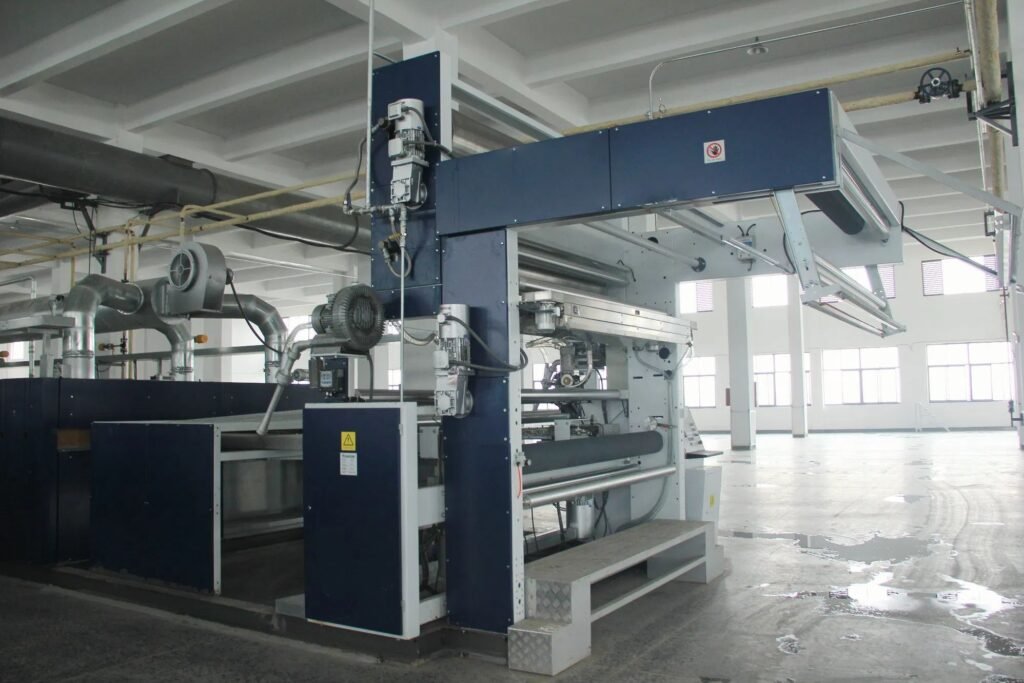
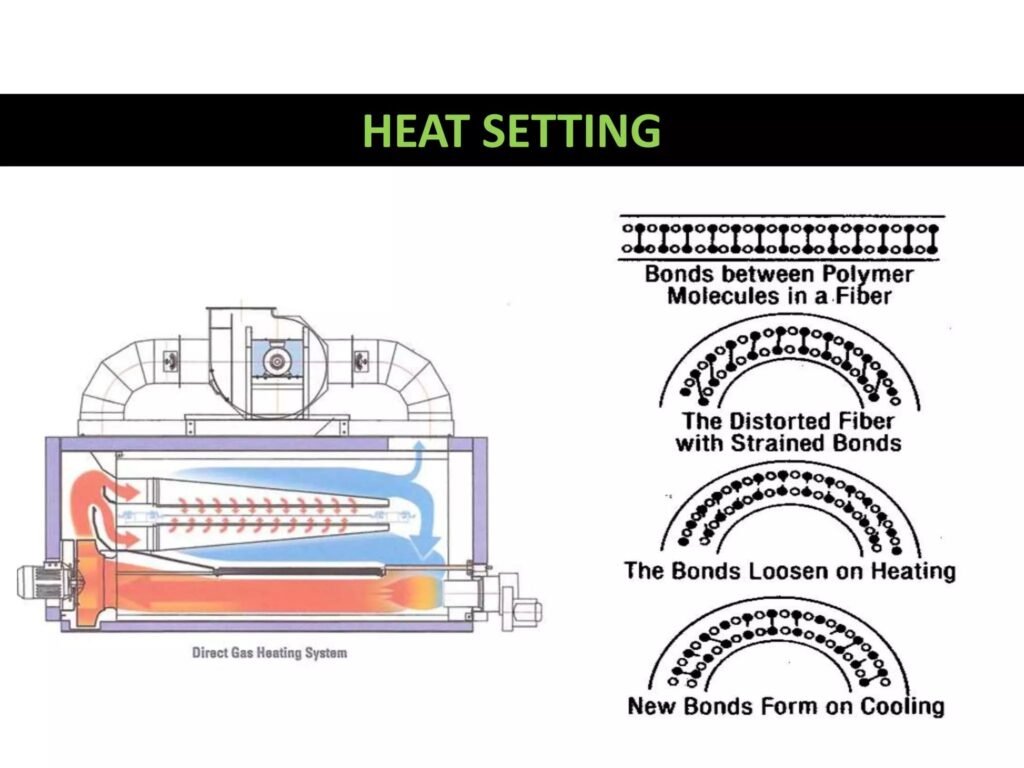
Dye fixation and heat setting must be coordinated. Fixation agents that improve fastness can also affect how the fabric responds to heat. If heat setting is too aggressive after fixation, bonded dye structures may break or discolor. If heat setting is too mild, elastic instability can undermine the benefits of fixation.
Successful mills validate fixation chemistry and heat-setting profiles together, not separately. This systems approach reduces shade drift and ensures consistent appearance over time.
Rubbing and Abrasion: Hidden Threats to Color Durability
Spandex fabrics experience more surface movement than rigid textiles. During wear, yarns slide microscopically against each other, increasing the risk of dye abrasion. Post-dyeing treatments that improve rubbing fastness are therefore essential.
After-soaping removes abrasive dye residues. Fixation strengthens dye–fiber attachment. Heat setting stabilizes the surface so abrasion is distributed evenly rather than concentrated in high-stress zones.
Without this combination, spandex fabrics may pass wash fastness tests but fail rubbing tests, especially in dark or saturated shades.
Evaluating Color Durability Beyond Standard Tests
Standard colorfastness tests are often performed on relaxed fabrics. For spandex textiles, this is insufficient. Real durability must be evaluated under conditions that simulate elastic use.
Experienced developers assess color performance in multiple states:
- Relaxed
- Partially stretched
- Fully stretched
They also evaluate after repeated stretch–wash cycles, not just isolated tests. Fabrics that maintain consistent appearance across these conditions are far more reliable in real applications.
Process Discipline Matters More Than Chemistry
In many color durability failures, chemistry is blamed when the real issue is process inconsistency. Variations in fabric tension, temperature ramps, dwell times, or winding tension after finishing can undo otherwise sound dyeing and fixation.
Spandex fabrics are especially sensitive to these variables. Small deviations can lead to uneven surface geometry, which manifests as shade inconsistency even when dye fixation is technically correct.
Mills that achieve strong color durability treat post-dyeing as a controlled engineering sequence rather than a checklist of steps.
Production Insight: Long-Term Performance Gains
In controlled comparisons, spandex fabrics that underwent full post-dyeing treatment—optimized after-soaping, proper neutralization, compatible fixation, and calibrated heat setting—showed markedly better durability. Wash fastness improved by one full grade on average, and rubbing fastness remained stable after extended stretch-wash cycles.
More importantly, visual appearance remained consistent in motion. Fabrics without this full treatment often looked acceptable flat but showed visible shade variation during wear.
Designing Color Durability Into the Process
Color durability in spandex fabrics is not achieved by any single step. It is the result of layered protection, where each post-dyeing treatment addresses a specific vulnerability introduced by elastane.
Dyeing alone defines the initial shade. Post-dyeing finishing determines whether that shade survives stretching, washing, and abrasion over time. When these processes are designed together—rather than applied reactively—spandex fabrics deliver color performance that matches their mechanical performance.
For brands and manufacturers, investing in disciplined post-dyeing treatment is not an added cost. It is insurance against returns, complaints, and inconsistent market perception. In elastic fabrics, durability is not proven on the day of dyeing—it is proven months later in real use.
How should manufacturers choose the right spandex dyeing and colorfastness solution for different applications?
Selecting the correct dyeing and colorfastness solution for spandex-containing fabrics is not a chemical decision in isolation. It is a use-driven engineering decision. Spandex behaves differently under color stress because it stretches, relaxes, and rebounds repeatedly throughout its service life. Color that looks stable on a static fabric sample can degrade quickly once elastic movement, washing, sweat, heat, or skin contact are introduced.
Many colorfastness failures in spandex fabrics are not caused by “bad dyes” or “poor fixation,” but by misalignment between the dyeing process and the real application conditions. A dyeing system optimized for fashion stretch tops may fail completely in swimwear. A process designed for light athleisure may not survive the repeated stretch and sweat exposure of performance sportswear.
This is why spandex dyeing cannot be one-size-fits-all. The correct approach starts with understanding how the fabric will be stressed, then building the dyeing and finishing strategy backward from that reality.
Start with usage. Build the process backward.
Why Application Context Matters More Than Dye Class
Traditional dye selection often focuses on fiber type: disperse dyes for polyester, acid dyes for nylon, reactive dyes for cotton. In spandex blends, this logic is incomplete. Spandex itself has low dye affinity and relies on surrounding fibers for color appearance. What determines success is not just how well the dye bonds chemically, but how well the entire fabric system withstands mechanical and environmental stress.
Key stress factors include:
- Frequency and amplitude of stretch
- Type and intensity of washing
- Exposure to sweat, oils, or chemicals
- Duration of skin contact
- Aesthetic expectations over time
A colorfastness solution that ignores these factors may pass lab tests but fail in real use. Manufacturers that consistently deliver reliable spandex fabrics treat dyeing as part of a performance system, not a finishing step.
Matching Dyeing Strategy to Application
Different end uses place fundamentally different demands on color stability. Understanding which stress dominates allows manufacturers to prioritize the right fastness properties instead of over-processing everything.
| Application | Key Colorfastness Priority |
|---|---|
| Sportswear | Wash + sweat fastness |
| Athleisure | Appearance retention |
| Swimwear | Chlorine + light fastness |
| Medical textiles | Stability under long wear |
| Fashion stretch | Shade brilliance + hand feel |
In sportswear, frequent washing and heavy perspiration are the primary threats. Color loss typically occurs through repeated detergent exposure and salt-induced migration rather than UV degradation. Dyeing strategies must emphasize wash durability and resistance to acidic and alkaline sweat.
Athleisure garments are often worn casually but repeatedly. Here, the dominant risk is gradual dulling, pilling-related color change, and uneven fading. Appearance retention—maintaining shade uniformity and surface quality over time—becomes more important than extreme fastness metrics.
Swimwear presents one of the most aggressive environments. Chlorine, saltwater, UV exposure, and constant stretch combine to attack both dye molecules and elastane integrity. Dye systems must resist oxidative damage without compromising elastic recovery.
Medical textiles prioritize stability under long, continuous wear. Fabrics may be worn for hours or days with limited washing frequency, but pressure consistency and color stability under skin contact are critical. Migration, staining, or color change can affect both function and perception of hygiene.
Fashion stretch fabrics often prioritize shade brilliance, softness, and drape. While durability still matters, excessive fixation or harsh after-treatments can ruin hand feel. The challenge is achieving acceptable fastness without sacrificing aesthetics.
Each application stresses color differently. Treating them the same leads to unnecessary cost in some cases and failure in others.
Stretch Frequency Changes Everything
One of the most overlooked variables in spandex dyeing is how often the fabric will stretch in use. Stretching does not just deform the fabric—it repeatedly exposes new fiber surface, disrupts dye-fiber equilibrium, and accelerates surface dye loss.
| Stretch Level | Dyeing Implication |
|---|---|
| Occasional | Standard fixation |
| Frequent | Enhanced after-soaping |
| Constant | Strong but elastic-safe fixation |
Fabrics that stretch occasionally, such as casual tops, can perform well with standard fixation and normal after-washing. Dye molecules experience limited mechanical stress, and surface migration is minimal.
Frequently stretched fabrics—leggings, training wear, fitted sports tops—require more thorough surface cleaning after dyeing. Enhanced after-soaping removes loosely bound dye that would otherwise migrate or rub off during repeated elongation.
Constant-stretch applications, such as compression wear or shapewear, demand the highest level of discipline. Dye fixation must be strong enough to resist constant deformation, but chemistry must remain elastane-safe. Aggressive fixation that damages spandex will shorten garment life, even if color initially looks stable.
A critical insight is that better colorfastness in high-stretch fabrics comes from cleaner surfaces, not harsher chemistry. Removing unfixed dye reduces bleeding and fading without increasing chemical attack on elastane.
Choosing Dyeing Conditions That Respect Elastane Limits
Spandex’s heat and chemical sensitivity place clear boundaries on dyeing conditions. Ignoring these limits often produces delayed failures that appear after finishing or consumer use.
Effective spandex dyeing strategies typically share these characteristics:
- Moderate dyeing temperatures
- Controlled pH ranges
- Short, efficient dwell times
- Elastane-compatible auxiliaries
Raising temperature or extending dyeing time to “force” color depth may improve initial shade but reduces elastic recovery and long-term durability. This trade-off is rarely acceptable in performance applications.
Instead, manufacturers focus on process efficiency: achieving exhaustion and fixation through controlled diffusion rather than brute force. This often means longer ramp times, staged dye addition, and precise control of bath conditions.
Colorfastness should be built through process discipline, not chemical aggression.
Cost vs Performance: A Realistic Balance
Every dyeing and finishing choice carries a cost. The mistake many manufacturers make is evaluating cost only at the processing stage, not across the product lifecycle.
| Choice | Short-Term Cost | Long-Term Result |
|---|---|---|
| Minimal finishing | Lower | Complaints, returns |
| Balanced process | Moderate | Stable reputation |
| Over-processing | Higher | Comfort loss |
Minimal finishing reduces immediate cost but often leads to complaints, shade instability, or returns after washing and wear. The savings are quickly offset by claims and reputation damage.
A balanced process—appropriate dye selection, controlled fixation, and adequate after-treatment—costs more upfront but delivers consistent results. Over time, this approach reduces quality variability and strengthens brand trust.
Over-processing is the opposite extreme. Excessive heat, aggressive chemicals, or heavy resin finishes may improve certain test results but often degrade hand feel, breathability, or elastane recovery. The product may meet technical specs but fail commercially due to poor comfort.
The best solution is rarely the cheapest or the most aggressive. It is the one that aligns cost with actual performance requirements, not theoretical maximums.
The Role of After-Treatments in Colorfastness
In spandex fabrics, after-treatments are often more important than the initial dyeing step. Proper washing-off, neutralization, and surface cleaning determine whether color remains stable under stretch.
Key after-treatment considerations include:
- Thorough removal of unfixed dye
- Neutralization of residual chemicals
- Use of elastane-safe softeners or stabilizers
Skipping or shortening after-soaping is a common cause of poor colorfastness in stretch fabrics. Residual dye sitting on the fiber surface migrates easily during stretch and wash, leading to fading, staining, or crocking.
However, after-treatments must be carefully chosen. Some cationic fixatives or resins improve rub fastness but reduce fabric elasticity or breathability. These may be acceptable in limited applications but problematic in performance or medical products.
The goal is not maximum fixation at any cost, but sufficient fixation with minimal impact on stretch performance.
Validation Before Scale-Up
No spandex dyeing solution should move to bulk production without application-specific validation. Laboratory success does not guarantee real-world performance.
Reliable producers always validate with:
- Wash testing under realistic conditions
- Rubbing fastness (dry and wet)
- Stretch–recovery cycling
- Shade stability after heat exposure
Wash testing reveals cumulative color loss and interaction with detergents. Stretch–recovery cycling exposes surface dye instability that static tests miss. Heat exposure testing simulates ironing, drying, or body heat buildup.
Most importantly, tests should reflect how the product will actually be used, not just standardized protocols. A swimwear fabric that passes domestic wash tests but fails chlorine exposure is not fit for purpose.
Testing closes the gap between lab success and real-world performance.
Avoiding Common Application Mismatches
Many failures occur because manufacturers apply the same dyeing solution across multiple product categories. Common mismatches include:
- Using fashion-focused dyeing for performance sportswear
- Applying aggressive swimwear chemistry to athleisure
- Over-fixing casual stretch fabrics and losing softness
Each mismatch creates a different failure mode: fading, discomfort, loss of elasticity, or poor consumer perception. Application-driven selection avoids these traps.
Manufacturers that segment dyeing strategies by application—rather than by fabric type alone—consistently achieve better outcomes.
Practical Manufacturing Perspective
In production environments, the most successful spandex dyeing operations share a similar mindset. They do not ask, “Which dye gives the strongest color?” They ask, “Which process delivers stable color for this use case?”
This shift changes decision-making:
- Temperature is set based on elastane safety, not dye speed
- After-treatment time is based on stretch frequency, not habit
- Testing protocols are chosen based on end use, not convenience
Over time, this approach reduces rework, improves consistency, and builds predictable performance across product lines.
Final Technical Perspective
Choosing the right spandex dyeing and colorfastness solution is not about maximizing test scores in isolation. It is about aligning dye chemistry, process control, and finishing with how the fabric will actually live its life.
Different applications stress color in different ways. Stretch frequency, washing intensity, skin contact, and environmental exposure all matter. When dyeing strategies are application-driven, spandex fabrics retain both color and elastic performance over time.
When they are not, problems simply appear later—after finishing, after washing, or after the product reaches the consumer.
The most reliable spandex dyeing solutions are built on restraint, clarity, and validation. They protect elastane, stabilize color, and deliver performance where it matters most: in real use, over time.
Spandex Dyeing Is About Control, Not Force
Spandex dyeing succeeds when the process respects what elastane is—and what it isn’t. It is not a fiber that tolerates extremes, but it rewards precision. Stable colorfastness comes from controlled temperature, gentle chemistry, disciplined timing, and thoughtful finishing—not from stronger dyes or harsher treatments.
When done right, spandex fabrics:
- Keep their color through washing and wear
- Maintain elastic performance
- Age gracefully instead of failing suddenly
That balance is the hallmark of a mature dyeing process.
If you’re developing custom spandex or spandex-blend fabrics and need reliable colorfastness solutions, SzoneierFabrics supports the full journey:
- Dyeing process design by application
- Elastane-safe dye selection and parameter control
- Post-dyeing finishing and heat setting
- Low-MOQ development with fast sampling
- Consistent quality and short lead times
Contact SzoneierFabrics today to request samples or a custom quotation. Great spandex color isn’t accidental—it’s engineered.