Skip to content

Stretch fabrics have redefined what consumers expect from clothing—flexibility, recovery, comfort, and resilience. But behind the performance of stretch lies a fundamental material choice: Spandex or natural rubber? While both offer elasticity, their chemistry, manufacturing processes, and application profiles differ significantly.
Spandex is a synthetic elastic fiber made from polyurethane, offering higher durability, heat resistance, and chemical stability than natural rubber, which is bio-derived and less resilient.
Spandex is a staple in activewear and shapewear, while natural rubber still finds use in medical textiles and industrial elastics. For textile manufacturers, the decision between these two materials can influence not just product quality, but also sustainability, processing costs, and consumer satisfaction.
Let’s explore their differences through the lens of science, supply chain, and real-world performance—starting with what Spandex really is and how it’s made.
1. What Is Spandex Fiber Made Of and How Is It Produced?
Spandex is a man-made elastic fiber developed through chemical synthesis. It is made primarily from polyurethane, created by reacting a polyester or polyether with a diisocyanate. The resulting elastic polymer is then spun into filaments using a solution dry spinning process, which produces fine, stretchable fibers that can be woven or knit into other fabrics.
Spandex is made from segmented polyurethane via solution dry spinning, enabling high elongation and recovery. It’s produced through chemical synthesis, not from natural sources.
The Making of Spandex Fiber
a. Chemical Structure and Elasticity
Spandex is a block copolymer, with:
- Soft segments (polyether/polyester): Provide flexibility and stretch
- Hard segments (urethane): Give strength and memory for recovery
This alternating structure gives Spandex its unique elasticity and snap-back ability, unlike most textile fibers.
b. Production Process: Solution Dry Spinning
| Step | Description |
|---|---|
| Polymerization | Polyurethane is created from prepolymer + diol |
| Solvent Mixing | Mixed with solvent (e.g., DMAc) for fluidity |
| Extrusion | Forced through a spinneret to form filaments |
| Evaporation | Hot gas removes solvent, solidifying the fiber |
| Drawing and Heat Setting | Fibers are stretched and heat-set for final strength |
| Winding | Fibers are wound onto cones or spools for weaving |
The fiber produced can stretch 500–700% its original length and still return to its original form—without breakage or distortion.
c. Industrial Milestone
- Invented in 1958 by Dr. Joseph Shivers at DuPont
- Marketed as Lycra® (a registered trademark still in use today)
- Now widely known as Spandex (U.S.) or Elastane (EU)
2. How Does Spandex Fiber Work Compared to Natural Rubber?
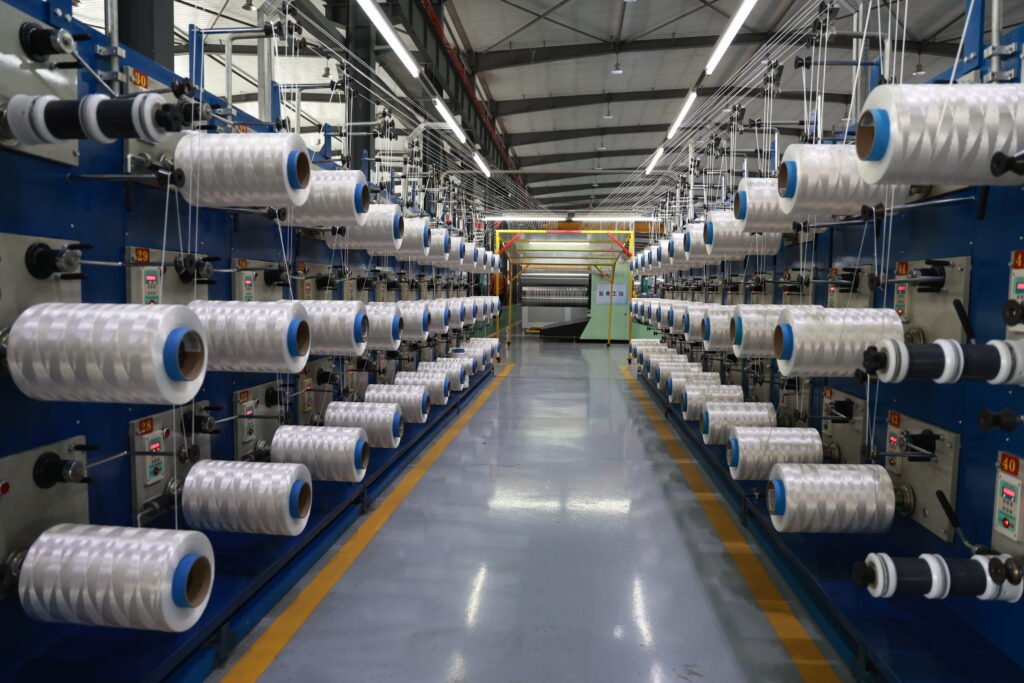
Both Spandex and natural rubber rely on molecular coil structures to create stretch, but the underlying chemistry is completely different. Spandex is a thermoplastic synthetic polymer, while natural rubber is derived from the latex sap of rubber trees (Hevea brasiliensis) and consists mostly of cis-1,4-polyisoprene.
Spandex and natural rubber both stretch due to coiled molecular structures, but Spandex is synthetic and thermoplastic, while natural rubber is organic and thermoset, making Spandex more chemically stable.
Elastic Behavior and Molecular Structure
a. Elasticity Mechanism
| Material | Elastic Component | Behavior Under Stretch |
|---|---|---|
| Spandex | Polyurethane chains | Chains uncoil and re-coil quickly after tension |
| Natural Rubber | Polyisoprene chains (natural) | Chains realign but are more prone to fatigue |
- Both rely on entropy-driven elasticity, but Spandex handles repeated deformation better.
b. Heat and UV Behavior
| Test | Spandex | Natural Rubber |
|---|---|---|
| Thermal resistance | Up to 150°C | Degrades above 70°C |
| UV resistance | Good with treatment | Poor without additives |
| Chemical resistance | Excellent | Poor against oils, ozone |
c. Real-World Comparison
In a stretch test over 1,000 extension cycles:
- Spandex retained 93% of its original recovery
- Natural rubber dropped to 70%, showing visible signs of fatigue
“We switched from rubber tape to Spandex cord in our elastic bands for sportswear and cut failure rates by 60%,” reported a Turkish OEM for athletic apparel in 2023.
3. Which Key Properties Distinguish Spandex from Natural Rubber?
Spandex and natural rubber both serve the purpose of stretch, but they differ drastically in mechanical, thermal, and environmental properties. For textile manufacturers, these differences directly affect decisions related to garment construction, performance, and end-use durability.
Spandex outperforms natural rubber in tensile strength, elongation, recovery rate, and resistance to heat, UV, and chemicals—making it the preferred elastic fiber in textiles.
Side-by-Side Property Comparison
a. Physical Property Comparison Table
| Property | Spandex | Natural Rubber |
|---|---|---|
| Elongation at break | 500–700% | 500–600% |
| Recovery rate (1000 cycles) | ≥90–95% | \~70–80% |
| Density | \~1.2 g/cm³ | \~0.93 g/cm³ |
| Tensile strength | 0.5–1.0 GPa | 0.25–0.5 GPa |
| Heat resistance | Stable up to 150°C | Starts degrading above 70°C |
| UV resistance | Good (with stabilizers) | Poor unless heavily treated |
| Resistance to oil/solvents | Excellent | Poor |
b. Stretch Performance
Spandex has a linear and predictable elongation curve, which makes it ideal for designing fabrics with precise stretch thresholds. Rubber’s response is less linear and prone to creep (permanent deformation under continuous strain).
c. Durability Metrics
- Spandex: Long life cycle in apparel use; resists heat setting, abrasion, and repeated washing
- Natural Rubber: Breaks down faster under sunlight, oxygen, and even body oils
d. Comfort and Skin Interaction
While natural rubber is derived from a biological source, it can cause latex allergies. Spandex, being synthetic, is non-allergenic and more skin-compatible, especially in close-to-body applications like undergarments, waistbands, and shapewear.
Many global underwear brands (e.g. Calvin Klein, Uniqlo) phased out rubber elastics in favor of Spandex blends in the early 2000s due to allergic concerns and garment longevity.
4. Is Spandex More Durable Than Natural Rubber in Textile Applications?
Yes—Spandex is significantly more durable than natural rubber when exposed to repeated stretching, laundering, and environmental conditions like sunlight and sweat. This makes Spandex better suited for long-lasting, performance-based textiles such as sportswear, swimwear, and shapewear.
Spandex is more durable than natural rubber in textiles because it resists fatigue, heat, UV exposure, and chemical degradation far better over time.
Lifecycle & Performance Evaluation
a. Degradation Under Real Conditions
| Condition | Spandex | Natural Rubber |
|---|---|---|
| Chlorinated water (swim) | Resistant (nylon blend) | Degrades quickly |
| UV/sunlight | Stable with additives | Discolors, cracks |
| Washing cycles (60°C) | 50+ washes with retention | 20–30 washes before fatigue |
| Heat setting for garments | Compatible (130–150°C) | Not applicable (melts early) |
b. Fatigue Resistance
- Spandex remains consistent in tension recovery even after repeated stretching and resting, especially in high-performance knitwear.
- Natural rubber is prone to stress relaxation—a loss of tension even if not permanently deformed.
c. Case Application: Swimwear
A surfwear brand in California replaced rubber waistbands with Spandex-blended nylon in 2022. After a 6-month wear test in ocean water and sun exposure:
- Spandex garments retained 91% elasticity
- Rubber-based products had visible brittleness and 27% stretch loss
d. Manufacturing Considerations
- Spandex tolerates heat molding, calendaring, and chemical treatments
- Rubber components typically need to be laminated or encased, increasing complexity
For textile items intended for repeat wear, outdoor use, or close-to-skin contact, Spandex is the more reliable and scalable solution.
5. How Do Spandex and Natural Rubber Differ in Dyeing and Finishing Processes?
Spandex offers greater compatibility with textile dyeing and finishing processes compared to natural rubber. While both require careful temperature and chemical control, Spandex can be dyed and finished within modern textile workflows, whereas rubber often needs protective encapsulation and cannot be processed like standard yarns.
Spandex blends are easier to dye and finish due to higher heat and chemical tolerance. Natural rubber requires special handling and often cannot withstand industrial dyeing temperatures.
Processability in Textile Manufacturing
a. Dye Affinity and Color Uniformity
| Fiber | Dye Compatibility | Colorfastness (Post-Wash) |
|---|---|---|
| Spandex (blended) | Acid, disperse, reactive (based on blend) | 4–5 (very good) |
| Natural Rubber | Poor dye affinity, must be covered or dyed separately | 2–3 (low to fair) |
- Spandex is generally dyed in blends (e.g. nylon-Spandex, cotton-Spandex), using the dye class appropriate for the companion fiber.
- Natural rubber is hydrophobic and chemically unstable during conventional dyeing; colors often bleed or fade quickly unless coated or dyed via transfer methods.
b. Temperature and Tension Control
| Process | Spandex | Natural Rubber |
|---|---|---|
| Dyeing temperature | 60–110°C (with blend caution) | <60°C only |
| Finishing temp | Up to 150°C (tensionless) | Not compatible |
| Stretch tolerance | Excellent, returns after setting | Deforms under high stress |
Spandex allows heat-setting and calendaring to lock fabric structure, important for uniform garment shape. Rubber melts, wrinkles, or loses elasticity under the same conditions.
c. Common Industry Practices
- Spandex is pre-scoured, dyed in soft-flow or jet machines, then finished with silicone-free softeners and set at 130–150°C.
- Rubber is usually inserted post-dye as covered yarn, not exposed to heat or dyes directly.
d. Quality Control
Brands like Adidas and Spanx rely on Spandex testing protocols such as:
- ASTM D4964 (Stretch & Recovery)
- ISO 105-C06 (Colorfastness to Washing)
- EN 14704-1 (Elasticity in fabric)
Natural rubber lacks standardized finishing benchmarks in fashion apparel due to inconsistent dye behavior.
6. Are There Environmental or Sustainability Differences Between the Two Fibers?

Yes, and the contrast is significant. Natural rubber is biodegradable and derived from renewable resources, but it has high energy and land-use impact during cultivation. Spandex, on the other hand, is synthetic and non-biodegradable, though newer recycled elastane options and cleaner production methods are improving its footprint.
Natural rubber is biodegradable but resource-intensive to produce. Spandex is synthetic and non-biodegradable, but recycled and bio-based versions are emerging for sustainable textiles.
Sustainability Metrics and Trends
a. Raw Material Source
| Fiber | Source | Sustainability Pros | Cons |
|---|---|---|---|
| Natural Rubber | Latex from rubber trees | Renewable, biodegradable | Deforestation, land-intensive |
| Spandex (virgin) | Petrochemical (polyurethane) | Long-lasting, versatile | Non-renewable, not biodegradable |
| Recycled Spandex | Post-industrial/pre-consumer | Reduced emissions, circular economy | Still synthetic |
b. Biodegradability
- Natural rubber decomposes within 1–5 years, depending on conditions.
- Spandex takes 20–100+ years, depending on blend and landfill environment.
c. Energy and Water Use
| Impact Area | Natural Rubber | Spandex |
|---|---|---|
| Land use | High | Low |
| Water use | Medium–High (farming) | Low |
| Carbon footprint | Medium (cultivation & processing) | High (unless recycled) |
d. Sustainable Alternatives
- Recycled Spandex (r-Elastane) – Now available with GRS (Global Recycled Standard) certification.
- Bio-based Spandex – Partially renewable (e.g. ROICA™ V550, partially made from corn-based feedstock).
- Rubber-free elastic blends – Some brands now use mechanically crimped yarns to mimic elasticity without elastomers.
Brands like Patagonia and Girlfriend Collective now require recycled Spandex in core collections, shifting away from virgin elastomers when possible.
7. Which Industries Prefer Spandex Over Rubber, and Why?
In today’s performance-focused and comfort-driven market, most textile-based industries now prefer Spandex over natural rubber due to its superior durability, better integration into modern textile systems, and ability to meet diverse functional needs.
Industries such as sportswear, shapewear, swimwear, and medical textiles prefer Spandex due to its superior stretch recovery, processing flexibility, and product lifespan.
Industry-Specific Preferences
a. Sportswear and Activewear
- Preferred Fiber: Spandex
- Reason: High recovery, moisture-wicking, ability to blend with polyester and nylon
- Brands Using Spandex: Nike, Under Armour, Lululemon
b. Shapewear and Intimates
- Preferred Fiber: Spandex
- Reason: Strong compression and fit retention without allergic reactions
- Insight: Many shapewear brands shifted from rubber to Spandex after 2000 to enhance comfort and minimize latex allergy complaints.
c. Swimwear and Surfwear
- Preferred Fiber: Nylon-Spandex blends
- Reason: Resistance to chlorine, UV, and saltwater; sleek fit and recovery
- Note: Natural rubber loses elasticity quickly when exposed to pool chemicals or ocean water.
d. Medical Textiles
- Use: Compression socks, support braces, post-surgery garments
- Why Spandex Wins: Precise gradient compression, skin compatibility, sterilization resistance
- Case Study: German compression wear company Mediven reported a 45% increase in customer satisfaction after switching to Spandex-based yarns.
e. Industrial and Technical Applications
- Spandex in wearable sensors, stretchable electronics, and adaptive garments is expanding
- Rubber is used in non-fabric products like belts, seals, and tires, but its textile use is minimal due to poor processability.
| Industry | Spandex Usage | Rubber Usage |
|---|---|---|
| Sportswear | Extensive | Minimal |
| Underwear/Shapewear | Extensive | Declining |
| Swimwear | Extensive | Obsolete |
| Medical Wearables | Extensive | Minimal |
| Industrial Fabrics | Growing | Niche/declining |
8. How Can Manufacturers Choose Between Spandex and Natural Rubber for Stretch Fabrics?

Choosing between Spandex and natural rubber depends on your product’s end use, processing requirements, cost constraints, and sustainability goals. For almost all apparel and technical textile uses, Spandex is the better long-term investment.
Featured Snippet Answer: Manufacturers should choose Spandex for performance textiles requiring durability, recovery, and dye compatibility. Rubber is best reserved for niche industrial or short-term use.
Dive Deeper: Decision-Making Framework
a. Performance Matrix
| Factor | Spandex | Natural Rubber | Recommendation |
|---|---|---|---|
| Stretch + Recovery | Excellent | Good initially | ✅ Spandex |
| Heat Resistance | High (150°C) | Low (60–70°C) | ✅ Spandex |
| Dyeing Compatibility | High | Poor | ✅ Spandex |
| Biodegradability | No | Yes | ⚠️ Rubber (if short-use focus) |
| Sustainability Score | Medium (improving) | Mixed (land-intensive) | Depends on supply chain |
| Cost (per kg) | Moderate | Low (but rising) | Spandex (more value long term) |
b. Key Questions to Ask:
- Is your product worn close to the skin or involves long-term contact?
- Will it undergo frequent washing, exposure to heat, or sunlight?
- Do you need consistent color matching or pattern printing?
- Is your brand committed to sustainable sourcing and GRS/OEKO-TEX certification?
If you answered yes to any of the above, Spandex is your optimal choice—especially when sourced through verified, ethical manufacturers like SzoneierFabrics.
Ready to Source Premium Spandex Blends?
At SzoneierFabrics, we specialize in:
- Custom-blended Spandex fabrics (cotton, polyester, nylon, modal, recycled options)
- Free design consultation and rapid sampling
- OEKO-TEX, GRS, and ISO-compliant production
- Low MOQs, fast turnaround, and 100% quality guarantee
Contact us now to get your custom elastic fabric manufactured with the performance your brand demands and the service your customers deserve.