Skip to content
A shoe bag may look like one of the simplest textile products in a travel or footwear collection. Cut several fabric panels, add a drawstring or zipper, print a logo, and the job appears finished. In practice, the material decision controls nearly everything the user notices later: whether the bag traps odor, leaks moisture, scratches polished leather, collapses neatly into luggage, survives repeated washing, or tears when a heavy pair of boots is lifted.
The materials most commonly used in shoe bag manufacturing include polyester, nylon, Oxford fabric, cotton, canvas, non-woven polypropylene, mesh, neoprene, PVC, PEVA-lined textiles, and TPU-laminated fabrics. Polyester and nylon suit lightweight travel bags, cotton and canvas provide a softer breathable presentation, Oxford fabric supports heavy-duty structures, mesh improves ventilation, and coated or laminated materials help isolate damp or dirty footwear.
Choosing the right fabric is not about finding the material with the highest denier, thickest coating, or lowest unit price. It means matching the material to the footwear, cleaning method, expected service life, logo process, packaging format, and customer experience. A lightweight nylon pouch may outperform a thick canvas bag inside a carry-on, while the same nylon pouch may be completely unsuitable for muddy work boots.
One development team once replaced a heavy 600D Oxford shoe pouch with a lighter 210D coated polyester construction to reduce shipping volume. The lighter sample passed the basic fit check, but its unreinforced base began wearing where hiking-boot lugs repeatedly rubbed against the fabric. The final solution was not returning to heavy fabric across the whole bag. It was using lightweight polyester on the upper panels and a stronger double-layer Oxford base. That small change captures the central lesson of shoe bag manufacturing: the best material is often a carefully planned combination, not a single fabric used everywhere.
What Materials Are Commonly Used?
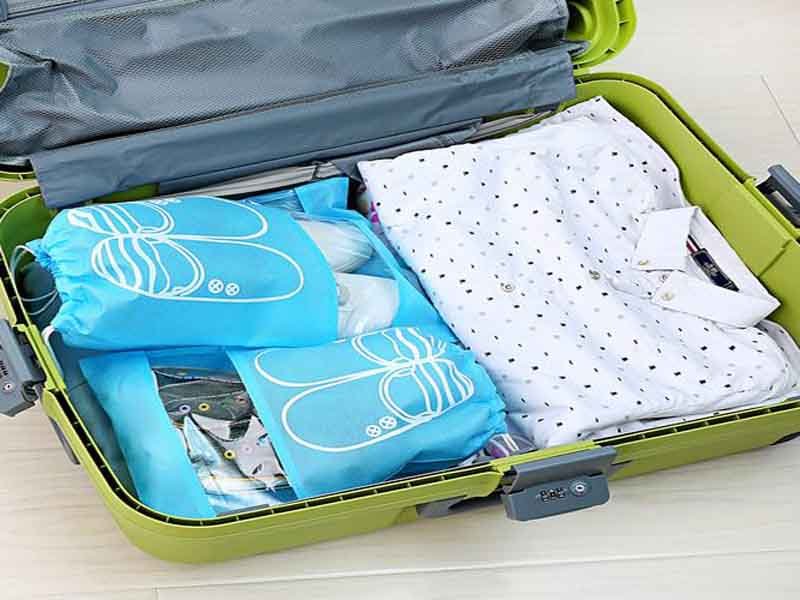
Polyester, nylon, cotton, canvas, non-woven polypropylene, mesh, Oxford fabric, and coated textiles are the most common shoe bag materials. Polyester provides a strong balance of cost, durability, drying speed, and decoration options. Nylon offers an excellent strength-to-weight ratio. Cotton and canvas create a natural, breathable feel. Non-woven fabric suits lightweight presentation packaging, while mesh is mainly used where airflow and visibility matter.
No material is automatically superior. A suitable fabric must support the way the bag will be packed, carried, cleaned, branded, and reused. A fabric selected only from a small swatch can behave very differently after it becomes a three-dimensional product with seams, a zipper, a lining, and a pair of shoes pressing against it.
Is Polyester Good for Shoe Bags?
Polyester is one of the most widely used shoe bag materials because it combines relatively low weight, good dimensional stability, fast drying, broad color availability, and compatibility with many printing and coating methods. It can be engineered into very light travel pouches or heavier structured boot bags simply by changing the yarn size, weave, coating, and lamination.
Common polyester options include 190T taffeta, 210D polyester, 300D polyester, 420D polyester, 600D Oxford polyester, polyester ripstop, brushed polyester, polyester mesh, and recycled polyester.
A lightweight 190T polyester is often selected for simple drawstring shoe covers, hotel slipper bags, promotional travel sets, and foldable organizers. It occupies little space when empty and can be produced in a wide range of colors. Its limitation is abrasion resistance. Sharp heel edges, rough boot soles, and repeated dragging across hard surfaces can wear through a very light fabric.
A 210D polyester offers a more balanced construction. It remains lightweight enough for luggage organization but handles repeated folding and normal sneaker use more reliably. A PU coating can be added to the back to improve resistance to damp soles and light spills.
A 300D or 420D polyester provides more body and a smoother, more substantial feel. It is frequently used for zippered travel organizers where the bag needs to hold its shape without becoming rigid.
A 600D polyester Oxford fabric is appropriate for hiking boots, work shoes, sports equipment, and larger multi-pair bags. It supports reinforced handles, piping, foam, board inserts, and heavier zippers. However, using 600D fabric for a simple pair of slippers would add unnecessary weight and bulk.
| Polyester construction | Approximate fabric weight | Main advantage | Common shoe bag use | Main limitation |
|---|---|---|---|---|
| 190T polyester taffeta | 55–80 g/m² | Very light and foldable | Hotel, travel and promotional pouches | Limited abrasion resistance |
| 210D polyester | 90–140 g/m² | Good weight-to-durability balance | General travel shoe bags | Limited shape without gusset or lining |
| 300D polyester | 130–190 g/m² | Refined surface and moderate structure | Branded zippered organizers | Heavier than basic travel fabric |
| 420D polyester | 160–230 g/m² | Better abrasion resistance | Sports and frequent travel | Increased packed weight |
| 600D Oxford polyester | 230–350 g/m² | Strong and structured | Boot bags and heavy footwear | Bulky for carry-on use |
| Polyester ripstop | 70–180 g/m² | Grid limits tear propagation | Outdoor and lightweight travel | Technical appearance |
| Recycled polyester | Varies | Recycled-fiber option | Travel and lifestyle collections | Certification and traceability required |
Fabric-weight ranges vary because coating thickness, yarn quality, weave density, and finishing all affect the final result. A fabric should therefore not be approved from the label “210D polyester” alone.
Two 210D fabrics can have noticeably different performance. One may use a loose weave and light coating, while another uses tighter construction and a heavier PU layer. They may look similar in a small photograph but react differently during sewing, rubbing, washing, and water exposure.
Polyester is also highly adaptable to branding.
Screen printing works well for simple logos and solid colors.
Heat transfer supports detailed multicolor artwork.
Sublimation allows full-surface graphics on suitable light-colored polyester.
Embroidery creates a more dimensional appearance.
Woven labels and rubber patches can be sewn onto heavier versions.
Branding should be tested on the exact production fabric. A print developed on smooth 210D polyester may lose edge clarity when transferred to textured 600D Oxford. Embroidery that looks clean on canvas may cause puckering on lightweight taffeta.
Polyester dries relatively quickly because it absorbs little moisture into the fiber. That makes it useful for travel and sports products. However, quick drying does not mean that a finished polyester bag cannot retain moisture. Water may remain in folded seams, zipper tape, foam, binding, or an absorbent lining.
The complete construction must therefore be evaluated, not merely the outer fabric.
Is Nylon Stronger Than Polyester?
Nylon generally offers greater abrasion resistance and tensile strength than a comparable lightweight polyester fabric, which allows manufacturers to create thin, strong, and highly packable shoe bags. It is particularly suitable for premium travel accessories, technical outdoor products, and bags that are folded frequently.
Common nylon options include 70D nylon, 210D nylon, 420D nylon, 500D nylon, ripstop nylon, high-tenacity nylon, and ballistic nylon.
A 70D ripstop nylon shoe pouch can be extremely light. It suits travelers who need a compact organizer that almost disappears when folded. The fabric is less suitable for rough boot soles unless reinforced in high-wear areas.
A 210D nylon offers good flexibility and strength for sneaker bags and carry-on organizers. It often has a smooth, slightly technical hand feel that works well with modern luggage collections.
A 420D nylon provides more abrasion resistance while remaining lighter and more flexible than many heavy polyester Oxford constructions. It can suit sports, hiking, and frequent-travel products.
Ballistic nylon and very heavy nylon constructions are normally unnecessary for ordinary shoe bags. They make sense only where unusually high abrasion resistance or equipment-level protection is required.
| Performance factor | Polyester | Nylon | Manufacturing implication |
|---|---|---|---|
| Strength-to-weight ratio | Good | Very good | Nylon can achieve strength at lower weight |
| Abrasion resistance | Good | Usually higher | Nylon suits repeated rubbing |
| Water absorption into fiber | Low | Higher than polyester | Nylon may take longer to dry |
| UV stability | Generally good | May require stabilization | Important for outdoor storage |
| Wrinkle resistance | Very good | Good | Polyester may retain a neater packed appearance |
| Printing versatility | Very good | Good with correct preparation | Polyester is often easier for full graphics |
| Cost | Usually lower | Usually higher | Nylon may raise material cost |
| Hand feel | Stable and varied | Smooth and flexible | Nylon can feel more premium or technical |
| Colorfastness control | Generally straightforward | Requires suitable dyeing control | Dark nylon should be tested for transfer |
The statement that nylon is stronger should not be interpreted as meaning it is always more durable in the finished product. Durability depends on several variables:
Yarn quality
Fabric density
Ripstop construction
Coating adhesion
Seam allowance
Thread type
Stitch density
Edge binding
Handle reinforcement
Actual loaded weight
A strong nylon fabric can still fail at a poorly constructed seam. A slightly less abrasion-resistant polyester may last longer when the bag uses better reinforcement and more suitable stitching.
Nylon absorbs more moisture than polyester at the fiber level. For most travel shoe bags, the practical difference is modest, but it can matter when products are repeatedly exposed to wet footwear. Coatings reduce direct water penetration, yet cut edges and stitch holes may remain exposed.
Nylon can also become softer and more flexible with use. Some customers value that feel, while others prefer the stable structure of polyester. Material selection should reflect the intended visual language.
For a premium ultralight travel collection, matte ripstop nylon can create a refined technical appearance.
For a brightly printed family travel set, polyester may offer easier color reproduction and lower cost.
For a heavy work-boot carrier, Oxford polyester may provide more economical structure.
For a compact running-shoe pouch, coated nylon may provide an excellent balance of strength and weight.
The decision is less about which fiber wins a general comparison and more about where each fiber creates value in the finished design.
Are Cotton and Canvas Breathable?
Cotton and cotton canvas are breathable, soft, printable, and visually associated with natural or premium lifestyle products. They suit dry footwear, dust covers, retail packaging, hotel use, luxury shoe protection, and reusable storage bags where airflow and tactile quality matter more than moisture containment.
Cotton fabric is available in many constructions, including plain weave, twill, drill, muslin, calico, brushed cotton, and canvas.
Light cotton fabrics work well for individual shoe sleeves and drawstring dust bags. They fold easily and are gentle against polished or delicate surfaces when the weave and finishing are suitable.
Canvas uses heavier yarns and a denser construction. It provides more body, abrasion resistance, and perceived value. Cotton canvas is commonly selected for fashion footwear, handmade shoes, premium retail packaging, and lifestyle travel accessories.
| Cotton material | Approximate weight | Feel and structure | Suitable application |
|---|---|---|---|
| Lightweight cotton | 80–140 g/m² | Soft and flexible | Individual shoe covers |
| Cotton poplin | 100–160 g/m² | Smooth and refined | Premium dust bags |
| Cotton twill | 160–260 g/m² | Soft with diagonal texture | Reusable branded bags |
| Light canvas | 180–260 g/m² | Moderate body | Travel and retail shoe bags |
| Medium canvas | 260–380 g/m² | Strong and structured | Premium multi-use bags |
| Heavy canvas | 380 g/m² and above | Thick and substantial | Rugged storage products |
Cotton breathability can help residual moisture escape more readily than from heavily coated synthetic fabric. However, cotton also absorbs water. A damp cotton bag can become heavier, dry slowly, develop marks, and transfer moisture to surrounding luggage.
Breathability and water resistance therefore pull the material decision in opposite directions.
An uncoated cotton bag supports airflow but provides little protection from wet soles.
Waxed canvas improves surface water resistance but reduces breathability and changes the hand feel.
A cotton outer shell with a removable coated sole liner preserves the natural appearance while improving cleaning.
A cotton bag with a mesh panel may provide more ventilation but less dust containment.
A cotton-polyester blend can improve dimensional stability and drying speed while retaining part of the natural texture.
Shrinkage is another important consideration. Cotton fabric may change dimensions after washing, especially if it has not been preshrunk. If the body fabric shrinks while a polyester zipper tape or synthetic lining remains stable, the bag can become distorted.
A washable cotton shoe bag should therefore be tested after repeated wash cycles. The evaluation should measure:
Length and width change
Twisting or skewing
Color fading
Drawcord-channel deformation
Logo cracking or puckering
Lining mismatch
Seam appearance
Cotton can be an excellent option for luxury footwear because it feels softer and less technical than nylon or coated polyester. Yet “natural” does not automatically mean safe for every shoe surface. Dark cotton dyes should be tested for dry and wet rubbing, particularly when the bag will hold white leather, light suede, satin, or pale fabric shoes.
Canvas also supports a wide range of logo treatments. Screen printing creates a classic appearance, while embroidery, woven labels, leather patches, and metal badges can create more premium presentations. Heavy embroidery should be stabilized to avoid distortion.
The question is not simply whether cotton breathes. The more useful question is whether the bag needs to release moisture, contain moisture, or balance both.
Is Non-Woven Fabric Cost-Effective?
Non-woven polypropylene is a cost-effective material for lightweight shoe packaging, promotional giveaways, retail dust covers, event products, and short-to-medium reuse cycles. It is available in many colors, accepts basic printing, and can be cut and sewn or produced through ultrasonic bonding.
Unlike woven fabric, non-woven polypropylene is formed by bonding fibers rather than interlacing yarns. Common weights used for shoe bags may range from approximately 60 to 120 g/m², although lighter and heavier options are available.
| Non-woven weight | General performance | Common use |
|---|---|---|
| 50–60 g/m² | Very light with limited tear resistance | Temporary retail packaging |
| 70–80 g/m² | Better balance for simple drawstring bags | Promotional and standard shoe covers |
| 90–100 g/m² | Improved body and printing surface | Reusable retail presentation |
| 110–120 g/m² | Stronger and more structured | Heavier footwear or premium non-woven bags |
Non-woven fabric can be economical, but evaluating it only by price may create problems. Very light material can tear near drawcord channels, seams, and sharp heel edges. It may also crease permanently during shipping.
A low unit cost is not valuable if the bag fails during the first use or creates a poor impression around a premium pair of shoes.
Non-woven polypropylene is suitable when the main objectives are:
Basic dust protection
Lightweight product packaging
Simple logo printing
Flat packing
High-volume production
Color coordination
Limited structural requirements
It is less suitable when the bag must endure:
Repeated machine washing
Heavy boots
Sharp outsole edges
Long outdoor exposure
High moisture containment
Luxury tactile requirements
Frequent folding and unfolding
The manufacturing method also affects strength. Ultrasonic bonding can create clean, fast seams without conventional thread, but the bond width and settings must match the material. Sewn seams offer more flexibility for complex shapes and drawstring channels, though needle holes and thread tension must be controlled.
Laminated non-woven materials can add printed graphics or moisture resistance, but lamination may make the product stiffer and less breathable. The layers should be checked for peeling after folding.
Non-woven bags can be positioned honestly as practical presentation or organization products. They should not be promoted as equivalent to woven nylon, polyester, or canvas when the expected service conditions are different.
When Is Mesh Fabric Suitable?
Mesh is suitable when airflow, visibility, quick drying, or low weight is more important than complete dirt and moisture containment. It is commonly used for athletic shoes, gym footwear, slippers, pool shoes, sandals, and ventilated travel organizers.
Most shoe bag mesh is made from polyester or nylon. Available constructions include fine mesh, micro-mesh, athletic mesh, sandwich mesh, spacer mesh, power mesh, and large-hole netting.
| Mesh type | Airflow | Visibility | Dirt containment | Common use |
|---|---|---|---|---|
| Fine polyester mesh | Moderate | Moderate | Good | General ventilated shoe bags |
| Micro-mesh | Moderate | Low to moderate | Very good | Premium subtle ventilation |
| Athletic mesh | High | High | Moderate | Gym and running footwear |
| Large-hole mesh | Very high | Very high | Low | Sandals and dry sports shoes |
| Spacer mesh | Moderate | Low | Good | Padded ventilation panels |
| Power mesh | High | Moderate | Low to moderate | Flexible lightweight compartments |
Mesh is rarely the ideal material for the complete bag when shoes are muddy, wet, or packed beside clean clothing. It allows air to move, but it may also allow dust, sand, odor, and moisture to escape.
A more balanced construction often uses mesh only in selected zones.
Coated polyester can form the lower sole compartment.
Mesh can be placed near the shoe upper.
A solid side panel can carry the logo.
Binding can stabilize the mesh edge.
A lining or divider can protect the shoe surface.
The position of the mesh is just as important as the mesh specification. Placing open mesh directly beneath a dirty outsole defeats the purpose of luggage separation. Positioning it higher on the side or top panel allows airflow while keeping most debris contained.
Mesh strength should be checked through burst, snag, and seam-pull testing. A mesh that feels strong when stretched by hand may still tear where it joins a heavier woven fabric.
Different materials feed through sewing machines at different rates. Soft mesh may stretch while rigid Oxford fabric remains stable, causing ripples along the seam. Reinforcement tape, binding, suitable presser-foot pressure, and controlled sewing tension help produce a cleaner result.
Mesh also limits logo placement. Detailed print can disappear across open holes. Branding is usually clearer on a solid woven panel, woven label, rubber patch, webbing handle, or reinforced logo zone.
For sports use, mesh improves drying but does not eliminate odor. Shoes packed while hot and saturated may still develop odor even in a ventilated bag. Washable construction and user care remain necessary.
How Do Less Common Materials Perform?
Neoprene, jute, linen, velvet, microfiber, PVC, PEVA, and felt are used less frequently, but each can support a distinct shoe bag concept.
Neoprene provides stretch, cushioning, and a soft protective structure. It works for individual sneakers, premium footwear sleeves, and compact protective cases. It is heavier and less breathable than mesh or uncoated fabric.
Jute creates a natural, textured appearance for retail packaging and gift presentation. Its coarse surface may not suit delicate footwear unless a soft lining is added. It also absorbs moisture and can shed fibers.
Linen and linen blends create an elevated natural look with better airflow. Pure linen wrinkles easily and can be more expensive, so blends are often easier to manufacture consistently.
Velvet and microfiber are used for luxury shoe dust bags. They provide a soft touch but require careful colorfastness control and may attract dust.
Felt provides cushioning and structure but can occupy considerable space. It is more suitable for home storage or premium cases than ultralight travel.
PVC and transparent films support visibility and moisture isolation. They can become stiff in cold conditions, crease during folding, and require careful compliance and odor control.
PEVA is often used as a wipe-clean lining rather than the sole outer material.
TPU-laminated fabric can provide a flexible moisture barrier and premium technical appearance. It costs more and requires tighter process control than basic PU-coated polyester.
| Less common material | Main benefit | Main limitation | Suitable concept |
|---|---|---|---|
| Neoprene | Cushioning and stretch | Heavier and less breathable | Protective sneaker sleeve |
| Jute | Natural textured appearance | Coarse and moisture-absorbing | Retail gift packaging |
| Linen blend | Breathable premium texture | Wrinkling and higher cost | Luxury dust bag |
| Microfiber | Soft surface protection | Can retain dust | Leather shoe storage |
| Velvet | Premium tactile quality | Color-transfer risk | Luxury footwear presentation |
| Felt | Structure and cushioning | Bulky when packed | Home storage or rigid cases |
| PVC film | Visibility and moisture barrier | Stiffness and creasing | Clear identification panel |
| PEVA | Wipe-clean surface | Limited structure | Removable lining |
| TPU laminate | Flexible moisture control | Higher material and process cost | Premium wet-shoe bag |
These materials should be selected because they solve a defined problem, not simply because they look unusual in a product catalogue.Which Material Fits Each Use?
The right shoe bag material depends on the footwear, environment, cleaning frequency, protection level, and packing method. Lightweight polyester or nylon works best for travel, soft cotton or microfiber protects luxury shoes, mesh-supported synthetics suit sports footwear, reinforced Oxford fabric handles boots, and non-woven or cotton bags work well for retail packaging.
Material selection becomes clearer when the development team begins with the use scenario instead of a fabric name. Asking “Should the bag be nylon or canvas?” is less useful than asking “Will it carry wet running shoes in a cabin suitcase, or polished leather shoes in a wardrobe?”
Which Fabric Is Best for Travel?
Lightweight coated polyester and nylon are usually the most practical travel shoe bag materials because they combine low weight, foldability, quick drying, and adequate resistance to dirt. A 210D polyester or nylon is a reliable starting point for general luggage use.
Travel bags need to perform in a difficult middle ground. They should be light but not fragile, water-resistant but not excessively stiff, washable but visually refined, and compact while still allowing shoes to load easily.
| Travel priority | Recommended material | Reason |
|---|---|---|
| Minimum weight | 70D–210D nylon | High strength at low weight |
| General travel | 210D coated polyester | Balanced cost and durability |
| Premium appearance | 300D polyester or matte nylon | Smoother, more refined surface |
| Frequent use | 420D nylon or polyester | Better abrasion resistance |
| Wet-weather travel | PU-coated polyester with lining | Improved moisture separation |
| Carry-on packing | Lightweight ripstop | Highly foldable |
| Family travel | Printed polyester | Easy color coding and cleaning |
| Sustainable collection | Verified recycled polyester | Familiar travel performance with recycled input |
Travel products should not be overbuilt. A heavy 600D shoe bag may survive years of use, but it can consume more luggage space than the footwear requires. The better solution may be 210D or 300D fabric with localized reinforcement at the base and handle.
A useful general-travel structure might include:
A 210D PU-coated polyester shell
A 150D or PEVA-lined sole zone
A lightweight polyester mesh ventilation panel
A No. 5 coil zipper
Polyester webbing handle
Bound internal seams
A printed or woven logo
Such a design separates dirty soles, provides controlled ventilation, and remains reasonably light.
For ultralight travelers, the lining and handle may be removed. For wet-weather use, the mesh may be reduced or moved higher on the bag.
The most important travel tests are not always laboratory tests. A loaded sample should be placed inside actual carry-on and checked luggage. The development team should observe:
Whether the shape fits between packing cubes
Whether the bag slides easily into position
Whether the zipper can open in a crowded suitcase
Whether the fabric catches on luggage hardware
Whether the handle remains accessible
Whether the loaded bag sags
Whether moisture transfers to surrounding fabric
A travel shoe bag should be evaluated as part of a luggage system, not as an isolated textile pouch.
Which Material Protects Luxury Shoes?
Soft cotton, brushed polyester, microfiber, velvet, and lined canvas are suitable for luxury shoes because they reduce surface rubbing and create a refined presentation. The inner surface matters more than outer fabric thickness.
Luxury footwear may use polished leather, suede, satin, embroidery, crystals, metallic finishes, hand-painted surfaces, or delicate hardware. A rough or poorly dyed bag can cause damage even when the outer shell appears premium.
A luxury shoe bag often uses a two-layer construction.
The outer layer provides appearance and light structure.
The inner layer provides softness, colorfastness, and friction control.
| Luxury footwear | Main risk | Suitable material direction |
|---|---|---|
| Polished leather | Scuffing and pressure marks | Cotton twill or microfiber lining |
| Suede | Surface rubbing and color transfer | Soft light-colored brushed lining |
| Satin shoes | Snagging and staining | Fine smooth woven or microfiber |
| Embellished heels | Snagging and crushing | Padded divided construction |
| White leather | Dye transfer | Tested light-colored lining |
| Metallic finish | Abrasion | Smooth nonwoven or tricot divider |
| Designer sneakers | Dirt and deformation | Lined structured polyester bag |
Colorfastness is critical. Dark fabric should be tested against light footwear under dry and damp conditions. A lining that passes normal dry rubbing may still transfer color when exposed to humidity.
The bag should also prevent the two shoes from damaging each other. A divider, individual sleeves, or separate compartments can keep soles and heel tips away from delicate uppers.
Material softness alone does not provide impact protection. When shoes include fragile embellishments or high heels, thin foam or a semi-structured shell may be needed. The foam should not create excessive pressure when the bag is packed.
A luxury shoe bag may use:
Cotton sateen outer fabric
Brushed microfiber lining
A padded divider
A satin or cotton drawcord
Metal cord ends
Embroidery or a woven label
Tissue or a molded insert for packaging
However, decorative metal components should not touch the shoes. A metal zipper pull or cord end can scratch leather if it falls inside the bag.
A premium experience also depends on consistency. Fabric shade, embroidery density, drawcord length, label position, and pressing should remain uniform across the order. Luxury presentation exposes small defects that might be accepted on a basic promotional pouch.
What Works for Sports Footwear?
Polyester, nylon, and mesh combinations work best for sports footwear because they dry quickly, resist repeated handling, and can be cleaned more easily than absorbent natural fabrics. The ideal construction separates dirty soles while allowing moisture to escape around the upper.
Sports shoes introduce three challenges at once:
Moisture from sweat or weather
Odor development
Abrasive or dirty soles
A full mesh bag improves airflow but provides limited dirt containment. A fully coated bag contains dirt but can trap moisture. A hybrid design provides a more useful balance.
| Sports scenario | Recommended material structure |
|---|---|
| Gym training | Polyester body with upper mesh panel |
| Running event | Lightweight nylon with ventilated sides |
| Football or rugby | Coated Oxford base with washable lining |
| Basketball | Large gusseted polyester and mesh bag |
| Cycling shoes | Structured nylon with protected sole zone |
| Golf shoes | 420D polyester with air eyelets or mesh |
| Swimming or pool use | TPU- or PEVA-lined wet compartment |
| Team travel | Color-coded polyester with reinforced handle |
A sports shoe bag should normally have a wide opening. Trying to force damp shoes through a narrow drawstring opening increases contact between the user’s hands, the outer bag, and the dirty footwear.
Cleaning should be designed into the structure. Smooth coated lower panels are easier to wipe than textured canvas. Removable liners and outward-turning interiors allow faster drying.
Ventilation does not need to cover half the bag. Small mesh zones, eyelets, or perforated panels may provide enough airflow while keeping debris under control.
Odor-control treatments can be explored, but claims should be supported by testing. An antimicrobial finish is not a substitute for washing and drying. Treatments may also lose effectiveness after repeated cleaning.
A representative sports-shoe development comparison might examine three sample constructions:
| Sample | Structure | Loaded weight | Airflow | Cleaning | Main result |
|---|---|---|---|---|---|
| A | Full 600D coated Oxford | Highest | Low | Easy to wipe | Strong but trapped moisture |
| B | Full athletic mesh | Lowest | Very high | Easy to rinse | Dirt escaped through mesh |
| C | 420D coated base with mesh upper | Moderate | High | Easy to maintain | Best balance for repeated use |
The mixed construction normally requires more pattern pieces and sewing operations, but the improved user experience can justify the additional work.
Which Fabric Suits Heavy Boots?
Heavy boots require abrasion-resistant Oxford polyester or nylon, reinforced bases, strong webbing, and durable internal surfaces. Fabrics between 420D and 900D are commonly considered, depending on boot weight and required structure.
The fabric should be selected around the most aggressive contact points rather than the total bag size.
Hiking-boot lugs can abrade the base.
Work-boot toe caps add weight.
Metal lace hooks may snag mesh.
Wet mud can enter seam corners.
Tall shafts require additional volume.
A heavy boot bag may use 600D polyester Oxford throughout, but a more efficient design can combine materials.
| Boot-bag component | Recommended material direction |
|---|---|
| Base | Double-layer 600D or 900D Oxford |
| Side panels | 420D–600D Oxford |
| Upper ventilation | Reinforced mesh or eyelets |
| Lining | PEVA, TPU-coated textile or wipe-clean polyester |
| Handle | 25–38 mm polyester or nylon webbing |
| Divider | Coated woven fabric or removable panel |
| Reinforcement | PP board, PE board or EVA where needed |
| Zipper | No. 5 or larger coil/molded zipper |
Denier should not be used as the only indicator of strength. A tightly woven 420D nylon can outperform a loosely woven 600D polyester in some abrasion conditions. Coating and backing also influence puncture and seam performance.
The handle attachment is often more important than the body fabric. A pair of wet work boots can become surprisingly heavy. Short handle tabs sewn only into a top seam may pull out. Webbing should extend farther down the side panel or wrap beneath the base for high loads.
Boot bags should also account for dirt removal. A removable bottom liner can be taken out, brushed, rinsed, and dried separately. Rounded corners reduce mud traps.
For tall fashion boots, heavy Oxford fabric may be visually inappropriate. Individual cotton, microfiber, or brushed polyester sleeves can protect the shafts without adding excessive bulk. “Boot bag” therefore covers two very different categories: rugged footwear containment and delicate tall-boot protection.
What Is Best for Retail Packaging?
Cotton, non-woven polypropylene, lightweight polyester, and recycled-fiber fabrics work well for shoe retail packaging. The choice depends on the footwear price, desired presentation, reuse expectations, printing method, and packaging budget.
Retail shoe bags perform a different role from travel organizers. They may not need a reinforced handle or waterproof lining. Instead, they must present the product attractively, protect it from dust, carry the logo clearly, and fit efficiently inside a shoe box.
| Footwear position | Suitable packaging material | Presentation effect |
|---|---|---|
| Promotional footwear | Non-woven polypropylene | Economical and colorful |
| Everyday sneakers | Lightweight polyester | Reusable and easy to print |
| Natural lifestyle shoes | Cotton | Soft and familiar |
| Premium leather shoes | Cotton twill or brushed fabric | Refined and protective |
| Luxury heels | Microfiber, satin or velvet | High-end presentation |
| Outdoor footwear | Recycled polyester or light Oxford | Technical and durable |
| Sustainable collection | Certified recycled or organic material | Supports documented material story |
Bag thickness must be coordinated with shoe-box dimensions. A heavy canvas bag can increase packaging volume and make the shoes difficult to place neatly inside the box.
Drawcords, cord locks, metal ends, and thick embroidery also consume space. The most premium-looking solution is not always the heaviest one. Clean proportions, accurate sewing, a soft hand feel, and controlled logo application can produce a stronger impression than excessive material.
For retail packaging, the interior should be free from loose fibers and unstable dyes. A dark velvet bag may look luxurious but create lint on a pale suede shoe. A coarse jute bag may suit an eco-inspired display but scratch polished leather.
Logo quality is central because the bag often acts as a secondary brand touchpoint after the shoe box is discarded. Screen printing suits cotton and non-woven fabric, sublimation suits polyester, embroidery supports premium woven materials, and woven labels work across many constructions.
The bag should remain useful after purchase. A customer may reuse it for travel, storage, accessories, or laundry. Designing for reuse can increase perceived value, but the construction must support the claim. A fragile packaging bag with a reusable message can damage trust instead of strengthening it.
Which Material Works for Different Price Levels?
Material price should be considered together with cutting efficiency, sewing difficulty, logo process, lining, hardware, inspection, packaging, and expected service life. The cheapest fabric does not always produce the lowest finished-product cost.
| Product level | Common material direction | Typical construction approach |
|---|---|---|
| Basic packaging | 60–90 g/m² non-woven | Simple drawstring or ultrasonic seam |
| Promotional travel | 190T or 210D polyester | Flat pouch with printed logo |
| Standard reusable | 210D–300D polyester | Zipper, gusset and basic lining |
| Sports | Polyester/Oxford plus mesh | Ventilated mixed-material construction |
| Premium travel | Matte nylon or 300D polyester | Refined hardware and clean binding |
| Heavy-duty | 600D–900D Oxford | Reinforced base and webbing |
| Luxury footwear | Cotton twill, microfiber or velvet | Soft lining and individual protection |
| Wet footwear | PU-, TPU- or PEVA-lined textile | Moisture-controlled construction |
A lower-cost outer fabric may require a lining to achieve the desired performance. A slightly more expensive coated fabric may eliminate that lining and simplify sewing. The complete bill of materials should therefore be compared rather than fabric price per meter alone.
Cutting yield matters too. Wide fabric, pattern direction, print repeat, defects, and panel shape influence how much material becomes usable product.
A directional printed canvas may create more waste than a solid polyester because every panel must face the same way.
A very slippery nylon may require slower sewing and more skilled handling.
A thick laminated material may need specialized machinery.
A mesh-and-Oxford combination adds seam operations.
A heavily embroidered logo may cost more than the main fabric.
The correct material is the one that reaches the required performance and presentation without adding cost where the user receives no meaningful benefit.
How Can Materials Be Combined More Effectively?
Combining materials allows each part of a shoe bag to perform a specific function. A durable base, breathable upper, soft divider, and printable front panel can provide better results than using one compromise fabric throughout.
A well-planned mixed-material shoe bag might use:
600D Oxford on the bottom
210D coated polyester on the sides
Fine mesh on the upper panel
Soft tricot for the divider
PEVA on the sole-contact surface
Webbing for the handle
TPU film for the identification window
The challenge is compatibility. Different materials may stretch, shrink, melt, crease, and feed through sewing machines differently.
| Material combination | Main benefit | Production concern |
|---|---|---|
| Oxford plus mesh | Durability and ventilation | Different stretch behavior |
| Cotton plus PEVA lining | Natural exterior and wipe-clean interior | Unequal shrinkage |
| Nylon plus foam | Lightweight protection | Lamination stability |
| Polyester plus PVC window | Visibility and structure | Cold cracking and seam stress |
| Canvas plus microfiber | Premium outer and soft inner | Added thickness |
| TPU laminate plus welded seams | Moisture containment | Specialized equipment |
| Non-woven plus printed film | Low-cost graphics | Delamination risk |
Mixed-material prototypes should be tested after folding, loading, washing, and temperature exposure. A clean sample on a workbench may develop rippling or separation after several trips.
For custom production, Szoneier can compare cotton, canvas, polyester, nylon, neoprene, jute, linen, Oxford fabric, mesh, coated fabrics, and laminated textiles according to the intended footwear and sales channel. Material selection can be followed by pattern development, logo testing, lining evaluation, sample production, and loaded-footwear checks before the final specification is approved.
How Do Fabric Specs Affect Quality?

Fabric specifications affect a shoe bag’s weight, strength, flexibility, appearance, water resistance, sewing stability, and service life. Denier, grams per square meter, weave density, coating type, thickness, and lining construction must be evaluated together because no single number can accurately describe finished-product quality.
A material can look strong on a specification sheet and still perform poorly after cutting and sewing. A high-denier fabric with a loose weave may fray around seams. A lightweight tightly woven fabric may resist tearing better than expected. A thick coating can improve water resistance but crack after repeated folding. A soft lining can protect leather shoes but increase drying time.
The most reliable material specification connects measurable fabric properties to real product use. Instead of asking only whether a fabric is 210D or 600D, the development team should ask whether the completed bag can carry the intended footwear, survive repeated opening, resist abrasion from soles, retain its color, and fit into luggage without unnecessary bulk.
What Does Fabric Denier Mean?
Denier measures the linear density of individual yarns. One denier represents one gram per 9,000 meters of yarn. In general, a higher denier indicates a thicker yarn, but it does not automatically guarantee a stronger, heavier, or more durable finished fabric.
A 600D polyester fabric uses thicker yarns than a 210D polyester fabric. It usually feels heavier and more structured. However, the complete performance still depends on weave density, yarn quality, coating, finishing, and fabric weight.
Two materials carrying the same denier can behave differently.
One 420D fabric may use high-tenacity yarn and a tightly controlled weave.
Another may use lower-strength yarn, wider spacing, and a thin coating.
Both may be sold as 420D, yet their tear resistance, abrasion resistance, and seam strength may vary considerably.
| Denier range | General character | Common shoe bag use | Main concern |
|---|---|---|---|
| 40D–100D | Ultralight and soft | Individual sleeves and compact travel pouches | Low puncture resistance |
| 150D–210D | Lightweight and flexible | General travel shoe bags | Needs reinforcement for heavy footwear |
| 300D–420D | Medium weight with more body | Sports and premium travel organizers | Added luggage weight |
| 500D–600D | Strong and structured | Boot bags and heavy-duty storage | More bulk when folded |
| 900D–1200D | Heavy-duty | Work boots and equipment-style bags | Often unnecessary for ordinary travel |
| 1680D and above | Very heavy and rugged | Specialized cases | High weight, stiffness, and cost |
Denier is most useful when comparing materials made from the same fiber and similar weave. Comparing 420D nylon directly with 420D polyester can be misleading because nylon and polyester have different strength, elasticity, moisture absorption, and surface behavior.
The denier figure also does not explain whether the fabric has:
A plain weave
An Oxford weave
A ripstop grid
A twill structure
A double-layer construction
A polyurethane coating
A TPU membrane
A PVC backing
A calendared finish
A water-repellent surface treatment
For shoe bags, denier should be treated as one part of the specification rather than the primary buying decision.
A common mistake is selecting a very high denier to make the bag sound more durable. The result may be a product that feels unnecessarily stiff, consumes more shipping volume, and costs more without improving the real user experience.
A lightweight sneaker bag does not need the same yarn size as a work-boot carrier. Material should be proportionate to loaded weight and abrasion exposure.
Which Fabric Weight Is Suitable?
Fabric weight, usually expressed in grams per square meter, shows how much one square meter of material weighs. It helps estimate the finished bag weight, handling feel, structure, shipping volume, and material consumption.
Fabric weight is influenced by yarn thickness, weave density, coating, lamination, and finishing. A coated 210D polyester may weigh more than an uncoated 300D fabric, even though the denier number is lower.
For shoe bags, suitable fabric weight depends on the product category.
| Shoe bag category | Suggested outer-fabric range | Main priority |
|---|---|---|
| Retail dust cover | 70–160 g/m² | Softness and presentation |
| Lightweight travel pouch | 70–140 g/m² | Low weight and packability |
| Standard zippered shoe bag | 120–220 g/m² | Balance of body and durability |
| Sports shoe bag | 150–260 g/m² | Abrasion resistance and washability |
| Premium lined bag | 160–300 g/m² outer shell | Appearance and protection |
| Hiking-boot bag | 220–380 g/m² | Strength and structure |
| Heavy work-boot carrier | 300–500 g/m² | Load support and abrasion resistance |
These ranges are general references. Finished-product weight depends on all components, including lining, mesh, zippers, webbing, dividers, padding, labels, and reinforcement boards.
A shoe bag made from 600D Oxford may still feel lightweight if the pattern is compact and unlined. A 210D bag can feel surprisingly heavy when combined with thick foam, a PEVA lining, two zippers, and several pockets.
Material weight should be viewed in relation to the shoes.
A 45-gram drawstring bag may be appropriate for flats.
A 90-gram zippered bag may suit everyday sneakers.
A 250-gram structured carrier may be reasonable for hiking boots.
A 500-gram case may be excessive unless it protects expensive or specialized footwear.
Users generally do not think in grams per square meter. They notice whether the product feels light, substantial, flexible, protective, or cumbersome. The technical specification should produce the intended experience rather than become a marketing number on its own.
Fabric weight also affects sewing.
Very light fabric can shift, wrinkle, and gather near zipper seams.
Medium-weight fabric usually provides greater pattern stability.
Heavy coated fabric can be difficult to turn at corners and may require larger needles.
Thick layered seams may interfere with zipper movement.
Laminated fabric may show permanent needle marks if stitching needs correction.
A suitable fabric weight therefore supports both product performance and stable manufacturing.
How Does Weave Affect Strength?
Fabric weave affects tear behavior, abrasion resistance, flexibility, surface texture, print appearance, and the way stress moves through the material. Plain weave, Oxford weave, twill, ripstop, and knitted mesh each create different performance characteristics.
A plain weave crosses yarns over and under each other in a regular pattern. It can create a smooth, stable fabric suitable for lightweight polyester, cotton, and lining materials.
Oxford weave groups yarns together, producing a slightly textured basket-like surface. It is common in medium and heavy shoe bags because it provides body and abrasion resistance.
Twill weave creates visible diagonal lines. Cotton twill and polyester twill often feel softer and drape better than stiff Oxford fabric. Twill can work well for premium dust bags and lifestyle products.
Ripstop fabric contains thicker reinforcement yarns arranged in a grid. When a small tear begins, the reinforced grid can limit its spread. Ripstop does not make the fabric puncture-proof, but it improves tear control at a low weight.
Knitted mesh stretches and allows airflow. Its open construction is useful for ventilation but less effective for dust and water containment.
| Fabric construction | Main strength | Main weakness | Suitable shoe bag use |
|---|---|---|---|
| Plain weave | Stable and smooth | May tear along a cut edge | Lightweight travel bags |
| Oxford weave | Durable and structured | Heavier and textured | Sports and boot bags |
| Twill weave | Soft with good drape | Can show directional shading | Premium cotton bags |
| Ripstop weave | Limits tear propagation | Technical visual appearance | Outdoor and ultralight bags |
| Satin weave | Smooth and refined | Lower snag resistance | Luxury dust bags |
| Knitted mesh | Breathable and flexible | Low dirt containment | Sports ventilation panels |
| Non-woven structure | Economical and simple | Lower long-term durability | Retail packaging |
Weave density is equally important. A dense plain weave can provide excellent particle containment, while a loose Oxford weave may allow fine dust to move through before coating is applied.
Fabric density affects printing too. Smooth tightly woven polyester supports sharper graphics. Coarse canvas creates a more textured, handmade print appearance. Open mesh is unsuitable for detailed artwork unless a solid logo patch is added.
The direction of the weave should remain consistent during cutting. Panels cut in different directions can stretch differently or reflect light unevenly. Pattern markers should control grain direction, particularly for twill, satin, printed fabrics, and materials with visible texture.
Bias stretch can also affect zipper installation. When a panel is cut at an angle to the yarn direction, the edge may stretch as it is sewn. This can create waves around the zipper opening.
A stable pattern layout improves both appearance and dimensional accuracy.
Does Fabric Thickness Matter?
Fabric thickness matters because it influences cushioning, folding behavior, seam bulk, shape retention, abrasion resistance, and perceived quality. However, a thicker material is not always stronger, and a thinner fabric is not always less durable.
Thickness may come from:
Thicker yarn
A dense weave
Heavy coating
Foam lamination
Multiple bonded layers
Brushed surface finishing
Pile construction
A 0.25 mm coated nylon fabric can be strong enough for a compact travel pouch. A 2 mm neoprene material provides much more cushioning but occupies significantly more space.
| Approximate material thickness | Product behavior | Suitable application |
|---|---|---|
| Below 0.2 mm | Very light and flexible | Dust covers and ultralight pouches |
| 0.2–0.4 mm | Flexible with moderate body | General travel organizers |
| 0.4–0.8 mm | More structured | Sports and premium bags |
| 0.8–1.5 mm | Substantial and protective | Boot bags and padded designs |
| 1.5–3 mm | Cushioned or semi-structured | Neoprene sleeves and protective cases |
| Above 3 mm | Bulky and highly padded | Specialized footwear protection |
The material stack should be measured rather than the outer fabric alone.
A shoe bag may include:
0.35 mm outer fabric
1.5 mm foam
0.15 mm lining
Binding around the edge
Zipper tape folded into the seam
At the seam intersection, the machine may need to sew through several millimeters of material. This affects needle selection, thread tension, corner shaping, and production speed.
Too much thickness near zipper ends can cause jamming. Too much foam around a drawstring channel can make the opening difficult to close. Thick dividers can reduce usable internal space.
Thickness should be concentrated where protection is needed.
A padded top panel may protect a decorative upper.
A reinforced bottom panel may resist boot soles.
A thin side panel may preserve flexibility.
A soft divider may separate the shoes without consuming much space.
Localized engineering usually produces a better result than making every panel equally thick.
How Do Linings Change Performance?
Linings change the interior feel, cleanliness, water behavior, structural stability, and overall durability of a shoe bag. They can protect delicate footwear, hide coatings and seams, improve cleaning, or create additional moisture control.
Common lining materials include:
190T polyester
210D polyester
Polyester tricot
Brushed microfiber
Cotton
Non-woven fabric
PEVA film
TPU-laminated textile
PVC-coated fabric
Mesh
A lining is not always necessary. An ultralight travel pouch may perform better without one because the product stays lighter and dries faster. A premium leather-shoe bag may require a soft lining to prevent scuffing.
| Lining material | Main benefit | Main limitation | Suitable use |
|---|---|---|---|
| Polyester taffeta | Smooth, light and economical | Limited cushioning | General travel bags |
| Polyester tricot | Soft and flexible | Can snag on rough hardware | Premium footwear |
| Microfiber | Gentle against leather and suede | Higher cost | Luxury shoes |
| Cotton | Natural and breathable | Absorbs moisture | Dry footwear |
| PEVA | Wipe-clean moisture barrier | Can crease and retain water at seams | Damp shoes |
| TPU laminate | Flexible and water-resistant | Higher process cost | Premium wet-shoe bags |
| PVC-coated lining | Strong containment | Heavy and stiff | Rugged wet footwear |
| Mesh | Airflow and low weight | Limited dirt protection | Sports products |
A lining can hide the rough backside of coated fabric and create a cleaner internal appearance. It also allows the outer fabric and inner performance to be selected independently.
For example, a cotton canvas outer shell can provide a natural premium appearance, while a removable PEVA liner protects against dirty soles.
A matte nylon exterior can be paired with microfiber to protect designer sneakers.
A 600D Oxford boot bag can use a smooth coated lining that wipes clean after muddy use.
Linings create additional concerns.
They may shrink differently from the outer fabric.
They can trap moisture between layers.
Loose linings can wrinkle and become caught in the zipper.
Dark linings may transfer dye.
Foam-backed linings may dry slowly.
Unsecured corners may pull out when the shoes are removed.
A lining should be anchored at appropriate points without creating tension. The construction may be fully attached, partially floating, removable, or formed as an independent insert.
A floating lining is easier to pull outward for cleaning but may move during loading.
A fully bonded lining feels stable but is harder to replace or dry.
A removable liner provides excellent maintenance but adds components and labor.
The correct structure depends on the expected contamination and product level.
How Do Fabric Finishes Change the Bag?
Fabric finishes can alter water repellency, softness, stiffness, gloss, color, odor, wrinkle resistance, and surface durability. Finishing is often the reason two fabrics made from the same fiber feel and perform very differently.
Common finishes for shoe bag materials include:
Calendaring
Brushing
Water-repellent treatment
Antistatic treatment
Flame-retardant treatment
Antimicrobial treatment
UV stabilization
Softening
Stiffening
Acrylic coating
PU coating
PVC coating
TPU lamination
Calendaring passes fabric through heated rollers to create a smoother, denser surface. It can improve wind resistance and produce a slight sheen, but excessive heat may make the material feel less natural.
Brushing raises fine fibers on the surface, creating softness. Brushed fabric works well for footwear protection but may retain dust.
Water-repellent treatment helps droplets bead on the surface. It does not make the fabric waterproof.
Stiffening treatment can improve the appearance of a structured bag but may crack or soften after washing.
Antimicrobial treatments may support odor-management claims, but their performance and wash durability should be verified through appropriate testing.
Flame-retardant finishes may be relevant for military, industrial, or institutional products, though they are rarely necessary for ordinary travel shoe bags.
Finishes can also affect logo application. A highly water-repellent surface may resist printing ink or adhesive transfer. A siliconized nylon may be difficult to print. A softener can reduce coating adhesion. The final fabric should be tested with the selected decoration method.
How Should Specifications Be Written?
A useful material specification should describe the fiber, construction, weight, coating, color, finish, usable width, testing requirement, and approved reference sample. A vague description such as “black waterproof Oxford fabric” leaves too much room for variation.
A more complete specification might state:
100% polyester
420D Oxford weave
Approximately 190 g/m² before coating
PU coating on reverse side
Target hydrostatic resistance after coating
Matte surface
Black color matched to approved standard
Specified usable width
No visible coating cracks after folding test
Colorfastness and abrasion requirements
Approved physical swatch reference
For cotton, the specification may include:
Fiber content
Yarn count
Fabric weight
Weave
Preshrink treatment
Color standard
Maximum shrinkage after washing
Colorfastness requirements
Surface finish
For recycled material, documentation may also include the recycled-content percentage, certification scope, transaction documentation, and chain-of-custody requirements.
The approved sample should remain the final visual and tactile reference. Numbers alone cannot fully describe hand feel, gloss, texture, and drape.
| Specification item | Why it matters |
|---|---|
| Fiber content | Defines the base material behavior |
| Denier or yarn count | Indicates yarn size |
| Fabric weight | Influences bag weight and structure |
| Weave or knit | Affects strength and texture |
| Coating type | Controls water and cleaning performance |
| Coating amount | Influences stiffness and barrier level |
| Color standard | Maintains production consistency |
| Finish | Changes feel, gloss and repellency |
| Width | Affects cutting yield and cost |
| Test requirements | Creates measurable quality limits |
| Approved swatch | Controls visual and tactile consistency |
Clear specifications reduce disputes, shade variation, unexpected hand-feel changes, and inconsistent production lots.
How Do Seams and Thread Affect Material Performance?
Even a well-selected fabric can fail when the seam, thread, needle, or stitch density is unsuitable. Shoe bag durability depends on how the materials are joined.
Common threads include polyester spun thread, polyester filament thread, nylon thread, bonded nylon, and specialized threads for outdoor or high-load products.
Polyester thread suits most shoe bags because it offers good strength, colorfastness, and moisture resistance.
Nylon thread provides high strength and flexibility but may stretch more.
Bonded nylon is useful for heavy Oxford and boot bags.
Fine thread suits lightweight dust bags.
Heavy thread supports rugged visual styling but creates larger needle holes.
| Product type | Common thread direction | Stitch consideration |
|---|---|---|
| Lightweight polyester pouch | Fine polyester thread | Avoid puckering |
| Cotton dust bag | Spun polyester or cotton-blend thread | Allow for shrinkage |
| Nylon travel bag | Polyester filament thread | Control slippery fabric |
| Sports shoe bag | Strong polyester thread | Reinforce zipper ends |
| Boot bag | Bonded nylon or heavy polyester | Use stronger seams and bartacks |
| Waterproof bag | Compatible synthetic thread | Minimize needle holes |
Stitch density must be balanced.
Too few stitches can weaken the seam.
Too many stitches can perforate lightweight coated fabric like a tear line.
Heavy material may need longer stitches.
Fine material may need smaller needles and shorter stitches.
Seam allowance is equally important. A strong fabric cannot compensate for a narrow edge that pulls out under load.
Stress areas should use reinforcement such as:
Double stitching
Bartacks
Box-X stitching
Binding
Webbing overlays
Folded seams
Reinforcement patches
For lined or water-resistant bags, seam construction also affects leakage. Needle holes create direct paths through coatings and laminates. Bound seams look clean but are not automatically waterproof. Heat-sealed tape or welded construction may be needed for stronger moisture containment.
How Should Material Quality Be Approved?
Material quality should be approved through physical swatches, specification review, sample sewing, functional testing, and comparison with the intended footwear. Laboratory data is useful, but the material must also work in the actual product structure.
A practical approval sequence includes:
Review the intended use.
Select two or three material options.
Compare hand feel, weight, appearance, and cost.
Test logo application.
Sew a small construction panel.
Produce a complete prototype.
Load the intended shoes.
Check abrasion, folding, cleaning, and moisture behavior.
Approve the final physical swatch.
Retain a sealed reference sample.
Bulk material should be compared with the approved reference before cutting begins. Differences in shade, stiffness, coating, texture, or thickness should be identified early.
A useful incoming-material inspection may check:
Roll width
Fabric weight
Color shade
Visible defects
Coating consistency
Surface marks
Odor
Roll length
Print alignment
Colorfastness
Water resistance
Lamination strength
Material inspection does not need to test every possible property on every roll. The sampling plan should focus on the risks most relevant to the product.
For a cotton luxury bag, color transfer and shrinkage matter.
For a wet-shoe bag, coating and seam performance matter.
For a heavy boot bag, abrasion and handle-load strength matter.
For a printed travel pouch, color consistency and print adhesion matter.
Which Materials Resist Water?
PU-coated polyester, PU-coated nylon, TPU-laminated textiles, PVC-coated fabrics, PEVA linings, and tightly woven materials with water-repellent finishes can resist water to different degrees. PU coating suits lightweight travel bags, TPU provides a flexible moisture barrier, PVC offers strong containment with added weight, and PEVA is commonly used as a wipe-clean lining.
Water resistance should be defined according to real exposure. A shoe bag may need to contain slightly damp soles for two hours, survive rain during transport, or hold fully soaked footwear without leaking. These are very different requirements.
The complete bag determines performance. Waterproof fabric does not create a waterproof product when water can escape through zipper teeth, needle holes, drawstring openings, or unsealed seams.
Is PU-Coated Fabric Water-Resistant?
PU-coated fabric is water-resistant because a polyurethane layer is applied to the back or surface of the textile, reducing the ability of water to pass through the weave. It is widely used in shoe bags because it offers a useful balance of flexibility, weight, cost, and moisture protection.
PU coating can be applied in different amounts and formulations. A light coating may provide basic splash resistance. A heavier coating may support higher hydrostatic-pressure performance.
The final material can still vary greatly.
| PU construction | General behavior | Suitable use |
|---|---|---|
| Light PU backing | Resists minor dampness | General travel shoe bags |
| Medium PU coating | Better moisture isolation | Sports and rainy-weather travel |
| Heavy PU coating | Stronger barrier and more body | Wet footwear and boot bags |
| PU-coated ripstop | Light with controlled tearing | Outdoor travel |
| PU-coated Oxford | Durable and structured | Hiking and work boots |
| PU-coated nylon | Flexible and lightweight | Premium technical bags |
PU-coated polyester is often more economical and dimensionally stable.
PU-coated nylon may provide a better strength-to-weight ratio and softer hand feel.
The coating can be clear, milky, colored, matte, or glossy. It may be applied once or through multiple passes.
A thicker PU layer can improve resistance to water, but it may also:
Increase stiffness
Create stronger creasing
Reduce breathability
Add weight
Slow drying
Become tacky under poor storage conditions
Crack if the formulation is unsuitable
Adhere poorly after repeated washing
Coating quality should be evaluated after bending and folding. Shoe bags are repeatedly compressed inside packaging and luggage. A coating that performs well on a flat laboratory sample may develop white stress marks or small cracks after real use.
Hydrostatic-pressure testing can measure the water pressure a fabric withstands before leakage. However, the test result should be interpreted in relation to product needs. A travel shoe bag does not necessarily require the same rating as a rain jacket or dry bag.
The coating should also tolerate the logo process. Heat-transfer printing may expose the material to temperatures that affect the PU layer. Embroidery creates needle holes. Screen-print ink may require pretreatment for adhesion.
A coated fabric should be tested after decoration, not only before it.
How Does TPU Lamination Perform?
TPU lamination performs well when a shoe bag needs a flexible, durable, and relatively high-level moisture barrier. A thermoplastic polyurethane film is bonded to a base textile, creating a smoother and often more consistent barrier than a light coating.
TPU laminates are used in premium wet bags, outdoor products, medical textile applications, and technical travel accessories. They can remain flexible at lower temperatures and may support heat-welded construction when the material and equipment are compatible.
| TPU-laminate feature | Practical benefit |
|---|---|
| Flexible film | Folds more easily than many heavy PVC coatings |
| Strong moisture barrier | Suitable for damp or wet footwear |
| Smooth surface | Easier to wipe clean |
| Weldability | Can reduce needle-hole leakage |
| Transparent options | Useful for identification windows |
| Good abrasion behavior | Supports repeated use when correctly specified |
TPU is generally more expensive than standard PU coating. It also requires tighter control during lamination, cutting, sewing, and welding.
Possible production issues include:
Delamination
Wrinkling
Air bubbles
Uneven bonding
Heat damage
Visible needle holes
Edge lifting
Color changes under heat
Welded construction can reduce leakage because it joins materials without conventional stitching. However, welding is not suitable for every pattern or fabric. Curved corners, thick overlaps, zippers, handles, and mixed materials may still require sewing.
A TPU-laminated shoe bag can be highly effective for wet pool shoes, beach footwear, running shoes after rain, or outdoor equipment. It may be excessive for clean dress shoes.
The specification should reflect required performance rather than use TPU simply because it sounds more advanced.
Is PVC Suitable for Wet Shoes?
PVC-coated fabric is suitable for wet and muddy footwear when strong moisture containment, abrasion resistance, and easy wiping are more important than low weight, softness, or breathability.
PVC can be applied as a coating, laminate, film, or transparent panel. It creates a robust barrier and is common in industrial bags, heavy-duty outdoor products, and economical waterproof constructions.
| PVC characteristic | Advantage | Limitation |
|---|---|---|
| Strong water barrier | Contains wet dirt effectively | Adds weight |
| Smooth surface | Easy to wipe clean | Can feel less premium |
| High structure | Supports heavy bags | Reduces foldability |
| Transparent options | Makes contents visible | May crease or yellow |
| Economical waterproofing | Useful for rugged products | Requires compliance control |
| Heat-weld potential | Can reduce seam leakage | Needs compatible equipment |
PVC can become stiffer in cold conditions. Transparent PVC may develop whitening, creasing, or cracking if folded tightly at low temperatures.
Some PVC materials also have a noticeable odor when newly produced. Raw material formulation, storage, ventilation, and packaging time influence odor levels.
Material compliance should be confirmed for the target market, especially when restrictions apply to phthalates, heavy metals, or other substances.
PVC is most appropriate where function outweighs packability.
Examples include:
Work-boot carriers
Fishing footwear bags
Rugged vehicle organizers
Industrial shoe storage
Mud-containment liners
Heavy-duty wet compartments
For ordinary carry-on shoe bags, PU-coated polyester or TPU-laminated fabric usually provides a lighter and more flexible alternative.
Are Waterproof and Water-Resistant Equal?
Waterproof and water-resistant are not equal. Water-resistant materials delay or reduce water penetration under limited exposure, while waterproof constructions are designed to prevent water passage under defined test conditions.
A durable water-repellent finish may cause drops to bead on the surface, but water can still pass through under pressure.
A PU-coated fabric may resist damp soles and light spills, but stitched seams may leak.
A TPU-laminated fabric may provide a waterproof panel, but a standard zipper can allow water through.
A roll-top welded bag can offer much stronger containment than an ordinary zippered pouch.
| Claim | Practical meaning | Suitable wording |
|---|---|---|
| Water-repellent | Surface causes water to bead temporarily | Resists light splashes |
| Water-resistant | Fabric limits water penetration | Helps isolate damp footwear |
| Highly water-resistant | Stronger barrier under moderate exposure | Suitable for wet-weather transport |
| Waterproof fabric | Material panel blocks water under test conditions | Fabric is waterproof |
| Waterproof bag | Finished construction resists leakage | Use only after finished-product testing |
| Watertight | Prevents water movement in or out under defined conditions | Requires strict validation |
Claims should describe the complete item accurately.
“Made with waterproof fabric” is different from “the bag is waterproof.”
“Wipe-clean lining” does not mean the exterior is water-resistant.
“Wet compartment” does not guarantee leakproof performance.
Accurate wording reduces customer disappointment and supports trustworthy product information.
How Do Seams Affect Leakage?
Seams affect leakage because sewing needles puncture coated or laminated materials. Water can move through the needle holes, thread path, seam allowance, and areas where several layers meet.
A seam can appear visually perfect and still leak under pressure.
Common seam constructions include:
Plain sewn seam
Bound seam
French seam
Flat-felled seam
Overlocked seam
Taped seam
Welded seam
| Seam type | Appearance | Water performance | Suitable use |
|---|---|---|---|
| Plain seam | Simple | Low without treatment | Basic bags |
| Bound seam | Clean interior | Low to moderate | General travel |
| French seam | Enclosed raw edge | Moderate for dry use | Cotton dust bags |
| Flat-felled seam | Strong and flat | Moderate | Canvas and heavy fabric |
| Taped seam | Covered needle holes | High when compatible | Water-resistant bags |
| Welded seam | No needle holes at joint | Very high | Technical wet bags |
| Combination seam | Sewn and sealed | High | Structured moisture-control bags |
Seam tape is applied using heat and pressure. The tape must be compatible with the fabric coating. Incorrect temperature can burn the fabric, weaken adhesion, or create visible distortion.
Taped seams are easier on straight or gently curved paths. Tight corners, zipper ends, webbing attachments, and thick intersections are more difficult to seal.
Welding can use radio-frequency, hot-air, hot-wedge, or other processes depending on the material. Not every coating is weldable. The product pattern may need to be redesigned for the process.
A water-resistant shoe bag may use stitched outer seams while adding a removable waterproof liner. This approach simplifies production and makes cleaning easier.
How Do Zippers Affect Water Resistance?
Zippers are common leakage points. Standard coil and molded zippers contain gaps between the teeth or coil, allowing moisture to pass through.
Water-resistant zippers use coated tape or reversed construction to reduce surface penetration. They improve protection but are not always fully waterproof.
| Zipper type | Water control | Flexibility | Suitable use |
|---|---|---|---|
| Standard coil zipper | Low | High | Dry travel shoe bags |
| Reversed coil zipper | Moderate | High | Cleaner appearance and light resistance |
| Coated water-resistant zipper | High at surface | Moderate | Damp footwear |
| Molded plastic zipper | Moderate | Lower around curves | Rugged boot bags |
| Waterproof airtight zipper | Very high | Lower and costly | Specialized containment |
| Roll-top closure | High without zipper | Flexible | Wet-shoe bags |
Zipper ends are especially difficult to seal. Even a coated zipper can leak where the chain terminates and joins the surrounding fabric.
A protective flap can cover the zipper and improve resistance to splashes. It also adds material and may make access slower.
For moderate wet-shoe use, a water-resistant zipper with a coated lining is often sufficient.
For stronger containment, a roll-top or welded closure may perform better.
The choice should reflect how wet the footwear is expected to be and how long it will remain inside.
Can Coated Fabrics Breathe?
Coated fabrics generally breathe less than uncoated textiles because the coating fills or covers the openings between yarns. The heavier and more continuous the barrier, the lower the airflow.
This creates a design trade-off.
More coating improves moisture containment.
Less coating improves airflow and flexibility.
A fully sealed shoe bag can protect clothing from wet soles but trap humidity and odor around the shoes.
A ventilated mesh bag releases moisture but allows odor and dust to escape.
Several design approaches can balance these needs.
Use coated fabric around the sole and uncoated fabric near the upper.
Add mesh panels above the dirty zone.
Use covered ventilation eyelets.
Create a removable waterproof liner inside a breathable outer shell.
Use a roll-top wet compartment only for temporary transport.
Include instructions to open and dry the bag after travel.
| Construction | Moisture containment | Airflow | Suitable use |
|---|---|---|---|
| Fully coated sealed bag | High | Very low | Short wet-footwear transport |
| Coated body with mesh top | Moderate to high | Moderate | Sports footwear |
| Breathable outer with waterproof liner | High | Adjustable | Premium travel |
| Uncoated fabric | Low | High | Dry shoe storage |
| Coated sole panel only | Moderate | High | General travel |
| Roll-top wet compartment | High | Very low | Pool and outdoor use |
There is no perfect combination that maximizes both waterproofing and ventilation. The product must prioritize one function or divide the bag into zones.
Which Linings Resist Moisture?
PEVA, TPU-laminated fabric, PVC-coated textile, and PU-coated polyester are common moisture-resistant linings. The best choice depends on required flexibility, cleaning method, cost, weight, and service conditions.
PEVA creates a smooth, wipe-clean interior and is often selected for travel and laundry products. It is relatively light but can crease at folds.
TPU lining offers flexibility and a more premium technical feel.
PVC-coated lining creates a strong barrier but adds weight.
PU-coated polyester offers a balanced, economical solution.
| Lining | Moisture resistance | Flexibility | Cleaning | Cost level |
|---|---|---|---|---|
| Light PU polyester | Moderate | High | Wipe or gentle wash | Low to medium |
| Heavy PU polyester | High | Moderate | Easy to wipe | Medium |
| PEVA | High | Moderate | Very easy | Low to medium |
| TPU laminate | High to very high | High | Very easy | Higher |
| PVC-coated textile | Very high | Low to moderate | Very easy | Medium |
| Uncoated polyester | Low | High | Washable | Low |
The lining should not trap water in inaccessible corners. Rounded patterns, fewer seam intersections, and outward-turning construction improve cleaning.
A removable liner may provide the best long-term maintenance for muddy shoes. It can be rinsed independently while the outer bag remains dry.
How Is Water Resistance Tested?
Water resistance can be tested at fabric and finished-product levels. Fabric tests provide controlled data, while finished-product tests show how seams, zippers, patterns, and workmanship perform together.
Possible fabric tests include:
Hydrostatic-pressure testing
Spray-rating testing
Water-repellency testing
Coating-adhesion testing
Water-absorption testing
Lamination-peel testing
Possible finished-product tests include:
Damp-shoe containment
Standing-water exposure
Seam-leak testing
Zipper-splash testing
Loaded compression testing
Repeated-fold testing
Wet wipe-clean evaluation
A simple practical test can place absorbent paper around the exterior of a loaded bag containing damp towels or wet footwear. The bag is left for a defined time and moved through common travel positions. Any transfer is recorded.
For higher-performance products, controlled laboratory testing is preferable.
| Test focus | What it reveals |
|---|---|
| Hydrostatic pressure | Resistance of the fabric panel to water pressure |
| Spray test | Surface wetting behavior |
| Seam leakage | Water movement through sewn areas |
| Zipper exposure | Leakage around the opening |
| Fold durability | Whether coatings crack after repeated folding |
| Peel strength | Stability of laminated layers |
| Wipe test | Ease of removing dirt and residue |
| Loaded storage test | Performance under actual shoe pressure |
Testing conditions should match the intended claim. A bag designed only for damp soles does not need to survive immersion. A product advertised for fully wet footwear requires stronger validation.
Which Waterproof Construction Is Most Practical?
The most practical construction depends on how wet the footwear will be.
For normal travel shoes, a light PU-coated polyester shell may be enough.
For damp running shoes, a coated lower compartment with ventilation above provides balance.
For muddy boots, a heavy coated Oxford shell with a wipe-clean liner works well.
For pool or beach footwear, a TPU- or PEVA-lined wet compartment may be suitable.
For near-watertight containment, welded seams and a roll-top closure are more reliable than an ordinary zipper.
| Use condition | Practical construction |
|---|---|
| Dry shoes with dirty soles | Uncoated or lightly coated polyester |
| Slightly damp shoes | PU-coated body |
| Sweaty sports shoes | Coated base plus mesh upper |
| Wet beach shoes | PEVA or TPU-lined bag |
| Muddy hiking boots | Coated Oxford with removable liner |
| Fully soaked footwear | Welded wet bag or roll-top design |
| Luxury leather shoes | Breathable outer with moisture-protective insert |
Overengineering should be avoided. A completely sealed construction can add cost, stiffness, and drying problems when the user only needs basic dirt separation.
Szoneier can compare uncoated, PU-coated, TPU-laminated, PVC-coated, PEVA-lined, and mixed-material constructions according to the intended footwear and exposure level. Prototype testing can examine folding, leakage, zipper performance, cleaning, abrasion, and luggage compatibility before the final material specification is approved.
Which Materials Improve Breathability?
Cotton, linen blends, mesh, lightweight uncoated polyester, and selected nylon constructions provide better airflow than heavily coated or laminated fabrics. Mesh offers the highest direct ventilation, while cotton and linen allow moisture vapor to move through the textile more gradually. The best breathable shoe bag often combines a solid lower panel for dirt containment with a ventilated upper panel for moisture release.
Breathability matters because shoes rarely enter a bag in a completely neutral condition. They may carry residual warmth, perspiration, rainwater, sand, or humidity from extended wear. When that moisture is trapped inside a closed bag, odor can become stronger and drying time increases.
A breathable material, however, does not automatically create a hygienic bag. Open fabric may release moisture, but it can also allow odor, fine dust, and dirty particles to move into surrounding luggage. Material selection must balance airflow with containment.
Is Cotton More Breathable?
Cotton is generally more breathable than heavily coated polyester, nylon, PVC, or laminated fabrics because air and moisture vapor can move through its woven structure. It works well for dry footwear, luxury shoe covers, home storage, hotel slippers, and retail packaging.
Cotton fibers also absorb moisture. That absorption can make the interior feel less humid for a short period, but the moisture remains inside the textile until the bag dries. A cotton bag can therefore feel comfortable and breathable while still taking longer to dry than polyester.
| Material | Airflow | Moisture absorption | Drying speed | Suitable use |
|---|---|---|---|---|
| Lightweight cotton | High | High | Slow to moderate | Dry shoes and dust covers |
| Cotton canvas | Moderate | High | Slow | Premium storage bags |
| Cotton-polyester blend | Moderate to high | Moderate | Moderate | Reusable travel bags |
| Uncoated polyester | Moderate | Low | Fast | General travel |
| Coated polyester | Low | Very low | Fast at surface | Damp-shoe containment |
| Mesh polyester | Very high | Very low | Very fast | Sports footwear |
| Linen blend | High | Moderate to high | Moderate | Premium breathable storage |
Cotton works especially well when footwear requires surface protection rather than moisture isolation. Polished leather shoes, loafers, ballet flats, and delicate fashion footwear benefit from a soft cotton or cotton-blend bag.
The weave should be selected carefully.
A fine cotton poplin provides a smooth surface and refined appearance.
Cotton twill gives more body and abrasion resistance.
Muslin is lightweight and breathable but may provide limited long-term durability.
Canvas is stronger but heavier and less airy than lightweight cotton.
Brushed cotton creates a soft interior but may retain dust.
For travel, pure cotton may not always be the most practical choice. It can absorb moisture from damp soles and transfer that moisture toward surrounding garments. A cotton exterior with a removable coated base insert can preserve the natural appearance while improving protection.
Another approach is using a cotton-polyester blend. Polyester improves shape retention, drying speed, and resistance to shrinkage, while cotton maintains a softer hand feel.
| Fiber blend | Main effect |
|---|---|
| 100% cotton | Natural feel and high moisture absorption |
| 80% cotton / 20% polyester | Mostly natural appearance with improved stability |
| 65% cotton / 35% polyester | Balanced softness, strength and drying |
| 50% cotton / 50% polyester | Better dimensional control and faster drying |
| Polyester-rich blend | More technical performance with a cotton-like surface |
Blend percentages should be confirmed through supplier documentation rather than judged by touch alone.
Cotton also requires colorfastness testing. Dark cotton bags may release dye when exposed to damp shoes. Light-colored or natural cotton can reduce that risk, although it shows dirt more easily.
For machine-washable cotton shoe bags, preshrinking and wash testing are important. The finished product should be measured before and after cleaning to confirm that the opening, drawcord channel, and internal dimensions remain functional.
Does Mesh Reduce Moisture Buildup?
Mesh reduces moisture buildup by allowing warm air and water vapor to leave the shoe compartment more easily. It is particularly useful for running shoes, gym footwear, cycling shoes, pool shoes, sandals, and sports products that are packed soon after use.
Mesh performance depends on aperture size, yarn thickness, fabric density, panel area, and placement.
A large mesh panel provides more direct airflow.
Fine micro-mesh offers lower visibility and better particle control.
Spacer mesh adds cushioning while maintaining limited ventilation.
Athletic mesh creates strong airflow but may snag more easily.
| Mesh configuration | Airflow | Dirt containment | Protection | Suitable use |
|---|---|---|---|---|
| Full mesh bag | Very high | Low | Low | Dry gym shoes and sandals |
| Mesh upper panel | High | Moderate to high | Moderate | Running and travel footwear |
| Fine mesh side strip | Moderate | High | Good | General travel |
| Small ventilation window | Low to moderate | High | Good | Dress and casual shoes |
| Spacer-mesh panel | Moderate | High | Good with cushioning | Premium sports bags |
| Mesh plus inner filter layer | Moderate | Very high | Good | Controlled ventilation designs |
Mesh should generally be positioned away from the outsole. The sole is the area most likely to carry mud, dust, sand, and street residue. A solid coated lower section can contain those particles, while mesh around the shoe upper supports drying.
The total ventilation area should match the product use. A small top panel may be enough for ordinary travel shoes. A large panel may be more appropriate for athletic footwear stored after training.
Mesh openings also affect privacy. Some users prefer to identify shoes immediately, while others do not want the contents fully visible. Fine mesh provides a useful compromise.
Snag resistance matters when footwear includes hooks, buckles, studs, or sharp heel edges. Hiking boots and football boots can damage open mesh. Reinforced binding, smaller holes, or a protective internal panel can reduce the risk.
Mesh should also be assessed for seam strength. The edge may pull away from a heavier Oxford panel when the bag is fully loaded. Reinforcement tape or folded binding distributes stress more effectively than a narrow seam alone.
A common design mistake is placing a large mesh panel on the bottom because it appears sporty. That arrangement may improve airflow, but it allows dirt to move directly into the suitcase. Functional panel placement should take priority over appearance.
How Do Linings Affect Airflow?
Linings reduce airflow when they cover the entire breathable outer fabric. A cotton or mesh exterior may appear ventilated, but a continuous PEVA, PVC, TPU, or heavily coated polyester lining can block almost all air movement.
The internal layer determines what actually reaches the footwear.
| Outer fabric | Lining | Resulting breathability |
|---|---|---|
| Cotton | No lining | High |
| Cotton | Lightweight polyester | Moderate |
| Cotton | PEVA | Very low |
| Mesh | No lining | Very high |
| Mesh | Fine tricot | High |
| Mesh | Coated polyester | Low |
| Nylon | No lining | Moderate |
| Nylon | TPU laminate | Very low |
| Oxford fabric | Partial mesh lining | Moderate |
| Oxford fabric | Full PVC lining | Very low |
A partial lining may provide a better balance than full coverage. The sole zone can use a wipe-clean lining, while the upper portion remains unlined or uses breathable tricot.
Zoned lining is especially effective in sports and travel shoe bags.
The lower 30–40% of the bag can isolate dirty soles.
The upper section can allow heat and moisture to escape.
A soft divider can protect shoe uppers.
A removable base liner can simplify cleaning.
The bag pattern should prevent the lining from blocking mesh openings. During sewing, loose lining can shift and cover the ventilation area. Stitching lines or internal anchors can hold it in place.
A fully floating lining may improve cleaning access but reduce airflow unpredictably if it collapses against the mesh. A shaped lining that follows the panel structure provides more consistent performance.
The lining material can also absorb odor. Brushed fabrics feel soft but have greater surface area, which can hold residue. Smooth coated linings are easier to wipe but release little moisture.
The right decision depends on the shoe category.
Luxury shoes benefit from soft lining.
Wet shoes need a smooth moisture barrier.
Sports footwear needs partial ventilation.
Basic travel shoes may need only an unlined coated shell.
Can Coated Fabrics Still Ventilate?
Coated fabrics do not provide meaningful airflow through the coated surface, but a shoe bag made from coated material can still ventilate through mesh panels, eyelets, perforations, open zipper zones, or uncoated fabric sections.
Ventilation can be engineered into the bag rather than expected from the primary fabric.
Common ventilation methods include:
Mesh side panels
Mesh zipper gussets
Covered metal eyelets
Laser-cut perforations
Perforated TPU panels
Open-weave fabric strips
Double-layer vent channels
Breathable top panels
| Ventilation method | Airflow level | Dirt protection | Manufacturing complexity |
|---|---|---|---|
| Mesh side panel | High | Moderate | Moderate |
| Small eyelets | Low | High | Low to moderate |
| Covered vent channel | Moderate | High | High |
| Laser perforation | Moderate | Moderate | Moderate |
| Mesh zipper gusset | Moderate to high | Moderate | High |
| Uncoated upper panel | Moderate | High | Moderate |
| Open drawstring top | Moderate | Low | Low |
Eyelets are easy to understand and create a rugged appearance, but each eyelet requires a hole in the fabric. The surrounding area may need reinforcement to prevent tearing.
Metal eyelets can add weight, corrode, or contact other luggage items. Molded plastic eyelets reduce metal contact but may have lower premium appeal.
Laser-cut perforations create a clean appearance on suitable synthetic or laminated materials. Hole spacing must preserve panel strength.
Covered ventilation channels provide airflow while reducing direct particle escape. They require more pattern pieces and sewing operations but can suit premium technical products.
Ventilation openings should be positioned above the dirty lower zone. They should also remain open after the bag is packed. A mesh panel pressed flat against the shoe may provide less airflow than expected.
A coated shoe bag is often designed for temporary transport rather than long-term sealed storage. Product instructions can encourage users to open and dry the bag after arrival.
Which Material Helps Control Odor?
No ordinary shoe bag material permanently prevents odor. Odor control depends on moisture release, surface cleanliness, washability, drying speed, and whether odor-producing residue accumulates inside the bag.
Quick-drying polyester and nylon are easier to maintain than absorbent cotton when used for sweaty sports shoes. Mesh improves ventilation. Smooth coated lining is easier to wipe. Activated-carbon inserts or tested antimicrobial finishes may provide additional support.
| Material approach | Odor-control benefit | Limitation |
|---|---|---|
| Full mesh | Releases humidity quickly | Allows odor to escape into luggage |
| Quick-dry polyester | Dries rapidly after washing | Does not neutralize odor |
| Coated wipe-clean lining | Prevents residue absorption | Traps moisture when sealed |
| Cotton | Absorbs some moisture initially | Can retain odor if not dried |
| Antimicrobial-treated fabric | May reduce microbial growth | Requires validated performance |
| Activated-carbon insert | Adsorbs some odor compounds | Must be replaced or refreshed |
| Removable washable liner | Allows thorough cleaning | Adds cost and components |
Odor develops through a combination of warmth, moisture, organic residue, and time. Material selection should address at least two of those factors.
A sports shoe bag may use a coated base to prevent sweat and dirt from entering the fabric, mesh above to release moisture, and a removable liner for washing.
A travel bag for dress shoes may prioritize clean storage rather than heavy ventilation because the footwear is normally dry.
A wet-shoe bag may intentionally contain odor during short transport. It should then be opened, cleaned, and dried afterward.
Antimicrobial treatments should not be used as unsupported marketing language. The supplier should provide information about the treatment, test method, wash durability, and intended function.
An antimicrobial result does not mean that the product sterilizes footwear, removes all odor, or eliminates the need for cleaning.
Activated-carbon inserts work best when they are replaceable. Sewing carbon material permanently into the bag can make washing difficult and reduce performance over time.
A small interior pocket allows users to remove or replace the insert.
How Does Drying Speed Differ by Material?
Drying speed depends on fiber absorption, fabric thickness, coating, lining, seam construction, and environmental airflow. Lightweight polyester and mesh dry quickly, while cotton, heavy canvas, foam, and multilayer structures take longer.
| Material | Relative drying speed | Main reason |
|---|---|---|
| Polyester mesh | Very fast | Open structure and low absorption |
| Lightweight polyester | Fast | Low fiber absorption |
| Lightweight nylon | Fast to moderate | Slightly higher absorption than polyester |
| PU-coated fabric | Fast on surface, slower at seams | Water remains around folds and stitching |
| Cotton | Moderate to slow | Fiber absorbs moisture |
| Heavy canvas | Slow | Dense structure and high absorption |
| Neoprene | Slow | Foam structure retains water |
| PEVA lining | Fast surface drying | Water can remain in corners |
| Foam-laminated fabric | Slow | Moisture becomes trapped between layers |
Finished construction can change the expected result. A light polyester bag with thick binding and foam may dry more slowly than an unlined cotton pouch.
Drying should therefore be tested on the complete bag.
A practical drying test can include:
Wash or wet the sample under defined conditions.
Remove excess water using the same method for each sample.
Hang all samples in the same environment.
Measure weight at regular intervals.
Record when the bag returns close to its dry weight.
Inspect seams and hidden corners separately.
Weight measurement is more reliable than touching the outer surface. A bag can feel dry while moisture remains inside the zipper tape or lining.
Products intended for sports, outdoor, or pool use benefit from a hanging loop and wide opening. These features may improve real drying performance more than a minor change in fiber type.
How Can Breathability Be Tested?
Breathability can be assessed through air-permeability testing, moisture-vapor testing, practical drying trials, and loaded-use comparisons. Laboratory data provides controlled measurements, while real footwear trials show how the product behaves in normal use.
Possible evaluations include:
Air permeability through the fabric
Water-vapor transmission
Drying time after washing
Humidity inside a loaded bag
Odor comparison after controlled storage
Condensation around the lining
Airflow through mesh and vent openings
A practical comparison might place equally damp shoes into several bag constructions.
| Sample | Construction | Internal humidity after storage | Odor containment | Drying result |
|---|---|---|---|---|
| A | Fully coated zippered bag | Highest | High | Slow |
| B | Full mesh bag | Lowest | Low | Fast |
| C | Coated base with mesh top | Moderate | Moderate | Balanced |
| D | Cotton drawstring bag | Moderate | Low to moderate | Moderate |
| E | TPU-lined roll-top bag | Very high | Very high | Very slow until opened |
The balanced option often depends on expected storage time. A sealed bag may be appropriate for a two-hour journey but unsuitable for several days of storage.
Claims such as “breathable,” “quick-drying,” or “odor-control” should be connected to material structure and testing rather than added as generic product language.
Which Breathable Construction Is Most Practical?
For most travel and sports shoe bags, the most practical breathable construction uses a solid or coated lower section with a mesh or uncoated upper panel. It controls dirt where contact is greatest while allowing some heat and humidity to escape.
| Footwear use | Practical breathable construction |
|---|---|
| Dry dress shoes | Cotton or soft uncoated fabric |
| General travel sneakers | Lightweight polyester with small mesh panel |
| Running shoes | Coated base with athletic-mesh upper |
| Gym footwear | Washable polyester and large ventilation zone |
| Hiking boots | Oxford base with reinforced upper vents |
| Pool shoes | Quick-dry mesh with separate wet liner |
| Luxury shoes | Soft breathable bag without open mesh |
| Long-term home storage | Cotton or linen-blend dust bag |
There is no universal percentage of mesh that guarantees good performance. Panel position, shoe volume, closure type, and storage conditions all matter.
A highly breathable bag should still protect clothing from visible dirt. A highly water-resistant bag should include a plan for post-travel drying.
Szoneier can develop breathable shoe bags using cotton, polyester, nylon, mesh, Oxford fabric, coated textiles, and mixed-material constructions. Physical sampling can compare airflow, dirt containment, drying speed, loaded shape, washability, and odor-management features before the final design is confirmed.
Which Materials Are More Sustainable?
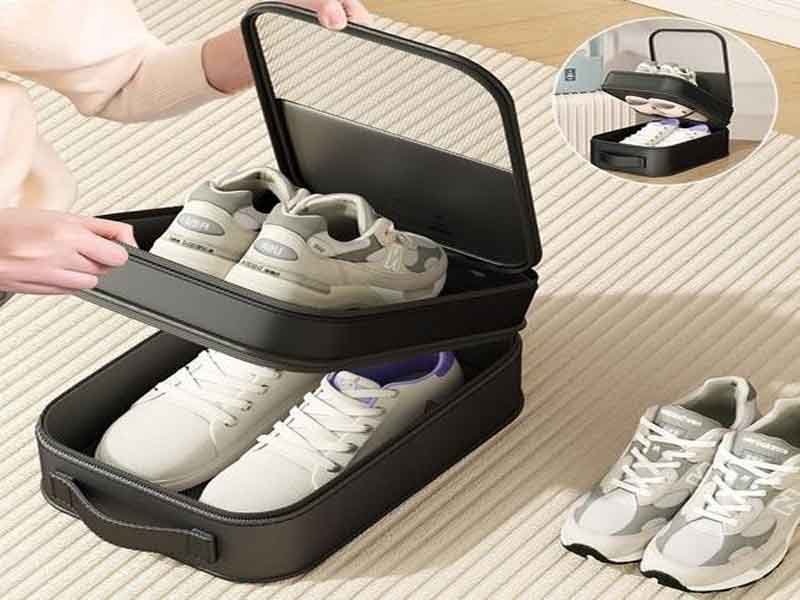
Recycled polyester, recycled nylon, organic cotton, recycled cotton, durable conventional fabrics, mono-material constructions, and carefully documented certified textiles can all support more sustainable shoe bag development. The strongest material choice is not automatically the one with the most environmental claims; it is the one that combines verified sourcing, appropriate performance, efficient manufacturing, long service life, and realistic end-of-use planning.
A lightweight recycled fabric may reduce virgin-fiber use, but the benefit can be weakened by poor durability, excessive coatings, difficult-to-separate components, or short product life. A durable conventional fabric may remain in service for years, while a poorly designed “eco” bag may be discarded after several trips.
Sustainability should therefore be evaluated across the whole product rather than reduced to one fiber label.
Is Recycled Polyester a Good Choice?
Recycled polyester is a practical choice for many shoe bags because it can deliver performance similar to conventional polyester while using recycled feedstock. It supports lightweight travel bags, packing organizers, retail dust covers, sports products, and coated Oxford constructions.
Recycled polyester is commonly produced from post-consumer plastic bottles, industrial polyester waste, or other recovered polyester sources. The material is converted into chips, yarn, and fabric through mechanical or chemical recycling processes.
| Recycled polyester benefit | Development consideration |
|---|---|
| Reduces demand for virgin polyester feedstock | Recycled content must be documented |
| Supports familiar fabric performance | Quality can vary by yarn source |
| Works with coatings and printing | Added finishes affect recyclability |
| Available in many deniers | Availability depends on color and quantity |
| Suitable for travel and sports bags | Abrasion and colorfastness still require testing |
| Can support certification | Certification scope and chain of custody must be checked |
Recycled polyester should not be treated as one uniform material. It is available in lightweight taffeta, ripstop, Oxford fabric, mesh, lining, webbing, and thread.
A shoe bag can therefore use recycled content across several components rather than only the main panel.
Possible recycled components include:
Outer fabric
Lining
Mesh
Webbing
Zipper tape
Sewing thread
Woven labels
Packaging
Using recycled polyester does not automatically make the complete bag recyclable. A product may combine recycled polyester with PU coating, metal hardware, foam, PVC windows, rubber patches, and mixed-fiber labels.
A mono-material design using mostly polyester components can simplify the material story and may support future recycling systems more effectively. However, performance requirements should still come first.
A sports shoe bag may need mesh, coating, and reinforcement. Making every component identical may reduce functionality. The development team should identify where material simplification is realistic and where mixed materials provide necessary value.
Color consistency can be another issue. Recycled yarn lots may show slight variation, particularly in pale or sensitive shades. Physical lab dips and bulk-lot approval help control the result.
For printed products, the base color and fabric surface must remain consistent enough to support the artwork.
Recycled polyester should be tested using the same standards as virgin polyester.
Abrasion resistance
Tear strength
Seam strength
Colorfastness
Coating adhesion
Dimensional stability
Wash durability
Odor
Recycled content does not excuse lower product performance.
Is Organic Cotton More Sustainable?
Organic cotton may support a lower-input agricultural approach because it is produced under defined standards that restrict or prohibit certain synthetic pesticides and fertilizers. It is suitable for premium shoe dust bags, natural lifestyle packaging, hotel products, and reusable storage bags.
Organic cotton should be selected for products that benefit from its softness, breathable character, and natural appearance. It is less suitable when the bag must contain wet or muddy footwear unless a separate lining is added.
| Organic cotton strength | Limitation to consider |
|---|---|
| Soft natural hand feel | Absorbs moisture |
| Suitable for premium presentation | Dries slower than polyester |
| Supports screen printing and embroidery | Can shrink without proper finishing |
| Available in several weaves | Often costs more |
| Works for dust bags and retail packaging | Needs colorfastness testing |
| Can be certified | Certification must cover the relevant supply chain |
Organic cotton can be woven into muslin, poplin, twill, canvas, and other structures. The environmental story should not overshadow fabric engineering.
A lightweight organic cotton bag may use less material but provide limited service life.
A heavy organic canvas bag may last longer but require more fiber, water, energy, and shipping weight.
The correct weight should match the actual application.
For luxury footwear packaging, a 120–180 g/m² organic cotton may be sufficient.
For a reusable lifestyle shoe bag, a 180–280 g/m² cotton twill or canvas may offer better durability.
For wet sports shoes, organic cotton is usually not the most practical option.
Dyeing and finishing also matter. Organic fiber can still undergo intensive processing. Bleaching, dyeing, printing, softening, and coating influence the overall environmental profile.
Natural or undyed cotton reduces some processing steps and creates a clear material appearance. It also shows dirt more easily and may vary slightly in shade.
An organic cotton claim should be supported by documentation. The relevant certification and transaction records should match the product stage and order.
The factory should avoid broad claims that cannot be verified through the supply chain.
Are Recycled Cotton Bags Durable?
Recycled cotton can be durable enough for lightweight shoe packaging and selected reusable bags, but its strength depends on recycled-fiber length, blending ratio, yarn construction, fabric weight, and intended service life.
Mechanical recycling shortens cotton fibers. Shorter fibers can reduce yarn strength and create a softer, more irregular appearance. Recycled cotton is therefore often blended with virgin cotton, polyester, or other fibers to improve spinning and durability.
| Recycled cotton construction | Expected durability | Suitable use |
|---|---|---|
| High recycled-content lightweight fabric | Low to moderate | Retail dust covers |
| Recycled cotton with virgin cotton | Moderate | Lifestyle packaging |
| Recycled cotton with polyester | Moderate to high | Reusable travel bags |
| Heavy recycled cotton canvas | High when well constructed | Premium storage bags |
| Recycled-cotton non-woven | Low to moderate | Promotional packaging |
A recycled-cotton shoe bag may have visible fiber variation, small neps, or a slightly uneven surface. These characteristics can support a natural recycled appearance, but the acceptable standard should be defined before production.
The fabric should be tested for:
Tensile strength
Tear resistance
Seam slippage
Colorfastness
Shrinkage
Pilling
Lint release
Abrasion
Print performance
Recycled cotton is better suited to dry footwear than wet shoes. It absorbs moisture and can retain dirt. A removable washable liner can extend its use range, though that adds another material.
Blending recycled cotton with polyester can improve strength and drying speed. The trade-off is a mixed-fiber construction that may be harder to recycle later.
Again, the most responsible decision depends on the complete product life rather than one input material.
A bag intended to be reused for years should have adequate seam strength, drawcord durability, and wash stability. A recycled fabric that tears early does not achieve the intended benefit.
Which Certifications Verify Materials?
Material certifications help verify recycled content, organic-fiber claims, restricted-substance control, chemical management, and textile safety. The appropriate certification depends on the fiber, processing stages, target market, and claim being made.
Common certification or verification frameworks may include:
Global Recycled Standard
Recycled Claim Standard
Global Organic Textile Standard
Organic Content Standard
OEKO-TEX Standard 100
bluesign-related material approval
Forest Stewardship Council for certain paper-based packaging components
ISO-based quality or environmental systems
Supplier-specific chemical compliance reports
| Certification or standard | Main purpose | Relevance to shoe bags |
|---|---|---|
| GRS | Verifies recycled content and processing requirements | Recycled polyester, nylon and cotton |
| RCS | Verifies recycled material content | Recycled-fiber claims |
| GOTS | Covers certified organic textiles and processing | Organic cotton bags |
| OCS | Verifies organic material content | Organic-fiber claims |
| OEKO-TEX Standard 100 | Tests textile components for harmful substances | Fabric, thread, labels and accessories |
| bluesign system | Focuses on responsible textile chemical and resource management | Selected performance fabrics |
| ISO 9001 | Quality-management system | Manufacturing consistency |
| ISO 14001 | Environmental-management system | Factory environmental processes |
Certification names should not be placed on product pages unless the relevant scope and documentation support the claim.
A fabric supplier may hold a certificate, but the finished-product factory, transaction, or specific material may not automatically be covered.
The development team should confirm:
Certificate holder
Certificate number
Valid dates
Certified material category
Applicable processing stage
Recycled or organic percentage
Transaction-certificate availability
Logo-use permission
Final product labeling rules
A test report and a certification are not the same.
A laboratory report may show that a material passes a restricted-substance test.
A certification may verify the supply chain, process, or content claim.
Both can be useful, but they support different statements.
For international orders, material claims should also match local advertising and labeling requirements. Broad words such as “eco-friendly,” “green,” or “sustainable” can be misleading when no specific basis is given.
More precise wording is stronger.
Made with 70% certified recycled polyester.
Outer fabric contains recycled polyester verified under an applicable standard.
Made from certified organic cotton.
Designed for repeated use.
Packaged without individual plastic bags where suitable.
Specific language improves trust and reduces claim risk.
How Does Durability Reduce Waste?
Durability can reduce waste by extending the time before a shoe bag needs replacement. Strong seams, suitable fabric weight, repairable components, washable interiors, and accurate sizing all support a longer service life.
A durable bag is not necessarily a heavy bag. Material should be reinforced only where stress occurs.
Key wear zones include:
Bottom corners
Sole-contact areas
Zipper ends
Drawcord channels
Handle attachments
Divider seams
Mesh connections
Logo edges
| Durability feature | Waste-reduction benefit |
|---|---|
| Reinforced base | Delays abrasion failure |
| Replaceable liner | Extends use after interior wear |
| Repairable zipper | Avoids discarding the full bag |
| Washable fabric | Supports repeated hygienic use |
| Strong handle attachment | Prevents early structural failure |
| Accurate sizing | Reduces seam and zipper stress |
| Colorfast material | Maintains acceptable appearance |
| Fold-resistant coating | Prevents cracking and peeling |
| Simple construction | Makes repair and material separation easier |
Overbuilding can also create waste. Using very heavy material for a low-load application increases resource use and shipping weight without necessarily extending useful life.
Durability should be proportionate.
A hotel slipper bag may need dozens of light-use cycles.
A personal travel bag may need several years of occasional use.
A sports-team bag may face weekly washing.
A work-boot carrier may endure daily heavy loads.
The target service level should guide the specification.
Repairability is rarely considered in basic shoe bags, but it can be valuable for premium and heavy-duty products. A replaceable drawcord, removable board, detachable liner, or accessible zipper construction can prevent the complete product from being discarded.
Design simplicity also supports durability. Every added pocket, buckle, panel, and seam creates another potential failure point.
A well-sized single-compartment bag with a strong zipper may last longer than an elaborate organizer filled with lightly constructed features.
Does a Thicker Fabric Always Last Longer?
A thicker fabric does not always last longer. Durability depends on fiber strength, weave density, coating adhesion, abrasion exposure, seam construction, and user behavior.
A lightweight high-tenacity nylon can outlast a heavier low-density polyester under repeated rubbing.
A heavy canvas may tear at a narrow seam.
A thick PVC coating may crack after repeated folding.
A thin ripstop fabric may control tear growth effectively.
A strong outer shell may still fail when the zipper is underspecified.
| Assumption | More accurate interpretation |
|---|---|
| Higher denier always lasts longer | Denier is only one performance factor |
| Heavy fabric means strong seams | Seam construction must be tested separately |
| Waterproof coating increases life | Poor coating can crack or peel |
| Natural fabric is always more sustainable | Service life and processing also matter |
| Recycled fabric is less durable | Quality depends on yarn and construction |
| Simple bags are low quality | Simplicity can improve reliability |
| More features increase value | Added components may shorten service life |
Material selection should therefore compare the complete construction under realistic conditions.
An abrasion test may show that a lighter fabric performs well enough for the intended footwear. Using the heavier option would add cost and shipping weight without a meaningful benefit.
A load test may reveal that the handle seam fails before the body fabric. Reinforcing the handle is more valuable than increasing fabric weight across the entire bag.
How Can Manufacturing Reduce Material Waste?
Material waste can be reduced through efficient pattern layout, standardized panel sizes, optimized fabric width, controlled cutting, defect mapping, digital pattern development, and reuse of suitable offcuts.
Pattern efficiency can have a significant effect on material consumption.
Rectangular drawstring bags usually provide high cutting efficiency.
Curved structured bags create more offcuts.
Directional prints reduce nesting flexibility.
Large logos may require precise panel placement.
Mixed sizes can sometimes share a cutting marker more efficiently.
| Waste-reduction method | Manufacturing benefit |
|---|---|
| Digital marker planning | Improves cutting yield |
| Standardized dimensions | Simplifies nesting and purchasing |
| Fabric-width matching | Reduces edge waste |
| Mixed-size markers | Uses space between large panels |
| Defect mapping | Avoids cutting unusable parts |
| Accurate sample approval | Reduces rejected production |
| Controlled printing | Prevents artwork-related waste |
| Offcut reuse | Creates small pouches, patches or test pieces |
Material yield should be considered during design. Increasing a bag dimension by only one or two centimeters may reduce the number of panels that fit across the fabric width.
A 150 cm-wide fabric may fit four panels at one size but only three after a minor increase. That change can raise material consumption much more than expected.
Fabric orientation also matters. Solid plain-weave material can often be nested efficiently. Twill, velvet, brushed fabric, and directional prints may require every panel to face the same direction.
Offcuts can sometimes be used for:
Zipper guards
Handle tabs
Internal pockets
Reinforcement patches
Logo-test pieces
Sample swatches
Small accessory pouches
Reuse should not create unnecessary products merely to consume scraps. It should be integrated only where the result has real value.
Accurate sampling also reduces waste. Producing bulk goods before size, material, and logo approval can result in major rework or rejected inventory.
Are Mono-Material Shoe Bags Better?
Mono-material shoe bags use one dominant material family across the outer fabric, lining, mesh, webbing, thread, and sometimes zipper components. They can simplify sourcing, material communication, and potential recycling, but they may not provide the best performance for every use.
A mostly polyester shoe bag could include:
Recycled polyester outer fabric
Polyester mesh
Polyester lining
Polyester webbing
Polyester thread
Polyester zipper tape
Such a construction reduces fiber diversity, although the zipper teeth, slider, coating, labels, and printing may still use other materials.
| Mono-material benefit | Possible limitation |
|---|---|
| Simpler material story | Not all components can be identical |
| Easier component matching | Performance may require coatings or hardware |
| Potentially easier recycling | Collection and recycling systems may be limited |
| Consistent dye behavior | Different polyester structures still vary |
| Simplified sourcing | May restrict premium design choices |
A luxury cotton bag with microfiber lining may provide better shoe protection than a cotton-only construction.
A wet-shoe bag may require a TPU or PEVA liner.
A boot bag may need plastic board reinforcement and a metal zipper slider.
Forcing a mono-material approach can reduce function or durability.
The better question is whether unnecessary material mixing can be eliminated without harming performance.
A simple unlined recycled-polyester drawstring bag may be highly suitable for dry travel shoes.
A technical wet-boot carrier may justifiably use several material types.
How Should Packaging Be Considered?
Packaging is part of the product’s material footprint. A compact shoe bag can be folded into a paper sleeve, bundled with a recycled-paper band, packed in a reusable pouch, or placed in an individual plastic bag depending on protection and sales-channel needs.
Possible packaging approaches include:
Recycled-paper belly band
FSC-certified paper sleeve
Printed kraft-paper box
Reusable fabric pouch
Minimal tissue wrap
Bulk inner packaging
Individual recycled-plastic bag where necessary
Plastic-free retail presentation
Packaging should protect the shoe bag from dust, moisture, abrasion, and deformation during transport. Removing all plastic may create damage or contamination in some supply chains, especially for pale cotton or premium products.
The best option balances protection with material reduction.
| Packaging format | Material use | Product protection | Suitable application |
|---|---|---|---|
| Paper belly band | Low | Low to moderate | Folded lightweight bags |
| Paper sleeve | Moderate | Moderate | Retail travel accessories |
| Individual polybag | Low material weight | High against dust and moisture | Export and warehouse storage |
| Recycled polybag | Low material weight | High | Moisture-sensitive logistics |
| Printed carton | High | High | Premium structured bags |
| Reusable pouch | Moderate | High | Gift sets and premium collections |
| Bulk packing | Very low per unit | Moderate | Institutional or wholesale orders |
Shipping-carton efficiency should also be evaluated. A heavily padded or structured shoe bag may occupy far more carton volume than a foldable version.
Reducing air in packaging can lower storage and shipping requirements. However, excessive compression may crease coatings, damage transparent windows, or deform foam.
The packing method should be tested after transit simulation or real shipment where possible.
How Can Sustainability Claims Stay Credible?
Sustainability claims remain credible when they are specific, measurable, documented, and limited to what the product and supply chain can actually prove.
Strong statements identify the exact material or design improvement.
Weak statement: environmentally friendly shoe bag.
Stronger statement: outer fabric made with certified recycled polyester.
Weak statement: zero-impact packaging.
Stronger statement: packed with a recycled-paper sleeve and no individual retail box.
Weak statement: fully recyclable.
Stronger statement: designed primarily with polyester textile components to reduce material complexity.
Credible product information should explain:
What material is used
What percentage is recycled or organic
Which certification applies
Which product component carries the claim
Whether the claim refers to fabric or finished product
How the bag is designed for reuse
How it should be cleaned and maintained
What packaging reduction has been made
A claim should not imply that one material choice solves every environmental issue. Honest limitations improve trust.
For example, a recycled-polyester outer fabric may still require a PU coating for moisture resistance. That trade-off can be explained rather than hidden.
Which Sustainable Material Is Most Practical?
The most practical sustainable material depends on the product function.
Certified recycled polyester suits lightweight travel, sports, and coated shoe bags.
Organic cotton suits dry-footwear packaging and premium dust covers.
Recycled cotton suits lifestyle packaging where some surface variation is acceptable.
Recycled nylon suits technical lightweight bags when supply and cost allow.
Durable conventional Oxford fabric may remain appropriate for heavy boots when long service life is the main objective.
| Product type | Practical material direction |
|---|---|
| Lightweight travel bag | Certified recycled polyester |
| Sports shoe bag | Recycled polyester with mesh ventilation |
| Luxury dust bag | Certified organic cotton |
| Natural retail packaging | Organic or recycled cotton blend |
| Premium technical bag | Recycled nylon |
| Heavy boot carrier | Durable Oxford fabric with replaceable liner |
| Wet-shoe bag | Recycled outer fabric with TPU or PEVA lining |
| Promotional pouch | Recycled non-woven or lightweight recycled polyester |
The strongest development process compares environmental goals with performance, cleaning, cost, order volume, certification, and service life.
Szoneier can source and evaluate recycled polyester, recycled nylon, organic cotton, recycled cotton blends, conventional durable fabrics, mesh, coated materials, and low-complexity constructions. Development can include material documentation, physical swatches, logo testing, wash evaluation, durability checks, packaging planning, and sample production before the final material is selected.
How Are Shoe Bag Materials Tested?
Shoe bag materials are tested for tensile strength, tear resistance, abrasion, seam strength, colorfastness, coating adhesion, water resistance, dimensional stability, chemical safety, and finished-product performance. The exact test plan should reflect how the bag will be used. A lightweight cotton dust bag does not require the same evaluation as a waterproof hiking-boot carrier.
Material testing is most useful when laboratory results are connected to real footwear and packing conditions. A fabric may pass a tensile-strength test but still fail where a zipper ends. A coating may resist water on a flat swatch but leak through sewn seams. A dark lining may look stable until it contacts damp white leather.
For this reason, quality evaluation should move through three levels:
Raw-material testing
Component and seam testing
Finished-bag testing with actual footwear
The objective is not to perform every available textile test. It is to identify the likely failure points, define measurable requirements, and confirm that the selected construction meets the intended product promise.
Which Tests Measure Fabric Strength?
Fabric strength is commonly evaluated through tensile-strength, tear-strength, bursting-strength, puncture, and seam-strength tests. Each test measures a different failure mode, so one result cannot represent the complete durability of a shoe bag.
Tensile-strength testing measures the force required to pull a fabric strip apart. It indicates how the material responds to direct loading along the warp and weft directions.
Tear-strength testing measures how easily an existing cut or tear continues through the material. It is particularly relevant to lightweight polyester, nylon, ripstop, and non-woven fabrics.
Bursting-strength testing applies pressure across a wider area until the fabric ruptures. It is useful for mesh, knitted fabrics, and materials that experience multidirectional stress.
Puncture testing evaluates resistance to sharp pressure from heel tips, boot hooks, sole edges, or hardware.
Seam-strength testing measures the force required to break the stitching, tear the fabric beside the seam, or cause the yarns to slip apart.
| Test | What it measures | Why it matters for shoe bags |
|---|---|---|
| Tensile strength | Resistance to straight pulling force | Relevant to loaded panels and handles |
| Tear strength | Resistance to continued tearing | Important around cuts, corners and eyelets |
| Bursting strength | Multidirectional pressure resistance | Useful for mesh and stretch materials |
| Puncture resistance | Resistance to concentrated sharp force | Relevant to heels and aggressive boot soles |
| Seam strength | Strength of joined fabric panels | Reveals sewing and seam weaknesses |
| Seam slippage | Yarn movement around stitching | Important for loose weaves and canvas |
| Handle-load strength | Loaded lifting performance | Critical for heavy footwear |
| Zipper pull strength | Opening and closing resistance | Important for tight or structured bags |
A shoe bag does not normally experience the same loading as a climbing pack or industrial lifting sling. Testing requirements should remain proportionate. However, a boot bag carrying several kilograms requires much higher seam and handle strength than a light drawstring dust cover.
The fabric should be tested in both principal directions because warp and weft strength can differ. The weaker direction may influence how panels are positioned during cutting.
The development team should also study how the sample fails.
Does the thread break?
Does the fabric tear beside the stitching?
Does the seam allowance pull out?
Do the yarns separate without tearing?
Does the zipper tape detach?
Does the webbing pull away from the body?
The failure location often provides more useful design information than the force number alone.
For example, increasing body-fabric weight will not solve a handle failure caused by an undersized reinforcement patch. The better correction may be extending the webbing farther down the panel, increasing seam allowance, or adding box-and-cross stitching.
How Is Abrasion Resistance Checked?
Abrasion resistance is checked by repeatedly rubbing the fabric against a defined surface under controlled pressure and observing wear, yarn breakage, coating loss, color change, or hole formation. It is especially important for the base and lower side panels of shoe and boot bags.
Footwear creates both internal and external abrasion.
Inside the bag, tread patterns, heel edges, studs, hooks, and dirt rub against the lining.
Outside the bag, the product moves against luggage shells, floors, vehicle interiors, shelves, and other equipment.
A material that performs well against smooth rubbing may react differently to sharp shoe lugs or embedded sand.
| Abrasion area | Main source of wear | Suitable response |
|---|---|---|
| Internal base | Outsole tread and dirt | Reinforced or coated panel |
| Lower corners | Loaded bag rubbing on surfaces | Double layer or piping |
| Zipper edge | Repeated hand and slider contact | Strong tape and clean stitching |
| Handle area | Pulling and flexing | Webbing reinforcement |
| Mesh section | Shoe hooks and surrounding luggage | Fine reinforced mesh |
| Logo surface | Folding and rubbing | Tested print or patch method |
| Coating surface | Repeated compression | Flexible coating formulation |
Standard abrasion methods can provide comparative results among fabrics. A sample may be examined after a defined number of cycles and graded for visible change or failure.
Practical footwear abrasion tests are also valuable. A bag can be loaded with the intended shoes and subjected to repeated movement, shaking, lifting, and unpacking.
A simple development test may include:
Load the largest intended footwear.
Place controlled dry grit on the outsole.
Carry and shake the bag for a defined cycle.
Remove and reload the shoes repeatedly.
Inspect the sole-contact zone.
Check the lining for thinning or punctures.
Inspect external corners and base.
Record visible wear and coating damage.
Such testing often reveals localized problems that a flat fabric test does not show.
Abrasion resistance should be concentrated where it is needed. Using the heaviest fabric throughout the bag is rarely the most efficient solution.
A lighter outer body with a replaceable or reinforced bottom panel may reduce weight while extending product life.
For luxury shoes, abrasion evaluation focuses on the opposite concern: whether the bag damages the footwear. The lining should be rubbed against representative leather, suede, satin, or coated surfaces to confirm that it does not scratch, transfer lint, or change the finish.
Are Colorfastness Tests Necessary?
Colorfastness tests are necessary whenever the shoe bag contains dyed, printed, or coated materials that may contact footwear, clothing, moisture, sweat, or cleaning products. They are particularly important for dark linings, bright drawcords, printed cotton, and bags intended for white or light-colored shoes.
Color can transfer through:
Dry rubbing
Wet rubbing
Washing
Perspiration
Water exposure
Prolonged contact
Heat
Cleaning agents
UV exposure
A black shoe bag may appear stable during ordinary handling but release color when pressed against damp white leather for several hours.
| Colorfastness test | Risk evaluated | Relevant product |
|---|---|---|
| Dry rubbing | Transfer during normal contact | All dark fabrics |
| Wet rubbing | Transfer under humidity or dampness | Sports and travel bags |
| Washing | Fading and staining during cleaning | Washable products |
| Water fastness | Migration after wet exposure | Wet-shoe bags |
| Perspiration fastness | Reaction to sweat | Sports footwear |
| Light fastness | Fading under sunlight | Outdoor and retail products |
| Heat migration | Dye movement under temperature | Laminated and heat-transferred products |
Both the outer and inner fabrics should be checked. The outer fabric may stain clothing, while the lining may stain the shoes.
Colorfastness also affects mixed-material products. A red cotton handle, black polyester body, white lining, and printed logo may react differently during washing. Color can move from one component to another even if each material looked acceptable separately.
Dark microfiber and velvet require particular caution because their soft surfaces create extensive contact with the shoe. Light-colored or undyed linings often reduce risk for luxury footwear, though they show dirt more easily.
Printed logos should be checked for both color loss and transfer. A heat-transfer logo may remain visually intact but become tacky under heat. Screen-print ink may crack or rub onto adjacent luggage.
For a reliable approval process, testing should use the actual bulk fabric, dye lot, print ink, and finishing method rather than a similar reference material.
How Is Coating Durability Evaluated?
Coating durability is evaluated through adhesion, flexing, folding, abrasion, hydrolysis, temperature, aging, washing, and peel tests. The objective is to confirm that the coating remains attached and functional throughout normal product use.
A coating can fail in several ways:
Peeling from the fabric
Cracking at folds
Becoming sticky
Turning powdery
Developing white stress marks
Separating from a laminated layer
Losing water resistance
Creating odor
Transferring onto other materials
| Coating test | What it reveals |
|---|---|
| Adhesion test | Bond between coating and base fabric |
| Peel-strength test | Resistance of laminated layers to separation |
| Flex test | Cracking after repeated folding |
| Abrasion test | Surface and backing wear |
| Hydrolysis aging | Breakdown under heat and humidity |
| Low-temperature test | Brittleness or cracking in cold conditions |
| Heat-aging test | Stickiness, discoloration or deformation |
| Wash test | Durability after cleaning |
| Water-pressure test | Retained moisture resistance |
| Storage test | Blocking, odor or surface transfer |
Hydrolysis deserves special attention for certain PU formulations. Heat and humidity can gradually break down poorly selected polyurethane, causing stickiness, flaking, or loss of strength. Products shipped or stored in warm, humid regions may need more demanding material specifications.
PVC and transparent films should be checked at low temperatures because they can stiffen and crack. TPU laminates should be checked for edge lifting and bonding consistency.
Repeated-fold testing is especially relevant to shoe bags. Many products are folded flat in retail packaging, unfolded for use, compressed into luggage, and folded again after the trip. Coatings must tolerate those cycles.
A practical flex evaluation may fold the sample along the same line hundreds or thousands of times, then inspect for:
Surface whitening
Cracks
Peeling
Loss of water resistance
Permanent crease formation
Color change
Lamination bubbles
Coating approval should occur after printing and sewing when possible. Heat transfer, embroidery, needle penetration, and seam pressing can change coating performance.
Which Safety Standards May Apply?
Safety requirements depend on the target market, material composition, customer specification, product age group, intended application, and whether the shoe bag is sold independently or included with another product. Textile chemical restrictions, labeling rules, packaging requirements, and product-specific standards may all be relevant.
A conventional adult travel shoe bag usually does not require the same testing program as a toy, medical textile, or children’s product. However, materials and components may still need to comply with restrictions covering hazardous substances.
Potential areas of review include:
Restricted azo dyes
Formaldehyde
Heavy metals
Phthalates in PVC or printed components
Polycyclic aromatic hydrocarbons in rubber parts
Dimethyl fumarate
Lead and cadmium in coatings or hardware
Nickel release from metal accessories
Persistent or restricted fluorinated finishes
Fiber-content labeling
Country-of-origin marking
Care labeling
Packaging substance restrictions
| Component | Possible compliance concern |
|---|---|
| Dyed fabric | Restricted dyes and formaldehyde |
| PVC window or coating | Phthalates and heavy metals |
| Rubber patch | PAHs and restricted substances |
| Metal puller or badge | Nickel release and metal content |
| Printed logo | Ink chemistry and adhesion |
| Water-repellent treatment | Restricted chemical chemistry |
| Recycled material | Traceability and contamination control |
| Packaging | Plastic, labeling and recycling rules |
| Children’s product | Additional safety requirements |
Testing should be selected according to actual risk rather than copied from unrelated products.
For example, a plain undyed cotton dust bag with cotton cord has a simpler chemical-risk profile than a PVC-coated boot bag with rubber patches, metal hardware, and multicolor printing.
Target-market requirements may change, so compliance specifications should be confirmed before production and shipment. Clients should communicate destination countries, retailer requirements, and any internal restricted-substance list during product development.
Third-party laboratory testing may be appropriate when:
A retailer requires formal reports.
The product uses PVC, rubber, coatings, or complex printing.
The bag is intended for children.
Claims require performance verification.
The order enters several regulated markets.
The material supplier cannot provide sufficient documentation.
Testing the correct sample is essential. A report for a similar black polyester fabric does not necessarily cover a newly produced red material, different coating, or changed print ink.
How Are Zippers and Hardware Tested?
Zippers and hardware are tested for operating smoothness, pull strength, repeated opening cycles, corrosion, coating durability, sharp edges, dimensional consistency, and attachment strength.
A high-quality fabric cannot compensate for a weak zipper. Zippers are one of the most frequently handled components and a common source of product complaints.
Useful zipper checks include:
Repeated opening and closing
Slider-lock function
Puller strength
Chain alignment
Resistance to separation
Tape colorfastness
Resistance to dirt
Operation around corners
Water resistance when claimed
End-stop strength
| Component | Main test | Typical risk |
|---|---|---|
| Coil zipper | Cycle and chain-strength test | Coil separation |
| Molded zipper | Tooth alignment and pull test | Tooth damage |
| Water-resistant zipper | Surface-exposure test | Leakage at ends |
| Cord lock | Repeated compression | Spring failure |
| Eyelet | Pull-out and corrosion test | Fabric tearing |
| Buckle | Opening-cycle and impact test | Cracking |
| Snap | Attachment and repeated-use test | Detachment |
| Handle hardware | Load test | Deformation or breakage |
| Metal badge | Edge and corrosion inspection | Scratching or rust |
Hardware should not have sharp edges that can damage the footwear, user, or luggage.
Metal parts should be checked for corrosion when exposed to moisture or salt. This is relevant to sports, beach, outdoor, and wet-shoe bags.
Plastic components should be checked at high and low temperatures. Low-quality plastic may become brittle in cold environments or soften under heat.
Hardware finishes should match approved colors and remain consistent across production. Black plating, gunmetal, nickel, and painted finishes can show variation if control is weak.
How Is Seam Quality Inspected?
Seam quality is inspected through visual examination, measurement, strength testing, stitch counting, edge control, and loaded-product checks.
Inspectors may review:
Stitch density
Straightness
Skipped stitches
Loose threads
Backstitching
Seam allowance
Binding coverage
Puckering
Needle damage
Corner shape
Thread tension
Reinforcement position
Seam symmetry
A seam can look straight while remaining weak. Visual checks should therefore be combined with manual pull tests and selected laboratory or load testing.
| Seam defect | Possible consequence |
|---|---|
| Skipped stitches | Progressive seam opening |
| Excessive stitch density | Fabric perforation |
| Low stitch density | Weak joining |
| Uneven tension | Puckering or loose loops |
| Narrow seam allowance | Fabric pull-out |
| Incomplete binding | Fraying and poor appearance |
| Missing bartack | Handle or zipper failure |
| Needle cuts | Early tearing in coated fabric |
| Twisted panel alignment | Poor shape and reduced capacity |
For coated and laminated materials, needle selection is important. A large needle creates bigger holes and can reduce moisture resistance. A small needle may break or deflect on heavy layers.
Needles should be monitored and replaced to reduce fabric damage, skipped stitches, and oil marks.
Quality standards should identify critical, major, and minor defects. A broken zipper or torn seam is critical to function. A small removable thread may be minor. Clear classification helps maintain consistent inspection decisions.
How Are Finished Shoe Bags Tested?
Finished shoe bags are tested with actual footwear to confirm fit, loading, closure, weight distribution, moisture control, cleaning, and durability. This stage reveals how the materials, components, pattern, and workmanship perform together.
A finished-product evaluation may include:
Fit test with minimum and maximum shoe sizes
Loaded zipper operation
Handle-load test
Drop or movement simulation
Repeated opening cycles
Abrasion from actual soles
Water or damp-shoe containment
Wash or wipe-clean test
Drying-time assessment
Color-transfer test
Luggage-fit test
Packaging recovery test
Odor check after storage
| Finished-product test | Question answered |
|---|---|
| Footwear fit | Does the intended shoe enter without force? |
| Opening test | Can users load and remove footwear easily? |
| Loaded carry test | Do handles and seams support the weight? |
| Luggage test | Does the bag fit the intended suitcase space? |
| Moisture test | Does dampness transfer outside? |
| Ventilation test | Can heat and humidity escape? |
| Cleaning test | Can dirt be removed without damage? |
| Fold test | Does the bag recover after compact storage? |
| Logo test | Does branding remain intact during use? |
| Packaging test | Does the product arrive without distortion? |
The largest intended footwear should be used for fit testing. A bag tested only with small sneakers may fail when customers load high-tops or men’s extended sizes.
Testing should also include repeated use. A first sample may operate smoothly, while the zipper begins catching after the lining shifts or the coating softens.
How Should Quality Standards Be Defined?
Quality standards should be defined before bulk production through approved materials, technical drawings, measurement tables, workmanship requirements, test limits, color standards, packaging instructions, and a signed pre-production sample.
A clear quality file may include:
Bill of materials
Fabric specification
Color reference
Approved swatches
Pattern dimensions
Measurement points
Tolerance table
Stitching requirements
Logo artwork
Logo position
Hardware specification
Testing requirements
Care-label content
Packing method
Carton marks
Inspection standard
The pre-production sample should represent final materials, colors, dimensions, branding, and construction. It becomes the main reference for production and inspection.
Measurement tolerance should reflect the material and structure. A flat unlined pouch can be controlled more tightly than a padded three-dimensional boot bag.
Critical dimensions should receive greater attention:
Usable internal length
Opening size
Gusset depth
Handle position
Divider location
Logo position
Aesthetic dimensions with little effect on performance may allow slightly wider tolerance.
AQL-based final inspection may be used for production orders, with sampling levels and defect categories agreed according to order size and client requirements. Critical functional points may also receive 100% checking, such as zipper operation or visible logo defects.
How Do You Select Custom Materials?
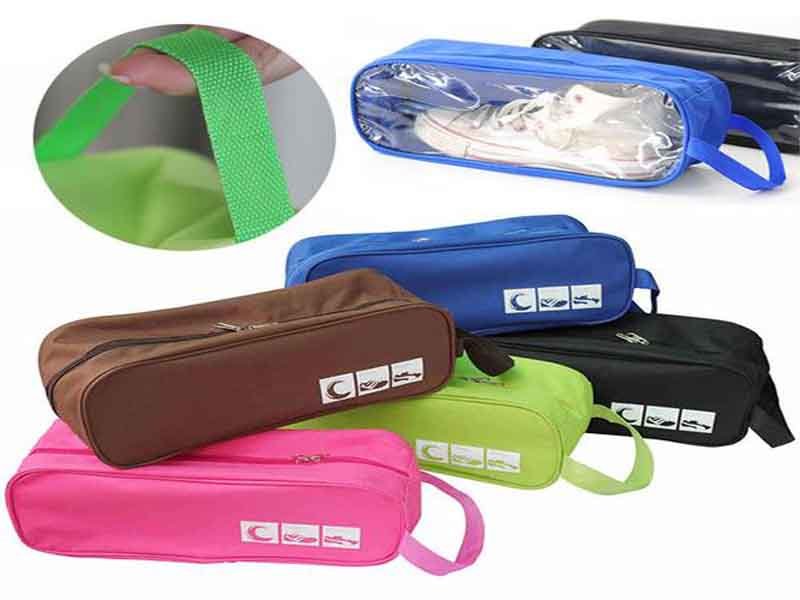
Custom shoe bag materials should be selected by starting with footwear type, use environment, required capacity, cleaning method, protection level, logo process, target market, order quantity, and budget. Material selection works best as a structured comparison rather than choosing a fabric from appearance alone.
A practical custom-development process usually follows five decisions:
Define the footwear and use scenario.
Identify required performance.
Compare suitable material systems.
Produce and test physical samples.
Approve the final specification before bulk production.
This approach prevents a common mistake: spending time perfecting the logo and color before confirming whether the bag can fit, protect, ventilate, or contain the intended footwear.
What Product Details Should Be Provided?
Clients should provide the intended footwear type, maximum dimensions, bag capacity, use environment, closure preference, material direction, branding artwork, packaging requirements, target quantity, destination market, and expected delivery schedule.
The more specific the information, the more accurately a manufacturer can recommend materials and construction.
Useful project information includes:
Shoe category
Footwear size range
Actual sole length and width
Overall footwear height
One-pair or multi-pair capacity
Dry, damp, sandy, or muddy use
Carry-on, checked luggage, retail, or home storage
Required ventilation
Required moisture resistance
Wash or cleaning method
Preferred closure
Logo artwork and colors
Target price range
Estimated quantity
Packaging format
Required compliance or testing
| Project detail | Why it affects material choice |
|---|---|
| Footwear type | Determines abrasion, size and protection needs |
| Largest shoe size | Controls usable dimensions |
| Moisture level | Determines coating and lining |
| Travel or storage use | Affects weight and structure |
| Cleaning method | Controls washable components |
| Logo process | Requires compatible surface |
| Product positioning | Influences appearance and hand feel |
| Quantity | Affects material availability and setup |
| Destination market | Determines compliance review |
| Packaging method | Influences foldability and crease resistance |
Reference images are useful for communicating visual direction, but they should be supported by functional information. A photograph cannot show fabric weight, coating, internal size, lining, or loaded performance.
Physical footwear samples provide the most reliable fit development. When physical shoes are unavailable, clients can provide detailed measurements, technical drawings, or three-dimensional data.
For fashion footwear, heel height, embellishment location, and surface sensitivity should be described.
For boots, shaft height, sole depth, and loaded weight matter.
For athletic shoes, ventilation, cleaning, and midsole protection may take priority.
Which Fabric Supports Each Logo Method?
The selected fabric must support the intended logo method without peeling, distortion, color migration, excessive needle damage, or loss of detail.
Smooth polyester works well with screen printing, transfer printing, and sublimation.
Cotton and canvas suit screen printing, embroidery, woven labels, and patches.
Nylon requires suitable inks, adhesives, or primers because some finishes reduce adhesion.
Mesh usually needs a solid logo panel or attached label.
Coated materials need testing to confirm print and heat compatibility.
| Logo method | Suitable materials | Key control point |
|---|---|---|
| Screen printing | Cotton, canvas, polyester, non-woven | Ink adhesion and curing |
| Heat transfer | Smooth polyester and selected nylon | Temperature and coating compatibility |
| Sublimation | Light-colored polyester | Fabric must accept sublimation dyes |
| Embroidery | Canvas, cotton twill, Oxford fabric | Puckering and needle holes |
| Woven label | Most sewn fabrics | Edge softness and placement |
| Rubber patch | Oxford, nylon and sports fabrics | Attachment strength |
| Leather patch | Canvas and lifestyle fabrics | Washability and color transfer |
| Reflective print | Polyester, nylon and sports fabrics | Reflective performance and adhesion |
| Metal badge | Structured woven fabrics | Weight, scratching and attachment |
| Printed lining | Polyester and cotton | Colorfastness against footwear |
Logo dimensions should be proportional to the visible panel after the bag is loaded. A large print may wrap around a gusset or crease inside luggage. Small lettering can disappear on coarse fabric.
The decoration process can also change product performance.
Embroidery penetrates water-resistant fabric with many needle holes.
Heat transfer can soften coatings.
Heavy rubber patches reduce flexibility.
Metal badges add weight and may scratch.
Leather patches may not tolerate machine washing.
A strong logo solution supports the product’s intended use rather than competing with it.
For a washable sports bag, a high-quality screen print or woven label may be more practical than a leather patch.
For a luxury cotton dust bag, subtle embroidery may reinforce the presentation.
For a rugged boot carrier, a rubber patch can tolerate abrasion.
For an ultralight nylon pouch, a small heat-transfer logo preserves packability.
How Can Materials Be Combined?
Materials can be combined by assigning a function to each part of the shoe bag. The base can resist abrasion, the upper can provide ventilation, the lining can protect footwear, and the front panel can support clear branding.
A functional material map may include:
Abrasion-resistant bottom
Lightweight side panels
Breathable upper zone
Soft shoe-contact divider
Wipe-clean sole liner
Strong webbing handle
Flexible zipper guard
Printable branding panel
| Product zone | Main requirement | Possible material |
|---|---|---|
| Outer body | Weight and appearance | Polyester, nylon, cotton or canvas |
| Base | Abrasion and dirt control | Coated Oxford or double-layer fabric |
| Upper vent | Airflow | Fine polyester mesh |
| Interior | Cleaning or softness | PEVA, TPU, tricot or microfiber |
| Divider | Shoe separation | Soft woven fabric or foam laminate |
| Handle | Load support | Polyester or nylon webbing |
| Window | Identification | TPU or PVC film |
| Reinforcement | Shape and protection | EVA, PE board or PP sheet |
| Trim | Edge stability | Polyester binding |
Material combinations should remain compatible through sewing, washing, folding, and storage.
Cotton combined with PEVA requires shrinkage control.
Mesh joined to heavy Oxford needs edge stabilization.
Nylon laminated to foam needs reliable adhesion.
PVC windows require suitable seam design and low-temperature evaluation.
Microfiber lining should be checked for color transfer.
Mixed materials should not be added only for visual complexity. Each layer should solve a real problem.
A simple one-material drawstring bag may be better for dry slippers than a six-material construction.
A technical sports bag may justify several materials because it must manage dirt, airflow, moisture, and loaded weight simultaneously.
How Do Samples Reduce Production Risk?
Samples reduce production risk by confirming dimensions, material behavior, logo appearance, closure operation, footwear fit, cleaning, packaging, and construction before the full order is produced.
Sampling is not only an appearance check. It is the stage where functional assumptions are tested.
A standard sample-development sequence may include:
Material swatch review
Initial construction sample
Fit sample with footwear
Logo sample
Revised functional sample
Pre-production sample
Packing sample
| Sample stage | Main purpose |
|---|---|
| Material swatch | Approve color, texture and weight |
| Prototype | Confirm structure and overall concept |
| Fit sample | Test actual footwear capacity |
| Logo sample | Approve branding process |
| Revised sample | Correct function and appearance |
| Pre-production sample | Confirm final bulk specification |
| Packaging sample | Check folding, labeling and presentation |
The first sample may use available colors or substitute materials to confirm size and structure. The pre-production sample should use final production materials wherever possible.
During sample review, clients should test more than visual appearance.
Load the largest intended shoes.
Open and close the zipper repeatedly.
Carry the loaded bag.
Place it inside the target luggage.
Check whether soles contact delicate panels.
Wipe or wash the interior.
Fold it into the planned packaging.
Leave damp footwear inside for the intended transport time.
Check the logo after handling.
A written sample-review form helps organize feedback. Comments should identify exact changes rather than broad reactions.
“Make the bag stronger” is difficult to execute precisely.
“Add a second layer of 420D Oxford to the base and extend the handle webbing 8 cm down each side” provides clear direction.
Measurements should be marked on photographs or technical drawings where possible.
Revisions should also consider how one change affects other areas. Increasing gusset depth improves capacity but changes fabric consumption, zipper length, carton volume, and loaded shape.
Adding foam improves protection but reduces usable internal space.
Changing from drawstring to zipper affects pattern, sewing time, and cost.
Sampling reveals these trade-offs before they become bulk-production problems.
How Do Cost and Performance Compare?
Cost and performance should be compared through the full product specification rather than fabric price alone. Material, coating, lining, zipper, logo, labor, testing, packaging, waste, and inspection all contribute to the final cost.
A lower-priced fabric may require additional reinforcement or lining.
A more expensive fabric may simplify construction and improve durability.
A complex mixed-material bag may use economical fabrics but require more cutting and sewing operations.
A premium logo process may cost more than the body material.
| Material direction | Relative material cost | Performance level | Typical application |
|---|---|---|---|
| Lightweight non-woven | Low | Basic | Retail packaging |
| 190T polyester | Low | Light-duty | Promotional and travel pouches |
| 210D polyester | Low to medium | Balanced | Standard reusable bags |
| 300D–420D polyester | Medium | Stronger and more structured | Premium travel and sports |
| 210D–420D nylon | Medium to high | Strong at lower weight | Technical travel |
| Cotton | Medium | Soft and breathable | Dust bags and lifestyle use |
| Heavy canvas | Medium to high | Durable and substantial | Premium natural products |
| 600D Oxford | Medium | Heavy-duty | Boot bags |
| Recycled certified fabric | Medium to high | Depends on specification | Documented material programs |
| TPU-laminated fabric | High | Strong moisture barrier | Premium wet-shoe bags |
| Microfiber or velvet | Medium to high | Soft protection | Luxury footwear |
A realistic cost comparison should include:
Fabric consumption per bag
Cutting yield
Material minimums
Dyeing or custom-color charges
Coating or lamination
Printing setup
Embroidery stitch count
Zipper length and quality
Lining consumption
Reinforcement materials
Sewing time
Inspection requirements
Packaging
Testing
Freight volume
A fabric that costs slightly more per meter may reduce sewing difficulty and production defects. A lightweight material may lower shipping cost. A fold-flat design may reduce carton volume. A durable zipper may reduce returns.
The lowest factory cost does not always create the lowest total commercial cost.
Which Material Is Best at Different Budget Levels?
Different budget levels can still produce reliable shoe bags when materials and features are prioritized correctly.
A basic product should focus on clean sewing, adequate size, and suitable fabric rather than unnecessary pockets or hardware.
A mid-range product can add a zipper, gusset, lining, and stronger branding.
A premium product can add lighter high-strength fabric, refined hardware, soft lining, and more developed testing.
| Budget level | Recommended material approach | Priority |
|---|---|---|
| Entry | Non-woven or 190T polyester | Basic separation and printing |
| Value | 210D polyester | Durability and packability |
| Standard | 300D polyester or mixed 210D construction | Better structure and appearance |
| Sports | Coated Oxford plus mesh | Ventilation and cleaning |
| Premium travel | Matte nylon or refined polyester | Low weight and finish |
| Luxury footwear | Cotton twill, microfiber or velvet | Softness and presentation |
| Heavy-duty | 600D–900D Oxford | Load and abrasion resistance |
| Technical wet use | TPU- or PEVA-lined construction | Moisture containment |
A controlled specification is more important than simply moving to a more expensive material.
A well-made 210D polyester shoe bag can deliver greater value than a poorly sewn heavy nylon bag.
Material upgrades should target the customer’s most important concern.
For frequent travelers, reduce weight.
For sports users, improve ventilation and washing.
For luxury footwear, improve lining softness and separation.
For boots, reinforce the base and handles.
For retail packaging, improve logo clarity and presentation.
How Should MOQ Affect Material Selection?
Order quantity affects material availability, custom dyeing, coating setup, printed fabric production, logo tooling, and unit cost. Standard stock fabrics usually support smaller production runs more efficiently, while custom-colored or specially laminated materials may require larger quantities.
Material availability may be divided into:
Stock color and stock specification
Stock fabric with custom printing
Custom-dyed fabric
Custom-coated fabric
Custom-woven or knitted fabric
Specially certified material
| Material route | Flexibility | Setup requirement | Suitable project |
|---|---|---|---|
| Stock fabric | High | Low | Fast development and smaller runs |
| Stock fabric with logo | High | Low to moderate | Standard custom programs |
| Custom dye | Medium | Dye-lot minimum | Brand-specific colors |
| Custom print | Medium | Artwork and print setup | Patterned collections |
| Custom coating | Low to medium | Production minimum | Technical performance |
| Custom weave | Low | Significant development | Large specialized programs |
| Certified recycled material | Medium | Documentation and sourcing | Sustainability-led products |
Selecting a rare material for a limited quantity can create excess inventory, long lead time, or high setup cost. A visually similar stock option may be more practical.
For repeat collections, committing to a core material and color palette can improve consistency and purchasing efficiency.
Szoneier can recommend stock and custom material routes according to quantity, timing, budget, and expected repeat orders. Material swatches and sample options can be compared before the final purchase plan is confirmed.
How Can Lead Time Be Controlled?
Lead time can be controlled by selecting available materials, confirming artwork early, minimizing unnecessary revisions, approving samples promptly, and identifying testing requirements before production begins.
Typical sources of delay include:
Custom fabric dyeing
Special coating or lamination
Imported hardware
Complex printing
Embroidery sampling
Certification documents
Repeated size changes
Unconfirmed packaging
Late compliance testing
Peak-season production schedules
A faster project usually uses an established fabric, standard zipper, available lining, confirmed logo file, and clear technical brief.
Custom-developed materials take longer because they may require:
Lab dips
Small-batch trial production
Coating evaluation
Color approval
Testing
Minimum production setup
Bulk-lot confirmation
The development timeline should distinguish sample time from material-production time. A factory may sew a sample quickly once all components are available, but producing a custom fabric can take substantially longer.
Providing vector artwork, Pantone references, footwear dimensions, packaging details, and destination-market requirements at the beginning reduces avoidable delays.
What Should Be Approved Before Production?
Before production, clients should approve the final fabric, color, lining, dimensions, structure, zipper, hardware, logo, care label, packaging, test requirements, and pre-production sample.
A final approval checklist may include:
Outer-fabric swatch
Lining swatch
Mesh or secondary materials
Coating or lamination
Color standard
Finished dimensions
Measurement tolerance
Shoe compatibility
Closure function
Handle strength
Logo color and size
Logo location
Care instructions
Compliance documents
Packaging artwork
Folding method
Carton quantity
Carton marks
Pre-production sample
Approval should be documented in writing. Verbal confirmation can lead to confusion when several similar options were discussed.
The approved sample should remain unchanged unless both parties confirm a revision. Any material substitution during bulk production should be disclosed and approved before use.
Bulk production should not begin while key details remain described as “similar,” “approximately,” or “to be decided.”
How Can Szoneier Support Custom Material Development?
Szoneier can support custom shoe bag development from fabric selection through finished manufacturing. With more than 18 years of experience in textile development and product production, the factory can evaluate cotton, canvas, polyester, nylon, neoprene, jute, linen, Oxford fabric, mesh, coated textiles, laminated materials, and mixed-material structures.
Development support can include:
Fabric consultation
Material swatches
Custom color matching
Fabric finishing
Coating and lamination
Free design support
Pattern development
Size optimization
Logo application
Closure selection
Lining development
Sample production
Loaded-footwear testing
Packaging design
Quality inspection
Private-label manufacturing
OEM and ODM production
A project can begin with a sketch, reference image, existing product, footwear sample, technical drawing, or written concept.
The Szoneier team can help convert the idea into a workable specification by comparing material weight, abrasion resistance, ventilation, moisture control, washability, branding, construction complexity, and target cost.
For a travel shoe bag, the recommendation may focus on lightweight coated polyester or nylon.
For athletic footwear, development may combine Oxford fabric with mesh ventilation.
For luxury shoes, cotton, microfiber, or a soft divided lining may be more suitable.
For wet footwear, TPU, PEVA, or coated textiles can be evaluated.
For boots, the structure may require heavier Oxford fabric, reinforced handles, and a removable wipe-clean base.
The final material should not be selected because it sounds impressive in a product description. It should be selected because it performs correctly in the hands of the person using it.
To begin a custom shoe bag project, send Szoneier the footwear type, largest dimensions, intended use, preferred material, logo artwork, estimated quantity, packaging requirements, and destination market. The team can recommend suitable fabrics, provide material options, prepare samples, test the construction, and manage production through final packing.
Contact Szoneier to request free material samples, discuss a private-label shoe bag collection, or develop an OEM or ODM product tailored to your footwear and market.