Skip to content
The worst sports bag is not always the one that tears first. Sometimes it is the bag that looks perfectly intact while trapping damp jerseys, wet towels, sweaty gloves, shin guards, swim fins, or training bibs in a warm, closed space. By the time the zipper is opened the next morning, the equipment may still be wet, the odor may have spread through the whole compartment, and the bag itself may already need cleaning.
A breathable mesh bag for sports equipment is a ventilated storage and transport bag designed to let air move around damp or warm gear. Its open structure supports moisture release, reduces the time equipment remains enclosed, improves visibility, and makes balls, uniforms, protective pads, swim gear, or training accessories easier to organize. The right design combines appropriate mesh openings, durable yarn, reinforced stress points, reliable closures, comfortable carrying systems, and enough capacity to avoid compressing wet equipment into a dense bundle.
Breathability, however, is only one part of good performance. A bag made entirely from lightweight open mesh may ventilate well but fail quickly when loaded with footballs, helmets, resistance bands, or metal training equipment. A heavily reinforced bag may last longer but become bulky, slow to dry, or uncomfortable to carry. The most reliable designs balance airflow with load strength, abrasion resistance, organization, and ease of cleaning.
Consider a simple scene after an evening football practice. Twenty training bibs, several pairs of goalkeeper gloves, marker cones, and damp towels need to leave the field before the lights go out. One solid duffel traps the entire warm load. A correctly designed mesh equipment bag lets the gear begin releasing heat and moisture before the team even reaches the parking lot. That difference explains why mesh construction is not merely a visual style; it is a functional part of equipment management.
What Are Breathable Mesh Sports Bags?
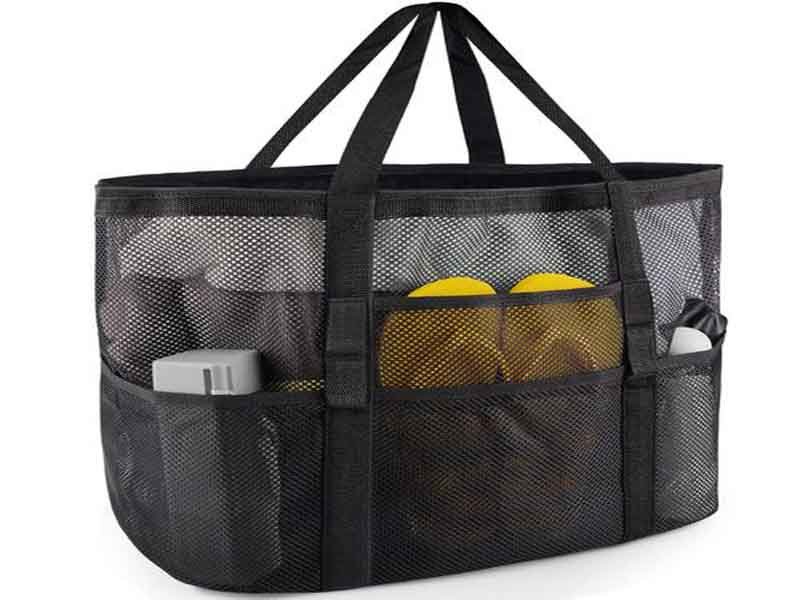
Breathable mesh sports bags are open-structure carriers used to store, organize, transport, and ventilate sports equipment. Unlike solid fabric bags that surround gear with a nearly continuous barrier, mesh bags contain the equipment while allowing air, moisture vapor, sand, and some surface water to move through the bag body.
The bags are commonly made from polyester or nylon mesh and may include reinforced Oxford fabric, woven webbing, coated bottom panels, drawcords, zippers, plastic cord locks, shoulder straps, or backpack systems. They range from small drawstring bags for swim gear to large team bags capable of holding multiple balls, uniforms, training cones, or protective equipment.
A functional mesh sports bag usually performs four jobs at the same time:
It contains equipment during storage and transport.
It supports air movement around damp or warm gear.
It helps users see and identify the contents.
It separates sports equipment from clean clothing, vehicle interiors, lockers, or household storage.
The importance of each job changes according to the sport. A swimming bag may prioritize drainage and corrosion-resistant components. A soccer ball bag may prioritize volume, seam strength, and shoulder comfort. A bag for boxing gloves may need moderate ventilation with stronger abrasion protection around the base and sides.
What Makes a Sports Bag Breathable?
A sports bag becomes breathable when its material and structure allow air to pass through a meaningful portion of the bag body. Mesh opening size is important, but breathability also depends on yarn thickness, knit structure, bag volume, loading density, reinforcement placement, and whether wet gear is packed tightly.
Large mesh openings generally allow faster visible airflow and drainage. Fine mesh offers more surface coverage and prevents small accessories from escaping, but it may release moisture more slowly when packed densely.
The following ranges are useful as product-development references rather than universal standards:
| Mesh Structure | Approximate Opening | Relative Airflow | Containment Level | Suitable Gear |
|---|---|---|---|---|
| Fine mesh | Below 2 mm | Moderate | High | Small straps, swim accessories, gloves, personal items |
| Medium mesh | 2–5 mm | High | Balanced | Jerseys, towels, training bibs, gym gear |
| Open mesh | 5–10 mm | Very high | Moderate | Balls, helmets, pads, shoes |
| Extra-open mesh | Above 10 mm | Maximum | Low | Large balls, oversized equipment, team storage |
| Spacer mesh | Layered 3D structure | High with cushioning | High | Shoulder straps, back panels, padded equipment zones |
A bag can have large mesh openings and still ventilate poorly if it is overfilled. When wet clothing is compressed into a solid mass, air moves around the outside rather than between the layers. Capacity and loading instructions are therefore part of breathable design.
Breathability can also be reduced by reinforcement. A full solid bottom prevents dirty water from dripping into a vehicle, but it also blocks air from entering through the base. Wide solid side panels improve strength and provide space for printing, yet they reduce the percentage of open mesh.
Good designs place reinforcement where load stress is concentrated while leaving large ventilation zones open. For example, Oxford fabric may be added around the bottom edge, zipper, strap attachments, and carry handles without covering the entire main compartment.
The closure affects airflow as well. A tightly zipped solid top limits vertical air exchange. A drawstring opening may allow more air to escape, although it provides less protection from rain, dust, or equipment loss. Some bags combine a zippered main opening with separate mesh ventilation panels.
How Does Mesh Release Moisture?
Mesh does not actively dry equipment in the way a heated dryer does. It supports drying by allowing warm, moisture-laden air to leave the bag and drier surrounding air to reach the equipment surface.
After training, moisture may exist in several forms:
Liquid water on swim gear, bottles, or rain-soaked equipment
Sweat absorbed into fabric, foam, straps, and padding
Warm humid air trapped between pieces of equipment
Condensation that forms when warm gear enters a cooler space
Residue held inside dense gloves, shoes, pads, or helmet liners
A solid bag slows moisture release because the humid air remains enclosed. Mesh reduces that enclosure, but actual drying speed still depends on temperature, humidity, airflow, equipment thickness, and how the gear is arranged.
| Condition | Moisture Release | Main Reason |
|---|---|---|
| Open mesh bag, lightly filled | Fastest | Air can move around separate items |
| Fine mesh bag, lightly filled | Good | Ventilation remains available |
| Open mesh bag, tightly packed | Slow | Equipment blocks internal airflow |
| Solid duffel, zipper partly open | Limited | Air exchange occurs only near opening |
| Closed waterproof bag | Very slow | Moisture remains trapped |
| Mesh bag stored in moving air | Faster | Continuous air replacement |
| Mesh bag left in humid locker | Slower | Surrounding air already contains high moisture |
Drainage and drying are related but different. Large mesh openings can let surface water escape quickly, which is useful for swimming, diving, beach, or water-sports equipment. A wet towel may stop dripping within minutes but remain internally damp for hours. Mesh helps the remaining moisture escape, but the towel should still be removed and spread out when possible.
Foam-based equipment creates another challenge. Boxing gloves, goalkeeper gloves, protective pads, and helmet liners contain internal layers that release moisture more slowly than their surfaces. A mesh bag prevents complete enclosure during transport, but it should not replace proper unpacking and drying after arrival.
A useful instruction is simple: mesh is for breathable transport and temporary storage, not permanent storage of wet gear. Equipment should be removed, opened, separated, and dried fully after use.
Which Equipment Fits Inside?
Mesh bags can be designed for personal equipment, team equipment, balls, water-sports gear, uniforms, training accessories, or mixed loads. The right structure depends on the size, weight, shape, and surface of the equipment.
Common applications include:
Football, basketball, volleyball, rugby, and handball balls
Training bibs, jerseys, shorts, socks, and towels
Shin guards, knee pads, elbow pads, and helmets
Swim fins, kickboards, goggles, caps, and wet towels
Boxing gloves, hand wraps, focus mitts, and protective headgear
Gym shoes, lifting straps, resistance bands, and yoga accessories
Tennis balls, cones, markers, nets, and coaching accessories
Camping, beach, diving, and outdoor recreation equipment
A small personal mesh backpack may hold one pair of shoes, a towel, a water bottle, and clothing. A large team sack may need to carry 10 to 15 full-size balls. A wheeled mesh cart bag may be more suitable when the load is too heavy for shoulder transport.
Reference capacities help during early product planning:
| Bag Format | Reference Capacity | Common Use |
|---|---|---|
| 10–15 L | Personal accessories | Goggles, cap, towel, gloves |
| 20–30 L | Individual training bag | Shoes, clothing, towel, bottle |
| 35–50 L | Multi-item athlete bag | Protective pads, uniform, shoes |
| 60–90 L | Coach or team bag | Bibs, cones, towels, smaller equipment |
| 90–120 L | Ball and equipment storage | Approximately 8–12 full-size balls |
| 120–160 L | Large team equipment bag | Approximately 12–18 balls or mixed training gear |
Ball quantities vary because ball diameter, inflation level, bag shape, and loading arrangement affect capacity. A narrow cylindrical bag may carry balls efficiently in a vertical stack, while a wide sack may be easier to load and unload but less stable during transport.
Sharp or abrasive equipment needs extra consideration. Metal clips, rough hook-and-loop fasteners, skate blades, tools, or hard-edged protective components can damage lightweight mesh. These items may need internal sleeves, solid reinforced zones, or separate compartments.
Small items also influence mesh selection. A bag for whistles, resistance bands, mouthguards, keys, or small training markers requires finer mesh or an enclosed accessory pocket. Large open mesh may provide excellent airflow but allow these products to fall through.
Are Mesh Bags Better Than Solid Bags?
Mesh bags are better when ventilation, drainage, visibility, low weight, and quick access are the main priorities. Solid bags are better when weather protection, privacy, dust control, clean-item separation, and protection from external dirt are more important.
Neither construction is universally superior. The strongest design may combine both.
| Performance Area | Mesh Bag | Solid Fabric Bag |
|---|---|---|
| Air circulation | Excellent | Limited unless vented |
| Water drainage | Excellent | Limited |
| Content visibility | High | Low |
| Bag weight | Usually lower | Usually higher |
| Rain protection | Low | Moderate to high |
| Dust protection | Low | High |
| Odor containment | Low | Higher, but odors remain trapped |
| Small-item containment | Depends on mesh size | High |
| Print area | Limited | Large |
| Abrasion resistance | Depends on reinforcement | Often higher |
| Cleaning access | Easy | Depends on lining |
| Wet-gear suitability | Strong for temporary transport | Weak without ventilation |
Hybrid bags solve several of these conflicts. A mesh upper section can release moisture, while a coated Oxford base protects the bag from rough floors and contains minor dripping. A solid front pocket can hold phones, keys, documents, or dry clothing. Mesh side panels can ventilate shoes without exposing the entire main compartment.
The intended use should determine the construction:
A pool deck bag benefits from high drainage and corrosion-resistant parts.
A football coach’s ball bag needs high capacity and reinforced straps.
A commuter gym bag may require a cleaner appearance and separate dry compartment.
A school sports bag may need a name panel and stronger small-item containment.
A beach equipment bag may need sand release and easy rinsing.
A hockey or protective-gear bag may need very high ventilation combined with heavy-duty seams.
How Much Mesh Is Enough?
The percentage of mesh used in a bag changes airflow, strength, appearance, privacy, and cost. More mesh does not always produce a better product.
A bag made from 100% open mesh provides maximum ventilation but offers little structure. It may collapse while loading, stretch under heavy weight, and provide limited space for a large logo.
A bag with only two small mesh panels may be marketed as ventilated, yet those panels may not release moisture effectively when blocked by packed equipment.
A more useful design process looks at ventilation zones:
Upper panels release rising warm air.
Side panels expose a large surface area.
Bottom mesh supports drainage but may allow dirty water to drip.
Back-panel mesh improves comfort but can transfer dampness to clothing.
Separate ventilated compartments prevent wet gear from contaminating dry items.
| Mesh Coverage | Main Advantage | Main Limitation | Best Application |
|---|---|---|---|
| 80–100% | Maximum airflow and low weight | Less structure and weather protection | Ball sacks, pool gear, beach equipment |
| 60–80% | Strong ventilation with reinforcement space | Moderate weather protection | Team equipment bags |
| 40–60% | Balanced airflow and organization | Heavier and slower drying | Gym backpacks, mixed-use bags |
| 20–40% | Controlled ventilation | Damp equipment may remain enclosed | Shoe compartments, urban sports bags |
| Below 20% | Small airflow benefit | May function more like a solid bag | Fashion-led bags with minor ventilation |
For custom manufacturing, the best mesh percentage should be decided after reviewing the equipment load, carrying method, environment, logo requirement, and expected price position.
Szoneier can combine polyester mesh, nylon mesh, recycled polyester mesh, Oxford fabric, canvas, coated fabric, spacer mesh, webbing, and reinforcement panels to create different balances of airflow and strength. Bag dimensions, mesh openings, pocket layout, straps, closures, logo areas, labels, and packaging can be adjusted around the intended sports application.
Why Use Mesh Bags for Sports Gear?
Mesh bags are used for sports gear because they make damp equipment easier to ventilate, identify, organize, carry, and clean. They are particularly useful after training, swimming, outdoor activity, or competition, when equipment may contain sweat, rainwater, pool water, sand, grass, mud, or body heat.
The main benefit is not that mesh eliminates odor or microbial growth on its own. The benefit is that it reduces the closed, humid environment in which unpleasant smells and moisture problems become harder to control.
A breathable bag also changes user behavior. When equipment is visible, athletes and coaches can quickly see whether balls, pads, bibs, or towels are missing. When the bag drains easily, users are more likely to rinse it. When wet and dry items have separate zones, clean clothing is less likely to become contaminated by used equipment.
Do Mesh Bags Reduce Odor?
Mesh bags can help reduce odor buildup by allowing warm, humid air to escape rather than remain trapped around sweaty equipment. They do not remove the sweat, body oils, bacteria, soil, or detergent residue that causes odor. The equipment and bag still need cleaning and complete drying.
Odor develops faster when several conditions appear together:
Warm equipment is packed immediately after activity.
Moisture remains inside foam, fabric, padding, or straps.
Air cannot circulate.
The bag stays closed for many hours.
Used equipment touches clean textiles.
Organic residue remains on the surface.
Mesh reduces one major factor: air enclosure. It works best when the bag is not overfilled and is stored in a ventilated location.
| Storage Method | Odor Risk | Why |
|---|---|---|
| Damp gear in closed solid bag | Very high | Heat and moisture remain trapped |
| Damp gear in tightly packed mesh bag | High | External airflow cannot reach inner layers |
| Damp gear in loosely filled mesh bag | Moderate | Moisture can begin escaping |
| Gear removed and spread after transport | Low | Maximum surface exposure |
| Clean, fully dried gear in mesh bag | Lowest | Minimal moisture and residue |
Consider a team that trains three evenings each week. If bibs and goalkeeper gloves are thrown into a closed duffel after every session, the fabric may never dry fully between uses. Replacing the duffel with a large mesh sack improves ventilation during transport, but the team still needs to unpack, wash, and dry the gear after returning. The bag improves the process; it does not replace it.
Odor-control finishes may be available for some mesh materials, but they require careful review. Performance can decline after repeated washing, and any antibacterial or antimicrobial claim may be regulated differently across markets. Clear material documentation and restrained claim language are safer than vague promises such as “odor proof.”
How Do They Speed Up Drying?
Mesh bags speed up the beginning of the drying process by increasing surface exposure and air exchange. Equipment releases moisture faster when humid air can move away from the surface.
Actual drying speed depends on several variables:
Mesh openness
Bag loading density
Equipment material
Foam or padding thickness
Ambient humidity
Air movement
Temperature
Whether the equipment is unfolded or compressed
Whether the bag is hanging or resting on a solid floor
A hanging mesh bag usually performs better than one lying flat because more of its surface remains exposed. A gusseted bag also holds equipment more loosely than a flat sack of the same length and width.
| Design Feature | Effect on Drying |
|---|---|
| Large open mesh panels | Increases air movement |
| Gusseted body | Prevents equipment from forming a flat compressed layer |
| Wide opening | Makes unpacking and rearranging easier |
| Hanging loop | Keeps bag exposed to surrounding air |
| Drainage base | Releases surface water |
| Internal dividers | Keeps wet items separated |
| Solid waterproof lining | Slows moisture release |
| Thick foam padding | Holds moisture longer |
| Overfilled compartment | Blocks internal airflow |
Drying also varies by equipment type.
A polyester training bib may release moisture quickly.
A cotton towel absorbs more water and needs more time.
A boxing glove may feel dry outside while remaining damp inside.
A helmet liner can retain moisture beneath the surface.
Swim fins do not absorb much water but may trap water in curved areas.
The bag should therefore support transport to a drying location. It should not encourage users to leave wet gear packed indefinitely.
Can They Help Prevent Mildew?
Mesh bags can help reduce mildew risk by supporting ventilation and faster moisture release, but they cannot guarantee prevention. Mildew and other fungal growth are influenced by moisture duration, temperature, organic residue, storage conditions, and material type.
The highest risk occurs when damp equipment remains closed for long periods, especially in warm lockers, vehicle trunks, storage closets, or equipment rooms.
Mesh helps by reducing humidity around the gear, but several conditions can cancel the benefit:
The bag is packed tightly.
The bag is placed inside another closed container.
Wet gear remains inside for days.
The storage room is humid and poorly ventilated.
The equipment contains thick foam or absorbent padding.
The bag itself is dirty.
| Practice | Mildew Risk |
|---|---|
| Leave wet gear in a closed vehicle | Very high |
| Store packed mesh bag in a sealed locker | High |
| Hang mesh bag in ventilated room | Lower |
| Remove and spread equipment | Much lower |
| Wash and dry gear fully | Lowest practical risk |
| Store clean gear only after complete drying | Best long-term practice |
If mildew spots or persistent musty odors appear, the bag should not simply be sprayed with fragrance. The equipment and bag need appropriate cleaning based on their material and care instructions. Heavily affected foam, padding, or fabric may require replacement.
For institutional applications, equipment rotation can help. A school, academy, gym, or club may use two bag sets so one can dry while the other is in service. Color coding can identify clean, used, and drying-stage equipment.
Do They Make Gear Easier to Find?
Mesh makes equipment visible without opening every compartment. This is especially useful for coaches, teachers, team managers, swim instructors, and families handling multiple similar items.
Visibility helps users identify:
Missing balls
Unreturned training bibs
Wet towels
Mixed team colors
Personal gear placed in the wrong bag
Damaged protective equipment
Items that still require cleaning
A mesh team bag can also reduce setup time. Coaches can see cones, markers, balls, or nets before unloading. At the end of training, it becomes easier to check whether all equipment has been collected.
Visibility should be balanced against privacy and appearance. A personal gym bag containing clothing and toiletries may need a solid main compartment with smaller mesh zones. A ball bag benefits from complete visibility because the contents are not private.
| Use Environment | Visibility Need | Recommended Structure |
|---|---|---|
| Team ball storage | Very high | Mostly open mesh |
| School equipment room | High | Color-coded mesh with labels |
| Swimming program | High | Mesh body with personal name panel |
| Personal gym commute | Moderate | Hybrid solid and mesh compartments |
| Competition travel | Moderate | Mesh ventilation plus covered storage |
| Medical or rehabilitation gear | Controlled | Fine mesh with clear identification |
| Retail consumer product | Depends on design | Balanced mesh and printable panels |
Identification can be added through:
Printed names or numbers
Woven labels
Heat-transfer logos
Embroidery patches
Color-coded bindings
Colored drawcords
Transparent document pockets
Removable ID cards
QR or barcode labels for managed equipment systems
A large logo panel should not block the main airflow path. One solution is to place the branding on a reinforced bottom, top flap, narrow front strip, or removable tag.
Can Mesh Bags Replace Equipment Care?
Mesh bags improve ventilation and organization, but they cannot replace cleaning, inspection, repair, or correct storage. This distinction matters because users may assume that breathable storage alone is enough to keep gear hygienic and durable.
A complete equipment-care routine includes:
Remove visible dirt.
Empty water and debris.
Wash or wipe equipment according to instructions.
Open gloves, pads, and protective components.
Dry internal layers completely.
Inspect seams, straps, buckles, and padding.
Store equipment without excessive compression.
Clean the bag itself.
| Care Need | Does Mesh Help? | What Else Is Required? |
|---|---|---|
| Moisture release | Yes | Unpack and expose internal surfaces |
| Odor control | Partly | Wash residue and dry fully |
| Mildew prevention | Partly | Control humidity and storage time |
| Dirt removal | No | Clean or rinse equipment |
| Disinfection | No | Use an approved method for the material |
| Structural inspection | Visibility may help | Manual inspection |
| Equipment repair | No | Repair or replace damaged parts |
| Weather protection | Usually limited | Use a covered or hybrid bag |
| Theft prevention | Limited | Use secure storage |
| Impact protection | Limited | Add padding or solid panels |
This balanced view is important when designing product instructions. Strong claims may attract attention, but accurate guidance builds long-term trust and reduces misuse.
What Changes in Team Environments?
A personal athlete may carry one towel, one pair of shoes, and one set of clothing. A team bag may handle repeated heavy loads, mixed equipment, hurried packing, and multiple users. Construction needs change quickly as scale increases.
A team environment may require:
Higher load capacity
Wider openings
Reinforced lifting handles
Backpack straps or dual-person carry handles
Color identification
Inventory labels
Washable name panels
Replaceable cords
Stronger base fabric
Faster loading and unloading
| Scenario | Main Challenge | Useful Bag Feature |
|---|---|---|
| Football academy | Many balls and bibs | Large opening, reinforced ball bag |
| Swim school | Repeated wet equipment | Open mesh, drainage, corrosion-resistant parts |
| Basketball team | Balls and training accessories | High-capacity cylindrical or sack design |
| Boxing gym | Damp gloves and wraps | Separate ventilated compartments |
| School sports department | Mixed equipment ownership | Color coding and ID windows |
| Outdoor training club | Mud, rain, and rough ground | Reinforced washable bottom |
| Rehabilitation center | Small organized equipment | Fine mesh and labeled compartments |
An illustrative football setup may use separate bags for match balls, training bibs, goalkeeper equipment, and marker cones. This reduces the need to search through one oversized mixed load and allows wet textiles to be washed separately from hard equipment.
For custom projects, Szoneier can develop single bags or coordinated equipment systems based on sport, load, capacity, user age, transport method, storage environment, and branding requirements. Mesh type, reinforcement, compartments, straps, logos, labels, packaging, and sample testing can be adjusted around the intended use rather than selected from a generic bag template.
Which Sports Need Mesh Equipment Bags?
Mesh equipment bags are most useful in sports where gear becomes wet, sweaty, sandy, muddy, warm, or difficult to identify after use. Swimming, football, basketball, volleyball, gym training, boxing, cycling, camping, and outdoor team activities all benefit from controlled ventilation and visible storage.
The right design changes from one sport to another. A swimming bag needs drainage and corrosion-resistant hardware. A football bag needs enough volume for inflated balls and reinforced shoulder straps. A gym bag may require separate compartments for shoes, towels, and clean clothing. Outdoor sports often need a combination of breathable mesh and abrasion-resistant Oxford fabric.
A practical sports bag should be developed around the actual equipment list rather than a generic capacity label. Two bags described as “large” may perform very differently when one is carrying lightweight training bibs and the other is carrying ten inflated footballs.
Which Bags Work for Ball Sports?
Ball sports need mesh bags that provide high volume, easy loading, strong seams, and enough ventilation to release surface moisture and outdoor odors. Footballs, basketballs, volleyballs, rugby balls, and handballs are bulky rather than extremely heavy, but their rounded shape creates continuous outward pressure against the bag body.
A cylindrical bag, barrel-shaped bag, or wide drawstring sack usually uses space more efficiently than a flat rectangular bag. The opening should be wide enough to load balls quickly without forcing them through a narrow zipper.
Reference capacities vary according to ball size, inflation, bag dimensions, and arrangement.
| Sport | Standard Equipment Load | Suggested Bag Volume | Suitable Structure |
|---|---|---|---|
| Football | 6–8 size 5 balls | 70–100 L | Cylindrical mesh sack |
| Football | 10–12 size 5 balls | 100–140 L | Large drawstring team bag |
| Basketball | 5–6 full-size balls | 80–110 L | Wide cylindrical bag |
| Volleyball | 8–10 balls | 90–120 L | Tall mesh sack |
| Rugby | 6–8 balls | 80–110 L | Reinforced barrel bag |
| Handball | 10–14 balls | 80–120 L | Fine-to-medium mesh sack |
| Tennis | Ball baskets and training balls | Based on container system | Fine mesh with secure closure |
Ball count should be confirmed using physical samples during development. A bag calculated only from theoretical volume may hold fewer balls because round objects leave empty spaces between them.
The lower section experiences the greatest abrasion when a team bag is dragged across courts, grass, concrete, or changing-room floors. A reinforced Oxford fabric ring or coated bottom panel can extend service life. The reinforcement should not cover so much of the body that it traps moisture.
Strap placement matters because a full ball bag is large and awkward. Two shoulder straps allow backpack carrying, but they must be positioned so the bag does not swing excessively. A single shoulder strap is easier to manufacture but may concentrate pressure on one side of the body.
For coaching use, a secondary handle near the bottom helps empty the bag quickly. The coach can lift the base and pour the balls out without reaching deeply into the sack.
What Fits Swim and Water Sports?
Swimming and water-sports bags need rapid drainage, high airflow, quick drying, and components that tolerate repeated exposure to pool water, salt water, sunscreen, and wet surfaces.
Common contents include:
Swim fins
Kickboards
Pull buoys
Hand paddles
Snorkels
Goggles
Swim caps
Wet towels
Water shoes
Diving masks
Small flotation aids
Pool toys
Fine mesh works well for goggles, caps, nose clips, and small accessories because it prevents them from slipping out. Open mesh is more suitable for fins, kickboards, and large wet equipment because it drains quickly.
A combination design may use open mesh for the main compartment and a fine-mesh zip pocket for smaller items.
| Water-Sport Item | Main Design Need | Suitable Feature |
|---|---|---|
| Swim fins | Long internal space | Tall bag or elongated compartment |
| Kickboard | Wide flat capacity | Large top opening |
| Goggles | Small-item containment | Fine-mesh pocket |
| Wet towel | Airflow and drainage | Open main compartment |
| Snorkel | Length and rigid shape | Side sleeve or tall bag |
| Diving mask | Protection from scratches | Separate padded pocket |
| Water shoes | Sand and water release | Reinforced open-mesh base |
| Swim cap | Easy identification | Small internal pocket |
Hardware should be selected carefully. Metal parts may corrode or discolor after repeated exposure to chlorinated or salty water. Plastic cord locks, resin zippers, coated zipper sliders, and synthetic webbing are often more suitable.
Drainage does not mean the bag should drip everywhere. Some users need a product for poolside use, while others carry wet equipment inside a car or public transport. A removable waterproof base insert or separate wet pouch can contain temporary dripping without sealing the entire bag.
The user should still remove the equipment after returning home. Wet towels and foam swimming aids can remain damp inside even a highly open mesh bag.
Are They Good for Gym Gear?
Mesh bags are useful for gym gear when ventilation and item separation are more important than complete privacy or weather protection. Shoes, towels, gloves, lifting straps, resistance bands, wraps, and used clothing can release heat and moisture during transport.
A fully open mesh sack may be suitable for a locker room or short trip home, but it may be less appropriate for commuting through rain or carrying personal items in public. Hybrid gym bags usually provide a better balance.
A hybrid design can include:
A ventilated shoe compartment
A mesh wet-clothing section
A solid main compartment
A small valuables pocket
A water-bottle holder
A removable laundry pouch
A padded shoulder strap
The separation between clean and used gear is especially important. Placing fresh clothing beside wet towels and shoes reduces the value of ventilation.
| Gym Item | Storage Need | Recommended Compartment |
|---|---|---|
| Training shoes | Ventilation and dirt separation | Mesh shoe pocket |
| Wet towel | Airflow and containment | Large mesh section |
| Clean clothing | Protection from moisture | Solid compartment |
| Lifting gloves | Odor release | Fine or medium mesh pocket |
| Resistance bands | Small-item control | Zippered accessory pocket |
| Toiletries | Leak containment | Coated solid pouch |
| Phone and keys | Dry, secure storage | Small solid zip pocket |
| Water bottle | Upright access | External elastic mesh pocket |
For high-intensity training, bag dimensions should consider shoes and towels first because these items occupy most of the volume. A bag advertised as 25 L may appear adequate but become crowded once a pair of size 12 shoes is placed inside.
Users who travel directly from work to the gym often need a cleaner visual style. Mesh can be positioned on the lower side panels or inside a ventilated shoe compartment rather than across the entire exterior.
Which Designs Suit Outdoor Sports?
Outdoor sports place greater demands on abrasion resistance, dirt release, weather exposure, and carrying comfort. Mesh supports ventilation, but lightweight open mesh alone may tear when it contacts rocks, branches, metal equipment, or rough ground.
Suitable applications include:
Camping equipment
Climbing accessories
Beach sports
Cycling gear
Trail-running equipment
Fishing accessories
Paddlesports
Outdoor team training
Protective pads and helmets
Outdoor bags often benefit from zoned construction. The upper body may use breathable mesh, while the base and contact areas use coated Oxford fabric, canvas, or reinforced polyester.
| Outdoor Condition | Main Risk | Useful Construction |
|---|---|---|
| Rough ground | Abrasion | Reinforced base panel |
| Rain | Water entering bag | Hybrid cover or roll-top section |
| Sand | Debris accumulation | Open mesh with easy rinsing |
| Mud | Staining and clogging | Dark washable mesh |
| Branches and rocks | Snagging | Smaller mesh openings or solid side zones |
| Long carrying distance | Shoulder fatigue | Padded backpack straps |
| Heavy hard equipment | Mesh distortion | Webbing load frame |
| Vehicle storage | Wet contamination | Removable coated base |
Beach bags often use large open mesh because sand can fall through. However, very open mesh may allow small shells, toys, keys, or sunscreen caps to escape. A fine-mesh accessory pocket solves this problem.
Cycling and trail-running bags may need helmet storage. A large external mesh cradle can hold a helmet while keeping the main compartment available for clothing and shoes.
For camping equipment, compression should be considered carefully. Mesh is useful for drying cookware, ropes, or damp textiles, but it does not provide weather protection. A separate waterproof liner may be needed for transport in rain.
Can Teams Use Color-Coded Bags?
Color-coded bags help teams separate equipment by player, category, age group, training function, or cleanliness status. The system can reduce setup time, missing items, and confusion in shared equipment rooms.
Possible color systems include:
One color for each team
Different colors for clean and used bibs
Separate colors for match and training balls
Player-specific binding colors
Age-group identification
Goalkeeper equipment separation
Medical or rehabilitation equipment identification
| Color System | Example Use | Operational Benefit |
|---|---|---|
| Red and blue bags | Two training groups | Faster field setup |
| Green bag | Clean bibs | Prevents mixing with used textiles |
| Black bag | Used or wet gear | Directs equipment to cleaning |
| Yellow binding | Goalkeeper equipment | Quick recognition |
| Numbered colors | Individual player kits | Reduces ownership disputes |
| White mesh | Indoor clean equipment | Easy dirt visibility |
| Dark mesh | Outdoor muddy equipment | Better appearance between washes |
Color should not be the only identification method because lighting, fading, and color-vision differences can reduce reliability. Printed words, numbers, symbols, or ID windows provide a second layer of clarity.
The colorfastness of mesh, binding, straps, and print should be checked. A dark drawcord that transfers dye onto light equipment can create avoidable complaints.
Should One Bag Serve Every Sport?
A universal mesh sports bag sounds efficient, but one design rarely performs equally well across all sports. The equipment shapes, moisture levels, carrying distances, and impact loads are too different.
A football bag needs volume.
A swimming bag needs drainage.
A boxing bag needs ventilation for thick foam products.
A gym commuter bag needs privacy and dry-item separation.
A beach bag needs sand release.
A team bag needs fast inventory checks.
| Universal Design Choice | Advantage | Compromise |
|---|---|---|
| Large open compartment | Fits many equipment types | Poor organization |
| Very open mesh | Maximum airflow | Small items can escape |
| Fine mesh | Better containment | Slower drainage |
| Solid reinforced base | Better durability | Reduced airflow |
| Backpack straps | Hands-free carrying | Added cost and sewing stress |
| Drawstring top | Fast loading | Less weather protection |
| Multiple pockets | Better organization | More weight and production steps |
A more effective product range may include three or four focused sizes rather than one oversized bag. For example:
A small personal drawstring bag
A medium hybrid gym backpack
A large team equipment sack
A reinforced ball bag
Szoneier can develop coordinated sports-bag collections using shared colors, logos, labels, and packaging while changing mesh density, capacity, reinforcement, and carrying systems for each use.
Which Mesh Material Is Best?
The best mesh material for a sports equipment bag depends on load weight, airflow, abrasion exposure, required softness, cleaning frequency, and product price. Polyester mesh is widely used for general sports bags because it offers dimensional stability, quick drying, broad weight options, and cost efficiency. Nylon mesh can provide a smoother hand feel and strong abrasion performance. Reinforced polyester, spacer mesh, and Oxford fabric are often combined when the bag must carry heavier equipment.
Material selection should not be reduced to a simple polyester-versus-nylon comparison. Yarn thickness, knitting structure, fabric weight, mesh opening, finishing, and seam compatibility can influence performance more than the fiber name alone.
A lightweight mesh suitable for swim caps may fail quickly under footballs. A heavy open mesh may survive the load but feel too rough for delicate clothing. The correct specification starts with the equipment.
Is Polyester or Nylon Better?
Polyester is usually the most practical choice for large sports equipment bags because it absorbs little water, dries quickly, maintains shape, and can be produced in many mesh structures. Nylon is often chosen when a smoother surface, softer hand feel, or high strength at lower fabric weight is needed.
| Property | Polyester Mesh | Nylon Mesh |
|---|---|---|
| Water absorption | Low | Higher than polyester |
| Drying speed | Fast | Fast, but may retain slightly more moisture |
| Dimensional stability | Strong | Good with correct finishing |
| Surface feel | Can range from crisp to soft | Often smoother |
| Abrasion resistance | Good | Often very good |
| Cost | Usually lower | Often higher |
| Color options | Broad | Broad |
| Recycled availability | Widely available | Available but less common |
| Common use | Ball bags, swim bags, team sacks | Premium personal bags, soft-contact pockets |
| Heat sensitivity | Generally manageable | Requires careful temperature control |
Polyester is often preferable for:
Large ball bags
Team equipment sacks
Pool and beach bags
Shoe compartments
Color-coded school bags
High-volume retail programs
Nylon may be preferable for:
Premium personal gym bags
Soft accessory pockets
Fine-mesh compartments
Garment-contact zones
Lightweight high-strength constructions
The final decision should include wash tests and abrasion tests. A smooth nylon fabric that feels premium when new may lose shape if it is not properly stabilized. A coarse polyester mesh may be durable but uncomfortable against bare skin.
Which Mesh Size Improves Airflow?
Larger mesh openings generally improve visible airflow and drainage, but the correct opening depends on the smallest item inside the bag and the likelihood of snagging.
| Opening Size | Airflow | Item Containment | Suitable Use |
|---|---|---|---|
| Below 2 mm | Moderate | Excellent | Small accessories, gloves, swim items |
| 2–5 mm | High | Good | Clothing, towels, general gym gear |
| 5–10 mm | Very high | Moderate | Balls, shoes, helmets |
| 10–20 mm | Maximum | Low | Large team equipment |
| Above 20 mm | Maximum | Very low | Oversized balls and large gear only |
Yarn diameter changes the result. A 5 mm opening made with thick yarn may provide less open area than a 4 mm opening made with finer yarn.
The shape of the opening also matters. Diamond, square, hexagonal, and circular-knit patterns stretch differently under load.
Diamond mesh expands easily and can accommodate irregular equipment, but it may distort.
Square mesh provides predictable dimensions but may feel more rigid.
Fine knitted mesh offers smooth containment but lower visible airflow.
Spacer mesh creates a thicker three-dimensional structure for straps and padded zones.
The bag should also be evaluated under load. Openings may enlarge when the mesh stretches around balls or helmets. Small buckles, clips, or straps that remain contained in an unloaded sample may push through once the bag is full.
Do Coated Meshes Last Longer?
Coatings and finishes can improve certain performance characteristics, but they do not automatically make mesh more durable. A coating may increase stiffness, reduce yarn movement, improve resistance to moisture, or change surface friction. It can also reduce breathability, crack after repeated folding, or make the bag harder to clean.
Possible treatments include:
Polyurethane coating
PVC coating
Water-repellent finishing
Antistatic finishing
UV-resistant treatment
Flame-retardant treatment
Antimicrobial treatment
Stiffening finish
Softening finish
| Treatment | Possible Benefit | Possible Limitation |
|---|---|---|
| PU coating | Improved surface control | Reduced airflow |
| PVC coating | Stronger structure and water resistance | Added weight and stiffness |
| Water-repellent finish | Faster water shedding | Does not make open mesh waterproof |
| UV treatment | Better outdoor exposure resistance | Requires performance validation |
| Softening finish | Better hand feel | May affect strength or wash durability |
| Stiffening finish | Helps bag hold shape | Can create roughness |
| Antimicrobial finish | May support odor-management program | Claims and wash durability require review |
| Flame-retardant finish | Required in some technical uses | May affect hand feel and compliance documentation |
For pool or beach products, a water-repellent finish may be unnecessary because the main purpose is drainage. For an outdoor team bag, UV resistance may be more useful.
Coating should be selected according to a measurable problem. Adding a finish simply to create more marketing claims can increase cost without improving the user experience.
When Is Oxford Reinforcement Needed?
Oxford fabric reinforcement is useful when the bag carries heavy, hard, or abrasive equipment. It is commonly added to the base, corners, strap attachments, zipper zones, and handle areas.
Possible Oxford specifications include 210D, 300D, 420D, 600D, and heavier constructions. The correct choice depends on load and abrasion exposure.
| Reinforcement Area | Main Stress | Suitable Approach |
|---|---|---|
| Bottom panel | Floor abrasion and concentrated load | Coated Oxford fabric |
| Lower sidewall | Dragging and impact | Partial Oxford wrap |
| Strap attachment | Pulling force | Webbing anchor with bartacks |
| Zipper opening | Repeated handling | Oxford facing |
| Handle base | Localized lifting stress | Double-layer reinforcement |
| Corner areas | Puncture and abrasion | Patch reinforcement |
| Wheel attachment | Very high load | Heavy Oxford with internal support |
A full solid bottom is useful when the bag is placed on dirty or wet floors. However, it may collect water inside. Drainage holes, mesh corner sections, or a removable insert can help.
The reinforcement fabric should be compatible with the mesh. A very heavy Oxford panel sewn directly to ultralight mesh can create a stress concentration where the two materials meet. The mesh may tear beside the strong panel.
A gradual transition using binding, webbing, or a wider seam allowance can distribute the load more evenly.
Are Recycled Mesh Fabrics Reliable?
Recycled polyester mesh can be reliable when the yarn source, fabric construction, finishing, and performance are controlled. Recycled content alone does not guarantee durability or environmental superiority.
A proper specification should identify:
Recycled fiber percentage
Material certification requirements
Yarn denier
Fabric weight
Mesh opening
Color method
Shrinkage target
Tensile and tear expectations
Wash performance
Abrasion resistance
Restricted-substance requirements
| Evaluation Area | Why It Matters |
|---|---|
| Recycled-content documentation | Supports accurate material claims |
| Yarn consistency | Affects strength and appearance |
| Color variation | Recycled feedstock may require tighter control |
| Wash stability | Prevents deformation |
| Abrasion performance | Important for equipment contact |
| Seam compatibility | Confirms mesh can hold stitching |
| Odor evaluation | Identifies processing residue |
| Packaging claims | Prevents misleading communication |
A recycled mesh bag that fails early may create more replacement demand than a durable conventional product. Material efficiency, service life, packaging, and transport volume should be considered together.
Recycled polyester is often well suited to:
Swim bags
Team bib bags
Lightweight ball sacks
Promotional sports collections
School equipment bags
General gym accessories
Heavy-duty applications may still require virgin or higher-strength reinforcement components, depending on testing and product goals.
Which Fabric Weight Is Appropriate?
Fabric weight influences strength, hand feel, drying speed, packability, and cost. Heavier mesh is not always better. It can reduce flexibility and add bulk without solving weak seam construction.
Reference ranges can support early development:
| Mesh Weight | Performance Direction | Suitable Application |
|---|---|---|
| 50–80 gsm | Lightweight and fast drying | Small swim bags, accessory pouches |
| 80–120 gsm | Balanced general use | Gym bags, clothing bags |
| 120–180 gsm | Stronger load support | Ball bags, team equipment sacks |
| 180–250 gsm | Heavy-duty mesh | Large protective equipment bags |
| 250 gsm and above | Specialized reinforced use | Commercial or high-load applications |
These ranges are not universal standards. Knit structure and yarn strength can make a lighter fabric outperform a poorly constructed heavier one.
A useful material decision combines:
Fabric weight
Opening size
Stretch
Recovery
Tear resistance
Abrasion resistance
Seam retention
Drying speed
Hand feel
Cost
How Should Materials Be Tested?
Testing should reflect real sports use rather than evaluating an empty fabric swatch only.
A ball bag should be tested while fully loaded.
A swim bag should be tested after repeated wetting and drying.
A shoe compartment should be exposed to abrasion and dirt.
A team bag should be lifted repeatedly from its actual handles.
| Test | What It Evaluates |
|---|---|
| Tensile strength | Resistance to pulling |
| Tear strength | Resistance to damage spreading |
| Seam slippage | Fabric movement around stitches |
| Abrasion testing | Surface wear |
| Repeated loading | Real carrying durability |
| Drop testing | Impact from handling |
| Wet-load testing | Performance when contents are saturated |
| Wash testing | Shrinkage, fading, and seam stability |
| UV exposure | Outdoor color and strength retention |
| Salt or chlorine exposure | Suitability for water sports |
| Zipper cycling | Closure life |
| Strap pull testing | Attachment security |
A practical sample evaluation may load the bag to the planned working capacity, carry it over a set distance, place it on rough surfaces, expose it to wet conditions, and repeat the process. The results reveal problems that a simple visual inspection cannot show.
Szoneier can develop sports mesh bags using polyester, nylon, recycled polyester, spacer mesh, Oxford fabric, canvas, coated materials, webbing, and customized reinforcement systems. Material selection can be matched to airflow, load, abrasion, washing, branding, and price requirements before sample approval and production.
What Size and Structure Should You Choose?

The right mesh sports bag should fit the actual equipment load without forcing gear into a compressed bundle or leaving so much unused space that the contents shift uncontrollably during transport. Size should be determined by usable internal volume, equipment dimensions, wet weight, carrying distance, opening width, and storage conditions—not by general labels such as small, medium, or large.
A personal swim bag may need only 15 to 25 liters, while a team ball bag may require more than 100 liters. A gym backpack carrying shoes, clothing, a towel, toiletries, and a bottle needs a different internal layout from a simple drawstring sack holding ten footballs.
Structure matters just as much as capacity. Flat bags work well for clothing and towels. Cylindrical bags use space efficiently for balls. Gusseted bags provide depth for shoes and protective pads. Backpack designs distribute weight across both shoulders. Hybrid bags separate wet gear from clean clothing.
The most useful size decision begins with a complete equipment list:
What is the largest item?
How many items must fit at one time?
Will equipment be wet when carried?
Does the load contain hard or sharp components?
How far will the bag be carried?
Must the bag fit inside a locker, vehicle compartment, or storage rack?
A bag that fits the equipment but is difficult to load, carry, clean, or store is still the wrong size.
How Many Balls Should a Bag Hold?
Ball capacity depends on the ball diameter, bag shape, opening size, fabric stretch, and how efficiently round objects can be arranged. A bag volume calculation provides an initial estimate, but physical loading tests are essential because empty spaces remain between inflated balls.
Full-size footballs, basketballs, volleyballs, and rugby balls do not occupy a bag in the same way. Basketballs are larger than standard footballs, while rugby balls have an elongated shape that creates different packing gaps.
| Ball Type | Approximate Diameter or Shape | Common Bag Capacity | Reference Bag Volume |
|---|---|---|---|
| Size 5 football | About 22 cm diameter | 6–8 balls | 70–100 L |
| Size 5 football | About 22 cm diameter | 10–12 balls | 100–140 L |
| Full-size basketball | About 24 cm diameter | 5–6 balls | 80–110 L |
| Full-size basketball | About 24 cm diameter | 8–10 balls | 120–160 L |
| Volleyball | About 21 cm diameter | 8–10 balls | 90–120 L |
| Rugby ball | Elongated shape | 6–8 balls | 80–110 L |
| Handball | Smaller diameter | 10–14 balls | 80–120 L |
| Small training balls | Varies | 15–30 pieces | Based on exact dimensions |
These figures are planning references. The final capacity should be verified using the actual ball type and inflation level.
A cylindrical bag is often efficient because balls can be stacked vertically. A wide sack with a large top opening is easier to load quickly but may create more empty space around the contents. A rectangular bag provides stable storage but requires stronger structural panels.
A team may also prefer a bag that intentionally holds fewer balls. A six-ball backpack can be easier for one coach to carry than a twelve-ball sack. Larger capacity reduces the number of trips but increases bulk, strap load, and handling difficulty.
The opening should allow the largest ball to enter without stretching the closure excessively. For a size 5 football, a narrow opening can slow down equipment collection at the end of practice. A full-width drawstring opening or large U-shaped zipper is more efficient.
Useful ball-bag details include:
A bottom lifting handle for quick emptying
Two reinforced shoulder straps
A drawcord with a large cord lock
An external ball-count label
A small pocket for a pump and needles
A washable identification panel
A coated lower section for ground contact
Reflective details for evening training
The working load should include both balls and accessories. A bag described as holding ten footballs may hold only eight once a pump, cones, and bibs are added.
Which Capacity Fits Individual Athletes?
Individual athletes usually need between 15 and 50 liters depending on the sport, duration of activity, weather, and whether clean and used equipment must be separated.
A short gym session may require shoes, a towel, a shirt, and a bottle. A swimmer may carry fins, goggles, a cap, a kickboard, a wet towel, and toiletries. A football player may need boots, shin guards, uniform, warm-up clothing, and personal items.
| User Scenario | Suggested Capacity | Typical Contents |
|---|---|---|
| Short gym visit | 15–25 L | Towel, shirt, gloves, bottle |
| Swim training | 20–35 L | Fins, goggles, cap, towel |
| Daily fitness routine | 25–35 L | Shoes, clothing, toiletries |
| Football or rugby player | 30–45 L | Boots, uniform, pads, bottle |
| Boxing training | 35–50 L | Gloves, wraps, headgear, clothing |
| Outdoor day activity | 35–50 L | Protective gear, extra layers, food, accessories |
| Youth athlete | 15–30 L | Smaller shoes, uniform, water bottle |
| Multi-sport athlete | 40–60 L | Mixed gear and separate compartments |
Capacity labels should be supported by dimensions because two 30-liter bags may feel very different. A tall narrow bag may fit swim fins but not bulky shoes. A wide low bag may hold boxing gloves well but be inconvenient in a narrow locker.
Body size also matters. A 45-liter backpack may be practical for an adult but oversized for a child. Youth bags need shorter straps, lower weight, smaller buckles, and easier closures.
The athlete’s routine should guide the layout:
Someone walking home from training needs comfortable straps.
Someone driving directly to practice may prefer a large duffel opening.
Someone using public transport may need a more compact shape.
Someone storing the bag in a school locker needs dimensions that fit the available space.
Someone carrying wet gear needs drainage and separation.
A bag should have enough reserve space for easy loading. Filling every liter of internal volume makes it difficult to close the bag and restricts airflow. A practical target is to use around 70–80% of the available capacity during normal use.
Are Backpack Straps More Comfortable?
Backpack straps are generally more comfortable for medium and large sports bags because they distribute the load across both shoulders and keep the hands free. Their performance depends on strap width, padding, spacing, adjustment range, attachment strength, and the shape of the loaded bag.
A large mesh sack with thin cords may feel acceptable when empty but become painful when filled with balls, wet towels, or protective gear. Wet equipment increases load weight and can cause narrow straps to dig into the shoulders.
| Strap Type | Comfort Level | Best Use | Main Limitation |
|---|---|---|---|
| Thin drawcord straps | Low to moderate | Lightweight personal bags | Pressure on shoulders |
| Flat webbing shoulder straps | Moderate | Ball sacks and team bags | Limited cushioning |
| Padded backpack straps | High | Heavy or long-distance carrying | Higher cost and drying time |
| Single shoulder strap | Moderate | Medium duffels | Uneven load distribution |
| Dual carry handles | Good for short distance | Loading into vehicles | Not hands-free |
| Convertible straps | Flexible | Multi-use sports bags | More hardware and complexity |
| Two-person carry handles | High for very large loads | Team equipment | Requires two users |
Strap width influences pressure distribution. Wider straps spread the load over a larger shoulder area. Padding improves comfort but may absorb sweat and dry slowly. Spacer mesh is often used on padded straps because it provides cushioning with better airflow than solid foam covered by dense fabric.
Straps should be positioned according to the loaded center of gravity. If attachment points are too close together, the bag may swing. If they are too wide, the straps may slide off the shoulders.
Adjustment range matters for different users. A team bag may be carried by adult coaches, teenagers, or volunteers wearing winter clothing. The straps should accommodate these changes without leaving excessive loose webbing.
The attachment area should connect to a stronger load path. Sewing straps directly onto open mesh without reinforcement concentrates force in a small area and can cause tearing. Webbing should extend into Oxford panels, binding, or internal reinforcement patches.
Comfort testing should be completed with the expected load rather than an empty sample. A useful evaluation includes:
Loading the bag to working capacity
Adjusting the straps for different body sizes
Walking for a realistic distance
Climbing stairs
Lifting the bag from the floor
Removing it from one shoulder
Checking strap slippage
Inspecting attachment points after repeated use
Do Separate Compartments Matter?
Separate compartments matter when wet, dirty, hard, or small items should not touch clean clothing or fragile equipment. They improve organization but add material, sewing time, weight, and cleaning complexity.
A simple ball sack may not need internal divisions. A gym or swim backpack often benefits from them.
Common compartment functions include:
Ventilated shoe storage
Wet-towel separation
Clean-clothing protection
Small-accessory containment
Bottle storage
Valuables protection
Helmet or ball attachment
Medical or first-aid organization
| Compartment | Recommended Material | Purpose |
|---|---|---|
| Wet-gear section | Open or medium mesh | Ventilation and drainage |
| Shoe compartment | Reinforced mesh and coated base | Dirt separation |
| Clean-clothing section | Solid polyester or Oxford | Moisture protection |
| Valuables pocket | Solid lined fabric | Privacy and security |
| Bottle pocket | Elastic mesh | Quick access |
| Small-accessory pocket | Fine mesh with zipper | Prevents item loss |
| Helmet cradle | Stretch mesh | External storage |
| Equipment divider | Mesh or coated fabric | Prevents hard-item contact |
The placement of compartments changes performance. A wet section above a clean-clothing area may allow water to move downward. A shoe pocket positioned at the bottom can improve stability but may reduce main-compartment volume.
Ventilated compartments need enough exposed mesh area. Adding a small mesh window to an otherwise sealed shoe pocket provides limited airflow, especially when the shoes press directly against the panel.
Removable pouches offer flexibility. A wet-gear pouch can be taken out and washed separately. A personal accessory bag can move between different sports bags. However, removable parts may be lost or mixed between users.
Compartments should not become so numerous that the bag is difficult to pack. Too many narrow pockets can reduce usable volume and frustrate athletes who need fast access after training.
The best layout reflects actual behavior. Coaches often need one large opening and fast unloading. Commuters usually value clean separation. Children benefit from simple, clearly marked zones.
Which Closure Works Best?
The best closure depends on loading speed, item security, weather exposure, airflow, and user age. Drawstrings are common for ball sacks and swim bags because they create a wide opening and are easy to manufacture. Zippers provide more secure containment and a cleaner shape. Roll-top and buckle closures offer better weather control but can slow access.
| Closure Type | Main Advantage | Main Limitation | Suitable Use |
|---|---|---|---|
| Drawstring | Fast and wide opening | Cord can tangle or loosen | Ball bags, swim sacks |
| Zipper | Secure and organized | Can corrode, jam, or add weight | Gym bags, equipment backpacks |
| U-shaped zipper | Excellent access | Longer zipper requires reinforcement | Duffels and team bags |
| Roll-top buckle | Better weather resistance | Slower to open | Outdoor hybrid bags |
| Flap with buckle | Durable and adjustable | Less complete closure | Large equipment sacks |
| Hook-and-loop | Quick operation | Can catch mesh and clothing | Limited specialist use |
| Elastic opening | Fast access | Lower security | Bottle or ball pockets |
| Cord and flap combination | Better containment | More parts | Team and travel bags |
Drawstring systems should use cords thick enough for handling but not so heavy that they reduce flexibility. The cord lock should remain secure under load and be large enough to operate with wet or cold hands.
Children’s products require particular attention to cord length and safety. Long loose cords can create entanglement risks. Strap and drawcord design should be reviewed according to the target age and destination-market requirements.
Zippers used around wet equipment should resist corrosion and detergent exposure. Resin coil zippers are commonly selected because they are lighter and less likely to rust than exposed metal teeth. The zipper tape should be reinforced where it joins the mesh.
A two-way zipper improves access on large duffels, but it creates two sliders that may meet under load. Zipper garages or covered ends can reduce snagging and noise.
Weather protection also influences closure choice. A fully open drawstring bag should not be expected to protect equipment from rain. A hybrid design may use a drawstring mesh body with a removable rain cover.
Why Liters Do Not Tell the Whole Story
Volume in liters is useful for comparison, but it does not explain whether the bag can hold a particular item. Equipment shape, opening dimensions, compartment layout, and material stretch influence real capacity.
A 40-liter bag may not fit a rigid 60 cm swim fin if its longest internal dimension is only 50 cm. Another 40-liter bag may fit the fin easily because of its tall shape.
| Capacity Factor | Why It Matters |
|---|---|
| External dimensions | Shows overall storage and transport size |
| Internal dimensions | Determines actual item fit |
| Opening dimensions | Controls loading convenience |
| Gusset depth | Adds usable three-dimensional space |
| Compartment walls | Reduce shared internal volume |
| Mesh stretch | Can increase capacity but reduce stability |
| Reinforcement panels | May limit expansion |
| Equipment shape | Creates unused spaces |
| Wet expansion | Textiles become denser and heavier |
| Closure position | May reduce access to full volume |
A better specification combines liters with intended contents. For example:
30 L personal swim bag for fins up to 55 cm
45 L boxing bag for one pair of gloves, headgear, wraps, shoes, and clothing
110 L football sack for approximately ten inflated size 5 balls
The wording “approximately” remains important because real equipment varies.
How Should a Prototype Be Size-Tested?
A paper pattern or digital model can estimate dimensions, but prototype fitting should use real equipment whenever possible.
A practical size test may follow these steps:
Prepare the full equipment list.
Record the dimensions and dry weight of each item.
Load the sample in the intended order.
Check whether the opening is wide enough.
Confirm that closures work without force.
Measure unused and compressed space.
Carry the bag over a realistic distance.
Repeat the test with wet textiles where relevant.
Place the bag in its intended locker or vehicle space.
Unload the contents under normal time pressure.
| Test Question | Acceptable Direction |
|---|---|
| Can the largest item enter easily? | No forced bending or overstretching |
| Is there room for air movement? | Equipment is not tightly compressed |
| Does the bag remain balanced? | Load does not pull strongly to one side |
| Can the user close it easily? | Closure works without forcing |
| Can it fit the storage area? | Dimensions match locker or vehicle |
| Is unloading fast? | Opening supports easy access |
| Are straps comfortable when full? | No severe pressure or slipping |
| Does wet equipment change performance? | Seams and straps remain stable |
Szoneier can develop custom dimensions using equipment lists, physical samples, drawings, photos, or target capacity. Prototype size can be adjusted after real loading tests so the approved bag reflects how it will actually be used.
How Durable Should a Sports Mesh Bag Be?
A sports mesh bag should be durable enough to carry its intended load repeatedly without seam opening, strap detachment, excessive mesh stretching, zipper failure, or abrasion damage. Durability should match the sport and frequency of use rather than relying on broad descriptions such as heavy duty.
A lightweight swim sack used twice a month does not need the same construction as a team ball bag dragged across concrete every day. Increasing fabric weight across the entire bag may add unnecessary cost and bulk. Targeted reinforcement at the base, handles, straps, closures, and corners often provides better results.
Durability depends on the complete construction:
Mesh yarn and knit structure
Fabric weight
Stretch and recovery
Seam allowance
Thread type
Stitch density
Binding
Reinforcement fabric
Webbing
Buckles and cord locks
Zipper specification
Load distribution
A durable bag is not one that never shows wear. It is one that remains safe and functional throughout a reasonable service period under its specified use conditions.
Which Areas Need Reinforcement?
Reinforcement is most important where pulling, abrasion, impact, or repeated handling concentrates force. These areas include strap attachments, carry handles, bottom panels, zipper ends, drawstring channels, corners, and contact points between hard equipment and mesh.
| Stress Area | Common Failure | Suitable Reinforcement |
|---|---|---|
| Shoulder strap base | Mesh tearing or stitch failure | Oxford patch and bartacks |
| Carry handle | Webbing detachment | Extended webbing and box-X stitching |
| Bottom panel | Abrasion holes | Coated Oxford or double-layer mesh |
| Lower corners | Puncture and wear | Corner patches |
| Zipper ends | Seam opening | Bartacks and facing panels |
| Drawstring channel | Fabric tearing | Folded or bound channel |
| Compartment divider | Seam separation | Wider seam allowance |
| Bottle pocket | Elastic failure | Reinforced top edge |
| Internal hard-item zone | Mesh cuts | Solid protective panel |
Reinforcement should follow the load path. A small patch may look strong but provide limited benefit if the strap force ends abruptly at the patch edge. Extending webbing farther down the bag distributes force across a larger area.
A common team-bag construction uses webbing that runs from the shoulder straps down the side panels and partially around the base. This creates a supportive frame that carries much of the load instead of asking the mesh alone to hold it.
Reinforcement must also remain compatible with airflow. Covering all side panels in heavy Oxford fabric may create a durable bag that no longer ventilates well.
The best approach uses:
Solid panels where abrasion occurs
Webbing where lifting force travels
Mesh where airflow is needed
Binding where edges require stability
Padding where the user feels pressure
How Strong Should the Seams Be?
Seam strength should exceed the expected forces created by the loaded bag, repeated lifting, movement, and occasional overloading. The correct seam depends on mesh type, reinforcement fabric, thread, stitch type, seam allowance, and load direction.
Open mesh presents a sewing challenge because the needle may pass through gaps rather than a continuous fabric surface. Narrow seam allowances can pull away under stress.
| Seam Construction | Relative Strength | Suitable Application |
|---|---|---|
| Single-needle seam | Basic | Light accessory bags |
| Overlock seam | Moderate | General mesh sacks |
| Bound seam | Moderate to high | Clean internal finish |
| Double-needle seam | High | Reinforced panels |
| Flat-felled seam | High | Solid fabric sections |
| Box-X stitching | Very high at attachments | Handles and straps |
| Bartack | High localized strength | Zipper ends and stress points |
| Webbing-bound seam | Very high | Team and heavy equipment bags |
A seam can fail in several ways:
The thread breaks.
The mesh pulls away from the stitch line.
The fabric tears beside the seam.
The seam allowance frays.
The binding separates.
The reinforcement patch detaches.
Thread selection should match the fabric and load. A thin thread may break under heavy use, while an oversized thread can damage fine mesh or create stiff seam lines.
Stitch density must also be controlled. More stitches per centimeter do not always create a stronger seam. Excessively dense stitching can perforate the fabric and create a tear line.
Wet-load conditions matter. A bag carrying wet towels, swim gear, or rain-soaked uniforms may be significantly heavier than the same load when dry. Seam evaluation should account for the maximum realistic wet weight.
Do Bottom Panels Prevent Damage?
Bottom panels can significantly reduce damage when bags are placed, dragged, or dropped on rough surfaces. They also provide shape and protect the mesh from concentrated equipment pressure.
Common bottom materials include:
420D polyester Oxford
600D polyester Oxford
900D polyester
Coated nylon
PVC mesh
Rubberized fabric
Tarpaulin
Double-layer mesh
The right material depends on abrasion, weight, cleaning, flexibility, and cost.
| Bottom Construction | Abrasion Resistance | Drainage | Suitable Use |
|---|---|---|---|
| Single mesh layer | Low to moderate | Excellent | Light swim bags |
| Double mesh layer | Moderate | Excellent | General sports sacks |
| 420D Oxford | Good | Low unless drainage added | Personal gym bags |
| 600D Oxford | Very good | Low | Team equipment bags |
| Tarpaulin base | High | None unless designed | Wet floors and outdoor use |
| Rubberized panel | High | None | Heavy team bags |
| Mesh with perimeter reinforcement | Balanced | Good | Ball and water-sports bags |
A solid bottom can create a pool of water inside the bag. Drainage eyelets, mesh corner inserts, or slightly raised side mesh can solve this problem.
Eyelets should be positioned and reinforced carefully. Metal eyelets may corrode in pool or marine environments. Molded plastic drainage components may be more suitable, depending on the construction.
The bottom panel should extend far enough up the sidewall to protect the main abrasion zone. A small flat patch protects only direct floor contact and leaves the lower corners exposed.
A removable base board can help the bag hold shape, but it may trap moisture. The board should be removable for cleaning and made from a material suitable for wet environments.
Which Straps Handle Heavy Loads?
Heavy loads require straps made from strong webbing with reinforced attachment points. The strap itself may be strong enough, but the complete carrying system can still fail where webbing meets mesh.
Common webbing materials include polyester, nylon, and polypropylene.
| Webbing Material | Main Strength | Main Limitation | Suitable Use |
|---|---|---|---|
| Polyester webbing | Low stretch, good weather resistance | Can feel firm | Team bags and outdoor use |
| Nylon webbing | Strong and flexible | Absorbs more water | Premium carrying systems |
| Polypropylene webbing | Lightweight and economical | Lower abrasion and heat performance | Light drawstring bags |
| Padded webbing strap | Improved comfort | Slower drying | Heavy personal bags |
| Tubular webbing | Soft and flexible | Less structured | Specialist straps |
Strap width should match the load. Narrow 10–15 mm cords may work for lightweight bags. Large equipment bags often use 25–50 mm webbing.
Reference directions include:
10–15 mm cord for light drawstring sacks
20–25 mm webbing for small personal bags
30–38 mm webbing for medium sports bags
38–50 mm webbing for large team bags
These are general design directions, not fixed engineering standards.
Adjustment hardware should also handle the load. Thin plastic sliders can deform or slip. Buckles should be tested under repeated tension, impact, and low-temperature conditions when outdoor use is expected.
Padded straps need ventilation. Spacer mesh on the shoulder contact surface can reduce heat buildup. The padding thickness should provide comfort without becoming bulky or waterlogged.
Large team bags may benefit from two carrying systems:
Backpack straps for one person
Side handles for short lifts or two-person carrying
The handles should be positioned so the bag can be lifted into a vehicle without dragging the mesh across the ground.
How Is Load Capacity Tested?
Load capacity should be tested with realistic contents and repeated handling rather than a single static weight. A bag may hold a heavy load while sitting on a table but fail after repeated lifting, swinging, dropping, and carrying.
A practical test program may include:
Static loading
Repeated lifting
Strap pull testing
Drop testing
Swing testing
Wet-load testing
Abrasion testing
Seam inspection
Closure cycling
Field-use simulation
| Test Type | Example Method | What It Reveals |
|---|---|---|
| Static load | Fill bag and suspend it | Basic structural capacity |
| Repeated lift | Lift by handles hundreds of times | Handle and seam fatigue |
| Strap pull | Apply controlled force | Attachment strength |
| Drop test | Drop loaded bag from set height | Impact resistance |
| Drag test | Pull across rough surface | Bottom abrasion |
| Wet-load test | Repeat with soaked textiles | Performance under increased weight |
| Zipper cycle | Open and close repeatedly | Closure durability |
| Drawcord cycle | Tighten and release repeatedly | Channel and cord-lock wear |
| Wash test | Repeat washing and drying | Material and seam stability |
| Field trial | Use during real training | Practical handling problems |
A sensible load test uses a safety margin above the intended working load. However, the exact test margin should be set according to product design, risk, and market requirements.
The contents used during testing matter. Metal weights create different pressure points from balls or towels. Real equipment should be included whenever possible.
For example, a 12 kg static test may not reproduce the outward pressure created by ten inflated footballs. A bag carrying boxing gloves and headgear may experience less total weight but more irregular contact and abrasion.
Why “Heavy Duty” Is Not a Specification
The phrase “heavy duty” has no fixed meaning unless it is supported by measurable construction and testing information.
A credible heavy-duty description may include:
Fabric weight
Mesh yarn specification
Reinforcement material
Webbing width
Stitch construction
Test load
Repeated lifting cycles
Abrasion performance
Maximum recommended working load
Intended equipment type
| Vague Claim | More Useful Information |
|---|---|
| Heavy-duty mesh | 160 gsm reinforced polyester mesh |
| Strong straps | 38 mm polyester webbing with reinforced anchors |
| Durable bottom | 600D coated Oxford lower panel |
| High capacity | Holds approximately ten size 5 footballs |
| Built to last | Tested under repeated loaded carrying |
| Premium zipper | Resin coil zipper with reinforced end stops |
| Extra strong seams | Bound double-stitched main seams |
Clear specifications help users select the right product and reduce unrealistic expectations.
A bag designed for lightweight training bibs should not be described in the same way as a bag designed for helmets and balls. Product naming should reflect the real load.
Can Too Much Reinforcement Create Problems?
Reinforcement improves durability but can introduce trade-offs.
More solid fabric reduces ventilation.
Thicker panels increase weight.
Heavy binding can make the bag stiff.
Large patches may create stress at their edges.
Foam padding dries slowly.
Multiple material layers complicate recycling.
Extra stitching increases production time.
| Reinforcement Decision | Benefit | Possible Drawback |
|---|---|---|
| Full Oxford bottom | Strong abrasion protection | Traps water |
| Wide side panels | Better structure and logo space | Less airflow |
| Heavy webbing frame | Strong load support | Added weight |
| Foam-padded straps | Better comfort | Slower drying |
| Double-layer mesh | Better tear resistance | More material |
| Thick binding | Stable edges | Stiffer hand feel |
| Large reinforcement patches | Strong attachment zones | Stress concentration at patch edge |
The goal is not maximum reinforcement everywhere. It is reinforcement in the correct places.
Szoneier can review expected load, equipment type, carrying frequency, storage conditions, and target service level before selecting mesh weight, Oxford reinforcement, webbing, seams, closures, and test methods. Sample testing can then identify weak points before production.
How Do You Clean Mesh Sports Bags?

Mesh sports bags should be emptied, shaken free of loose dirt, washed according to their material and component limits, rinsed thoroughly, and dried completely before reuse or storage. Regular cleaning removes sweat residue, mud, sand, grass, sunscreen, body oils, pool chemicals, and odor-causing buildup that ventilation alone cannot eliminate.
Breathable mesh makes dirt easier to see and water easier to drain, but it does not make the bag self-cleaning. Fine openings can trap hair and lint, while reinforced bottoms, zipper covers, padded straps, and folded seams may hold moisture long after the main mesh panels feel dry.
Cleaning frequency should reflect the contents and use environment. A bag carrying dry balls may need occasional cleaning. A swim bag exposed to pool water several times per week may need rinsing after every use. A bag carrying boxing gloves, shoes, towels, or protective pads may require frequent washing because it contacts sweat and body oils.
A basic care routine includes:
Remove every item from the bag.
Open all pockets and compartments.
Shake out sand, grass, and loose debris.
Brush dried mud from reinforced panels.
Rinse chlorine, salt, or sweat residue promptly.
Secure zippers, cords, and buckles before washing.
Use a mild detergent suitable for the materials.
Avoid overloading the washer.
Dry the bag fully with compartments open.
Inspect seams, straps, and closures before reuse.
The cleaning method must account for the complete bag, not only the mesh body. A polyester mesh panel may tolerate machine washing, while foam padding, printed logos, waterproof coatings, plastic support panels, or bonded components may require gentler care.
Can Mesh Bags Be Machine Washed?
Many polyester and nylon mesh sports bags can be machine washed, provided the care instructions allow it and the bag does not contain rigid frames, wheels, cardboard inserts, electronic components, or heat-sensitive bonded structures.
Before machine washing, remove detachable base boards, straps, labels, hooks, and accessories where possible. Empty every pocket and close the zippers so the teeth and sliders do not catch the mesh. Long shoulder straps should be shortened or secured.
| Bag Construction | Machine-Wash Suitability | Recommended Direction |
|---|---|---|
| Basic polyester mesh sack | Usually suitable | Gentle or standard cycle as specified |
| Nylon mesh drawstring bag | Often suitable | Cool or lukewarm water |
| Mesh and Oxford hybrid bag | Often suitable | Check coating and print limits |
| Padded backpack | Depends on foam and structure | Gentle cycle or hand cleaning |
| Wheeled equipment bag | Usually unsuitable | Surface clean or hand wash |
| Bag with rigid base insert | Remove insert first | Wash only flexible body |
| Heat-transfer printed bag | Depends on print quality | Lower temperature and gentle cycle |
| Reflective printed bag | Requires care | Avoid aggressive heat and abrasion |
| Bag with leather trim | Usually unsuitable | Specialist cleaning direction |
| Bag with electronic tracker | Unsuitable until removed | Remove device before cleaning |
A laundry bag or pillowcase can be used to reduce zipper impact during machine washing, but the outer container must be large enough to allow water circulation.
Detergent dosage should remain moderate. Mesh rinses quickly when lightly loaded, but thick webbing, binding, foam, and reinforcement panels can retain detergent. Excess detergent may create a sticky feel, fragrance buildup, or recurring odor.
Fabric softener may not be appropriate for every bag. It can leave residue on synthetic fibers and may affect moisture-management finishes. Bleach should only be used when all materials, prints, threads, labels, and components are confirmed compatible.
Hot washing is not automatically more hygienic or effective. Excessive heat can shrink binding, weaken elastic, distort plastic hardware, affect coatings, and damage logos. The care label should define the safe temperature range.
How Should Wet Gear Be Stored?
Wet sports gear should remain inside a mesh bag only for temporary transport. After arriving home, at a hotel, or at an equipment room, the items should be removed, separated, opened, and dried according to their individual care instructions.
A mesh bag improves ventilation, but tightly packed wet equipment still blocks internal airflow. Towels, jerseys, gloves, pads, and footwear should not remain compressed overnight.
A better wet-gear routine is:
Use the mesh bag to carry equipment from the field, pool, gym, or beach.
Keep the bag open or loosely closed where practical.
Remove the equipment as soon as possible.
Separate absorbent textiles from hard equipment.
Open gloves, pads, and shoes.
Hang or spread textiles.
Allow foam and internal linings to dry fully.
Rinse the bag if it contacted chlorine, salt, mud, or heavy sweat.
| Wet Equipment | Temporary Bag Use | After Transport |
|---|---|---|
| Swimwear | Fine or medium mesh | Rinse and air dry |
| Wet towel | Open mesh, loosely packed | Remove and spread fully |
| Football bibs | Large team mesh bag | Wash and dry promptly |
| Boxing gloves | Ventilated compartment | Open and dry interior |
| Goalkeeper gloves | Separate breathable pocket | Clean and reshape |
| Shoes | Reinforced mesh section | Remove insoles and air dry |
| Protective pads | Open mesh with room | Separate and expose inner surfaces |
| Helmet | External mesh cradle | Dry liner and straps |
| Wetsuit accessories | Large drainage mesh | Rinse salt and dry away from heat |
Wet gear should not be stored inside a sealed locker, vehicle trunk, plastic container, or closed suitcase simply because it is inside a mesh bag. The surrounding enclosure prevents the mesh from exchanging air with the wider environment.
Team facilities can improve wet-equipment handling by adding hanging rails, ventilated shelves, drying hooks, and designated clean-versus-used zones. Color-coded mesh bags can identify which equipment is waiting for washing, drying, inspection, or return to storage.
How Do You Remove Odor?
Odor should be removed by addressing its source: moisture, sweat, body oils, dirt, detergent residue, and incomplete drying. Fragrance sprays may temporarily cover the smell but do not clean the bag.
Start by identifying where odor remains. Open mesh panels often dry quickly, while padded straps, reinforced bases, internal pockets, zipper covers, and bound seams retain moisture longer.
A practical odor-removal process includes:
Remove all loose debris.
Wash or rinse the bag according to its care label.
Use a measured amount of mild detergent.
Gently clean high-contact areas such as straps and handles.
Rinse until no detergent remains.
Open every compartment.
Dry the bag completely in moving air.
Repeat cleaning if odor remains after drying.
| Odor Source | Common Location | Corrective Action |
|---|---|---|
| Sweat and body oils | Straps, back panels, handles | Wash contact zones thoroughly |
| Damp textiles | Main compartment | Remove contents promptly |
| Shoes | Lower pocket or base | Clean pocket and dry fully |
| Pool chemicals | Swim compartments | Rinse after each use |
| Salt water | Mesh, zippers, webbing | Fresh-water rinse |
| Mud and grass | Bottom and side panels | Brush, rinse, then wash |
| Excess detergent | Foam, seams, binding | Use additional rinsing |
| Long closed storage | Entire bag | Wash, ventilate, and inspect |
Baking soda, vinegar, disinfectants, and specialty odor products are often suggested online, but they should not be used casually. Acids, alkaline powders, oxidizing agents, and disinfectants can affect dyes, coatings, prints, elastic, metal parts, and fiber strength.
Any treatment should be compatible with the bag materials and destination-market instructions. Mixing household cleaning chemicals can also create safety risks.
Antimicrobial treatments may be considered during product development, but they should not be presented as a substitute for cleaning. Their durability, regulatory status, intended claim, and effect after repeated washing should be reviewed before use.
How Should the Bag Be Dried?
A mesh sports bag should be dried with all openings, pockets, and compartments fully exposed. Hanging the bag usually improves airflow, but heavy padded bags may need to be supported so wet weight does not distort the straps.
Flat mesh sacks dry quickly because they contain little material. Hybrid backpacks, padded straps, reinforced Oxford bases, and layered compartments need more time.
| Bag Type | Preferred Drying Method | Key Check |
|---|---|---|
| Lightweight mesh sack | Hang fully open | Drawstring channel is dry |
| Swim bag | Hang after fresh-water rinse | No chlorine residue remains |
| Hybrid gym backpack | Open all compartments | Padding and base are dry |
| Ball bag | Hang or stand open | Bottom seam is dry |
| Padded equipment bag | Support shape during air drying | Foam is dry internally |
| Shoe bag | Open gusset completely | Corners and base are dry |
| Team bag | Invert where practical | Bound seams are dry |
| Bag with removable insert | Dry insert separately | No trapped water beneath panel |
Direct high heat may damage synthetic mesh, coatings, labels, prints, elastic, foam, and plastic components. Tumble drying should only be used when approved.
Strong direct sunlight can accelerate fading and affect some plastics or coatings. A shaded, ventilated drying area is often more suitable.
The bag should not be folded or returned to a closed locker until it is fully dry. A dry exterior does not guarantee that the inner foam, binding, or reinforced base has released all moisture.
When Should It Be Replaced?
A sports mesh bag should be replaced when it can no longer carry, contain, or ventilate equipment safely. Minor fading may be cosmetic, but damaged straps, torn mesh, open seams, broken closures, and exposed rigid parts create functional risks.
Common replacement signs include:
Mesh holes large enough for equipment to escape
Straps separating from the body
Broken or slipping adjustment hardware
A zipper that opens under load
A drawcord channel tearing
A cord lock that no longer holds
Open bottom seams
Sharp exposed reinforcement
Cracked coating
Persistent odor after proper cleaning
Padding that remains compressed or wet
Permanent structural distortion
| Condition | Continue Using? | Recommended Response |
|---|---|---|
| Light color fading | Usually | Continue monitoring |
| Minor surface fuzzing | Usually | Inspect after each use |
| Small loose thread | Possibly | Trim or repair carefully |
| Small mesh hole | Risk depends on contents | Repair before next use |
| Open seam | No under load | Repair professionally or replace |
| Loose strap attachment | No | Stop carrying equipment |
| Broken zipper | No for secure transport | Replace zipper or bag |
| Cracked cord lock | No | Replace hardware |
| Worn bottom panel | Limited | Reinforce or replace |
| Persistent musty odor | Not until resolved | Deep clean and inspect |
| Exposed frame edge | No | Replace immediately |
Team and institutional bags should be inspected on a schedule rather than waiting for failure during practice. A monthly visual inspection may be appropriate for frequent use, while high-intensity programs may check equipment bags weekly.
Inspection records can identify recurring weak points. If multiple bags fail around the same strap base, zipper end, or bottom corner, the next production version should reinforce that area rather than treating each failure as an isolated event.
Does Frequent Washing Shorten Bag Life?
Repeated washing creates mechanical, chemical, and thermal stress. It may gradually fade color, soften coatings, loosen seams, reduce elastic recovery, and wear printed graphics. Avoiding necessary cleaning, however, allows sweat, salt, chlorine, dirt, and body oils to remain in the material and may shorten service life in different ways.
The goal is not to wash as rarely as possible. It is to clean according to use.
| Use Pattern | Suggested Care Direction |
|---|---|
| Dry ball storage | Brush and clean when visibly dirty |
| Weekly gym use | Wash according to odor and soil level |
| Daily swim use | Fresh-water rinse frequently |
| Boxing and combat sports | Clean and dry after sweat exposure |
| Outdoor muddy training | Remove soil promptly |
| Beach use | Shake out sand and rinse salt water |
| School team use | Establish routine cleaning cycles |
| Shared facility use | Follow documented hygiene procedures |
Gentle cleaning performed regularly may be less damaging than occasional aggressive cleaning after heavy buildup.
Durability can be improved through:
Wash-resistant thread
Colorfast mesh
Secure binding
Corrosion-resistant hardware
Removable inserts
Replaceable drawcords
Washable ID labels
Print methods suited to repeated cleaning
Clear care instructions
How Can Care Instructions Improve Product Life?
A product may fail because the materials are weak, but it can also fail because users do not know how to load, clean, dry, or store it.
Useful care instructions should explain:
Maximum recommended load
Suitable contents
Cleaning temperature
Machine-wash or hand-wash direction
Detergent limitations
Bleach restrictions
Dryer suitability
Air-drying method
Wet-gear storage limits
Closure preparation
Inspection and replacement signs
| Instruction | Problem It Helps Prevent |
|---|---|
| Do not overfill | Seam and zipper stress |
| Remove wet gear promptly | Odor and mildew risk |
| Rinse after salt or chlorine | Material and hardware buildup |
| Secure straps before washing | Tangling and machine damage |
| Air dry fully | Trapped moisture |
| Do not use high heat | Deformation and coating damage |
| Inspect strap anchors | Sudden carrying failure |
| Keep sharp items separated | Mesh puncture |
| Follow maximum load | Excessive structural stress |
Instructions can be printed on a sewn label, packaging card, hangtag, QR-linked care guide, or internal panel. Simple icons help users understand the main points quickly, while detailed text can explain limits more accurately.
Szoneier can customize mesh sports bags with permanent care labels, load guidance, sport-specific instructions, team identification, wash symbols, and multilingual packaging. Material and construction choices can be reviewed alongside cleaning expectations so care instructions match the real product.
How Are Custom Mesh Sports Bags Made?
Custom mesh sports bags are developed by converting the intended sport, equipment load, capacity, carrying method, ventilation need, and branding requirements into a controlled material and construction specification. The process normally moves from requirement review to material selection, pattern development, sampling, load evaluation, revisions, production, inspection, and packaging.
The strongest projects begin with specific use information. A request for a “large breathable sports bag” leaves too many unanswered questions. A request for a bag holding ten size 5 footballs, carried by one coach, placed on outdoor ground, printed with a club logo, and stored in a 120 cm cabinet provides a much clearer development direction.
A useful development brief identifies:
Sport and user group
Equipment list
Expected capacity
Dry and wet load
Bag dimensions
Mesh opening
Reinforcement zones
Carrying distance
Closure type
Pocket layout
Logo size and method
Color requirements
Cleaning process
Packaging format
Destination market
The design should then be tested with realistic equipment rather than approved only from drawings or empty product photos.
Which Features Can Be Customized?
Nearly every functional part of a mesh sports bag can be adjusted around the sport and intended user. Customization should solve a real use problem rather than add unnecessary components.
Available design directions may include:
Flat, cylindrical, barrel, duffel, backpack, or sack shape
Fine, medium, open, or spacer mesh
Polyester, nylon, or recycled-polyester mesh
Oxford, canvas, coated, or reinforced base panels
Drawstring, zipper, buckle, flap, or roll-top closure
Single shoulder, backpack, carry, or two-person handles
Wet and dry compartments
Shoe sections
Ball compartments
Bottle pockets
Name windows
Reflective details
Drainage openings
Removable base inserts
Internal dividers
Hanging loops
Compression straps
| Custom Area | Available Direction | Main Decision |
|---|---|---|
| Main mesh | Fine to extra-open | Airflow versus item containment |
| Bag shape | Flat, gusseted, cylindrical, backpack | Equipment geometry |
| Capacity | Personal to team size | Load and carrying comfort |
| Base | Mesh, Oxford, tarpaulin, reinforced | Drainage versus abrasion |
| Closure | Drawstring, zipper, buckle | Access versus security |
| Straps | Cord, webbing, padded backpack | Load and distance |
| Compartments | Single or multi-zone | Organization needs |
| Color | Solid, contrast, team-coded | Identity and visibility |
| Logo | Print, patch, embroidery, label | Mesh compatibility |
| Packaging | Bulk, pouch, carton, retail card | Sales and storage method |
Customization should remain proportional to the product. A simple ball sack may need only strong mesh, two straps, a drawcord, a pump pocket, and a logo. Adding several small compartments may increase cost without improving field use.
A personal gym backpack may justify more complex organization because the user carries clean clothing, shoes, toiletries, electronics, and wet gear together.
How Are Logos Applied?
Logo application depends on mesh opening, yarn texture, logo detail, color count, expected wash frequency, and the amount of solid printable area available.
Printing directly across large open mesh may produce broken lines because ink lands on yarn but not in the openings. Fine mesh supports more detail, although the logo can still appear less solid than it would on Oxford fabric.
Common branding methods include:
Screen printing
Heat-transfer printing
Sublimation on suitable polyester
Embroidery
Woven labels
Rubber or silicone patches
Printed Oxford panels
Reflective transfer
PVC or TPU badges
| Logo Method | Best Surface | Main Strength | Main Limitation |
|---|---|---|---|
| Screen printing | Fine mesh or solid panel | Cost-effective and bold | Fine details may break on open mesh |
| Heat transfer | Fine mesh or Oxford | Detailed multicolor graphics | Heat compatibility required |
| Sublimation | White or light polyester | Durable full-color image | Limited to suitable polyester |
| Embroidery | Solid reinforcement panel | Premium appearance | Can distort open mesh |
| Woven label | Any suitable seam area | Clear small detail | Limited size |
| Rubber patch | Solid panel | Strong three-dimensional branding | Added weight and sewing |
| Reflective transfer | Oxford or stable fine mesh | Night visibility | Requires wash validation |
| Printed webbing | Straps and handles | Repeating identity | Limited logo height |
A solid branding panel is often the most reliable solution for open-mesh bags. It creates a clean logo area and can reinforce the bag at the same time.
Logo placement should not interfere with airflow, pocket access, folding, or strap movement. Large prints across a ventilation panel may reduce openness if the ink layer is heavy.
Wash and abrasion expectations should be discussed before selecting the method. A promotional event bag used a few times has different requirements from a school team bag washed weekly.
Color matching also requires care. Mesh, Oxford fabric, webbing, binding, plastic hardware, and printed ink may use different dye or material systems. A single team color can appear slightly different across each component. Physical color approval is more reliable than judging digital screens alone.
What Should a Tech Pack Include?
A tech pack should define the bag clearly enough for pattern making, quotation, sampling, production, inspection, and future reorders. It reduces assumptions and keeps material, dimensions, workmanship, and branding decisions in one controlled document.
A useful mesh sports bag tech pack includes:
Front, back, side, top, and internal views
Finished dimensions
Capacity target
Equipment reference
Mesh material and weight
Mesh opening
Reinforcement fabric
Webbing width
Closure specification
Zipper length and type
Pocket dimensions
Strap length and adjustment range
Stitching and seam directions
Logo artwork and position
Label content
Color standards
Packaging requirements
Testing expectations
| Tech Pack Section | Information Needed |
|---|---|
| Product overview | Sport, user, intended load |
| Measurements | Height, width, depth, opening, straps |
| Material bill | Mesh, Oxford, lining, webbing, thread |
| Hardware | Zippers, sliders, buckles, cord locks |
| Construction | Seams, binding, bartacks, reinforcement |
| Capacity | Ball count, liters, or equipment list |
| Branding | Logo size, color, method, placement |
| Labels | Brand, care, identification, compliance |
| Testing | Load, wash, abrasion, colorfastness |
| Packaging | Folding, bag, carton, inserts |
| Revision control | Version date and approved changes |
Equipment photos can be included, but they should not replace measurements. A reference image may show the appearance of a football bag without revealing ball count, mesh weight, strap construction, or base reinforcement.
Logo files should ideally be supplied in editable vector formats such as AI, EPS, SVG, or PDF. Raster images may be useful for visual reference but can become unclear when resized.
A complete tech pack also improves repeat orders. Without controlled specifications, material substitutions, dimension drift, and logo-position changes can occur between production batches.
How Are Samples Evaluated?
Samples should be evaluated for fit, capacity, ventilation, load balance, carrying comfort, closure operation, sewing quality, branding, cleaning, and packaging. Visual appearance is only the first stage.
A practical sample review should use the real equipment whenever possible.
For a ball bag, load the required number of inflated balls.
For a swim bag, add wet fins, a towel, goggles, and a kickboard.
For a boxing bag, add gloves, wraps, shoes, headgear, and clothing.
For a school bag, test the product with the intended age group.
For a team bag, ask a coach to load, carry, and unload it under normal practice conditions.
| Sample Check | Evaluation Question |
|---|---|
| Capacity | Does the full equipment list fit without compression? |
| Opening | Can the largest item enter quickly? |
| Airflow | Is enough mesh exposed after loading? |
| Balance | Does the bag lean or swing excessively? |
| Straps | Are width, length, and padding comfortable? |
| Seams | Do stress areas remain stable under load? |
| Closure | Can it be operated with wet or gloved hands? |
| Base | Does it resist floor abrasion and drain properly? |
| Pockets | Are they accessible when the bag is full? |
| Logo | Is the position clear and undistorted? |
| Cleaning | Does the sample wash and dry as expected? |
| Packaging | Can the bag be folded without permanent damage? |
Sample evaluation may reveal conflicts. Increasing capacity can make the bag too wide for comfortable backpack carrying. Adding a solid base can improve durability but slow drainage. Enlarging a logo panel can reduce airflow.
Development should resolve these trade-offs before production.
A structured sample report can record:
Requested specification
Actual sample measurement
Observed problem
Recommended correction
Client comment
Approved revision
Final confirmation
This approach prevents verbal changes from being forgotten or interpreted differently.
Which Packaging Fits the Product?
Packaging should protect the bag, communicate its use, control folding, support storage, and fit the intended sales channel. Mesh bags are flexible, but padded straps, rigid bases, printed panels, and structural frames may be damaged by aggressive compression.
Common packaging options include:
Bulk carton packing
Individual recycled-polyester or polyethylene bags
Paper belly bands
Printed header cards
Drawstring storage pouches
Folding cartons
Hangtags
Retail display hooks
Multipack sleeves
Reusable zip pouches
| Packaging Type | Best Use | Main Benefit |
|---|---|---|
| Bulk carton | Team, school, or institutional orders | Low packaging volume |
| Individual bag | General distribution | Protects product from dirt |
| Paper band | Retail mesh sacks | Minimal material and clear branding |
| Header card | Hanging retail display | Strong shelf visibility |
| Folding carton | Premium structured bags | Shape and information protection |
| Reusable pouch | Personal sports collection | Adds storage value |
| Multipack sleeve | Coordinated bag sets | Keeps products organized |
| Hangtag | Simple branded product | Flexible information space |
Packaging information can include:
Product dimensions
Capacity examples
Recommended sports
Material content
Maximum load guidance
Cleaning instructions
Drying instructions
Wet-gear warning
Logo and company information
Barcode
Country-of-origin marking
Recycling directions
A ball bag package may show the approximate number and size of balls it holds. A swim bag may show fins, towels, and goggles. Equipment illustrations communicate capacity more clearly than a liter figure alone.
Carton planning should consider compressed dimensions, product recovery after unpacking, total carton weight, and transport efficiency. Excessive folding can crease printed panels, deform padded straps, or damage rigid inserts.
How Should Cost and Performance Be Balanced?
A lower unit cost can be achieved by reducing fabric weight, reinforcement, pocket count, strap padding, hardware quality, printing complexity, or packaging. Each reduction should be reviewed against the expected use rather than applied uniformly.
| Cost Decision | Immediate Saving | Possible Performance Effect |
|---|---|---|
| Lighter mesh | Lower material cost | Reduced load and abrasion strength |
| Narrower webbing | Lower strap cost | Less carrying comfort |
| Fewer reinforcements | Less sewing | Earlier stress-point failure |
| Basic cord lock | Lower hardware cost | Closure slippage |
| Smaller logo | Lower printing cost | Reduced visibility |
| Single compartment | Simpler production | Less organization |
| Bulk packaging | Lower packaging cost | Limited retail presentation |
| No padded straps | Lower cost and faster drying | Less comfort for heavy loads |
Cost should be removed from areas that do not improve the intended use, not from critical load paths.
For a lightweight swim sack, padded straps may be unnecessary.
For a ten-ball team bag, strong webbing and base reinforcement should remain priorities.
For a premium commuter gym backpack, compartment organization and carrying comfort may justify higher construction cost.
For a promotional event bag, simple structure and strong branding may matter more than long-term heavy loading.
Which Quality Checks Matter Before Shipping?
Finished sports mesh bags should be inspected for dimensions, materials, sewing, closures, straps, logos, cleanliness, capacity, packaging, and appearance.
Important checks include:
Correct mesh type and color
Finished dimensions within approved tolerance
Secure strap attachments
Complete bartacks
No open seams
No sharp edges
Smooth zipper operation
Secure cord locks
Correct pocket placement
Accurate logo size and position
Readable care labels
Clean surfaces
Correct packaging count
| Inspection Area | Common Defect |
|---|---|
| Mesh panels | Holes, yarn damage, uneven openings |
| Seams | Skipped stitches, narrow allowance, puckering |
| Binding | Twisting, incomplete coverage |
| Straps | Unequal length, loose attachment |
| Zippers | Sticking, missing stops, misalignment |
| Drawcords | Uneven length, weak knots |
| Hardware | Cracks, color mismatch, loose fitting |
| Printing | Smudging, wrong position, poor coverage |
| Dimensions | Incorrect capacity or compartment fit |
| Packaging | Wrong folding, label, quantity, or carton mark |
Functional checks may be completed on sampled units by loading equipment, carrying the bag, operating the closure, and inspecting stress points. A product can appear visually acceptable while failing during the first loaded use.
Request Custom Breathable Mesh Sports Bags from Szoneier
A successful sports equipment bag begins with the equipment, not with a generic bag shape. Ball size, wet weight, ventilation, carrying distance, ground contact, user age, cleaning frequency, team organization, and logo placement all affect the final construction.
Szoneier has more than 18 years of experience in textile development and finished-product manufacturing in China. Material capabilities include polyester, nylon, cotton, canvas, Oxford fabric, neoprene, linen, jute, recycled textiles, coated fabrics, spacer mesh, webbing, and related reinforcement materials.
Custom development can cover:
Football and basketball bags
Volleyball and rugby ball sacks
Swimming and water-sports bags
Gym and fitness backpacks
Boxing and protective-gear bags
Team equipment bags
School sports bags
Beach and outdoor mesh bags
Helmet and pad carriers
Color-coded equipment systems
Wet-and-dry compartment bags
Recycled-polyester sports collections
Szoneier can customize mesh openings, fabric weight, dimensions, capacity, Oxford reinforcement, compartments, closures, straps, logos, care labels, identification systems, retail packaging, and carton plans.
Send Szoneier your equipment list, target capacity, dimensions, reference images, logo files, preferred materials, expected quantity, cleaning requirements, and packaging direction. The development team can review the construction, prepare a custom design, create samples, adjust the fit after equipment testing, and plan production around the intended sports environment.
Contact Szoneier to request a quotation or begin sample development for your custom breathable mesh sports equipment bags.