Skip to content
A shoulder bag can look simple from the outside: two body panels, a strap, a zipper, perhaps a pocket or two. Yet material selection changes almost everything that happens after the sketch is finished. A soft full-grain leather can make the same silhouette feel substantial and refined, while cotton canvas may make it relaxed and tactile. Nylon can remove weight and improve resistance to everyday moisture. Polyester Oxford can support coatings, printing and structured construction. Even when two bags have identical dimensions, their weight, drape, edge construction, stitching method, reinforcement strategy, maintenance needs and expected wear pattern may be completely different.
Leather is generally the better choice when a shoulder bag needs a rich hand feel, natural surface character, strong shape retention and an appearance that can develop with age. Fabric is usually the better choice when low weight, broader color options, printing flexibility, washable or easier-care surfaces, technical coatings and functional performance are priorities. Neither material is automatically more durable. A well-engineered nylon, polyester or heavy canvas bag can outperform poorly selected leather in demanding use, while properly specified leather can remain attractive for many years when its finish, thickness, reinforcement and construction match the application.
That distinction matters because “leather vs fabric” is not really one material against another. Leather itself may be full-grain, corrected-grain, split, suede, nubuck or coated. Fabric may mean cotton canvas, polyester, nylon, Oxford, linen, neoprene or a laminated technical textile. Even within one fabric name, weight, yarn size, weave density, coating and finishing can change performance dramatically.
The smartest comparison therefore begins with the bag you are trying to create rather than the material you already prefer.
Imagine two shoulder bags sitting next to each other on a café table. After six months, one has softened beautifully around the corners and developed a deeper surface character. The other still weighs almost nothing, has survived unexpected rain, and its printed graphics remain the reason its owner receives compliments. Neither bag “won.” Each material simply solved a different problem. The rest of this guide explains how to decide which problem matters most.
What Are the Main Differences Between Leather and Fabric Shoulder Bags?
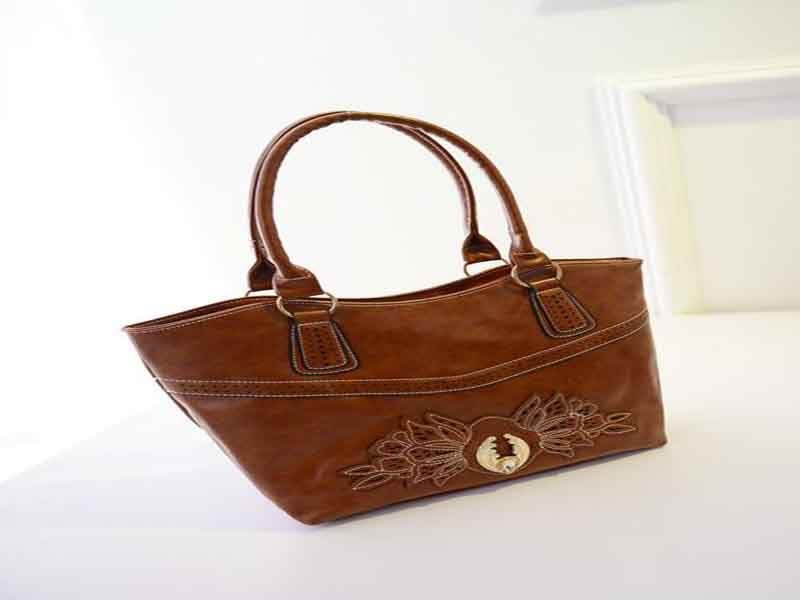
The main difference is not simply that leather is more luxurious while fabric is more casual. Leather and textile materials behave differently under bending, loading, abrasion, moisture, sewing and finishing. Leather is a natural sheet material whose grain structure, thickness and finish affect its strength and feel. Fabric is built from fibers and yarns, so its performance depends heavily on fiber type, yarn size, weave or knit construction, fabric weight and any coating or lamination applied afterward.
For a shoulder bag, these differences affect much more than appearance. They determine whether the body stands upright or collapses naturally, how much reinforcement is required around the strap anchors, which printing or logo processes can be used, how the edge should be finished, how easily dirt can be removed and how the bag changes after months of everyday use.
That is why material development should start with measurable specifications instead of descriptions such as “premium leather” or “strong canvas.”
What Is a Leather Shoulder Bag?
A leather shoulder bag uses natural leather as the primary exterior shell, although linings, reinforcements, pocket materials and internal structural layers may still be textile-based.
The phrase “leather shoulder bag,” however, covers products with very different characteristics.
Full-grain leather retains the original grain surface and is often selected when natural markings and long-term surface development are desirable. Corrected or pigmented leather provides a more controlled appearance and can offer greater consistency across larger production runs. Nubuck is buffed to create a soft surface but usually demands more careful protection from staining. Suede creates a different tactile experience again and behaves very differently around edges, hardware and high-contact areas.
Thickness also matters.
A soft fashion shoulder bag may use relatively thin, supple leather supported by lining and localized reinforcement. A structured messenger-style shoulder bag may require thicker leather, firmer temper or additional internal boards. Increasing leather thickness alone is not always the right solution because it can add unnecessary weight and make folded seams difficult to manufacture cleanly.
A practical leather specification therefore considers several variables together:
| Leather Variable | Why It Matters to a Shoulder Bag | What Can Go Wrong |
|---|---|---|
| Leather type | Controls appearance, grain and hand feel | Material looks different from the approved sample |
| Thickness | Influences strength, folding and weight | Heavy seams or insufficient body support |
| Temper | Determines softness or stiffness | Bag collapses or feels excessively rigid |
| Surface finish | Affects color consistency and wear | Scratching, peeling or uneven appearance |
| Color fastness | Matters around clothing contact | Dye transfer to light-colored garments |
| Tear strength | Important near hardware and seams | Material tears around stressed areas |
| Flex behavior | Affects folds and moving areas | Surface cracking around repeated bends |
| Batch consistency | Controls production appearance | Visible shade or grain variation |
A leather bag therefore cannot be engineered from a color swatch alone.
When Szoneier develops a leather or mixed-material shoulder bag, the exterior material needs to be considered alongside lining, reinforcement, thread, edge paint, backing materials, strap construction and hardware weight. A beautiful leather can still produce an uncomfortable bag if the total structure becomes too heavy.
Leather also has an important characteristic that designers often actively want: controlled aging.
Minor creases, polishing at contact areas and gradual changes in surface tone may become part of the product character rather than defects. This is especially true with less heavily coated leathers. A brand expecting every bag to maintain exactly the same visual appearance for years may therefore prefer a more protected leather finish or a coated textile rather than a highly natural leather.
What Is a Fabric Shoulder Bag?
A fabric shoulder bag uses a woven, knitted, nonwoven, laminated or coated textile as its main shell material.
Unlike leather, the word “fabric” does not identify one performance level. A lightweight cotton cloth and a densely woven coated nylon may both be called fabric, yet their suitability for a loaded shoulder bag is completely different.
Common shoulder bag fabrics include cotton canvas, polyester, nylon, Oxford fabric, linen blends and neoprene. Each can also be modified through coating, lamination, printing, washing, brushing or other finishing processes.
Cotton canvas is popular when natural texture and a substantial hand feel are important. It can support embroidery, screen printing and many washed or vintage-style finishes.
Polyester is widely used where color consistency, dimensional stability and broad finishing flexibility matter. Polyester Oxford constructions are particularly common in functional bags because different yarn sizes, backing treatments and coatings allow the material to be adapted for different structures.
Nylon is frequently chosen when reducing weight while maintaining good mechanical performance is important. Depending on the construction, it can work particularly well for travel, outdoor and technical shoulder bags.
Neoprene provides cushioning, stretch and a distinctive soft hand, making it useful when the product requires protection or a modern technical appearance.
Linen offers a recognizable natural texture but requires thoughtful construction because wrinkle behavior and abrasion expectations differ from synthetic bag fabrics.
One of the most common material-specification mistakes is treating denier as if it describes the complete fabric.
A label such as 420D or 600D refers to yarn linear density, not the finished fabric’s complete strength, weight or durability. Two 600D polyester fabrics can have different yarn counts, weave densities, backing systems, coatings, finished weights and tear resistance.
For custom bag development, a more useful specification may look like this:
| Fabric Variable | Example Specification Question | Why It Matters |
|---|---|---|
| Fiber | Cotton, polyester or nylon? | Influences hand, moisture behavior and finishing |
| Yarn size | 210D, 420D, 600D, etc. | Influences construction but does not define durability alone |
| Fabric weight | What is the finished GSM? | Helps control weight and body |
| Weave | Plain, Oxford, twill, ripstop? | Changes texture and tear behavior |
| Density | How tightly is the fabric woven? | Influences stability and surface performance |
| Coating | PU, TPU or another system? | Changes water resistance, hand and weight |
| Lamination | Is another layer bonded underneath? | Can add structure or waterproof performance |
| Finishing | Water repellent, brushed, washed, coated? | Changes appearance and functional behavior |
| Color | Piece dyed, solution dyed or printed? | Affects visual result and production method |
This matters when comparing fabric shoulder bag samples. A buyer may receive two visually similar black Oxford fabrics and assume they are interchangeable. After sewing, one may maintain the intended bag silhouette while another wrinkles around the zipper. One may tolerate repeated corner abrasion better, while another may offer better water resistance because of its backing.
The visible face tells only part of the story.
How Do Leather and Fabric Feel Different?
Leather normally feels denser and more substantial in the hand, while fabric offers a wider spectrum ranging from crisp and structured to soft, flexible and almost weightless.
But “feel” is not merely a subjective sales term. It can influence perceived quality, comfort and product function.
Leather softness can even be evaluated using standardized methods. ISO 17235 specifies a non-destructive method for determining the softness of non-rigid leather, including leather used in leather goods. That is useful because two leathers that look similar in photographs can behave noticeably differently once turned into a shoulder bag.
For textile materials, hand feel is shaped by fiber, yarn, weave, surface treatment and backing. A brushed cotton canvas may feel warm and dry. High-density nylon may feel smooth and technical. Coated polyester may feel firmer and more synthetic. Neoprene may feel soft and resilient.
This creates a useful design question:
What should the customer experience during the first five seconds of touching the bag?
If the desired impression is natural, substantial and tactile, leather or heavy cotton canvas may make sense.
If the desired impression is lightweight, clean and technical, nylon or fine polyester may fit better.
If a soft, protective feel is important, neoprene or laminated textile constructions may be more suitable.
It is also worth thinking about how that feel changes once the bag is loaded.
A beautiful soft leather may stretch or drape differently around a laptop, bottle or cosmetic pouch. A lightweight fabric may feel excellent when empty but require foam or reinforcement to prevent the loaded body from deforming.
Material and structure should therefore be developed together.
Which Material Looks More Premium?
Leather often creates a stronger traditional luxury impression because of its natural grain, density, edge-finishing possibilities and association with long-lasting leather goods. That does not mean fabric automatically looks inexpensive.
High-end shoulder bags increasingly use technical nylon, dense cotton canvas, jacquard, specialty woven fabrics and mixed-material constructions. Premium perception comes from the entire product system: material quality, silhouette, pattern accuracy, stitching, hardware, lining, tactile details and finishing consistency.
Consider three examples.
A full-grain leather bag with poorly painted edges, uneven stitching and lightweight hardware will rarely feel truly premium.
A dense cotton canvas shoulder bag with clean binding, custom metal hardware, reinforced stress points and carefully matched lining can feel highly considered.
A technical nylon shoulder bag with a precisely controlled surface, lightweight hardware and engineered compartments can communicate an entirely different kind of premium value: performance rather than tradition.
This is why brands should avoid asking only:
“Which material looks more expensive?”
A better question is:
“Which material makes the product concept believable?”
For a heritage-inspired shoulder bag, vegetable-tanned or natural-grain leather may support the story.
For an outdoor utility bag, a coated nylon or polyester fabric may make the product feel more authentic.
For an artistic lifestyle bag, cotton canvas may create a stronger foundation for printing, embroidery or patches.
For a lightweight commuter design, heavy leather may actually work against the product promise.
Premium design begins when the material reinforces the purpose instead of competing with it.
Which Material Is More Durable?
Neither leather nor fabric is universally more durable. Durability depends on the exact leather grade or textile construction, the load carried, abrasion exposure, moisture, UV exposure, seam design, hardware attachment, coatings, reinforcement and maintenance.
High-quality leather can provide excellent long-term performance, particularly when its thickness, finish and temper match the product. At the same time, engineered nylon, polyester and heavy canvas fabrics can perform extremely well in shoulder bags exposed to frequent rubbing, travel and repeated handling.
The important distinction is between material durability and bag durability.
A material can pass an impressive laboratory abrasion test while the finished bag still fails because a strap anchor tears, stitching cuts through the material or an unsupported zipper opening distorts. ASTM specifically notes that laboratory abrasion resistance is only one factor influencing real-world durability for both textiles and leather.
For a shoulder bag, durability has to be engineered at the system level.
How Long Do Leather Shoulder Bags Last?
A well-designed leather shoulder bag can remain functional for many years, but assigning one universal lifespan such as “10 years” or “20 years” is misleading.
Leather durability changes with several factors:
Leather type
Thickness
Surface treatment
Frequency of use
Carried load
Humidity
Rain exposure
Perspiration
Storage
Cleaning products
Hardware design
Seam construction
Edge treatment
A lightly used leather bag stored carefully indoors faces a completely different environment from a daily commuter bag rubbing against clothing, train seats and tabletops.
Leather also tends to show wear rather than hide it.
On some products, this can be desirable. The surface develops creases, polishing and color variation that owners associate with character.
On other products, the same changes may be considered deterioration.
This difference between “patina” and “damage” should be decided during product development.
A useful durability plan divides the bag into wear zones:
| Bag Area | Typical Stress | Leather Risk | Development Response |
|---|---|---|---|
| Bottom corners | Repeated rubbing | Surface wear and discoloration | Select appropriate finish or reinforce corners |
| Strap anchors | Concentrated tensile load | Tearing or stretching | Add hidden reinforcement |
| Flap fold | Repeated flexing | Finish cracking | Check flex behavior and leather temper |
| Zipper ends | Pulling and distortion | Local tearing | Add backing or end reinforcement |
| Bag opening | Repeated handling | Stretch or shape loss | Reinforce edge construction |
| Back panel | Clothing friction | Surface polish or dye transfer | Evaluate rubbing and color fastness |
| Handle or strap | Sweat and bending | Darkening, stretching | Choose appropriate construction and backing |
Testing leather independently is also important.
ISO 3376 specifies methods for measuring leather tensile strength and elongation, while ISO 17076-1 covers abrasion resistance using a Taber apparatus. ASTM D7255 provides another abrasion test method for leather. These methods allow developers to compare materials under controlled conditions rather than relying only on visual inspection.
There is an important catch.
ASTM D7255 specifically cautions that abrasion cycles and actual durability are related but are not the same thing. Test conditions, abrasive media, pressure, surface finishes and evaluation methods all influence the result.
In plain language: a laboratory number is useful for comparing controlled samples, but it should not be treated like a guaranteed number of days a customer can use the bag.
That is why prototype wear testing remains valuable.
Are Fabric Shoulder Bags Durable?
Yes. Properly specified fabric shoulder bags can be extremely durable, especially when synthetic yarns, dense constructions, reinforcement and appropriate coatings are combined.
The mistake is assuming that fiber name alone predicts performance.
“Polyester” is not a durability specification.
“Nylon” is not a durability specification.
“Canvas” is not a durability specification.
The complete construction matters.
For example, a development team evaluating a polyester shoulder bag may need to consider:
Yarn denier
Warp and weft density
Finished GSM
Tear strength
Tensile strength
Abrasion resistance
Coating adhesion
Water resistance
Color fastness
Seam slippage
UV exposure
Backing type
The same applies to cotton canvas. A dense heavy canvas can feel remarkably robust, but exposed corners may gradually fade or abrade with repeated use. That surface aging may fit a heritage product beautifully, yet it may be undesirable for a clean fashion bag expected to maintain a uniform appearance.
Standardized abrasion testing helps make textile comparisons more meaningful.
ISO 12947-2 describes the Martindale method for determining the point at which a textile specimen breaks down during abrasion testing. ASTM D3884 addresses textile abrasion using a rotary platform abrader and notes that results can vary with fiber properties, yarn construction, fabric construction, finishes and test conditions.
Those standards reinforce an important manufacturing principle:
Do not compare two fabrics using one marketing specification.
A fabric described as “600D polyester” may sound stronger than a “420D nylon,” but denier alone cannot determine which finished fabric will perform better in a specific shoulder bag.
A more useful comparison looks like this:
| Question | Weak Specification | Better Specification |
|---|---|---|
| What is the material? | 600D polyester | Fiber + denier + weave + finished GSM |
| Is it water resistant? | Waterproof fabric | Coating system + target water test |
| Is it durable? | Heavy-duty | Abrasion + tear + tensile targets |
| Is it suitable for printing? | Printable | Print method + adhesion + color requirements |
| Will it hold shape? | Thick material | Fabric stiffness + backing + reinforcement |
| Will colors stay consistent? | Black | Approved color standard + tolerance |
| Will it survive sewing? | Strong fabric | Seam behavior + needle/thread specification |
This approach becomes especially important when a shoulder bag has large printed surfaces, multiple compartments or lightweight construction targets.
Which Material Resists Abrasion Better?
There is no technically sound answer without identifying the exact materials and test methods.
A heavily finished leather may resist surface wear very differently from soft aniline leather. A high-density nylon may resist repeated rubbing differently from loosely woven cotton canvas. A PU-coated polyester fabric may initially protect the textile surface well but introduce another question: how will the coating behave after folding, humidity and long-term use?
Abrasion is also not one single type of wear.
A shoulder bag experiences:
Flat surface rubbing against clothing
Corner abrasion against walls and furniture
Strap friction against jackets
Repeated contact around zipper openings
Localized hardware rubbing
Flexing combined with abrasion
This is why test selection matters.
| Material | Relevant Test Approach | What It Helps Evaluate |
|---|---|---|
| Textile fabric | ISO 12947-2 Martindale | Abrasion until specimen breakdown |
| Textile fabric | ASTM D3884 | Rotary-platform abrasion comparison |
| Leather | ISO 17076-1 | Leather abrasion using Taber apparatus |
| Leather | ASTM D7255 | Rotary-platform leather abrasion |
| Leather | ISO 3376 | Tensile strength and elongation |
ISO 12947-2 applies to textile fabrics and determines specimen breakdown under Martindale abrasion, while ISO 17076-1 provides an abrasion method specifically for leather. ASTM maintains separate guidance for textile abrasion under D3884 and leather abrasion under D7255.
The separation is important.
Results produced using different test methods should not casually be placed side by side as though they came from the same scale. ASTM D7255 even notes that its leather abrasion method is similar to, but not equivalent to, ISO 17076-1 and that results should not be directly compared between the two methods.
For product development, the better strategy is to establish a reference material that already performs satisfactorily, test candidate materials under the same method and conditions, and then verify promising candidates in finished prototypes.
The laboratory narrows the choices.
The finished bag confirms them.
How Do Seams Affect Bag Durability?
Seams can determine the practical life of a shoulder bag even when the shell material itself remains undamaged.
This happens because sewing creates holes in the material and concentrates stress along a narrow line.
Leather and fabric respond differently.
In leather, needle holes remain in the material. If the stitch length is too short, holes can become so closely spaced that the seam begins to behave like a perforated tear line. Excessive needle size can create the same problem.
Fabric can face other issues. Threads may pull apart around the seam, the fabric may slip, or the coating may be damaged during sewing. Loosely constructed textiles generally require more attention around load-bearing seams than dense fabrics.
Thread choice also matters.
A heavy-looking thread may suit the visual design but require a larger needle. A larger needle creates a larger hole. Increasing thread size therefore does not automatically create a stronger seam.
The construction engineer has to balance:
Thread material
Thread ticket size
Needle size
Stitch density
Seam allowance
Edge distance
Reinforcement
Material thickness
Number of layers
A typical durability problem illustrates this well.
Suppose the shell fabric is strong enough to carry the intended load. During testing, however, the strap attachment begins tearing beside the stitches.
The wrong conclusion is:
“We need stronger fabric.”
The actual issue may be that the strap load is concentrated into too small an area.
Increasing the reinforcement footprint, changing the stitch geometry or adding an internal backing layer may solve the problem without changing the exterior material at all.
This is why Szoneier evaluates shoulder bag materials as part of a construction system rather than as isolated swatches. The shell, lining, reinforcement, webbing, hardware and seam configuration must share the load.
Which Material Handles Heavy Loads Better?
The material with the best load performance is the one supported by the better construction.
For most shoulder bags, the highest stress does not occur across the middle of the body panel. It occurs around strap anchors, handles, seams, zipper ends and reinforcement transitions.
Imagine placing 8 kg inside two bags.
Bag A uses thick leather but has a narrow strap anchor stitched directly onto an unsupported body panel.
Bag B uses a lighter woven synthetic fabric but spreads the strap load through a large internal reinforcement panel.
Bag B may prove more reliable even though its exterior material feels thinner.
This is why heavy-load design should use a load-path approach.
The load starts inside the bag.
It transfers through the bottom and side panels.
It reaches the strap attachment.
It travels through the strap.
It finally reaches the user’s shoulder.
Every transition can become a failure point.
For bags expected to carry heavier items, engineers commonly review:
Strap anchor footprint
Internal backing dimensions
Webbing strength
Stitch pattern
Seam allowance
Fabric tear resistance
Leather tear resistance
Hardware strength
Bottom reinforcement
Load distribution
The same thinking applies when selecting leather thickness. Simply specifying the thickest available leather can make the bag heavy and difficult to sew without addressing the actual stress concentration.
Fabric designs have a similar trap. Choosing a higher denier does not automatically solve a weak strap attachment.
A better development sequence is:
Define the expected carrying load.
Identify the major load paths.
Select materials with sufficient tensile and tear performance.
Reinforce concentrated stress zones.
Build the prototype using production-intent materials.
Conduct static and repeated-load evaluations.
Inspect not only complete failure but also deformation, stitch movement, elongation and early tearing.
Adjust material or construction where necessary.
The result is a shoulder bag engineered around how people actually use it rather than around one impressive-looking material specification.
That is the real lesson behind the leather-versus-fabric durability question: materials matter enormously, but materials do not work alone.
Which Material Is Lighter and More Comfortable?
Fabric shoulder bags are generally lighter than comparable leather bags, especially when nylon, lightweight polyester or thinner Oxford fabrics are used. Leather usually has greater material mass and often requires additional structural components, edge finishing and substantial hardware. Comfort, however, cannot be judged by shell weight alone. Strap width, load distribution, bag dimensions, hardware, padding, lining and the distance between the bag and the body can influence shoulder pressure as much as the exterior material.
For an everyday shoulder bag, a difference of a few hundred grams before anything is placed inside can become surprisingly noticeable after adding a tablet, phone, charger, cosmetics, keys and a water bottle.
Consider a practical example. Two bags have approximately the same 30 × 22 × 10 cm dimensions. One uses a relatively substantial leather shell with metal hardware and reinforced handles. The other uses coated nylon with lightweight webbing and a textile lining. If the empty leather design reaches around 900–1,200 g while the textile design is engineered closer to 400–700 g, the difference may seem modest on a product specification sheet. Add 3 kg of personal items, however, and the lighter bag can reduce the total carried mass by roughly 10–20%.
The more useful question is therefore not simply “Which material is lighter?” It is “How much of the total weight budget should the bag itself consume?”
Is Leather Heavier Than Fabric?
In most comparable constructions, yes. Genuine leather normally contributes more weight than common bag textiles because it is a relatively dense natural material and is often used at thicknesses intended to provide body, durability and visual substance.
Fabric weight is commonly specified by grams per square meter, or GSM, while synthetic woven fabrics are also frequently identified by yarn denier. Leather is usually controlled more directly through thickness, substance and area, so comparing a leather specification with a fabric specification using only one number can be misleading.
For shoulder bag development, approximate material categories may look like this:
| Material Category | Common Design Character | Relative Shell Weight | Typical Shoulder Bag Direction |
|---|---|---|---|
| Soft leather | Dense, flexible, substantial | High | Fashion, premium everyday bags |
| Structured leather | Firm, shape-retaining | High to very high | Business and structured handbags |
| Cotton canvas | Natural, tactile, substantial | Medium | Casual, lifestyle, tote-style shoulder bags |
| Polyester Oxford | Adjustable through denier and coating | Low to medium | Everyday, promotional, travel and functional bags |
| Nylon | High strength-to-weight potential | Low | Travel, commuter and technical bags |
| Ripstop nylon | Lightweight with reinforced weave structure | Very low to low | Packable and outdoor-oriented designs |
| Neoprene | Soft, thick and cushioning | Medium | Protective and lifestyle bags |
| Linen blend | Natural texture and softer structure | Low to medium | Fashion and casual designs |
These ranges are directional rather than universal specifications. A heavy 24 oz canvas, for example, can become much more substantial than a lightweight leather. A heavily coated 1680D synthetic textile may also weigh considerably more than a thin nylon shell.
The construction stack is what eventually determines finished bag weight.
Imagine a leather shell that appears relatively thin. To achieve a particular shape, the design may include reinforcement board, foam, fabric backing and a full lining. Add zinc-alloy buckles, metal strap adjusters and a decorative chain, and the final bag can become considerably heavier than the leather swatch suggested.
Fabric presents the opposite possibility. A 420D or 600D textile may appear simple, but the manufacturer can combine it with thin foam, lightweight lining and high-strength webbing to obtain the required structure without creating the same mass.
This gives product developers an important tool: weight budgeting.
Instead of completing the design and discovering the bag is too heavy, assign a target finished weight before sample development.
A simple development target might look like this:
| Component | Example Weight Budget |
|---|---|
| Exterior shell | 220 g |
| Lining and pockets | 110 g |
| Foam and reinforcement | 80 g |
| Shoulder strap | 90 g |
| Zippers | 45 g |
| Hardware | 90 g |
| Labels and trims | 15 g |
| Target finished bag | 650 g |
If the first sample weighs 820 g, the team has something concrete to investigate.
Perhaps the hardware can be changed from solid metal to a lighter specification.
Perhaps reinforcement is being used across an entire panel when only the strap attachment requires it.
Perhaps the chosen shell fabric is heavier than necessary.
Perhaps a leather trim can remain around high-value visual areas while the larger body panels move to canvas or nylon.
This approach produces better decisions than simply asking a factory to “make the bag lighter.”
Which Fabrics Are Lightweight?
Nylon and polyester generally provide the broadest options for lightweight shoulder bag construction because their yarn size, weave density, coating and backing can be engineered across a wide range.
Ripstop nylon is particularly useful when a design requires relatively low weight while maintaining resistance to progressive tearing. The familiar grid visible in many ripstop materials is created by reinforcing yarns integrated into the weave. It does not make the fabric indestructible, but it can help limit the growth of small tears depending on the construction.
Standard nylon fabrics can also provide an attractive strength-to-weight balance for commuter, travel and outdoor bags.
Polyester is similarly versatile. Lightweight polyester is common in packable bags and internal linings, while higher-denier polyester Oxford materials are used when more body and surface durability are required.
Cotton canvas occupies a different position. It is rarely selected because it is the lightest possible material. Its appeal usually comes from natural texture, print compatibility, familiar hand feel and the ability to create a substantial but approachable product.
A simplified material-selection comparison is useful:
| Fabric | Weight Potential | Structure | Moisture Performance | Visual Character | Good Fit For |
|---|---|---|---|---|---|
| Lightweight nylon | Excellent | Soft to medium | Good with suitable finish | Technical | Travel and packable bags |
| Ripstop nylon | Excellent | Soft | Good with coating or finish | Outdoor/technical | Lightweight utility bags |
| Polyester | Very good | Wide range | Good with coating | Highly versatile | Everyday shoulder bags |
| Oxford polyester | Good | Medium to firm | Very good when coated | Functional | Commuter and travel bags |
| Cotton canvas | Moderate | Medium to firm | Limited untreated | Natural/casual | Lifestyle and fashion bags |
| Linen blend | Good | Soft to medium | Limited untreated | Natural/premium casual | Fashion bags |
| Neoprene | Moderate | Soft and cushioned | Material itself handles water well | Modern/sporty | Protective lifestyle bags |
There is another factor that does not receive enough attention: the amount of material required by the pattern.
Two shell materials with similar GSM can produce different finished weights if one design requires binding, double-layer construction or extra reinforcement.
For example, a fabric with adequate inherent structure may allow one body layer plus lining. A softer material may need foam and reinforcement over several large areas.
Saving 40 g/m² on the shell therefore does not automatically save the same amount in the finished bag.
At Szoneier, fabric selection can be approached from both directions. If a customer starts with a material preference, the construction can be developed around that material. If the customer starts with a finished-weight target, different cotton, canvas, polyester, nylon, neoprene, linen and Oxford constructions can be compared before the final shell is selected.
This is particularly useful when a bag must balance visual character with shipping weight.
For an e-commerce product shipped internationally, removing 150–250 g from a bag can matter beyond shoulder comfort. Across thousands of pieces, the difference affects carton weight, freight planning and fulfillment economics.
Lightweight engineering can therefore influence both the person carrying the product and the company shipping it.
How Does Bag Weight Affect Shoulder Comfort?

Shoulder comfort is influenced by the total carried mass and by how that mass is distributed against the body.
A 700 g bag may feel perfectly comfortable when carrying a phone and wallet. Put a laptop, charger, bottle and documents inside it, and the experience changes.
The strap becomes especially important because it transfers the load over a relatively small area of the shoulder.
A narrow strap concentrates pressure.
A wider strap spreads that load.
A soft padded strap can reduce localized pressure further, although excessively thick padding can become bulky or trap heat.
The relationship is easy to understand without complicated biomechanical formulas. Imagine applying the same force through a narrow cord and through a wide belt. The total force is unchanged, but the wider contact area generally feels less concentrated.
For shoulder bags, useful ergonomic variables include:
| Design Variable | Comfort Effect | Common Mistake |
|---|---|---|
| Empty bag weight | Adds directly to carried load | Heavy shell and hardware used without a weight target |
| Strap width | Spreads shoulder pressure | Narrow strap used on a high-capacity bag |
| Strap padding | Reduces localized pressure | Decorative padding too short to stay on the shoulder |
| Strap length | Changes bag position | Bag hangs too low and swings while walking |
| Hardware weight | Adds non-functional mass | Oversized metal parts selected mainly for appearance |
| Bag depth | Moves load away from body | Deep bag pulls outward when heavily loaded |
| Internal organization | Controls load position | Heavy items collect far from the body |
| Back-panel shape | Influences stability | Rigid corners press against the body |
| Strap attachment position | Controls balance | Bag tilts forward when loaded |
Bag depth is particularly easy to overlook.
Suppose two shoulder bags each carry 4 kg. One is slim and keeps most of the load close to the body. The other has a deep gusset that allows heavy objects to sit farther away.
The second bag may feel more awkward because its mass is positioned farther from the body and can create more movement during walking.
This is one reason “capacity” should not automatically be maximized.
More internal volume can look attractive in a specification sheet, but additional volume encourages additional load. If the strap system and body structure were not designed for that load, comfort deteriorates quickly.
Internal pocket placement can help.
A tablet sleeve positioned against the body panel keeps a relatively heavy item closer to the wearer.
A bottle pocket placed at one end should be balanced carefully because a full bottle can make a small bag lean to one side.
Large loose compartments may need dividers if the intended contents are heavy.
Material affects these decisions because a lightweight fabric shell leaves more of the weight budget available for useful structure and organization.
Leather takes a larger portion of the budget, but its natural body may reduce the need for some supporting layers.
Neither approach is inherently better.
The goal is efficient use of weight.
Which Material Is Better for Daily Carry?
For daily carry, fabric is often the more practical option when the priorities are low weight, easy maintenance, weather resistance and frequent use. Leather becomes especially attractive when appearance, tactile quality, shape and long-term visual character carry more weight than minimum product mass.
The correct choice depends heavily on the daily routine.
A commuter walking between public transportation, office buildings and cafés may benefit from lightweight nylon or coated polyester. The bag may regularly encounter rain, seat surfaces, floor contact and crowded spaces.
Someone carrying a small shoulder bag mainly for a phone, wallet and keys may have no meaningful concern about the additional weight of leather. In that case, leather’s tactile and aesthetic value can become more important.
A photographer, field technician or traveler may care more about weight, compartment construction and moisture exposure than traditional luxury cues.
A fashion customer may prioritize silhouette and surface character even if the bag requires more careful maintenance.
The decision becomes clearer when daily-use conditions are defined before material selection.
| Daily Use Scenario | Strong Material Candidates | Primary Reason |
|---|---|---|
| Urban commuting | Nylon, coated polyester, Oxford | Low weight and weather practicality |
| Casual everyday use | Canvas, polyester, leather | Broad balance of appearance and function |
| Premium office carry | Leather, leather-textile hybrid | Structure and refined appearance |
| Travel | Nylon, polyester, Oxford | Weight and maintenance |
| Outdoor lifestyle | Nylon, ripstop, coated Oxford | Moisture and abrasion management |
| Fashion-focused use | Leather, canvas, specialty woven fabric | Surface character and design flexibility |
| Art or graphic-led bag | Canvas, polyester | Printing and embroidery flexibility |
| Compact personal bag | Leather or fabric | Total load is low enough for either |
Hybrid construction deserves special attention because it avoids treating leather and fabric as mutually exclusive choices.
A shoulder bag can use coated nylon for large body panels and leather at the handle, flap or logo patch.
Canvas can form the main shell while leather reinforces corners and strap anchors.
Leather can define the front-facing visual area while lightweight textile panels reduce mass elsewhere.
Neoprene can protect a device compartment inside a woven textile shell.
This combination is often more intelligent than insisting that one material perform every function.
For custom development, the best question to give Szoneier is not simply “Can you make this in leather or fabric?”
A more productive brief might say:
The bag should weigh less than 650 g, carry approximately 4 kg in normal use, tolerate light rain, maintain a structured front panel and have a warm premium appearance.
That gives the material team something measurable to solve.
Perhaps the answer is coated polyester with leather trim.
Perhaps it is nylon with a structured backing.
Perhaps canvas with a protective finish provides the right visual balance.
Perhaps leather remains the best choice because the bag is compact enough that weight is not a meaningful concern.
Material selection becomes much easier once daily life is translated into technical requirements.
Which Material Handles Water and Stains Better?
Coated synthetic fabrics usually provide the most practical combination of water resistance and easy surface cleaning for everyday shoulder bags. Leather can tolerate limited moisture when properly finished, but it should not automatically be treated as waterproof. Untreated cotton canvas also absorbs water relatively easily, while polyester, nylon and Oxford fabrics can be engineered with water-repellent finishes, PU coatings, TPU laminations or other backing systems to achieve substantially better moisture resistance.
An important distinction is often missed in product descriptions: water repellent, water resistant and waterproof do not mean exactly the same thing.
A surface can cause droplets to bead while still allowing water to penetrate under sustained exposure.
A coated fabric can resist water penetration through the panel while stitched seams remain vulnerable.
A highly water-resistant material does not automatically create a waterproof shoulder bag.
The finished product has to be evaluated as a system.
Is Leather Waterproof?
Most conventional leather shoulder bags should not be described as completely waterproof unless their complete construction has been specifically designed and verified for that claim.
Leather is a natural material with a fibrous internal structure. Its ability to handle water depends strongly on tanning, finishing, surface coating, oils, waxes and other treatments.
A pigmented leather with a protective finish may resist brief contact with rain better than highly absorbent suede or aniline leather.
Waxed or treated leather may provide improved resistance.
Suede and nubuck generally require greater caution because their open, textured surfaces can show water marks or staining more readily.
Even when the surface performs well, water can still enter through seams, zipper openings and construction gaps.
A useful comparison is:
| Leather Type or Finish | Response to Light Moisture | Stain Sensitivity | Care Requirement |
|---|---|---|---|
| Protected pigmented leather | Generally good | Lower | Moderate |
| Semi-aniline leather | Moderate | Moderate | Moderate to high |
| Aniline leather | More sensitive | Higher | High |
| Waxed leather | Often good when maintained | Moderate | Periodic maintenance |
| Nubuck | Sensitive | High | High |
| Suede | Sensitive | High | High |
These are design tendencies, not guarantees. Leather formulation and finishing vary significantly between suppliers.
Leather can also be assessed through standardized testing rather than informal water-droplet demonstrations. ISO 5403-1:2025 provides a current method for determining the water resistance of flexible leather using repeated linear compression. The standard is especially associated with flexible leather applications and illustrates an important principle: useful water-resistance evaluation can include movement rather than testing a completely stationary specimen.
This matters because shoulder bags bend.
A flap folds every time the bag is opened.
A soft gusset flexes while walking.
A strap curves around the shoulder.
Leather that appears resistant when lying flat may behave differently after extended flexing and surface wear.
Color behavior should also be considered. ISO 11640:2018 specifies a method for evaluating leather surface behavior during repeated rubbing with wool felt, and ISO is currently developing a replacement edition.
For a shoulder bag that regularly touches clothing, rubbing performance can be just as important as whether rain initially beads on the surface.
A dark leather that transfers color onto a white jacket creates a much more memorable customer complaint than a specification sheet can repair.
This is why Szoneier’s material development process can include not only appearance review but also consideration of color fastness, rubbing behavior, flexing and intended exposure conditions when the product requires them.
Are Fabric Shoulder Bags Water Resistant?
They can be, but the fiber name alone does not determine water resistance.
Untreated textile materials contain spaces between yarns through which water can eventually move. Surface finishes, coating chemistry, coating thickness, weave density and lamination can change that behavior significantly.
A useful way to understand fabric water performance is to separate three layers of protection.
The first is surface repellency.
A durable water-repellent treatment can reduce wetting at the outer face and encourage water droplets to bead and roll away.
The second is material resistance to penetration.
A PU coating, TPU film or another barrier layer can prevent water from passing through the fabric body under a defined pressure.
The third is product-level construction.
Seams, zippers and openings must also prevent water entry if the finished bag is expected to achieve a strong waterproof claim.
These are different properties and should be tested differently.
ISO 4920 specifies a spray method for evaluating resistance to surface wetting. Importantly, ISO states that the method is not intended to predict resistance to rain penetration because it measures surface wetting rather than water passing through the material.
AATCC TM22 follows the same broad concept: controlled water spray is used to evaluate the wetting pattern of a textile surface. AATCC also explains that this test is useful for evaluating water-repellent finishes but is not itself a measurement of water penetration through the fabric.
When actual penetration resistance matters, a hydrostatic-pressure method is more relevant.
ISO 811:2018 specifies a hydrostatic pressure test for fabrics intended to resist water penetration, whether or not they have a water-resistant or water-repellent finish. ISO confirmed this edition in 2025, so it remains the current published version as of 2026.
That difference can prevent misleading product claims.
A fabric may achieve excellent spray repellency but relatively modest hydrostatic resistance.
Another fabric may have a strong waterproof backing while the face becomes visibly wet.
Which one is “better” depends on what the customer actually expects.
For a fashion shoulder bag, preventing obvious wetting and staining during a brief shower may be enough.
For a cycling bag containing electronics, resistance to water penetration becomes much more important.
For a medical or equipment bag, material cleaning, chemical compatibility and seam construction may matter alongside water performance.
One universal “waterproof fabric” specification cannot serve all three applications.
How Does Canvas React to Rain?
Untreated cotton canvas normally absorbs water because cotton fibers are hydrophilic and the woven structure provides pathways for moisture.
That does not mean canvas is unsuitable for outdoor or everyday shoulder bags.
It means its performance has to match the intended product.
Heavy canvas can provide excellent hand feel, body and abrasion character. For a casual lifestyle bag, occasional darkening during light rain may be acceptable if the material dries properly afterward.
For another customer, visible wet spots may be unacceptable even if water never reaches the contents.
In that case, canvas can be treated.
Common approaches include water-repellent finishing, waxing, coating or lamination.
Each changes the character of the material.
Waxed canvas typically becomes darker and more structured. It may develop creases and marks that contribute to a heritage appearance.
PU-coated canvas can provide stronger barrier performance but can change breathability, hand feel and flexibility.
A water-repellent surface finish may preserve more of the natural canvas character, but surface repellency should not be confused with complete waterproofing.
The trade-offs can be summarized this way:
| Canvas Construction | Water Behavior | Hand Feel | Visual Character | Main Trade-Off |
|---|---|---|---|---|
| Untreated cotton canvas | Absorbs relatively easily | Natural | Traditional | Limited rain protection |
| Water-repellent canvas | Better surface beading | Mostly natural | Similar to untreated | Finish performance can change with wear |
| Waxed canvas | Good practical rain resistance | Firmer/waxy | Heritage | Creasing and maintenance |
| PU-coated canvas | Improved penetration resistance | Less natural | Cleaner/technical | Added weight and changed flexibility |
| Laminated canvas | Strong barrier potential | More structured | Depends on laminate | Complexity and cost |
There is also a drying issue.
When cotton becomes wet, moisture can remain within the fibers and structure longer than on many hydrophobic synthetic materials.
Putting a damp canvas bag into an enclosed cabinet immediately after use is therefore poor practice. Adequate drying becomes important for odor control and material condition.
For product developers, this means care instructions should reflect actual materials.
A label that simply says “water resistant” gives very little useful guidance.
A better development process answers several questions:
How much rain exposure is expected?
Should water bead visibly?
Can the face material become wet?
How quickly should the material dry?
Does the bag contain electronics?
Will customers expect machine washing?
Can the treatment survive repeated cleaning?
Does the finish change color or hand feel?
These questions define the specification far better than choosing canvas first and trying to make it waterproof afterward.
Which Fabrics Resist Water Best?
For shoulder bags requiring strong moisture protection without excessive weight, coated or laminated polyester and nylon are usually among the most versatile options.
Oxford fabric is also widely used, although “Oxford” refers to fabric construction rather than one specific fiber. Polyester Oxford and nylon Oxford can therefore behave differently depending on their yarns, weave density and backing.
TPU-laminated textile systems can support demanding water-resistance requirements and provide a flexible barrier.
PU-coated fabrics remain popular because performance, hand feel, cost and coating weight can be adjusted across many applications.
PVC-coated fabrics can provide strong barrier properties but create a different hand feel and product profile.
Neoprene has a closed-cell foam structure and handles moisture differently from woven textile shells, although seam design still determines whether a finished neoprene bag prevents water from reaching its interior.
A decision matrix can help:
| Material System | Water Potential | Weight | Flexibility | Branding Compatibility | Typical Use |
|---|---|---|---|---|---|
| Uncoated polyester | Low to moderate | Low | Good | Excellent | Casual bags |
| PU-coated polyester | Moderate to high | Low to medium | Good | Very good | Everyday and travel |
| TPU-laminated polyester | High | Medium | Good | Depends on surface | Technical bags |
| Uncoated nylon | Low to moderate | Very low to low | Excellent | Very good | Lightweight bags |
| PU-coated nylon | Moderate to high | Low | Excellent | Very good | Outdoor and travel |
| TPU-laminated nylon | High | Low to medium | Excellent | Good | Technical performance |
| Coated Oxford | Moderate to high | Medium | Good | Excellent | Commuter and utility |
| Treated canvas | Moderate | Medium to high | Moderate | Excellent | Lifestyle bags |
| Neoprene | Good material-level resistance | Medium | Excellent | Good | Protective bags |
Water-resistance targets should preferably be tied to a testing method.
For example:
“Water-resistant polyester” is vague.
“Fabric to meet the agreed ISO 811 hydrostatic-pressure requirement” is measurable.
“Water-repellent finish” is vague.
“Surface wetting evaluated according to the agreed spray-test standard before and, where relevant, after conditioning” is much clearer.
Coated fabrics can require broader testing because the coating itself becomes part of the performance system. The current ASTM D751-26 standard includes methods addressing characteristics such as breaking strength, tearing strength, hydrostatic resistance, coating adhesion, seam strength, low-temperature behavior and accelerated aging for coated fabrics.
That list demonstrates why choosing a coated fabric only from a water-column number is risky.
A coating can resist water but adhere poorly to the textile.
A material can perform well initially but become brittle in certain conditions.
A strong shell material can still leak at its seams.
Performance should be balanced.
How Do Coatings Improve Water Resistance?
Coatings improve water resistance by creating or strengthening a barrier that makes it more difficult for liquid water to move through the textile structure.
In a plain woven fabric, tiny spaces exist between yarns.
A coating can fill or bridge those spaces.
A laminated film can create a more continuous barrier.
Surface finishes can reduce the ability of water to spread across and wet the face.
Different technologies therefore solve different parts of the problem.
PU coatings are widely used for bag fabrics because they can provide a practical balance between flexibility, water resistance, hand feel, coating weight and cost.
TPU laminations can be selected when stronger barrier properties, flexibility or particular technical characteristics are required.
Water-repellent surface finishes operate differently. Rather than creating a complete backing barrier, they change how water interacts with the fabric surface.
This distinction matters when building a specification:
| Treatment | Main Function | What It Does Not Automatically Solve |
|---|---|---|
| Water-repellent finish | Reduces surface wetting | Does not guarantee penetration resistance |
| PU coating | Creates backside water barrier | Does not seal stitched seams |
| TPU lamination | Creates continuous film barrier | Does not make zipper openings waterproof |
| Wax treatment | Improves practical water shedding | Requires appropriate care and maintenance |
| Seam tape | Reduces water entry through certain seams | Cannot compensate for open zippers |
| Waterproof zipper construction | Reduces entry at zipper | Does not improve shell fabric |
This is one reason a finished bag may use a highly water-resistant fabric but still be marketed more conservatively as water resistant rather than waterproof.
Every sewing needle creates holes.
Ordinary coil zippers have paths through which water can move.
Pocket openings can collect rain.
Binding seams may expose multiple fabric layers.
Water can wick along thread or textile edges.
If a genuinely waterproof product is required, these construction details have to be addressed from the beginning.
A practical development sequence may look like this:
Define expected exposure.
A bag intended for occasional urban rain does not require the same construction as a bag expected to sit on a wet kayak deck.
Set the material requirement.
Choose a fabric and coating system appropriate to the intended exposure.
Confirm surface behavior.
Use an appropriate spray or wetting method if visible repellency matters.
Confirm penetration resistance.
Use an appropriate hydrostatic or related method if preventing water passage is important.
Review seams and openings.
Determine whether ordinary sewing, seam sealing, welding or taped construction is required.
Evaluate zippers.
Choose conventional, water-resistant or more specialized closure systems based on the product goal.
Build a finished prototype.
A material test cannot reveal every route by which water may enter a completed bag.
Conduct product-level exposure testing.
Inspect the inside, especially around seams, corners, zipper ends and attachment points.
This level of development prevents one of the most common misunderstandings in custom bags: purchasing an impressive “waterproof” fabric and assuming the final shoulder bag automatically inherits the same performance.
It does not.
The material sets the potential.
Construction determines how much of that potential survives in the finished product.
The same principle applies to stains.
A smooth coated polyester surface can often be wiped more easily than absorbent cotton canvas. Protected leather may resist some spills better than natural untreated leather. Dark fabrics hide certain stains more effectively, but they can reveal dust, salt marks or surface abrasion differently. Light materials make cleanliness more visible but can expose dye transfer and everyday grime.
For a bag designed for hospitals, travel, school, outdoor use or frequent commuting, stain behavior may deserve its own specification.
For a luxury fashion bag, the priority may instead be preserving the desired hand feel and surface depth without applying a finish that makes the material look artificial.
That is where material customization becomes useful.
Szoneier can develop cotton, canvas, polyester, nylon, neoprene, linen and Oxford fabric constructions with different weights, textures, colors, printing methods, coatings, laminations and post-finishing processes according to the intended shoulder bag. Rather than starting with a generic fabric name, customers can provide the expected use, target hand feel, weight requirement, rain exposure, visual direction and price range, then compare material options and samples before confirming production.
Water resistance should never be purchased as a buzzword.
It should be engineered around where the bag is actually going.
How Do You Clean and Maintain Each Material?
Fabric shoulder bags are generally easier to maintain when the design uses coated polyester, nylon or other synthetic textiles, while leather usually requires more controlled cleaning and periodic conditioning. The comparison changes, however, with the exact surface finish. A heavily coated fabric may wipe clean in seconds, while untreated cotton canvas can hold oil and pigment deep inside its fibers. Protected leather can handle routine wiping reasonably well, while suede, nubuck and natural aniline leather require much more careful treatment. For a shoulder bag used every day, maintenance should therefore be considered during material selection rather than left as an after-sales issue.
Cleaning also affects product longevity. Aggressive detergent can weaken a water-repellent finish. Excessive soaking can distort reinforcement materials hidden inside the bag. Improper leather cleaners can remove oils or alter surface color. Machine washing may clean a textile shell while damaging foam, labels, coated linings, hardware finishes or internal boards.
The practical question is not simply whether leather or fabric can be cleaned. Almost every material can be cleaned somehow. The important question is how much cleaning effort the intended customer will realistically tolerate.
A luxury shoulder bag used on weekends can reasonably require specialized care. A commuter bag carried five days a week probably should not.
How Do You Clean a Leather Shoulder Bag?
Most leather shoulder bags should be cleaned gradually rather than aggressively.
Routine care usually begins with removing loose dust using a clean, soft cloth. If the leather specification permits damp cleaning, a slightly damp cloth can be used for localized surface dirt. More persistent stains may require a cleaner formulated for the specific leather type, but the product should first be tested on an inconspicuous area because leather finishes can react differently.
The biggest mistake is treating all genuine leather as though it were one surface.
Pigmented leather has a relatively protective surface coating.
Aniline leather allows more of the natural grain to remain visible and usually has less surface protection.
Nubuck has been lightly abraded to create its characteristic velvet-like touch.
Suede exposes a fibrous surface on the flesh side or split structure.
Each behaves differently when exposed to water, detergent, oil and mechanical rubbing.
A general care framework looks like this:
| Leather Condition | Safer Initial Response | What to Avoid |
|---|---|---|
| Loose dust | Soft dry cloth | Hard brushing |
| Light surface dirt | Slightly damp cloth if finish allows | Saturating the leather |
| Small water exposure | Blot and air dry naturally | Hair dryers or direct heaters |
| Oil or cosmetic stain | Specialist treatment based on leather type | Strong household degreasers |
| Suede surface dirt | Appropriate suede brush or cleaner | Heavy wet wiping |
| Wet leather | Reshape and dry gradually | Direct sun or high heat |
| Dry leather surface | Suitable conditioner where appropriate | Excessive oil application |
| Mold concern | Isolate, dry and use suitable professional cleaning | Returning damp bag to storage |
Leather should normally dry naturally at room temperature.
Heat is tempting because it makes the surface appear to dry faster, but rapid drying can alter the distribution of moisture and oils within the leather and may contribute to stiffness or dimensional change.
Conditioner also needs moderation.
Consumers sometimes assume that frequent conditioning always extends leather life. In practice, the wrong conditioner or excessive application can darken the surface, soften the bag beyond its intended structure or leave a residue that attracts dirt.
The treatment should match the leather.
A structured shoulder bag built from firm leather is supposed to retain a certain temper. Saturating it with conditioning oils until it becomes noticeably softer defeats part of the original engineering.
Care instructions therefore should not be copied from one leather product to another.
For custom shoulder bags, the factory can establish cleaning guidance after the final leather and finish are confirmed. That is much more reliable than printing generic instructions such as “wipe clean” before the actual material has been selected.
Color transfer deserves particular attention because shoulder bags regularly rub against clothing.
ISO 11640:2018 remains the published ISO method for evaluating how leather surfaces behave during repeated rubbing with wool felt. A replacement edition is under development, but the 2018 edition is still the published standard at present.
Leather color fastness can also be evaluated for exposure to perspiration and water. ISO’s current catalogue lists ISO 11641:2025 for color fastness to perspiration and ISO 11642:2025 for color fastness to water.
Those tests matter more than they might initially seem.
A shoulder strap lies directly against shirts, jackets and dresses.
In hot weather, moisture and perspiration can increase the risk of color transfer.
A beautiful dark leather that looks perfect during sample approval but rubs color onto a customer’s light-colored clothing creates a serious usability problem.
Maintenance begins with material performance.
How Do You Clean a Fabric Shoulder Bag?

Fabric shoulder bags can often be easier to clean, but the care method should be based on the entire bag construction rather than the exterior textile alone.
An unstructured cotton canvas tote may tolerate more aggressive washing than a structured shoulder bag containing foam, cardboard, EVA, coated reinforcement, leather trim and metal hardware.
Even when the outer fabric could technically survive machine washing, the completed bag may not.
For most structured fabric shoulder bags, localized cleaning is the safer starting point.
Remove loose dirt.
Use a mild cleaning solution compatible with the fabric.
Treat the stain gently rather than scrubbing a large area immediately.
Remove cleaning residue.
Reshape the bag.
Allow it to air dry completely before storage.
The exact method depends on the fiber and finish.
Cotton absorbs water readily and can shrink or wrinkle depending on its construction and pretreatment.
Polyester generally absorbs much less moisture and is often easier to wipe clean.
Nylon also offers practical everyday maintenance but can react differently to certain chemicals and heat.
Coated Oxford fabrics often allow dirt to be removed from the face relatively easily, although strong solvents can damage coatings.
Neoprene requires attention to adhesives, laminations and printed surfaces when cleaning.
A practical comparison looks like this:
| Material | Routine Cleaning Difficulty | Main Cleaning Concern | Drying Behavior |
|---|---|---|---|
| Cotton canvas | Moderate | Staining, shrinkage, fading | Slower |
| Polyester | Low | Finish or print compatibility | Relatively fast |
| Nylon | Low | Heat and chemical compatibility | Relatively fast |
| Coated Oxford | Low | Protect coating from harsh chemicals | Fast surface drying |
| Linen blend | Moderate | Wrinkling and dimensional change | Moderate |
| Neoprene | Low to moderate | Adhesives, prints and trapped moisture | Moderate |
| Leather | Moderate to high | Finish sensitivity and conditioning | Controlled drying preferred |
| Suede/nubuck | High | Water marks and surface disturbance | Careful drying required |
Another common mistake is soaking a finished shoulder bag without knowing what is hidden between the shell and lining.
A structured front panel may contain polyethylene sheet, foam, nonwoven reinforcement or another support material.
A bag base may include a removable or fixed board.
The strap anchor may have multiple reinforcement layers.
Some materials tolerate saturation.
Others distort, delaminate or retain moisture.
A product that looks like “just a fabric bag” from the outside may actually contain six or eight different material systems.
For custom production, cleaning expectations should therefore be communicated during development.
If washable construction is a major selling point, the bag can be engineered around that requirement. Reinforcement, trims, thread, labels and prints can be selected accordingly.
Trying to make an already-developed fashion shoulder bag machine washable at the end of the project is much harder.
Which Material Stains More Easily?
There is no universal winner because stain resistance depends more on surface chemistry and color than on the simple leather-versus-fabric distinction.
Untreated natural fibers such as cotton can absorb liquid stains relatively readily.
Suede and nubuck can also be sensitive because their textured surfaces provide many places for dirt and liquids to become visible.
Smooth coated polyester may resist many everyday spills well because liquids remain closer to the surface.
Protected pigmented leather can also perform well against casual contact with dirt and moisture.
The nature of the stain matters too.
Water, oil, coffee, makeup, ink and mud interact differently with materials.
A material that performs well against water may still hold oily cosmetics.
A dark fabric may hide coffee but reveal sunscreen residue.
A beige leather may hide dust while showing denim dye transfer.
A black shoulder bag may conceal many food stains but make lint and dried mineral marks highly visible.
Stain performance therefore has at least four dimensions:
Absorption
How quickly does the contaminant penetrate?
Adhesion
How strongly does it remain on the surface?
Visibility
How obvious is the stain against the material color and texture?
Cleanability
Can the stain be removed without changing the original appearance?
This distinction helps explain why a material can technically be easy to clean while still receiving poor customer reviews.
Suppose a coated cream polyester can be wiped clean after a makeup stain. If the stain remains highly visible until the owner finds a damp cloth, the immediate user experience may still be frustrating.
Another dark heathered fabric may technically absorb more material, yet the mark is barely noticeable during ordinary use.
Visual forgiveness matters.
For shoulder bags designed for travel, school, commuting, healthcare or parenting applications, surface texture and color can therefore be chosen strategically rather than purely aesthetically.
A lightly textured mid-tone fabric often hides everyday wear better than an extremely smooth pale surface.
That does not mean every practical bag should be gray.
It means color development and maintenance performance should be considered together.
How Should Shoulder Bags Be Stored?
Most shoulder bags last longer when stored clean, dry, supported and away from excessive heat, moisture and direct sunlight.
Leather especially benefits from a stable storage environment because long periods of high humidity can encourage mold, while excessive heat and dryness can affect hand feel and flexibility.
Fabric bags also need dry storage. Cotton and natural-fiber textiles can absorb moisture from humid air, while coatings and adhesives may age poorly when stored continuously under unfavorable temperature and humidity conditions.
Shape deserves equal attention.
A structured shoulder bag should not normally be crushed flat under heavier products.
Light internal stuffing can help maintain volume.
The strap should not be folded sharply through the same point for months.
Heavy metal chains may be wrapped or positioned so they do not indent a leather or coated textile surface.
Dust bags can protect delicate materials, but the storage cover should allow an appropriate environment rather than trapping significant residual moisture inside.
A useful storage checklist is straightforward:
Clean obvious dirt before long-term storage.
Make sure the bag is fully dry.
Empty food, cosmetics and liquids.
Remove excessive load from internal pockets.
Support the intended body shape.
Avoid sharp permanent folds.
Keep metal hardware from pressing into sensitive surfaces.
Store away from direct sunlight.
Avoid sealed humid environments.
Check natural leather periodically rather than leaving it untouched for years.
Storage also matters before the bag ever reaches the customer.
During manufacturing and international transportation, products can spend weeks packed tightly inside polybags and cartons.
Materials may pass through warm warehouses, ocean freight environments and regional fulfillment centers.
A factory therefore has to consider packing condition, material moisture, carton storage and potential compression during shipment.
A shoulder bag that leaves the production line in perfect condition can still arrive with crushed panels or surface transfer if the packaging configuration is poor.
For structured products, Szoneier can evaluate filling materials, folding direction, individual bag protection and master-carton arrangement before shipment.
Packaging is not just logistics.
It is the final stage of material protection.
Which Material Requires Less Maintenance?
For most high-frequency everyday applications, coated polyester, nylon and Oxford fabrics require less routine care than natural leather.
They generally tolerate casual wiping, occasional rain and repeated handling with fewer specialized maintenance requirements.
Leather usually asks more from the owner, especially when the design uses natural finishes, suede or nubuck.
That does not automatically make fabric the better material.
Maintenance effort is part of the product experience.
Someone purchasing a naturally finished leather shoulder bag may actually appreciate the way it develops character and may accept periodic cleaning or conditioning.
Someone purchasing a gym-to-office commuter bag probably does not want a Sunday leather-care ritual.
This is where user profile matters.
| User Priority | More Practical Direction |
|---|---|
| Minimal maintenance | Coated polyester or nylon |
| Natural aging and character | Leather |
| Machine-wash potential | Purpose-designed textile construction |
| Easy wipe-down | Coated synthetic fabric |
| Heritage appearance | Leather or waxed canvas |
| Outdoor use | Treated nylon, polyester or Oxford |
| Luxury tactile experience | Suitable leather |
| Casual natural texture | Cotton canvas |
| Frequent stain exposure | Smooth, cleanable coated textile |
| Colorful graphic surface | Polyester or canvas depending print process |
Maintenance also affects perceived sustainability and value.
A bag that survives structurally but becomes visually unacceptable after six months is unlikely to remain in use.
The best material is therefore not necessarily the one with the highest laboratory strength.
It is the one the intended customer can realistically keep looking and functioning well.
For one person, that means leather that can be conditioned and repaired.
For another, it means a nylon bag that can be wiped after a rainy commute.
For another, it means washable cotton canvas.
Designing for maintenance is designing for actual ownership.
Which Material Offers More Style and Customization?
Fabric offers the widest range of customization possibilities because fiber, weave, weight, coating, texture, dyeing, printing, embroidery and lamination can all be adjusted across an enormous design range. Leather offers fewer large-scale printing options but excels in tactile branding, natural surface character, embossing, debossing, edge finishing and premium trim details. For custom shoulder bags, the strongest design often combines material choice with the decoration process rather than selecting the shell first and forcing the logo onto it later.
This is where fabric has a major structural advantage.
A textile can be developed before it becomes a bag.
The yarn can be colored.
The fabric can be woven into a pattern.
The surface can be printed.
A coating can change its gloss.
A backing can change its stiffness.
Embroidery can add dimensional branding.
Jacquard construction can integrate a logo directly into the textile itself.
Leather customization works differently. The natural grain, finish, thickness and color often carry more of the visual identity, while branding is added through embossing, foil, screen printing, patches, metal logos or carefully finished structural details.
Neither system is creatively limiting.
They simply offer different design languages.
Which Material Works for Luxury Bags?
Leather remains one of the strongest materials for traditional luxury shoulder bags because its grain, depth, edge construction and tactile behavior create visual cues that consumers have associated with premium leather goods for generations.
But luxury is no longer synonymous with leather.
High-density nylon, custom jacquards, technical woven fabrics, coated canvas and specialized textile constructions now appear across premium fashion and travel categories.
What separates premium material execution from ordinary execution is often consistency.
Consider leather.
A luxury-looking leather bag needs more than attractive hides.
Panels must be selected so grain and shade work together.
Edges need consistent preparation and paint.
Stitch distance from the edge needs to remain controlled.
Hardware plating needs the right mass and finish.
Reinforcement should support the silhouette without making the bag feel artificial.
The lining should complement rather than undermine the exterior.
Now consider fabric.
A premium nylon bag may depend on extremely clean weave appearance, low surface defects, precise coating, custom-dyed webbing, smooth zipper operation, carefully controlled stitch tension and hardware that feels appropriate to the textile.
Canvas can achieve a premium position through density, finishing, custom coloration, leather reinforcement and refined internal details.
Premium is therefore less about a material hierarchy and more about execution.
| Premium Signal | Leather Approach | Fabric Approach |
|---|---|---|
| Surface character | Natural grain and finish | Weave, texture or technical surface |
| Structure | Leather temper + reinforcement | Fabric + backing + internal support |
| Edge quality | Painted, folded or burnished | Binding, turned seams or coated edges |
| Branding | Embossing, debossing, foil | Printing, embroidery, jacquard |
| Hardware integration | Metal fittings and leather tabs | Webbing, textile tabs or reinforced mounts |
| Color depth | Dye and leather finish | Yarn dye, piece dye or printing |
| Aging | Patina may be desirable | Appearance usually expected to remain stable |
| Tactility | Dense and organic | Soft, crisp, technical or textured |
This also explains why replacing leather with fabric purely to reduce cost can produce disappointing results.
If the original pattern relies on leather stiffness, folded edges and natural bulk, inserting a thin polyester into the same pattern can make the bag look empty and inexpensive.
The pattern has to be re-engineered.
Foam, backing, seam construction or dimensions may need to change.
Material substitution is design work, not a purchasing shortcut.
Which Material Works for Casual Bags?
Fabric usually offers more natural flexibility for casual shoulder bags.
Cotton canvas can feel relaxed and familiar.
Washed cotton can create a softer vintage appearance.
Linen blends provide visual texture.
Polyester supports bright colors and printed graphics.
Nylon can create a sporty or urban look.
Oxford fabrics work well for everyday utility designs.
Neoprene creates a soft contemporary appearance.
Leather can still work beautifully in casual bags, especially softer and less structured designs, but the textile family gives designers more freedom to control mood without introducing significant weight or material cost.
Canvas deserves particular attention because it sits between fashion and function.
A 100% cotton canvas shoulder bag can look natural and understated.
Add enzyme or garment washing and the surface becomes softer and more lived-in.
Add screen printing and it becomes graphic.
Combine it with leather trim and the same basic fabric becomes more refined.
Use a heavier weave and brass-tone hardware and the product begins to feel heritage-inspired.
Change the trim to nylon webbing and molded hardware and it becomes much more modern.
The shell material has not necessarily changed.
The surrounding system has.
This is why custom development should evaluate material combinations rather than isolated swatches.
A customer may initially request “a canvas shoulder bag,” but there are still dozens of choices:
Natural or dyed canvas?
Cotton or cotton-polyester blend?
Plain weave or twill?
Lightweight or heavyweight?
Rigid or washed?
Uncoated or water-repellent?
Leather or webbing strap?
Metal or plastic hardware?
Printed or embroidered logo?
Cotton or polyester lining?
Without those decisions, “canvas bag” is only the beginning of a specification.
How Do Logo Options Differ?
Fabric generally offers a broader range of logo techniques, particularly when full-color graphics, large artwork or repeated patterns are required.
Leather performs particularly well with branding methods that use pressure, heat or surface contrast.
Common options include:
| Logo Method | Leather | Canvas | Polyester/Nylon | Typical Effect |
|---|---|---|---|---|
| Embossing | Excellent | Not typical | Not typical | Subtle recessed branding |
| Debossing | Excellent | Limited | Limited | Tactile logo |
| Foil stamping | Excellent | Limited | Limited | Metallic or colored premium mark |
| Screen printing | Possible with correct ink | Excellent | Good with compatible ink | Solid graphic colors |
| Heat transfer | Depends on leather finish | Good | Excellent on suitable fabric | Detailed graphics |
| Sublimation | No | Limited | Excellent on suitable polyester | Full-color integrated print |
| Embroidery | Possible but less common | Excellent | Excellent | Raised textile logo |
| Woven label | Excellent as applied trim | Excellent | Excellent | Consistent branded label |
| Rubber/silicone patch | Excellent | Excellent | Excellent | Technical dimensional branding |
| Leather patch | Native material | Excellent contrast | Excellent contrast | Heritage/premium detail |
| Metal logo | Excellent | Excellent with reinforcement | Excellent with reinforcement | Strong premium accent |
| Jacquard logo | No | Possible in woven construction | Excellent when custom woven | Logo integrated into material |
The manufacturing consequences of each method are different.
Embroidery passes thousands of stitches through the material. On a light textile, backing may be required to prevent distortion.
A heavy embroidery field can make a soft bag panel noticeably stiffer.
Screen printing requires ink compatibility and controlled curing.
Sublimation relies on suitable polyester content and is particularly effective when high-resolution, all-over graphics are required.
Metal logos require reinforcement because concentrated weight and movement can damage thin shell materials.
Embossing leather requires the correct combination of leather surface, temperature, pressure, die design and dwell time.
Very fine logo details may disappear when pressed into a deeply textured grain.
Large embossed areas may react differently from small marks.
The logo therefore should be tested on the actual production material rather than approved from a computer rendering.
This is especially important with color.
A gold foil that looks subtle on dark brown leather may feel completely different on pale beige leather.
White screen printing may require different preparation on dark canvas.
Heat-transfer films can shift the hand feel of a lightweight textile.
Embroidery thread can appear slightly different when viewed against matte cotton and glossy nylon.
Branding is physical.
A digital mockup can predict placement, but it cannot fully predict texture.
Are Fabric Colors and Prints More Flexible?
Yes. Fabric generally provides significantly greater flexibility for large-scale color, pattern and artwork customization.
The simplest route is piece dyeing, where fabric is produced and then dyed to the required color.
Yarn-dyed construction can create woven stripes, checks and more integrated patterns.
Digital printing allows complex artwork and relatively fine tonal variation on suitable substrates.
Screen printing can provide bold solid colors and is widely used for logos and repeated graphics.
Sublimation is particularly effective with suitable polyester fabrics because the color becomes associated with the fiber rather than sitting as a thick surface layer.
Jacquard weaving can create patterns directly through yarn structure.
The design possibilities become much broader than choosing a shell color from a stock leather catalogue.
There is, however, a production reality behind every “custom Pantone color” request.
Different fibers take color differently.
Different coatings alter appearance.
Texture changes perceived shade.
Gloss changes perceived depth.
Lighting changes color judgment.
Even the same color can look different on the shell, webbing, zipper tape and embroidery thread.
For this reason, a professional custom shoulder bag does not rely only on a Pantone number.
A physical approved color standard becomes much more useful.
Suppose a customer requests a specific muted green.
The polyester shell is dyed to the target.
The nylon webbing absorbs or reflects color differently.
The zipper tape is supplied by another manufacturer.
The molded buckle uses pigmented plastic.
The printed logo uses ink.
All five components may be technically “matched” to the same reference and still look slightly different side by side.
The objective is visual harmony, not theoretical numerical identity.
Color fastness should also be evaluated where the application demands it.
For textiles, ISO 105-X12:2016 is the current published ISO method for evaluating color fastness to rubbing. ISO’s catalogue shows the earlier 1987, 1993 and 2001 editions as withdrawn while the 2016 edition remains current.
This becomes particularly relevant on dark or heavily dyed shoulder bags because the product spends hours rubbing against clothing.
Printed products add another layer of evaluation.
The ink or transferred image may have excellent color accuracy initially but still needs adequate adhesion, flex resistance and rubbing performance for the application.
A graphic positioned on the front center panel sees relatively little flexing.
The same graphic wrapped around a gusset or placed beside a zipper may bend hundreds of times.
Placement changes performance requirements.
This is why Szoneier can coordinate fabric coloration and subsequent printing or finishing rather than treating decoration as an independent final step.
A good print begins with the right substrate.
How Does Material Affect Bag Structure?
Material is one of the strongest determinants of a shoulder bag’s silhouette.
A pattern is not just a two-dimensional shape that works identically in every material.
Soft leather, stiff canvas, coated Oxford, thin nylon and neoprene all fold, stretch and recover differently.
If the design needs a sharply rectangular front panel, a very soft fabric may need backing.
If the design needs a slouchy crescent shape, too much reinforcement can destroy the intended drape.
If a gusset must curve tightly around a small radius, extremely stiff material may create wrinkling.
If the bag must stand upright when empty, shell stiffness and internal reinforcement need to work together.
Four structural characteristics matter particularly often:
Drape
How naturally does the material hang under its own weight?
Bending stiffness
How much force is required to fold or curve it?
Recovery
Does the material return toward its original shape after deformation?
Stretch
How much does it elongate under load?
These characteristics help explain why two fabrics of similar weight can produce very different bags.
A densely woven coated polyester may create a crisp box shape.
A cotton canvas of similar GSM may feel softer and develop more natural wrinkles.
A thin nylon may collapse unless foam or another backing is added.
Neoprene may maintain soft volume because the foam structure provides body.
Leather can range from extremely supple to board-like depending on type and temper.
The interaction between shell and reinforcement can be summarized this way:
| Desired Silhouette | Shell Direction | Typical Structural Support |
|---|---|---|
| Soft slouchy bag | Soft leather, nylon, washed canvas | Minimal reinforcement |
| Clean casual shape | Canvas, polyester | Light interfacing |
| Structured fashion bag | Firm leather, coated textile | Panel reinforcement |
| Padded technology bag | Nylon, polyester, neoprene | Foam |
| Foldable travel bag | Lightweight nylon/polyester | Minimal support |
| Boxy shoulder bag | Firm leather or stiff Oxford | Board/interfacing |
| Quilted bag | Textile or soft leather | Foam or batting |
| Bucket silhouette | Soft-medium leather or fabric | Reinforced base |
Pattern dimensions may also need to change when materials change.
A thick leather seam consumes more space than a thin nylon seam.
Turning a thick seam can reduce internal dimensions.
A bulky bound edge changes corner radius.
Neoprene compresses during sewing.
Stretch fabrics can distort around zippers.
Leather does not fray like woven textile, so raw-edge construction becomes possible in places where fabric would require binding, folding or another edge treatment.
Those differences affect labor as well as appearance.
Consider a simple shoulder bag front pocket.
In leather, its upper edge might be skived, folded and glued before stitching.
In canvas, it might be double-folded.
In coated nylon, binding could produce the cleanest result.
In neoprene, a raw or bound edge may work depending on the intended appearance.
The pocket performs the same function, yet manufacturing methods are different.
That is why changing material after a sample is approved can create unexpected problems.
A customer may say:
“Everything is perfect. Just change the body from canvas to leather.”
That sounds like one modification.
In practice it may affect stitch length, seam allowance, needle specification, reinforcement, edge treatment, pattern dimensions, hardware attachment and total weight.
A proper material change requires another engineering review.
Which Material Gives More Customization Freedom?
If customization means colors, prints, textures, coatings, weights and graphic treatments, fabric has the broader range.
If customization means tactile luxury, natural grain, patina, edge painting and subtle dimensional branding, leather has a distinctive advantage.
The most interesting products often stop treating the decision as either/or.
Consider a canvas shoulder bag with leather reinforcement.
The canvas provides a broad printable surface.
The leather protects the base corners and anchors the strap.
A woven label provides brand information.
A metal logo creates a focal point.
A coated polyester lining makes the interior easier to clean.
One bag now uses five material systems because each solves a different requirement.
Another product might use lightweight nylon across most of the body, neoprene around an electronics pocket and leather only on the zipper pulls.
That approach preserves the visual cue of leather while controlling weight.
Mixed-material design also allows cost to be directed toward the areas the customer actually sees and touches.
Full leather across every panel may be unnecessary if only the flap and handle need the tactile character.
Conversely, using a tiny leather patch cannot magically make weak textile construction feel premium.
Material combinations should still be purposeful.
A practical customization process can begin with five questions:
What should the bag look like from three meters away?
This identifies silhouette, color and major graphic direction.
What should it feel like when someone picks it up?
This defines hand feel, weight and hardware character.
Where will the bag experience the most wear?
This identifies reinforcement zones.
What branding technique is essential?
This can determine whether leather, polyester, canvas or another substrate is most suitable.
What performance cannot be compromised?
This may be weight, water resistance, washability, load strength or a particular texture.
Once these answers are established, material selection becomes much more precise.
For Szoneier, this is where having fabric development and finished-product manufacturing within the same supply chain is useful. Cotton, canvas, polyester, nylon, neoprene, jute, linen and Oxford constructions can be evaluated not only as raw materials but in relation to the actual shoulder bag pattern, printing process, reinforcement, lining, stitching and hardware.
A material can look excellent as a swatch and wrong as a bag.
Another can look ordinary on the roll and become exceptional once it is quilted, washed, printed or combined with the right trim.
The purpose of customization is not to add as many options as possible.
It is to select the few options that make the finished shoulder bag feel intentional.
Which Material Costs More?

Leather shoulder bags usually cost more to produce than comparable fabric shoulder bags, especially when the design uses full-grain or high-grade corrected leather, extensive edge painting, skiving, reinforced handles, premium hardware and labor-intensive construction. Fabric, however, is not automatically inexpensive. High-density nylon, custom jacquard, TPU-laminated textiles, specialty canvas, custom-dyed fabrics and complex printing can push material and processing costs well above ordinary polyester. The meaningful comparison is total finished-bag cost, not the price of one square meter or one square foot of shell material.
A shoulder bag’s final cost is built from several layers: raw material, material utilization, lining, reinforcement, hardware, decoration, cutting efficiency, sewing difficulty, finishing, inspection, packaging and production volume.
Leather often increases several of these layers at the same time.
Natural hides have irregular shapes and visible variations, so cutting efficiency is different from cutting fabric from a roll. Certain areas may contain scars, loose grain or shade differences that cannot be used on highly visible panels. Skilled operators may also need to skive thick areas, fold edges carefully, apply adhesive, paint edges in multiple passes and control stitch appearance closely.
Fabric generally provides more predictable roll utilization and faster cutting, but technical fabrics introduce their own expenses. A TPU-laminated nylon, for example, may cost more than conventional canvas and require specialized seam treatment. A custom jacquard can involve yarn development and loom setup before the first bag is sewn. A multi-color digital print may reduce artwork restrictions but add printing and color-management costs.
This is why material price should be discussed together with construction.
Why Are Leather Shoulder Bags More Expensive?
Leather usually carries a higher raw-material cost and more complex manufacturing requirements.
The material itself is one part of the difference.
Leather is supplied in hides rather than perfectly rectangular rolls. The usable area varies because natural markings and edge regions may need to be excluded depending on the visual standard.
A large front panel for a premium shoulder bag may need to be cut from a particularly clean area.
Small reinforcement tabs can use less visually perfect sections.
Good pattern nesting therefore involves both geometry and appearance.
Fabric cutting is different. Roll goods allow multiple pattern pieces to be nested across a regular width. Automated or multi-layer cutting can improve production efficiency on suitable orders.
Leather normally requires greater material-by-material judgment.
Construction also changes the labor structure.
A simplified comparison looks like this:
| Cost Factor | Leather Shoulder Bag | Fabric Shoulder Bag |
|---|---|---|
| Shell material | Usually higher | Low to high depending on textile |
| Material utilization | Lower and more variable | Generally predictable |
| Cutting | More selective | Efficient roll cutting |
| Edge treatment | Often labor intensive | Usually folded, bound or sewn |
| Skiving | Frequently required | Rarely required |
| Reinforcement | Depends on leather temper | Often required for soft fabrics |
| Stitching speed | Usually slower | Often faster |
| Printing | More limited/specialized | Broad options |
| Hardware | Often premium/heavier | Wide range |
| Finishing labor | Higher | Low to moderate |
| Shade control | Natural variation requires care | Usually easier to standardize |
| Inspection | Surface selection is important | Fabric defects and coating consistency are key |
Edge painting illustrates the cost difference particularly well.
A high-quality painted leather edge is not created by brushing color on once.
Depending on the design, the edge may need trimming, sanding, base coating, drying, additional paint applications and final surface inspection.
If a shoulder bag contains a long flap, multiple handles, zipper pullers and exposed leather edges, the total edge length can become considerable.
Each centimeter represents labor.
Fabric bags often avoid this process by turning the seam inward or covering it with binding.
Leather construction can also require skiving.
Where several layers meet, leather may become too thick to fold or sew cleanly. The edges are thinned before assembly so the finished seam remains controlled.
Again, the customer sees a clean edge.
The factory sees another manufacturing operation.
This does not mean the extra cost is wasted. Those details are part of why a well-made leather bag feels different.
The problem appears when a design includes expensive operations that do not contribute meaningfully to the intended customer experience.
Product engineering should spend money where it is visible, tactile or functionally necessary.
Which Fabric Shoulder Bags Cost Less?
Basic polyester and standard cotton constructions usually provide some of the most economical options for shoulder bag production, especially when stock colors and straightforward sewing are used.
But fabric pricing covers an enormous range.
A basic polyester woven fabric and a custom high-tenacity nylon with TPU lamination should not be placed in the same cost category simply because both are textiles.
The most common cost levels can be thought of approximately like this:
| Fabric Direction | Relative Material Cost | Main Cost Drivers |
|---|---|---|
| Basic polyester | Low | Standard yarn and stock construction |
| Standard cotton | Low to medium | Cotton price, GSM and finishing |
| Heavy cotton canvas | Medium | Fabric weight and dyeing |
| Polyester Oxford | Low to medium | Denier, coating and backing |
| Nylon | Medium | Yarn quality and construction |
| High-tenacity nylon | Medium to high | Higher-performance yarn |
| Neoprene | Medium | Foam thickness and lamination |
| Linen blend | Medium to high | Fiber composition and weaving |
| Custom jacquard | Medium to high | Custom yarns and weaving setup |
| TPU-laminated technical textile | High | Film, lamination and performance requirements |
This makes polyester especially useful when a project needs cost flexibility.
A basic shoulder bag may use straightforward woven polyester.
A more refined version can move to higher-density polyester, custom coloration, PU coating or specialty texture without changing the entire material family.
Canvas offers a different type of value.
It may not be the cheapest textile per finished bag, especially at heavier weights, but it can create visual substance without requiring expensive internal structure.
A dense canvas shell can sometimes provide enough body that fewer reinforcement layers are needed.
That is why comparing shell prices alone can lead to false savings.
A cheaper soft fabric may require foam, backing, extra labor and more complicated sewing.
A slightly more expensive fabric may allow a simpler structure.
The second option can produce a better bag at a similar total cost.
How Does Material Grade Affect Price?
Material grade can change cost dramatically even when two shoulder bags use the same general material name.
“Leather” is too broad.
“Cotton canvas” is too broad.
“600D polyester” is too broad.
Material grade is created by multiple specifications working together.
For leather, price can be affected by hide quality, tanning system, finishing, usable area, thickness control, grain selection, color consistency and surface treatment.
For canvas, price can change with fiber quality, yarn count, fabric density, GSM, dyeing, washing and special finishes.
For nylon and polyester, yarn quality, denier, weave density, coating, lamination and functional finishing all matter.
Consider two polyester Oxford fabrics.
Both may be described as 600D.
Fabric A uses a lighter backing, lower weave density and standard color.
Fabric B uses tighter construction, heavier PU coating and custom color matching.
The market name looks almost identical.
The price and performance do not.
A more useful quotation specification contains enough information to explain what is being purchased.
For example:
Material: 600D polyester Oxford
Finished weight: agreed GSM range
Backing: PU coating
Color: approved custom standard
Surface: matte
Water resistance: agreed test target
Color fastness: agreed requirement
Application: shoulder bag exterior shell
That information is far more valuable than “good quality 600D.”
The same principle applies to leather.
Instead of asking for “premium genuine leather,” specify the intended grain, thickness, temper, finish, visual standard and application.
Precision improves both quotation accuracy and production consistency.
How Does Material Affect Manufacturing Cost?
Material affects manufacturing cost by changing how the bag must be cut, reinforced, sewn, finished and inspected.
A difficult material can cost more to process even when its purchase price is reasonable.
Thick leather can slow sewing and require skiving.
Very lightweight nylon can be inexpensive by weight but difficult to control if the design includes long zippers and large unsupported panels.
Neoprene compresses under the presser foot and can require specific seam techniques.
Heavy canvas increases sewing resistance and may require stronger needles and thread.
Coated textiles can be damaged if the wrong needle or handling method is used.
Printed panels require accurate alignment if artwork must match across seams.
The relationship between material and labor can be summarized as follows:
| Material Feature | Manufacturing Effect | Potential Cost Impact |
|---|---|---|
| Very thick shell | Slower sewing | Higher labor |
| Slippery surface | Harder panel alignment | More handling time |
| Stretch | Distortion risk | More control and reinforcement |
| Heavy coating | Needle resistance | Slower sewing/tool adjustment |
| Natural grain variation | Selective cutting | Higher material loss |
| Large print placement | Precise cutting required | Increased setup and inspection |
| Fraying woven edge | Binding/folding required | Additional operations |
| Raw-edge leather | Cleaner edge possible | May reduce folding but require edge finishing |
| Soft shell | Requires backing | Added material and assembly |
| Very stiff shell | Difficult turning | More complex construction |
This is why a factory that manufactures the finished product can often make more useful material recommendations than a supplier that only sells fabric.
The correct question is not:
“Which fabric is cheaper?”
It is:
“Which material achieves the required appearance and performance with the most efficient total construction?”
For some products, a higher-cost shell creates a lower-cost finished bag because it removes other layers.
For others, an inexpensive shell is appropriate because the design itself is simple.
Cost engineering works best when the complete bill of materials and manufacturing sequence are visible.
Which Material Offers Better Long-Term Value?
Leather can offer excellent long-term value when customers appreciate its aging characteristics and are willing to maintain it. Fabric can offer better practical value when low weight, weather resistance, easy cleaning and lower replacement cost matter more.
Long-term value should not be confused with initial price.
A $180 shoulder bag used twice a month is not automatically better value than a $70 bag used every day for three years.
Usage frequency changes the equation.
So does repairability.
A leather strap may sometimes be repaired or refinished.
A modular fabric shoulder strap may be replaced entirely.
A coated textile body may remain highly functional but become less attractive when coating damage appears.
Canvas may fade and soften while remaining structurally sound.
Customers judge these changes differently.
A useful way to think about value is cost per satisfactory use.
If a shoulder bag costs $120 and is happily used 400 times, its cost per use is $0.30.
If another costs $60 but is abandoned after 50 uses because the strap is uncomfortable or the fabric stains badly, its cost per satisfactory use is $1.20.
The cheaper bag produced less value.
Material selection should therefore support continued use.
That includes appearance.
For a heritage canvas product, fading may strengthen the character.
For a minimal black commuter bag, visible coating peeling is much less acceptable.
For natural leather, patina may be desirable.
For highly uniform fashion leather, uncontrolled color change may be considered a defect.
Long-term value is partly technical and partly emotional.
A durable product has to remain worth carrying.
How Do You Choose the Right Shoulder Bag Material?
Choose the shoulder bag material by starting with use, load, weight, weather exposure, appearance, maintenance expectations, branding method and target cost. Leather works especially well when tactile quality, structure, natural character and premium positioning are important. Nylon, polyester and Oxford fabrics are strong choices when weight, weather resistance and practical performance matter. Canvas works well for natural and casual designs, while hybrid construction often provides the best balance when no single material can meet every requirement efficiently.
The most reliable selection process begins before anyone requests a material swatch.
Define what the bag must do.
Then select the material.
This sounds obvious, yet many shoulder bag projects begin in the opposite order.
A brand finds a fabric it likes.
The entire product is designed around it.
Only after sampling does the team discover the bag is too heavy, too soft, too difficult to print or too sensitive to rain.
A better workflow turns customer expectations into measurable requirements first.
Which Material Is Best for Everyday Bags?
For most everyday shoulder bags, polyester, nylon, coated Oxford, canvas and medium-weight leather are all realistic options.
The strongest choice depends on how the bag will be used.
A city commuter bag benefits from low weight, a cleanable surface and reasonable rain protection.
A casual weekend bag may prioritize texture and visual warmth.
A compact fashion bag may carry so little that shell weight becomes almost irrelevant.
An everyday work bag may need enough structure to hold documents or electronics.
A useful everyday comparison is:
| Priority | Strong Material Direction |
|---|---|
| Lowest practical weight | Nylon |
| Easy everyday care | Coated polyester |
| Natural appearance | Cotton canvas |
| Premium tactile feel | Leather |
| Water resistance | Coated Oxford or nylon |
| Graphic printing | Polyester or canvas |
| Structured silhouette | Leather or backed textile |
| Soft contemporary look | Neoprene |
| Heritage appearance | Canvas + leather trim |
| Balanced cost/performance | Polyester Oxford |
Do not choose one material because it wins the largest number of categories.
Choose it because it wins the categories that matter to the actual customer.
A lightweight nylon commuter bag does not need to outperform leather in natural grain.
A leather fashion bag does not need to compete with coated polyester on machine-wash convenience.
Product identity becomes clearer once irrelevant comparisons are removed.
Which Material Is Best for Travel Bags?
Nylon, polyester and coated Oxford fabrics are usually stronger starting points for travel-oriented shoulder bags because they can combine low weight, abrasion resistance, easy maintenance and practical moisture protection.
Travel makes every unnecessary gram more noticeable.
A traveler may carry the shoulder bag through airports, train stations and city streets for hours at a time.
The bag may be placed under seats, inside overhead compartments, on luggage handles and against rough surfaces.
Weather changes unexpectedly.
Food and cosmetic spills happen.
For these reasons, travel designs often benefit from synthetic textiles.
That does not mean leather has no place in travel.
Leather can be highly suitable for smaller travel organizers, premium crossbody bags and business-oriented shoulder bags where visual presentation matters.
The key is capacity.
A 350 g leather crossbody carrying a passport and phone creates a very different experience from a 1.4 kg leather messenger bag loaded with a laptop.
Travel bag development should therefore focus on:
Empty weight
Expected carrying load
Strap comfort
Water resistance
Abrasion zones
Security pockets
Zipper reliability
Luggage attachment
Cleanability
Packability
A fabric with slightly lower visual prestige may create a far better travel product when it reduces weight and improves everyday handling.
Function is part of design.
Which Material Is Best for Fashion Bags?
There is no single best fashion material because fashion depends on silhouette, season, audience and visual language.
Leather remains exceptionally strong for structured handbags, compact shoulder bags and products where surface quality is central to perceived value.
Fabric becomes more powerful when the concept relies on color, print, quilting, oversized volume, unusual texture or seasonal experimentation.
A designer working on a clean architectural bag may choose firm leather because sharp edges and controlled structure are essential.
Another working on a soft crescent shoulder bag may select washed nylon because movement is part of the design.
A graphic-led collection may use digitally printed polyester.
A summer collection may favor linen or canvas.
A quilted shoulder bag may use polyester or nylon over soft batting.
Material choice can even change the apparent proportions of the same pattern.
Dark smooth leather emphasizes silhouette.
Textured canvas visually softens it.
Glossy nylon reflects light and can make curved surfaces more pronounced.
Matte textiles reduce visual contrast.
This is why material should be reviewed on a three-dimensional sample whenever possible.
A flat swatch cannot show how light moves across a curved bag.
It cannot reveal whether wrinkles feel intentional.
It cannot show whether the gusset collapses correctly.
It cannot tell you whether hardware feels too heavy for the shell.
Sampling turns material theory into a physical object.
Which Material Is Best for Outdoor Bags?
Nylon, polyester, ripstop and coated Oxford fabrics are usually the most practical choices for outdoor shoulder bags because they can be engineered for low weight, abrasion resistance and controlled water performance.
Outdoor products face a combination of stresses rather than one.
UV exposure can affect color.
Rain tests coatings.
Sand and dirt increase abrasion.
Cold temperatures can change the flexibility of certain coatings.
Heavy loads test seams and strap anchors.
Repeated packing creates flexing.
The bag may also need to dry quickly.
For this reason, outdoor material selection should include more than a single waterproof specification.
A practical outdoor checklist may include:
| Performance Area | Development Question |
|---|---|
| Weight | What is the maximum empty-bag target? |
| Tear resistance | Can small damage propagate quickly? |
| Abrasion | Which panels contact rocks, ground or equipment? |
| Water | Is light rain or sustained exposure expected? |
| UV | Will the bag spend long periods outdoors? |
| Coating | How should the backing behave after aging? |
| Cold flexibility | Will the product be used in low temperatures? |
| Drying | Should the shell absorb minimal moisture? |
| Cleaning | Can mud and dust be removed easily? |
| Hardware | Should components be metal or lightweight molded parts? |
Material selection then becomes an engineering exercise rather than an outdoor-looking aesthetic choice.
A camouflage print does not make a fabric suitable for outdoor use.
Neither does the word “tactical.”
Performance has to come from the construction.
For demanding applications, the shoulder bag should be evaluated as a full system including fabric, coating, webbing, thread, zipper, reinforcement and hardware.
How Do Brands Choose Materials for Custom Bags?
The strongest custom bag projects usually begin with a written material brief rather than a photograph and the sentence “make something similar.”
Reference images are useful for understanding appearance.
They are poor substitutes for specifications.
A useful custom shoulder bag brief can define:
Bag dimensions
Target finished weight
Expected carrying load
Preferred hand feel
Required structure
Material appearance
Color standard
Weather exposure
Cleaning expectation
Logo process
Hardware direction
Target retail positioning
Compliance requirements
Packaging requirements
Expected order quantity
Target production cost
Not every project needs exact numbers for every field at the beginning. The point is to identify priorities.
If finished weight is critical, say so.
If the front panel must remain perfectly flat for printing, say so.
If the bag must tolerate regular rain, say so.
If a natural hand feel matters more than maximum water resistance, say so.
The factory can then compare materials against the same objective.
A practical selection process may follow this sequence.
Define the use case.
Clarify what customers will carry, where they will carry it and how frequently the product will be used.
Set the visual direction.
Decide whether the bag should feel natural, technical, luxurious, casual, outdoor-oriented or fashion-led.
Establish the weight target.
This immediately helps narrow leather thickness and fabric constructions.
Set performance requirements.
Identify load, abrasion, water resistance, color fastness and cleaning needs.
Choose potential shell materials.
Shortlist leather, canvas, polyester, nylon, Oxford, neoprene, linen or mixed constructions.
Review decoration compatibility.
Make sure printing, embroidery, embossing or other logo methods work properly with the shortlisted surfaces.
Build material combinations.
Select lining, reinforcement, webbing, zippers and hardware around the shell.
Create prototypes.
Evaluate appearance, weight, structure and function as a finished bag.
Test critical details.
Focus on strap anchors, zipper areas, corners, seams, color behavior and relevant environmental performance.
Approve a reference sample.
The approved sample should define the intended production standard.
Control bulk production.
Confirm incoming material, color, workmanship and final product quality against the approved specifications.
This process is especially useful when the initial idea is not fully resolved.
A customer may arrive wanting a premium fabric shoulder bag but be uncertain whether canvas, Oxford or nylon will work best.
Material comparison can resolve that.
Another may have an existing shoulder bag that feels too heavy.
A leather-to-textile redesign can reduce weight without abandoning the original visual identity.
Another may want an outdoor bag to feel less technical.
Canvas or mixed canvas-leather construction may provide the desired appearance while targeted coatings and reinforcement address performance.
Customization works best when it solves those contradictions.
Is Leather or Fabric Better Overall?
For most buyers, neither material is better overall.
Leather is stronger when the priorities are natural surface character, tactile quality, traditional premium appearance, structured design and graceful aging.
Fabric is stronger when the priorities are lightweight construction, printing flexibility, broad color choice, practical weather resistance, easier maintenance and greater control over performance characteristics.
The final comparison can be reduced to the factors that actually influence ownership:
| Decision Factor | Leather | Fabric |
|---|---|---|
| Premium natural feel | Excellent | Depends on textile |
| Lightweight potential | Limited | Excellent |
| Color range | Good | Excellent |
| Large graphic printing | Limited | Excellent |
| Water-resistance engineering | Moderate | Excellent |
| Easy maintenance | Moderate | Good to excellent |
| Natural aging | Excellent | Limited |
| Structure | Excellent with correct leather | Highly adjustable |
| Abrasion performance | Excellent with suitable leather | Excellent with suitable fabric |
| Custom texture | Natural grain driven | Extremely broad |
| Logo methods | Strong tactile options | Broadest overall options |
| Cost flexibility | Moderate | Excellent |
| Technical performance | Moderate | Excellent |
| Heritage appearance | Excellent | Excellent with canvas |
| Hybrid potential | Excellent | Excellent |
The table does not produce one winner because there should not be one.
A shoulder bag is a collection of priorities.
Material is the way those priorities become physical.
A premium compact fashion bag may be better in leather.
A commuter bag may be better in coated nylon.
A casual graphic shoulder bag may be better in canvas.
A lightweight travel product may be better in polyester.
A demanding technical bag may use laminated nylon.
A product trying to combine natural texture with lower weight may use canvas with leather trim.
The material should follow the intended experience.
What Should You Tell a Manufacturer Before Choosing Material?
Start with what the finished shoulder bag needs to accomplish rather than trying to write a complete technical specification yourself.
Useful information includes the intended application, size, estimated load, preferred appearance, target weight, desired water resistance, logo artwork, reference images, color direction and expected price position.
Even a rough description such as “a lightweight daily shoulder bag that looks more premium than a typical nylon bag, needs light-rain protection and should carry a tablet” gives a material development team several useful constraints.
That brief could lead to a dense matte polyester.
It could lead to nylon with leather trim.
It could lead to a coated canvas.
The right answer becomes clearer after the materials are sampled and turned into a prototype.
If an existing bag is being improved, provide the problems as well.
The current bag feels too heavy.
The corners wear too quickly.
The print cracks.
The lining tears around the pocket.
The strap slips.
The shell absorbs stains.
The body collapses when empty.
These observations are extremely useful because each points toward a different combination of material and construction changes.
A good factory should not simply replace the material named in the complaint.
It should identify what is causing the problem.
Final Thoughts: Choosing Between Leather and Fabric Shoulder Bags
Leather versus fabric sounds like a simple buying decision until the bag is taken apart layer by layer.
The exterior material influences weight, but the hardware and reinforcement also matter.
It influences durability, but the seam and strap construction may determine where failure actually occurs.
It influences water resistance, but zippers and needle holes can still let water inside.
It affects appearance, yet lining, edge finishing and hardware can completely change how premium the final bag feels.
That is why the most successful shoulder bags are rarely designed around a material name alone.
They are designed around people.
Where will someone carry the bag?
How long will they wear it?
What will they put inside?
Will they walk through rain?
Will they throw it onto a car seat every morning?
Will they expect it to develop a patina, or still look nearly new after two years?
Will a bold printed graphic sell the product, or will the grain of the material be the visual focus?
Answer those questions first and leather versus fabric becomes far easier to resolve.
Szoneier combines more than 18 years of fabric development and finished-product manufacturing experience, working with cotton, canvas, polyester, nylon, neoprene, jute, linen, Oxford fabrics and other material systems for bags and products across different applications. Material selection can be coordinated with fabric finishing, pattern development, sampling, printing, embroidery, reinforcement, sewing, hardware, quality control and packaging so the shell material is evaluated as part of the complete product rather than as an isolated swatch.
If you are developing a new shoulder bag, improving an existing design or comparing leather with canvas, nylon, polyester, Oxford or another textile, send Szoneier your reference images, dimensions, logo artwork and performance requirements. The team can help compare suitable materials, develop samples and turn the selected construction into a custom, private-label or OEM/ODM shoulder bag ready for production.
Start your custom shoulder bag project with Szoneier and request a material recommendation and quotation based on the product you actually want to build.