 Skip to content
Linen vs Cotton MOQ Analysis: Minimum Order Quantities for Bulk Buyers
In today’s increasingly agile fashion and textile supply chains, the concept of minimum order quantity (MOQ) is no longer just a technicality — it’s a critical purchasing lever. Especially for linen and cotton fabrics, MOQ has become a decisive factor in how quickly brands can respond to market demand, reduce overstock risk, and negotiate favorable production timelines.
Linen and cotton, though both natural fibers, differ vastly in their global production networks, availability, processing complexities, and customization requirements. These variables directly influence how much fabric a supplier is willing (or able) to manufacture per batch. Understanding these MOQ thresholds by fiber type, region, and supplier tier is essential for smart sourcing. Linen fabric typically has higher MOQ thresholds than cotton due to limited global production and higher processing costs. Cotton is more flexible, with lower MOQs from suppliers in India, Pakistan, and China, especially for standard weaves.
To illustrate, imagine a boutique hotel brand sourcing linen bed linens in France — their supplier may require a 500-meter MOQ, while a similar cotton set from India might need only 100 meters. MOQ flexibility can mean the difference between agile collections and dead inventory.
Let’s explore the production realities and MOQ benchmarks that differentiate linen from cotton, and how you can make smarter sourcing decisions through data-backed analysis.
1. What Are the Typical MOQ Requirements for Linen Fabric?
Linen fabrics usually require higher MOQs compared to cotton, often starting from 300–500 meters per color or weave. This is due to the limited availability of flax fibers, more labor-intensive weaving, and smaller-scale production facilities.
Understanding Linen MOQ Dynamics
a. Global Availability and Production Limits
- Flax is only grown in limited regions — mainly Europe (Belgium, France), China, and some Eastern European countries.
- Unlike cotton, linen is not harvested year-round, limiting supply cycles.
b. Weaving and Dyeing Complexity
- Linen’s stiffer fiber structure demands slower looms, increasing the cost of short runs.
- Reactive or pigment dyeing often involves minimum batch sizes for effective color fixation.
c. Supplier Tiering and Customization Impact
| Supplier Type | MOQ (Meters) | Custom Color Allowed | Lead Time |
|---|---|---|---|
| European mill | 500–1000 | Yes (Pantone match) | 30–45 days |
| Chinese mill | 300–500 | Yes (limited tones) | 20–30 days |
| Small batch OEM | 100–200 | No (stock colors only) | 15–25 days |
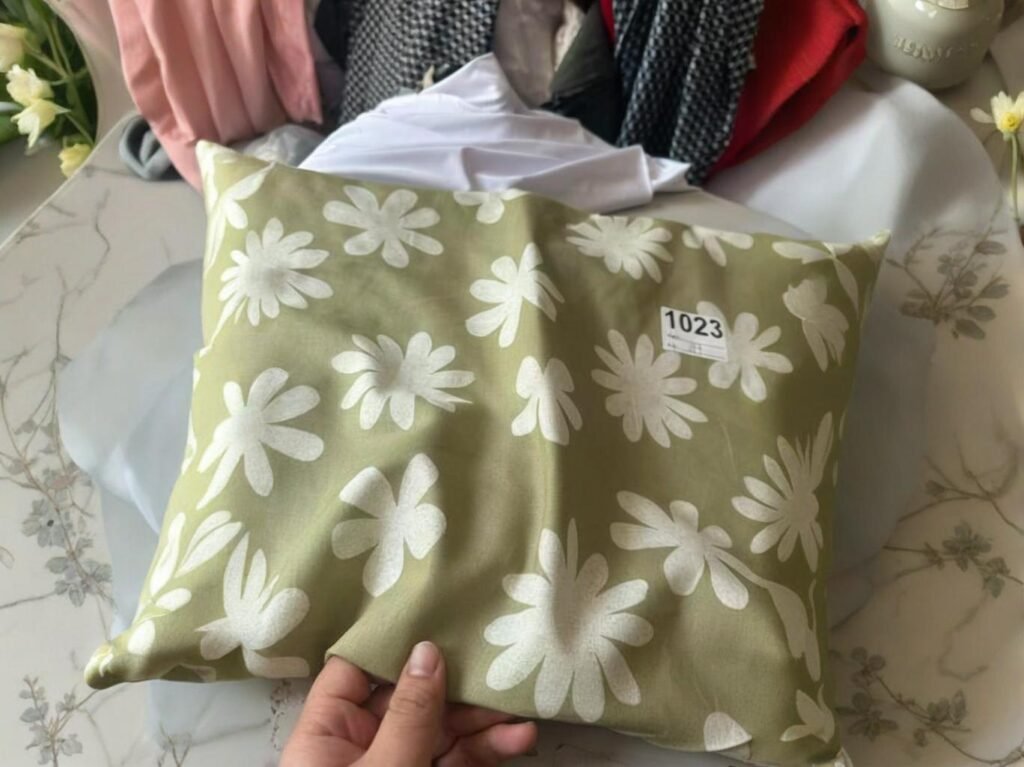
d. Case Example: A Canadian resort brand sourcing 100% Belgian linen for embroidered pillowcases was quoted a MOQ of 800 meters per design with a 6-week lead time. In contrast, switching to Chinese linen reduced MOQ to 300 meters but limited their embroidery yarn choices due to machine width constraints.
2. How Do Cotton Fabric MOQ Requirements Compare Globally?
Cotton fabrics usually offer lower MOQ thresholds than linen, with many suppliers starting at just 100–200 meters, especially for standard constructions like poplin or twill. This flexibility is due to cotton’s global availability, mechanized harvesting, and scale economies in weaving.
Cotton MOQ Structures Across Regions
a. Global Cotton Supply Chain Efficiency
- Cotton is widely grown in India, China, Pakistan, the U.S., and Turkey.
- It benefits from automated ginning and weaving processes, making it cost-effective for short runs.
b. MOQ by Supplier Region and Fabric Type
| Region | Standard MOQ | Fabric Examples | Custom Dye MOQ |
|---|---|---|---|
| India | 100–200 m | Cambric, voile, canvas | 300–500 m |
| Pakistan | 200–300 m | Twill, poplin, sheeting | 400–600 m |
| China | 100–300 m | Muslin, sateen, jacquard | 300–800 m |
| Turkey | 300–500 m | Organic jersey, denim | 600–1000 m |
c. Factors Lowering MOQ in Cotton Sourcing
- Use of pre-dyed yarns
- Access to greige fabric stock
- Digital printing adoption
- Shared dye lot pooling
d. Real Buyer Perspective: An eco-conscious apparel startup in Australia ordered 150 meters of GOTS-certified cotton jersey from India with a lead time of 18 days, while the same order in organic linen was only available in 400-meter minimums, extending the lead to 35 days.
3. How Does Fabric Weight (GSM) Affect MOQ in Linen and Cotton?
Fabric weight, measured in grams per square meter (GSM), plays a pivotal role in determining MOQ for both linen and cotton. Heavier fabrics typically require higher MOQ because they consume more raw fiber, involve more complex weaving setups, and result in longer machine runtime per order. Heavier linen or cotton fabrics (above 250 GSM) generally require higher MOQ, often 400–800 meters per design, compared to lightweight fabrics (below 150 GSM), which can be ordered starting at 100–300 meters.
How GSM Shapes MOQ Requirements
a. Cost & Raw Material Consumption by GSM Bracket
| Fabric Type | GSM Range | Typical MOQ | Usage Examples |
|---|---|---|---|
| Linen – Light | 100–160 | 150–300 m | Shirts, curtains, scarves |
| Linen – Midweight | 160–250 | 300–600 m | Tablecloths, dresses |
| Linen – Heavy | 250–400 | 400–800 m | Upholstery, jackets |
| Cotton – Light | 90–150 | 100–200 m | Blouses, sheets |
| Cotton – Midweight | 150–250 | 200–400 m | Pants, casualwear |
| Cotton – Heavy | 250–450 | 400–700 m | Jackets, aprons, canvas |
b. Loom Calibration and Weaving Speed Heavy fabrics require thicker warp and weft threads, slower loom speeds, and increased setup time — driving up production cost and MOQ. Mills prefer batching heavier GSM fabrics into longer runs to offset overhead.
c. Buyer Case Study: A French furniture brand ordered 550 GSM linen canvas for lounge chairs from a Lithuanian mill. The MOQ was set at 600 meters with a 45-day lead due to machine calibration time and dye bath minimums. However, a similar cotton canvas at 320 GSM had a 200-meter MOQ from Pakistan and a 20-day turnaround.
d. Strategic Tip: Consider GSM when designing your product line — choosing a midweight (180–220 GSM) range offers the best balance between durability, comfort, and sourcing flexibility for both cotton and linen.
4. What Role Does Fabric Customization Play in MOQ Negotiations?
Customization — such as color-matching, digital printing, weaving patterns, or adding finishes (anti-wrinkle, fire-retardant) — significantly raises MOQ due to the added cost of development and exclusive dye-lot setup. Custom-dyed or finished linen and cotton fabrics usually require a MOQ of 300–1000 meters per design or color, depending on the process complexity and mill capabilities.
MOQ Impacts by Customization Type
a. Color Matching & Dyeing MOQ Benchmarks
| Customization Type | MOQ for Linen | MOQ for Cotton | Lead Time Increase |
|---|---|---|---|
| Pantone color dyeing | 500–1000 m | 300–600 m | +10–20 days |
| Yarn-dyed stripes/checks | 800–1200 m | 600–1000 m | +15–30 days |
| Reactive printing | 600–800 m | 400–600 m | +12–18 days |
| Digital pigment printing | 100–200 m | 100–150 m | +5–10 days |
| Coatings (PU, anti-bac) | 400–800 m | 300–500 m | +15 days |
b. Mills’ Cost Recovery Model Customizations mean higher wastage risk and increased process steps — which suppliers offset through MOQ thresholds to maintain profit margins.
c. MOQ Flexibility with Digital Printing Digital pigment printing allows much lower MOQ (even 30–50 meters for test runs) but is often limited to cotton and lighter-weight linen due to ink absorption properties.
d. Customization Case Example: A Canadian fashion brand needed a custom-dyed dusty rose linen in 180 GSM. The Chinese supplier quoted a MOQ of 600 meters for dye-to-match, while digital pigment print on cotton poplin in a similar tone was available at just 100 meters per artwork.
e. Negotiation Advice:
- Request lab dips before committing to full batch
- Opt for digital if sampling or small runs
- Ask for shared dye baths when ordering stock shades
5. Which Countries Offer the Lowest MOQ for Linen and Cotton?
Minimum order quantities vary significantly based on production region. Countries with vertically integrated supply chains, lower labor costs, and robust textile ecosystems generally offer lower MOQs. However, low MOQ doesn’t always equal lower cost per unit or better service.
India, Pakistan, and China typically offer the lowest MOQ for both linen and cotton, often starting at 100–300 meters per design. European countries like Italy or Portugal tend to require higher MOQs due to premium production standards and certifications.
Global MOQ Benchmark by Country
a. MOQ Comparison Table
| Country | Linen MOQ (Avg) | Cotton MOQ (Avg) | Lead Time | Notable Strengths |
|---|---|---|---|---|
| China | 150–300 m | 100–200 m | 15–30 days | Large capacity, low MOQ, variety |
| India | 200–400 m | 150–300 m | 20–35 days | Organic cotton, block printing |
| Pakistan | 200–500 m | 100–300 m | 25–40 days | Low cost, dyed cotton poplin |
| Turkey | 300–600 m | 250–500 m | 20–25 days | Fast shipping to Europe |
| Italy | 600–1000 m | 400–800 m | 30–45 days | High-end finishing & design |
| Lithuania | 300–800 m | 250–500 m | 25–40 days | Sustainable linen, woven quality |
| Vietnam | 200–400 m | 150–250 m | 25–35 days | Balance of price & quality |
b. Real Supplier Trends
- Chinese suppliers often allow low MOQ but expect higher volume follow-ups.
- European suppliers focus on quality and compliance (GOTS, OEKO-TEX), rarely compromising on MOQ.
- Indian and Pakistani mills tend to negotiate on MOQ if long-term partnership is proposed.
c. Sourcing Strategy Tip For small to mid-volume orders or market testing, China and India remain top choices. For luxury-focused lines, invest in EU-based partners for elevated quality and certification compliance.
6. What Negotiation Strategies Can Lower MOQ Requirements?
MOQ isn’t always fixed — many suppliers are willing to reduce thresholds under certain conditions. Knowing what levers you can pull — like stock fabrics, combined orders, or longer lead times — helps unlock flexible deals even for smaller buyers. To reduce MOQ, buyers can leverage strategies such as choosing stock fabrics, bundling SKUs, accepting standard colors, or extending lead times. Clear communication and long-term intent also encourage supplier flexibility.
Proven MOQ Reduction Tactics
a. Table: Effective MOQ Reduction Methods
| Strategy | Impact on MOQ | Trade-Off |
|---|---|---|
| Use stock fabric | Drops MOQ by 50–70% | Limited color/style choices |
| Choose standard dye colors | Drops MOQ by 30–50% | Less brand uniqueness |
| Accept longer lead times | Drops MOQ by 20–40% | Slower delivery cycle |
| Group purchase across SKUs | Drops MOQ per SKU | Higher total volume commitment |
| Develop long-term sourcing plan | Drops MOQ gradually | Requires trust and forecasting |
| Order with other clients (shared) | Drops MOQ sharply | Possible IP and priority issues |
b. Case Example: Shared Dyeing Program A German eco-fashion label collaborated with another brand to co-order 180 GSM natural-dyed linen from a Chinese mill. By pooling, each secured just 200 meters MOQ, rather than 500 individually.
c. Long-Term Relationship Impact Repeat orders and consistent communication lead to more cooperative MOQ terms. Suppliers often reduce MOQ after 2–3 successful transactions with timely payments.
d. Pro Tips:
- Ask if your supplier maintains a ready-stock program.
- Consider white-labeled designs for test batches.
- Negotiate fabric MOQ separate from MOQ per garment if you’re also manufacturing.
7. Are MOQ Thresholds Different for Apparel vs Home Textiles?
Yes, MOQ thresholds often differ depending on the product category. Apparel generally involves more styles and color variations with lower fabric yardage per item, while home textiles—like sheets and tablecloths—require larger quantities per SKU due to fabric consumption, resulting in differing MOQ expectations. Apparel fabrics usually have lower MOQ due to smaller fabric usage per item and more varied styles, while home textile fabrics often require higher MOQ due to bulk cutting and fewer SKU variations.
MOQ Differences by End Use
a. Table: MOQ Expectations by Product Category
| Product Type | Typical MOQ – Linen | Typical MOQ – Cotton | Notes |
|---|---|---|---|
| Shirts & Dresses | 100–300 meters | 100–200 meters | High style variation, lower yardage |
| Trousers & Jackets | 200–500 meters | 200–400 meters | Heavier fabric use, higher yield |
| Table Linens | 500–1000 meters | 400–800 meters | Larger cuts per unit |
| Bedding Sets | 600–1200 meters | 500–1000 meters | Consistency needed in dye lot and feel |
| Upholstery Fabric | 300–800 meters | 300–600 meters | Often thicker GSM, sold by roll |
b. Why Home Textiles Require Higher MOQ
- Larger cuts per item (e.g., queen sheet = 6–8 meters)
- Fewer SKUs but more yardage needed
- Tighter QC demands on shade continuity
- Often tied to contract manufacturing for hotels or homeware brands
c. Apparel-Specific Considerations
- Sampling-first approach makes lower MOQ more common
- Multi-color capsule collections spread fabric types thinly
- Pre-shrunk linen or enzyme-washed cotton often used in 100–200m test batches
d. Strategic Advice If you’re ordering for fashion launches, request flexible MOQ terms by grouping styles or opting for undyed greige fabric. For home collections, forecast demand accurately to avoid stockouts—since reorders typically require meeting the original MOQ again.
8. What’s the Best Way to Evaluate MOQ When Choosing a Supplier?
MOQ should never be evaluated in isolation. The smartest buyers assess it alongside price per unit, shipping cost, flexibility, and production reliability. A supplier offering a low MOQ but with long delays or inconsistent quality may not be the best choice. To evaluate MOQ effectively, weigh it against unit cost, lead time, quality consistency, and future scalability. A holistic sourcing matrix will help balance short-term needs with long-term growth.
Evaluating MOQ in a Broader Framework
a. Key Considerations Checklist
| Evaluation Metric | Why It Matters |
|---|---|
| MOQ | Affects cash flow and sampling |
| Unit Cost | Lower MOQ may increase cost per meter |
| Lead Time | Longer timelines may offset low MOQ |
| Fabric Consistency | Re-dye risks increase with low MOQ |
| Supplier Communication | Impacts flexibility and transparency |
| Scalability | Can supplier scale when you grow? |
b. Use a Weighted Scorecard
Create a sourcing matrix to rank potential suppliers. Example below:
| Criteria | Weight | Supplier A | Supplier B | Supplier C |
|---|---|---|---|---|
| MOQ Flexibility | 30% | 8 | 6 | 9 |
| Unit Cost | 20% | 7 | 9 | 6 |
| Lead Time | 15% | 6 | 7 | 8 |
| Communication | 15% | 9 | 6 | 8 |
| Quality Assurance | 20% | 8 | 7 | 9 |
| Total | — | 7.55 | 6.85 | 8.05 |
c. Ask the Right Questions
- Can MOQ be lowered for repeat orders?
- Are there price breaks at higher MOQ tiers?
- Is there a stock fabric catalog that bypasses MOQ entirely?
d. Smart Final Tip Always get samples before confirming bulk orders, even at low MOQ. Confirm shrinkage rates, GSM tolerance, and visual uniformity.
Custom MOQ Sourcing With Confidence
Choosing between linen and cotton—and understanding the MOQ landscape—requires a blend of strategy, data, and supplier collaboration. From the softness of 120 GSM cotton voile to the structure of heavyweight 350 GSM linen, different projects require different approaches.
Whether you’re launching a limited edition apparel line or outfitting 50 hotel rooms, having a trusted supplier who understands both MOQ flexibility and quality assurance is key.
Looking for low MOQ, fast sampling, and custom-designed linen or cotton fabrics?SzoneierFabrics offers premium support for your next project—whether it’s 100 meters or 10,000. Contact us today to get started on your custom sourcing journey.
linen vs cotton MOQ, linen fabric minimum order, cotton fabric minimum order, bulk linen fabric supplier, bulk cotton fabric supplier, MOQ for fabric orders, fabric MOQ analysis, linen MOQ for garments, cotton MOQ for apparel, low MOQ fabric manufacturers, fabric supplier for hotels, cotton vs linen for upholstery, apparel fabric MOQ comparison, sustainable linen suppliers, MOQ for textile sourcing, how to choose fabric MOQ, bulk textile pricing guide, minimum order fabric quantity, cotton linen blend MOQ, fabric sourcing for designers, hospitality fabric suppliers, GSM and fabric MOQ, fabric types and MOQ, linen cotton fabric wholesalers, linen vs cotton wholesale, fabric production minimums, cotton fabric for bulk purchase, linen for hotel textiles, MOQ for home textiles, custom MOQ fabric orders
Can't find the answers?
No worries, please contact us and we will answer all the questions you have during the whole process of bag customization.
Make A Sample First?
If you have your own artwork, logo design files, or just an idea,please provide details about your project requirements, including preferred fabric, color, and customization options,we’re excited to assist you in bringing your bespoke bag designs to life through our sample production process.