Skip to content

Most people think stretch denim is just “cotton with a bit of stretch added.” Comfort denim is often assumed to be the same thing—just softer. In real fabric development, neither of those assumptions holds up.
What denim is made of today is no longer a single answer. Stretch and comfort denim lines are built through carefully balanced fiber systems, where cotton, elastic fibers, and sometimes synthetics each play a very specific role. Change one ingredient slightly, and the fabric behaves differently after washing, wearing, and months of use. Modern stretch and comfort denim fabrics are primarily made of cotton blended with controlled amounts of elastane or other fibers such as polyester, modal, or TENCEL™, combined through engineered yarn structures. The exact composition determines how much the denim stretches, how well it recovers, how soft it feels, and how it performs over time.
A denim developer once said, “Stretch is easy to add. Comfort is harder. Keeping both after six months—that’s the real test.” Understanding fabric composition is where that test begins.
What Is Denim Fabric Made Of in Modern Stretch and Comfort Denim?

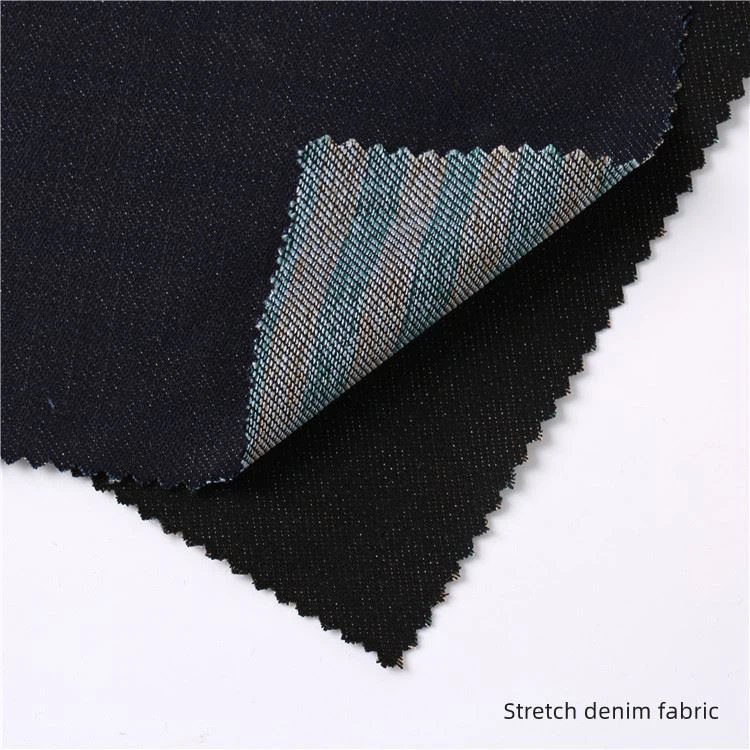
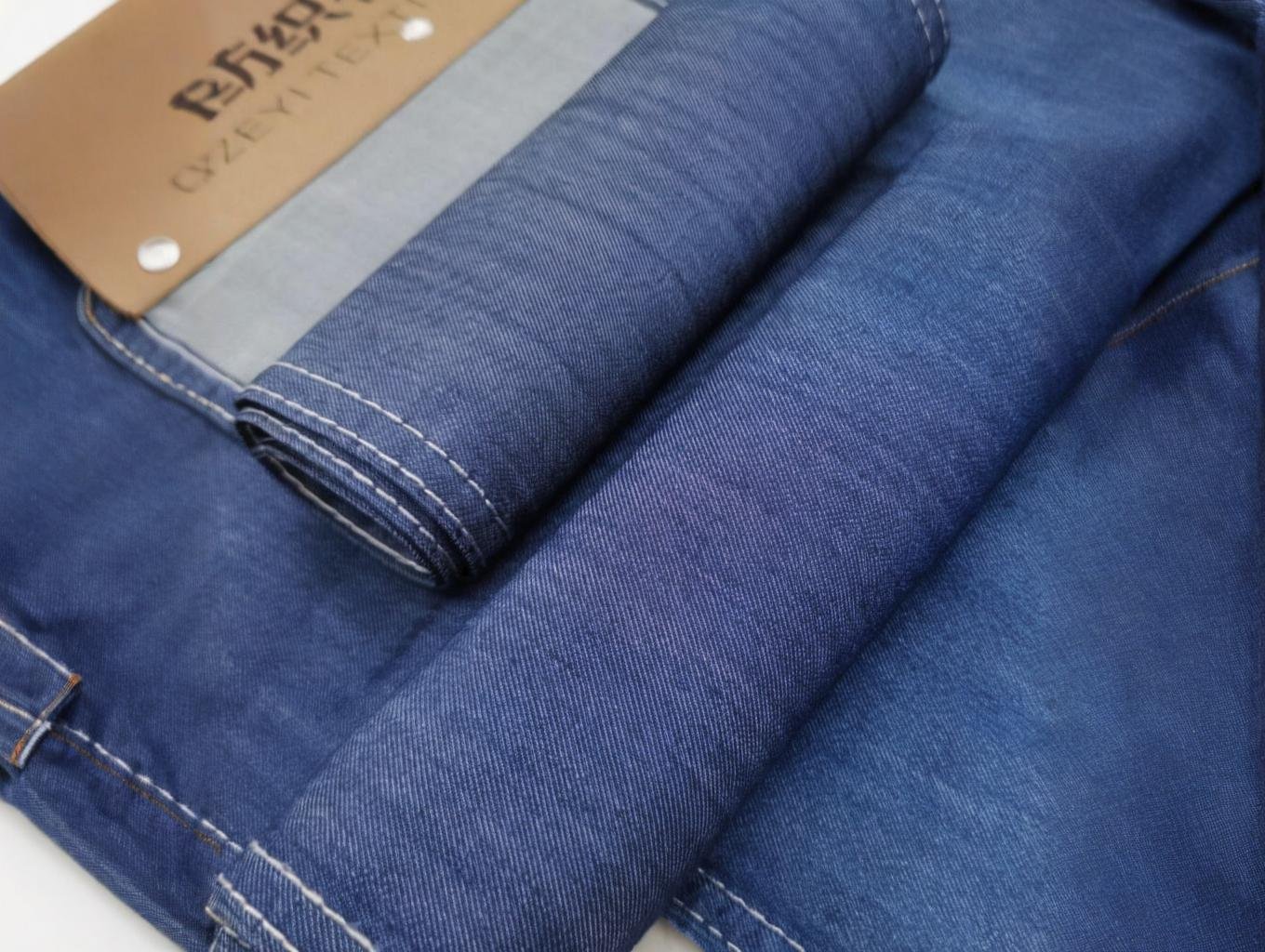
Modern denim has evolved far beyond the rigid, 100 % cotton canvas that defined blue jeans for more than a century. Today’s stretch and comfort denim fabrics are carefully engineered blends that balance comfort, shape retention, durability, and aesthetic character in ways that pure cotton alone cannot deliver. The textures, mechanical behaviors, and end-use performance you experience in a pair of contemporary stretch denim jeans are largely dictated by how cotton works alongside small percentages of elastane and other performance-enhancing fibers.
Understanding the Base Fiber: Cotton as the Backbone
At its core, denim remains a cotton-based textile, using cotton yarns woven in a diagonal twill structure that gives denim its characteristic strength and surface appearance. The reason cotton persists as the dominant base fiber is simple: its natural breathability, inherent strength, and excellent affinity for indigo dye allow for the familiar look and long wear life that consumers expect from denim garments. High-quality cotton retains moisture without feeling clammy, resists abrasion better than many synthetics in woven contexts, and forms soft, personalized creases over time.
| Cotton Trait | Practical Contribution to Denim |
|---|---|
| Breathability | Keeps wearer cool and comfortable during extended wear |
| Strength & Abrasion Resistance | Maintains shape and resists surface wear from friction |
| Dye Affinity | Holds indigo deeply and creates dynamic fading characteristics |
Cotton content in modern denim generally ranges from the mid-90 % level up to pure cotton in specialty, heritage styles. Increasing cotton content enhances traditional denim characteristics but also introduces limitations in flexibility and recovery without added stretch fibers.
Elastic Fibers: The Key to Stretch and Shape Retention
The shift toward stretch denim began as demand grew for silhouettes that move with the body while still delivering the classic denim look. Elastane (often branded as Spandex or Lycra®) is the most common elastic fiber added to denim, typically in amounts between 1 % and 3 % of the total fabric weight. Although this seems like a small percentage, even 1 – 2 % elastane dramatically alters how the fabric performs under strain—enabling fabrics to stretch with movement and then recover toward their original shape.
| Elastic Fiber | Functional Role in Denim |
|---|---|
| Elastane / Spandex | Provides controlled stretch and recovery, improves comfort |
| Lycra® (branded elastane) | Ensures uniform elasticity and controlled performance |
Proper placement of elastane—usually wrapped within core yarns or integrated evenly throughout warp and weft—matters more to stretch behavior than the absolute percentage. Even a well-engineered 1 % elastane blend can outperform a poorly distributed 3 % blend in comfort and recovery.
Performance Enhancers and Comfort Fibers
Beyond cotton and elastane, designers sometimes introduce additional fibers to tailor hand feel and mechanical properties:
| Fiber Added | Functional Contribution |
|---|---|
| Polyester | Shapes fabric stability and wrinkle resistance |
| Modal | Improves softness and drape with a smoother surface |
| TENCEL™ (Lyocell) | Enhances moisture management and a refined hand feel |
Fibers like polyester can improve shape stability and wrinkle recovery, addressing performance limitations intrinsic to high-cotton fabrics. Modal and TENCEL™ (a lyocell fiber derived from sustainably sourced wood pulp) contribute softer hand feel and improved moisture wicking, making denim feel more comfortable against the skin. The inclusion of these fibers must be calibrated carefully: too much polyester can compromise breathability, and excessive cellulosics can affect long-term durability.
Typical Modern Stretch Denim Composition
Modern comfort and stretch denim fabrics are engineered across a spectrum of compositions that reflect their intended use cases:
| Denim Type | Typical Composition Range |
|---|---|
| Comfort Stretch | ~97 – 99 % cotton, ~1 – 3 % elastane |
| Stretch Denim (Performance) | ~92 – 98 % cotton, ~1 – 3 % elastane, optional polyester/modal |
| Tailored Comfort / Premium | Cotton + elastane + 5 – 15 % performance fibers (e.g., TENCEL™, polyester) |
Individual brands and mills may adjust these ratios based on desired performance parameters like stretch recovery, tensility, shrinkage tolerance, and wearer feel. No two “comfort denims” are identical, even if they share similar percentages on paper—yarn construction and finishing processes significantly shape final behavior.
How Composition Influences Denim Behavior in Wear
Analysing denim performance requires connecting fiber makeup with wearer experience:
- High cotton content maintains the classic denim look and breathability, but without elastic fibers can restrict movement and slow shape recovery.
- Adding elastane introduces flexibility that is most noticeable in high-movement areas like knees and hips, enabling slimmer and body-contour silhouettes without the “stiff” feel of traditional denim.
- Incorporating polyester or cellulosics supplements durability and softness respectively, but also alters dye affinity and surface feel.
This layered approach to fabric design makes it possible to tune denim for a wide range of products—from rugged workwear and heavy jeans to premium stretch styles that feel closer to activewear in performance.
Testing and Tolerances in Denim Development
In professional textile development, fabric composition does not stand alone. Textile engineers evaluate denim against key metrics such as:
- Stretch and recovery percentage
- Shrinkage after wash
- Tensile strength in warp and weft
- Spirality (fabric distortion over time)
These tests guide adjustments to fiber ratios and yarn engineering so that the finished denim meets both target performance profiles and customer expectations. For example, a fashion brand targeting activewear-like comfort might tolerate higher elastane content and tighter recovery specifications, while a heritage denim brand might prioritize cotton content and natural character.
Adaptation to market demands has transformed stretch denim into a highly specialized fabric category, one where chemistry, yarn engineering, and finishing treatments collaborate to serve both aesthetic and functional goals in ways pure cotton denim could not achieve alone.
Which Fibers Are Commonly Used in Stretch Denim Fabrics?
Stretch denim is often described as “cotton with a bit of stretch,” but in reality it is a multi-fiber engineering system where each fiber plays a specific mechanical role. Comfort, recovery, durability, and long-term appearance are not achieved by elastane alone. They are the result of how cotton, elastic fibers, and stabilizing synthetics work together at yarn and fabric level.
In modern denim development, fiber selection is less about chasing maximum stretch and more about controlling movement over time. A fabric that stretches easily but fails to recover after weeks of wear quickly loses commercial value. This is why most successful stretch denim fabrics rely on carefully balanced fiber combinations rather than a single “hero” fiber.
Fiber Roles Inside Stretch Denim
Understanding stretch denim starts with understanding why each fiber is there, not just what percentage it occupies on a spec sheet.
Cotton: still the majority fiber
Cotton remains the dominant fiber in stretch denim, typically accounting for 85–99% of total composition depending on performance goals. Its role is not stretch, but structure, dye behavior, and wearer comfort.
| Cotton Type | Impact |
|---|---|
| Long-staple cotton | Higher tensile strength, better abrasion resistance |
| Combed cotton | Smoother surface, reduced pilling |
| Carded cotton | Lower cost, coarser hand feel |
Long-staple cotton varieties contribute significantly to denim longevity, especially in stretch fabrics where yarns are under repeated mechanical stress. Shorter fibers tend to migrate and break more quickly when combined with elastane, accelerating surface wear and fuzzing.
Combed cotton is commonly used in premium stretch denim lines because removing short fibers improves yarn uniformity. This directly affects how elastane behaves inside the yarn: smoother cotton sheaths reduce friction and delay elastic fatigue.
Carded cotton still appears in entry-level stretch denim, but mills often compensate with higher yarn counts or added polyester to offset durability limitations.
Elastane / spandex fibers
Elastane (also known as spandex) is the primary source of stretch, yet it typically represents only 0.5–3% of the total fabric weight. Its influence is disproportionate to its quantity.
| Characteristic | Effect |
|---|---|
| High elasticity | Enables multi-directional stretch |
| Low percentage use | Preserves traditional denim appearance |
| Fatigue sensitivity | Loses recovery if overstressed |
Elastane can stretch up to five to seven times its original length, but it is also fatigue-sensitive. Repeated stress without support causes gradual loss of recovery, leading to bagging at knees, hips, and seat areas.
For this reason, elastane is rarely used as a standalone component in high-performance stretch denim. How it is wrapped, covered, or supported inside the yarn is often more important than the percentage used. A well-engineered 1% elastane fabric can outperform a poorly constructed 3% elastane fabric in real wear conditions.
Polyester as a stabilizer
Polyester plays a quiet but critical role in modern stretch denim: stability. While it contributes little to stretch itself, it helps manage elastane behavior over time.
| Role | Benefit |
|---|---|
| Strength | Improves yarn durability |
| Recovery support | Reduces permanent deformation |
| Dimensional control | Limits wash shrinkage |
Polyester is frequently introduced through dual-core or multi-core yarn constructions, where elastane provides stretch and polyester provides recovery control. In these systems, polyester acts as a “memory framework,” helping the fabric return closer to its original shape after stress.
In long-term wear testing, stretch denim fabrics that include even 5–10% polyester typically show significantly lower growth and bagging than cotton-elastane-only constructions. This difference becomes especially visible after repeated laundering.
Importantly, modern polyester used in denim is often engineered with low sheen and fine denier to avoid compromising the natural look of cotton denim.
How Dual-Core Yarns Change Fiber Behavior
One of the most important developments in stretch denim over the past decade has been the adoption of dual-core yarn technology. Instead of a single elastic core, these yarns combine elastane and polyester inside a cotton sheath.
The result is a fabric that:
- Stretches smoothly under movement
- Recovers more consistently after wear
- Maintains silhouette through multiple wash cycles
In practical terms, dual-core yarns reduce the risk of customer complaints related to sagging, misshaping, and inconsistent fit across sizes. This is why many mid- to high-end denim brands now specify yarn construction type alongside fiber percentages in their fabric briefs.
Emerging fiber combinations
As comfort expectations rise and sustainability pressures increase, stretch denim is incorporating a broader range of fibers beyond traditional cotton, elastane, and polyester.
| Fiber | Reason for Use |
|---|---|
| Recycled polyester | Lower environmental footprint |
| Bio-based elastane | Reduced fossil resource use |
| Lyocell blends | Cooling effect and moisture management |
Recycled polyester is increasingly used as a drop-in replacement for virgin polyester in stabilizing roles. When properly processed, it delivers comparable mechanical performance while supporting brand sustainability commitments.
Bio-based elastane remains a small but growing segment. While performance is similar to conventional elastane, cost and supply stability still limit widespread adoption.
Lyocell fibers, including branded variants, are used primarily to enhance thermal comfort and softness. Their smooth surface reduces skin friction, making stretch denim feel lighter and cooler, particularly in warm-climate markets.
Fiber Balance and Real Wear Performance
In real-world use, the success of stretch denim depends on how fibers behave after months of wear, not just during initial fitting. Fabrics built only from cotton and elastane often show strong stretch initially but suffer from gradual recovery loss.
Brands that add a small percentage of polyester—sometimes as little as 4–6%—consistently achieve better long-term fit stability. This improvement is not always visible on day one, but it becomes obvious after repeated sitting, walking, and washing.
From a manufacturing perspective, fiber balance also affects:
- Cutting stability during garment production
- Sewing seam integrity
- Washing yield and rejection rates
These downstream impacts explain why mills increasingly treat fiber selection as a risk-management decision, not just a design choice.
Testing Standards That Guide Fiber Selection
Professional stretch denim development relies on standardized testing to validate fiber combinations. Key performance indicators typically include:
- Fabric growth under load
- Recovery percentage after rest
- Residual deformation after washing
- Tensile strength in warp and weft
Fabrics that meet stretch targets but fail recovery benchmarks are often rejected before bulk production. This disciplined testing approach ensures that fiber systems deliver consistent performance beyond showroom conditions.
Real-World Insight
Brands that rely solely on cotton and elastane frequently encounter faster loss of recovery, especially in slim or high-movement fits. Introducing polyester as a supporting fiber—often through dual-core yarns—dramatically improves long-term shape retention without sacrificing comfort or visual authenticity.
In modern stretch denim, stretch is no longer a single-fiber feature. It is the outcome of deliberate fiber collaboration, where each component compensates for the limitations of the others. This systems-based approach is what separates short-lived comfort denim from fabrics that perform reliably throughout a garment’s lifespan.
How Do Elastane, Spandex, and Lycra® Work Inside Denim Fabric?
Elastane, spandex, and Lycra® are often spoken about as if they are interchangeable magic ingredients that simply “add stretch” to denim. In reality, their role inside denim is far more controlled and far less visible than most people assume. Stretch denim does not behave like a rubber band. It behaves like a mechanically managed system, where elastic fibers are deliberately hidden inside stronger fibers that limit, guide, and recover movement.
Modern stretch denim works because elastane is not allowed to act freely. Instead, it is constrained within yarn structures that balance flexibility with resistance. This is why two denim fabrics with the same elastane percentage can feel and perform completely differently once worn, washed, and lived in.
What Actually Happens Inside Stretch Denim Yarns
To understand how elastane functions in denim, it helps to stop thinking in terms of fabric surfaces and start thinking in terms of yarn architecture. Elastane rarely touches the skin directly. It lives at the core of the yarn, where it is protected, stretched, and restrained by other fibers.
Elastane vs spandex vs Lycra®
These three terms cause endless confusion, especially outside the textile industry.
| Term | What It Means |
|---|---|
| Elastane | Generic fiber name |
| Spandex | Common US industry term |
| Lycra® | Branded elastane with controlled specifications |
From a chemical standpoint, all three refer to the same class of polyurethane-based elastic fibers. Functionally, they stretch and recover in the same way. The real difference lies in manufacturing consistency, filament uniformity, and quality control, not in basic fiber chemistry.
In denim production, branded elastane such as Lycra® is often specified not because it stretches more, but because its elongation limits, recovery curves, and fatigue behavior are more predictable across large production runs. For brands managing thousands of garments per style, that consistency matters.
How Elastane Is Built Into Denim Yarns
Contrary to popular belief, most stretch denim does not contain visible or exposed elastane. The elastic fiber is almost always embedded within the yarn.
| Yarn Structure | Description |
|---|---|
| Core-spun yarn | Elastane filament at the center, wrapped with cotton |
| Dual-core yarn | Elastane + polyester core, cotton outer wrap |
| Covered yarn | Elastane wrapped with another filament |
Core-spun yarns were the first major step in stretch denim evolution. In this structure, elastane forms the core, while cotton fibers wrap around it. The cotton defines the surface look and dye behavior, while elastane provides controlled extensibility.
Dual-core yarns represent a more advanced system. By adding polyester alongside elastane in the core, mills introduce a stabilizing element that limits permanent deformation. Polyester does not stretch much, but it helps pull the fabric back into shape after stress.
Covered yarns are less common in classic denim because they can affect texture and dye uniformity, but they still appear in specialized comfort fabrics.
Why Dual-Core Yarns Changed Stretch Denim
Dual-core yarns became widely adopted because they solve a problem that pure elastane systems cannot: elastic fatigue. Elastane stretches easily, but repeated cycles of stress gradually reduce its recovery power.
By pairing elastane with polyester in the yarn core, denim fabrics gain:
- Better long-term shape retention
- Reduced knee and seat bagging
- More stable fit after washing
In wear testing, dual-core denim consistently shows lower residual growth compared to single-core constructions, even when elastane percentages are identical. This is why many modern comfort denim programs specify yarn structure explicitly, not just fiber composition.
Stretch Direction Matters More Than Stretch Amount
Stretch denim performance is strongly influenced by where stretch is allowed, not just how much stretch exists.
| Stretch Direction | Result |
|---|---|
| Weft stretch | Comfort during sitting and bending |
| Warp stretch | Vertical mobility and body contouring |
| Bi-stretch | Maximum movement, higher deformation risk |
Traditional stretch denim almost always limits elastane to the weft direction. This allows horizontal movement while preserving the vertical rigidity that gives denim its iconic drape and durability.
Warp stretch denim, where elastane is introduced vertically, offers greater freedom of movement but also increases risks related to garment growth and pattern distortion. Bi-stretch denim maximizes comfort but requires extremely tight engineering controls to avoid rapid shape loss.
For many brands, weft stretch remains the safest balance between comfort and structural integrity.
Why Elastane Needs Support
Elastane’s greatest strength—extreme elasticity—is also its weakness. Without support, it fatigues quickly.
| Without Support | With Support |
|---|---|
| Faster shape loss | Improved recovery |
| Knee bagging | Stable silhouette |
| Short wear life | Extended garment lifespan |
Support typically comes from two sources: high-quality cotton and synthetic stabilizers such as polyester. Long-staple cotton reduces internal friction around the elastane core, slowing fiber breakdown. Polyester adds tensile resistance that counteracts permanent elongation.
This support system is why elastane percentages alone are misleading. A denim with 1% elastane and proper support can outperform a 3% elastane fabric that lacks structural balance.
How Stretch Feels vs How It Performs
One of the biggest disconnects in stretch denim development is the difference between fitting room comfort and real-life wear performance. Fabrics with high initial stretch often feel impressive when first tried on, but they may lose shape after hours of wear.
Professional denim development evaluates:
- Immediate elongation
- Recovery after rest
- Residual growth after extended wear
- Dimensional change after laundering
Fabrics that score well only on initial stretch but poorly on recovery are typically rejected during development, even if they feel comfortable at first touch.
Manufacturing Implications of Elastane Use
Embedding elastane into denim affects more than just wear comfort. It also influences:
- Cutting accuracy during garment production
- Sewing seam stability
- Washing yield and defect rates
Uncontrolled elastane behavior can cause skewing, twisting, and inconsistent sizing across production batches. This is why mills and garment factories treat elastane management as a process discipline, not a styling choice.
Production Insight
At SzoneierFabrics, elastane-based denim is evaluated against growth after extended wear, not just laboratory stretch and recovery figures. Fabrics that look excellent in initial testing but show excessive deformation after simulated wear cycles are revised or rejected.
This approach avoids the common scenario where garments fit perfectly in the fitting room but lose shape in daily use. In modern denim, real comfort is not defined by how much a fabric stretches, but by how well it returns to where it started.
Elastane, spandex, and Lycra® do not work alone inside denim. They succeed only when their power is restrained, supported, and guided by the surrounding fibers. That controlled collaboration is what transforms elastic potential into reliable, wearable stretch denim.
What Is the Difference in Fabric Composition Between Comfort Denim and Stretch Denim?
Comfort denim and stretch denim are often grouped together in product descriptions, but from a fabric engineering perspective, they are designed to solve different wear problems. The confusion usually begins when elastane is treated as the universal solution to comfort. In reality, comfort and stretch are not the same objective, and the way fibers are combined reflects that difference.
Comfort denim prioritizes ease of wear over long hours, temperature balance, and a natural hand feel. Stretch denim prioritizes mobility, body conformity, and silhouette control. When a fabric is engineered for one purpose but used for the other, dissatisfaction is almost guaranteed—either the garment feels restrictive, or it loses shape too quickly.
Comfort Denim vs Stretch Denim, Fiber by Fiber
The most visible difference between the two categories is elastane percentage, but the deeper difference lies in how much control the fabric applies to that elastane and what other fibers are asked to do.
Typical composition comparison
| Fabric Type | Common Composition |
|---|---|
| Comfort denim | 97–99% cotton, 1–2% elastane |
| Stretch denim | 92–97% cotton, 2–3% elastane |
| Comfort-performance | Cotton + elastane + polyester or modal |
Comfort denim keeps elastane at the lower end of the usable range. At 1–2%, elastane provides subtle flexibility without dominating fabric behavior. The cotton remains the primary driver of hand feel, breathability, and aging characteristics.
Stretch denim pushes elastane higher and often relies on engineered yarn systems—such as dual-core constructions—to manage increased elasticity. The fabric is designed to respond actively to movement rather than simply accommodate it.
How Composition Affects Wear Experience
Wear experience is where these two fabrics diverge most clearly. On paper, the difference between 1% and 3% elastane may look minor. On the body, it is not.
| Attribute | Comfort Denim | Stretch Denim |
|---|---|---|
| Initial softness | High | Medium |
| Stretch range | Moderate | High |
| Recovery behavior | Medium | High if engineered |
| Heat retention | Lower | Higher |
Comfort denim feels immediately familiar. The fabric bends easily but resists excessive extension. This makes it ideal for long periods of sitting, standing, and walking without creating pressure points or tension fatigue.
Stretch denim feels more dynamic. It responds strongly to movement, allowing tighter fits and more aggressive silhouettes. However, that responsiveness also increases heat retention and mechanical stress, particularly in warm climates or extended wear situations.
The Role of Cotton Quality in Comfort Denim
One of the most overlooked factors in comfort denim is cotton selection. Comfort is often improved more effectively by upgrading cotton quality than by increasing elastane content.
Long-staple and combed cottons reduce surface friction, improve airflow, and create a smoother yarn surface. This directly affects perceived softness and reduces irritation during extended wear. In many cases, replacing carded cotton with combed cotton has a greater comfort impact than adding an extra 0.5% elastane.
This is why comfort denim often feels better over time. As the fabric relaxes with wear, cotton fibers soften and adapt without losing structural integrity.
Stretch Denim and Controlled Elasticity
Stretch denim accepts higher elastane content, but only when paired with control mechanisms. Without those controls, higher stretch quickly becomes a liability.
In stretch denim, elastane is usually:
- Embedded in the weft direction
- Supported by polyester or high-strength cotton
- Tested for growth and recovery, not just elongation
The goal is not maximum stretch, but repeatable stretch. A well-engineered stretch denim may only stretch slightly more than comfort denim, but it will do so consistently across thousands of wear cycles.
Shrinkage and Stability Differences
Shrinkage behavior reveals another key difference between comfort and stretch denim.
| Behavior | Comfort Denim | Stretch Denim |
|---|---|---|
| Wash shrinkage | Low to medium | Low |
| Shape change over time | Gradual | Controlled |
| Recovery fatigue risk | Lower | Higher if overstretched |
Comfort denim typically shrinks slightly more during initial washes because of higher cotton dominance. However, that shrinkage tends to stabilize quickly.
Stretch denim often shows lower wash shrinkage due to synthetic fiber support, but it is more sensitive to mechanical fatigue. Overstretching during wear or washing can permanently alter dimensions if recovery is not properly engineered.
Design Intent Matters More Than Labels
The most common mistake brands make is selecting stretch denim when they actually need comfort denim—or vice versa.
Comfort denim works best for:
- Straight, relaxed, and classic fits
- Everyday garments worn for long hours
- Office, travel, and lifestyle use
- Customers sensitive to heat and pressure
Stretch denim works best for:
- Slim, skinny, and fitted silhouettes
- Movement-intensive garments
- Fashion-driven styles requiring shape control
- Body-contouring designs
Problems arise when stretch denim is used to “fix” discomfort caused by poor pattern design or low-quality cotton. Extra elastane may mask the issue initially, but long-term wear often reveals shape instability.
Thermal Comfort and Breathability
Another underappreciated difference is thermal behavior. Higher elastane and polyester content reduces air permeability. This is rarely noticeable in short fittings but becomes obvious during full-day wear.
Comfort denim, with its higher cotton ratio, dissipates heat more effectively. This makes it better suited for warmer climates and transitional seasons. Stretch denim tends to trap more heat, which can be uncomfortable without careful garment ventilation or lighter fabric weights.
Cost and Production Considerations
From a manufacturing perspective, comfort denim is generally:
- Easier to cut and sew
- More forgiving in washing
- Lower risk in size consistency
Stretch denim requires:
- Tighter cutting tolerances
- Controlled sewing tension
- More precise washing and finishing
These production differences affect yield, defect rates, and overall cost. Stretch denim is not inherently better—it is simply more process-sensitive.
Development Lesson
Many brands attempt to solve comfort complaints by increasing elastane content. In practice, this often introduces new problems: bagging, recovery loss, and inconsistent sizing.
In many cases, the better solution is:
- Higher-quality cotton
- Improved yarn structure
- Optimized fabric weight
- Better pattern engineering
Elastane should enhance a well-built system, not compensate for weaknesses elsewhere.
Comfort denim and stretch denim are both valuable tools, but they are not interchangeable. When fiber composition aligns with design intent, the fabric disappears into the wearer’s daily life. When it does not, discomfort and dissatisfaction quickly follow.
How Do Cotton Quality and Yarn Structure Affect Stretch and Comfort?
When people talk about stretch denim or comfort denim, they often focus on elastane percentages as if stretch begins and ends with rubbery fibers. In reality, stretch and long-term comfort begin with the cotton that surrounds those fibers and the way yarns are engineered at the microscopic level. Fiber quality and yarn structure are what determine how denim feels on the body, how it performs under repeated stress, and how well it recovers after washing.
Cotton and Yarn Choices That Change Everything
Every denim fabric starts as yarn bundles woven together. What those yarns are made of, and how they are constructed, influences nearly every performance characteristic of the finished fabric.
Cotton Fiber Length and Maturity
Not all cotton is created equal. The length and maturity of cotton fibers significantly affects how yarns behave during spinning, dyeing, and wear.
| Cotton Quality | Impact on Denim |
|---|---|
| Long-staple cotton | Smoother hand, stronger yarn, better abrasion resistance |
| Medium-staple cotton | Balanced performance, moderate sizing control |
| Short-staple cotton | Surface fuzz, faster fiber breakage, and early wear |
Long-staple cotton (such as Egyptian or Pima cotton) creates yarns that are inherently stronger and smoother. The reduction in short fibers decreases internal friction during stretch and recovery cycles, which directly improves comfort and extends the life of elastane embedded in the yarn. Fabrics spun from long-staple cotton also tend to exhibit more desirable aging characteristics, with controlled fading and fewer loose fibers on the surface.
Short-staple cotton, by contrast, contributes to rougher surfaces and increases the likelihood of fuzzing and pilling as garments age. In stretch denim, this leads to earlier complaints about rough feel and visual wear, even when elastane content is within typical industry ranges.
Combed vs Carded Cotton Yarns
How cotton is processed before spinning has a dramatic effect on yarn integrity.
| Yarn Type | Comfort | Durability |
|---|---|---|
| Combed cotton | Higher | Higher |
| Carded cotton | Lower | Lower |
Combed cotton undergoes an extra process that removes short fibers and aligns the longer fibers more uniformly. This results in yarns that are smoother, stronger, and more consistent. The absence of short fibers also reduces hairiness, which in turn minimizes mechanical friction against elastane filaments during repeated stretch cycles.
Carded cotton contains more short fibers and shows more surface fuzz. While carded yarns are less expensive, they are also less stable and more prone to wear—a trade-off that is often visible in entry-level comfort denim.
Yarn Twist Level
Yarn twist refers to how tightly the fibers are spun together. Twist level directly influences both comfort and stretch behavior.
| Twist Level | Effect on Comfort | Effect on Stretch |
|---|---|---|
| Low twist | Softer hand feel | Higher apparent stretch |
| Medium twist | Balanced feel and performance | Controlled elongation |
| High twist | Firmer fabric | Lower stretch potential |
Low-twist yarns feel soft against the skin and often appear to stretch more easily, but they lack the structural integrity needed for controlled recovery. High-twist yarns, on the other hand, produce firm, high-strength denims with lower apparent stretch.
Medium twist levels are often chosen for balanced performance: sufficient softness without sacrificing tensile strength and dimensional stability. In stretch denim, the optimal twist must be calibrated with elastane placement to avoid overstressing the elastic core.
Yarn Structure Around Elastane
The way yarns are constructed around elastane filaments profoundly affects both comfort and recovery.
| Structure | Result |
|---|---|
| Loose wrap | Softer, less control |
| Tight wrap | Firmer, more control |
| Dual-core wrap | Balanced comfort and recovery |
Loose wrap yarns allow more freedom for elastane to extend, yielding high comfort and initial softness, but they also permit greater elongation that is unrecoverable over time. This often results in garments that feel comfortable initially but lose shape quickly.
Tight wrap yarns constrain elastane more effectively, reducing uncontrolled stretch and improving recovery, but this can make the fabric feel stiffer.
Dual-core wraps, in which elastane and a stabilizing fiber such as polyester are integrated in the core before being wrapped with cotton, strike the optimal balance. The cotton sheath provides softness and aesthetic integrity, elastane provides stretch, and the stabilizing fiber supports recovery and reduces permanent set.
Why Yarn Quality Shapes Long-Term Performance
Stretch doesn’t begin with elastane alone. It begins with how elastane interacts with surrounding yarn structure, and that interaction is shaped by cotton quality and yarn design.
In practical testing at the mill level, fabrics constructed with long-staple, combed cotton exhibited:
- Lower residual deformation after repeated wear
- Fewer surface pulls or pilling
- Better controlled color development during dyeing
Conversely, fabrics constructed from short-staple, carded cotton showed early signs of fuzzing and elastic fatigue even at moderate wear cycles.
Real Wear-Life Insight
At SzoneierFabrics, an internal comparison between two comfort denims with identical elastane content revealed striking differences once yarn quality was altered:
When a comfort denim fabric transitioned from carded cotton yarn to combed cotton yarn with the same 1.5 % elastane, the result was:
- noticeable reduction in knee bagging
- improved smoothness in garment surface
- better recovery after wash
This outcome illustrates a fundamental principle: cotton quality and yarn engineering matter as much as elastane content in determining how denim wears over time.
The Interplay Between Cotton and Elastane
The reason cotton quality and yarn structure matter so much is that elastane relies on cotton as a mechanical partner. Elastane stretches, but cotton dictates how that stretch is guided, resisted, and recovered.
High-quality cotton provides:
- Lower internal friction, reducing elastane fatigue
- Better surface hand, minimizing abrasion against the skin
- Enhanced structural support that prevents uncontrolled elongation
Poor cotton quality introduces excessive fiber ends and weak points that accelerate elastane degradation and compromise long-term comfort.
Why This Matters in Product Development
In garment development, focusing solely on elastane percentage often leads to performance gaps. Designers may assume that adding more elastane will solve comfort issues, but without the right yarn structure, extra elastane increases risk of bagging and deformation without improving comfort.
By paying attention to:
- cotton staple length
- combing process
- yarn twist
- core and dual-core structures
developers ensure that stretch and comfort are achieved through balanced mechanics, not just temporary elasticity.
In engineered denim, the cotton that surrounds elastane—and the structure of those yarns—is the foundation of both comfort and performance. High-quality yarn design maximizes the potential of stretch fibers and ensures garments remain comfortable and dimensionally stable over their useful life.
Are Blended Fibers Like Polyester, Modal, or TENCEL™ Used in Comfort Denim?
Yes—polyester, modal, and TENCEL™ are increasingly used in comfort denim, but not as simple upgrades. Each blended fiber changes how denim behaves mechanically, thermally, and visually over time. When blended correctly, these fibers improve softness, stability, or moisture control. When blended poorly, they create new problems that traditional cotton denim never had.
The key mistake is assuming that blended fibers automatically make denim better. In reality, they shift performance trade-offs. Comfort denim succeeds when those trade-offs are anticipated and managed through yarn engineering, fabric density, and finishing—not when blends are added in isolation.
What Each Blended Fiber Really Does
Blended fibers play very different roles inside comfort denim. Understanding their true function helps avoid misapplication.
Polyester Blends
Polyester is the most commonly used blended fiber in comfort denim, especially in fabrics designed to hold shape over long wear cycles.
| Benefit | Trade-Off |
|---|---|
| Improves recovery | Less natural aging character |
| Reduces shrinkage | Slightly stiffer hand |
| Increases durability | Lower breathability |
Polyester’s primary value lies in dimensional stability. It resists elongation, supports elastane recovery, and limits wash shrinkage. In comfort denim, polyester is often introduced at low to moderate levels to prevent gradual growth at knees and seat areas.
However, polyester does not fade like cotton. Over time, high polyester content can reduce the depth and character of indigo aging. It also lowers moisture absorption, which can make garments feel warmer during extended wear.
For this reason, polyester works best when used as a stabilizer, not as a dominant fiber.
Modal Blends
Modal is a regenerated cellulosic fiber known for its exceptional softness and drape.
| Benefit | Trade-Off |
|---|---|
| Very soft hand | Lower abrasion resistance |
| Enhanced drape | Faster wear in stress zones |
Modal significantly improves next-to-skin comfort. Fabrics with modal blends often feel broken-in from the first wear, making them popular for lifestyle and casual comfort denim programs.
The downside is durability. Modal fibers are weaker than cotton under abrasion and repeated stress. In high-movement areas such as knees, thighs, and seams, unreinforced modal blends can show early wear.
Successful modal denim programs compensate by:
- increasing yarn twist
- tightening weave density
- reinforcing stress zones through garment construction
Without these adjustments, modal blends often fail durability testing despite excellent initial comfort.
TENCEL™ / Lyocell Blends
TENCEL™ (lyocell) represents a more technical approach to comfort enhancement.
| Benefit | Trade-Off |
|---|---|
| Smooth surface | Requires controlled finishing |
| Better moisture control | Higher raw material cost |
| Cooling feel | Alters classic denim behavior |
TENCEL™ fibers have a smooth, uniform surface that reduces skin friction and improves moisture transport. This gives comfort denim a noticeably cooler, drier feel—especially valuable in warm climates or all-day wear garments.
At higher blend ratios, TENCEL™ also changes how denim drapes and how indigo appears on the surface. The fabric feels lighter and more fluid, which some consumers love and others perceive as less “authentic.”
Because TENCEL™ fibers are sensitive to processing conditions, finishing parameters such as enzyme wash strength and mechanical agitation must be tightly controlled to avoid surface damage or excessive fuzzing.
Typical Blend Ranges in Comfort Denim
Blended fibers are rarely used at extreme levels unless the design intent explicitly calls for it.
| Fiber | Common % Range |
|---|---|
| Polyester | 5–20% |
| Modal | 10–30% |
| TENCEL™ | 10–40% |
Lower percentages provide subtle benefits with minimal risk. Higher percentages amplify both advantages and weaknesses, making fabric engineering and garment design more critical.
For example, a denim with 15% TENCEL™ may feel slightly cooler and smoother than cotton denim. At 40%, it becomes a fundamentally different fabric that requires new expectations around aging, drape, and structure.
How Blends Interact With Elastane
In comfort denim, blended fibers often work alongside low elastane levels rather than replacing them. The interaction between these fibers matters.
- Polyester + elastane improves recovery and limits bagging
- Modal + elastane improves softness but increases fatigue risk
- TENCEL™ + elastane enhances comfort but requires recovery control
Blends that ignore elastane support tend to perform well in short-term fitting but degrade faster in real wear.
Blends and Breathability
One overlooked effect of blending is airflow. Cotton and regenerated cellulosics absorb moisture well, while polyester does not. As polyester content rises, breathability drops.
This is why polyester-heavy comfort denim may feel fine in cool conditions but uncomfortable during long wear in warm environments. Modal and TENCEL™ help offset this by improving moisture movement, but they cannot fully replace cotton’s natural breathability.
Aging and Visual Character
Blended fibers also change how denim ages.
- Cotton develops creases, fades, and whiskers naturally
- Polyester resists fading and retains color
- Modal and TENCEL™ soften visual contrast over time
Comfort denim programs must decide whether natural aging or long-term visual consistency matters more. There is no universally correct answer—only alignment with product intent.
Practical Blending Guidance
Blended fibers work best when chosen for a specific reason, not added generically.
- Use polyester when shape retention and wash stability matter
- Use modal or TENCEL™ when softness and thermal comfort are priorities
- Reinforce high-stress zones through yarn structure and weave density
- Adjust finishing processes to match fiber sensitivity
Blends should always be supported by structural decisions, not expected to carry performance alone.
In several comfort denim development programs, durability failures occurred after modal was added without changing yarn twist or fabric density. The fiber itself performed as expected—but the structure around it did not.
Once yarn twist was increased and weave density adjusted, the same modal blend passed abrasion and recovery testing with no loss of comfort.
The lesson is clear: fiber upgrades demand structural upgrades. Comfort denim succeeds not because of blended fibers, but because those fibers are integrated into a system that respects their strengths and limitations.
Blended fibers can elevate comfort denim when used deliberately. When treated as shortcuts, they often do the opposite.
How Does Fabric Composition Influence Fit, Recovery, and Long-Term Wear?
When people judge a pair of jeans, they often do it in three stages—sometimes without realizing it. The first judgment happens in the fitting room: How does it feel right now? The second happens after a few days of wear: Does it still feel the same after sitting, walking, and bending? The third judgment happens months later: Has the shape held up, or does it look tired?
These three stages—fit, recovery, and long-term wear—are governed less by pattern design than by fabric composition. The balance between fibers determines how denim behaves under stress, how it rebounds, and how quickly it fatigues. A fabric that excels in one stage but fails in the others rarely succeeds in the market.
Composition Effects Over Time
Fabric composition does not express itself all at once. Its impact unfolds gradually as the garment experiences real movement, heat, moisture, and repeated washing.
Fit Behavior at First Wear
Initial fit is dominated by elastic response and surface hand feel. At this stage, fabrics with more stretch often win immediate approval.
| Composition Type | Initial Fit Feel |
|---|---|
| High cotton, low elastane | Firm, supportive |
| Balanced cotton + elastane | Comfortable, adaptive |
| High elastane blends | Very flexible, body-hugging |
High-cotton, low-elastane denim tends to feel structured. It supports the body rather than following it, which many wearers interpret as “secure” or “authentic.” Balanced cotton-elastane fabrics offer a compromise, flexing with movement while retaining a denim-like resistance.
High-elastane blends feel extremely comfortable at first contact. They contour easily, reduce pressure points, and adapt quickly to different body shapes. The risk is that this flexibility can mask weaknesses that only appear later.
Why Initial Fit Can Be Misleading
A fabric that stretches easily during fitting is not necessarily a fabric that will recover well. Initial fit is largely about elongation; long-term satisfaction is about controlled return.
In consumer testing, fabrics with the highest immediate stretch often score highest in first impressions but show declining satisfaction after repeated wear. This disconnect is one of the most common reasons for returns related to fit.
Recovery After Movement
Recovery is the fabric’s ability to return toward its original dimensions after stress. It is the most critical factor in preventing knee bagging, seat sagging, and silhouette collapse.
| Fiber System | Recovery Performance |
|---|---|
| Cotton only | Low |
| Cotton + elastane | Medium |
| Dual-core systems | High |
| Polyester-supported elastane | Very high |
Pure cotton denim has minimal elastic recovery. Once stretched through wear, it relies on washing to reset shape. Cotton + elastane improves recovery, but only to a point. Elastane stretches easily, yet it is vulnerable to fatigue if overstressed or unsupported.
Dual-core systems and polyester-supported elastane provide a framework that limits permanent deformation. Polyester does not stretch much, but it resists elongation and helps pull the fabric back into shape. This makes recovery more repeatable over time.
Recovery Is More Important Than Stretch Percentage
One of the most persistent misconceptions in denim development is that higher elastane automatically means better performance. In reality, recovery capability matters far more than stretch capacity.
A denim fabric that stretches 15% but recovers only 70% will look worse after wear than a fabric that stretches 8% but recovers 95%. This is why mills increasingly specify recovery benchmarks alongside stretch targets during development.
Long-Term Wear and Fiber Fatigue
Over months of use, fibers fatigue at different rates. Fabric composition determines which fiber becomes the weakest link.
| Composition | Long-Term Risk |
|---|---|
| Cotton + high elastane | Elastane fatigue |
| Cotton + modal | Abrasion loss |
| Cotton + polyester + elastane | Balanced durability |
High elastane content accelerates elastic fatigue, especially in slim fits that experience constant tension. Modal improves softness but sacrifices abrasion resistance, leading to faster thinning in stress zones.
Balanced systems—where cotton provides surface integrity, elastane provides movement, and polyester provides restraint—tend to show the best long-term stability.
The Accumulated Effect of Small Movements
Long-term wear is not caused by dramatic motion but by thousands of small movements: sitting, standing, walking, climbing stairs. Each motion stretches the fabric slightly. Over time, small unrecovered extensions accumulate.
Fabric compositions that lack recovery control show gradual but visible distortion. Those with engineered balance absorb movement without permanent change.
Heat, Moisture, and Comfort Drift
Comfort is not static. It shifts with temperature, humidity, and activity level. Fabric composition governs how denim handles these variables.
| Fiber | Thermal Behavior |
|---|---|
| Cotton | Breathable, moisture absorbent |
| Polyester | Retains heat, low absorption |
| TENCEL™ | Cooling, moisture regulating |
| Elastane | Heat neutral |
Cotton-rich fabrics dissipate heat effectively and feel comfortable during long wear. Polyester increases stability but traps heat. TENCEL™ improves moisture management and creates a cooling sensation, particularly in warm conditions.
Elastane itself contributes little to thermal behavior but can indirectly increase heat retention by tightening fabric structure.
Seasonal Performance Matters
A denim fabric that feels excellent in a cool fitting room may feel heavy or restrictive in summer. Comfort denim designed for year-round use must balance stability with breathability, especially when polyester content increases.
This is why some comfort denims are praised in winter but criticized in warmer months. The issue is not fit, but thermal composition.
How Composition Influences Garment Longevity
Long-term wear performance directly affects consumer behavior. Garments that lose shape early may still be wearable, but they are rarely repurchased.
Brands that monitor post-purchase feedback often see a pattern:
- High initial satisfaction with high-stretch fabrics
- Rising fit complaints after several months
- Increased returns or negative reviews related to shape loss
These outcomes are not random. They correlate strongly with elastane levels that exceed what yarn structure can support.
Real Wear Insight
Brands tracking returns over a 6–9 month period often find that fit complaints increase sharply when elastane content rises beyond structural limits—even when early fitting feedback is overwhelmingly positive.
In many cases, reducing elastane slightly and improving yarn support results in better long-term satisfaction, even if the fabric feels marginally firmer at first wear.
The Balance That Drives Repeat Purchases
Fit attracts attention. Recovery earns trust. Long-term wear builds loyalty.
Fabric composition is the quiet factor that determines whether a garment progresses smoothly through all three stages. When fibers are balanced, the fabric disappears into daily life. When they are not, discomfort, distortion, and dissatisfaction slowly emerge.
The most successful denim fabrics are not the stretchiest or the softest on day one. They are the ones that look and feel right long after the novelty of first wear has passed.
How Should Brands Choose the Right Denim Fabric Composition for Different Denim Lines?
Choosing denim fabric composition is one of the most consequential decisions a brand makes, yet it is often treated as a styling detail rather than a strategic choice. Fiber percentages, yarn structures, and blend decisions quietly determine whether a denim line feels reliable or frustrating once it reaches real customers. Softness and stretch may sell the first fitting, but recovery, stability, and fatigue resistance decide whether a garment earns repeat purchases.
The key mistake many brands make is selecting composition based on short-term sensations. A fabric that feels impressive in a showroom can behave very differently after weeks of wear, repeated washing, and exposure to heat and movement. Successful denim programs reverse that thinking. They start with how the product will actually be worn, then engineer composition to support that reality.
Composition is strategy, not decoration.
A Practical Composition Selection Framework
A disciplined framework helps brands avoid overengineering or underengineering their denim lines. The goal is not to chase the most complex blend, but to align fiber behavior with product intent.
Step 1: Define the product’s real use case
Every denim line has a primary job. Defining that job clearly prevents mismatched fabric choices later.
| Product Line | Primary Need |
|---|---|
| Everyday jeans | Comfort and stability |
| Slim or fitted styles | Stretch with strong recovery |
| Premium heritage | Authentic hand feel and aging |
| Active or commuter | Performance and durability |
Everyday jeans must tolerate long sitting hours, repeated movement, and frequent washing. Slim styles need controlled elasticity to maintain silhouette. Heritage denim prioritizes texture, weight, and natural fading. Active or commuter denim must manage heat, moisture, and mechanical stress.
When these needs are blurred, composition choices become compromises that satisfy no one.
Step 2: Match composition to intent
Once the use case is defined, fiber systems can be matched deliberately to the product goal.
| Denim Line | Recommended Composition |
|---|---|
| Comfort denim | High-quality cotton plus 1–2% elastane |
| Stretch denim | Cotton plus 2–3% elastane using core or dual-core yarns |
| Performance denim | Cotton plus elastane plus polyester |
| Soft luxury denim | Cotton plus modal or TENCEL™, structurally reinforced |
Comfort denim keeps elastane low to preserve breathability and a natural hand feel. Stretch denim accepts higher elastane but demands engineered yarn structures to control recovery. Performance denim uses polyester strategically to stabilize shape and reduce fatigue. Soft luxury denim introduces regenerated fibers for feel, but only when yarn twist and fabric density are adjusted to protect durability.
Adding more fibers does not guarantee better results unless the structure supports them.
Step 3: Set numeric performance limits early
One of the most effective ways to prevent long-term failures is to define numeric limits before sampling begins. These limits force objective evaluation instead of relying on subjective feel.
Before approving any denim composition, brands should define:
- Maximum allowable growth after extended wear
- Minimum recovery percentage after washing
- Acceptable shrinkage range
- Target hand feel after five or more wash cycles
These benchmarks shift development conversations from “this feels soft” to “this stays within limits.” They also prevent the common scenario where a fabric passes initial fitting but degrades rapidly in customer use.
Why Limits Matter More Than Claims
Stretch claims and softness descriptors are easy to market, but they rarely reflect durability. Fabrics that exceed growth limits often look acceptable in the first weeks and disappointing a few months later. Setting limits early aligns mills, designers, and product teams around long-term behavior.
Step 4: Test composition, not just fabric
Laboratory testing alone is not enough. Many composition failures appear only after repeated, low-level stress, not single-cycle lab tests.
| Test | Why It Matters |
|---|---|
| Extended wear test | Reveals elastic fatigue and bagging |
| Multi-wash cycles | Shows dimensional drift |
| Abrasion testing | Predicts lifespan in stress zones |
Extended wear testing exposes cumulative deformation that short tests miss. Multi-wash cycles reveal how fibers respond to heat and agitation over time. Abrasion testing identifies whether softness comes at the expense of surface durability.
Testing must reflect real use, not ideal conditions.
Avoiding the “Soft Now, Sloppy Later” Trap
One of the most common denim failures occurs when brands prioritize immediate softness without controlling recovery. High elastane or soft fiber blends can feel excellent at launch but gradually lose shape.
The solution is not to avoid softness, but to anchor softness with structure. That means:
- supporting elastane with yarn engineering
- reinforcing regenerated fibers with twist and density
- limiting stretch to where it is functionally needed
Aligning Composition With Fit Strategy
Fit strategy and composition must work together. Slim silhouettes magnify fabric weaknesses, while relaxed fits can hide them.
Slim and fitted styles require:
- higher recovery thresholds
- tighter growth limits
- stronger yarn support around elastane
Relaxed and straight fits allow:
- lower elastane content
- greater reliance on cotton structure
- more forgiving recovery behavior
Ignoring this relationship often leads to complaints that a fabric “doesn’t work” for a style, when the real issue is misalignment between fit and composition.
Cost, Yield, and Production Reality
Composition decisions also affect production efficiency. Highly elastic or blended fabrics can increase cutting difficulty, sewing tension issues, and wash variability.
From a cost perspective:
- simpler compositions usually deliver higher yield
- complex blends require tighter process control
- unstable compositions increase rework and rejection rates
Brands focused on long-term margin consider not only fabric cost, but also production stability when selecting composition.
How SzoneierFabrics Supports Composition Decisions
SzoneierFabrics supports stretch and comfort denim programs by approaching composition as a system, not a formula. Development begins with real wear expectations and ends with bulk-ready stability.
Support typically includes:
- engineering fiber compositions around actual movement and wear duration
- optimizing yarn structures to balance stretch and recovery
- running wear-focused evaluations alongside laboratory testing
- supporting low MOQ development for early-stage validation
- scaling proven compositions into consistent bulk production
This approach ensures that denim behaves predictably months after purchase, not just during initial fitting.
Denim Composition Is the Hidden Design Decision
Consumers rarely see fiber breakdowns or yarn structures, but they experience the consequences every time they sit, walk, or wash their jeans. Stretch and comfort do not come from adding fibers randomly. They come from intentional composition, where each fiber has a defined role and clear limits.
The most successful denim lines are not those with the most complex blends. They are the ones where composition, construction, and wear expectations are aligned from the start.
When that alignment exists, denim stops being unpredictable. It becomes reliable, wearable, and repeatable. That reliability is what turns a single purchase into long-term brand loyalty.
Start Your Custom Stretch & Comfort Denim Development with SzoneierFabrics
If you’re developing stretch denim or comfort denim lines and want full control over fit, recovery, and long-term wear, SzoneierFabrics can support you with:
- Custom denim fabric composition design
- Yarn and fiber system optimization
- Wear, wash, and recovery testing
- Low MOQ sampling and fast iteration
- Stable scale-up for repeat production
Share your product concept, target wearer, and performance expectations. Our team will help you build denim that feels right on day one—and still fits months later.
When you’re ready, contact SzoneierFabrics to request samples or a tailored quotation.
denim fabric composition, what is denim fabric made of, stretch denim fabric composition, comfort denim fabric, denim fabric fibers, denim fabric materials, elastane denim fabric, spandex denim fabric, lycra denim fabric, cotton denim fabric, blended denim fabric, denim fabric with elastane, comfort stretch denim, stretch denim materials, denim fabric yarn structure, denim fabric fiber blends, denim fabric recovery, denim fabric fit and comfort, denim fabric long term wear, denim fabric durability, performance denim fabric composition, denim fabric supplier china, custom denim fabric development, denim fabric low MOQ, denim fabric sampling, denim fabric manufacturing process, denim fabric quality control, denim fabric for jeans production, denim fabric engineering