Skip to content
A packaging bag may remain in a customer’s hands for only a few minutes, or it may stay in their home for years. That difference matters. A thin disposable bag normally finishes its useful life shortly after a purchase, while a thoughtfully designed jute bag can become a grocery carrier, storage basket, picnic bag, gift container, or everyday tote. The real value of jute packaging therefore comes not only from what the material is made from, but also from how long people continue to use it.
Jute bags can be an effective sustainable packaging choice when they are durable enough for repeated use, appropriately sized, minimally processed, and designed around a clear end-of-life route. Natural jute is a renewable plant-based fibre, and uncoated jute can biodegrade under suitable environmental conditions. However, a jute bag should not automatically be described as environmentally superior simply because it looks natural. Fabric weight, dyeing, lamination, printing ink, handles, transport distance, product lifespan, and actual reuse all influence its total environmental performance.
The Food and Agriculture Organization describes jute and other plant fibres as versatile materials with advantages over synthetic fibres and identifies fibre-based products as potential alternatives to plastics. At the same time, life-cycle guidance from the United Nations Environment Programme stresses that reusable alternatives provide greater value when they are genuinely reused rather than treated as another disposable item.
That is the central idea of this guide: the most sustainable bag is rarely the one with the greenest-looking surface. It is the one whose material, construction, use frequency, and disposal route work together. Imagine two jute bags sitting beside a checkout counter. One tears after three trips. The other returns every weekend for two years. They may share the same fibre, but they do not tell the same environmental story.
What Are Jute Bags?
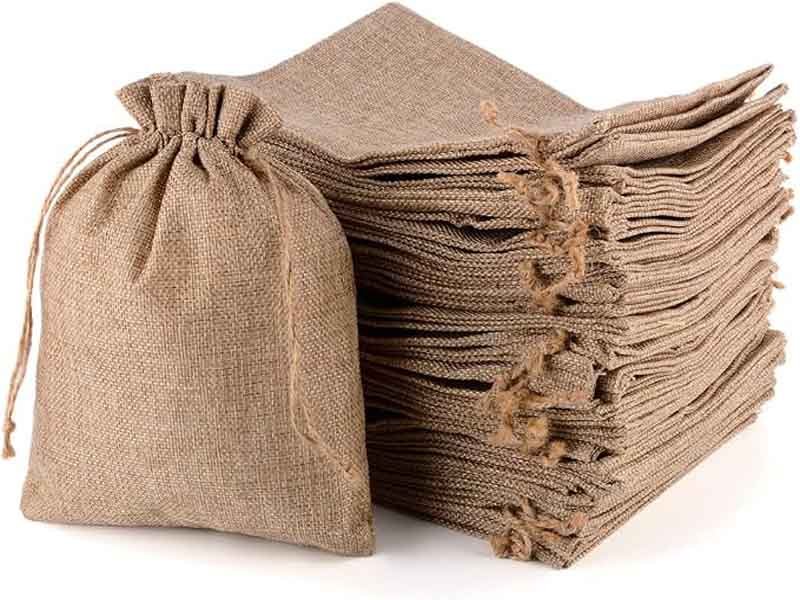
Jute bags are reusable or industrial packaging products made from woven yarns obtained from the stems of jute plants. They range from coarse agricultural sacks to refined retail totes with soft handles, printed logos, inner linings, pockets, closures, and structured bases. The correct type depends on what the bag must carry, how often it will be reused, how it should look, and whether it requires moisture resistance or food-contact controls.
The term “jute bag” covers products with very different levels of performance. A loosely woven promotional bag, a laminated grocery tote, and a certified sack for carrying 50 kilograms of grain should not be evaluated by the same criteria. Their yarn count, weave density, seam construction, dimensions, moisture requirements, surface treatment, and testing methods can be substantially different.
What Is Jute Fabric?
Jute is a bast fibre, meaning that the useful fibre is extracted from the stem area of the plant rather than from a seed, leaf, or fruit. After harvesting and retting, the fibres are separated, washed, dried, graded, spun into yarn, and woven into fabric.
Jute fabric is known for its visible natural texture, relatively low extensibility, useful tensile performance, breathability, and distinctive golden-brown appearance. FAO identifies jute as one of the most important renewable natural fibres by production volume and notes its long-standing use in sacks, hessian cloth, coverings, upholstery, and other manufactured products.
The fibre’s texture is part of its appeal, but it also creates production challenges. Natural variations in fibre diameter and shade can cause small differences between fabric batches. A professional manufacturer therefore evaluates more than the final bag dimensions. Yarn consistency, weave density, fabric weight, moisture condition, colour tolerance, printing surface, and cutting direction can all affect the finished appearance.
| Jute characteristic | Practical packaging value | Possible limitation | Manufacturing response |
|---|---|---|---|
| Natural textured surface | Creates an organic, handcrafted appearance | Fine artwork may lose sharpness | Adjust artwork, ink deposit, screen mesh, or print base |
| Low stretch | Helps the bag retain shape under load | Stress may concentrate near seams | Reinforce handles and load-bearing seams |
| Breathable weave | Useful for produce and dry products | Does not block moisture or dust completely | Add a suitable lining only when necessary |
| Coarse fibre structure | Provides visual depth and grip | May feel rough against skin or delicate goods | Use softened jute, blended fabric, or inner lining |
| Natural colour variation | Supports an authentic material story | Exact shade matching can be difficult | Approve physical swatches and tolerance ranges |
| Biodegradable natural fibre | Supports material recovery and natural breakdown | Treatments may alter end-of-life performance | Specify coating, ink, adhesive, and handle materials carefully |
A common mistake is selecting jute fabric only by appearance. Two fabrics may look similar in a photograph while having different weights, weaving densities, stiffness levels, shedding tendencies, and printing results. For custom production, physical samples are much more reliable than screen images because lighting and digital colour profiles can hide meaningful differences.
How Are Jute Bags Made?
Jute bag production begins long before the fabric reaches a sewing machine. The manufacturer must translate the intended use into measurable specifications. A bag for a premium gift set may need a clean weave, soft cotton handles, a stable rectangular bottom, and precise multicolour printing. A sack for agricultural goods may prioritize tensile strength, breathability, closure efficiency, and load safety.
A typical production route includes material selection, fabric inspection, calendaring or softening, dyeing or printing, lamination when required, cutting, component preparation, sewing, trimming, inspection, packing, and shipment.
| Production stage | Main decision | Common risk | Recommended control |
|---|---|---|---|
| Requirement review | Size, load, reuse frequency, appearance | Bag designed from dimensions alone | Confirm product weight and intended use |
| Fabric selection | Weight, weave, colour, softness | Fabric too loose or too stiff | Approve a physical swatch |
| Fabric inspection | Defects, width, weight, moisture | Shade or weave variation | Establish acceptance tolerances |
| Printing | Method, colour, artwork size | Ink spread on uneven fibres | Conduct a print trial |
| Cutting | Grain direction and panel dimensions | Distortion or mismatched panels | Use controlled patterns and cutting checks |
| Sewing | Seam type, thread, reinforcement | Handle pull-out or seam opening | Add box stitching or cross reinforcement |
| Finishing | Trimming, pressing, cleaning | Loose fibres and uncut threads | Use a defined finishing checklist |
| Inspection | Appearance, dimensions, strength | Defects discovered after packing | Inspect during and after production |
| Packing | Folding, moisture protection, carton load | Creasing, odour, or mildew | Control dryness and carton conditions |
The sewing structure is especially important. Increasing fabric weight does not automatically make a bag reliable when the handle attachment is weak. In many reusable bags, the highest stress is concentrated where the handles meet the body. Extending the handle webbing down the panel, using a box-and-cross stitch, reinforcing the top hem, and selecting suitable thread can improve real-world performance more effectively than adding unnecessary fabric weight.
At Szoneier, custom jute bag development can begin with a product brief, reference sample, drawing, packaging concept, or existing bag that needs improvement. Material, construction, logo process, handle design, lining, closure, and carton plan can then be evaluated together instead of being treated as separate purchasing decisions.
What Types of Jute Bags Are Available?
Jute bags can be made for retail, gifts, food, wine, cosmetics, events, agriculture, home storage, and product presentation. Their construction should change according to the application.
A wine bottle bag needs vertical stability and a reinforced base. A grocery tote needs comfortable handles and resistance to repeated loading. A drawstring pouch must close smoothly without the coarse fabric damaging the cord. A gift bag may require a cleaner weave and more controlled printing than a produce sack.
| Jute bag type | Common use | Useful construction features | Questions to confirm |
|---|---|---|---|
| Jute shopping tote | Groceries and retail purchases | Wide gusset, reinforced handles, strong top hem | What is the expected carrying weight? |
| Jute gift bag | Events, gift sets, seasonal packaging | Clean panels, soft handles, refined printing | Will the bag replace a box or supplement it? |
| Jute wine bag | Bottles and beverage gifts | Dividers, padded base, vertical seams | One bottle, two bottles, or more? |
| Jute drawstring pouch | Cosmetics, tea, accessories, small gifts | Smooth channel, cotton cord, controlled dimensions | Does the product require a lining? |
| Jute food bag | Coffee, grains, produce, dry foods | Breathability, suitable lining, controlled treatments | Is direct food contact involved? |
| Jute promotional bag | Exhibitions, campaigns, memberships | Visible logo area, practical reuse value | Will recipients have a reason to reuse it? |
| Jute storage basket | Home organization and displays | Structured sides, lining, handles, firm base | Must the item stand upright when empty? |
| Industrial jute sack | Grain and agricultural products | Standardized weave, seam and load performance | Which regulations or specifications apply? |
Industrial jute sacks demonstrate how technical these products can become. The Bureau of Indian Standards maintains specifications for jute bags used to pack different foodgrain loads, including standards covering bags for up to 30 kilograms and bags for 50-kilogram applications. These documents address construction and performance rather than appearance alone.
For retail packaging, there may not be a single mandatory construction standard that fits every use. This makes the product brief even more important. The bag should be developed around a defined load, expected number of uses, customer handling conditions, and target appearance.
Which Jute Grades Suit Packaging?
There is no universal “best” jute grade for every bag. The correct material is the one that delivers enough strength, visual consistency, printability, and structure without adding unnecessary weight or processing.
Coarser jute can work well for agricultural sacks, rustic gift packaging, and promotional products where a natural appearance is desirable. Finer and more uniform jute is generally more suitable for detailed printing, fashion-oriented totes, cosmetics packaging, and premium gift presentation.
Fabric suppliers and bag factories may describe jute by weight, weave, finish, commercial grade, or intended application. Because terminology varies, the specification should not rely on a name alone. It should include measurable or physically approvable requirements.
| Selection factor | Entry-level packaging | Standard reusable bag | Refined retail bag |
|---|---|---|---|
| Surface appearance | Visible slubs and variation acceptable | Moderate consistency | Cleaner, more uniform face |
| Weave density | Open to medium | Medium | Medium to tighter weave |
| Structure | Flexible or coarse | Balanced body | Controlled stiffness and shape |
| Printing demand | Simple one-colour artwork | Standard logos and text | Fine artwork or multiple colours |
| Handle option | Jute or basic webbing | Cotton or reinforced webbing | Soft cotton, padded, or custom handles |
| Lining | Usually none | Optional | Often used for finish or protection |
| Recommended use | Sacks, rustic events, basic promotion | Shopping and general retail | Gifts, fashion, cosmetics, presentation |
Fabric weight is frequently discussed in grams per square metre, but GSM alone cannot predict bag performance. A tightly woven lighter fabric may behave differently from a heavier open weave. Finishing treatments can also change stiffness and handle feel. Sample approval should therefore consider weight, weave, yarn quality, surface finish, and assembled-bag performance together.
How Do Jute and Burlap Differ?
Jute is the fibre, while burlap usually refers to a coarse, loosely woven fabric commonly made from jute. In some markets, the terms “burlap,” “hessian,” and “jute fabric” are used interchangeably, but they do not always describe exactly the same construction.
“Hessian” often refers to a comparatively lighter or finer woven jute cloth, while “sacking” usually describes heavier material used for sacks and industrial packaging. “Burlap” is widely used in North America to describe coarse woven fabric with a rustic appearance.
| Term | Usually describes | Typical appearance | Common packaging use |
|---|---|---|---|
| Jute | The plant fibre or products made from it | Varies by yarn and weave | All jute-based bags and fabrics |
| Burlap | Coarse woven fabric, often made from jute | Open, rustic, highly textured | Gift bags, décor, pouches, promotions |
| Hessian | Woven jute cloth, often lighter or cleaner | More uniform than coarse sacking | Shopping bags, gift packaging, printing |
| Sacking | Heavier woven fabric | Strong, coarse, functional | Grain, produce, and industrial sacks |
| Jute canvas | Dense or structured jute construction | Firmer, more substantial | Totes, storage, home products |
Terminology should never replace a fabric sample. A customer may request “burlap” while expecting a clean retail-grade surface, whereas a factory may interpret the same word as an open decorative weave. The safest approach is to confirm reference photos, a physical swatch, approximate weight, weave density, softness, colour, and intended printing method before pricing.
Are Jute Bags Sustainable?
Jute bags can support sustainable packaging because jute is a renewable plant fibre, uncoated fabric can biodegrade, and a well-made bag can replace many disposable carriers. Their real environmental benefit, however, depends on repeated use, efficient manufacturing, responsible chemical choices, minimal unnecessary components, suitable transport, and a realistic end-of-life plan.
A jute bag that is used dozens of times can deliver more practical value than one distributed as a short-lived giveaway. Conversely, a heavy bag with plastic lamination, multiple synthetic decorations, oversized packaging, and little chance of reuse may not perform as well as its natural appearance suggests.
Is Jute a Renewable Material?
Yes. Jute is obtained from an agricultural crop and is therefore a renewable biological resource. Unlike petroleum-based materials, its raw fibre can be regrown through future crop cycles.
FAO classifies jute among important natural plant fibres and highlights the renewable and biodegradable characteristics of plant-fibre products. Current industry statistics also show that jute remains a commercially significant crop rather than a niche decorative material. The Indian Jute Mills Association’s supply data records raw-jute production and industrial consumption across recent crop years, demonstrating an established production system serving packaging and textile markets.
Renewable does not mean impact-free. Cultivation practices, retting water management, fibre processing, dyeing, factory energy, waste handling, and transportation still matter. A credible sustainability assessment should examine the full supply chain rather than stopping at the statement that jute comes from a plant.
| Sustainability question | Positive characteristic | Qualification |
|---|---|---|
| Is the raw material renewable? | Jute can be regrown as an agricultural crop | Farming and processing practices still create impacts |
| Is it fossil-free? | Natural jute fibre is plant-based | Coatings, threads, inks, and accessories may be synthetic |
| Does it store biogenic carbon temporarily? | Carbon is held within the plant-derived material during use | Storage is temporary and should not be presented as permanent removal |
| Can it replace disposable bags? | A durable design can support repeated use | Replacement only occurs when customers actually reuse it |
| Is it locally available everywhere? | Jute has an established international supply chain | Long transport routes can influence total impact |
For packaging development, the useful question is not merely “Is jute renewable?” It is “How much of the finished bag remains renewable?” A natural jute body combined with polyester handles, polypropylene lamination, plastic piping, metal eyelets, foam reinforcement, and synthetic labels becomes a multi-material product. Such additions may improve performance, but they should be chosen intentionally.
Are Jute Bags Biodegradable?
Untreated jute fibre is biodegradable because microorganisms can break down its natural plant-based structure under suitable conditions. This makes it fundamentally different from conventional plastic fibres that can persist and fragment in the environment.
However, biodegradability is not an invitation to litter, and it is not a guarantee that every finished jute bag will disappear quickly in every environment. Temperature, moisture, oxygen, microbial activity, fabric thickness, dye chemistry, coatings, and attached components all influence breakdown.
| Bag construction | Likely end-of-life behavior | Main concern |
|---|---|---|
| Uncoated natural jute with natural-fibre thread | Fibre can biodegrade under suitable conditions | Handles, labels, and inks still require review |
| Dyed jute | Fibre remains plant-based | Dye and finishing chemistry may affect claims |
| Jute with cotton handles | Primarily natural-fibre construction | Sewing thread and printed components may be synthetic |
| Jute with PP lamination | Natural fibre plus persistent plastic layer | Difficult separation and reduced biodegradability |
| Jute with PE lining | Improved moisture resistance | Mixed-material disposal |
| Jute with metal fittings | Components may be recoverable separately | Disassembly may be inconvenient |
| Jute-polyester blend | Greater consistency or durability | Finished fabric is not fully biodegradable |
A manufacturer should therefore avoid using “100% biodegradable” for a finished bag unless every relevant component supports that claim and the evidence matches the intended disposal environment. The more accurate claim may be “made with natural jute fibre,” “reusable jute bag,” or “uncoated jute body,” depending on the construction.
Are Jute Bags Compostable?
Natural, untreated jute can break down in composting conditions, but a finished jute bag should not automatically be marketed as certified compostable. Certification normally requires testing against a recognized standard and applies to the complete product configuration, not merely the main fabric.
A bag may contain screen-printing ink, polyester sewing thread, a care label, adhesive reinforcement, plastic lamination, magnetic closures, or coated handles. Even small components can make a broad compostability statement misleading.
This distinction matters because “biodegradable” and “compostable” are not interchangeable marketing words. Biodegradable describes the capacity of a material to be broken down biologically under certain conditions. Compostable usually implies breakdown within a managed composting process while meeting defined requirements for disintegration, biodegradation, and material safety.
| Claim | What it should mean | Evidence to request |
|---|---|---|
| Natural jute | Main fabric is made from jute fibre | Material declaration or supplier specification |
| Biodegradable fibre | Fibre can biologically decompose under suitable conditions | Fibre composition and treatment information |
| Home compostable | Finished product meets a relevant home-compost standard | Third-party test or certification |
| Industrially compostable | Product meets controlled composting requirements | Certification for the complete construction |
| Plastic-free | No intentionally added plastic components | Full bill of materials |
| Recyclable | An accessible recycling route exists for the finished product | Market-specific collection and processing evidence |
When compostability is a project requirement, Szoneier can help simplify the bag structure by reviewing the body fabric, handles, sewing thread, labels, inks, closures, and reinforcement components. The design may not need to eliminate every performance feature, but each addition should have a clear function.
How Does Reuse Reduce Environmental Impact?
Reuse spreads the manufacturing impact of a bag across more carrying occasions. A durable bag that performs 50 trips uses the same initial production resources more efficiently than an equivalent bag discarded after one trip.
UNEP’s life-cycle guidance emphasizes that alternatives to single-use products should be assessed by function and number of uses, not by material identity alone. Its public guidance notes, for example, that some paper shopping bags need multiple uses before their impact becomes lower than that of a single-use plastic bag. Although that figure does not directly establish a break-even point for jute, it illustrates why reuse frequency is central to comparing packaging materials.
A jute bag can encourage reuse when it is comfortable, attractive, washable or easily cleaned, appropriately sized, and strong enough for normal loads. People rarely continue using an awkward promotional item just because it has an environmental message printed on it.
| Design choice | Effect on reuse | Practical recommendation |
|---|---|---|
| Comfortable handle width | Reduces pressure on the hand or shoulder | Match handle width to expected load |
| Useful bag dimensions | Fits regular shopping or storage tasks | Design around real products, not only logo space |
| Reinforced handle attachment | Prevents early structural failure | Use load testing and suitable stitching |
| Neutral or attractive artwork | Makes the bag acceptable beyond one campaign | Avoid overly time-sensitive graphics |
| Stable gusset and base | Improves loading and product organization | Confirm whether the bag must stand upright |
| Cleanable lining | Extends life for groceries or cosmetics | Choose lining only when the benefit justifies it |
| Replaceable or simple components | Supports repair and end-of-life separation | Avoid unnecessary decorative hardware |
A useful design exercise is to ask what the recipient will do with the bag after removing the original product. A jute gift bag sized only for one unusually shaped box may have little second-life value. Adjusting its dimensions to fit groceries, books, wine bottles, or household storage can increase the chance that it remains useful.
Do Coatings Affect Sustainability?
Yes. Coatings and laminations can improve moisture resistance, print appearance, stiffness, and cleanability, but they can also introduce fossil-based materials and make the bag more difficult to biodegrade, compost, or separate for recovery.
Polypropylene lamination is common because it creates a smoother inner surface, reduces fibre shedding, improves structure, and offers some resistance to moisture. The trade-off is that the resulting bag combines natural fibre with plastic. A laminated jute bag may still be reusable and durable, but it should not be presented as though it behaves like untreated jute at the end of life.
| Treatment | Main benefit | Sustainability trade-off | Best used when |
|---|---|---|---|
| No coating | Simple material structure and natural feel | Limited water resistance | Dry goods, gifts, events, general shopping |
| Starch or natural stiffening treatment | Improves body and shape | Performance may vary with moisture | Light retail and presentation bags |
| PP lamination | Structure, wipe-clean surface, moisture resistance | Adds a plastic layer | Repeated grocery or retail use where protection matters |
| PE lining | Liquid and moisture barrier | Mixed-material construction | Specific products requiring an inner barrier |
| Cotton lining | Softer interior and improved finish | Adds material and sewing complexity | Cosmetics, fashion, gifts, delicate products |
| Nonwoven lining | Shape and surface protection | Often synthetic and difficult to separate | Structured retail bags requiring added support |
| Water-repellent finish | Reduces wetting | Chemistry and durability must be reviewed | Outdoor or moisture-prone use |
The correct decision is not always to reject lamination. A coating that doubles or triples the useful life of a bag may provide a practical benefit, particularly where the bag is exposed to damp products or frequent cleaning. The mistake is adding lamination by default without evaluating whether the application genuinely requires it.
A more disciplined design process begins with the performance need. Does the product require a true moisture barrier, or only slightly more structure? Could a tighter weave, removable insert, internal paperboard base, or different packing method solve the problem with fewer mixed materials? These questions often reveal opportunities to simplify the construction without sacrificing function.
For markets such as the European Union, packaging decisions are increasingly evaluated across the entire life cycle. The EU Packaging and Packaging Waste Regulation entered into force on February 11, 2025, and generally applies from August 12, 2026. It addresses packaging design, material use, reusability, recoverability, and waste prevention across packaging types. This direction reinforces the need for evidence-based claims and designs that consider more than the appearance of sustainability.
Szoneier can develop uncoated, lined, laminated, printed, dyed, or naturally finished jute bags according to the required load, appearance, moisture protection, reuse plan, and destination market. Material samples and prototype testing allow the construction to be reviewed before mass production, reducing the risk of choosing an attractive specification that does not perform properly in real use.
Which Packaging Material Is Better?
No packaging material is automatically better in every environmental category. Jute performs well when natural texture, repeated use, strength, breathability, and reduced dependence on disposable plastic are priorities. Plastic may provide a stronger moisture barrier with less material, paper is lightweight and widely collected in many markets, and cotton offers a smoother surface and softer feel. The best choice depends on the product, carrying load, number of expected uses, transport distance, contamination risk, and available disposal system.
Comparisons often become misleading when they measure one bag against another without first confirming that both bags perform the same job. A thin plastic carrier, a paper shopping bag, and a reinforced jute tote may differ greatly in weight, load capacity, lifespan, and moisture resistance. A meaningful comparison should use a shared function, such as carrying ten kilograms of groceries a defined number of times, rather than comparing one physical bag with another.
Life-cycle studies also show that production assumptions, electricity sources, material weight, reuse rates, disposal routes, and secondary uses can change the result. UNEP’s review of shopping-bag assessments therefore emphasizes that there is no universally superior material under every condition. Reuse behavior and product design are often more influential than the material name printed on the label. (UNEP – UN Environment Programme)
Are Jute Bags Better Than Plastic?
Jute bags can be better than disposable plastic bags when they are made for long-term use and customers actually reuse them. They offer a natural-fibre body, a distinctive texture, good carrying strength, and less risk of persisting as conventional plastic litter when the construction remains uncoated and free from synthetic components. However, a heavy jute bag used only once may consume more material and production energy per trip than a lightweight plastic carrier.
Plastic has practical advantages that should not be ignored. It is lightweight, highly resistant to water, easy to seal, and capable of providing strong protection with a thin material layer. These characteristics can be valuable for liquids, frozen products, medical items, contaminated goods, or products that must remain dry. Replacing plastic without maintaining the required protection may result in damaged goods, leakage, hygiene problems, or additional packaging.
Jute becomes most convincing when its purpose is repeated carrying rather than one-time barrier protection. A jute grocery bag with reinforced handles and a stable gusset can return to the store repeatedly. A small disposable inner bag protecting wet food may still require a barrier material. In such a system, jute does not need to replace every gram of plastic to create value; it can replace the repeated use of outer shopping carriers while the inner packaging remains designed for product safety.
| Comparison factor | Jute bag | Thin plastic bag | Reusable plastic bag |
|---|---|---|---|
| Raw material | Plant-based jute fibre | Fossil-based or recycled polymer | Fossil-based or recycled polymer |
| Typical design goal | Repeated use and visible presentation | Short-term carrying | Multiple shopping trips |
| Moisture resistance | Low without treatment | High | High |
| Surface character | Natural and textured | Smooth and flexible | Smooth, woven, or nonwoven |
| Weight per bag | Relatively high | Very low | Low to moderate |
| Printing | Strong visual character, but texture affects detail | Sharp and economical | Sharp with several print options |
| End-of-life concern | Coatings and mixed components complicate disposal | Litter persistence and collection limitations | Reuse rate and recycling access |
| Best environmental strategy | Maximize useful life | Reduce unnecessary distribution and encourage reuse | Reuse repeatedly and recycle where accepted |
A company considering jute should therefore avoid a simple “plastic-free equals sustainable” calculation. The more useful questions are practical:
Does the jute bag replace an outer carrier that customers previously discarded?
Will the dimensions make it useful after the original purchase?
Can it survive the expected load without tearing?
Does it require plastic lamination, or can the design remain uncoated?
Will the customer reuse it often enough to justify its heavier construction?
The UK Environment Agency’s carrier-bag assessment concluded that production and raw-material stages account for much of the impact of carrier bags and that, regardless of material, repeated reuse is a central way to improve performance. The report did not establish one universal number for jute because bag constructions and study assumptions vary. Its broader conclusion is more useful: a durable bag should be kept in circulation rather than replaced frequently.
Consider a practical retail example. A store distributes 50,000 lightweight carriers each year. It replaces them with 10,000 reinforced jute totes, expecting each tote to complete at least five shopping trips. On paper, both systems provide 50,000 carrying events. In real life, however, the result depends on whether customers remember to bring the jute bags back. Handle comfort, useful dimensions, visual appeal, and storage convenience are therefore environmental design decisions, not merely styling details.
Is Jute Better Than Cotton?
Jute may be a stronger choice than cotton when the project prioritizes natural texture, structural stiffness, rustic presentation, and lower material refinement. Cotton may be preferable when softness, washing, close weaving, detailed printing, and direct contact with clothing or skin are more important.
The two materials should not be treated as interchangeable natural fibres. Jute fibres are comparatively coarse and stiff, giving a bag body and visual texture. Cotton fibres are softer and can be spun into finer yarns, creating smoother fabrics that accept detailed printing and fold comfortably. These different properties influence construction, appearance, care, and likely reuse.
| Decision area | Jute | Cotton |
|---|---|---|
| Hand feel | Coarse, dry, and structured | Soft and flexible |
| Natural appearance | Strong visible texture | Cleaner textile appearance |
| Shape retention | Good, especially with lamination or lining | Usually softer unless heavier fabric is used |
| Fine printing | Requires artwork and ink adjustment | Generally supports finer details |
| Washing | Usually spot-cleaned; dimensional change and fibre release must be considered | Often washable when dyes and construction allow |
| Moisture behavior | Absorbs moisture and may become stiff or distorted | Absorbs moisture but is generally easier to launder |
| Premium gift presentation | Strong for rustic, food, wine, and natural themes | Strong for fashion, cosmetics, apparel, and lifestyle uses |
| Construction options | Jute body with cotton handles is common | Full cotton body and handles are easy to coordinate |
Cotton is sometimes chosen automatically because it feels softer and appears more refined. Yet a heavy cotton tote may need substantial material to achieve the same upright shape as a lighter structured jute bag. The added fabric may be useful when the bag is frequently washed, but unnecessary when the main goal is gift presentation or dry-product carrying.
Life-cycle comparisons frequently show that cotton bags need extensive reuse to distribute their initial production impact. Published results vary because they depend on cotton type, bag weight, energy assumptions, reuse of competing bags, and impact categories. The UK Food Standards Agency’s review of alternatives notes a broad estimate of 50 to 150 uses for a cotton bag to perform better than a single-use plastic bag under the referenced life-cycle assumptions. That range should not be transferred directly to every cotton or jute design, but it demonstrates why material weight and actual reuse matter.
Jute and cotton can also be combined. A jute body with cotton webbing handles often gives a useful balance: the body retains natural texture and structure, while the softer handles improve carrying comfort. Juco, a woven blend of jute and cotton, offers a smoother printing face than coarse jute while preserving some of jute’s visual character.
| Material option | Main advantage | Main limitation | Suitable application |
|---|---|---|---|
| Natural jute | Strong texture and upright form | Coarse hand feel | Grocery, wine, food gifts, retail |
| Softened jute | Improved handling and sewing | Additional processing required | Fashion-oriented shopping bags |
| Jute with cotton handles | Comfortable carrying with natural body | Mixed materials need end-of-life consideration | Reusable retail totes |
| Juco fabric | Smoother surface and clearer printing | Higher cost than basic jute | Premium promotional and lifestyle bags |
| Cotton canvas | Soft, washable, print-friendly | More fabric may be needed for structure | Apparel, cosmetics, books, daily totes |
| Jute with cotton lining | Refined interior and natural exterior | More complex sewing and higher material use | Gift sets and premium packaging |
The decision can be simplified by asking what the customer should feel when picking up the bag. Jute communicates texture, nature, craft, harvest, and durability. Cotton communicates softness, familiarity, fashion, and everyday textile use. Neither message is universally better; the material should support the product story and expected reuse behavior.
How Does Jute Compare With Paper?
Jute is generally more suitable for repeated carrying, while paper is often more suitable for lightweight, single-distribution packaging with established collection and recycling routes. Jute tolerates repeated flexing and loading better when properly sewn, while paper offers a smoother print surface, efficient folding, and easier integration into conventional retail packaging systems.
Paper bags can be an effective choice for dry, lightweight products such as clothing, bakery items, gifts, cosmetics, and takeaway goods. They are easily printed, stack compactly, and may be widely recyclable when clean and free from problematic coatings. Their weaknesses include reduced strength when wet, handle tearing, limited resistance to repeated folding, and lower suitability for heavy or irregular loads.
Jute bags are heavier and bulkier to transport, but they can deliver many more carrying cycles. A jute tote may also continue as home storage or a shopping bag after the original product has been removed. That second-life potential is valuable only when the bag has useful proportions and durable construction.
| Performance factor | Jute bag | Paper bag |
|---|---|---|
| Reuse potential | High when well constructed | Usually limited, although strong paper bags can be reused |
| Wet strength | Limited without coating, but woven structure remains useful | Often drops sharply when wet |
| Print surface | Textured and visually distinctive | Smooth and suitable for detailed graphics |
| Storage before filling | Bulkier | Flat and space-efficient |
| Heavy products | Suitable with reinforced seams and handles | Requires heavier paper and strong handle attachment |
| Recycling route | Depends on local textile or fibre recovery | Often more familiar where paper collection exists |
| Biodegradation | Natural uncoated fibre can break down | Uncoated paper can break down |
| Coating concern | Plastic lamination changes end-of-life profile | Plastic films and wet-strength treatments affect recovery |
| Brand visibility after purchase | High if repeatedly reused | Usually shorter exposure period |
UNEP notes that a paper shopping bag may need to be used several times before achieving a lower environmental impact than a single-use plastic bag in certain life-cycle scenarios. This does not mean paper is environmentally poor; it shows that heavier alternatives carry an initial production impact and should be used efficiently. (UNEP – UN Environment Programme)
A useful packaging program may use both materials instead of forcing one material into every role. Paper can provide a folding carton or protective sleeve, while a jute bag serves as the reusable outer carrier. Alternatively, a simple jute drawstring bag may replace a rigid gift box when product protection is already provided by an inner container.
The best system is often the one that removes redundant layers. Putting a small product into a plastic pouch, then a paper box, then a jute bag, followed by a shipping carton may create an attractive unboxing sequence, but every layer should have a clear purpose. A packaging review should identify which layer protects, communicates, groups, transports, or supports reuse. Layers without a defined function are candidates for removal.
Which Material Lasts Longer?
A correctly constructed jute bag will normally outlast a conventional paper shopping bag under repeated dry-use conditions. Its lifespan compared with reusable plastic or cotton depends on fabric quality, seam design, handling, moisture exposure, cleaning, storage, and load.
Durability is not a single property. A bag may have strong fabric but weak handles. It may carry heavy products yet lose shape after getting wet. It may survive hundreds of light uses but fail during the first overloaded trip. A realistic durability specification should separate several risks.
| Durability area | What can fail | Recommended assessment |
|---|---|---|
| Fabric tensile performance | Panel tears under steady load | Material tensile test or controlled load test |
| Seam strength | Stitch line opens | Seam pull test |
| Handle attachment | Handle tears away from body | Static and dynamic handle-load test |
| Abrasion resistance | Base or corners wear through | Repeated rubbing or use simulation |
| Dimensional stability | Bag shrinks, twists, or loses shape | Moisture and cleaning trial |
| Print durability | Logo cracks, rubs off, or fades | Dry rub, wet rub, and adhesion checks |
| Closure life | Zip, snap, or drawcord stops functioning | Repeated opening cycles |
| Storage stability | Odour, mildew, or deformation develops | Humidity-controlled storage review |
For custom jute bags, Szoneier can establish a target load rather than relying on vague descriptions such as “strong” or “heavy duty.” The test load should reflect the intended product plus a safety margin. A bag expected to carry eight kilograms of groceries should not be tested only with a two-kilogram display load.
A static load test checks whether the bag can hold a defined weight for a specified time. A dynamic test adds movement, lifting, or repeated cycles to imitate walking and handling. Dynamic testing is particularly important because handle attachments experience short, concentrated forces every time the bag is lifted.
The following ranges are practical development examples rather than universal standards:
| Intended use | Typical working-load target | Suggested development test | Structural focus |
|---|---|---|---|
| Small gift pouch | 0.5–2 kg | Product weight plus safety margin | Drawcord channel and bottom seam |
| Wine bottle bag | 1.5–4 kg | Filled bottle load with lift cycles | Base reinforcement and divider seams |
| Fashion retail tote | 3–7 kg | Static hang and repeated lifting | Handle attachment and top hem |
| Grocery shopper | 8–15 kg | Static and dynamic carry test | Full handle path, gusset, and base |
| Agricultural sack | Product-specific, often much higher | Applicable sack specification | Weave, closure, seam, and drop resistance |
FAO guidance explains that natural-fibre sacks, including jute, are used for fresh produce and agricultural goods, while capacity and weave must be selected around the product and handling system. This reinforces the principle that durability should be engineered for the application rather than inferred from the fibre name.
Which Option Creates Less Waste?
The option that creates less waste is usually the packaging system that uses the least necessary material, prevents product damage, remains useful for as long as possible, and has a realistic collection or disposal route. Material substitution alone does not guarantee waste reduction.
A single durable jute bag can reduce the number of disposable outer carriers used over time. Yet overproduction can cancel part of that advantage. Ordering far more promotional bags than an event can distribute creates unused inventory. Printing a specific date may make leftover stock unusable after the campaign. Selecting an unusual size may reduce the bag’s second-life value.
Waste prevention should begin at the design and purchasing stage.
| Waste source | Common cause | Better approach |
|---|---|---|
| Unused stock | Order quantity exceeds realistic demand | Use forecast-based production and staged delivery |
| Cutting waste | Inefficient panel dimensions | Adjust bag size to fabric width and cutting layout |
| Rejected printing | Artwork unsuitable for jute texture | Approve a printed sample before production |
| Early bag failure | Weak seams or handles | Test assembled bags, not fabric alone |
| Redundant packaging | Multiple layers perform the same function | Define the purpose of every component |
| Obsolete inventory | Date-specific or event-specific graphics | Use timeless artwork where practical |
| Mixed-material disposal | Permanent lining and complex hardware | Simplify components or make them removable |
| Product damage | Insufficient barrier or cushioning | Preserve the protection needed for the actual product |
A jute bag may reduce visible plastic waste while increasing textile waste if it is poorly designed or rarely reused. The better goal is not to distribute the largest possible number of “eco bags.” It is to place fewer, better bags into circulation and give people a practical reason to keep them.
Which Jute Bag Types Work Best?

The best jute bag type is determined by the product’s shape, weight, moisture sensitivity, presentation needs, carrying method, and expected second use. Retail totes need comfortable handles and attractive printing; food bags require careful material and contact-safety review; gift bags need presentation value; agricultural sacks prioritize load performance and breathability; promotional bags must be useful enough to survive beyond the campaign.
A successful specification begins with the contents, not with a catalogue photo. The same bag shape may behave very differently when carrying folded clothing, glass bottles, coffee beans, vegetables, cosmetics, or metal tools. Product dimensions, sharp edges, condensation, odour, oil, and movement inside the bag all influence construction.
Which Bags Suit Retail Packaging?
Jute shopping totes with side and bottom gussets are among the most versatile options for retail packaging. They offer a large printable area, good internal capacity, and a structure that customers can reuse for groceries, books, clothing, or household items.
The most suitable retail construction depends on what is being sold. Fashion retailers may prefer softened jute, cotton handles, clean seams, and a lined interior. Grocery stores may prioritize a wide base, strong handles, and a wipe-clean inner surface. Homeware stores may need extra width for bulky products, while cosmetics companies may select a smaller, more structured format.
| Retail category | Recommended jute format | Useful features | Common design mistake |
|---|---|---|---|
| Fashion and apparel | Softened jute tote | Cotton handles, clean printing, inner pocket | Bag too coarse for delicate garments |
| Grocery | Wide-gusset shopper | Reinforced handles, stable base, optional lining | Handles too narrow for heavy loads |
| Cosmetics | Small structured tote | Smooth lining, short handles, closure | Oversized bag wastes material and feels empty |
| Books and stationery | Flat or narrow-gusset tote | Full-length handles, reinforced bottom | Base too weak for concentrated weight |
| Home and garden | Large rectangular shopper | Extended handle webbing, broad gusset | Dimensions become awkward when filled |
| Premium retail | Juco or refined jute bag | Detailed printing, piping, fitted lining | Too many decorative components reduce reuse |
The handle drop should match the carrying style. Short handles work for hand carrying and compact gift bags. Longer handles allow shoulder carrying but place different forces on the top edge. A heavy grocery bag may benefit from wider handles because narrow webbing concentrates pressure on the hand.
A retailer should also decide whether the bag needs to stand upright at the checkout counter. An internal base board or structured gusset can make packing easier and improve presentation. The board may be removable so the user can fold the bag later and separate components at the end of its life.
A representative retail specification might use a 38 × 32 × 15-centimetre body, cotton webbing handles, a reinforced top hem, and a target working load of ten kilograms. These dimensions are not a universal recommendation; they illustrate how product volume, handle comfort, load testing, and reuse can be considered together.
Which Bags Suit Food Packaging?
Jute bags work well as outer packaging for dry foods, produce, coffee, grains, wine, gift baskets, and packaged specialty foods. Direct contact with food requires more careful review because the complete material system—including fabric treatments, dyes, inks, linings, adhesives, and contamination controls—must suit the destination market and food type.
Natural jute is breathable, which can be useful for some agricultural products. The same breathability becomes a limitation for products requiring protection from humidity, oxygen, oil, aroma loss, insects, or fine-particle leakage. Jute should therefore be treated as one component of the packaging system rather than assumed to provide every barrier function.
| Food product | Suitable jute use | Additional protection to consider | Main risk |
|---|---|---|---|
| Fresh produce | Breathable outer sack or carrier | Product-specific ventilation | Crushing, contamination, moisture |
| Coffee beans | Decorative outer bag or transport sack | Food-safe inner liner for roasted coffee | Aroma and moisture loss |
| Tea and spices | Gift pouch around sealed primary pack | Airtight inner packet | Fine particles and aroma migration |
| Rice and grains | Woven sack for appropriate supply chains | Moisture or pest barrier where required | Humidity and infestation |
| Wine bottles | One- or multi-bottle gift bag | Divider and reinforced base | Bottle collision and base failure |
| Bakery gifts | Outer presentation bag | Grease-resistant food-contact wrap | Oil transfer and staining |
| Preserves and jars | Structured gift carrier | Dividers or padding | Glass impact and concentrated weight |
FAO identifies jute and other natural-fibre sacks as established options for produce and agricultural packaging. It also notes that textile packaging provides limited gas and moisture barrier performance, which is why liners or other primary packs may be required for sensitive foods. (FAOHome)
Food-contact compliance cannot be assumed from the word “natural.” In the European Union, materials intended to contact food must not transfer substances at levels that endanger health, unacceptably alter the food, or affect its taste and odour. Good Manufacturing Practice requirements also apply to food-contact materials. (Food Safety)
For this reason, a jute bag used around a sealed coffee pouch is different from a jute pouch placed in direct contact with loose tea. The first acts as secondary packaging; the second becomes a food-contact material and requires a more demanding review.
Questions to confirm before developing food-related jute packaging include:
Will food touch the jute directly?
Is the product dry, oily, acidic, aromatic, or moisture-sensitive?
Will the bag be filled hot or stored in humid conditions?
Does the liner need to be removable?
Which market will receive the product?
Which migration, chemical, microbiological, or documentation requirements apply?
Does the printing remain outside the food-contact surface?
Szoneier can develop the outer jute bag and coordinate suitable lining, stitching, printing, and packaging construction. Compliance requirements should be confirmed early because changing the lining or ink after sample approval can affect dimensions, cost, appearance, sealing, and production time.
Which Bags Suit Gift Packaging?
Gift packaging works best when the jute bag feels intentional rather than like a standard shopping tote with a different logo. Proportion, handle style, closure, internal organization, colour, and print placement should be designed around the gift set.
Jute is particularly effective for wine, gourmet food, candles, gardening products, handmade goods, natural cosmetics, holiday sets, and corporate gifts. Its texture creates warmth and visual depth without requiring a large amount of printed decoration.
| Gift format | Recommended construction | Presentation feature | Reuse opportunity |
|---|---|---|---|
| Single wine bottle | Tall narrow bag | Cotton rope handle or die-cut handle, reinforced base | Bottle carrier |
| Two- or three-bottle set | Divided rectangular bag | Internal separators and strong bottom | Beverage shopping bag |
| Food hamper | Wide-gusset tote or basket | Structured sides, fabric lining | Grocery or home storage |
| Cosmetics set | Small lined tote | Closure, pocket, clean logo | Toiletry or daily storage bag |
| Candle set | Box-shaped bag | Base board and internal divider | Home organization |
| Seasonal gift | Drawstring pouch or compact tote | Printed motif and ribbon | Storage for accessories |
| Corporate kit | Document-sized tote | Pocket and shoulder handles | Work or event bag |
Gift bags are often judged at the moment they are handed over. Wrinkled panels, uneven handles, loose fibres, distorted printing, or a weak base can damage the perceived value of the products inside. Quality checks should therefore include presentation details as well as load performance.
The bag should also fit the gift closely enough to look full without being difficult to pack. An oversized bag makes the contents slide and may require additional tissue or filler. An undersized bag places pressure on seams and can damage boxes. A physical packing trial with the real gift components is more reliable than calculating from individual dimensions alone.
A practical gift-development sequence is:
Arrange every product in the intended orientation.
Measure the total packed dimensions rather than adding catalogue measurements.
Allow space for easy insertion and removal.
Determine whether bottles or jars require dividers.
Choose a closure that remains usable after the gift is opened.
Test the complete loaded bag for carrying stability.
Review how the bag can be reused when the original products are gone.
Which Bags Suit Agricultural Products?
Woven jute sacks are suitable for many dry agricultural products because they offer breathability, grip, low stretch, and useful resistance to rough handling. They have long been used for grains, potatoes, coffee, cocoa, nuts, and other commodities, but the correct sack construction depends on product weight, particle size, moisture, filling process, storage conditions, and transport method.
Agricultural packaging is not simply a larger version of a retail tote. The bag may pass through mechanical filling, sewing, stacking, palletization, warehouse storage, truck transport, port handling, and unloading. A failure in one seam can cause product loss, contamination, delays, and safety risks.
| Agricultural requirement | Why it matters | Specification area |
|---|---|---|
| Product weight | Determines fabric and seam demand | Weave, yarn, bag dimensions, closure |
| Particle size | Fine products may leak through open weave | Weave density or inner liner |
| Moisture sensitivity | Jute is not a complete moisture barrier | Storage controls and liner selection |
| Ventilation | Some produce benefits from airflow | Open weave or ventilation design |
| Mechanical filling | Bag mouth must fit equipment | Opening dimensions and stiffness |
| Stacking | Bag shape affects pallet stability | Filled dimensions and seam placement |
| Traceability | Agricultural shipments need identification | Printing, labels, batch codes |
| Reuse or recovery | Sacks may enter secondary markets | Contamination and material condition |
FAO documentation describes natural-fibre sacks as packaging for fruit, vegetables, roots, and agricultural commodities. It also highlights the role of packaging in limiting handling damage and food loss. The bag must therefore be judged not only by its own material impact but by how effectively it protects the product inside. (FAOHome)
Coffee is a useful example. Traditional jute sacks provide handling strength and allow the commodity to be stacked and transported, but high-value green coffee may also use an inner barrier liner to reduce moisture and aroma changes. The jute sack supplies mechanical protection and identification, while the liner performs the barrier function. Removing the liner solely to create an all-natural appearance could reduce product quality and create more waste if the coffee is damaged.
Agricultural buyers should confirm applicable national standards and customer specifications. Some jute sacks are governed by detailed requirements for dimensions, fabric construction, seams, load, marking, and performance. A retail-bag specification cannot be substituted for an industrial sack standard.
Which Bags Suit Promotional Campaigns?
The best promotional jute bag is one people would still use if the logo were smaller. Practical dimensions, comfortable handles, attractive artwork, and durable construction determine whether the bag becomes repeated advertising or immediate clutter.
Many campaign bags fail because the design focuses on the printing area rather than the recipient’s daily needs. A conference bag that cannot hold a laptop or documents, a grocery tote with painful handles, or an event bag covered with a large date may have little value after the campaign.
| Campaign type | Effective bag design | Useful content capacity | Reuse strategy |
|---|---|---|---|
| Trade exhibition | Document or laptop tote | Brochures, samples, notebook | Neutral design for work or shopping |
| Product launch | Structured gift bag | Launch kit and retail products | Remove date-specific graphics |
| Sustainability campaign | Uncoated jute shopper | Groceries and daily items | Include practical care instructions |
| Hotel or resort event | Beach-style tote | Towels and personal items | Use destination-inspired artwork |
| Food and wine promotion | Bottle or hamper bag | Products distributed at event | Design for future grocery use |
| Membership program | Refined everyday tote | Personal items and purchases | Add pocket or closure |
| Employee kit | Strong shoulder tote | Laptop accessories and documents | Reinforced handles and useful sizing |
A promotional bag should be developed around a target cost per useful exposure rather than cost per unit alone. Suppose one inexpensive bag costs USD 1.00 but is used twice. Its bag cost is USD 0.50 per use. A better-constructed bag costs USD 2.40 and is used 30 times. Its bag cost falls to USD 0.08 per use, while the logo remains visible much longer. These figures are a simple planning example, but they demonstrate why the cheapest quotation is not always the most economical campaign choice.
Artwork also needs adjustment for jute. Fine reversed text, thin lines, subtle gradients, and close colour registration can be difficult on a coarse weave. Strong shapes, suitable line thickness, and carefully selected ink coverage usually produce more reliable results. A printed strike-off or finished sample should be approved before the full order.
Promotional claims require the same discipline as the physical construction. Phrases such as “zero impact,” “100% eco-friendly,” or “completely compostable” can be difficult to support. Clearer communication focuses on verifiable features:
Made with natural jute fabric
Designed for repeated use
Uncoated jute body
Reusable shopping bag
Plastic-free construction, when confirmed by the full bill of materials
Natural-fibre handles, when accurately specified
Szoneier supports custom development for retail totes, food gift bags, wine carriers, agricultural sacks, drawstring pouches, promotional shoppers, and structured jute packaging. Bag dimensions, fabric construction, handles, printing, linings, closures, reinforcement, test loads, and packing methods can be adjusted around the actual product and destination market rather than selected from a one-size-fits-all template.
How Durable Are Jute Bags?
Jute bags can be highly durable when the fabric weight, weave density, panel direction, seam structure, handles, reinforcement, and intended load are engineered as one system. A heavier jute fabric does not automatically produce a stronger bag. Many failures begin at the handle attachment, bottom seam, gusset corner, or top hem rather than in the centre of the fabric panel.
Durability should be defined through measurable use conditions. A wine bag must survive concentrated bottle weight and repeated lifting. A grocery shopper must tolerate movement, uneven loading, moisture exposure, and abrasion against car seats or store counters. A promotional tote may carry only brochures, but it still needs to retain its shape and print quality after repeated folding.
Textile laboratories can evaluate fabric maximum force using methods such as ISO 13934-1, while seam performance can be assessed using methods such as ISO 13935-2. The 2026 edition of ISO 13935-2 addresses the maximum force of sewn seams when force is applied perpendicular to the seam using a grab-test method. These standards do not prescribe one universal pass value for every jute bag; they provide repeatable ways to measure fabric and seam behavior.
A reliable specification therefore starts with four questions:
What will the bag carry?
How much will the contents weigh?
How often will the bag be lifted and reused?
Where is the greatest stress likely to occur?
The answers determine whether the design needs thicker fabric, tighter weaving, wider handles, extended handle webbing, reinforced seams, a stronger base, or a different bag shape.
How Much Weight Can Jute Bags Hold?
A jute bag’s carrying capacity depends on its complete construction rather than the jute fibre alone. Fabric weight, weave density, bag dimensions, handle material, stitch pattern, thread strength, seam allowance, load distribution, and product shape all influence the safe working load.
A small gift bag may comfortably carry one or two kilograms, while a reinforced grocery shopper may be developed for substantially heavier repeated loads. Industrial jute sacks can handle much greater weights when manufactured according to application-specific specifications. These examples should not be treated as automatic guarantees because a bag’s actual capacity must be verified on the final construction.
| Jute bag application | Illustrative working load | Key stress area | Suitable development test |
|---|---|---|---|
| Jewellery or cosmetic pouch | 0.2–1 kg | Drawcord channel and bottom seam | Filled-product lift test |
| Small gift bag | 1–3 kg | Handle attachment and side seam | Static hanging test |
| Wine bottle bag | 1.5–4 kg | Base seam and handle connection | Repeated bottle lift test |
| Fashion retail tote | 3–7 kg | Top hem and handle stitching | Static and dynamic carry test |
| General shopping bag | 6–12 kg | Handles, gusset, and bottom panel | Repeated loading cycles |
| Reinforced grocery shopper | 10–18 kg | Full handle path and base structure | Dynamic movement and drop simulation |
| Agricultural sack | Product-specific | Fabric, mouth closure, and side seam | Applicable industrial sack testing |
The working load should represent normal use, while the test load should include an agreed safety margin. If a bag is intended to carry eight kilograms, testing it with exactly eight kilograms leaves little information about manufacturing variation, sudden lifting, or uneven loading.
A practical sampling program may include:
A static hanging test, where the loaded bag remains suspended for a defined period.
A repeated lifting test, where the bag is raised and lowered through multiple cycles.
A walking simulation, where movement introduces changing forces at the handles.
A low-height drop test, where the filled bag is placed or dropped onto its base.
A handle-pull test, where force is concentrated at the attachment points.
A seam inspection after testing, checking for broken stitches, yarn slippage, elongation, and panel distortion.
The product inside also matters. Eight kilograms of clothing spreads pressure across the bottom, while eight kilograms of bottles concentrates force at a few hard contact points. Metal tools, books, jars, and boxed products can create sharp corners that rub against the fabric or push into the gusset.
| Product type | Load behavior | Design response |
|---|---|---|
| Folded clothing | Soft, evenly distributed | Standard gusset and reinforced handles |
| Books | Dense, flat, concentrated at the base | Strong bottom seam and wider base |
| Glass bottles | Heavy with hard contact points | Dividers, padded insert, reinforced bottom |
| Groceries | Variable, moving, sometimes damp | Wide handles, strong gusset, optional lining |
| Cosmetics | Small but sometimes heavy and rigid | Structured panels and controlled internal fit |
| Tools or hardware | Abrasive with sharp corners | Heavy lining, reinforced base, strong thread |
| Agricultural produce | Irregular and shifting | Suitable weave, closure, and drop resistance |
Customers sometimes request an extremely high load capacity for a bag that will never carry that weight. Overengineering can increase fabric consumption, shipping volume, stiffness, and cost without improving the actual user experience. The better approach is to set a realistic working load and design the bag to meet it consistently.
Szoneier can test assembled jute bags using agreed sample loads and handling cycles. The test method, load, duration, number of cycles, and acceptance criteria should be written into the product specification so that production inspection follows the same standard as sample approval.
Which GSM Should You Choose?
GSM means grams per square metre and describes the weight of a fabric area. It is useful for comparing jute fabrics, but it does not directly measure strength, tightness, stiffness, or bag capacity.
Two fabrics with the same GSM can behave differently. One may use thicker yarns in a relatively open weave, while another uses finer yarns in a denser structure. The first may look rustic and allow more light through the fabric. The second may provide a cleaner print surface and better resistance to small objects pushing through the weave.
Finishing can also change how the material feels. Calendaring, softening, dyeing, starch treatment, backing, and lamination can make a fabric appear heavier, smoother, firmer, or more structured without necessarily improving every area of durability.
| Approximate jute fabric range | General character | Common applications | Points to verify |
|---|---|---|---|
| Below 200 GSM | Light and flexible | Decorative pouches, light gifts, wraps | Openness, seam slippage, print coverage |
| 200–280 GSM | Light to medium | Promotional bags, small totes, gift bags | Handle strength and panel stability |
| 280–350 GSM | Medium and versatile | Retail totes, wine bags, general shopping | Weave consistency and gusset strength |
| 350–450 GSM | Heavier and more structured | Grocery bags, box-shaped bags, storage products | Stiffness, folding volume, sewing thickness |
| Above 450 GSM | Heavy-duty or highly structured | Specialized carriers and industrial uses | Weight, cost, seam bulk, user comfort |
These are development ranges rather than universal product standards. The suitable GSM depends on the weave, yarn, finishing, bag size, intended load, and construction.
A small 20 × 20-centimetre gift bag may not require the same material weight as a 45-centimetre grocery tote. As bag dimensions increase, the fabric spans a larger area and the contents have more room to move. Larger bags may need stronger panels or better load control even when they are designed for the same total weight.
The selection process should consider five dimensions of fabric performance:
| Fabric factor | What it tells you | What it does not tell you |
|---|---|---|
| GSM | Material weight per square metre | Exact tensile or tear strength |
| Weave density | How closely yarns are packed | Yarn quality or seam performance |
| Yarn thickness | Visual texture and structural character | Finished bag load capacity |
| Tensile strength | Resistance to pulling force | Handle or seam reliability |
| Tear resistance | Ability to resist an existing cut growing | Overall bag stability |
| Stiffness | Ability to hold shape | Durability under repeated folding |
| Surface uniformity | Suitability for printing and presentation | Internal fibre strength |
A professional fabric approval should record more than “natural jute, 300 GSM.” A clearer specification might include:
Natural-colour jute fabric.
Target GSM with an agreed tolerance.
Required fabric width.
Visual weave reference.
Permitted slubs and yarn variations.
Maximum acceptable holes or broken yarns.
Required stiffness or hand feel.
Colour range approved by physical swatch.
Print-area surface requirements.
Applicable tensile, tear, or seam tests.
Physical approval is especially important for natural jute because fibre colour and texture may vary between batches. Digital photographs can help with communication, but they cannot fully represent surface roughness, shedding, stiffness, smell, weave openness, or shade under different lighting.
How Do Handles Affect Strength?
Handles are among the most common failure points in reusable bags. Their material, width, length, placement, insertion depth, stitching pattern, and relationship with the top hem determine how effectively the carrying load transfers into the bag body.
When a loaded bag is lifted, the weight pulls downward while the handles pull upward. If the attachment area is too small, force is concentrated within a narrow group of jute yarns. Those yarns may separate, the stitches may tear through the fabric, or the top hem may fold and distort.
A strong handle system distributes force across a larger area.
| Handle construction | Strength potential | Comfort | Typical application |
|---|---|---|---|
| Self-jute handle | Moderate | Coarse | Rustic gift bags and light retail |
| Rolled jute handle | Moderate | Improved over flat jute | Wine and gift bags |
| Cotton webbing | High when properly attached | Soft and comfortable | Retail and grocery totes |
| Polyester webbing | High and dimensionally stable | Smooth, less natural | Heavy reusable carriers |
| Rope handle | Depends on eyelet and knot system | Comfortable at light loads | Gift and wine packaging |
| Padded handle | High comfort | Excellent for heavier loads | Premium grocery or lifestyle bags |
| Cut-out handle | Limited by panel reinforcement | No separate component | Small structured bags |
| Full-length webbing | Very high load distribution | Good | Heavy shopping and utility bags |
Handle width affects both strength and comfort. A narrow handle can be structurally strong but uncomfortable because it concentrates pressure on the hand or shoulder. A wider handle spreads the load across a larger contact area.
Handle drop should match the carrying method:
A short drop of approximately 10–15 centimetres suits hand carrying.
A medium drop of approximately 18–25 centimetres may fit the hand or forearm.
A longer drop of approximately 25–35 centimetres supports shoulder carrying, depending on bag dimensions and user clothing.
These ranges are design references, not universal rules. A finished prototype should be tested by users because body size, winter clothing, bag depth, and handle placement affect comfort.
The attachment method is just as important as the handle material.
| Attachment method | Load distribution | Appropriate use |
|---|---|---|
| Short straight stitch | Low | Very light promotional or gift bags |
| Rectangle stitch | Moderate | Light to medium loads |
| Box-and-cross stitch | High | Reusable retail and grocery bags |
| Multiple horizontal rows | High when spacing is controlled | Webbing attachments |
| Handle sewn into top hem | Moderate to high | Clean retail construction |
| Extended webbing down the body | Very high | Heavy shopping and utility bags |
| Riveted attachment | Depends on reinforcement | Decorative or leather-trimmed bags |
| Eyelet and rope | Concentrated around eyelet | Light gift and bottle bags |
Box-and-cross stitching forms a rectangular perimeter with diagonal lines through the centre. This distributes load more effectively than a single short stitch line. For heavier applications, the webbing can extend several centimetres down the bag panel or continue beneath the bag as a continuous support strap.
Rivets and metal eyelets may look strong, but hardware can create concentrated pressure and damage jute if the surrounding area is not reinforced. A backing patch, internal washer, folded reinforcement, or denser fabric panel may be necessary.
A realistic handle test should use the finished bag rather than a fabric strip alone. Seam methods such as ISO 13935-2 can quantify seam maximum force, while application-specific lifting tests reveal how the entire handle system behaves during use.
Is Jute Resistant to Moisture?
Jute is not naturally waterproof. It absorbs moisture from the surrounding environment and can become heavier, softer, distorted, stained, or vulnerable to mildew when stored damp for extended periods.
The woven structure may tolerate brief contact with light moisture, but untreated jute should not be relied upon as a liquid barrier. Water can pass through the weave, and the fibre can absorb some of it. This makes natural jute appropriate for dry products and breathable applications but less suitable for unprotected wet, frozen, oily, or highly moisture-sensitive goods.
| Moisture condition | Likely effect on uncoated jute | Recommended response |
|---|---|---|
| Brief light rain | Surface darkening and temporary dampness | Dry promptly in ventilated conditions |
| Damp groceries | Local staining and absorbed moisture | Use removable or appropriate inner protection |
| Refrigerated products | Condensation may wet the fabric | Add a suitable lining or separate carrier |
| Long humid storage | Odour, mildew, and dimensional change | Control warehouse and carton humidity |
| Direct liquid contact | Leakage through weave | Use a tested barrier system |
| Repeated washing | Shrinkage, distortion, fibre release | Conduct wash trials before making washability claims |
| Wet printing or dye transfer | Colour may rub onto other surfaces | Test wet rubbing fastness |
Moisture protection can be added in several ways, but every method creates trade-offs.
A polypropylene lamination provides a practical internal barrier and improves structure, but introduces a plastic layer.
A polyethylene liner can protect the contents, but makes the bag a multi-material product.
A cotton lining improves feel and reduces direct fibre contact but does not provide a complete liquid barrier.
A removable inner pouch can protect the contents while allowing the outer jute bag to remain simpler.
A water-repellent treatment may reduce wetting, but the chemistry, durability, and destination-market requirements must be reviewed.
A tightly woven fabric reduces openness but still does not become waterproof.
Storage control is equally important. Jute fabric and finished bags should be packed dry, stored away from walls and floors that may transmit moisture, and protected from condensation during shipping. Desiccants may be used when appropriate, but they should support—not replace—proper moisture management.
A sealed shipping container can experience temperature changes between factory, port, ocean transit, and destination warehouse. Warm humid air may condense on colder surfaces. Carton ventilation, container condition, loading moisture, shipping route, and season can all influence risk.
A practical moisture-control checklist includes:
Measure or assess fabric moisture before packing.
Avoid packing immediately after wet cleaning or humid processing.
Use dry, undamaged cartons.
Protect cartons from warehouse floors and walls.
Review whether polybag packing traps residual moisture.
Consider desiccants for high-risk routes.
Inspect containers for water entry or strong odour.
Allow destination cartons to acclimatize before opening when temperature differences are large.
Moisture resistance should be specified in functional terms. “Waterproof jute bag” is too broad unless the finished construction has been tested against a defined water-exposure method. More accurate descriptions may include “laminated inner surface,” “wipe-clean lining,” “water-repellent finish,” or “suitable for brief exposure to light moisture.”
How Can Stitching Prevent Failure?
Stitching prevents failure by securing the cut fabric edges, distributing load, controlling seam slippage, and reinforcing high-stress areas. The stitch type alone is not enough. Thread material, stitch density, seam allowance, needle size, folded edges, reinforcement pieces, and operator consistency all affect the result.
Jute’s relatively open weave can make it vulnerable to yarn movement near a seam. If the seam allowance is too narrow, the stitching may pull through the edge. If stitches are too close together, the needle perforations can weaken the material. If they are too far apart, the seam may open under pressure.
| Sewing variable | Too low or too small | Too high or too large | Balanced approach |
|---|---|---|---|
| Seam allowance | Edge may fray or pull out | Adds bulk and material | Set according to weave and load |
| Stitch density | Seam may gap | Excess perforation may weaken fabric | Test on actual fabric |
| Thread strength | Thread breaks before fabric | May cut into weaker fabric | Match thread to material and use |
| Needle size | Skipped stitches or needle damage | Large holes and fibre disruption | Select for yarn and thread thickness |
| Reinforcement area | Stress remains concentrated | Excess stiffness and cost | Reinforce only load zones |
| Top hem depth | Weak handle foundation | Unnecessary bulk | Coordinate with handle attachment |
| Backstitching | Stitch line may unravel | Thick local stitch cluster | Secure ends without excessive buildup |
Common seam options include:
Plain seams for internal joins where raw edges are enclosed or controlled.
Overlocked edges to reduce fraying before final assembly.
Folded seams for a cleaner appearance and stronger edge.
Binding tape around internal seams to reduce fibre shedding.
Double-needle stitching for greater stability and visual consistency.
Box-and-cross reinforcement at handles.
Bartacks in localized stress areas.
Bottom-panel reinforcement where hard products concentrate pressure.
The strongest seam is not always the best-looking seam. Premium gift bags may require concealed internal reinforcement so that the exterior remains clean. Heavy grocery bags may show visible webbing and reinforcement because function takes priority.
The manufacturing sequence also matters. If printing is completed before cutting, artwork placement must account for seam allowances and gusset folds. If handles are attached after the top hem is closed, the internal reinforcement method may be limited. Technical drawings should therefore show the order and position of every component.
A well-written sewing specification can include:
Stitch type.
Thread material and colour.
Target stitches per centimetre.
Seam allowance.
Hem depth.
Handle insertion depth.
Reinforcement pattern.
Bartack length and position.
Permitted skipped stitches.
Permitted loose threads.
Acceptance criteria after load testing.
Seam testing methods can quantify how much force causes rupture or slippage. ISO 13935-2 describes a grab method for determining maximum force to seam rupture when force is applied perpendicular to the seam. Fabric tensile testing under ISO 13934-1 can separately assess the fabric’s maximum force and elongation. Evaluating both helps identify whether failure comes from the fabric, thread, stitching, or seam geometry.
A practical development case illustrates the difference. Consider two grocery bags made from the same jute fabric. Bag A has narrow cotton handles attached with two short stitch lines. Bag B uses wider handles, a reinforced top hem, and box-and-cross stitching extending farther down the panel. The fabric cost is nearly identical, but Bag B distributes the carrying force across a larger area and is less likely to fail at the handle.
This is why Szoneier reviews the assembled structure rather than approving material weight in isolation. Fabric, handles, thread, seam position, gusset shape, printing, lining, and load testing are developed together so that the finished bag performs as expected.
How Can Jute Bags Be Customized?

Jute bags can be customized through their dimensions, shape, fabric weight, weave, colour, printing, handles, lining, lamination, closure, reinforcement, internal organization, labels, and retail packaging. Effective customization does more than place a logo on a standard tote. It adapts the bag to the product, carrying load, visual identity, customer experience, reuse plan, and destination-market requirements.
Every added feature should solve a clear problem. A lining may protect a delicate product. A divider may stop bottles from colliding. A pocket may help customers reuse the bag. A closure may prevent small items from falling out. Decorative hardware that adds no useful function may increase cost, assembly time, shipment weight, and end-of-life complexity.
The most successful projects balance four goals:
The product fits and remains protected.
The bag is comfortable and useful after purchase.
The artwork reproduces reliably on the chosen jute surface.
The construction can be produced consistently at scale.
Which Sizes Can Be Produced?
Jute bags can be produced in compact pouch sizes, bottle formats, conventional shopping-tote dimensions, oversized grocery shapes, storage baskets, and product-specific custom structures. The practical size is influenced by available fabric width, cutting efficiency, printing equipment, sewing access, handle design, carton dimensions, and the intended load.
A custom size should begin with the packed product rather than a general bag measurement. Three dimensions usually define the body:
Width: the horizontal face of the bag.
Height: the vertical distance from bottom to top edge.
Gusset: the depth created at the side or bottom.
A listed dimension of 40 × 35 × 15 centimetres may be interpreted differently by different factories unless the drawing identifies width, height, gusset, seam allowance, and measurement method.
| Product application | Illustrative bag dimensions | Useful structure |
|---|---|---|
| Jewellery or small cosmetic pouch | 10 × 15 cm | Flat or drawstring |
| Tea or coffee gift pouch | 15 × 20 cm | Flat or small bottom gusset |
| Single wine bottle bag | 12 × 35 × 10 cm | Narrow side gusset and strong base |
| Two-bottle carrier | 20 × 35 × 10 cm | Internal divider |
| Small retail gift bag | 25 × 22 × 10 cm | Box shape with short handles |
| Fashion tote | 35 × 40 cm | Flat or narrow gusset |
| Grocery shopper | 40 × 35 × 18 cm | Wide side and bottom gusset |
| Large home-storage bag | 50 × 40 × 25 cm | Structured panels and reinforced handles |
These dimensions are concept references, not fixed catalogue requirements.
The correct internal size must account for:
Product dimensions.
Number of items.
Required orientation.
Protective inner packaging.
Space for easy insertion.
Closure allowance.
Divider thickness.
Lining thickness.
Expected movement during carrying.
A bag that matches the exact external product measurements may be too tight once seam allowances, lining, and closure are added. Conversely, excessive empty space can allow bottles, jars, or boxes to shift and strike each other.
A physical packing test is particularly valuable for multi-product gift sets. The development team can arrange the actual items, determine the most stable orientation, measure the combined volume, and build a prototype around the complete set.
Size also affects material efficiency. A small adjustment of one or two centimetres may allow cutting panels to fit more efficiently across the fabric width, reducing offcuts. The optimal dimensions should therefore balance product fit with cutting yield rather than copying an arbitrary market size.
| Size decision | Customer benefit | Production consideration |
|---|---|---|
| Compact fit | Better presentation and less filler | Requires accurate packing tolerance |
| Wider gusset | Improved capacity and standing ability | Adds seam complexity and fabric |
| Taller body | Fits bottles or long products | May require stronger vertical structure |
| Larger logo face | Greater visual exposure | More fabric and possible panel sagging |
| Foldable shape | Easier home storage | Less upright presentation |
| Structured shape | Premium appearance and easy packing | More components and shipping volume |
Carton planning should begin before the bag size is finalized. Structured jute bags, thick handles, rope attachments, and internal dividers can consume substantial shipping volume. A bag that is two centimetres wider may reduce the number of units per carton and increase freight cost.
Szoneier can produce a dieline or technical drawing showing finished dimensions, seam positions, gussets, handle spacing, print location, label position, closure details, and tolerance points. This drawing becomes the shared reference for sampling, production, and final inspection.
Which Printing Method Works Best?
The best printing method depends on artwork detail, number of colours, order quantity, jute texture, required durability, colour opacity, and whether the bag is natural, dyed, coated, or laminated.
Screen printing is the most common option for bold logos and limited-colour artwork. Heat transfer can reproduce finer details on compatible surfaces. Digital transfer or film-based processes may be used for complex artwork, while embroidery creates a textured premium result. Printed fabric panels can also be prepared before the bag is assembled.
| Printing method | Best for | Main advantage | Main limitation |
|---|---|---|---|
| Screen printing | Bold logos and solid colours | Strong coverage and efficient production | Fine detail is limited by fabric texture |
| Heat transfer | Detailed or multicolour artwork | Sharper image reproduction | Film feel and adhesion must be tested |
| Digital printing | Complex graphics and gradients | Flexible image detail | Natural jute may require pretreatment or a print layer |
| Sublimation | Polyester-containing panels or inserts | Durable full-colour image | Does not work directly on natural jute fibre |
| Embroidery | Premium logos and small motifs | Rich texture and strong perceived value | Adds weight, backing, and stitch stress |
| Woven label | Consistent brand detail | Fine text and repeatability | Adds a separate component |
| Leather or imitation-leather patch | Premium identification | Strong visual contrast | Material claim and attachment need review |
| Direct fabric printing | Repeating patterns | Full-panel decoration | Requires careful alignment during cutting |
Screen printing works by pushing ink through selected openings in a mesh screen. The uneven jute surface can interrupt fine lines and small text. Artwork that looks perfect on a computer screen may appear broken when printed across thick yarns and gaps.
For reliable screen printing on jute:
Use stronger line widths.
Avoid very small reversed text.
Simplify intricate gradients.
Allow for slight edge variation.
Select ink opacity for natural or dyed backgrounds.
Test whether the ink bridges open areas of the weave.
Approve a strike-off on the actual production fabric.
Confirm dry and wet rubbing performance.
Colour fastness to rubbing can be evaluated using ISO 105-X12, which covers resistance to rubbing off and staining other materials under dry and wet conditions. This is particularly relevant for strongly dyed jute or dark printed areas that may contact clothing.
Heat transfer may offer sharper detail because the image is applied through a transfer layer. However, the transfer needs enough contact with the uneven jute surface. Poor temperature, pressure, dwell time, or surface preparation can cause incomplete adhesion, edge lifting, or cracking during folding.
Embroidery is visually attractive, but it should be planned carefully. Dense stitching can pucker a flexible jute panel or place stress on the open weave. Backing fabric may be required behind the embroidery. The logo should also be positioned away from heavy seam folds, gusset corners, or handle attachment points.
| Artwork feature | Recommended approach |
|---|---|
| One bold logo | Screen printing |
| Two to four solid colours | Registered screen printing |
| Photographic image | Transfer print or separate printed panel |
| Fine small text | Woven label, transfer, or smoother fabric |
| Metallic appearance | Specialty ink, foil patch, or metallic embroidery |
| Repeating pattern | Preprinted fabric panels |
| Premium small emblem | Embroidery or patch |
| Variable names or codes | Digital label or post-production marking |
Printing chemistry should be reviewed for the destination market and intended use. ECHA provides guidance and tools for chemical management in the textile industry, and REACH restrictions can apply to hazardous substances in textile articles. This means printing inks, dyes, coatings, and finishes should be selected through documented chemical controls rather than colour performance alone.
How Are Logos Printed Clearly?
Clear logo printing begins with choosing artwork that suits the jute surface. Natural jute is visually active: thick yarns, small gaps, shade variations, and occasional slubs compete with fine details. A successful logo design works with that texture instead of pretending it is smooth paper.
The print result is influenced by:
Fabric weave and surface uniformity.
Natural or dyed background colour.
Ink viscosity and opacity.
Screen mesh.
Squeegee pressure.
Number of ink passes.
Drying or curing temperature.
Logo size.
Line thickness.
Registration between colours.
Bag panel tension during printing.
A high-resolution vector file is normally preferable because it allows the artwork to be resized and separated into colours without losing edge quality. Common production formats include AI, EPS, editable PDF, or SVG, depending on the factory workflow.
| Logo issue | Likely cause | Practical correction |
|---|---|---|
| Broken thin lines | Open weave or insufficient ink | Increase line width or ink deposit |
| Natural fabric showing through | Ink lacks opacity | Use an opaque base or additional pass |
| Blurred edges | Excess ink or pressure | Adjust screen, viscosity, and squeegee pressure |
| Misaligned colours | Registration movement | Simplify artwork or improve panel fixtures |
| Small text unreadable | Character size too small | Enlarge text or use a label |
| Print cracks when folded | Ink film too rigid | Adjust ink system and curing |
| Colour differs from screen | Fabric shade and colour-profile difference | Approve a physical print sample |
| Ink rubs onto clothing | Inadequate curing or fastness | Conduct dry and wet rub testing |
Pantone references can guide colour matching, but printing on natural jute will not look identical to printing on white coated paper. The base fabric absorbs and visually mixes with the ink. A bright yellow may appear warmer or darker; a white ink may need multiple passes to remain opaque.
For colour-critical projects, the approval process can include:
Digital artwork approval.
Fabric swatch approval.
Ink colour preparation.
Printed strike-off on the actual fabric.
Review under standardized lighting.
Dry-rub test.
Wet-rub test where relevant.
Finished bag sample approval.
Production colour tolerance reference.
The position of the logo should also be dimensioned from stable edges. Measuring only “centered on the bag” can create disagreement because gussets and seams alter the visible face. The technical drawing should state the distance from the finished top edge, side seam, or panel centre.
Logo placement should consider how the bag looks when filled. A print positioned too close to the bottom may disappear as the base expands. Artwork crossing a gusset may distort. A large print beneath the handles may be visually interrupted when the bag is carried.
A practical case might involve a three-colour food logo with thin leaf details. Printing the original design directly onto coarse jute may cause the leaves to break visually. Increasing the logo size, thickening the veins, reducing the number of tiny gaps, and approving the revised strike-off can preserve the identity while producing a cleaner final result.
Which Handles Should You Select?
Handle selection should balance load, carrying comfort, appearance, material composition, bag size, reuse behavior, and cost. The most visually natural option is not always the most comfortable, and the strongest industrial webbing may not suit a premium gift bag.
| Handle type | Visual style | Carrying comfort | Strength potential | Suitable use |
|---|---|---|---|---|
| Flat jute | Fully natural and rustic | Moderate to low | Moderate | Light gifts and promotional bags |
| Rolled jute | Natural and refined | Moderate | Moderate | Wine and gift packaging |
| Cotton webbing | Soft and familiar | High | High | Retail, grocery, and lifestyle totes |
| Polyester webbing | Clean and consistent | High | Very high | Heavy reusable bags |
| Cotton rope | Decorative and soft | Moderate | Depends on attachment | Gift and bottle bags |
| Twisted jute rope | Rustic and natural | Moderate | Moderate | Wine and specialty-food bags |
| Padded fabric handle | Premium and comfortable | Very high | High | Heavy retail and travel-style bags |
| Leather handle | Premium and structured | High | High | Luxury gifts and fashion |
| Cut-out handle | Minimal component count | Moderate | Limited by panel | Small structured bags |
Cotton handles are popular because they soften the contact area and can be dyed to match the artwork. Polyester webbing provides high strength and colour consistency but reduces the natural-fibre content of the finished bag. Jute handles preserve a unified material appearance but may feel coarse when the bag is heavily loaded.
Rope handles need secure attachment. Options include:
Knotted rope through metal eyelets.
Rope inserted through stitched fabric channels.
Rope ends enclosed between reinforced panels.
Wooden, bamboo, or metal rings connecting rope to the body.
Each method changes the stress pattern. Eyelets can pull through the jute unless the surrounding area has sufficient reinforcement.
Handle colour should be approved alongside the body fabric and print. “Natural cotton” may range from creamy white to warm beige. Dyed handles may vary between production lots and should be checked for rubbing fastness, especially when dark colours may contact light clothing.
The handle decision should also consider end-of-life separation. A sewn cotton webbing handle may be difficult to remove but keeps the product primarily fibre-based. A detachable synthetic strap can be reused separately, although clips and hardware add complexity. There is no single correct choice; the construction should support the actual performance and sustainability priorities.
Do Laminated Jute Bags Work Better?
Laminated jute bags work better when the application requires improved structure, reduced fibre shedding, easier cleaning, better moisture resistance, or a smoother interior. They do not automatically work better for every use because lamination adds material, stiffness, processing, and end-of-life complexity.
Polypropylene lamination is commonly bonded to one side of the jute fabric. It can help the bag stand upright, protect packaged products from direct contact with loose fibres, and resist brief moisture exposure. It is frequently used for grocery shoppers and structured retail bags.
| Performance area | Unlaminated jute | Laminated jute |
|---|---|---|
| Natural texture | Strong inside and outside | Strong outside, smoother inside |
| Breathability | High | Reduced |
| Moisture resistance | Limited | Improved, but not always fully waterproof |
| Fibre shedding | More visible | Reduced on laminated side |
| Shape retention | Flexible to moderate | More structured |
| Folding | Easier and softer | Can crease or become bulky |
| Cleaning | Usually spot-cleaned | Inner surface may be wiped |
| End-of-life simplicity | Better when components remain natural | Mixed jute-plastic structure |
| Sewing | Conventional textile handling | Needle, fold, and delamination risks require control |
| Cost | Generally lower | Additional material and processing |
Lamination is useful for:
Reusable grocery bags carrying damp packaged products.
Food gift carriers where a cleaner interior is preferred.
Box-shaped retail bags that must stand upright.
Bags requiring reduced fibre shedding.
Products exposed to brief light moisture.
It may be unnecessary for:
Dry gift items.
Decorative pouches.
Breathable produce packaging.
Rustic promotional bags.
Projects prioritizing a simple natural-fibre construction.
A laminated bag should still be tested. The film can separate near folds, crack after repeated creasing, or be damaged by sewing needles. Adhesion needs to remain stable during cutting, stitching, packing, shipment, and use.
Important review points include:
Lamination material and thickness.
Bonding quality.
Odour.
Surface appearance.
Crease behavior.
Delamination after folding.
Seam performance.
Temperature sensitivity.
Moisture protection level.
Chemical compliance for the destination market.
Contact suitability when used near food.
“Laminated” should not be treated as synonymous with “waterproof.” Water may still enter through seams, needle holes, the bag opening, or unsealed edges. A product requiring true containment needs a more complete barrier design and a defined test method.
Alternatives to permanent lamination include:
A removable inner pouch.
A fitted cotton lining.
A replaceable protective base.
A paperboard insert.
A separate primary package around the product.
A tighter jute weave.
A limited water-repellent treatment where technically and chemically appropriate.
These options may preserve more of the jute bag’s natural character while providing the required protection.
Chemical selection is especially important for dyed, printed, coated, or laminated textile articles. ECHA notes that textile-industry chemical management must account for REACH and related controls, while restrictions apply to certain carcinogenic, mutagenic, or reproductive-toxic substances in clothing, textiles, and footwear. Materials intended for EU distribution should therefore be supported by relevant declarations, testing, and supplier documentation based on the final product and use.
At Szoneier, jute bag customization can cover natural or dyed fabric, different GSM ranges, custom dimensions, gusset structures, screen printing, heat transfer, embroidery, woven labels, cotton or rope handles, linings, lamination, dividers, pockets, closures, reinforcement, and retail packing.
A useful inquiry should include the intended product, bag dimensions, estimated carrying weight, preferred fabric appearance, logo file, printing colours, handle style, lining or moisture requirements, order quantity, destination market, and required delivery date. With this information, Szoneier can recommend a construction, prepare material options, develop samples, and test the finished bag before production.
How Is Quality Controlled?
Jute bag quality is controlled by inspecting the incoming fabric, approving colour and printing references, checking cutting dimensions, monitoring sewing operations, testing seams and handles, reviewing finished appearance, and verifying packing before shipment. The most reliable system prevents defects during production instead of relying only on a final inspection after every bag has already been sewn.
Natural jute needs especially clear acceptance standards because variations in fibre shade, yarn thickness, slubs, weave openness, surface hairiness, and stiffness are part of the material. Some variation is normal and visually desirable. Other variation can weaken seams, distort printing, or make one production batch look noticeably different from the approved sample.
Quality control therefore begins with an agreed specification that separates natural characteristics from unacceptable defects. Without this document, one person may see an authentic natural texture while another sees poor fabric consistency. A signed sample, material swatch, technical drawing, colour reference, defect list, test requirement, and packing standard give the factory and customer the same basis for judgment.
ISO 9001 provides a framework for organizations to standardize processes, manage responsibilities, meet customer and regulatory expectations, and improve consistency. It is evidence that a quality management system exists, but it does not replace product specifications, shipment inspections, laboratory testing, or application-specific performance checks.
A practical jute bag control plan normally follows several connected stages.
| Control stage | What is inspected | Why it matters | Typical record |
|---|---|---|---|
| Requirement review | Dimensions, load, fabric, print, accessories, market | Prevents an unsuitable design entering production | Approved specification sheet |
| Incoming material inspection | Fabric weight, width, weave, shade, defects, moisture | Stops poor material before cutting | Incoming inspection report |
| Pre-production approval | Finished sample, print colour, seam structure, packing | Establishes the production reference | Signed approval sample |
| Cutting inspection | Panel dimensions, grain direction, print position | Prevents distorted or mismatched bags | Cutting audit record |
| In-process sewing inspection | Stitching, handle position, reinforcement, lining | Finds structural errors before completion | Line inspection report |
| Printing inspection | Colour, registration, opacity, curing, rubbing | Reduces large-scale artwork rejection | Print approval and test record |
| Finished-product inspection | Appearance, measurements, function, workmanship | Confirms completed units meet requirements | Final inspection report |
| Performance testing | Load, seams, handles, rubbing, moisture where needed | Verifies real-use performance | Test report |
| Packing inspection | Quantity, folding, polybags, cartons, markings | Prevents shipping and warehouse problems | Packing checklist |
| Shipment release | Inspection status, documents, carton count | Prevents unapproved goods from leaving | Release authorization |
Final inspection can use an acceptance-sampling system rather than checking every characteristic on every unit. ISO 2859-1:2026 defines acceptance sampling plans for inspection by attributes, using factors such as lot size, inspection level, and acceptance quality limit. Sampling reduces inspection effort, but it does not mean a shipment is guaranteed to contain no defects. It manages the statistical risks associated with accepting or rejecting a production lot.
For high-risk features, sample inspection may not be enough. Critical safety issues, mixed carton markings, sharp hardware, prohibited substances, incorrect customer logos, and missing required labels may justify tighter controls or complete checking. The inspection method should reflect the consequence of failure rather than applying one general AQL to every characteristic.
A useful defect classification for a reusable jute bag might look like this:
| Defect class | Meaning | Jute bag examples | Typical response |
|---|---|---|---|
| Critical | Could create a safety, legal, or serious compliance risk | Sharp exposed wire, prohibited chemical result, incorrect safety warning, contaminated food-contact surface | No acceptance normally permitted |
| Major | Reduces function, saleability, or expected appearance | Broken handle, open seam, unreadable logo, wrong dimensions, missing lining, severe shade mismatch | Controlled by agreed sampling level |
| Minor | Does not seriously affect normal use | Small loose thread, slight print variation, minor surface slub within limits | Controlled by agreed sampling level |
| Natural material characteristic | Inherent variation approved within a reference range | Small colour variation, occasional yarn thickening, normal fibre texture | Accepted when within the approved standard |
The difficult part is not creating the table. It is deciding where each defect belongs. A small print mark may be minor on an agricultural sack but major on a premium cosmetics gift bag. The classification must match the intended market, price level, artwork, and customer experience.
How Is Jute Fabric Inspected?
Jute fabric inspection covers composition, weight, usable width, weave density, yarn condition, shade, surface defects, smell, moisture, stiffness, and suitability for cutting, printing, laminating, and sewing. The inspection should be completed before large quantities are cut because fabric problems become much more expensive after printing and assembly.
The first check is identity. A supplier description such as “natural jute” does not reveal whether the material is pure jute, juco, a jute blend, laminated cloth, softened cloth, or a construction containing synthetic backing. Composition should be matched to the product specification and any marketing claims.
Fabric weight is then checked against the approved target and tolerance. GSM influences cost, structure, folding volume, and perceived strength, but the inspector should also review weave openness and yarn quality. A heavier open weave may be less suitable for small products or detailed printing than a slightly lighter but more uniform construction.
| Incoming fabric item | Inspection method | Possible problem | Production consequence |
|---|---|---|---|
| Material identity | Supplier documents and physical comparison | Wrong blend or finish | Incorrect claims and performance |
| GSM | Cut-and-weigh method or approved laboratory method | Fabric outside tolerance | Different stiffness, cost, and strength |
| Usable width | Measurement across the roll | Width below specification | Reduced cutting yield |
| Weave consistency | Visual inspection against swatch | Open sections or irregular yarn spacing | Poor printing and seam slippage |
| Shade | Comparison under controlled lighting | Roll-to-roll colour difference | Mixed-looking finished bags |
| Broken yarns | Visual inspection | Holes or weak areas | Panel tearing |
| Slubs and knots | Compare with approved defect limit | Excessive surface irregularity | Poor premium appearance |
| Stiffness and hand feel | Physical reference comparison | Material too soft or rigid | Different bag shape and sewing behavior |
| Moisture condition | Moisture assessment and storage review | Damp rolls | Mildew, odour, dimensional change |
| Odour | Controlled sensory check | Chemical, mould, or storage smell | Customer complaints |
| Lamination adhesion | Peel and fold checks | Film separation | Delamination during sewing or use |
| Surface cleanliness | Visual check | Oil, dirt, rust, or contamination | Rejection after cutting or printing |
Natural jute shade should be approved as a range rather than as one digitally selected colour. A material swatch can show a light and dark boundary, allowing the inspector to separate acceptable crop-related variation from a visibly different or poorly processed lot.
Roll mapping is useful when a fabric contains localized defects. Inspectors mark damaged areas before spreading the fabric so cutters can avoid them. This is more efficient than cutting every panel first and discovering holes during sewing.
Fabric direction also matters. Woven jute has warp and weft directions that may differ in tension, appearance, and dimensional behavior. Panels cut in inconsistent directions can reflect light differently or stretch unevenly when filled. A cutting plan should specify orientation for front, back, gusset, pocket, and handle components.
The physical strength of woven fabric can be evaluated separately from the finished bag. ISO 13934-1 specifies a strip method for determining maximum force and elongation at maximum force in textile fabrics. This helps compare material lots, although the result does not by itself predict handle attachment or completed-bag performance.
A customer does not necessarily need laboratory tensile testing for every basic gift pouch. Testing becomes more valuable when the bag carries heavy products, has a large body, uses an unfamiliar fabric, supports a repeated retail program, or must meet a written performance specification.
A balanced incoming-material plan can therefore use visual and dimensional checks for every lot, targeted in-house tests for risk areas, and third-party laboratory testing when the application or market requires independent evidence.
How Is Color Consistency Checked?
Colour consistency is checked by comparing the jute fabric, printing ink, handles, lining, thread, and labels with approved physical references under controlled lighting. Digital screens and emailed photographs are useful for communication, but they are not reliable final colour standards because cameras, monitors, lighting, and the natural jute background alter visual appearance.
Colour control begins by separating three different targets: the colour of the jute fabric, the colour of dyed accessories, and the final printed colour as it appears on the actual fabric. A Pantone reference may guide ink preparation, but the printed result on golden-brown jute will not look identical to the same ink on white paper.
| Colour component | Best approval reference | Main source of variation | Recommended control |
|---|---|---|---|
| Natural jute body | Approved physical shade range | Crop, retting, fibre grading, storage | Light and dark boundary swatches |
| Dyed jute | Laboratory dip or production swatch | Dye lot, fibre absorption, finishing | Approved shade under standard light |
| Printed logo | Strike-off on actual fabric | Base shade, ink opacity, screen settings | Signed printed reference |
| Cotton handles | Dyed webbing sample | Fibre and dye-lot variation | Approve with body and print |
| Sewing thread | Thread card or sewn sample | Supplier shade variation | Match under production lighting |
| Lining | Physical fabric swatch | Different fibre and dye system | Review inside assembled sample |
| Woven label | Finished label sample | Yarn colour and weaving density | Approve legibility and shade |
| Carton printing | Printed carton sample | Paper colour and ink absorption | Separate packaging approval |
Controlled lighting matters because colours can match under one light and look different under another. Retail products may be viewed under daylight, store lighting, office lighting, and photography lamps. Colour-critical projects should be reviewed under the light sources most relevant to the final market.
A practical approval process begins with the design reference, followed by fabric selection, ink preparation, a strike-off, and a completed pre-production sample. The approved sample should be stored away from strong sunlight, moisture, dust, and chemical fumes so it remains a usable production reference.
Printed and dyed components also need rubbing checks. ISO 105-X12 specifies a method for assessing how textile colour resists rubbing off and staining another material, with separate dry and wet tests. This is relevant when dark handles, dyed jute, or large printed areas may rub against clothing, food packaging, or other bags.
A colour that looks correct but transfers onto a white shirt is not acceptable for a shoulder tote. The inspection therefore needs to evaluate both appearance and stability.
| Colour problem | What the customer sees | Likely cause | Corrective action |
|---|---|---|---|
| Bag panels have mixed shades | Front and back look unrelated | Rolls mixed without shade sorting | Group rolls by approved shade range |
| White logo looks dull | Natural fibre shows through | Insufficient ink opacity | Add suitable underbase or print pass |
| Printed edges look fuzzy | Logo lacks definition | Coarse weave or excess ink | Adjust artwork, mesh, and ink deposit |
| Handle colour clashes | Components look separately sourced | Independent approvals | Approve all components together |
| Dark print marks packaging | Ink rubs after handling | Inadequate curing or fastness | Improve curing and retest |
| Production differs from sample | Brand colour inconsistency | Changed fabric or ink settings | Lock approved materials and process |
| Colour changes after moisture | Staining or bleeding | Inadequate wet fastness | Test and revise dye or print system |
Colour tolerances should be realistic for the material. Demanding paper-like uniformity from minimally processed natural jute may create excessive sorting and waste without improving function. On the other hand, describing every large difference as “natural variation” is equally unhelpful. The approved range should reflect the product’s intended position.
Premium gift packaging usually needs a narrower visual tolerance than an agricultural sack. A screen-printed event tote can accept small texture interruptions that would be unacceptable in fine text for a cosmetics launch. Quality should be defined by customer use, not by a single factory-wide rule.
How Are Seams and Handles Tested?
Seams and handles are tested through visual inspection, measurement, static loading, repeated lifting, dynamic movement, and laboratory seam-strength methods where required. The purpose is to confirm that the assembled bag can carry its intended contents without stitches breaking, yarns slipping, handles pulling out, hems distorting, or base seams opening.
Visual inspection comes first. A handle may appear firmly attached while containing skipped stitches, short insertion depth, insufficient backstitching, or a reinforcement pattern that missed part of the webbing. Inspectors should compare the construction with the technical drawing and approved sample.
| Seam or handle feature | Inspection point | Failure risk |
|---|---|---|
| Handle spacing | Distance from centre and side seam | Uneven carrying and poor appearance |
| Handle length | Finished drop on both sides | One handle longer than the other |
| Insertion depth | Length enclosed or sewn to panel | Pull-out under load |
| Stitch pattern | Box, cross, rows, bartacks | Insufficient force distribution |
| Stitch density | Stitches per unit length | Gapping or fabric perforation |
| Seam allowance | Fabric beyond stitch line | Fraying and yarn pull-out |
| Top hem | Depth and folding consistency | Handle foundation distortion |
| Bottom seam | Alignment and reinforcement | Failure under concentrated load |
| Gusset corners | Stitch continuity | Opening when the bag expands |
| Thread ends | Secured and trimmed | Seam unraveling |
| Reinforcement patch | Position and material | Stress remains concentrated |
| Hardware attachment | Backing and sharp edges | Pull-through or user injury |
A static load test places a defined weight inside the bag and suspends it for an agreed time. It is simple and useful, but it does not reproduce the changing forces created by walking, lifting the bag from the floor, or setting it down.
A dynamic test repeats lifting and lowering. This places cyclical stress on the handle attachment and can reveal gradual yarn movement or stitch failure. The number of cycles should reflect the project risk. A light gift bag may require a modest confirmation test, while a reusable grocery program may justify a much more demanding cycle plan.
ISO 13935-2:2026 specifies a grab method for determining the maximum force of sewn seams when force is applied perpendicular to the seam. It provides a repeatable laboratory measure, while complete-bag load testing evaluates the way the actual handles, seams, fabric, and contents interact.
The two approaches answer different questions. A laboratory seam test shows how a controlled specimen behaves. A finished-bag test shows whether the product works in use.
| Test type | What it evaluates | Suggested acceptance observations |
|---|---|---|
| Static hanging test | Sustained carrying load | No seam opening, handle pull-out, or permanent distortion |
| Repeated lift test | Cyclic stress | No progressive yarn slippage or broken stitching |
| Walking simulation | Dynamic movement | Bag remains balanced and structurally stable |
| Base drop test | Impact at bottom and corners | No product breakthrough or seam rupture |
| Handle pull test | Attachment strength | Reinforcement remains secured |
| Seam laboratory test | Maximum force to rupture | Meets project-specific force requirement |
| Overload trial | Safety margin and failure mode | Failure does not occur below agreed threshold |
| Packed-product trial | Actual load shape and movement | Contents remain stable and protected |
Acceptance criteria should be written before testing. “Pass load test” is incomplete. A clearer requirement states the test weight, loading material, duration, number of cycles, lifting height, movement, and acceptable post-test condition.
For example, a ten-kilogram grocery tote might be tested with distributed weights for a defined hanging period and repeated lift cycles. After testing, inspectors check handle elongation, loose stitches, top-hem distortion, fabric tearing, bottom deformation, and print damage. The numbers should be set around the actual application rather than copied blindly from another bag.
The pattern of failure provides useful engineering information. When the thread breaks but the fabric remains intact, stronger or differently balanced thread may help. When the jute yarns pull apart around an intact stitch line, increasing thread strength alone may make the problem worse; the attachment area or reinforcement needs redesign.
When a handle pulls out at one end, the stitching pattern, operator consistency, or insertion depth may be responsible. When the base opens, the seam allowance, gusset geometry, or interaction with a rigid product may need revision.
Testing should lead to design decisions, not merely produce a pass-or-fail photograph.
Which Packaging Tests Are Required?
The required tests depend on whether the jute bag is a retail carrier, gift package, food-contact article, industrial sack, promotional item, or part of a complete shipping system. There is no single universal test package for every jute bag.
The correct test plan begins by identifying the product inside, the carrying weight, likely user contact, destination market, transport route, environmental claims, and consequences of failure.
| Application | Priority tests and checks | Reason |
|---|---|---|
| Light promotional tote | Dimensions, printing, seams, basic load | Confirms appearance and normal carrying |
| Reusable grocery bag | High-cycle handles, base, abrasion, wet rubbing | Repeated heavy use and clothing contact |
| Wine carrier | Bottle fit, base load, divider, repeated lifting | Concentrated glass-bottle weight |
| Food gift bag | Material review, odour, migration where applicable | Proximity or contact with food |
| Direct food-contact pouch | Market-specific food-contact compliance | Chemical and sensory safety |
| Children’s promotional item | Market-specific chemical and mechanical review | Foreseeable child contact |
| Agricultural sack | Applicable sack standard, load, seam, drop, marking | Industrial filling and transport |
| Premium dyed tote | Colour fastness, shade, print adhesion | Appearance and clothing contact |
| Laminated bag | Adhesion, folding, odour, barrier performance | Delamination and mixed-material behavior |
| E-commerce shipment set | Carton compression, vibration, drop, moisture | Distribution-system performance |
Dimension inspection confirms that the bag fits the product and works with packing equipment. Measurements should specify whether the bag is flat or filled, where the gusset is measured, and how much tolerance is permitted.
Appearance inspection reviews printing, colour, fibre condition, seam alignment, handle placement, cleanliness, smell, and finishing.
Functional tests cover closures, pockets, dividers, zippers, snaps, drawcords, and removable inserts.
Strength testing evaluates fabric, seams, handles, base, and repeated loading.
Colour tests evaluate dry and wet rubbing when transfer is a concern.
Moisture tests assess the specific exposure the product is expected to face. This might be a wipe test, spray exposure, humidity conditioning, or a more defined barrier assessment. “Waterproof test” is not meaningful unless the exposure method is written.
Chemical testing should be based on the materials and market. Dyed jute, printing inks, water-repellent treatments, laminated films, synthetic handles, metal fittings, and adhesives may create different test needs.
Food-contact review is required when the finished material is intended to touch food. The European Commission states that food-contact materials must not release substances at levels that endanger health, unacceptably alter food composition, or affect taste or smell. Textiles, adhesives, coatings, and printing inks can all fall within the broader food-contact material system when they are intended to contact food.
A jute tote holding sealed jars is usually secondary packaging. A jute pouch containing loose herbs is a different exposure scenario. The test plan must be based on actual contact rather than the product photograph.
Shipping tests should assess the complete distribution pack, not only the empty bag. Cartons may encounter stacking pressure, vibration, drops, humidity changes, and handling at multiple warehouses. Heavy rope handles and structured gussets may crush or crease nearby bags if packing is poorly designed.
| Distribution risk | Possible result | Preventive test or check |
|---|---|---|
| Carton compression | Bags lose shape or cartons collapse | Stack and compression assessment |
| Repeated vibration | Hardware rubs, printing marks, bags shift | Packed-carton vibration simulation |
| Drops during handling | Dividers break or corners deform | Packed-carton drop test |
| Humidity and condensation | Mildew, odour, staining | Moisture review and route-risk assessment |
| Excessive folding | Permanent creases or lamination cracks | Folding and recovery trial |
| Tight carton loading | Handles deform or prints transfer | Packing trial with production arrangement |
| Loose carton loading | Movement and abrasion | Adjust quantity or internal support |
| Incorrect carton markings | Warehouse and delivery errors | Barcode and shipping-mark verification |
Not every project requires expensive laboratory simulation. A small order of unprinted dry-gift pouches may be adequately controlled through physical approval, dimensional checks, sewing inspection, and practical loading. A national grocery rollout or food-contact program deserves a more formal and documented approach.
Testing should be proportional to risk, but “low risk” should be established through reasoning rather than assumed from the natural appearance of the material.
Which Certifications Should You Check?

The certifications and reports worth checking are those connected to the actual product, factory process, destination market, and claims. A long certificate list can look impressive while failing to answer the most important question: does the exact jute bag being purchased meet the required specification and legal obligations?
ISO 9001 relates to the manufacturer’s quality management system. It can indicate structured processes, document control, corrective actions, and continual improvement, but it does not certify that a particular jute bag is strong, chemical-compliant, food-safe, biodegradable, or defect-free.
OEKO-TEX STANDARD 100 is a product label for textiles tested for harmful substances, covering stages from yarn to finished textile products. Its relevance depends on whether the specific fabric or finished components fall within a valid certificate scope. It should not be described as a general biodegradability or carbon-footprint certification.
REACH is European Union chemicals legislation rather than an optional product badge. ECHA provides textile-industry guidance because dyes, finishes, coatings, and other textile chemicals may create legal responsibilities. A supplier’s statement should be supported by an appropriate material review or testing plan for the actual product and current requirements.
| Document or certification | What it can demonstrate | What it does not automatically prove | What to verify |
|---|---|---|---|
| ISO 9001 certificate | Quality management system | Every shipment meets specifications | Issuer, validity, site, and scope |
| OEKO-TEX STANDARD 100 | Tested textile product within certificate scope | Finished bag is biodegradable or sustainable in every respect | Certificate number, product class, covered materials |
| REACH test or declaration | Review of relevant restricted substances | Universal compliance in every future market | Materials tested, date, current substance scope |
| Food-contact declaration or test | Suitability for specified food-contact conditions | Every food and temperature scenario | Contact type, simulant, time, temperature, market |
| Fibre-composition report | Material identity | Environmental superiority | Sample description and test method |
| Colour-fastness report | Resistance to specified exposure | All colours and future batches are identical | Colour, method, rating, tested lot |
| Load or seam test report | Strength under defined conditions | Unlimited carrying capacity | Test method, load, duration, specimen construction |
| Social audit | Review of labour and management practices | Product quality or chemical compliance | Audit scheme, site, date, findings |
| Environmental-management certification | Structured environmental system | A specific bag has a low footprint | Factory scope and current certificate |
| Compostability certification | Compliance with named composting criteria | Breakdown in every natural environment | Complete product scope and disposal setting |
| Recycled-content certification | Chain of custody for qualifying recycled materials | Jute itself is recycled or all components qualify | Certified material and transaction documentation |
Certificate scope is the quiet detail that causes many misunderstandings. A factory may hold a certificate for cotton fabric while the order uses dyed jute, polypropylene lamination, polyester thread, and metal eyelets. The certificate may be genuine yet irrelevant to most of the finished bag.
The customer should check the legal company name, manufacturing address, issuing body, issue date, expiry date, certificate number, product description, and materials covered. Certificate numbers can often be verified through the scheme owner or certification body.
Test reports also need identity checks. A report for natural-colour unprinted fabric does not necessarily support a dark dyed and laminated finished bag. The sample photograph, material description, style number, colour, coating, print, and report date should match the order closely enough to support the intended conclusion.
Claims require separate evidence.
“Natural jute” may be supported through composition information.
“Tested for harmful substances” requires a relevant test or certification scope.
“Food-contact suitable” needs evidence for the actual contact conditions.
“Plastic-free” requires review of thread, labels, coatings, adhesives, and packaging—not only the main fabric.
“Compostable” requires evidence for the finished construction and stated composting system.
“Recyclable” requires both a technically suitable material and a realistic collection pathway in the destination market.
“Reusable” should be supported through construction and performance appropriate for repeated use.
The strongest sourcing decision combines factory-system evidence, product-specific testing, in-process controls, and shipment inspection. No single certificate replaces the others.
How Do You Source Jute Bags?
You source custom jute bags effectively by giving the manufacturer a complete product brief, comparing suppliers on technical capability rather than unit price alone, approving physical materials and a finished sample, agreeing on quality standards, confirming compliance documents, and planning production and shipping around the required delivery date.
The biggest sourcing errors often begin before the first quotation. A request that says only “natural jute tote, logo printed, best price” leaves unanswered questions about dimensions, GSM, weave, load, handles, lining, logo size, print colours, packing, compliance, and quantity. Different suppliers then quote different constructions, making the prices look comparable when the products are not.
A good quotation process creates a common specification. Every supplier should price the same size, material, construction, printing, accessories, testing, packing, quantity, shipping term, and delivery requirement.
| Sourcing stage | Main objective | Required output |
|---|---|---|
| Product brief | Define actual use and construction | Written requirement and artwork |
| Technical review | Identify design risks and alternatives | Manufacturer recommendations |
| Material selection | Confirm fabric and components | Approved swatches |
| Quotation | Compare equivalent specifications | Itemized commercial offer |
| Sample development | Prove appearance and function | Finished approval sample |
| Testing | Verify risk areas | Agreed test results |
| Pre-production approval | Lock production details | Signed sample and specification |
| Mass production | Maintain consistency | In-process quality records |
| Final inspection | Confirm shipment conformity | Inspection report |
| Shipping | Deliver dry, protected, correctly marked goods | Packing list and transport documents |
A supplier should be able to explain why a particular fabric, handle, seam, print method, lining, or carton arrangement is recommended. A quotation that merely repeats the inquiry provides less technical value than one that identifies likely failure points.
What Should You Tell a Manufacturer?
Tell the manufacturer what the bag will contain, the required dimensions, expected load, reuse purpose, preferred jute appearance, printing details, handles, lining, closure, order quantity, destination market, compliance needs, packing method, and delivery deadline.
The actual product is the starting point. A bag carrying candles has different risks from one carrying groceries. Wine bottles create concentrated weight and collision risk. Cosmetics may require a clean lining. Agricultural products may need breathability. Frozen products can generate condensation.
| Information to provide | Example | Why the manufacturer needs it |
|---|---|---|
| Product inside | Two 750 mL glass bottles | Determines size, divider, and base strength |
| Filled weight | Approximately 3.2 kg | Sets working load and test requirement |
| Finished dimensions | Width × height × gusset | Establishes cutting and construction |
| Fabric preference | Natural medium-weight jute | Guides swatch selection |
| Desired appearance | Refined weave, limited loose fibres | Defines material grade and finishing |
| Logo artwork | Vector file with two Pantone colours | Determines printing method and setup |
| Print location | Centred on front, defined dimensions | Prevents placement disagreement |
| Handle style | Cotton webbing, shoulder length | Affects comfort, cost, and reinforcement |
| Lining | Removable cotton divider | Affects internal dimensions and sewing |
| Closure | No closure or magnetic snap | Changes components and testing |
| Order quantity | 3,000 pieces | Determines material purchase and production plan |
| Destination | Germany | Guides chemical, packaging, and documentation review |
| Packing | 25 pieces per export carton | Influences folding and freight |
| Delivery date | Warehouse arrival date | Allows production and transit planning |
| Shipping term | FOB, CIF, DAP, or DDP request | Clarifies cost responsibility |
Artwork should include a vector file whenever possible, a colour reference, maximum print dimensions, and information about whether small text or fine details can be adjusted. A flattened low-resolution image may be enough for early pricing but not for final production.
The destination market matters because chemical, packaging, food-contact, labelling, and claim requirements vary. The supplier does not need to replace the importer’s legal review, but early market information allows the materials and documentation plan to be discussed before production.
The delivery date should be the required arrival date, not merely the preferred factory completion date. The timeline must include sampling, revision, material ordering, production, inspection, export preparation, transport, customs, and local delivery.
A strong brief can be written in one page when supported by a technical drawing. It should be detailed enough to reduce assumptions without becoming a fifty-page document that hides the important decisions.
The following example shows the difference.
| Weak inquiry | Production-ready inquiry |
|---|---|
| Need eco jute bag with logo | Need a reusable natural-jute grocery tote for boxed dry foods |
| Standard size | Finished size 40 × 35 × 18 cm |
| Strong handles | 3 cm cotton webbing handles, 28 cm finished drop |
| Good quality | Target working load 10 kg with agreed repeated-lift test |
| Print our logo | One-colour black screen print, 22 cm wide, front centre |
| Inside coated | PP-laminated inner face for wipe cleaning |
| Cheap packing | Flat folded, 20 pieces per moisture-protected export carton |
| Send quickly | 2,000 pieces required at Osaka warehouse by October 20 |
The second inquiry allows the supplier to evaluate material, sewing, printing, test loading, packing volume, and schedule. It also makes future supplier comparisons much fairer.
Szoneier can work from product samples, reference bags, sketches, technical drawings, or an early design idea. Free design assistance can help convert the concept into a manufacturable specification before sampling.
How Do You Choose the Right Supplier?
Choose a jute bag supplier by evaluating material knowledge, manufacturing control, sampling accuracy, communication, testing capability, compliance documentation, production capacity, defect handling, and shipment planning. Price matters, but the lowest quotation can become expensive when it excludes reinforcement, proper printing, testing, moisture protection, or realistic fabric quality.
A factory that controls both fabric development and finished-product manufacturing has an advantage when the project requires custom GSM, weave, dyeing, coating, printing, or performance adjustment. Problems can be investigated across the material and sewing stages instead of being passed between unrelated suppliers.
A trading company may still be suitable for standard bags or multi-product sourcing. The key is transparency: who selects the fabric, who prints, who sews, who inspects, and who is responsible when the approved specification is not met?
| Supplier factor | Strong evidence | Warning sign |
|---|---|---|
| Material knowledge | Explains GSM, weave, finish, lamination, and variation | Describes every fabric only as “good quality” |
| Technical review | Identifies load, print, moisture, and construction risks | Quotes without asking about use |
| Sampling | Sample matches drawing and documents changes | Repeated unexplained differences |
| Quality system | Written inspection stages and records | Relies only on final visual checking |
| Testing | Can define and document practical load tests | Makes unsupported weight claims |
| Compliance | Provides relevant, traceable reports | Sends unrelated certificates |
| Production control | Clear factory process and capacity plan | Cannot identify production site |
| Communication | Answers questions directly and records decisions | Changes specifications in chat without revision control |
| Corrective action | Investigates root cause and proposes prevention | Blames natural material for every defect |
| Packing experience | Reviews folding, moisture, carton, and freight | Treats packing as an afterthought |
| Commercial clarity | States inclusions, exclusions, payment, and shipping terms | Very low price with vague specification |
| Confidentiality | Can sign an NDA and control artwork access | Uses customer designs in marketing without permission |
Factory audits can review material storage, cutting, printing, sewing, inspection, needle and sharp-tool control where relevant, finished-goods storage, moisture prevention, and document traceability.
A video call is useful when an in-person visit is not practical. Ask to see actual fabric rolls, printing equipment, sewing lines, inspection stations, sample room, warehouse conditions, and current products with similar construction.
Reference samples should be evaluated critically. A supplier may show a well-made bag without proving it was produced in the same facility or using the proposed material. The custom sample remains the most relevant evidence because it combines your dimensions, fabric, print, handles, seams, and packing.
Quotation comparison should normalize the specification.
| Cost element | Supplier A | Supplier B | Supplier C |
|---|---|---|---|
| Jute GSM and weave | Confirmed | Vague | Confirmed |
| Lamination | Included | Not stated | Included |
| Cotton handle width | 30 mm | 25 mm | 30 mm |
| Reinforcement | Box-and-cross | Straight stitch | Box-and-cross |
| Print size and colours | Confirmed | Logo only | Confirmed |
| Sample charge | Stated | Free, freight excluded | Stated |
| Load test | Included | Not included | Optional |
| Individual packing | Included | Not included | Included |
| Export carton | Included | Thin local carton | Included |
| Final inspection | Internal report | Not stated | Third party optional |
| Shipping term | FOB | Ex-factory | FOB |
A unit price without these details is not a complete comparison.
The right supplier should also be willing to challenge an unsuitable request. Agreeing to every feature may feel cooperative, but technical honesty is more valuable. When a requested fine print will not reproduce on coarse jute, the supplier should recommend larger artwork, a smoother fabric, a patch, or another print method.
When a heavy product is paired with decorative rope handles, the supplier should discuss reinforcement rather than quietly produce a weak bag.
Szoneier combines more than 18 years of fabric development and finished-product manufacturing experience, with customization across jute, cotton, canvas, polyester, nylon, neoprene, linen, Oxford, and other material systems. This integrated capability is useful when a jute construction needs to be compared with alternative fabrics rather than forced into an unsuitable application.
What MOQ Is Common for Custom Orders?
The MOQ for custom jute bags depends on whether the project uses stock fabric or custom-woven material, natural or dyed colour, standard or custom handles, printing complexity, lamination, accessories, packaging, and production setup. A simple stock-fabric screen-printed tote can usually support a lower MOQ than a custom-dyed, fully lined, multicolour bag with moulded hardware.
MOQ is not only a factory preference. It is often created by upstream material and process minimums.
| Custom feature | Effect on MOQ | Why |
|---|---|---|
| Stock natural jute | Lower | Fabric is already available |
| Custom GSM or weave | Higher | Loom setup and fabric production required |
| Custom dye colour | Higher | Dye-bath and colour-control minimums |
| One-colour screen print | Lower to moderate | Simple screen setup |
| Multicolour registered print | Moderate | More screens and setup waste |
| Digital transfer | Lower for some designs | Less colour-separated setup |
| Custom cotton webbing colour | Moderate to higher | Handle supplier dye minimum |
| Stock rope or handles | Lower | Existing components available |
| Custom hardware | Higher | Moulding or plating minimum |
| Standard lining | Lower | Stock material can be used |
| Custom printed lining | Higher | Separate printing production |
| Individual retail box | Higher | Printed-packaging setup |
| Multiple sizes or colours | Divides volume | Each version may require separate setup |
A low MOQ can be achieved by simplifying the specification. Stock natural jute, a standard handle colour, one print colour, a common size, and simple packing reduce setup requirements. This can be useful for product testing, seasonal programs, regional launches, or early-stage custom development.
However, lowering MOQ by compromising fabric, seam structure, or safety is a false economy. The specification can be simplified without weakening the bag. A standard cotton handle may replace a custom-dyed handle, but the attachment should still be properly reinforced.
The relationship between quantity and price is rarely linear.
| Order stage | Main cost pressure | Pricing behavior |
|---|---|---|
| Prototype sample | Manual work, artwork setup, material sourcing | Highest cost per unit |
| Low-volume custom run | Setup spread across fewer bags | Higher unit cost |
| Standard production run | Better material and line efficiency | Lower unit cost |
| Large repeat order | Stable materials and established workflow | Improved efficiency |
| Very large multi-SKU program | Planning, storage, and complexity increase | Requires detailed capacity planning |
A large order can still have a high price if it includes expensive material, complex lining, detailed embroidery, custom hardware, individual boxes, strict testing, or difficult packing.
The buyer should ask whether the stated MOQ applies per order, per colour, per size, per artwork, or per construction. An order of 2,000 bags split into four colours may be treated as four 500-piece production lots, each with separate ink, handle, and material requirements.
For Szoneier projects, low-MOQ customization can be discussed by using suitable stock materials and practical production combinations. The most useful inquiry states the ideal quantity, acceptable quantity range, number of artwork versions, and expected future reorder volume. This allows the factory to suggest a structure that supports the first order without creating avoidable setup cost.
How Long Does Sampling Take?
Jute bag sampling commonly requires material confirmation, artwork preparation, printing setup, cutting, sewing, finishing, internal inspection, and courier dispatch. A straightforward sample using stock natural jute and simple printing can be developed quickly, while custom dyeing, woven fabric, special lamination, embroidery, hardware, or laboratory testing extends the schedule.
A sample timeline should distinguish between preparation time and transit time. “Sample in seven days” may mean the prototype leaves the factory on day seven, not that it arrives at the customer’s office on that date.
| Sample type | Illustrative factory time | Main variables |
|---|---|---|
| Existing stock sample | 1–3 working days | Availability and courier booking |
| Material swatch set | 2–5 working days | Fabric, handle, lining, and colour options |
| Simple unprinted prototype | 3–7 working days | Stock fabric and standard construction |
| Screen-printed custom sample | 5–10 working days | Artwork approval and screen preparation |
| Lined or divided gift bag | 7–12 working days | Pattern, fit, and structural adjustments |
| Embroidered or hardware sample | 7–15 working days | Digitizing, backing, hardware sourcing |
| Custom-dyed material sample | 10–20 working days or more | Laboratory dip and dye production |
| Custom-woven jute | Project-specific | Yarn, loom setup, weaving, and finishing |
| Sample requiring external tests | Adds laboratory time | Test scope and laboratory schedule |
These ranges are planning examples rather than guaranteed universal lead times.
The fastest sample is not necessarily the most useful. A rushed prototype made from substitute materials may confirm shape but not colour, print quality, stiffness, load, or final cost. The sample purpose should be stated clearly.
A construction sample checks dimensions and sewing.
A print strike-off checks artwork and colour.
A material sample confirms fabric and accessories.
A pre-production sample combines approved production materials and construction.
A shipment sample is selected from mass production to represent the actual order.
Confusing these sample types creates risk. Approving a rough construction sample as the final production standard may leave printing, colour, lining, or handle material unresolved.
| Sample review area | Questions to answer |
|---|---|
| Product fit | Can the real contents be inserted and removed easily? |
| Dimensions | Are finished measurements within tolerance? |
| Appearance | Does the jute grade match the intended position? |
| Printing | Is the logo readable, centred, opaque, and durable? |
| Handles | Are length, width, comfort, and position correct? |
| Structure | Does the bag stand, fold, and carry as intended? |
| Lining | Does it fit without pulling or excess fabric? |
| Closure | Does it operate smoothly under load? |
| Strength | Does the bag pass the agreed practical test? |
| Packing | Can it be folded without damaging print or shape? |
| Shipping volume | Does the proposed carton arrangement remain efficient? |
| Compliance | Are materials and reports aligned with the final construction? |
Sample feedback should be specific. “Make it stronger” does not tell the technician whether to change the fabric, thread, handle, reinforcement, seam, or base.
A clearer revision note might state: extend the cotton webbing 50 millimetres farther down each panel, change the handle attachment to box-and-cross stitching, and retest with ten kilograms for the agreed number of lift cycles.
Revision control should identify sample versions. Photographs, measurements, comments, artwork files, and material changes should be attached to a version number and date. This prevents the factory from combining instructions from different chat messages or producing from an obsolete file.
Free samples can reduce early sourcing cost, but the customer should confirm what “free” covers. It may refer to available material swatches, an existing reference bag, a refunded sample charge after ordering, or a fully customized prototype. Printing screens, embroidery programs, custom dyeing, moulds, special hardware, laboratory tests, and courier freight may still involve costs.
Szoneier can provide material samples and design support, then move into custom prototyping once the fabric, dimensions, printing, handles, and structure are sufficiently clear. Fast sampling is most effective when decisions are prepared early rather than changed repeatedly after sewing begins.
How Should Jute Bags Be Shipped?
Jute bags should be shipped dry, clean, correctly folded, protected from contamination and moisture, packed in export-quality cartons, and arranged to prevent excessive compression, handle deformation, print transfer, mildew, and wasted freight volume.
Jute is bulky compared with thin plastic bags, so carton engineering has a meaningful effect on shipping cost. A structured bag with thick rope handles may occupy several times the volume of a flat unlined tote. Folding can reduce volume, but aggressive compression may create permanent creases, crack lamination, distort gussets, or mark printed surfaces.
| Bag construction | Packing approach | Main risk |
|---|---|---|
| Flat unlined tote | Neatly stacked and folded | Print-to-print transfer |
| Laminated grocery bag | Controlled fold along approved lines | Lamination creasing |
| Structured gift bag | Light folding or shape support | Permanent panel distortion |
| Rope-handle wine bag | Handles arranged consistently | Rope impressions on fabric |
| Bag with metal hardware | Protective tissue or separation | Scratching and rust marks |
| Embroidered bag | Avoid heavy direct pressure | Flattened embroidery |
| Dyed dark bag | Colour-transfer protection | Staining lighter components |
| Food-related bag | Clean protective packing | Odour and contamination |
Individual polybags can protect against dust and handling, but they add plastic and may trap residual moisture. The choice should be based on route risk, retail requirements, cleanliness, and the bag’s material condition.
Alternatives include paper bands, grouped protective liners, recyclable master bags where available, tissue separation, or direct clean-carton packing. No option is impact-free; the goal is to use the least packaging that protects the order adequately.
Carton quantity should be established through a real packing trial. Estimated mathematical volume often ignores handle bulk, fabric spring-back, gusset stiffness, and the need to keep prints from rubbing.
| Carton-planning factor | Why it matters |
|---|---|
| Units per carton | Controls handling weight and freight volume |
| Carton dimensions | Affects palletization and carrier charges |
| Gross weight | Must remain safe and practical for handling |
| Folding method | Influences bag recovery and presentation |
| Inner protection | Prevents dust, moisture, and print transfer |
| Carton strength | Must withstand stacking and route conditions |
| Shipping marks | Support warehouse identification and traceability |
| Barcode position | Must remain scannable after transport |
| Pallet pattern | Influences stability and container use |
| Desiccant plan | Supports moisture control on high-risk sea routes |
Moisture management begins before packing. Damp fabric should not be sealed inside cartons and loaded into a container. Finished bags need adequate drying and storage conditions after printing, cleaning, or humid production processes.
Cartons should be dry and free from strong odour, mould, oil, and damage. Finished goods should be kept away from damp floors and walls. Container condition should be reviewed before loading, especially for long sea routes and humid seasons.
Desiccants may help manage container humidity, but they cannot correct wet goods, leaking containers, or poor warehouse conditions. Their type and quantity should match the route, season, container volume, packaging barrier, and cargo moisture.
Shipping methods involve different trade-offs.
| Shipping method | Main advantage | Main limitation | Suitable use |
|---|---|---|---|
| Express courier | Fast and door-to-door | High cost for bulky cartons | Samples and urgent small quantities |
| Air freight | Faster than sea for production orders | Volumetric weight can be expensive | Launches and moderate urgent orders |
| Rail freight | Middle-ground option on available routes | Route and schedule limitations | Selected Eurasian destinations |
| Sea LCL | Suitable for smaller commercial volumes | More handling and consolidation risk | Orders below full-container volume |
| Sea FCL | Better control and cost for large volumes | Longer transit and inventory commitment | Large repeat programs |
| DDP service | Simplified destination delivery | Cost and importer responsibility need clarity | Customers seeking landed service |
| FOB shipment | Customer controls main freight | Requires freight coordination | Experienced import programs |
The Incoterm should be stated with the named place or port and the applicable version. “FOB price” without the port is incomplete. “DDP” should identify the delivery address and clarify duties, taxes, customs documents, unloading, and local surcharges.
The production completion date is only one milestone. A realistic arrival plan includes factory preparation, final inspection, booking availability, export customs, port handling, main transport, destination customs, and last-mile delivery.
Seasonal congestion, public holidays, weather, inspection holds, and destination-port conditions can add uncertainty. Important launch dates should include schedule margin rather than assuming every step will use the fastest published transit.
Final shipping documents commonly include a commercial invoice, packing list, bill of lading or airway bill, certificate of origin when required, test reports or declarations requested by the customer, and any market-specific paperwork. The exact documents depend on the destination, product, shipment term, and importer requirements.
Before shipment, the carton count, unit quantity, gross and net weight, dimensions, markings, product codes, colours, and packing arrangement should be checked against the commercial documents. A perfectly manufactured order can still create costly delays when documents and cartons do not match.
A useful shipment-release package can include photographs of finished products, measurement records, load-test results, print and colour checks, final inspection results, carton images, carton dimensions, carton weights, packing list, and loading photographs. This gives the customer visibility before the goods leave the factory.
The strongest jute packaging program is not built by selecting a natural-looking bag from a catalogue and printing a logo on it. It is built by connecting material choice, bag engineering, printing, load performance, chemical controls, production inspection, customer reuse, and end-of-life communication.
A simple uncoated jute tote may be the right answer for a dry retail product. A laminated shopper may be more practical for repeated grocery use. A lined gift bag may protect a premium product and remain useful at home. An industrial sack may need to follow an entirely different set of construction and testing requirements.
The material should serve the application rather than forcing the application to serve a sustainability slogan.
Szoneier offers integrated fabric development and finished-product manufacturing for custom jute bags and packaging. Available options include natural or dyed jute, different fabric weights and weaves, custom sizes, gussets, cotton or rope handles, screen printing, transfer printing, embroidery, linings, lamination, dividers, closures, reinforced seams, private-label details, and export packing.
Send Szoneier your product dimensions, expected carrying weight, artwork, preferred bag style, quantity, destination market, and delivery date. The team can recommend suitable materials, provide design assistance and samples, develop a working prototype, verify critical performance points, and prepare a custom quotation for your sustainable packaging project.