Skip to content
Oxford shirts look simple. That’s exactly why quality differences are often underestimated. To most people, an Oxford shirt is just “a button-down made of Oxford fabric.” To experienced buyers, it’s one of the easiest categories to get wrong—and one of the hardest to fix once production starts. Two Oxford shirts can feel similar on the hanger yet perform very differently after washing, wearing, and repeated use. Oxford shirt quality grade is determined by a combination of raw material selection, yarn count, weave density, finishing processes, and performance consistency in bulk production. Buyers evaluate quality not only by touch and appearance, but by shrinkage control, pilling resistance, color stability, and structural balance after repeated laundering.
At SzoneierFabrics, we often see first-time buyers focus on fabric weight or price per meter, while experienced buyers focus on what happens after ten washes. One brand learned this the hard way when a mid-grade Oxford fabric passed initial inspection but lost shape and developed surface fuzz after retail testing. Another brand upgraded yarn quality without changing weight—and cut customer complaints in half. The difference wasn’t visible at first glance. It showed up later, where quality always reveals itself.
What Is an Oxford Shirt Fabric, and How Is “Quality Grade” Defined in Commercial Sourcing?

Oxford shirt fabric is often described in simple terms—a basket-weave cotton fabric used for classic shirts. In reality, that description barely scratches the surface of how Oxford fabric behaves in commercial production and why quality grade matters so much in sourcing.
At its core, Oxford shirt fabric is a basket-weave construction, traditionally woven with a slightly heavier yarn in the weft direction and a finer yarn in the warp. This structure creates the recognizable textured surface, balanced breathability, and durability that place Oxford fabric between formal dress shirting and casual wear. It is precisely this balance that has made Oxford fabric a long-term staple in global shirt programs.
However, from a sourcing and production perspective, not all Oxford fabrics are equal. In commercial terms, quality grade does not describe how soft a fabric feels in the showroom. It describes how reliably that fabric performs over time, across washes, and at production scale.
A truly high-grade Oxford fabric is not the one that feels best on day one—it is the one that behaves predictably after months of real use.
What “Quality Grade” Actually Means in Real Production
In commercial sourcing, quality grade is a performance concept. It reflects how consistently a fabric meets expectations once it leaves the sampling table and enters bulk manufacturing, logistics, retail, and end-user wear.
Quality grade is determined by the interaction of several technical elements:
- Fiber selection and fiber length
- Yarn quality and consistency
- Weave balance and density
- Finishing processes and stability
- Defect rate control in bulk production
If any one of these elements is weak, the overall grade drops—even if the fabric initially looks acceptable.
This is why quality disputes often arise months after production rather than during sample approval.
Oxford Fabric Is Not One Standard
One of the most common misunderstandings in sourcing is assuming that Oxford fabric categories are standardized across mills or markets. They are not.
| Common Market Term | What It Usually Means |
|---|---|
| Basic Oxford | Carded cotton, lower yarn count |
| Premium Oxford | Combed cotton, tighter weave |
| Pinpoint Oxford | Finer yarns, higher density |
| Luxury Oxford | Long-staple cotton, advanced finishing |
These terms are descriptive, not regulated. A “premium Oxford” from one supplier may perform worse than a “basic Oxford” from another, depending on execution.
This is why experienced buyers avoid approving fabrics based solely on category names. Quality grade must be measured and verified, not assumed.
Why Label-Based Assumptions Create Risk
When buyers rely on market labels instead of technical evaluation, several risks emerge:
- Unexpected shrinkage in bulk production
- Surface fuzz or pilling after washing
- Inconsistent sizing across production lots
- Color variation between dye lots
None of these issues are visible in a single lab dip or showroom sample. They are symptoms of grade misalignment, not design failure.
Core Elements Behind Oxford Shirt Quality Grade
Quality grade emerges from how multiple technical dimensions interact, not from any single feature.
| Quality Dimension | Why It Matters |
|---|---|
| Fiber length | Directly affects pilling and long-term softness |
| Yarn consistency | Controls surface evenness and visual quality |
| Weave balance | Determines shape retention and drape |
| Finish stability | Influences wash performance and durability |
Each of these dimensions plays a specific role in how Oxford fabric behaves over time.
Fiber Length: The Foundation of Surface Quality
Fiber length is one of the most critical yet overlooked contributors to Oxford fabric grade.
- Short fibers increase surface fuzz and pilling
- Longer fibers spin into stronger, smoother yarns
- Long-staple cotton maintains appearance longer
Lower-grade Oxford fabrics often use carded cotton with a higher proportion of short fibers. This may reduce cost, but it increases the likelihood of:
- Early pilling
- Rougher handfeel over time
- Faster visual degradation
Higher-grade Oxford fabrics rely on combed or long-staple cotton to improve durability and appearance retention.
Yarn Consistency: Where Visual Quality Is Won or Lost
Even with good fiber, poor yarn control can undermine fabric quality.
In Oxford fabrics, yarn consistency affects:
- Surface smoothness
- Visual uniformity
- Dye uptake consistency
- Abrasion resistance
Inconsistent yarns create uneven surfaces that become more visible after washing, especially in lighter colors. This is often mistaken for dye problems when the root cause is actually yarn irregularity.
High-grade Oxford fabrics maintain tight yarn tolerance throughout spinning and weaving, reducing visual noise and improving long-term appearance.
Weave Balance: Structure Matters More Than Density Alone
Many buyers focus on fabric weight or thread count, but weave balance is more important than either.
In Oxford fabric:
- Warp-to-weft balance controls drape and recovery
- Poor balance leads to twisting or skewing after washing
- Excessively loose weaves lose shape
- Overly tight weaves feel stiff and reduce breathability
High-grade Oxford fabrics are engineered for structural equilibrium, allowing the fabric to relax without distorting.
This balance is especially critical for collar and cuff areas, where stress concentration is highest.
Finish Stability: Where Grade Reveals Itself After Washing
Finishing processes can temporarily mask underlying quality issues. This is why some Oxford fabrics feel excellent at first but degrade quickly.
Finish stability determines:
- Shrinkage behavior
- Wrinkle recovery
- Handfeel retention
- Colorfastness
Lower-grade fabrics may rely heavily on surface finishes to improve initial feel. After several washes, those finishes diminish, revealing the fabric’s true structure.
High-grade Oxford fabrics are engineered to perform with or without finishing assistance, making them more reliable long-term.
Defect Control and Production Discipline
Quality grade is not just about design—it is about execution at scale.
In bulk production, defect rates matter:
- Broken yarns
- Weave streaks
- Color shading variation
- Density inconsistency
Higher-grade Oxford programs invest more in:
- Loom maintenance
- Inline inspection
- Lot-level quality monitoring
This discipline reduces surprises between sampling and mass production.
Why Buyers Care About Grade (Even If Consumers Don’t Name It)
Consumers rarely articulate quality issues in technical language. They express dissatisfaction in practical terms:
- “It feels rough now.”
- “The collar doesn’t sit right.”
- “It doesn’t look new anymore.”
- “It shrank more than expected.”
All of these complaints trace back to quality grade.
Buyers care about grade because it predicts:
- Return rates
- Review sentiment
- Replacement frequency
- Brand trust erosion
Grade determines whether a shirt quietly succeeds or slowly disappoints.
Sample Approval vs Bulk Reality
One of the most costly sourcing mistakes is approving Oxford fabric based on:
- Handfeel alone
- Visual inspection
- Single-wash testing
In bulk production, variables multiply:
- Different loom conditions
- Environmental humidity changes
- Finishing batch variation
- Dye lot shifts
High-grade Oxford fabrics absorb these variables more gracefully. Lower-grade fabrics amplify them.
This difference becomes visible only after scale.
How Experienced Buyers Evaluate Oxford Fabric Grade
Professional buyers typically:
- Wash test fabrics multiple times
- Review shrinkage and recovery data
- Compare multiple lots, not one roll
- Evaluate surface change over time
- Ask for bulk performance history
At SzoneierFabrics, Oxford quality grade is defined using performance thresholds, not marketing language. This approach reduces misalignment between sample approval and bulk reality—especially for long-term programs.
Grade Is About Predictability, Not Perfection
A high-grade Oxford fabric is not flawless. It may still wrinkle. It may still soften. But it behaves in expected, repeatable ways.
That predictability is what buyers are ultimately sourcing.
Low-grade fabrics create uncertainty. High-grade fabrics create confidence.
Why Quality Grade Should Shape Product Strategy
Brands that understand quality grade can:
- Position products more honestly
- Match fabrics to usage scenarios
- Reduce customer dissatisfaction
- Simplify long-term sourcing
Brands that ignore grade often chase short-term cost savings and pay for it later in returns, complaints, and rework.
Quality Grade Is Behavior Over Time
Oxford shirt fabric quality grade is not a label, a price point, or a feel. It is a behavioral profile—how the fabric performs across wear, wash, and scale.
- Basket weave defines the category
- Fiber, yarn, weave, and finishing define the grade
- Predictability defines success
A truly high-grade Oxford fabric does not just look good on day one. It earns trust by behaving consistently long after the sale.
That consistency is what commercial sourcing ultimately pays for.
Which Raw Materials and Yarn Types Determine Oxford Shirt Quality?

Raw material selection is the foundation of Oxford shirt quality. Long before finishing, cutting, or garment construction enters the picture, the fate of an Oxford shirt is largely decided at the fiber and yarn level. Once cotton type, yarn processing method, and yarn balance are chosen, most performance outcomes—surface feel, pilling behavior, shape stability, and wash longevity—are already locked in.
In commercial sourcing, finishing can enhance a good fabric or soften its early handfeel, but it cannot correct fundamental weaknesses in fiber quality or yarn structure. This is why experienced buyers evaluate Oxford shirt quality from the inside out, starting with raw materials rather than surface appearance.
Oxford shirt quality is primarily determined by three factors: cotton fiber length and cleanliness, yarn processing method (carded vs combed), and warp–weft yarn count balance. Together, these elements dictate how the fabric behaves not just on day one, but after months of wear and repeated laundering.
Why Raw Materials Matter More Than Most Buyers Expect
Many sourcing discussions focus on finishing terms—enzyme wash, softener type, wrinkle-resistant treatment. These matter, but they operate on the surface. Raw materials determine the structural behavior of the fabric.
Poor fiber quality leads to:
- Early pilling
- Roughening after wash
- Inconsistent dye uptake
- Faster visual aging
High-quality raw materials:
- Maintain surface clarity
- Reduce fuzz and linting
- Stabilize shrinkage behavior
- Extend usable garment life
This difference is often invisible at sample stage and becomes obvious only after real use.
Raw Materials Buyers Actually Evaluate
In serious Oxford programs, buyers evaluate raw materials using a combination of specification data, supplier history, and wear outcomes. The most critical raw-material questions include:
- What cotton type is being used?
- How long and clean are the fibers?
- Are yarns carded or combed?
- Are yarn counts balanced for the weave structure?
- How consistently can these inputs be repeated at scale?
Once these questions are answered, many downstream risks disappear.
Cotton Types Commonly Used in Oxford Fabric
Cotton is not a single material. Fiber length, cleanliness, and maturity vary significantly by type, and those differences directly influence Oxford fabric quality.
| Cotton Type | Fiber Length | Typical Quality Grade |
|---|---|---|
| Regular upland cotton | Short–medium | Entry-level |
| Combed cotton | Medium–long | Mid-grade |
| Long-staple cotton | Long | High-grade |
| Extra-long staple (ELS) | Very long | Premium |
Fiber length is critical. Longer fibers twist together more securely during spinning, producing yarns with fewer loose ends. Fewer loose ends mean:
- Less surface fuzz
- Lower pilling risk
- More stable handfeel over time
Shorter fibers, common in entry-level cotton, increase the likelihood of pills and surface roughness after washing.
Cleanliness and Fiber Uniformity
Beyond length, cleanliness matters. Contaminants, immature fibers, and inconsistent fiber maturity introduce weak points into yarns. These weak points often show up later as:
- Broken fibers during weaving
- Uneven dyeing
- Localized pilling
High-grade Oxford programs specify not only fiber length but also fiber uniformity, which improves yarn consistency and fabric appearance.
Yarn Processing: Carded vs Combed
Once cotton fiber is selected, yarn processing becomes the next major quality lever. The distinction between carded and combed yarns is fundamental in Oxford shirting.
| Yarn Type | Key Difference | Impact on Shirt |
|---|---|---|
| Carded yarn | Minimal fiber alignment | Rougher feel, more fuzz |
| Combed yarn | Short fibers removed | Smoother, more durable |
Carded yarns retain short fibers and impurities. They are less expensive to produce but create yarns with more protruding fiber ends. In Oxford fabric, this leads to:
- Increased surface fuzz
- Higher pilling tendency
- Faster visual degradation
Combed yarns undergo an additional step that removes short fibers and aligns longer ones. The result is:
- Smoother yarn surface
- Stronger yarn structure
- Better resistance to abrasion and washing
At SzoneierFabrics, most retail-grade Oxford shirts use combed yarns—not as a marketing feature, but because they retain appearance and customer satisfaction longer under repeated laundering.
Why Combed Yarn Matters More in Oxford Than Poplin
Oxford’s basket weave exposes more yarn surface than flat weaves like poplin. This means:
- Yarn quality is more visible
- Surface imperfections show sooner
- Fiber protrusion translates quickly into fuzz
As a result, the benefits of combed yarn are magnified in Oxford fabric compared to smoother weaves.
Yarn Count and Balance: Often Overlooked, Always Critical
Oxford fabric is defined not just by yarn quality, but by yarn balance. Traditionally, Oxford uses a finer yarn in the warp and a coarser yarn in the weft. This contrast creates texture and strength—but only if properly balanced.
Typical Oxford constructions include:
- Finer warp yarns for surface refinement
- Heavier weft yarns for durability and structure
| Warp × Weft | Resulting Fabric Character |
|---|---|
| 40s × 20s | Classic, durable |
| 60s × 30s | Softer, lighter |
| 80s × 40s | Premium, refined |
Balance matters more than absolute yarn count. An imbalance can cause:
- Differential shrinkage
- Fabric twisting after wash
- Distorted garment panels
- Collar and placket deformation
Higher yarn counts are not automatically better. They require tighter process control to maintain stability.
Warp–Weft Interaction and Fabric Behavior
In Oxford fabric, warp and weft yarns interact differently under stress:
- Warp yarns experience higher tension during weaving
- Weft yarns contribute more to bulk and texture
If warp yarns are too fine relative to weft, the fabric may lose shape. If weft yarns are too coarse, the fabric becomes stiff and less breathable.
High-quality Oxford fabric achieves structural equilibrium, allowing the fabric to relax evenly during washing without distortion.
The Role of Yarn Twist
Yarn twist is another subtle but important factor:
- Low twist improves softness but reduces durability
- High twist improves strength but increases stiffness
Oxford shirting typically uses moderate twist levels to balance comfort and durability. Excessive softness at yarn level often comes at the cost of long-term stability.
Real Case Insight: Same Numbers, Different Outcome
One brand upgraded its Oxford program from 40s × 20s carded yarn to 40s × 20s combed yarn, keeping:
- Fabric weight unchanged
- Weave structure unchanged
- Finishing unchanged
On day one, samples looked nearly identical. After several months of retail sales, customer feedback shifted noticeably:
- Fewer complaints about roughness
- Reduced pilling reports
- Better perceived quality after washing
No design change. No finishing change. Just better raw materials.
That is how raw material quality works—quietly, cumulatively, and decisively.
Why Finishing Cannot Fix Poor Yarn
Finishing treatments can:
- Improve initial handfeel
- Reduce static
- Add temporary wrinkle resistance
They cannot:
- Lengthen fibers
- Remove short fibers
- Correct yarn irregularity
- Fix imbalance in yarn count
When finishes wash out, underlying yarn quality is exposed. This is why low-grade Oxford fabrics often deteriorate rapidly after early washes.
How Buyers Verify Raw Material Claims
Experienced buyers verify raw material quality by:
- Requesting yarn specifications, not just fabric weight
- Comparing combed vs carded performance
- Reviewing pilling and abrasion test results
- Conducting multi-wash wear trials
- Comparing multiple production lots
Raw material transparency reduces long-term risk far more effectively than post-production inspection.
Raw Materials as a Strategic Choice
Choosing better raw materials is not about luxury positioning alone. It is about:
- Predictable performance
- Fewer quality disputes
- Lower return rates
- Stronger brand trust
For Oxford shirts—where customers expect durability and long-term wear—raw material decisions define whether the product quietly succeeds or gradually disappoints.
Quality Starts Before the Loom
Oxford shirt quality does not begin at finishing, cutting, or sewing. It begins with:
- The length and cleanliness of cotton fibers
- The way those fibers are processed into yarn
- The balance between warp and weft yarns
Once those decisions are made, most outcomes are already determined.
High-quality raw materials do not shout. They hold up—wash after wash, wear after wear. And in Oxford shirting, that quiet reliability is what separates truly high-grade fabric from everything else.
How Does Oxford Fabric Construction and Weave Density Affect Shirt Quality and Durability?
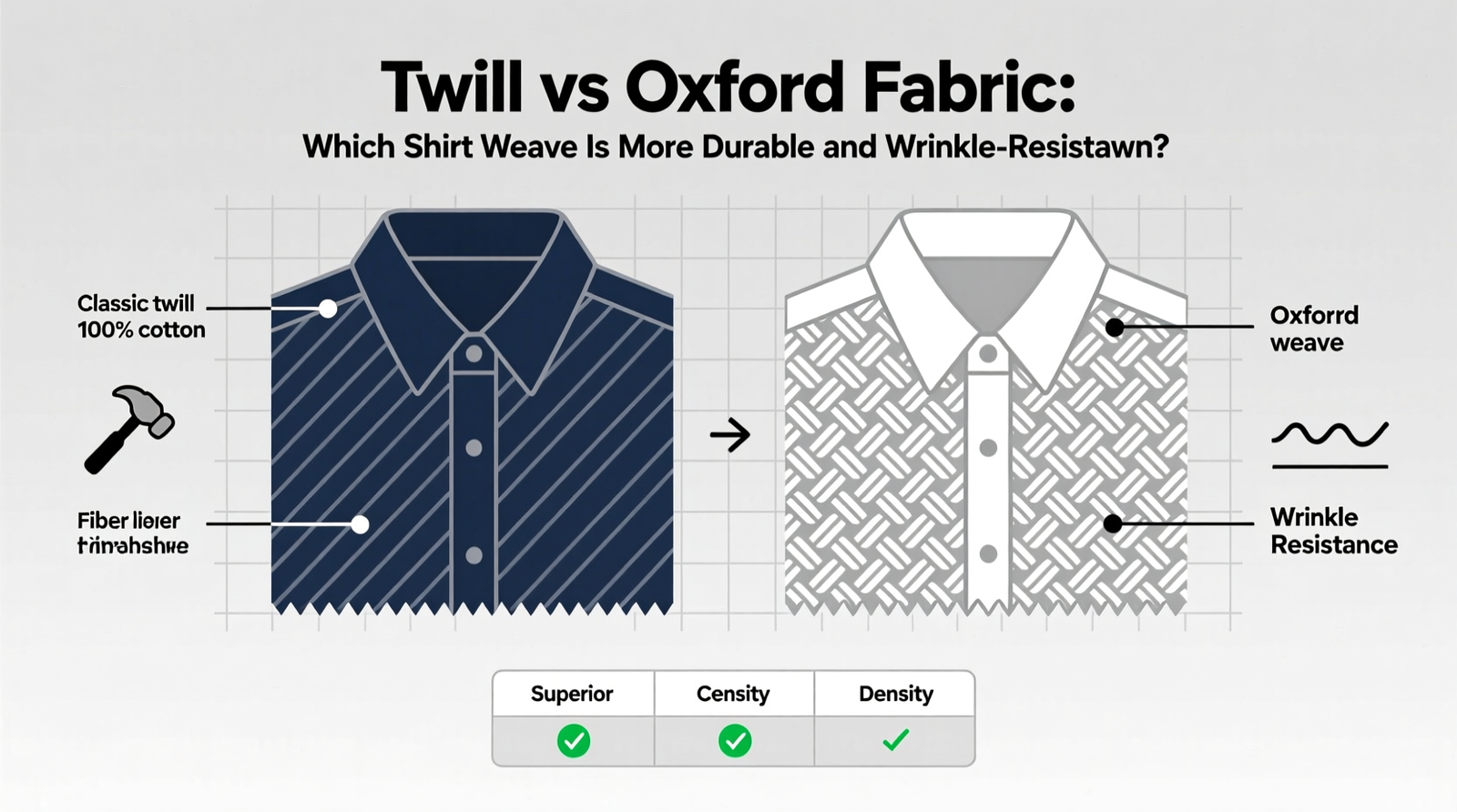
In Oxford shirting, raw materials set the ceiling—but construction determines whether that ceiling is ever reached. Two Oxford fabrics can use the same cotton, the same yarn count, and even the same finishing process, yet behave very differently once they are cut into shirts and worn repeatedly. The difference almost always comes down to construction quality: how yarns are arranged, how densely they are packed, and how evenly tension is controlled across the fabric.
From a sourcing perspective, construction is where Oxford fabric either earns its quality grade or quietly undermines it. Weave density, warp–weft balance, and structural symmetry decide whether a shirt stays aligned over time or slowly drifts out of shape through washing, wearing, and drying.
High-quality Oxford fabrics age evenly and predictably. Lower-grade constructions may feel solid at first touch but reveal problems later—twisting seams, distorted plackets, uneven shrinkage, and collars that no longer sit correctly.
Why Construction Matters More Than Most Buyers Expect
Many buyers focus on yarn count or fiber type because those factors are easier to compare on paper. Construction, however, is harder to see and harder to measure—yet it has a disproportionate impact on long-term performance.
Construction affects:
- Dimensional stability after washing
- Shape retention across panels
- Breathability and comfort
- How evenly the fabric relaxes over time
A well-constructed Oxford fabric behaves like a balanced system. A poorly constructed one slowly pulls itself apart under everyday stress.
Construction Details Buyers Learn to Check
Experienced buyers learn to look beyond surface feel and ask deeper questions:
- Is the weave balanced between warp and weft?
- Is density appropriate for the yarn size?
- Is tension consistent across the fabric width?
- Does the fabric relax evenly after washing?
These questions matter more than whether the fabric feels “firm” or “soft” at first touch.
Understanding the Oxford Basket Weave
Oxford fabric is defined by its basket weave, a variation of the plain weave in which multiple yarns interlace as a group rather than individually. This grouped structure creates Oxford’s signature texture and air permeability.
Most Oxford shirting uses either a 2×1 or 2×2 basket weave, though finer constructions also exist.
| Weave Type | Visual Texture | Durability |
|---|---|---|
| 2×1 Oxford | More pronounced, grainy | High |
| 2×2 Oxford | Smoother, more uniform | Medium–High |
| Pinpoint Oxford | Fine, compact | Very High |
- 2×1 Oxford uses two yarns in one direction interlacing with single yarns in the other. This produces a stronger texture and slightly more rugged appearance.
- 2×2 Oxford interlaces yarn pairs in both directions, resulting in a more uniform surface and softer visual effect.
- Pinpoint Oxford tightens the structure further using finer yarns and higher density, creating a compact, refined fabric often associated with higher quality grades.
Pinpoint Oxford is not “better” by definition—but it demands tighter control and is less forgiving of construction errors, which is why it often appears in premium programs.
Weave Density: A Critical but Misunderstood Variable
Weave density—how many yarns are packed into a given area—directly affects durability, breathability, and comfort. However, higher density does not automatically mean higher quality.
| Density Level | Outcome |
|---|---|
| Too loose | Early deformation, low durability |
| Balanced | Stable, breathable, durable |
| Too tight | Stiff handfeel, reduced comfort |
A loose Oxford weave may feel airy and soft initially, but it often:
- Loses shape quickly
- Distorts after washing
- Develops uneven shrinkage
An overly tight weave may appear premium and firm, but it can:
- Trap heat
- Reduce airflow
- Feel stiff against the skin
- Resist natural drape
High-quality Oxford fabrics sit within a controlled density window—tight enough to maintain structure, loose enough to remain breathable and comfortable.
At SzoneierFabrics, Oxford constructions are engineered to stay within this optimal density range rather than chasing extreme tightness for visual impact alone.
Density Must Match Yarn Count
Density cannot be evaluated independently of yarn count. Finer yarns require higher density to maintain structure, while coarser yarns need more space to avoid stiffness.
Problems arise when:
- Fine yarns are woven too loosely → instability
- Coarse yarns are packed too tightly → rigidity
Balanced construction aligns yarn size with appropriate density so the fabric can relax evenly during laundering.
Warp–Weft Balance and Shape Retention
Beyond density, warp–weft balance plays a decisive role in whether an Oxford shirt maintains its shape.
| Imbalance Issue | Long-Term Effect |
|---|---|
| Warp dominant | Lengthwise shrinkage |
| Weft dominant | Width distortion |
| Uneven tension | Shirt twisting |
In real garments, these imbalances show up as:
- Sleeves rotating after washing
- Plackets pulling off-center
- Collars sitting unevenly
- Side seams drifting forward
These issues are often blamed on sewing or pattern making, but the root cause is frequently fabric construction imbalance.
Why Tension Control Matters
During weaving, warp yarns are held under continuous tension while weft yarns are inserted across the width. If warp tension is uneven across the loom, the fabric will store stress unevenly.
That stored stress is released during washing.
When that happens:
- One side of the fabric may shrink more than the other
- Panels twist instead of lying flat
- Garments lose symmetry
High-quality Oxford fabrics are woven with tight tension control, ensuring stress is distributed evenly and released predictably during laundering.
Pinpoint Oxford: Precision Comes at a Cost
Pinpoint Oxford is often perceived as a higher-grade fabric because of its smooth surface and refined appearance. Structurally, it uses:
- Finer yarns
- Higher density
- Tighter weave balance
This construction improves durability and visual consistency—but it also reduces tolerance for error. Minor tension or density deviations that might go unnoticed in classic Oxford become visible in pinpoint constructions.
As a result, pinpoint Oxford quality depends heavily on:
- Loom calibration
- Yarn consistency
- Process discipline
When executed well, pinpoint Oxford ages exceptionally well. When executed poorly, it magnifies defects.
Construction vs Sewing: Where the Problem Really Starts
When shirts twist or distort after washing, factories are often blamed for poor sewing. In reality, sewing follows the grain of the fabric. If the fabric grain is unstable, sewing cannot correct it.
Construction issues manifest regardless of sewing quality:
- Perfectly sewn shirts still twist
- Accurate patterns still distort
- Interfacing cannot compensate for fabric imbalance
This is why experienced buyers evaluate fabric behavior before garment production, not after.
Practical Buyer Insight
A menswear brand once approved an Oxford fabric that felt firm, dense, and premium in the sample stage. The yarn quality was excellent, and the weight was consistent. After bulk production and customer laundering, shirts began to twist slightly.
The investigation revealed:
- Uneven warp tension during weaving
- Stress stored across fabric width
- Release of that stress after washing
The yarn was not the problem. The sewing was not the problem. Construction balance was.
This is a classic example of how fabric can pass visual inspection and still fail long-term performance expectations.
How Buyers Evaluate Construction Quality
Experienced buyers assess Oxford construction by:
- Measuring shrinkage in both warp and weft directions
- Checking post-wash grain alignment
- Observing panel behavior after laundering
- Comparing multiple rolls, not just one
- Reviewing loom and density specifications
Construction quality is verified through behavior, not appearance.
Construction as a Quality Multiplier
Good construction amplifies the benefits of good raw materials. Poor construction neutralizes them.
- High-quality cotton with poor balance still fails
- Modest yarns with excellent construction can outperform expectations
This is why construction quality often explains why two Oxford fabrics with similar specs perform very differently in real use.
Construction Is Where Quality Becomes Real
Oxford fabric construction is the bridge between material potential and garment reality. Fiber and yarn set the ingredients, but construction determines the outcome.
Balanced weave density, controlled tension, and structural symmetry allow Oxford shirts to:
- Retain shape
- Age evenly
- Resist distortion
- Deliver consistent performance over time
Lower-grade constructions may feel impressive at first touch, but they reveal their weaknesses gradually and irreversibly.
For buyers and brands, understanding construction is not optional—it is the difference between shirts that quietly succeed and those that slowly disappoint.
In Oxford shirting, quality is not only woven into the fabric. It is engineered into the structure.
What Finishing Processes Influence Oxford Shirt Quality Grade?
If raw materials and construction define the potential of an Oxford fabric, finishing determines whether that potential is realized—or quietly undermined. Finishing is the stage where Oxford shirt quality is refined, stabilized, and prepared for real-world use. It is also the stage where shortcuts can temporarily disguise weaknesses that later surface after washing and wear.
In commercial sourcing, finishing has an outsized impact on perceived quality versus actual quality. A fabric can feel excellent at the sample stage and still degrade rapidly if finishes are poorly chosen or over-applied. Conversely, restrained, technically correct finishing can significantly extend fabric lifespan without altering its fundamental character.
Oxford shirt quality grade is therefore strongly influenced by how finishing processes are selected, combined, and controlled. High-grade finishes enhance performance without hiding structural flaws. Low-grade finishes often rely on temporary softness and visual smoothness that disappears once the shirt enters real use.
Why Finishing Is a Quality Risk Point
Buyers often encounter Oxford fabric at its most flattering moment: freshly finished, carefully pressed, and untouched by washing. Finishing processes can:
- Improve handfeel dramatically
- Reduce visible fuzz
- Increase visual uniformity
- Temporarily boost wrinkle resistance
But finishing can also:
- Lock in internal stress
- Reduce breathability
- Mask yarn defects
- Create performance gaps between sample and bulk
This is why finishing is not simply an enhancement stage—it is a risk management stage.
Finishing Methods That Matter Most
Not all finishing processes affect Oxford fabric quality equally. Some are foundational and almost mandatory for mid- to high-grade shirts. Others are optional and must be applied carefully.
Core Finishing Processes Explained
| Finish Type | Purpose | Quality Impact |
|---|---|---|
| Singeing | Removes surface fuzz | Cleaner appearance, reduced pilling |
| Enzyme wash | Reduces loose fibers | Softer handfeel, improved longevity |
| Mercerizing | Improves strength & dye uptake | Higher-grade appearance and durability |
| Resin finish | Wrinkle resistance | Useful but risky if overused |
Understanding what each finish does—and what it cannot do—is critical for correct grade positioning.
Singeing: The First Quality Filter
Singeing is often the earliest finishing step applied to Oxford fabric. It involves passing the fabric over controlled flames to burn off protruding surface fibers.
Why singeing matters:
- Reduces initial surface fuzz
- Lowers early-stage pilling risk
- Improves visual clarity of the weave
- Enhances dye uniformity
Without singeing, even good yarns can appear hairy and degrade quickly in wear. For this reason, singeing is considered foundational for any Oxford fabric above entry level.
However, over-singeing can damage yarn strength. High-grade programs focus on controlled, even singeing—not maximum intensity.
Enzyme Washing: Improving Aging, Not Just Softness
Enzyme washing is often misunderstood as a cosmetic softening process. In reality, its most important role is controlling how the fabric ages.
Enzymes selectively remove loose fiber ends that contribute to pilling and roughness over time. In Oxford fabric, where yarn surface exposure is high, this step is particularly valuable.
Benefits of enzyme washing include:
- Reduced pilling after laundering
- Smoother surface development over time
- More consistent handfeel after multiple washes
Enzyme washing does not make poor yarn good—but it allows good yarn to stay good longer.
Mercerizing: A Structural Upgrade, Not a Softener
Mercerizing is one of the most misunderstood finishing processes. It is often described as a way to add sheen or softness, but its real value lies deeper.
Mercerizing:
- Swells cotton fibers under tension
- Improves fiber strength
- Enhances dye uptake and color depth
- Stabilizes fiber structure
In Oxford shirting, mercerizing is typically reserved for higher-grade programs because it requires:
- Better raw materials
- Tighter process control
- Higher production cost
When applied correctly, mercerizing improves both appearance and durability. When applied to low-grade yarns, it can amplify defects.
This is why mercerizing is a selective tool, not a default upgrade.
Softness vs Longevity: The Core Trade-Off
One of the most common quality traps in Oxford shirting is chasing immediate softness at the expense of long-term performance.
| Approach | Result After 10 Washes |
|---|---|
| Mechanical softening | Softness fades quickly |
| Chemical softening | Moderate retention |
| Fiber-level finishing | Long-lasting improvement |
Mechanical and chemical softeners can make fabric feel luxurious at sampling. But these effects are often superficial. After repeated washing:
- Softness diminishes
- Surface feels flat or lifeless
- Underlying yarn flaws emerge
Fiber-level improvements—such as better cotton selection, combed yarns, singeing, and enzyme washing—create softness that persists, because it is structural rather than cosmetic.
High-grade Oxford fabrics rely less on softeners and more on inherent material quality.
Resin and Wrinkle-Resistance Finishes: A Double-Edged Sword
Wrinkle-resistant finishes are among the most requested—and most problematic—treatments in Oxford shirting.
Resin finishes can:
- Improve wrinkle recovery
- Enhance appearance after washing
- Reduce ironing needs
But they can also:
- Reduce breathability
- Increase fabric stiffness
- Create unnatural handfeel
- Introduce durability issues if poorly controlled
Over-application of resin often leads to shirts that pass lab wrinkle tests but feel uncomfortable in daily wear.
At SzoneierFabrics, wrinkle resistance is treated as a controlled option, not a default feature. Light, balanced application is favored over aggressive “no-iron” positioning.
Formaldehyde Risk and Compliance
Poorly controlled resin finishes can introduce formaldehyde-related risks, particularly in low-cost programs. This creates:
- Compliance concerns
- Skin sensitivity complaints
- Regulatory exposure in certain markets
High-grade Oxford programs use:
- Low-formaldehyde or formaldehyde-free systems
- Lower resin add-on levels
- Performance acceptance rather than lab perfection
This approach prioritizes wearer comfort and safety over marketing claims.
Finishing Can Mask—or Reveal—Defects
One of the most important buyer lessons is that finishing can temporarily hide defects:
- Heavy softeners mask rough yarn
- Resin hides poor construction balance
- Visual smoothness conceals weak fiber
After washing, these masks disappear.
High-grade finishing is intentionally transparent. It enhances what is already good rather than hiding what is weak.
Sample vs Bulk: Where Finishing Gaps Appear
Many quality disputes arise because sample finishing and bulk finishing differ subtly:
- Different softener dosage
- Slightly different curing temperature
- Process shortcuts at scale
These small differences can create large perception gaps after delivery.
Experienced buyers:
- Wash finished samples multiple times
- Request finishing specs, not just fabric specs
- Compare sample and bulk handfeel after laundering
Finishing consistency is as important as finishing choice.
A Buyer’s Real Experience
One uniform supplier requested a “no-iron” Oxford shirt for a large corporate program. The fabric passed wrinkle-resistance tests and looked excellent on delivery. Within months, wearer feedback shifted:
- Shirts felt stiff
- Breathability complaints increased
- Fabric aged poorly despite low wrinkle scores
The following season, the brand reduced resin intensity and accepted light wrinkling. Comfort improved, wear life extended, and satisfaction rose.
The fabric was technically less “perfect,” but practically far better.
That is finishing aligned with real use, not laboratory ideals.
How Experienced Buyers Evaluate Finishing Quality
Professionals evaluate finishing by:
- Washing samples repeatedly
- Comparing handfeel before and after laundering
- Observing surface change over time
- Reviewing finishing recipes and tolerances
- Testing breathability alongside wrinkle recovery
They do not judge finishing by first impression alone.
Finishing as a Quality Multiplier—or Divider
Finishing can amplify the value of good raw materials and construction. It can also destroy it.
- Good fiber + good construction + controlled finishing = high-grade Oxford
- Good fiber + aggressive finishing = unstable results
- Weak fiber + heavy finishing = short-lived quality illusion
Understanding this interaction is critical for correct grade positioning.
Final Perspective: Finishing Should Support, Not Compete
Oxford shirt finishing should never try to outperform the fabric beneath it. Its role is to:
- Clean the surface
- Stabilize performance
- Enhance longevity
- Respect breathability and comfort
High-quality finishes work quietly. They do not announce themselves at the sample stage. They reveal their value after months of wear, washing, and use.
In Oxford shirting, finishing is not about how good the fabric feels today. It is about how honestly it performs tomorrow.
That honesty is what defines true quality grade.
How Do Buyers Evaluate Oxford Shirt Quality Through Physical Tests and Performance Indicators?

Experienced buyers almost never trust handfeel alone when evaluating Oxford shirt quality. Touch is emotional, immediate, and highly subjective. Performance, on the other hand, reveals itself only through time, repetition, and stress. This is why professional sourcing decisions rely on a combination of controlled laboratory tests, repeat-wash observation, and real-world wear simulation, often compared side by side against known benchmark fabrics.
In commercial sourcing, Oxford shirt quality grade is not confirmed at sampling—it is confirmed after the fabric has been washed, worn, compressed, and evaluated again. Buyers know that many fabrics feel acceptable on day one. The real question is whether the fabric continues to meet expectations after weeks or months of use.
High-grade Oxford fabrics demonstrate predictable behavior: minimal dimensional change, low surface degradation, stable color, and consistent structure. Lower-grade fabrics often pass initial inspection but fail quietly after repeated laundering.
Why Physical Testing Matters More Than Descriptions
Oxford fabric defects rarely announce themselves immediately. Instead, they surface gradually as:
- Shrinkage inconsistencies
- Pilling and surface haze
- Collar and cuff distortion
- Uneven color aging
These issues are difficult to predict by appearance alone. Physical testing exposes them early—before bulk production locks them in.
Experienced buyers therefore evaluate Oxford fabric quality through behavioral indicators, not marketing language or finish claims.
What Buyers Actually Test (and Why)
Professional evaluation typically focuses on five core areas:
- Dimensional stability
- Surface durability and pilling resistance
- Color stability and aging behavior
- Seam and panel behavior after wash
- Wear simulation under real conditions
Together, these tests provide a reliable picture of how the fabric will perform once it leaves the warehouse.
Dimensional Stability: Shrinkage and Skew
Dimensional stability is one of the first and most important indicators buyers examine. Shrinkage does not only affect garment size—it affects fit consistency across production runs, which directly impacts customer satisfaction and return rates.
| Test Item | Acceptable Range (High Grade) |
|---|---|
| Length shrinkage | ≤ 3% |
| Width shrinkage | ≤ 3% |
| Skew after wash | ≤ 3% |
Shrinkage beyond these limits often leads to:
- Size inconsistency between batches
- Twisting panels
- Collars no longer aligning correctly
- Sleeves rotating after laundering
At SzoneierFabrics, Oxford fabrics are evaluated through multiple wash cycles, not just a single lab wash. This reflects real consumer behavior—shirts are washed repeatedly, not once.
Single-wash results can be misleading. True stability shows up only after repeated laundering.
Why Skew Matters as Much as Shrinkage
Skew refers to how much the fabric grain shifts after washing. Even if overall shrinkage is acceptable, excessive skew causes:
- Plackets drifting off-center
- Side seams moving forward
- Shirts appearing “twisted” when worn
Buyers often misattribute these issues to poor sewing. In reality, skew originates in fabric imbalance and tension control, which physical testing reveals early.
Pilling and Surface Appearance
Surface appearance is another critical quality indicator, particularly for Oxford fabric, where yarn surface exposure is high due to the basket weave.
| Test | High-Grade Expectation |
|---|---|
| Pilling (Martindale) | Grade 4–5 |
| Surface fuzz after wash | Minimal |
| Yarn clarity | Still visible |
Low-grade Oxford fabrics often look acceptable before washing but develop a cloudy or fuzzy surface after wear. This haze results from short fibers breaking free and tangling—a direct sign of weaker raw materials or insufficient finishing.
High-grade Oxford fabrics maintain yarn definition even after repeated use. The texture remains visible, not blurred.
Why Oxford Reveals Pilling Faster Than Other Weaves
Because Oxford fabric exposes more yarn surface than poplin or twill, pilling risk is inherently higher. This makes pilling tests especially meaningful for Oxford sourcing.
A fabric that barely passes pilling tests in the lab often performs poorly in real life. Buyers therefore look for strong margins, not borderline results.
Color Stability and Aging Behavior
Color performance is not just about whether dye bleeds—it is about how the fabric ages visually. Oxford shirts are frequently worn and washed, especially in professional settings. Buyers pay close attention to how colors evolve over time.
| Indicator | Buyer Concern |
|---|---|
| Wash fade | Shirt looks “old” too quickly |
| Collar discoloration | Uneven, unattractive aging |
| Shade inconsistency | Mismatch across batches |
White, light blue, and pastel Oxford shirts are particularly unforgiving. They reveal:
- Fiber contamination
- Uneven dye uptake
- Finishing inconsistencies
- Localized abrasion
High-grade Oxford fabrics age evenly. Lower-grade fabrics often show collar graying, patchy fading, or shade drift after only a few months.
Batch Consistency Checks
Buyers sourcing at scale often compare:
- Fabric from different dye lots
- Shirts from different production runs
- Bulk fabric against original samples
Shade consistency across batches is a major quality signal. Even small deviations create problems in retail and uniform programs, where visual uniformity matters.
Seam Behavior and Panel Stability
While seam strength is partly a sewing issue, fabric quality strongly influences how seams behave after washing.
Buyers observe:
- Seam puckering
- Panel distortion
- Differential shrinkage between body and placket
- Collar edge curling
These issues often trace back to:
- Uneven weave density
- Warp–weft imbalance
- Excessive finishing stress
High-grade Oxford fabrics relax evenly, allowing seams to remain flat and panels to stay aligned.
Wear Simulation: Informal but Highly Influential
Beyond formal testing, many experienced buyers conduct informal wear simulations. These tests rarely appear in documentation, but they carry significant weight in approval decisions.
Typical wear simulations include:
- Wearing the shirt for a full workday
- Sitting, walking, and commuting
- Observing elbow and collar creasing
- Washing and air-drying overnight
- Reassessing shape and feel the next day
These tests reveal things lab data cannot:
- How the fabric feels after heat buildup
- Whether wrinkles relax naturally
- How quickly the shirt regains shape
- Whether discomfort appears over time
Performance fabrics often outperform cotton here. Cotton often feels best initially but degrades more visibly after extended wear.
Post-Wash Appearance: The Deciding Moment
Many buyers consider post-wash appearance without ironing the most honest quality indicator.
Questions they ask include:
- Does the shirt look acceptable straight from drying?
- Are wrinkles evenly distributed or chaotic?
- Does the collar sit naturally?
- Has the fabric lost body or gained stiffness?
High-grade Oxford fabrics look “intentionally relaxed.” Low-grade fabrics look neglected.
Benchmark Comparison: The Buyer’s Shortcut
Rather than evaluating fabrics in isolation, buyers often compare candidates directly against:
- Proven past programs
- Known high-performing references
- Industry-standard benchmarks
Side-by-side comparison after washing exposes differences quickly. Even small gaps in raw material quality or construction become obvious when fabrics are evaluated together.
Lab Tests vs Reality: Why Both Matter
Laboratory tests provide controlled data. Wear tests provide context.
Buyers use lab data to:
- Screen out poor candidates
- Confirm compliance
- Establish baseline performance
They use real-world testing to:
- Predict customer experience
- Anticipate complaints
- Validate sourcing decisions
High-grade Oxford fabrics perform well in both environments. Low-grade fabrics often pass labs but fail in life.
How Buyers Weight Test Results
Not all failures are equal. Buyers consider:
- Severity of deviation
- Visibility to end user
- Impact on fit and comfort
- Likelihood of complaints
For example:
- Minor wrinkling may be acceptable
- Size inconsistency is not
- Slight fading may be tolerable
- Panel twisting is not
Quality grade is therefore contextual, not absolute.
Why Testing Protects Long-Term Programs
Brands that skip rigorous testing often face:
- Inconsistent repeat orders
- Rising return rates
- Customer dissatisfaction over time
- Internal blame between sourcing and production teams
Testing shifts quality evaluation from opinion to evidence.
At SzoneierFabrics, Oxford quality decisions are supported by repeat-wash data, side-by-side comparisons, and wear feedback, not just sample-room impressions.
Quality Is Proven, Not Claimed
Oxford shirt quality cannot be judged at a glance. It must be proven through behavior—how the fabric responds to washing, wearing, compression, and time.
High-grade Oxford fabrics:
- Shrink predictably
- Pill minimally
- Age evenly
- Retain structure
- Maintain appearance
Low-grade fabrics often feel acceptable at first and disappoint later.
Buyers who understand this do not ask, “Does it feel good today?” They ask, “Will it still perform six months from now?”
That question—and the tests behind it—define true Oxford shirt quality.
Which Defects or Inconsistencies Most Commonly Lower Oxford Shirt Quality Grades in Bulk Production?

In Oxford shirting, quality rarely collapses in a dramatic way. More often, it erodes quietly. A single shirt may look acceptable, a single test may pass, and a single batch may ship without complaint. But across thousands of garments, small inconsistencies accumulate—until buyers, retailers, or end customers begin to sense that something is “off.”
This is how Oxford shirt quality grades are most often downgraded in bulk production: not by one catastrophic failure, but by a series of minor, compounding defects that only become visible at scale and over time.
Understanding these defects—and why they appear—is critical for buyers who want to protect quality grades beyond the sampling stage.
Why Bulk Production Exposes Weaknesses
Sampling environments are controlled. Bulk production is not.
During scale-up, fabrics are exposed to:
- Longer production runs
- Multiple finishing batches
- Wider loom usage
- Environmental variation
- Operator differences
A fabric that performs well in a single sample run may behave very differently when exposed to these variables. High-grade Oxford fabrics absorb variation gracefully. Lower-grade ones amplify it.
This is why many quality disputes begin after bulk production has already started.
Defects Buyers Learn to Spot Early
Experienced buyers don’t wait for customer complaints. They learn to identify early warning signs—subtle indicators that quality grade may slip if left unaddressed.
These indicators often appear in fabric inspection, cutting rooms, or early wash tests of bulk garments.
Common Fabric-Level Defects
Fabric-level defects are usually the first contributors to grade erosion. Individually, they may seem minor. Collectively, they can undermine an entire program.
| Defect | Visual Symptom | Buyer Reaction |
|---|---|---|
| Uneven shrinkage | Twisted or distorted panels | Grade downgrade |
| Excess surface fuzz | Dull, cloudy appearance | Rejection risk |
| Shade variation | Mismatch between panels | High complaint rate |
| Yarn slubs | Irregular texture | Limited acceptance |
Uneven Shrinkage: The Silent Shape Killer
Uneven shrinkage is one of the most damaging defects in Oxford shirting because it directly affects fit and symmetry.
It often shows up as:
- Panels twisting after washing
- Side seams drifting forward
- Plackets no longer sitting straight
- Sleeves rotating slightly
These problems are rarely obvious before washing. Once they appear, they are impossible to correct through sewing or pressing.
From a buyer’s perspective, uneven shrinkage almost always results in a quality grade downgrade, because it affects every wear and every wash.
Excess Surface Fuzz and Early Pilling
Oxford fabric exposes more yarn surface than smoother weaves. This makes it particularly sensitive to:
- Short fibers
- Poor singeing
- Inadequate enzyme treatment
Excess fuzz leads to:
- A “flat” or hazy surface
- Loss of texture definition
- Early pilling at collars and cuffs
Even when pilling is moderate, buyers often downgrade quality because the shirt looks older than expected after limited wear.
Shade Variation: A Scale-Specific Problem
Shade variation is one of the most common bulk-only defects. Fabric rolls that look acceptable individually can reveal noticeable differences once garments are cut and assembled.
Buyers encounter:
- Front panels slightly lighter than sleeves
- Collars not matching bodies
- Size runs showing visible shade shifts
Even small shade differences become obvious when shirts are worn under consistent lighting or displayed side by side in retail.
For uniform programs and professional lines, shade variation is one of the fastest paths to rejection or return escalation.
Yarn Slubs and Texture Inconsistency
Oxford fabric allows texture, but not randomness. Yarn slubs that appear inconsistently create:
- Patchy visual texture
- Uneven dye uptake
- Perceived manufacturing defects
Some brands accept controlled slub character in casual programs. Most buyers downgrade quality when slubs appear unintentionally or irregularly.
Process-Driven Inconsistencies
Many quality issues are not caused by raw materials, but by process drift during production.
| Process Issue | Result |
|---|---|
| Inconsistent finishing | Variable handfeel |
| Tension fluctuation | Fabric distortion |
| Over-softening | Weak surface, fast aging |
Inconsistent Finishing Between Batches
One of the most common bulk-production problems occurs when finishing parameters are not locked tightly after sampling.
Small changes in:
- Softener dosage
- Enzyme time
- Curing temperature
can result in:
- Some shirts feeling softer than others
- Uneven wrinkle behavior
- Different aging patterns after washing
Buyers may not notice this immediately, but customers will—especially after repeated wear.
Tension Fluctuation During Weaving
Warp tension variation across looms or shifts creates stored stress in the fabric. This stress releases during washing.
Symptoms include:
- Skew after laundering
- Twisting garments
- Panels that never lie flat
Because this defect originates during weaving, it cannot be corrected downstream. Buyers typically downgrade quality once the pattern becomes consistent across returns.
Over-Softening: Short-Term Gain, Long-Term Loss
Over-softening is a common tactic to improve initial handfeel. In Oxford fabric, it often backfires.
Over-softened fabrics:
- Feel excellent at delivery
- Lose body quickly
- Develop surface weakness
- Age poorly after washing
Buyers increasingly view excessive softness as a warning sign rather than a benefit—especially if it disappears after several washes.
Sewing-Revealed Fabric Issues
Some defects are invisible until the fabric is cut and sewn. These issues are often misattributed to poor garment construction, when the root cause is fabric quality.
Common sewing-revealed symptoms include:
- Button placket pulling
- Collar bubbling
- Sleeve twisting
In most cases, these originate from:
- Fabric skew
- Uneven shrinkage
- Density imbalance
- Finishing stress
Even perfect sewing cannot compensate for unstable fabric.
Why These Issues Trigger Grade Downgrades
Quality grade is not just about passing tests—it’s about predictability and repeatability.
When buyers see:
- Inconsistent fit feedback
- Rising return rates
- Uneven appearance across sizes
- Conflicting customer complaints
they reassess the fabric’s grade, even if no single metric fails outright.
Oxford shirt quality grading is cumulative.
A Quiet Downgrade Scenario
A casualwear brand approved a mid-grade Oxford fabric that passed all initial lab tests. Early sales were strong. Over several months, customer feedback shifted:
- “The shirt doesn’t hold shape.”
- “It looks worn too quickly.”
- “Different colors behave differently.”
No single defect was severe. But together:
- Slight skew
- Moderate pilling
- Inconsistent softness
- Minor shade variation
combined to lower the perceived quality grade.
The fabric was not rejected outright—but it was quietly moved out of future core programs.
Why These Defects Appear Only at Scale
Bulk production reveals defects because:
- More looms are used
- More operators are involved
- More finishing batches are run
- Environmental conditions vary
High-grade Oxford fabrics are designed to tolerate this variation. Lower-grade fabrics magnify it.
This tolerance—more than any single metric—is what separates stable quality grades from fragile ones.
How Experienced Buyers Prevent Grade Erosion
Buyers who consistently maintain Oxford shirt quality grades take preventive steps:
- Lock finishing recipes immediately after sampling
- Monitor shrinkage and skew continuously during bulk
- Compare rolls and batches side by side
- Wash-test early bulk garments
- Reject “almost acceptable” variation
At SzoneierFabrics, bulk Oxford production is run with fixed finishing parameters once sampling is approved. Process drift is treated as a quality risk, not an efficiency gain.
Why Small Defects Matter More Than Big Ones
Large defects are obvious and easy to reject. Small defects are dangerous because they:
- Slip through inspection
- Accumulate across volume
- Erode customer trust slowly
- Increase returns quietly
By the time the issue is visible in data, the damage is already done.
Quality Is the Sum of Its Weakest Points
Oxford shirt quality does not fail at the strongest part of the fabric. It fails at the weakest.
- Slight skew plus moderate pilling plus minor shade drift equals a downgrade.
- None alone may justify rejection.
- Together, they change how the shirt is perceived.
This is why quality grading in Oxford shirting is holistic, not binary.
Grade Loss Is Rarely Sudden
Oxford shirt quality grades are rarely lost overnight. They are worn down by accumulated inconsistency.
Buyers who understand this stop asking: “Does this fabric pass?”
They start asking: “Will this fabric behave consistently across thousands of shirts, dozens of washes, and months of wear?”
That question—not a single test result—is what ultimately protects Oxford shirt quality in bulk production.
How Do Different Oxford Shirt Quality Grades Align with Market Positioning and Price Expectations?



Oxford shirt quality grade is not just a technical label used by mills or sourcing teams—it is a commercial positioning decision that directly shapes price perception, customer satisfaction, and long-term brand equity. Every choice around fiber, yarn, construction, and finishing ultimately expresses a belief about who the shirt is for, how often it will be worn, and what the customer will tolerate over time.
Many sourcing mistakes happen when buyers select Oxford fabric grades based primarily on unit cost rather than usage frequency, customer expectations, and brand promise. Lower-grade Oxfords can be perfectly appropriate in the right context. Higher-grade Oxfords justify their cost only when the market expects durability, consistency, and repeat wear.
When quality grade and market positioning are aligned, products sell smoothly and age quietly. When they are misaligned, problems surface slowly—through returns, reviews, and brand erosion rather than immediate rejection.
Why Quality Grade Is a Commercial Decision
From a buyer’s perspective, Oxford fabric grade determines:
- Cost structure
- Visual appeal at retail
- Wear life after purchase
- Likelihood of repeat purchase
- Long-term brand credibility
From a consumer’s perspective, quality grade is rarely articulated—but it is felt. Customers may not name fiber length or yarn type, but they quickly notice:
- Shirts losing shape
- Inconsistent sizing
- Premature aging
- Declining comfort over time
These perceptions are directly tied to grade.
Matching Quality Grade to Market Reality
Quality grade only makes sense when viewed through the lens of market reality, not aspiration. Every market segment has a tolerance range for wear, care, and aging.
Typical Quality Grade Segmentation
| Quality Grade | Fabric Characteristics | Common Market Use |
|---|---|---|
| Entry Grade | Carded yarn, lower density | Promotional, low-cost uniforms |
| Mid Grade | Combed yarn, balanced weave | Core casual shirts |
| High Grade | Long-staple cotton, refined finishing | Premium retail |
| Luxury Grade | ELS cotton, pinpoint Oxford | Designer and flagship collections |
Each tier serves a valid commercial purpose. Problems begin when a product is marketed above its grade—or priced below what its grade requires to sustain quality.
Entry Grade: Price-Led, Expectation-Limited
Entry-grade Oxford fabrics are designed for price sensitivity, not longevity. They typically use:
- Carded cotton yarns
- Lower weave density
- Minimal finishing
- Broader tolerance in shrinkage and surface change
These fabrics are suitable when:
- Shirts are worn infrequently
- Replacement is expected
- Visual perfection is short-lived
- Cost is the primary driver
Typical applications include:
- Promotional apparel
- Event uniforms
- Entry-level private-label programs
- Large-volume, short-life cycles
Issues arise when entry-grade Oxford is sold as an “everyday essential.” In that role, its limitations become visible quickly.
Mid Grade: The Commercial Workhorse
Mid-grade Oxford fabrics represent the largest commercial segment. They balance cost, appearance, and durability using:
- Combed cotton yarns
- Balanced weave density
- Foundational finishing (singeing, enzyme wash)
- Controlled shrinkage and skew
This grade works well for:
- Casual retail brands
- Weekly wear patterns
- Moderate care expectations
- Broad consumer demographics
Mid-grade Oxford shirts usually:
- Look good at retail
- Perform consistently for several seasons
- Age acceptably rather than gracefully
For many brands, this grade defines the “core” of the collection.
High Grade: Built for Repeat Wear and Trust
High-grade Oxford fabrics are designed for repeat wear and long-term satisfaction. They use:
- Long-staple cotton
- Tighter process control
- More precise construction balance
- Stable finishing systems
This grade supports:
- Premium price points
- Weekly or daily rotation
- Strong fit consistency
- Brand trust over time
High-grade Oxford shirts are not about dramatic visual difference on day one. Their value becomes obvious after months of use, when they:
- Hold shape
- Maintain surface clarity
- Retain comfort
- Age evenly
Brands that rely on repeat customers and word-of-mouth benefit disproportionately from this grade.
Luxury Grade: Low Volume, High Expectation
Luxury-grade Oxford fabrics occupy a smaller but highly visible segment. They often feature:
- Extra-long staple (ELS) cotton
- Pinpoint Oxford construction
- High yarn counts
- Advanced finishing
- Tight tolerance throughout production
This grade supports:
- Designer collections
- Flagship products
- Story-driven branding
- Elevated price points
Luxury-grade Oxfords are expected to deliver not just durability, but refinement—a clean surface, precise drape, and controlled aging.
Because expectations are high, execution must be flawless. Small defects that might be tolerated at lower grades become unacceptable here.
Price Sensitivity vs Wear Expectation
One of the most useful ways to align quality grade with market positioning is to map wear frequency against consumer price tolerance.
| Consumer Behavior | Recommended Grade |
|---|---|
| Occasional wear | Entry–Mid |
| Weekly wear | Mid–High |
| Daily rotation | High |
| Long-term wardrobe staple | High–Luxury |
Oxford shirts are often marketed as “everyday essentials.” When the grade does not support that claim, dissatisfaction accumulates gradually rather than immediately.
This delayed dissatisfaction is particularly dangerous because:
- Returns increase slowly
- Reviews worsen over time
- Repeat purchases decline quietly
Visual Value vs Functional Value
Lower-grade Oxford fabrics can look acceptable—or even impressive—at first glance. Finishing can enhance surface feel and appearance temporarily.
The difference between grades becomes clear over time.
| Timeframe | Entry Grade | High Grade |
|---|---|---|
| After first wash | Acceptable | Excellent |
| After 10 washes | Noticeable wear | Stable |
| After 30 washes | Shape loss, fuzz | Still presentable |
Higher-grade Oxford fabrics retain functional value long after visual novelty fades. This retention directly affects brand perception.
Why Misalignment Creates Commercial Risk
Misalignment between quality grade and market positioning usually results in one of three outcomes:
- Return Pressure Customers experience issues earlier than expected and return products.
- Review Erosion Complaints focus on fit, durability, or aging rather than design.
- Brand Dilution Customers quietly stop repurchasing, even if price was attractive.
These outcomes are rarely traced back to “quality grade” in marketing discussions, but they originate there.
A Market Lesson in Cost vs Trust
One private-label brand reduced Oxford fabric cost by approximately 8% by switching from mid-grade to entry-mid material. Initial margins improved, and the shirts looked nearly identical at launch.
Within six months:
- Fit inconsistency complaints increased
- Returns rose modestly but steadily
- Repeat purchase rates declined
The cost saving was real—but temporary. The brand spent the next season repairing trust rather than growing volume.
How Brands Should Use Quality Grade Strategically
Quality grade should be treated as a portfolio tool, not a one-size decision.
Effective brands:
- Use entry grades where replacement is expected
- Use mid grades for volume drivers
- Use high grades for reputation anchors
- Use luxury grades for brand storytelling
This segmentation allows each product to succeed on its own terms without forcing compromise.
Why “Overgrading” Is Also a Risk
Using a higher grade than the market requires can also create problems:
- Prices become uncompetitive
- Margins compress
- Customers fail to recognize the added value
Quality grade must match not only wear expectations, but willingness to pay.
Reputation Durability vs Cost Optimization
Short-term cost optimization often conflicts with long-term reputation durability.
At SzoneierFabrics, brands are encouraged to evaluate Oxford fabrics not just for unit economics, but for:
- Repeat purchase likelihood
- Review trajectory
- Customer lifetime value
- Program stability across seasons
Fabric grade decisions shape all of these outcomes.
The Quiet Power of the Right Grade
When quality grade aligns with market positioning:
- Products sell with fewer complaints
- Returns stay manageable
- Reviews remain consistent
- Brand trust accumulates quietly
When it doesn’t, even small issues feel amplified.
Grade Is the Bridge Between Product and Promise
Oxford shirt quality grade is not about superiority—it is about fit for purpose.
- Entry grade supports access and scale
- Mid grade supports consistency
- High grade supports trust
- Luxury grade supports aspiration
The best brands are not those that always choose the highest grade, but those that choose the right grade for the right promise.
In Oxford shirting, quality grade is the bridge between what the brand claims and what the customer lives with over time.
When that bridge is strong, the product carries the brand forward.
How Can Buyers Select the Right Oxford Shirt Quality Grade for Their Brand and End Use?


Selecting the right Oxford shirt quality grade is not about finding the highest specification or the lowest price. It is about clarity—clarity about how the shirt will be used, how often it will be worn and washed, and what the brand has implicitly promised the customer.
Buyers who struggle with Oxford quality decisions usually fall into one of two traps: either they overpay for quality their customer will never notice, or they under-specify fabric for how the shirt is actually used. Both lead to problems—one in margin, the other in satisfaction.
The most reliable buyers approach Oxford quality grade selection as a use-driven decision, validated by real-life testing rather than theoretical benchmarks. When the grade matches the end use, Oxford shirts perform quietly and predictably. When it doesn’t, problems surface slowly—through returns, reviews, and repeat-order hesitation.
Why Grade Selection Is a Strategic Skill
Oxford shirt quality grades exist to support different realities, not to rank fabrics as good or bad.
A quality grade is “right” only when:
- The fabric survives the expected number of washes
- The shirt behaves acceptably in daily wear
- The price feels justified over time
- The product supports the brand’s reputation
Buyers who understand this stop asking, “What’s the best Oxford?” They start asking, “What’s the right Oxford for this program?”
A Practical Buyer Decision Framework
Instead of starting with fiber types or marketing terms, experienced buyers move through a simple but disciplined framework.
Step 1: Define Real Use Conditions (Not Aspirational Ones)
The most important step happens before any fabric is touched.
Buyers should ask practical, sometimes uncomfortable questions:
- How often will this shirt realistically be worn?
- Will it be machine washed weekly, or occasionally?
- Is ironing expected—or avoided?
- Will the shirt be worn for full days or short periods?
- Is comfort or shape retention the bigger pain point?
These answers immediately narrow the viable quality grade range.
For example:
- A shirt worn once a month can tolerate lower grade drift.
- A shirt worn weekly cannot.
- A travel shirt must prioritize recovery and stability.
- A heritage casual shirt can prioritize natural feel.
Clarity here prevents 80% of future quality disputes.
Step 2: Translate Use Conditions Into Grade Range
Once real use is defined, grade selection becomes more mechanical than emotional.
Typical alignment looks like this:
- Occasional, low-pressure wear → Entry to Mid Grade
- Weekly wear, moderate care → Mid to High Grade
- Daily rotation, frequent washing → High Grade
- Flagship or long-term staple → High to Luxury Grade
Trying to push an entry-grade Oxford into a high-frequency role rarely works, no matter how good it looks at sampling.
Step 3: Compare Fabrics Side by Side, Not in Isolation
One of the most effective buyer practices is side-by-side evaluation. Specs and lab results are useful, but comparison reveals differences faster than numbers.
| Comparison Point | What to Observe |
|---|---|
| Handfeel after wash | Does softness remain or collapse? |
| Shape retention | Does the fabric twist, sag, or stay aligned? |
| Surface appearance | Is pilling or fuzz visible? |
Key insight: A fabric rarely fails absolutely—it fails relative to another option.
Side-by-side washing and wear testing exposes:
- Which fabric ages faster
- Which loses structure
- Which holds visual clarity longer
Buyers who rely only on single-fabric evaluation often miss this.
Step 4: Wash and Wear Before You Decide
Laboratory testing is essential—but insufficient.
Buyers who consistently choose the right Oxford grade nearly always:
- Wash samples multiple times at home
- Wear shirts for a full day
- Observe post-dry appearance without ironing
- Reassess comfort after heat and movement
These informal tests reveal truths that lab data cannot:
- Whether wrinkles relax naturally
- Whether stiffness develops
- Whether shape holds after sitting and movement
- Whether the fabric “feels tired” quickly
If a fabric disappoints the buyer during wear testing, it will disappoint customers later.
Step 5: Balance Cost Against Longevity, Not Just Price
One of the most common sourcing errors is focusing on fabric cost per meter rather than cost per wear.
| Strategy | Outcome |
|---|---|
| Cheapest acceptable | Short-term margin gain |
| Balanced grade | Stable performance and repeat orders |
| Over-specification | Diminishing returns, poor cost recognition |
Lower-grade Oxford fabrics often look economical at purchase—but generate:
- Higher replacement rates
- More complaints over time
- Declining repeat orders
Higher-grade fabrics cost more upfront but often deliver lower total program cost by extending usable life and reducing dissatisfaction.
The right decision depends on:
- How visible degradation will be to customers
- How sensitive the market is to aging
- How often replacement is expected
Step 6: Align Grade With Brand Promise
Every Oxford shirt carries an implicit promise.
If a brand message suggests:
- “Everyday essential”
- “Built to last”
- “Reliable work shirt”
then the quality grade must support repeat wear without disappointment.
If the brand message is:
- “Seasonal style”
- “Affordable classic”
- “Occasional wear”
then a lower grade may be commercially honest.
Misalignment here is dangerous because customers judge brands by experience, not intention.
Step 7: Avoid Over-Specification
While under-specifying quality is risky, over-specifying is also a mistake.
Over-specification happens when:
- Luxury-grade fabrics are used for price-sensitive markets
- High-grade Oxford is used where wear frequency is low
- Customers cannot perceive the added value
This leads to:
- Uncompetitive pricing
- Margin pressure
- Poor cost-to-value recognition
The goal is not maximum quality—it is appropriate quality.
Step 8: Lock the Grade Before Scaling
Once the right Oxford quality grade is selected, it must be protected.
Buyers should lock:
- Fiber and yarn specifications
- Construction parameters (density, balance)
- Finishing recipes and tolerances
Any change after sampling—even small ones—can shift the fabric into a different effective grade.
At SzoneierFabrics, bulk Oxford production is always executed to sample-locked standards. Finishing recipes, tension settings, and construction parameters are fixed once approval is granted. This prevents quiet quality drift between seasons.
Why Grade Drift Is a Hidden Risk
Many buyers approve the right grade—then lose it unintentionally.
Grade drift occurs when:
- Mills adjust yarn sources
- Finishing parameters change slightly
- Density or tension varies between runs
Each change may seem minor. Together, they alter fabric behavior.
Locking grade parameters is as important as choosing the grade itself.
A Buyer Mindset Shift That Matters
Experienced buyers develop a different mindset:
They stop asking:
- “Is this fabric good enough?”
They start asking:
- “Is this fabric appropriate for how it will be used?”
That shift changes sourcing outcomes dramatically.
A Realistic Buyer Scenario
A brand sourcing Oxford shirts for a casual office line tested three grades:
- Entry-mid
- Mid
- High
Initial visual differences were minimal. After five washes and full-day wear tests:
- Entry-mid showed twisting and surface haze
- Mid remained acceptable but softened noticeably
- High maintained shape and surface clarity
The brand selected mid-grade for most SKUs and high-grade for bestsellers—balancing cost with longevity.
No fabric was rejected. Each was placed where it belonged.
Why Testing Protects Both Buyer and Brand
Testing fabrics through real-use scenarios does more than confirm quality—it:
- Builds internal confidence
- Reduces post-launch surprises
- Aligns teams around expectations
- Creates defensible sourcing decisions
When issues arise later, buyers can trace outcomes back to deliberate choices—not guesswork.
Right Grade Beats Best Grade
Selecting the right Oxford shirt quality grade is not about compromise—it is about precision.
- Precision about how the shirt will be used
- Precision about what customers expect
- Precision about where quality actually matters
- Precision about what the brand stands for
Buyers who master this precision:
- Avoid unnecessary cost
- Prevent silent dissatisfaction
- Build long-term program stability
In Oxford shirting, the smartest choice is rarely the highest grade or the cheapest option.
It is the grade that behaves exactly as the customer expects— wash after wash, wear after wear, season after season.
Oxford Shirt Quality Is Proven Over Time, Not at First Touch
Oxford shirts earn their reputation slowly. The best ones don’t shout quality—they demonstrate it quietly through repeated wear, washing, and continued comfort. Quality grade is the language that connects fiber selection, construction discipline, finishing restraint, and buyer evaluation into one coherent system.
At SzoneierFabrics, Oxford shirt fabrics are developed with this long view in mind. Our team supports brands and apparel programs with:
- Custom Oxford fabric development
- Yarn count and construction optimization
- Finish selection based on real use
- Low-MOQ sampling and fast prototyping
- Stable bulk production with consistent quality grades
If you are developing Oxford shirts and want fabric quality that aligns with your market position—not just your sample—reach out to SzoneierFabrics. Share your target customer, price range, and performance expectations, and our team will help you engineer the right Oxford shirt quality grade from the start.